REVIEW 4 major objections 6 minor 40 references
Efficient and Trustworthy Block Propagation for Blockchain-enabled Mobile Embodied AI Networks: A Graph Resfusion Approach
T0 review · 4 major / 6 minor · reviewed 2026-08-10 · deepseek-v4-flash
Pith's one-line read The paper claims that a graph Resfusion model can compute the fastest block-propagation route through trusted miners in consortium blockchain-enabled MEANETs, improving both efficiency and trustworthiness.
desk verdict A competent incremental systems paper whose central optimality claim is undercut by training on Euclidean TSP while reporting a Shannon-capacity time objective; it deserves a serious referee but needs a re-framed objective and a check on the PBFT-to-TSP assumption. read the letter →
The pith
A machine-rendered reading of the paper's core claim, the machinery that carries it, and where it could break.
The reading
What carries the argument
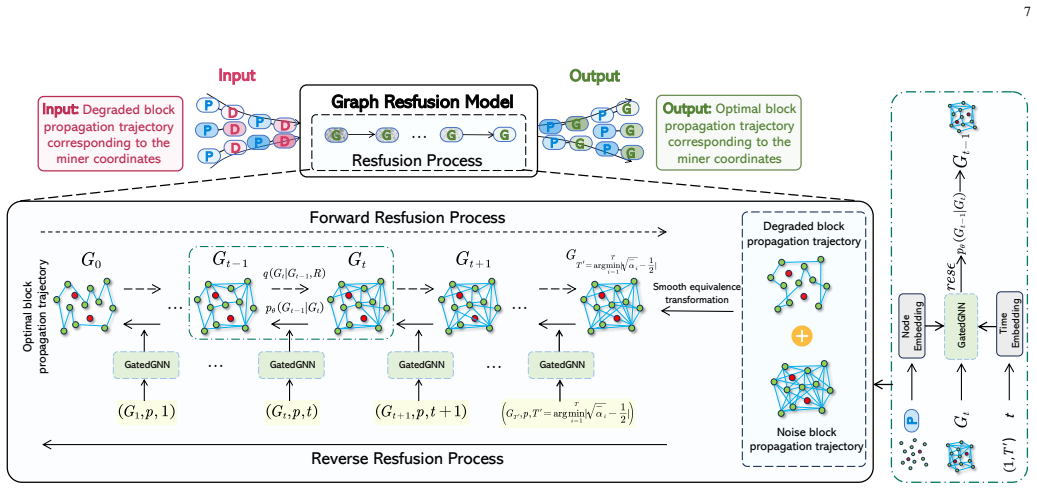
The load-bearing object is the graph Resfusion model: a diffusion model whose forward process corrupts the optimal trajectory with Gaussian noise plus a residual $R = \hat{G}_0 - G_0$, and whose reverse process, parameterized by a GatedGNN, estimates the residual noise $res^\epsilon$ to recover $G_0$ from a degraded trajectory. The GatedGNN is an anisotropic graph network that updates edge embeddings alongside node embeddings, letting it score candidate edges of the propagation tour. A second load-bearing component is the cloud-model trust score, computed as $TS_{r_j} = (S_{rep} + S_{tw} - e^{RiskC(S_{rep})} - e^{RiskC(S_{tw})})/(2e)$, which filters out miners below the threshold $\lambda$ before routing.
What would settle it
Simulate or instrument a real PBFT-based consortium blockchain in which the leader broadcasts the block to all replicas rather than touring them sequentially; if the graph Resfusion route does not reduce the measured end-to-end confirmation time under that message pattern, the claimed optimal trajectory does not correspond to actual propagation. A second check is to run the model on standard TSP instances with known optimal values and compare the returned tour lengths; if the gap is no better than a simple 2-opt baseline, the efficiency claim is not supported.
Extended reading notes
Core claim
On the paper's own terms, the central discovery is that the block-propagation routing problem can be solved by a diffusion model that learns to remove both noise and a known residual. The optimization objective is to minimize the total propagation time $\sum_{i=2}^K \Lambda_{i-1,i}$ subject to each selected miner's trust score $TS_i > \lambda$, where propagation delay follows a Shannon-formula rate. The graph Resfusion model treats the optimal propagation trajectory $G_0$ as the target, defines a degraded trajectory $\hat{G}_0$ that is easy to construct, forms the residual $R = \hat{G}_0 - G_0$, and learns to predict the residual noise $res^\epsilon$ with a GatedGNN. The reverse process starts from a computable trajectory at step $T'$ instead of pure noise, which the authors argue reduces sampling space and inference time. Simulations show shorter propagation time than the baselines and a 33.3% lower failure rate than Difusco at 99 vehicles.
Load-bearing premise
The entire optimization rests on the premise that after untrusted miners are filtered out, PBFT-style block propagation in a consortium blockchain is a sequential tour: the leader forwards the block to one trusted miner at a time, collects each vote, and returns, so the routing problem is a traveling salesman problem.
Editorial extensions
If this is right
- If the framework is correct, consortium blockchains in MEANETs can propagate blocks over shorter, high-trust routes, which lowers the chance of forks and signature-collection failures.
- Filtering by the cloud-model trust score raises the average trust of participating miners, reducing exposure to selfish mining and Sybil attacks; the paper reports a 19.60% trust-score gain at 99 vehicles.
- The residual-guided reverse process reaches a valid trajectory in 368 diffusion steps instead of the 1000 steps of a standard diffusion model, which matters for dynamically changing topologies.
- Generalization tests in the paper show trajectory-length deviation below 2% when the model is evaluated on fleet sizes different from training, suggesting retraining may not be needed after every topology change.
Reading between the lines
- We infer the same residue-constrained diffusion recipe could be applied to other sequential routing problems on graphs, such as UAV inspection planning or delivery routing, wherever a cheap feasible tour and a learned residual denoiser are available.
- We infer the trust-cloud scoring is protocol-agnostic and could be reused in other PBFT-style consortium chains, but the TSP premise would need to be revalidated for any consensus protocol that broadcasts in parallel.
- A natural testable extension is to replace the sequential tour with a parallel broadcast tree or DAG and let the GatedGNN predict edges of that structure; the residual-resfusion mechanism should transfer directly.
Editorial analysis
A structured set of objections, weighed in public.
Referee Report
Summary. The paper proposes a framework for trustworthy and efficient block propagation in consortium blockchain-enabled Mobile Embodied AI Networks. A cloud-model-based trust score filters out low-trust miners, and a graph Resfusion model (a diffusion model with residual guidance, using a GatedGNN) is trained to generate a block propagation trajectory. The optimization objective is stated as minimizing total Shannon-capacity transmission time subject to a trust-score threshold. The paper reports simulations on Chengdu and Porto vehicle-trajectory datasets, comparing against greedy, genetic algorithm, attention-model-based, and Difusco baselines. The central claims are that the proposed method generates near-optimal propagation trajectories, reduces failed samples compared with Difusco, and adapts well to dynamic topologies.
Significance. If the central claims are substantiated, the paper would offer a practical combination of trust filtering and diffusion-based combinatorial optimization for a relevant mobile networking problem. The adaptation of Resfusion to a graph setting, the use of real urban trajectory data, and the explicit specification of channel parameters are useful strengths. The training-and-sampling pipeline is clearly described, and the generalization test across problem sizes is a valuable check. However, the claimed optimality with respect to the stated Shannon-time objective is not established by the current training-label design, and the underlying sequential-TSP model of PBFT propagation is not justified. The paper also does not provide code, statistical error bars, or external validation of the trust model. These issues are load-bearing for the main efficiency and trustworthiness claims.
major comments (4)
- [Section V-A and Section VI-A2] The training labels do not match the optimization objective. Eq. (22) defines the cost to minimize as the sum of Shannon transmission times Lambda_{i-1,i} = S_block / (W log2(1 + a rho Gamma_{i-1,i}^{-epsilon}/(N0 W))), which is strictly increasing but nonlinear in distance. Section VI-A2 says labels are generated by the Concorde exact solver following [28], and Section VI-B/Fig. 11 evaluate trajectory lengths in a unit square. Thus the model is trained to minimize Euclidean tour length, not the Shannon-time sum of Eq. (22). Since edge costs in Eq. (22) are heterogeneous and non-affine functions of distance, the minimizing Hamiltonian cycle for Euclidean length need not minimize the stated objective. The paper gives no argument that the two optima coincide for the Chengdu and Porto geometries, so the reported 'optimal block propagation trajectory' and the efficiency comparisons in Fig. 6 do not establish optimality for the problem the paper formulates.
- [Section III-A] The sequential-TSP premise for PBFT block propagation is unverified and load-bearing. Section III-A states that after filtering untrusted miners, 'the remaining propagation process can be modeled as the traveling salesman problem (TSP) in terms of miner node selection alone [22],' with the leader sequentially forwarding the block to each miner and collecting votes. Practical Byzantine Fault Tolerance normally requires broadcast or all-to-all message exchanges among replicas in its prepare and commit phases; a single sequential tour through each miner does not obviously implement PBFT. The cited reference [22] addresses consortium blockchain energy trading and does not provide a PBFT message-level model. If this assumption is false, the optimized trajectory is for a different propagation mechanism and the framework's applicability to PBFT-based consortium blockchains is not established. The authors should specify the PBFT message exchanges this sequential tour implements, or explicitly adopt a different consensus protocol.
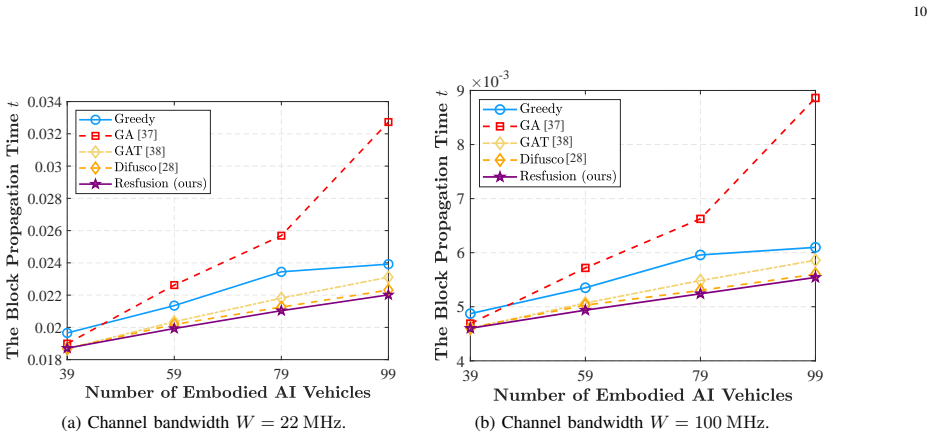
- [Section VI-B and Fig. 6] The empirical outperformance claim is not accompanied by any uncertainty quantification. Fig. 6 reports point estimates only for the total block propagation time, yet the compared methods include stochastic algorithms (GA, attention model, Difusco, and the proposed diffusion-based method). Without error bars, multiple seeds, or significance tests, the stated performance ranking (proposed > Difusco > GAT > GA > Greedy) is not statistically supported. The failure-probability comparison in Section VI-E does use 32 parallel samplings, but the propagation-time comparison does not report any such replication; this asymmetry weakens the main efficiency conclusion.
- [Eq. (31) and Section VI-E] The reduced failure probability claimed in Fig. 10 is partly forced by construction, so it does not by itself demonstrate higher inference accuracy. As shown in Eq. (31), the reverse Resfusion process starts from G_T' = sqrt(alpha_T') G_hat_0 + sqrt(1 - alpha_T') epsilon, i.e., a noisy version of the already-feasible degraded trajectory G_hat_0. Compared with Difusco, which starts from pure noise, the Resfusion sampler is initialized in a feasible region and will trivially produce fewer infeasible trajectories. The paper should separate this initialization effect from genuine solution-quality gains; for example, report constraint satisfaction conditioned on equal-distance-from-feasible-set starting points, and report the achieved objective value of the decoded trajectories, not only their feasibility.
minor comments (6)
- [Throughout] There are repeated typographical errors, including 'Resfuion model' in Section VI-B and VI-E, and 'graph Resfuion model' in Section VI-E; these should be corrected.
- [Section VI-B] The baseline called 'Graph attention network' is cited as [38], but [38] is Kool et al., 'Attention, learn to solve routing problems!', which is an attention model for routing, not a graph attention network in the usual GAT sense. The citation and the algorithm description should be aligned.
- [Section VI-E / Fig. 11] The generalization table reports percentages in a matrix but does not define the exact formula used to compute them or the baseline convention (the diagonal is labeled as the benchmark). Please state the computation explicitly in the text or caption so the reader can interpret the 'maximum percentage does not exceed 2%' claim.
- [Section IV-C] The trustworthiness capability indicators are described ambiguously: 'average miner block propagation time' is listed as a positive ability indicator, while lower propagation time is usually preferable. If the intended indicator is throughput or a normalized delay metric, this should be stated to avoid confusion.
- [Section V-D and Algorithm 1] The notation T' in Algorithm 1 is computed by arg min over i of |sqrt(alpha_i) - 1/2|, but alpha_i is not defined in the algorithm block; it should reference Eq. (27) or define the cumulative product explicitly. Also, Algorithm 1 computes T' but then samples t uniformly from {1,...,T'}; the role of T' in training should be explained.
- [Conclusion] The manuscript has no limitations paragraph. Given the load-bearing modeling assumption in Section III-A and the training-label issue in Section VI-A2, a brief discussion of the scope and threats to validity would improve the paper.
Circularity Check
The graph Resfusion equations are internally consistent and externally benchmarked, but the PBFT-as-TSP problem definition rests on a load-bearing self-citation and one reported trust-score gain is tautological by construction.
-
self citation load bearing
[Section III-A, Block Propagation Mechanism]
"Specifically, the remaining propagation process can be modeled as the traveling salesman problem (TSP) in terms of miner node selection alone [22], where the block keeper (also termed the miner leader) sequentially forwards the block to each participating miner node."
This sentence defines the entire optimization class: Eq. (22) is a TSP objective, the Concorde-generated training labels are TSP tours, and the decoding uses TSP heuristics. The only cited support for identifying PBFT block propagation with a sequential TSP tour is [22], a prior paper co-authored by this paper's Jiawen Kang. The manuscript offers no independent derivation, external validation, or benchmark connecting the sequential-tour model to the actual PBFT message-exchange process. Thus the central problem formulation is accepted on the authority of a self-citation rather than established within the paper, matching the load-bearing self-citation pattern.
-
self definitional
[Section VI-B, Trustworthiness and Efficiency (Fig. 5)]
"This improvement can be attributed to the cloud-based trust calculation mechanism, which effectively filters out embodied AI vehicles with low trust scores, thus improving the overall reliability and trustworthiness of block propagation in MEANETs."
The reported improvement in total trust score is the direct set-theoretic consequence of the mechanism itself: the paper computes trust scores, removes the (V-K) miners whose scores are below the threshold lambda, and then reports that the remaining set has a higher trust score than the unfiltered set. The 19.60% increase is therefore not an empirical discovery about the method's security benefit; it is the selection rule restated as a simulation result. This is a by-construction outcome rather than an independent evaluation of trustworthiness.
full rationale
The core graph Resfusion derivation is not circular: Eqs. (23)-(36) and Algorithms 1-2 define a residual-constrained diffusion process that is trained to invert the forward corruption, and the reverse process starts from a noisy feasible degraded trajectory by design. The lower failure probability relative to Difusco is a designed consequence of starting from a feasible degraded solution, not a hidden equivalence, and the paper states this prior explicitly. The comparisons against Greedy, GA, GAT, and Difusco use external baselines and independent test geometry, so the efficiency claims are not merely restatements of the training objective. The legitimate circularity concerns are narrower: the PBFT-as-TSP premise is imported from the authors' own earlier work without independent support, and the trust-score improvement in Fig. 5 is tautological because filtering low-trust miners necessarily raises the average trust score of the retained set. A possible objective mismatch between Euclidean Concorde labels and the Shannon-time objective in Eq. (22) is a correctness risk, but it is not itself a circularity because the paper exhibits no reduction of Eq. (22) to the training labels. Overall, some by-construction elements exist, but the central Resfusion model has independent content, so the score is moderate.
Assumptions & free parameters
free parameters (7)
- Trust score threshold lambda =
0.5
- Number of untrusted miners removed (V-K) =
19
- Capability weights w_y in the trustworthiness score =
not reported
- Reputation evaluation bound eta and waiting-time threshold t_wait =
eta=0.2; t_wait not reported
- Diffusion noise schedule beta_t and total diffusion steps T =
T=1000; schedule not reported
- Cloud model numerical characteristics Ex, En, He =
not reported for simulations
- GatedGNN architecture width and depth =
d=256, 12 layers
assumptions (7)
- standard math Shannon capacity formula with path loss (Eq. 22) gives the per-hop block transmission time.
- domain assumption PBFT block propagation in consortium blockchains can be modeled as a sequential TSP tour through trusted miners.
- ad hoc to paper Euclidean shortest-tour solutions from Concorde are valid labels for the optimal trajectory under Eq. (22).
- domain assumption Cloud model trust-score formulas (Eqs. (20) and (21)) apply to miner reputation, trustworthiness, and risk.
- domain assumption The smooth equivalence transformation (Eq. (31)) gives a valid reverse-process starting point with small bias.
- domain assumption Vehicle positions at a chosen time slot can be treated as a static snapshot for block propagation.
- standard math Reparameterization and Gaussian noise in the forward diffusion process (Eqs. (24)-(27)) follow standard DDPM theory.
Cite this review
Pith. "Pith review of Efficient and Trustworthy Block Propagation for Blockchain-enabled Mobile Embodied AI Networks: A Graph Resfusion Approach." pith.science (2026). https://pith.science/paper/GKGTX7DG
@misc{pith2026250209624,
  author       = {Pith},
  title        = {Pith review of: Efficient and Trustworthy Block Propagation for Blockchain-enabled Mobile Embodied AI Networks: A Graph Resfusion Approach},
  year         = {2026},
  howpublished = {\url{https://pith.science/paper/GKGTX7DG}},
  note         = {Machine review of arXiv:2502.09624}
}
read the original abstract
By synergistically integrating mobile networks and embodied artificial intelligence (AI), Mobile Embodied AI Networks (MEANETs) represent an advanced paradigm that facilitates autonomous, context-aware, and interactive behaviors within dynamic environments. Nevertheless, the rapid development of MEANETs is accompanied by challenges in trustworthiness and operational efficiency. Fortunately, blockchain technology, with its decentralized and immutable characteristics, offers promising solutions for MEANETs. However, existing block propagation mechanisms suffer from challenges such as low propagation efficiency and weak security for block propagation, which results in delayed transmission of vehicular messages or vulnerability to malicious tampering, potentially causing severe traffic accidents in blockchain-enabled MEANETs. Moreover, current block propagation strategies cannot effectively adapt to real-time changes of dynamic topology in MEANETs. Therefore, in this paper, we propose a graph Resfusion model-based trustworthy block propagation optimization framework for consortium blockchain-enabled MEANETs. Specifically, we propose an innovative trust calculation mechanism based on the trust cloud model, which comprehensively accounts for randomness and fuzziness in the miner trust evaluation. Furthermore, by leveraging the strengths of graph neural networks and diffusion models, we develop a graph Resfusion model to effectively and adaptively generate the optimal block propagation trajectory. Simulation results demonstrate that the proposed model outperforms other routing mechanisms in terms of block propagation efficiency and trustworthiness. Additionally, the results highlight its strong adaptability to dynamic environments, making it particularly suitable for rapidly changing MEANETs.
Figures


Figures from the paper (6 more)



Reference graph
Works this paper leans on
-
[28]
Difusco: Graph-based diffusion solvers for combinatorial optimization,
Z. Sun and Y . Yang, “Difusco: Graph-based diffusion solvers for combinatorial optimization,” Advances in Neural Information Processing Systems, vol. 36, pp. 3706–3731, 2023
work page 2023
-
[22]
Consortium blockchain for secure energy trading in industrial Internet of Things,
Z. Li, J. Kang, R. Yu, D. Ye, Q. Deng, and Y . Zhang, “Consortium blockchain for secure energy trading in industrial Internet of Things,” IEEE transactions on industrial informatics , vol. 14, no. 8, pp. 3690– 3700, 2017
work page 2017
-
[8]
Graph attention network-based block propagation with optimal AoB and reputation in Web 3.0,
J. Liao, J. Wen, J. Kang, C. Yi, Y . Zhang, Y . Jiao, D. Niyato, D. I. Kim, and S. Xie, “Graph attention network-based block propagation with optimal AoB and reputation in Web 3.0,” IEEE Transactions on Cognitive Communications and Networking , vol. 10, no. 6, pp. 2427– 2441, 2024
work page 2024
-
[1]
Y . Zhong, J. Kang, J. Wen, D. Ye, J. Nie, D. Niyato, X. Gao, and S. Xie, “Generative diffusion-based contract design for efficient AI twin migration in vehicular embodied AI networks,” IEEE Transactions on Mobile Computing, pp. 1–16, 2025
work page 2025
-
[2]
Embodiedscan: A holistic multi-modal 3D perception suite towards embodied AI,
T. Wang, X. Mao, C. Zhu, R. Xu, R. Lyu, P. Li, X. Chen, W. Zhang, K. Chen, T. Xue et al. , “Embodiedscan: A holistic multi-modal 3D perception suite towards embodied AI,” in Proceedings of the IEEE/CVF Conference on Computer Vision and Pattern Recognition , 2024, pp. 19 757–19 767
work page 2024
-
[3]
Y . Yang, Y . Chen, J. Wang, G. Sun, and D. Niyato, “Embodied AI- empowered low altitude economy: Integrated sensing, communications, computation, and control (ISC3),” arXiv preprint arXiv:2412.19996 , 2024
arXiv 2024
-
[4]
P. Krop, M. J. Koch, A. Carolus, M. E. Latoschik, and C. Wienrich, “The effects of expertise, humanness, and congruence on perceived trust, warmth, competence and intention to use embodied AI,” in Extended Abstracts of the CHI Conference on Human Factors in Computing Systems, 2024, pp. 1–9
work page 2024
-
[5]
Embodied AI in mobile robots: Coverage path planning with large language models,
X. Kong, W. Zhang, J. Hong, and T. Braunl, “Embodied AI in mobile robots: Coverage path planning with large language models,” arXiv preprint arXiv:2407.02220, 2024
arXiv 2024
Show all 40 references
-
[6]
A comprehensive review of blockchain technology: Underlying principles and historical background with future challenges,
G. Tripathi, M. A. Ahad, and G. Casalino, “A comprehensive review of blockchain technology: Underlying principles and historical background with future challenges,” Decision Analytics Journal , p. 100344, 2023
2023
-
[7]
Blockchain intelligence for Internet of Vehicles: Challenges and solutions,
X. Wang, H. Zhu, Z. Ning, L. Guo, and Y . Zhang, “Blockchain intelligence for Internet of Vehicles: Challenges and solutions,” IEEE Communications Surveys & Tutorials , vol. 25, no. 4, pp. 2325–2355, 2023
2023
-
[9]
Opportunistic block validation for IoT blockchain networks,
S. Lee and J.-H. Kim, “Opportunistic block validation for IoT blockchain networks,” IEEE Internet of Things Journal, vol. 11, no. 1, pp. 666–676, 2023
2023
-
[10]
Enhancing security and scalability in vehicular networks: A Bayesian DAG blockchain approach with edge- assisted RSU,
I. S. Alkhalifa and A. S. Almogren, “Enhancing security and scalability in vehicular networks: A Bayesian DAG blockchain approach with edge- assisted RSU,” IEEE Access, vol. 12, pp. 116 558–116 571, 2024
2024
-
[11]
Blockchain topology optimization based on node clustering,
P. Ran, Y . Ji, M. Liu, P. Zhao, S. Yu, Y . Huang, D. Wang, Z. A. Bhuiyan, and G. Li, “Blockchain topology optimization based on node clustering,” in IEEE INFOCOM 2023-IEEE Conference on Computer Communications Workshops (INFOCOM WKSHPS) . IEEE, 2023, pp. 1–6
2023
-
[12]
Blockchain network propagation mechanism based on P4P architecture,
J. Huang, L. Tan, S. Mao, and K. Yu, “Blockchain network propagation mechanism based on P4P architecture,” Security and Communication Networks, vol. 2021, no. 1, p. 8363131, 2021
2021
-
[13]
Optimal AoI-based block propagation and incentive mechanism for blockchain networks in Web 3.0,
J. Wen, J. Kang, Z. Xiong, H. Du, Z. Yang, D. Niyato, M. Shen, Y . Jiao, and Y . Zhang, “Optimal AoI-based block propagation and incentive mechanism for blockchain networks in Web 3.0,” IEEE Transactions on Cognitive Communications and Networking , pp. 1–1, 2024
2024
-
[14]
An intelligent trust cloud management method for secure clustering in 5G enabled Internet of Medical Things,
L. Yang, K. Yu, S. X. Yang, C. Chakraborty, Y . Lu, and T. Guo, “An intelligent trust cloud management method for secure clustering in 5G enabled Internet of Medical Things,” IEEE Transactions on Industrial Informatics, vol. 18, no. 12, pp. 8864–8875, 2021
2021
-
[15]
Embodied AI-enhanced vehicular networks: An integrated large language models and reinforcement learning method,
R. Zhang, C. Zhao, H. Du, D. Niyato, J. Wang, S. Sawadsitang, X. Shen, and D. I. Kim, “Embodied AI-enhanced vehicular networks: An integrated large language models and reinforcement learning method,” arXiv preprint arXiv:2501.01141 , 2025
2025 arXiv
-
[16]
Blockchain-enabled secure communication framework for enhancing trust and access control in the Internet of Vehicles (IoV),
S. Hussain, S. Tahir, A. Masood, and H. Tahir, “Blockchain-enabled secure communication framework for enhancing trust and access control in the Internet of Vehicles (IoV),” IEEE Access , vol. 12, pp. 110 992– 111 006, 2024
2024
-
[17]
A hierarchical blockchain-enabled security- threat assessment architecture for IoV,
Y . Liu, L. Pan, and S. Chen, “A hierarchical blockchain-enabled security- threat assessment architecture for IoV,” Digital Communications and Networks, vol. 10, no. 4, pp. 1035–1047, 2024
2024
-
[18]
Blockchain-based efficient access control with handover policy in IoV-enabled intelligent transportation system,
S. Roy, S. Nandi, R. Maheshwari, S. Shetty, A. K. Das, and P. Lorenz, “Blockchain-based efficient access control with handover policy in IoV-enabled intelligent transportation system,” IEEE Transactions on Vehicular Technology, vol. 73, no. 3, 2024
2024
-
[19]
Diffkg: Knowledge graph diffusion model for recommendation,
Y . Jiang, Y . Yang, L. Xia, and C. Huang, “Diffkg: Knowledge graph diffusion model for recommendation,” in Proceedings of the 17th ACM International Conference on Web Search and Data Mining , 2024, pp. 313–321
2024
-
[20]
Autoregressive diffusion model for graph generation,
L. Kong, J. Cui, H. Sun, Y . Zhuang, B. A. Prakash, and C. Zhang, “Autoregressive diffusion model for graph generation,” in International conference on machine learning . PMLR, 2023, pp. 17 391–17 408
2023
-
[21]
Conditional diffusion based on discrete graph structures for molecular graph generation,
H. Huang, L. Sun, B. Du, and W. Lv, “Conditional diffusion based on discrete graph structures for molecular graph generation,” inProceedings of the AAAI Conference on Artificial Intelligence , vol. 37, no. 4, 2023, pp. 4302–4311
2023
-
[23]
Trust mechanism-based multi-tier computing system for service-oriented edge-cloud networks,
M. Huang, Z. Li, F. Xiao, S. Long, and A. Liu, “Trust mechanism-based multi-tier computing system for service-oriented edge-cloud networks,” IEEE Transactions on Dependable and Secure Computing , no. 01, pp. 1–13, 2023
2023
-
[24]
Resfusion: Prior residual noise embedded denoising diffusion probabilistic models,
S. Zhenning, D. Changsheng, P. Bin, X. Xueshuo, H. Along, Q. Qiaoy- ing, and L. Tao, “Resfusion: Prior residual noise embedded denoising diffusion probabilistic models,” arXiv preprint arXiv:2311.14900, 2023
2023 arXiv
-
[25]
Li and Y
D. Li and Y . Du, Artificial intelligence with uncertainty . CRC press, 2017
2017
-
[26]
Dependence assessment in human reliability analysis based on cloud model and best-worst method,
C. Ji, F. Gao, and W. Liu, “Dependence assessment in human reliability analysis based on cloud model and best-worst method,” Reliability Engineering & System Safety , vol. 242, p. 109770, 2024. 14
2024
-
[27]
A cloud-based trust model for evaluating quality of Web services,
S.-X. Wang, L. Zhang, S. Wang, and X. Qiu, “A cloud-based trust model for evaluating quality of Web services,” Journal of Computer Science and Technology, vol. 25, no. 6, pp. 1130–1142, 2010
2010
-
[29]
Denoising diffusion probabilistic models,
J. Ho, A. Jain, and P. Abbeel, “Denoising diffusion probabilistic models,” Advances in neural information processing systems , vol. 33, pp. 6840– 6851, 2020
2020
-
[30]
Deep reinforcement learning guided improvement heuristic for job shop scheduling,
C. Zhang, Z. Cao, W. Song, Y . Wu, and J. Zhang, “Deep reinforcement learning guided improvement heuristic for job shop scheduling,” in The Twelfth International Conference on Learning Representations , 2024. [Online]. Available: https://openreview.net/forum?id=jsWCmrsHHs
2024
-
[31]
An empirical NB-IoT power consumption model for battery lifetime estimation,
M. Lauridsen, R. Krigslund, M. Rohr, and G. Madueno, “An empirical NB-IoT power consumption model for battery lifetime estimation,” in 2018 IEEE 87th Vehicular Technology Conference (VTC Spring). IEEE, 2018, pp. 1–5
2018
-
[32]
Fractional time exploitation for serving IoT users with guaranteed QoS by 5G spectrum,
A. A. Nasir, H. D. Tuan, and T. Q. Duong, “Fractional time exploitation for serving IoT users with guaranteed QoS by 5G spectrum,” IEEE Communications Magazine, vol. 56, no. 10, pp. 128–133, 2018
2018
-
[33]
A survey on 5G networks for the Internet of Things: Communication technologies and challenges,
G. A. Akpakwu, B. J. Silva, G. P. Hancke, and A. M. Abu-Mahfouz, “A survey on 5G networks for the Internet of Things: Communication technologies and challenges,” IEEE access, vol. 6, pp. 3619–3647, 2017
2017
-
[34]
A tutorial on 5G NR V2X communications,
M. H. C. Garcia, A. Molina-Galan, M. Boban, J. Gozalvez, B. Coll- Perales, T. ¸ Sahin, and A. Kousaridas, “A tutorial on 5G NR V2X communications,” IEEE Communications Surveys & Tutorials , vol. 23, no. 3, pp. 1972–2026, 2021
1972
-
[35]
Energy-efficiency optimization for D2D communications underlaying UA V-assisted industrial IoT networks with SWIPT,
Z. Su, W. Feng, J. Tang, Z. Chen, Y . Fu, N. Zhao, and K.-K. Wong, “Energy-efficiency optimization for D2D communications underlaying UA V-assisted industrial IoT networks with SWIPT,” IEEE Internet of Things Journal, vol. 10, no. 3, pp. 1990–2002, 2022
1990
-
[36]
Benchmarking graph neural networks,
V . P. Dwivedi, C. K. Joshi, A. T. Luu, T. Laurent, Y . Bengio, and X. Bresson, “Benchmarking graph neural networks,” Journal of Machine Learning Research, vol. 24, no. 43, pp. 1–48, 2023
2023
-
[37]
Genetic algorithm,
S. Mirjalili and S. Mirjalili, “Genetic algorithm,” Evolutionary algo- rithms and neural networks: theory and applications , pp. 43–55, 2019
2019
-
[38]
Attention, learn to solve routing problems!
W. Kool, H. van Hoof, and M. Welling, “Attention, learn to solve routing problems!” in International Conference on Learning Representations, 2019. [Online]. Available: https://openreview.net/ forum?id=ByxBFsRqYm
2019
-
[39]
Blockchain for secure and efficient data sharing in vehicular edge computing and networks,
J. Kang, R. Yu, X. Huang, M. Wu, S. Maharjan, S. Xie, and Y . Zhang, “Blockchain for secure and efficient data sharing in vehicular edge computing and networks,” IEEE internet of things journal , vol. 6, no. 3, pp. 4660–4670, 2018. Jiawen Kang received the Ph.D. degree from Gu...
2018
-
[2018]
He is currently a full professor at Guangdong University of Technology, China
He has been a postdoc at Nanyang Technolog- ical University, Singapore from 2018 to 2021. He is currently a full professor at Guangdong University of Technology, China. His research interests mainly focus on generative AI, blockchain, security, and privacy protection in wirele...
2018
Reviewed August 10, 2026 · model on record in the stance chip above.
Discussion (0). Continue with ORCID to comment.