REVIEW 5 major objections 6 minor 2 cited by
Krutrim LLM: Multilingual Foundational Model for over a Billion People
T0 review · 5 major / 6 minor · reviewed 2026-08-08 · deepseek-v4-flash
Pith's one-line read Krutrim LLM claims a 7B, 2-trillion-token model built on the largest known Indic corpus beats GPT-3.5 on most Indic benchmarks while matching Llama-2 7B on English.
desk verdict A credible engineering report on a 7B Indic LLM whose benchmark claims are currently unverifiable due to missing decontamination and inconsistent tables. read the letter →
The pith
A machine-rendered reading of the paper's core claim, the machinery that carries it, and where it could break.
The reading
What carries the argument
The load-bearing object is Krutrim LLM itself: a 7B-parameter, 32-layer decoder-only transformer with 48 attention heads, 8 key-value heads, Grouped Query Attention (which shares key-value heads across queries to cut memory), ALiBi (a positional-encoding scheme that biases attention by token distance and supports context extrapolation), and a 4096-token context. Around that architecture sits a from-scratch SentencePiece byte-pair-encoding tokenizer tuned for English and Indic scripts, and a training recipe that balances Indic languages in the corpus. The paper credits the Indic-heavy corpus and tokenizer for the multilingual gains, continual pre-training for adding languages without catastrophic forgetting, and Direct Preference Optimization for aligning the model to Indian user preferences.
What would settle it
Run an exact and near-duplicate match of every test prompt from IndicCOPA, IndicQA, IndicSentiment, IndicTranslation, IndicXParaphrase, and the English benchmark set against the 2-trillion-token training corpus; if a substantial share of test examples or their paraphrases are found in training, the reported scores are explained by memorization rather than multilingual ability.
Extended reading notes
Core claim
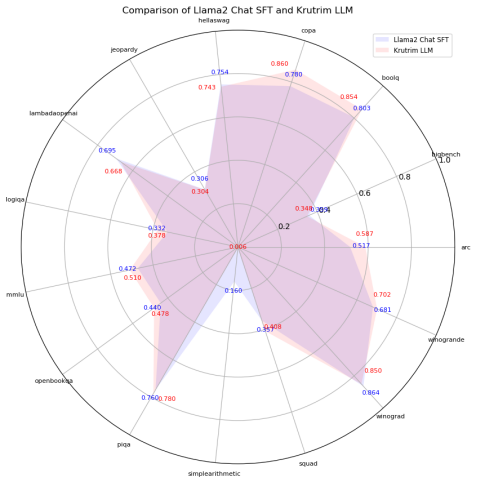
The central claim is that a 7B-parameter decoder-only transformer, pre-trained on 2 trillion tokens with hundreds of billions of Indic tokens and a tokenizer built for English and Indic scripts, reaches or exceeds state-of-the-art performance on Indic benchmarks while staying competitive in English. On IndicCOPA, IndicQA, IndicSentiment, IndicTranslation, and IndicXParaphrase, the reported scores beat GPT-3.5 in nearly every language tested and surpass dedicated regional models such as Airavata, Kannada-LLaMA, and Tamil-LLaMA. On English tasks, Krutrim matches or beats Llama-2 7B chat on 10 of 16 tasks, with average scores of 0.57 versus 0.55. The authors attribute the result to data composition rather than scale, and they add continual pre-training across 22 Indic languages plus Direct Preference Optimization to support the capability and alignment claims.
Load-bearing premise
The load-bearing premise is that the benchmark questions used to evaluate Krutrim never appeared in its 2-trillion-token training mixture, because the paper reports no decontamination or overlap analysis between training data and evaluation data.
Editorial extensions
If this is right
- A balanced Indic corpus lets a smaller model match or beat English-centric baselines on Indic tasks, so data composition becomes a cheaper lever than model scale.
- One model can cover English plus 22 Indic languages, which removes the need to deploy separate monolingual fine-tuned variants for each language.
- Adding web retrieval moves Krutrim's factual-answer accuracy to 79.13% on the paper's test set, within about 2 points of leading conversational search engines, while cutting its error rate from 18.93% to 7.47%.
- A continual-pre-training mix of about 25% original data and 75% new data improves qualitative scores across fact-checking, creative writing, math, reasoning, safety, comprehension, and summarization compared with SFT on the base pre-trained model.
Reading between the lines
- An explicit next step not in the paper is to test whether the same data-rebalancing and tokenizer recipe transfers to under-represented language families beyond India.
- A decontamination audit, matching benchmark prompts against the training corpus, would settle whether the reported scores reflect generalization or memorization; the paper leaves this out.
- The 25% original / 75% new continual-pre-training ratio, offered as a recipe for Indian languages, points toward a low-cost method for upgrading English-centric models to multilingual use, a direction the authors do not explore.
Editorial analysis
A structured set of objections, weighed in public.
Referee Report
Summary. The paper introduces Krutrim LLM, a 7B-parameter decoder-only transformer trained on 2 trillion tokens with a from-scratch SentencePiece BPE tokenizer for English and 22 scheduled Indic languages. The model uses GQA, ALiBi, continual pretraining, SFT, and DPO, and is deployed in a conversational app with WebRAG. The authors claim the largest known Indic pretraining corpus and report evaluations on IndicXtreme tasks (COPA, QA, sentiment, translation, paraphrase) where Krutrim matches or beats GPT-3.5 and several Llama-2-based Indic models, plus English benchmarks where Krutrim surpasses Llama-2 Chat on 10 of 16 tasks. The paper also includes layer-wise probing, UMAP analyses, qualitative examples, and a factual-QA evaluation against two unnamed conversational search engines.
Significance. If the quantitative claims survived scrutiny, Krutrim would be a valuable reference point for Indic-centric LLM training: it is a rare 7B-scale, 2T-token multilingual model with a dedicated Indic tokenizer, a detailed PT/CPT/SFT/DPO pipeline, and a public deployment. The paper's strengths include the from-scratch tokenizer, explicit architectural choices, and attention to Indic data imbalance. However, the central benchmark claims currently rest on unverified benchmark isolation and internally inconsistent tables; the manuscript provides no contamination analysis, and several reported numbers do not match the tables. These issues are load-bearing because the headline contributions are the comparisons against GPT-3.5 and Llama-2, so the evidence as written is not yet reliable enough to support them.
major comments (5)
- [3.1, 5.3, 6.3] No decontamination or overlap analysis is reported between the training corpora and the evaluation benchmarks. Section 3.1 describes only generic de-duplication and low-quality removal, and Section 5.3 lists instruction-tuning families (translation, summarization, general knowledge, dialogue) that overlap with the IndicXtreme-style tasks used in Section 6.3. Since pretraining includes 2T tokens from open-web and proprietary sources, public benchmark instances or near-duplicates could plausibly appear in training; without overlap statistics or an evaluation after removing suspicious examples, the headline gains (e.g., IndicSentiment 0.94-0.97 vs GPT-3.5 0.51-0.96) cannot be attributed to generalization rather than memorization.
- [Tables 7 and 8] The GPT-3.5 row in Table 8 is identical to the GPT-3.5 row in Table 7 (0.72, 0.54, 0.78, 0.54, 0.57, 0.71, 0.34), even though Table 8 reports IndicXParaphrase accuracy while Table 7 reports IndicTranslation BERTScore. This is either a copy-paste error or a duplicated baseline; in either case, Section 6.3.5's claim that Krutrim is superior across languages lacks a valid GPT-3.5 comparison in that table.
- [6.3.3] The text states that Krutrim surpasses GPT-3.5 in Tamil and Telugu "by more than 0.8 points," but Table 6 shows margins of 0.43 (0.94 vs 0.51) and 0.42 (0.95 vs 0.53). The narrative overstates the measured advantage and should be corrected to match the table.
- [6.4, Table 9] Table 9 lists 16 tasks, while Section 6.4 says "10 out of 17 tasks"; the abstract correctly says 16. In addition, the reported averages 0.552 and 0.569 do not match the row-wise means of the displayed numbers (approximately 0.545 and 0.561 over the 16 tasks). These numerical inconsistencies directly affect the central comparison with Llama-2 and must be resolved.
- [6.4] The paper excludes Llama-3 and Mistral from English comparisons because of FLOPS differences, which is a defensible compute-matched criterion, but the abstract and Section 6.3 repeatedly use "state-of-the-art" without that qualifier. Since Llama-3 and Mistral are standard 7B-scale references for English and multilingual capability, the claim of matching or exceeding state-of-the-art models is not supported as stated; the claim should be explicitly limited to the compared baselines or the comparison set should be expanded.
minor comments (6)
- [5.1.1] The sentence "We trained Krutrim on H100 GPUs resulting in 1023 FLOPS" appears to be a typo; please specify the intended number (e.g., 10^23 FLOPs) and report the tokens-per-FLOP basis used in the compute comparison.
- [6.6, Figure 10] The text says the findings are shown in "Figures 10.b and 10.b"; the duplicate figure reference should be corrected to refer to the left and right panels of Figure 10.
- [6.1] The UMAP separability comparison with Llama-2 is qualitative, so the text should avoid claiming "superiority overall" from plot separation alone, or it should provide a quantitative separability metric.
- [3.2] The claim of the "largest known Indic dataset" is not substantiated with corpus statistics or a comparison to prior Indic corpora such as IndicLLMSuite or IndicCorp; a language-wise token distribution table would also support the balanced-representation claims in Section 3.2.
- [6.2] The probing experiments report qualitative observations but no numeric comparison table against the LLaMA results from Chen et al.; adding numerical results, or at least a table of layer-wise accuracies, would make the alignment claim verifiable.
- [References] Reference [27] (Navarsa) and reference [30] (mhrd) lack full bibliographic details, and the URL for reference [45] is incomplete; these should be completed.
Circularity Check
No significant circularity: the paper's claims are empirical benchmark comparisons, not derivations from fitted inputs or self-cited theorems.
full rationale
This report makes no formal derivation chain; its central claims are empirical comparisons on external benchmarks (IndicXtreme subsets, MMLU, ARC, BoolQ, etc.). No parameter is fitted to a benchmark and then reported as a prediction of that same benchmark, no uniqueness theorem or scientific result is imported from the authors' prior work, and no ansatz is smuggled in via citation. The only self-referential element is the 'largest known Indic dataset' description, which is a data-accounting claim rather than a derived result. The absence of a decontamination analysis is a validity risk (benchmark overlap with pretraining data could inflate scores), and the Table 9 count and average inconsistencies are reporting errors, but neither makes the evaluation circular: the reported numbers are externally anchored to fixed benchmark datasets and to Llama-2/GPT-3.5 comparisons. Accordingly, no specific reduction of a claimed result to its own input can be exhibited, and the circularity score is 0.
Assumptions & free parameters
free parameters (3)
- DPO beta =
0.1
- DPO learning rate =
5e-7
- CPT data mixture =
25% original / 75% new
assumptions (3)
- domain assumption Evaluation benchmarks are not present in pretraining or fine-tuning data.
- domain assumption The self-reported 2 trillion token corpus and 'largest known Indic dataset' claim are accurate.
- domain assumption BERTScore and accuracy on the translated evaluation sets measure meaningful language ability across all 22 languages.
Cite this review
Pith. "Pith review of Krutrim LLM: Multilingual Foundational Model for over a Billion People." pith.science (2026). https://pith.science/paper/VBKWOW7X
@misc{pith2026250209642,
  author       = {Pith},
  title        = {Pith review of: Krutrim LLM: Multilingual Foundational Model for over a Billion People},
  year         = {2026},
  howpublished = {\url{https://pith.science/paper/VBKWOW7X}},
  note         = {Machine review of arXiv:2502.09642}
}
read the original abstract
India is a diverse society with unique challenges in developing AI systems, including linguistic diversity, oral traditions, data accessibility, and scalability. Existing foundation models are primarily trained on English, limiting their effectiveness for India's population. Indic languages comprise only 1 percent of Common Crawl corpora despite India representing 18 percent of the global population, leading to linguistic biases. Thousands of regional languages, dialects, and code mixing create additional representation challenges due to sparse training data. We introduce Krutrim LLM, a 2 trillion token multilingual model designed for India's linguistic landscape. It incorporates the largest known Indic dataset, mitigating data scarcity and ensuring balanced performance across dialects. Krutrim outperforms or matches state-of-the-art models on Indic benchmarks while maintaining competitive English performance. Despite being significantly smaller in training flops, Krutrim LLM matches or exceeds models like LLAMA-2 on 10 out of 16 tasks, with an average score of 0.57 versus 0.55. This evidences Krutrim's flexible multilingual fluency across diverse linguistic contexts. Krutrim is integrated with real-time search to improve factual accuracy in conversational AI applications. This enhances accessibility for over 1 billion users worldwide. Through intentional design choices addressing data imbalances, Krutrim LLM signifies meaningful progress in building ethical, globally representative AI models.
Figures


Figures from the paper (13 more)




Forward citations
Cited by 2 Pith papers
-
Meta-Learning Preferences for Multilingual LLM Alignment
Meta-learning a shared initialization on multilingual preference data lets LLMs align to a new language from ~100 preference samples, with up to 28% win-rate gains over baselines.
-
HITSZ's End-To-End Speech Translation Systems Combining Sequence-to-Sequence Auto Speech Recognition Model and Indic Large Language Model for IWSLT 2025 in Indic Track
An end-to-end Whisper-plus-Krutrim speech translation system for English and Hindi, Bengali, and Tamil is evaluated on IWSLT 2025, with chain-of-thought fine-tuning showing large but selectively measured BLEU gains.
Reference graph
Works this paper leans on
-
[1]
Josh Achiam et al. “Gpt-4 technical report”. In: arXiv preprint arXiv:2303.08774 (2023)
arXiv 2023
-
[2]
Grok AI. Grok AI. 2024. URL: https://x.ai/blog/grok-os
work page 2024
- [3]
-
[4]
meta AI. Meta AI. 2024. URL: https://ai.meta.com/blog/meta-llama-3/
work page 2024
-
[5]
Perplexity AI. Perplexity AI. 2023. URL: https://www.perplexity.ai/search
work page 2023
-
[6]
GQA: Training Generalized Multi-Query Transformer Models from Multi-Head Checkpoints
Joshua Ainslie et al. GQA: Training Generalized Multi-Query Transformer Models from Multi-Head Checkpoints. 2023. arXiv: 2305.13245 [cs.CL]
arXiv 2023
-
[7]
The Claude 3 Model Family: Opus, Sonnet, Haiku
Anthropic. The Claude 3 Model Family: Opus, Sonnet, Haiku. 2024
2024
-
[8]
A General Language Assistant as a Laboratory for Alignment
Amanda Askell et al. “A General Language Assistant as a Laboratory for Alignment”. In: ArXiv abs/2112.00861 (2021). URL: https://api.semanticscholar.org/CorpusID: 244799619
arXiv 2021
Show all 47 references
-
[9]
Tamil-Llama: A New Tamil Language Model Based on Llama 2
Abhinand Balachandran. Tamil-Llama: A New Tamil Language Model Based on Llama 2. 2023. arXiv: 2311.05845 [cs.CL]
2023 arXiv
-
[10]
Bing copilot
bing. Bing copilot. 2024. URL: https://www.bing.com/chat?q=Bing+AI
2024
-
[11]
Brown et al
Tom B. Brown et al. Language Models are Few-Shot Learners. 2020. arXiv: 2005.14165 [cs.CL]
2020 arXiv
-
[12]
N-gram Counts and Language Models from the Common Crawl
Christian Buck, Kenneth Heafield, and Bas Van Ooyen. “N-gram Counts and Language Models from the Common Crawl.” In: LREC. V ol. 2. 2014, p. 4
2014
-
[13]
Beyond Surface: Probing LLaMA Across Scales and Layers
Nuo Chen et al. “Beyond Surface: Probing LLaMA Across Scales and Layers”. In: arXiv preprint arXiv:2312.04333 (2023)
2023 arXiv
-
[14]
Training verifiers to solve math word problems
Karl Cobbe et al. “Training verifiers to solve math word problems”. In: arXiv preprint arXiv:2110.14168 (2021)
2021 arXiv
-
[15]
Continual Pre-Training Mitigates Forgetting in Language and Vision
Andrea Cossu et al. Continual Pre-Training Mitigates Forgetting in Language and Vision
-
[16]
Towards Leaving No Indic Language Behind: Building Mono- lingual Corpora, Benchmark and Models for Indic Languages
Sumanth Doddapaneni et al. “Towards Leaving No Indic Language Behind: Building Mono- lingual Corpora, Benchmark and Models for Indic Languages”. In: ArXiv abs/2212.05409 (2022)
2022 arXiv
-
[17]
Airavata: Introducing Hindi Instruction-tuned LLM
Jay Gala et al. Airavata: Introducing Hindi Instruction-tuned LLM. 2024. arXiv: 2401.15006 [cs.CL]
2024 arXiv
-
[18]
IndicTrans2: Towards High-Quality and Accessible Machine Translation Models for all 22 Scheduled Indian Languages
Jay Gala et al. “IndicTrans2: Towards High-Quality and Accessible Machine Translation Models for all 22 Scheduled Indian Languages”. In: Transactions on Machine Learning Research (2023)
2023
-
[19]
Parameter-efficient transfer learning for NLP
Neil Houlsby et al. “Parameter-efficient transfer learning for NLP”. In:International conference on machine learning. PMLR. 2019, pp. 2790–2799
2019
-
[20]
Lora: Low-rank adaptation of large language models
Edward J Hu et al. “Lora: Low-rank adaptation of large language models”. In: arXiv preprint arXiv:2106.09685 (2021)
2021 arXiv
- [21]
-
[22]
Language Models (Mostly) Know What They Know
Saurav Kadavath et al. Language Models (Mostly) Know What They Know . 2022. arXiv: 2207.05221 [cs.CL]
2022 arXiv
-
[23]
IndicNLPSuite: Monolingual corpora, evaluation benchmarks and pre-trained multilingual language models for Indian languages
Divyanshu Kakwani et al. “IndicNLPSuite: Monolingual corpora, evaluation benchmarks and pre-trained multilingual language models for Indian languages”. In:Findings of the Association for Computational Linguistics: EMNLP 2020. 2020, pp. 4948–4961. 20
2020
-
[24]
Continual Pre-training of Language Models
Zixuan Ke et al. Continual Pre-training of Language Models . 2023. arXiv: 2302 . 03241 [cs.CL]
2023
-
[25]
IndicLLMSuite: A Blueprint for Creating Pre- training and Fine-Tuning Datasets for Indian Languages
Mohammed Safi Ur Rahman Khan et al. “IndicLLMSuite: A Blueprint for Creating Pre- training and Fine-Tuning Datasets for Indian Languages”. In:arXiv preprint arXiv:2403.06350 (2024)
2024 arXiv
-
[26]
Building a Llama2-finetuned LLM for Odia Language Utilizing Domain Knowledge Instruction Set
Guneet Singh Kohli et al. Building a Llama2-finetuned LLM for Odia Language Utilizing Domain Knowledge Instruction Set. 2023. arXiv: 2312.12624 [cs.CL]
2023 arXiv
-
[27]
Navarsa: Indic LLMs based on Gemmma
Telugu Labs. Navarsa: Indic LLMs based on Gemmma
-
[28]
TruthfulQA: Measuring How Models Mimic Human Falsehoods
Stephanie Lin, Jacob Hilton, and Owain Evans. “TruthfulQA: Measuring How Models Mimic Human Falsehoods”. In: Proceedings of the 60th Annual Meeting of the Association for Computational Linguistics (Volume 1: Long Papers). 2022, pp. 3214–3252
2022
-
[29]
UMAP: Uniform Manifold Approximation and Projection for Dimension Reduction
Leland McInnes, John Healy, and James Melville. UMAP: Uniform Manifold Approximation and Projection for Dimension Reduction. 2020. arXiv: 1802.03426 [stat.ML]
2020 arXiv
-
[30]
mhrd. mhrd. 2024. URL: https://www.education.gov.in/sites/upload_files/ mhrd/files/upload_document/languagebr.pdf
2024
-
[31]
The RefinedWeb dataset for Falcon LLM: outperforming curated corpora with web data, and web data only
Guilherme Penedo et al. “The RefinedWeb dataset for Falcon LLM: outperforming curated corpora with web data, and web data only”. In: arXiv preprint arXiv:2306.01116 (2023)
2023 arXiv
-
[32]
Composite Task-Completion Dialogue Policy Learning via Hierarchical Deep Reinforcement Learning
Baolin Peng et al. “Composite Task-Completion Dialogue Policy Learning via Hierarchical Deep Reinforcement Learning”. In:Proceedings of the 2017 Conference on Empirical Methods in Natural Language Processing . Association for Computational Linguistics, 2017. DOI: 10.18653/v1/d...
2017 doi
-
[33]
Language Models as Knowledge Bases?
Fabio Petroni et al. “Language Models as Knowledge Bases?” In: Proceedings of the 2019 Conference on Empirical Methods in Natural Language Processing and the 9th International Joint Conference on Natural Language Processing (EMNLP-IJCNLP). 2019, pp. 2463–2473
2019
-
[35]
Smith, and Mike Lewis
Ofir Press, Noah A. Smith, and Mike Lewis. Train Short, Test Long: Attention with Linear Biases Enables Input Length Extrapolation. 2022. arXiv: 2108.12409 [cs.CL]
2022 arXiv
-
[36]
Direct Preference Optimization: Your Language Model is Secretly a Reward Model
Rafael Rafailov et al. Direct Preference Optimization: Your Language Model is Secretly a Reward Model. 2023. arXiv: 2305.18290 [cs.LG]
2023 arXiv
-
[37]
Proximal Policy Optimization Algorithms
John Schulman et al. Proximal Policy Optimization Algorithms. 2017. arXiv: 1707.06347 [cs.LG]
2017 arXiv
-
[38]
Dolma: An Open Corpus of Three Trillion Tokens for Language Model Pretraining Research
Luca Soldaini et al. “Dolma: An Open Corpus of Three Trillion Tokens for Language Model Pretraining Research”. In: arXiv preprint arXiv:2402.00159 (2024)
2024 arXiv
-
[39]
Learning to summarize from human feedback
Nisan Stiennon et al. Learning to summarize from human feedback. 2022. arXiv: 2009.01325 [cs.CL]
2022 arXiv
-
[40]
Gemini: A Family of Highly Capable Multimodal Models
Gemini Team et al. Gemini: A Family of Highly Capable Multimodal Models. 2023. arXiv: 2312.11805 [cs.CL]
2023 arXiv
-
[41]
Llama 2: Open foundation and fine-tuned chat models
Hugo Touvron et al. “Llama 2: Open foundation and fine-tuned chat models”. In:arXiv preprint arXiv:2307.09288 (2023)
2023 arXiv
-
[42]
Attention Is All You Need
Ashish Vaswani et al. “Attention Is All You Need”. In: (2023). arXiv:1706.03762 [cs.CL]
2023 arXiv
-
[43]
Languages of India
wiki. Languages of India. 2024. URL: https://en.wikipedia.org/wiki/Languages_ of_India
2024
-
[44]
Zhaorui Yang et al.Self-Distillation Bridges Distribution Gap in Language Model Fine-Tuning
-
[45]
You.Com. You.Com. 2023. URL: you.com
2023
-
[46]
ReClor: A Reading Comprehension Dataset Requiring Logical Reasoning
Weihao Yu et al. “ReClor: A Reading Comprehension Dataset Requiring Logical Reasoning”. In: International Conference on Learning Representations. 2019. 21
2019
-
[2022]
arXiv: 2205.09357 [cs.LG]
-
[2024]
arXiv: 2402.13669 [cs.CL]
Reviewed August 8, 2026 · model on record in the stance chip above.
Discussion (0). Continue with ORCID to comment.