REVIEW 3 major objections 5 minor 1 cited by
Meta-INR: Efficient Encoding of Volumetric Data via Meta-Learning Implicit Neural Representation
T0 review · 3 major / 5 minor · reviewed 2026-08-07 · deepseek-v4-flash
Pith's one-line read This paper claims that a meta-learning pretraining pass over a tiny subsample of a time-varying or ensemble volume dataset learns an initialization from which each new volume can be encoded by a SIREN in a few gradient steps, cutting…
desk verdict Competent MAML-for-INR application to volume data with real engineering value, but the 'unseen volume' claim is untested because every evaluated volume contributed subsampled samples to meta-pretraining. read the letter →
The pith
A machine-rendered reading of the paper's core claim, the machinery that carries it, and where it could break.
The reading
What carries the argument
The mechanism is a meta-learned initialization $\theta_m$, produced by repeated inner-loop finetuning of cloned parameters on subsampled volumes followed by an outer-loop update of $\theta_m$ with the accumulated adaptation gradients. During pretraining, each inner loop clones $\theta_m$, runs $K$ gradient steps on random batches from a subsampled volume, and returns the direction $\theta - \theta'$; the outer loop averages these directions over all volumes and moves $\theta_m$ along them. This makes $\theta_m$ a parameter region from which $K$ steps of ordinary SGD at learning rate 1e-5 reach a low-MSE fit for any volume sharing the dataset's structure. The same few-step adaptation is then applied at full resolution to each volume, and the resulting per-volume parameters are the objects analyzed for interpretability. This design carries the argument because it converts dataset-level shared structure into a reusable prior without requiring any architectural modification of the SIREN backbone.
What would settle it
Take a dataset of volumes with deliberately unrelated structures, for instance one turbulence snapshot, one medical CT volume, one cosmological density field, and one combustion simulation, meta-pretrain on their subsamples, and then finetune each full volume from the shared initialization for $K=16$ steps; if the resulting PSNR is no better than, or worse than, finetuning from random initialization for the same number of steps, the central claim that Meta-INR generalizes to unseen similar volumes is refuted for heterogeneous collections.
Extended reading notes
Core claim
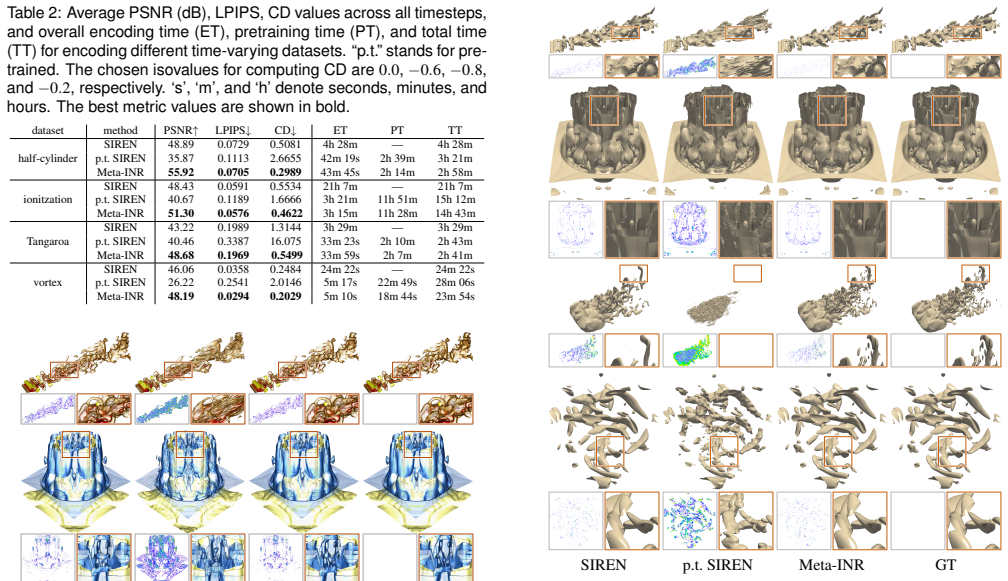
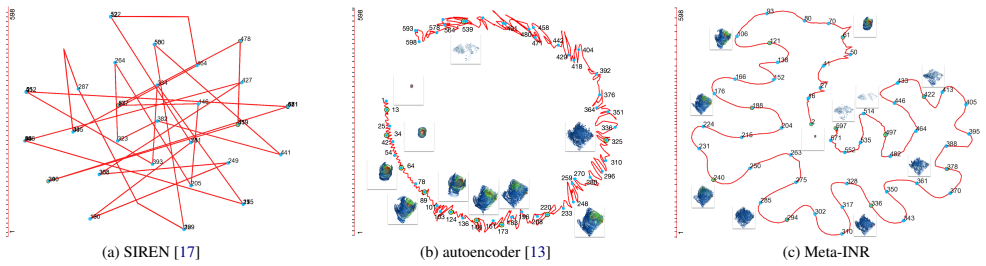
The central claim is that meta-learning initialization, not architecture change, is what makes INR encoding of volumetric sequences efficient. The paper proposes to pretrain a seven-layer SIREN, a fully connected network with sinusoidal activations, using a MAML-style inner-loop and outer-loop update on a spatiotemporally downsampled version of the dataset with spatial factor $\lambda_s=4$ and temporal factor $\lambda_t=2$, so the outer loop sees only about 0.78% of the original voxel-time samples. After pretraining, each volume in the full dataset is encoded by finetuning the shared initialization for $K=16$ gradient steps at learning rate 1e-5; the inner-loop update in pretraining mirrors this finetuning, so the initialization is optimized specifically to be easy to adapt. The authors report that this strategy beats both training from scratch and a vanilla pretrained SIREN on reconstruction quality (PSNR, LPIPS, Chamfer distance) on all four tested time-varying datasets, and that the adapted parameter sets form smooth trajectories in t-SNE space that correlate with time and with simulation parameters such as h0 and OmM0 in the Nyx ensemble. In short, the discovery is that a meta-learned prior converts per-volume INR training from hours-scale optimization into a few-step adaptation task while improving fidelity.
Load-bearing premise
The method assumes the volumes in a dataset are similar enough in structure that one shared starting point, learned from a tiny subsample, lets a few dozen gradient steps fit every volume well; if the collection is heterogeneous, that shared start can be worse than starting from scratch.
Editorial extensions
If this is right
- New volumes added after meta-pretraining can be encoded with only $K=16$ gradient steps, cutting average encoding time by about 5.87x across the four tested datasets.
- A pretraining sample of roughly 0.78% of voxel-time coordinates suffices to learn dataset-level structure that improves reconstruction quality over from-scratch training.
- Because all adapted networks share a common starting point, their parameter differences reflect volume-specific variation, enabling representative timestep selection and simulation-parameter analysis from the weights alone.
- Naive pretraining on the same subsample does not work, so the inner-loop adaptation that mimics finetuning is essential to the improvement, not the subsampling alone.
Reading between the lines
- The speed-up is an amortized one: for a single isolated volume, meta-pretraining plus finetuning costs more than training from scratch, so the practical benefit requires a collection of several similar volumes.
- The parameter-space structure suggests adapted INR weights could be used as compact latent embeddings for volume collections, enabling retrieval or clustering tasks the paper does not test.
- The paper fixes the subsampling intervals at $\lambda_s=4$ and $\lambda_t=2$; varying these would reveal how much pretraining data is actually needed and is a natural sensitivity test.
Editorial analysis
A structured set of objections, weighed in public.
Referee Report
Summary. Meta-INR proposes a two-stage pretraining strategy for implicit neural representations (INRs) of volumetric time-varying and ensemble data. In the first stage, a seven-layer SIREN backbone is meta-trained with a MAML-style inner/outer loop on spatiotemporally subsampled volumes (lambda_s=4, lambda_t=2, about 0.78% of the original samples). In the second stage, the meta-learned initialization is finetuned for K=16 steps on each target volume. The authors report that this reduces average encoding time by about 5.87x relative to training each SIREN from scratch, while improving PSNR, LPIPS, and Chamfer distance across four datasets. The paper also presents t-SNE-based qualitative analyses for representative timestep selection on the earthquake dataset and simulation parameter analysis on the Nyx ensemble dataset, and it compares against SIREN-from-scratch and a vanilla pretrained SIREN baseline.
Significance. The proposed recipe is simple, practical, and the reported encoding-time savings are consistently large across four datasets. The paper ships code, reports total time including pretraining, and applies a standard meta-learning formulation to a relevant visualization problem; these are concrete strengths. If the generalization claim were supported by a properly held-out split, the work would be a useful contribution to INR-based volume encoding, since the meta-learned initialization is architecture-compatible with existing SIREN-based pipelines. The interpretability analyses in Sections 4.3 and 4.4 are suggestive rather than quantitative. The central weakness is that the experiments do not actually evaluate 'unseen' volumes: because meta-pretraining subsamples every timestep or ensemble in the dataset, Table 2 measures adaptation to volumes whose coarse structure was already observed during pretraining. The speed and within-distribution quality results remain meaningful, but the paper's headline claim of generalization to unseen similar volumes is untested and requires a corrected experimental protocol.
major comments (3)
- [Section 3.1 and Section 4.2 (also Section 4.4)] Algorithm 1 constructs the meta-training set by subsampling D under lambda_s and lambda_t and then runs the outer loop over all T' volumes of the resulting Dhat. Section 4.2 then finetunes and evaluates on all timesteps of the same four datasets, and Section 4.4 similarly meta-pretrains on a subsampled Nyx dataset before finetuning all of its ensembles. Consequently, every volume reported in Table 2 had subsampled voxels from itself in the meta-training set. The abstract and Section 1 claim adaptation to 'unseen similar volumes' and 'generalizable features,' but no held-out volume or ensemble split is performed. This is load-bearing because the method's novelty is cross-volume meta-generalization. The authors should split volumes into meta-train and meta-test sets before any subsampling, pretrain only on the meta-train volumes, and then finetune and evaluate on the meta-test volumes; the same correction is needed for the Nyx analysis.
- [Algorithm 1, line 12] The meta-gradient update is written as 'gradient_theta_m <- gradient_theta_m + (theta - theta_prime)', but theta is never defined in the algorithm or in the surrounding text. In a first-order MAML update, this term should be (theta_m - theta_prime), where theta_prime is the adapted clone after K inner steps, or an explicitly stored copy of theta_m taken before cloning. As written, the core training equation is not reproducible from the manuscript. Please correct the notation and state explicitly whether the implementation uses first-order or full MAML gradients.
- [Section 4.2, Table 2] No variance or repeated-seed information is reported for any of the quantitative metrics. Several quality differences are small: LPIPS for half-cylinder is 0.0705 vs. 0.0729 and for ionization is 0.0576 vs. 0.0591, while the PSNR differences are larger but still dataset-dependent. Without at least a few independent trials (e.g., 3-5 random seeds) or an equivalent statistical statement, it is not possible to tell whether the quality advantages over SIREN are significant or partly due to initialization and training noise. This matters because the paper claims consistent quality improvement, not only faster encoding.
minor comments (5)
- [Table 2] The dataset name is misspelled as 'ionitzation' and should be 'ionization'.
- [Section 4.2, baselines] The 'pretrained SIREN' baseline is described only as pretraining without inner-loop updating; a formal statement of its objective and number of outer-loop steps would make the comparison precise and easier to reproduce.
- [Section 3.1, hyperparameters] The values lambda_s=4, lambda_t=2, K=16, alpha, and beta are chosen empirically, but no sensitivity analysis is provided. Since these hyperparameters directly control the pretraining/finetuning trade-off, a short ablation would strengthen the claims about data efficiency and robustness.
- [Sections 4.3 and 4.4] The t-SNE interpretability claims are qualitative. Consider adding quantitative measures, such as the correlation between parameter-space distance and timestep or simulation-parameter distance, or at least acknowledging the dependence of the conclusions on t-SNE hyperparameters.
- [Section 4.3] The autoencoder baseline from Porter et al. [13] is used in Figure 3 but its training details are not described in this paper, so readers cannot assess whether the comparison is fair.
Circularity Check
No significant circularity: the meta-learning optimization and evaluation are distinct, though the 'unseen volume' generalization claim is not tested by a held-out split.
full rationale
No circular step is present in the paper's derivation chain. Meta-INR optimizes initial parameters theta_m with a MAML-style nested loop on a spatiotemporally subsampled dataset D_hat (Algorithm 1, Section 3.1), then finetunes theta_m on full-resolution volumes and evaluates reconstruction quality with PSNR, LPIPS, and Chamfer distance (Section 4.2, Table 2). The objective being optimized is MSE on coordinate-value pairs; the reported metrics are computed on full reconstructions and are not algebraically determined by the fitted initialization, so no prediction reduces to an input by construction. The backbone SIREN and the MAML update rule are external, cited results (Finn et al. 2017; Sitzmann et al. 2020), not self-citations. The paper's own protocol does contain a generalization-testing gap: meta-pretraining subsamples the full dataset D, including every volume listed in Table 2, so the abstract's claim of adapting to 'unseen similar volume data' is not supported by a held-out volume split. However, this is an evaluation-protocol limitation rather than circularity: the meta-model still must reconstruct full-resolution voxel values that were not directly provided during pretraining, and the comparison with SIREN from scratch is a legitimate speed and fidelity comparison on the same volumes. Because no equation or fitted parameter is relabeled as a prediction, the circularity score is 0.
Assumptions & free parameters
free parameters (6)
- Spatial subsampling interval lambda_s =
4
- Temporal/ensemble subsampling interval lambda_t =
2
- Inner-loop adaptation steps K =
16
- Learning rates alpha and beta =
1e-4 meta-pretraining, 1e-5 finetuning
- SIREN architecture and batch size =
7 layers, width 256, batch 50,000
- Outer-loop steps =
500
assumptions (4)
- domain assumption Volumes within each dataset share sufficient structural patterns for a common initialization to accelerate adaptation
- domain assumption MSE between predicted and ground-truth voxel values is an adequate objective for volume representation
- ad hoc to paper t-SNE projections of adapted INR parameters preserve meaningful temporal and parametric structure
- domain assumption A 7-layer, 256-unit SIREN can represent the test volumes at the reported fidelity
Cite this review
Pith. "Pith review of Meta-INR: Efficient Encoding of Volumetric Data via Meta-Learning Implicit Neural Representation." pith.science (2026). https://pith.science/paper/JCP77S3A
@misc{pith2026250209669,
  author       = {Pith},
  title        = {Pith review of: Meta-INR: Efficient Encoding of Volumetric Data via Meta-Learning Implicit Neural Representation},
  year         = {2026},
  howpublished = {\url{https://pith.science/paper/JCP77S3A}},
  note         = {Machine review of arXiv:2502.09669}
}
read the original abstract
Implicit neural representation (INR) has emerged as a promising solution for encoding volumetric data, offering continuous representations and seamless compatibility with the volume rendering pipeline. However, optimizing an INR network from randomly initialized parameters for each new volume is computationally inefficient, especially for large-scale time-varying or ensemble volumetric datasets where volumes share similar structural patterns but require independent training. To close this gap, we propose Meta-INR, a pretraining strategy adapted from meta-learning algorithms to learn initial INR parameters from partial observation of a volumetric dataset. Compared to training an INR from scratch, the learned initial parameters provide a strong prior that enhances INR generalizability, allowing significantly faster convergence with just a few gradient updates when adapting to a new volume and better interpretability when analyzing the parameters of the adapted INRs. We demonstrate that Meta-INR can effectively extract high-quality generalizable features that help encode unseen similar volume data across diverse datasets. Furthermore, we highlight its utility in tasks such as simulation parameter analysis and representative timestep selection. The code is available at https://github.com/spacefarers/MetaINR.
Figures

Figures from the paper (1 more)

Forward citations
Cited by 1 Pith paper
-
F-Hash: Feature-Based Hash Design for Time-Varying Volume Visualization via Multi-Resolution Tesseract Encoding
F-Hash encodes time-varying volumes into a 4D multi-resolution tesseract grid, reporting 10x to 100x faster convergence and fewer parameters than existing input encodings.
Reference graph
Works this paper leans on
-
[1]
A. S. Almgren, J. B. Bell, M. J. Lijewski, Z. Luki ´c, and E. Van An- del. Nyx: A massively parallel AMR code for computational cosmol- ogy. The Astrophysical Journal, 765(1):39, 2013. doi: 10.1088/0004 -637X/765/1/39 2
doi:10.1088/0004 2013
- [2]
- [3]
-
[4]
P. Gu, D. Z. Chen, and C. Wang. NeRVI: Compressive neural repre- sentation of visualization images for communicating volume visual- ization results. Computers & Graphics, 116:216–227, 2023. doi: 10. 1016/J.CAG.2023.08.024 1
work page 2023
- [5]
- [6]
- [7]
-
[8]
H. Li and H.-W. Shen. Improving efficiency of iso-surface extrac- tion on implicit neural representations using uncertainty propagation. IEEE Transactions on Visualization and Computer Graphics, 31(1):1– 13, 2024. doi: 10.1109/TVCG.2024.3365089 1
Show all 28 references
-
[9]
Y . Lu, P. Gu, and C. Wang. FCNR: Fast compressive neural represen- tation of visualization images. InProceedings of IEEE VIS Conference (Short Papers), pp. 31–35, 2024. doi: 10.1109/VIS55277.2024.00014 1
2024
-
[10]
Y . Lu, K. Jiang, J. A. Levine, and M. Berger. Compressive neural rep- resentations of volumetric scalar fields. Computer Graphics Forum, 40(3):135–146, 2021. doi: 10.1111/cgf.14295 1
2021 doi
- [11]
-
[12]
Popinet, M
S. Popinet, M. Smith, and C. Stevens. Experimental and numer- ical study of the turbulence characteristics of airflow around a re- search vessel. Journal of Atmospheric and Oceanic Technology , 21(10):1575–1589, 2004. doi: 10.1175/1520-0426(2004)021 <1575: EANSOT>2.0.CO;2 2
2004 doi
-
[13]
W. P. Porter, Y . Xing, B. R. von Ohlen, J. Han, and C. Wang. A deep learning approach to selecting representative time steps for time- varying multivariate data. In Proceedings of IEEE VIS Conference (Short Papers) , pp. 131–135, 2019. doi: 10.1109/VISUAL.2019. 8933759 4
2019 doi
-
[14]
I. B. Rojo and T. G ¨unther. Vector field topology of time-dependent flows in a steady reference frame. IEEE Transactions on Visualization and Computer Graphics, 26(1):280–290, 2019. doi: 10.1109/TVCG. 2019.2934375 2
2019
-
[15]
Silver and X
D. Silver and X. Wang. Tracking and visualizing turbulent 3D fea- tures. IEEE Transactions on Visualization and Computer Graphics , 3(2):129–141, 1997. doi: 10.1109/2945.597796 2
1997
- [16]
- [17]
-
[18]
Y . Song, T. Wang, P. Cai, S. K. Mondal, and J. P. Sahoo. A comprehen- sive survey of few-shot learning: Evolution, applications, challenges, and opportunities. ACM Computing Surveys, 55(13s):1–40, 2023. doi: 10.1145/3582688 2
2023 doi
-
[19]
Tancik, B
M. Tancik, B. Mildenhall, T. Wang, D. Schmidt, P. P. Srinivasan, J. T. Barron, and R. Ng. Learned initializations for optimizing coordinate- based neural representations. In Proceedings of IEEE Conference on Computer Vision and Pattern Recognition, pp. 2846–2855, 2021. doi: 10...
2021
-
[20]
Tang and C
K. Tang and C. Wang. ECNR: Efficient compressive neural rep- resentation of time-varying volumetric datasets. In Proceedings of IEEE Pacific Visualization Conference , pp. 72–81, 2024. doi: 10. 1109/PacificVis60374.2024.00017 1
2024
-
[21]
Tang and C
K. Tang and C. Wang. STSR-INR: Spatiotemporal super-resolution for time-varying multivariate volumetric data via implicit neural rep- resentation. Computers & Graphics, 119:103874, 2024. doi: 10.1016/ j.cag.2024.01.001 1
2024
-
[23]
van der Maaten and G
L. van der Maaten and G. Hinton. Visualizing data using t-SNE. Jour- nal of Machine Learning Research, 9(86):2579–2605, 2008. 4
2008
-
[24]
Wang and J
C. Wang and J. Han. DL4SciVis: A state-of-the-art survey on deep learning for scientific visualization. IEEE Transactions on Visualiza- tion and Computer Graphics , 29(8):3714–3733, 2023. doi: 10.1109/ TVCG.2022.3167896 1
2023
-
[25]
Weiss, P
S. Weiss, P. Herm ¨uller, and R. Westermann. Fast neural represen- tations for direct volume rendering. Computer Graphics Forum , 41(6):196–211, 2022. doi: 10.1111/cgf.14578 1, 5
2022 doi
-
[26]
Whalen and M
D. Whalen and M. L. Norman. Ionization front instabilities in primor- dial H II regions. The Astrophysical Journal, 673:664–675, 2008. doi: 10.1086/524400 2
2008 doi
-
[27]
S. W. Wurster, T. Xiong, H.-W. Shen, H. Guo, and T. Peterka. Adap- tively placed multi-grid scene representation networks for large-scale data visualization. IEEE Transactions on Visualization and Computer Graphics, 30(1):965–974, 2024. doi: 10.1109/TVCG.2023.3327194 1, 5
2024
-
[28]
Xiong, S
T. Xiong, S. W. Wurster, H. Guo, T. Peterka, and H.-W. Shen. Regular- ized multi-decoder ensemble for an error-aware scene representation network. IEEE Transactions on Visualization and Computer Graph- ics, 31(1):645–655, 2025. doi: 10.1109/TVCG.2024.3456357 1
2025
-
[29]
S. Yao, Y . Lu, and C. Wang. ViSNeRF: Efficient multidimensional neural radiance field representation for visualization synthesis of dy- namic volumetric scenes. InProceedings of IEEE Pacific Visualization Conference, 2025. Accepted. 1
2025
Reviewed August 7, 2026 · model on record in the stance chip above.
Discussion (0). Continue with ORCID to comment.