REVIEW 4 major objections 4 minor 117 references
The bright, dusty aftermath of giant eruptions & H-rich supernovae. Late interaction of supernova shocks & dusty circumstellar shells
T0 review · 4 major / 4 minor · reviewed 2026-08-07 · deepseek-v4-flash
Pith's one-line read This paper claims that dust formed in giant stellar eruptions survives a later supernova only if the explosion arrives while the erupted shell is still dense enough to radiate the shock away, with survival ranging from about 75% for a…
desk verdict Solid 3D dust-destruction simulations with a genuinely new result, but the headline survival fractions are explicitly upper limits because optically thick cooling is ignored. read the letter →
The pith
A machine-rendered reading of the paper's core claim, the machinery that carries it, and where it could break.
The reading
What carries the argument
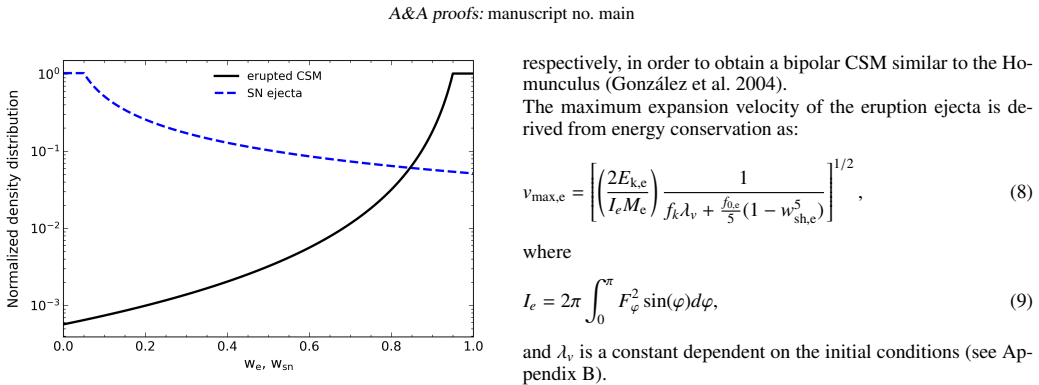
The load-bearing mechanism is the coupling between the density of the erupted shell and radiative cooling of the shocked gas, implemented in 3D hydrodynamic simulations that track dust as an advected mass scalar with a grain-size distribution eroded on the fly by thermal sputtering. A latitude-dependent expansion velocity, a Hubble-like radial flow modulated by a pole-to-equator contrast function, builds either a spherical or a Homunculus-like bipolar shell, and the supernova ejecta are inserted with a power-law density profile. When the shock meets dense shell gas, it radiates a large fraction of its kinetic energy (up to about half the injected energy), drops out of the Sedov-Taylor regime, and weakens both the forward shock and the reverse shock, so grains survive. The 12-year-delay cases reach densities around $10^9\,\mathrm{cm}^{-3}$, forcing this radiative transition before the bulk of the dust has been processed, which is the physical reason the reported dust fractions remain high.
What would settle it
Measure the surviving dust mass in a young, circumstellar-interacting Type II supernova whose eruption-to-explosion delay is known from pre-explosion imaging to be about a decade: the model predicts that more than half of the initial $0.25\,M_\odot$ of eruption dust should remain as warm grains a decade after the explosion, while finding less than about $0.03\,M_\odot$ would contradict the predicted short-delay survival.
Extended reading notes
Core claim
The paper's central claim is that the late interaction between a supernova blast wave and a dusty shell ejected by a giant eruption destroys dust mainly through thermal sputtering, and that the destruction efficiency is governed by two parameters: the shape of the shell and the eruption-to-supernova delay. In the long-delay spherical case, the forward shock spends roughly 170 years crossing a low-density cavity before reaching the dense shell, so only about 10% of the dust is lost early and roughly 25% of the initial $0.25\,M_\odot$ remains at 250 years. In the long-delay bipolar case, the equator of the shell is reached within about 20 years, the remnant's thermal energy peaks near $0.15E_{\rm SN}$, and dust survival falls to about 2% within 115 years. With a 12-year delay, the shell is still extremely dense, the shock becomes radiative before reaching most grains, up to half of the injected kinetic energy is radiated away, and the surviving fraction stabilizes at about 75% for the standard explosion and about 20% for $15$--$20\,M_\odot$ ejecta with $5\times10^{51}$ erg. The authors therefore state that a shorter delay and an early radiative transition increase the survival of pre-existing circumstellar dust, reduce the reverse shock's effect on supernova-condensed dust, and weaken the later impact on ambient interstellar dust.
Load-bearing premise
The whole calculation leans on the assumption that high-energy gas atoms erode the dust grains (thermal sputtering) and that the dense gas cools without blocking its own radiation, so the reported dust fractions are upper limits; if other destruction processes act or cooling is weaker, the fractions fall.
Editorial extensions
If this is right
- In a Homunculus-like bipolar nebula, a supernova occurring about 200 years after the eruption would destroy nearly all of the eruption-formed dust, leaving less than 2% after about a century.
- When the forward shock is weakened by early radiative cooling, the reverse shock is also weaker, which should reduce the destruction of dust condensed inside the supernova ejecta itself.
- The interaction radiates roughly $(0.4\text{--}2.5)\times10^{51}$ erg over the first decade, and the paper expects this energy to emerge as infrared radiation from shock-heated circumstellar dust.
- A weaker forward shock also implies less destruction of ambient interstellar dust in the wind-driven shell far from the explosion site.
- For a given explosion energy, the shorter the eruption-to-supernova gap, the larger the surviving dust mass, so surveys should not assume that promptly exploding progenitors leave no dust behind.
Reading between the lines
- The simulations inject dust only with the eruption, not with the supernova ejecta; if supernova-condensed dust is added, the weakened reverse shock in the 12-year cases suggests that additional dust mass could survive, but that is an extrapolation beyond the computed models.
- A testable extension is to weight these survival fractions by the observed distribution of eruption-to-supernova delays: if short delays are common, the average surviving dust mass per event could be much higher than the long-delay numbers of 25% and 2% alone suggest.
- Because the paper treats the dense shocked gas as optically thin, the quoted fractions are upper limits; including radiative trapping or additional grain destruction channels such as shattering would likely lower the 20--75% numbers, especially for the 12-year bipolar cases, while the qualitative ordering by delay and geometry would probably remain.
Editorial analysis
A structured set of objections, weighed in public.
Referee Report
Summary. This paper reports 3D adaptive-mesh-refinement hydrodynamical simulations, using FLASH and the Cinder dust module, of supernova shocks expanding into a dusty circumstellar medium formed by a giant stellar eruption. The computational setup includes the progenitor stellar wind, a spherical or bipolar (Homunculus-like) ejected shell, and a delayed hydrogen-rich core-collapse supernova. Six cases are presented: S200 and B200 (200-year eruption-to-SN delay, spherical and bipolar CSM), and B12-10, B12-56Ni, B12-15, B12-20 (12-year delay, bipolar CSM, with standard and more massive/energetic SN ejecta). The main quantitative results are that 25% of the erupted dust survives at 250 years in the spherical case, 2% survives at 115 years in the bipolar 200-year case, about 75% survives for a standard 10 Msun, 10^51 erg explosion with a 12-year delay, and about 20% survives for the 15-20 Msun, 5x10^51 erg explosions. The authors attribute the higher survival in the short-delay cases to a rapid transition of the forward shock to a radiative phase, which reduces the post-shock temperature and therefore the thermal sputtering rate before most dust is processed.
Significance. If the quantitative results hold, the paper advances the understanding of dust survival in interacting supernovae and in evolved massive stars such as eta Carinae analogs. The simulations couple gas and dust cooling self-consistently, follow thermal sputtering and grain growth on the fly, and include dedicated convergence tests; the reported survival fractions are emergent outputs rather than fitted quantities. The central qualitative trend - that CSM geometry and a very early eruption-to-SN delay have opposite effects on dust survival, with the short delay preserving dust because the shock becomes radiative before sputtering most grains - is interesting, physically plausible, and testable against late-time IR and optical observations. However, the headline survival numbers are explicitly upper limits in the manuscript's own Section 4, because only thermal sputtering is included and radiative cooling is treated as optically thin; the size of the associated correction is not quantified. The quantitative claims therefore need additional support before the abstract-level numbers can be taken at face value.
major comments (4)
- [Section 4; Section 3.2, Figs. 6 and 8] The B12 survival fractions (75% for B12-10 and about 20% for B12-15/B12-20) are produced by the early onset of strong radiative cooling in gas with densities up to a few times 10^9 cm^-3. This is precisely the regime where the optically thin cooling assumption can fail: optical depth is determined by column density and opacity, and a shell of thickness 0.00152 pc at 10^8-10^9 cm^-3 already has a very large column density. If the cooling radiation is trapped, the post-shock gas remains hotter and denser for longer and thermal sputtering continues at a higher rate, lowering the surviving dust fraction. The manuscript states in Section 4 that the optically thick regime is not accounted for and that the dust fractions are upper limits, especially in the B12 cases, but it does not quantify the correction. Because this assumption is the mechanism behind the counter-intuitive headline result, the authors should provide an explicit estimate of the optical depth at the peak densities, or a test with reduced/suppressed cooling, or an equivalent treatment of the optically thick regime, and then either confirm or soften the quantitative conclusions.
- [Section 2.4; Section 4] Dust destruction is modeled only through thermal sputtering in the Cinder module. Other destruction channels - non-thermal sputtering in the shock precursor, grain-grain collisions, shattering, and vaporization in the densest shocked layers - are not included. These processes would act in addition to thermal sputtering, so the quoted survived dust masses are upper limits in every scenario, not only with respect to the optically thin cooling assumption. The authors state this caveat for cooling; they should state it explicitly for the destruction physics as well, and ideally give an estimate of whether non-thermal sputtering or grain-grain processing is expected to be negligible at the physical conditions reached in these simulations.
- [Section 4; Table 1; Appendix E] The paper warns that Cartesian grid effects influence the highest densities, especially at late times, and that these densities may not be appropriate for evolved remnants. In the B200 and B12 cases the equatorial region, where the highest densities are reached, is also the region that controls the dust sputtering rate, so a grid-aligned density enhancement could bias the destruction efficiency. The resolution test B12-10-Test (Table 1) changes the maximum resolution by a factor of two and gives agreement to 0.3%, but a convergence test on the same Cartesian grid orientation does not remove an artificial symmetry imposed by the grid itself. The authors should demonstrate, for example with a different grid orientation or a non-Cartesian comparison, that the equatorial density structure and the resulting dust survival are not artifacts of the Cartesian geometry.
- [Section 3.2; Table 1] The B12-15 and B12-20 simulations are stopped after 7-8 years because the remnant reaches the computational boundary, and the paper states that the most relevant phase of the evolution has already occurred. This may be true for the direct passage of the forward shock through the dense CSM shell, but the reverse shock, the subsequent expansion into the lower-density wind, and the possible reprocessing of dust that was only partially sputtered by the weakened forward shock are not followed. The claim that the dust mass fractions have stabilized should be supported by a quantitative demonstration that the remaining dust resides in regions that will not be shocked again or further sputtered within the system's evolution, rather than solely by the flat shape of the survival curves at 7-10 years.
minor comments (4)
- [Section 2] There are several typographical and spacing artifacts in the manuscript, including 'metalliciy' in Section 2, 'di ffusion' and 'e ffects' in Section 4, and 'S 200 and S 200' in the caption of Fig. 5, where the second entry should presumably be B200; the text should be carefully copy-edited.
- [Abstract and Section 5] The abstract and the conclusions present the B12 survival fractions as plain numbers, while Section 4 states that they are upper limits; adding the qualifier 'upper limits' in the abstract and conclusions would make the manuscript internally consistent with its own caveats.
- [Figure 7] The caption of Fig. 7 says 'Gas temperature distribution slices in the x-z plane' but the plotted panels appear to show temperature in a single slice per case; the wording should be clarified.
- [Section 3.2] The sentence 'the simulations have reached the boundaries of the computational domain, but the most relevant phase of their evolution has already taken place' would benefit from a quantitative justification, such as the fraction of the CSM mass already swept up at the stopping time.
Circularity Check
No significant circularity: the survival fractions are emergent simulation outputs, not fitted parameters; the main self-citation (Cinder) is not load-bearing.
full rationale
The paper's claims—25%, 2%, 75%, and 20% dust survival—are outputs of 3D hydrodynamical simulations (FLASH with the Wind and Cinder modules) that use initial conditions set by stellar evolution tracks and standard SN parameters (10 M_sun, 10^51 erg, etc.). No parameter is adjusted to reproduce these survival numbers, and the dust-destruction calculation is governed by thermal sputtering and the dust-to-gas ratio, not by the conclusions. The paper explicitly labels its survival fractions as upper limits because radiative cooling is treated as optically thin (Section 4), and the grid-symmetry caveat is stated; these are limitations on accuracy, not circular reductions. The principal self-reference is the Cinder module (Martinez-Gonzalez et al. 2018, 2019, 2022), which provides sputtering and gas-grain cooling rates; it is a modeling tool benchmarked in earlier work, not a premise that presupposes the reported dust fractions. No fitted parameter is renamed as a prediction, no uniqueness theorem is invoked, and no known result is repackaged by definition. The derivation chain is therefore self-contained relative to its stated assumptions.
Assumptions & free parameters
free parameters (10)
- Eruption ejecta mass Me =
25 Msun
- Eruption kinetic energy Ek,e =
10^50 erg
- Dust-to-gas mass ratio =
0.01
- Eruption-SN delay time =
200 yr and 12 yr
- SN ejecta mass and kinetic energy =
10 Msun/10^51 erg; 15 Msun/5x10^51 erg; 20 Msun/5x10^51 erg
- 56Ni mass =
0, 0.032, 0.9, 2.5 Msun
- Bipolar CSM shape parameters alpha and beta =
alpha=0.78, beta=0.3
- Stellar wind mass-loss rate and terminal velocity =
1e-3 Msun/yr and 250 km/s
- Grain size distribution parameters =
a0=0.1 micron, sigma=0.7, amin=0.005 micron, amax=0.5 micron
- Eruption shell structure parameters =
k=2.5, wsh,e=0.95
assumptions (7)
- standard math Compressible Euler hydrodynamics with PPM is an adequate description of the SN-CSM interaction.
- domain assumption Collisional ionization equilibrium and instantaneous electron-ion energy equipartition hold in the post-shock gas.
- domain assumption Radiative cooling is optically thin up to gas densities around 10^10 cm^-3.
- domain assumption Thermal sputtering is the only dust destruction channel.
- domain assumption A single eruptive event with a fixed shell structure represents the CSM.
- domain assumption Progenitor mass budgets from BoOST stellar tracks lead to hydrogen-rich core-collapse supernovae.
- domain assumption No dust is injected with the stellar wind or SN ejecta.
Cite this review
Pith. "Pith review of The bright, dusty aftermath of giant eruptions & H-rich supernovae. Late interaction of supernova shocks & dusty circumstellar shells." pith.science (2026). https://pith.science/paper/5Y54PURV
@misc{pith2026250209700,
  author       = {Pith},
  title        = {Pith review of: The bright, dusty aftermath of giant eruptions & H-rich supernovae. Late interaction of supernova shocks & dusty circumstellar shells},
  year         = {2026},
  howpublished = {\url{https://pith.science/paper/5Y54PURV}},
  note         = {Machine review of arXiv:2502.09700}
}
abstract
The late-stage evolution of massive stars is marked by intense instability as they approach core-collapse. During these phases, giant stellar eruptions lead to exceptionally high mass-loss rates, forming significant amounts of dust. However, the survival of these dust grains is challenged by the powerful shock waves generated when the progenitor explodes as a supernova (SN). We explore the impact of hydrogen-rich SN explosions from 45, 50, and 60 M$_\odot$ progenitors on dust formed after these eruptions, focusing on interactions with circumstellar shells occurring from a few years to centuries after the event. Using 3D hydrodynamical simulations, we track the evolution of dust particles in a scenario that includes the progenitor's stellar wind, a giant eruption, and the subsequent SN explosion, following the mass budgets predicted by stellar evolution models. For a standard SN ejecta mass of 10 M$_\odot$ and kinetic energy of $10^{51}$ erg, only 25% of the dust mass survives 250 years post-explosion in a spherical circumstellar medium (CSM), while merely 2% remains a century after the explosion in a bipolar CSM. If the SN follows the eruption within a dozen years, 75% of the dust survives for a standard explosion, dropping to 20% for more massive ejecta (15-20 M$_\odot$) with kinetic energy of $5 \times 10^{51}$ erg. The geometry of the CSM and the early transition of the SN remnant into a radiative phase significantly influence dust survival. As the shock wave weakens and efficiently converts kinetic energy into thermal radiation (up to half of the injected kinetic energy) the likelihood of dust survival increases, affecting not only pre-existing dust in the CSM but also SN-condensed dust and ambient interstellar dust. Contrary to expectations, a larger fraction of the dust mass can survive if the SN occurs only a few years after the eruption.
Figures


Figures from the paper (5 more)


Reference graph
Works this paper leans on
-
[1]
, " * write output.state after.block = add.period write newline
ENTRY address archiveprefix author booktitle chapter edition editor howpublished institution eprint journal key month note number organization pages publisher school series title type volume year label extra.label sort.label short.list INTEGERS output.state before.all mid.sentence after.sentence after.block FUNCTION init.state.consts #0 'before.all := #1 ...
-
[2]
write newline
" write newline "" before.all 'output.state := FUNCTION n.dashify 't := "" t empty not t #1 #1 substring "-" = t #1 #2 substring "--" = not "--" * t #2 global.max substring 't := t #1 #1 substring "-" = "-" * t #2 global.max substring 't := while if t #1 #1 substring * t #2 global.max substring 't := if while FUNCTION word.in bbl.in " " * FUNCTION format....
-
[3]
Anderson , J. P. 2019, , 628, A7
2019
-
[4]
E., Gallagher , J
Andrews , J. E., Gallagher , J. S., Clayton , G. C., et al. 2010, , 715, 541
2010
-
[5]
Andrews , J. E. & Smith , N. 2018, , 477, 74
2018
-
[6]
C., Orellana , M., Folatelli , G., et al
Bersten , M. C., Orellana , M., Folatelli , G., et al. 2024, , 681, L18
2024
-
[7]
M., Lundqvist , P., & Chevalier , R
Blondin , J. M., Lundqvist , P., & Chevalier , R. A. 1995, in American Astronomical Society Meeting Abstracts, Vol. 187, American Astronomical Society Meeting Abstracts, 78.01
1995
-
[8]
2022, , 939, 105
Brethauer , D., Margutti , R., Milisavljevic , D., et al. 2022, , 939, 105
2022
Show all 117 references
-
[9]
2013, EAS Publications Series, 60, 175
Cherchneff, I. 2013, EAS Publications Series, 60, 175
2013
-
[10]
Chevalier , R. A. 1982, , 258, 790
1982
-
[11]
Chevalier , R. A. & Clegg , A. W. 1985, , 317, 44
1985
-
[12]
Chevalier , R. A. & Fransson , C. 2017, in Handbook of Supernovae, ed. A. W. Alsabti & P. Murdin , 875
2017
- [13]
-
[14]
& Woodward , P
Colella , P. & Woodward , P. R. 1984, Journal of Computational Physics, 54, 174
1984
-
[15]
Crowther , P. A. 2003, , 285, 677
2003
-
[16]
& McCray , R
Dalgarno , A. & McCray , R. A. 1972, , 10, 375
1972
-
[17]
2020, Galaxies, 8, 10
Davidson , K. 2020, Galaxies, 8, 10
2020
-
[18]
& Humphreys , R
Davidson , K. & Humphreys , R. M. 1997, , 35, 1
1997
-
[19]
J., Audit , E., Livne , E., & Waldman , R
Dessart , L., Hillier , D. J., Audit , E., Livne , E., & Waldman , R. 2016, , 458, 2094
2016
-
[20]
Draine , B. T. 2003 a , , 41, 241
2003
-
[21]
Draine , B. T. 2003 b , , 598, 1017
2003
-
[22]
Draine , B. T. 2011, Physics of the Interstellar and Intergalactic Medium
2011
-
[23]
J., Ivison , R
Dunne , L., Maddox , S. J., Ivison , R. J., et al. 2009, , 394, 1307
2009
-
[24]
1987, , 322, 812
Dwek , E. 1987, , 322, 812
1987
-
[25]
2005, in American Institute of Physics Conference Series, Vol
Dwek , E. 2005, in American Institute of Physics Conference Series, Vol. 804, Planetary Nebulae as Astronomical Tools, ed. R. Szczerba , G. Stasi \'n ska , & S. K. Gorny , 197--203
2005
-
[26]
G., et al
Dwek , E., Sarangi , A., Arendt , R. G., et al. 2021, , 917, 84
2021
-
[27]
& Werner , M
Dwek , E. & Werner , M. W. 1981, , 248, 138
1981
-
[28]
Dyson , J. E. 1989, in IAU Colloq. 120: Structure and Dynamics of the Interstellar Medium, ed. G. Tenorio-Tagle , M. Moles , & J. Melnick , Vol. 350, 137
1989
-
[29]
Elmegreen , B. G. 1981, , 251, 820
1981
-
[30]
1995, , 441, L77
Frank , A., Balick , B., & Davidson , K. 1995, , 441, L77
1995
-
[31]
2000, , 131, 273
Fryxell , B., Olson , K., Ricker , P., et al. 2000, , 131, 273
2000
-
[32]
C., Fox , D
Gal-Yam , A., Leonard , D. C., Fox , D. B., et al. 2007, , 656, 372
2007
-
[33]
& Hjorth , J
Gall , C. & Hjorth , J. 2018, , 868, 62
2018
-
[34]
Garcia-Segura , G., Langer , N., & Mac Low , M. M. 1996 a , , 316, 133
1996
-
[35]
M., & Langer , N
Garcia-Segura , G., Mac Low , M. M., & Langer , N. 1996 b , , 305, 229
1996
-
[36]
L., Vlahakis , C., Stretch , C
Gomez , H. L., Vlahakis , C., Stretch , C. M., et al. 2010, , 401, L48
2010
-
[37]
F., de Gouveia Dal Pino , E
Gonz \'a lez , R. F., de Gouveia Dal Pino , E. M., Raga , A. C., & Velazquez , P. F. 2004, , 600, L59
2004
-
[38]
F., Zapata , L
Gonz \'a lez , R. F., Zapata , L. A., Raga , A. C., et al. 2022, , 659, A168
2022
-
[39]
R., Millman , K
Harris , C. R., Millman , K. J., van der Walt , S. J., et al. 2020, , 585, 357
2020
-
[40]
A., Moriya , T
Hiramatsu , D., Howell , D. A., Moriya , T. J., et al. 2021 a , , 913, 55
2021
-
[41]
A., Van Dyk , S
Hiramatsu , D., Howell , D. A., Van Dyk , S. D., et al. 2021 b , Nature Astronomy, 5, 903
2021
-
[42]
& Davidson, K
Humphreys, R. & Davidson, K. 1994, Publications of the Astronomical Society of the Pacific, 106, 1025
1994
-
[43]
Humphreys , R. M. & Martin , J. C. 2012, in Astrophysics and Space Science Library, Vol. 384, Eta Carinae and the Supernova Impostors, ed. K. Davidson & R. M. Humphreys , 1
2012
-
[44]
Hunter, J. D. 2007, Computing in Science & Engineering, 9, 90
2007
-
[45]
2021, , 505, 4669
Jim \'e nez , S., Tenorio-Tagle , G., & Silich , S. 2021, , 505, 4669
2021
-
[46]
J., & Schmidt , F
Kirchschlager , F., Barlow , M. J., & Schmidt , F. D. 2020, , 893, 70
2020
-
[47]
D., Barlow , M
Kirchschlager , F., Schmidt , F. D., Barlow , M. J., et al. 2019, , 489, 4465
2019
-
[48]
Kochanek , C. S. 2011, , 743, 73
2011
-
[49]
2019, , 488, 3089
Kumar , B., Eswaraiah , C., Singh , A., et al. 2019, , 488, 3089
2019
-
[50]
M., Langer , N., & Garc \' a-Segura , G
Mac Low , M. M., Langer , N., & Garc \' a-Segura , G. 1996, in Bulletin of the American Astronomical Society, Vol. 28, 882
1996
-
[51]
& McCray , R
Mac Low , M.-M. & McCray , R. 1988, , 324, 776
1988
-
[52]
S., & Antiochos , S
MacNeice , P., Spicer , D. S., & Antiochos , S. K. 1999, in ESA Special Publication, Vol. 448, Magnetic Fields and Solar Processes, ed. A. Wilson & et al. , 459
1999
-
[53]
I., Gull, T
Madura, T. I., Gull, T. R., Owocki, S. P., et al. 2012, Monthly Notices of the Royal Astronomical Society, 420, 2064
2012
-
[54]
2022, , 933, 238
Margalit , B. 2022, , 933, 238
2022
-
[55]
C., Folatelli , G., Orellana , M., & Ertini , K
Martinez , L., Bersten , M. C., Folatelli , G., Orellana , M., & Ertini , K. 2023, arXiv e-prints, arXiv:2310.08733
2023 arXiv
-
[56]
2021, , 507, 1175
Mart \' nez-Gonz \'a lez , S., Silich , S., & Tenorio-Tagle , G. 2021, , 507, 1175
2021
-
[57]
2018, , 866, 40
Mart \' nez-Gonz \'a lez , S., W \"u nsch , R., Palou s , J., et al. 2018, , 866, 40
2018
-
[58]
2019, , 887, 198
Mart \' nez-Gonz \'a lez , S., W \"u nsch , R., Silich , S., et al. 2019, , 887, 198
2019
-
[59]
2022, , 934, 51
Mart \' nez-Gonz \'a lez , S., W \"u nsch , R., Tenorio-Tagle , G., et al. 2022, , 934, 51
2022
-
[60]
M., et al
Massey , P., Plez , B., Levesque , E. M., et al. 2005, , 634, 1286
2005
-
[61]
D., & Goldberg , J
Matsumoto , T., Metzger , B. D., & Goldberg , J. A. 2024, arXiv e-prints, arXiv:2401.13731
2024 arXiv
-
[62]
J., Zijlstra , A
Matsuura , M., Barlow , M. J., Zijlstra , A. A., et al. 2009, , 396, 918
2009
-
[63]
C., Filippenko , A
Mauerhan , J. C., Filippenko , A. V., Zheng , W., et al. 2018, , 478, 5050
2018
-
[64]
C., Van Dyk , S
Mauerhan , J. C., Van Dyk , S. D., Johansson , J., et al. 2017, , 834, 118
2017
-
[65]
R., Matsuura , M., & Sarangi , A
Micelotta , E. R., Matsuura , M., & Sarangi , A. 2018, , 214, 53
2018
-
[66]
J., Blinnikov , S
Moriya , T. J., Blinnikov , S. I., Tominaga , N., et al. 2013, , 428, 1020
2013
-
[67]
2010, , 713, 356
Nozawa , T., Kozasa , T., Tominaga , N., et al. 2010, , 713, 356
2010
-
[68]
2024, , 271, 33
Ono , M., Nozawa , T., Nagataki , S., et al. 2024, , 271, 33
2024
-
[69]
M., Hamann , W
Oskinova , L. M., Hamann , W. R., & Feldmeier , A. 2007, , 476, 1331
2007
-
[70]
& Silk , J
Ostriker , J. & Silk , J. 1973, , 184, L113
1973
-
[71]
2013, , 433, 838
Pan , T., Patnaude , D., & Loeb , A. 2013, , 433, 838
2013
-
[72]
J., et al
Pearson , J., Hosseinzadeh , G., Sand , D. J., et al. 2023, , 945, 107
2023
-
[73]
Pittard , J. M. 2013, , 435, 3600
2013
-
[74]
D., Arias , M., Barlow , M
Priestley , F. D., Arias , M., Barlow , M. J., & De Looze , I. 2022, , 509, 3163
2022
-
[75]
D., Chawner , H., Matsuura , M., et al
Priestley , F. D., Chawner , H., Matsuura , M., et al. 2021, , 500, 2543
2021
-
[76]
2023, arXiv e-prints, arXiv:2309.10022
Qin , Y.-J., Zhang , K., Bloom , J., et al. 2023, arXiv e-prints, arXiv:2309.10022
2023 arXiv
-
[77]
Sarangi , A., Matsuura , M., & Micelotta , E. R. 2018, , 214, 63
2018
-
[78]
& Slavin , J
Sarangi , A. & Slavin , J. D. 2022, , 933, 89
2022
-
[79]
M., Kosenko , D., Kaastra , J
Schure , K. M., Kosenko , D., Kaastra , J. S., Keppens , R., & Vink , J. 2009, , 508, 751
2009
-
[80]
2003, , 590, 791
Silich , S., Tenorio-Tagle , G., & Mu \ n oz-Tu \ n \'o n , C. 2003, , 590, 791
2003
-
[81]
D., Bryan , G
Smith , B. D., Bryan , G. L., Glover , S. C. O., et al. 2017, , 466, 2217
2017
-
[82]
2006, , 644, 1151
Smith , N. 2006, , 644, 1151
2006
-
[83]
2010, , 402, 145
Smith , N. 2010, , 402, 145
2010
-
[84]
2011, Bulletin de la Societe Royale des Sciences de Liege, 80, 322
Smith , N. 2011, Bulletin de la Societe Royale des Sciences de Liege, 80, 322
2011
-
[85]
2014, , 52, 487
Smith , N. 2014, , 52, 487
2014
-
[86]
2017, in Handbook of Supernovae, ed
Smith , N. 2017, in Handbook of Supernovae, ed. A. W. Alsabti & P. Murdin , 403
2017
-
[87]
& Andrews , J
Smith , N. & Andrews , J. E. 2020, , 499, 3544
2020
-
[88]
E., Milne , P., et al
Smith , N., Andrews , J. E., Milne , P., et al. 2023, arXiv e-prints, arXiv:2312.00253
2023 arXiv
-
[89]
E., Rest , A., et al
Smith , N., Andrews , J. E., Rest , A., et al. 2018, , 480, 1466
2018
-
[90]
M., Filippenko , A
Smith , N., Chornock , R., Silverman , J. M., Filippenko , A. V., & Foley , R. J. 2010, , 709, 856
2010
-
[91]
& Ferland , G
Smith , N. & Ferland , G. J. 2007, , 655, 911
2007
-
[92]
Smith , R. K. & Hughes , J. P. 2010, , 718, 583
2010
-
[93]
1962, Physics of Fully Ionized Gases
Spitzer , L. 1962, Physics of Fully Ionized Gases
1962
-
[94]
I., et al
Steffen , W., Teodoro , M., Madura , T. I., et al. 2014, , 442, 3316
2014
-
[95]
D., Arendt , R
Szalai , T., Fox , O. D., Arendt , R. G., et al. 2021, , 919, 17
2021
-
[96]
2022, , 658, A125
Sz \'e csi , D., Agrawal , P., W \"u nsch , R., & Langer , N. 2022, , 658, A125
2022
-
[97]
D., Sollerman , J., et al
Taddia , F., Stritzinger , M. D., Sollerman , J., et al. 2013, , 555, A10
2013
-
[98]
& Chevalier , R
Tang , X. & Chevalier , R. A. 2017, , 465, 3793
2017
-
[99]
2020, , 635, A39
Tartaglia , L., Pastorello , A., Sollerman , J., et al. 2020, , 635, A39
2020
-
[100]
2015, , 799, 158
Temim , T., Dwek , E., Tchernyshyov , K., et al. 2015, , 799, 158
2015
-
[101]
1990, , 244, 563
Tenorio-Tagle , G., Bodenheimer , P., Franco , J., & Rozyczka , M. 1990, , 244, 563
1990
-
[102]
2015, , 800, 131
Tenorio-Tagle , G., Silich , S., Mart \' nez-Gonz \'a lez , S., Terlevich , R., & Terlevich , E. 2015, , 800, 131
2015
-
[103]
Tielens , A. G. G. M. 2005, The Physics and Chemistry of the Interstellar Medium
2005
-
[104]
& Ferrara, A
Todini, P. & Ferrara, A. 2001, , 325, 726
2001
-
[105]
Truelove , J. K. & McKee , C. F. 1999, , 120, 299
1999
-
[106]
S., & Meikle , W
Trundle , C., Kotak , R., Vink , J. S., & Meikle , W. P. S. 2008, , 483, L47
2008
-
[107]
J., Langer , N., & Garc \' a-Segura , G
van Marle , A. J., Langer , N., & Garc \' a-Segura , G. 2004, in Revista Mexicana de Astronomia y Astrofisica Conference Series, Vol. 22, Revista Mexicana de Astronomia y Astrofisica Conference Series, ed. G. Garcia-Segura , G. Tenorio-Tagle , J. Franco , & H. W. Yorke , 136--139
2004
-
[108]
J., Smith , N., Owocki , S
van Marle , A. J., Smith , N., Owocki , S. P., & van Veelen , B. 2010, , 407, 2305
2010
-
[109]
E., et al
Virtanen, P., Gommers, R., Oliphant, T. E., et al. 2020, Nature Methods, 17, 261
2020
-
[110]
2016, , 458, 1253
Vlasis , A., Dessart , L., & Audit , E. 2016, , 458, 1253
2016
-
[111]
2022, , 933, 102
Wang , L.-J., Liu , L.-D., Lin , W.-L., et al. 2022, , 933, 102
2022
-
[112]
1977, , 218, 377
Weaver , R., McCray , R., Castor , J., Shapiro , P., & Moore , R. 1977, , 218, 377
1977
-
[113]
2012, in Astrophysics and Space Science Library, Vol
Weis , K. 2012, in Astrophysics and Space Science Library, Vol. 384, Eta Carinae and the Supernova Impostors, ed. K. Davidson & R. M. Humphreys , 171
2012
-
[114]
A., Wik , D
Wong , K.-W., Irwin , J. A., Wik , D. R., et al. 2016, , 829, 49
2016
-
[115]
E., Blinnikov , S., & Heger , A
Woosley , S. E., Blinnikov , S., & Heger , A. 2007, , 450, 390
2007
-
[116]
2017, , 835, 60
W \"u nsch , R., Palou s , J., Tenorio-Tagle , G., & Ehlerov \'a , S. 2017, , 835, 60
2017
-
[117]
2008, , 683, 683
W \"u nsch , R., Tenorio-Tagle , G., Palou s , J., & Silich , S. 2008, , 683, 683
2008
Reviewed August 7, 2026 · model on record in the stance chip above.
Discussion (0). Continue with ORCID to comment.