REVIEW 3 major objections 5 minor 2 cited by
Iterative quantum optimisation with a warm-started quantum state
T0 review · 3 major / 5 minor · reviewed 2026-08-07 · deepseek-v4-flash
Pith's one-line read An iterative warm-starting scheme builds the next initial state from the best measured strings and reports that the QAOA keeps improving rather than getting stuck.
desk verdict Novel iterative warm-start for QAOA with solid MaxCut simulations, but the DGMVP scaling claim rests on a suspicious power-law fit and the theory is hand-wavy. read the letter →
The pith
A machine-rendered reading of the paper's core claim, the machinery that carries it, and where it could break.
The reading
What carries the argument
The central object is the t-order statistic state: after measuring an optimised QAOA circuit, rank the observed bitstrings by cost and form a superposition of the top $t$ of them, with amplitudes proportional to the square roots of their measured frequencies. The state is prepared via a permutation-based sparse-state routine, giving a circuit of $O(tN)$ on $N$ qubits. The argument that iteration escapes the stuck bound rests on two mechanisms: each iteration resets the local thermal equilibrium, so the thermality coefficient grows as $\epsilon_{wK} = \epsilon_{w0} + D K$, and the post-selected search space expands as $d_K = d_0 e^{\lambda K}$; the paper claims these together convert the single-shot $O(1/\sqrt{m})$ improvement bound into a compounding $O(K/\sqrt{m})$ one.
What would settle it
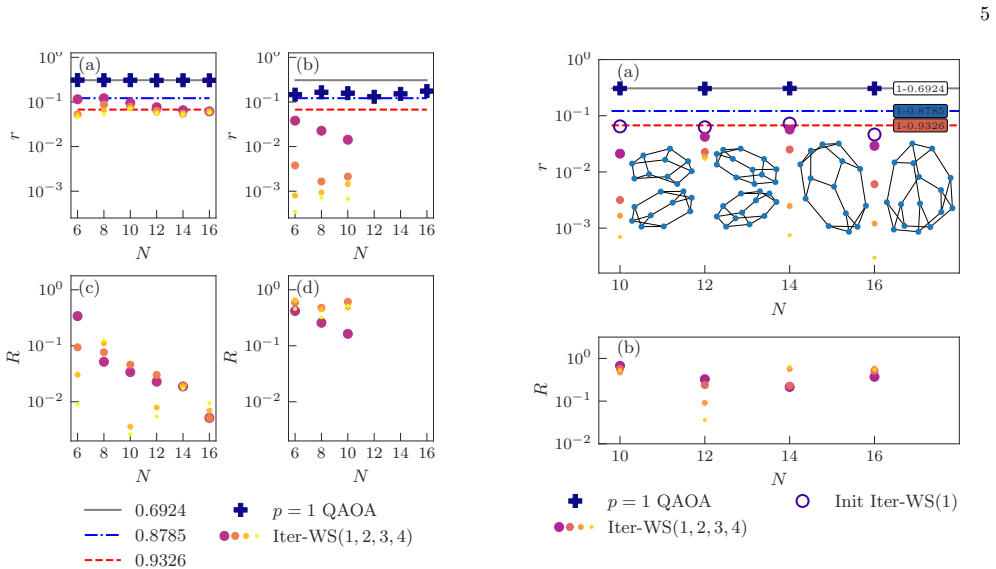
Take a family of 3-regular graphs built entirely from the g6 subgraph, run p = 1 QAOA with a 20th-order statistic warm start, and record $r$ and $R$ after four iterations. The paper's claimed worst-case behaviour predicts $r$ falls below $1 - 0.6924$ and moves toward $1 - 0.9326$; if for some $N \ge 12$ the measured $r$ plateaus above $0.3076$ or $R$ turns negative, the central claim is contradicted. A more direct check is to estimate the thermality coefficient $\epsilon_{wK}$ from the measured output distributions: if it does not grow with $K$, the Appendix A mechanism is absent.
Extended reading notes
Core claim
The central claim is that a measurement-derived superposition warm start escapes the stuck bound that holds for single-string warm starts. After each QAOA optimisation the measured bitstrings are sorted by cost, the top $t$ are superposed with probabilities renormalised, and that state is used as the next initial state. Over iterations the approximation error $r$ keeps falling and the relative change ratio $R$ remains positive on simulated 3-regular MaxCut instances, with the worst case reported to approach $1 - 0.9326$; on DGMVP the fitted exponent $b$ in $\bar{P}_{gm} = a\,P_c(n,l)^b$ becomes substantially closer to zero than for standalone QAOA or classical constrained sampling, meaning fewer samples are needed to hit the global minimum.
Load-bearing premise
The load-bearing premise is that each iteration actually expands the accessible search space, modelled by an exponential growth $d_K = d_0 e^{\lambda K}$ and a linearly growing thermality coefficient $\epsilon_{wK} = \epsilon_{w0} + D K$; if these growth laws fail on larger or adversarial instances, the theoretical reason the iterative method escapes the stuck bound collapses, even though the reported simulations could still be correct.
Editorial extensions
If this is right
- A warm start can be built entirely from measurement outcomes, so no external classical solver or SDP relaxation is needed to initialise QAOA.
- The single-shot improvement bound $O(1/\sqrt{m})$ is replaced by a compounding $O(K/\sqrt{m})$ bound over $K$ iterations, so the stuck issue is not merely mitigated but escaped.
- The same initial-state construction transfers to constrained problems such as DGMVP without changing the QAOA ansatz, improving both mean and minimum-value approximation ratios.
- Fitted scaling exponents in Fig. 9 imply the iterative method asymptotically needs fewer samples than classical constrained sampling to find the global minimum of DGMVP instances.
- Because the update rule depends only on measured costs, the procedure can be applied to any variational quantum algorithm, not only QAOA.
Reading between the lines
- The theoretical escape from the stuck bound is argued through two growth laws, $\epsilon_{wK} = \epsilon_{w0} + D K$ and $d_K = d_0 e^{\lambda K}$, that the paper does not derive from the QAOA dynamics; a direct test would be to estimate these quantities from measured distributions on large instances.
- A useful control experiment would replace the QAOA with a classical sampler that also returns the top $t$ measured strings; if the classical loop shows the same improvement in $r$, then the advantage is due to post-selection rather than quantum coherence.
- If the reported $b$ exponents hold at larger $n$ and $l$, the method gives a concrete route to a sampling advantage for portfolio optimisation on near-term devices, but the plateau observed after four iterations suggests the classical optimiser, not the state preparation, may become the bottleneck.
Editorial analysis
A structured set of objections, weighed in public.
Referee Report
Summary. The paper proposes an iterative warm-started QAOA method in which, after each optimization run, the measured strings are sorted by cost and a 't-order statistic' superposition state is prepared from the best measurements and used as the initial state for the next run. The method is tested numerically on 3-regular MaxCut with standard QAOA and on the DGMVP portfolio-optimization model with a hard nearest-neighbour mixer. The authors report that the iterative scheme avoids the 'stuck issue' of single-string warm-started QAOA, that the MaxCut approximation error decreases across iterations, and that the probability of measuring the DGMVP global minimum scales more favourably than classical constrained sampling. Theoretical appendices attempt to explain the improvement by an energy-injection argument and a state-space-expansion argument.
Significance. If established, the iterative warm-started scheme would be a simple and potentially useful heuristic for improving QAOA beyond the single-string warm-start limitations identified in Ref. [1]. The MaxCut simulations on random and specially constructed 3-regular graphs are internally consistent and show a clear qualitative improvement on small instances; this is a genuine empirical contribution. However, the paper's broader claims are currently conditional: the DGMVP scaling advantage rests on a power-law fit whose reported exponents have an inconsistent sign, and the theoretical explanation in Appendices A and B relies on unproven growth assumptions rather than derivations. The paper does not provide code or data, so exact reproducibility of the numerical results is limited.
major comments (3)
- [§IV, Fig. 9 and surrounding text] The DGMVP scaling claim is not supported by the reported fits. The text fits \bar{P_gm} = a · Pc(n,l)^b and reports mostly negative b values, e.g. b = -1.36, -0.22, -0.21 for l-scaling at p=1 and b = -1.65, -0.78, -0.19 for n-scaling at p=1. Since Pc(n,l)=1/B(n,l) lies in (0,1) and decreases when l or n increases, a negative exponent makes \bar{P_gm} increase as the problem size grows, which is impossible for a probability and contradicts the intended 'more favourable scaling' conclusion. The later statement that positive b values for p=4 n-scaling are 'much better' confirms the sign inconsistency. This is a load-bearing issue because the abstract's scaling claim depends directly on these exponents; the authors need to clarify the sign convention, refit with a correct model, or remove the scaling claim.
- [Appendix A and Appendix B] The theoretical resolution of the 'stuck issue' is not derived. Equation (A5) assumes the thermality coefficient grows as ε_wK = ε_w0 + D K with an unspecified 'diffusion constant' D, and Eq. (B4) assumes the reachable state count expands as d_K = d_0 e^{λK} via an amplification process governed by unspecified factors g_k. No mechanism in Algorithm 1 is shown to imply D>0 or λ>0, and no bound on K is derived from the algorithm's parameters. The conclusion in Sec. V that establishing theoretical bounds is future work is consistent with this assessment. These appendices should be reframed as heuristic motivation or replaced by a genuine analysis, because the paper currently presents them as explaining the simulation results.
- [§IV, Figs. 2-4] The claim that the worst-case r 'converges toward' the best classical bound 1-0.9326 and even surpasses it is stronger than what the simulations establish. The data cover only N ≤ 16 and at most four iterations, and no statistical uncertainty or significance testing is reported for the r and R curves. The designed worst-case graphs are specific constructions containing only the g6 subgraph, so they do not establish a worst case for the iterative method itself. The wording should be revised to describe an observed trend on small instances rather than a convergent or benchmark-surpassing guarantee.
minor comments (5)
- [§II and §III] There are numerous typos and encoding artifacts that should be corrected: 'Hardamard' for Hadamard, 'approxiamtion' for approximation, 'Dual Anealing' for Dual Annealing, and 'ans¨atze' with broken encoding.
- [Eq. (5)] The definition of the percentile state is self-referential: p'_i is defined in terms of p'_i on the right-hand side. It should presumably read p_i or a normalized version of the measured counts.
- [Eq. (19) and surrounding text] The definition P = (N_total - N_static)/N_total is the fraction of states that are improved, but the text says 'N_static will increase cumulatively' and interprets low P positively; the naming and interpretation should be made consistent.
- [Fig. 9 caption and §IV] The simulation parameter 'M = 218' appears to be a typo for 2^18; please correct it and similarly check the notation for m and M throughout the figure captions.
- [§IV end] The sentence 'Thus, the scalings in Fig. 9 demonstrate demonstrate that...' contains a duplicated word and should be edited.
Circularity Check
MaxCut results are non-circular, but the theoretical escape-from-stuck argument assumes its conclusion in Appendices A-B and the DGMVP scaling advantage is a fitted exponent, making the abstract-level scaling claims partially circular.
-
other
[Appendix A, Eqs. (A5)-(A6)]
"If we denote the thermality coefficient after K iterations as εwK , its iterative growth can be approximated by: εwK = εw0 + DK, where D is a diffusion constant characterizing the perturbation per iteration. Since the improvement bound depends on εw, this leads to an overall improvement scaling as: CK − C0 = O(K/√m)."
The escape from the Ref. [1] stuck bound is not derived; it is assumed. The linear growth εwK = εw0 + DK is exactly the statement that each iteration injects enough energy to keep improving, and D is never computed from the QAOA dynamics or measurement statistics. The conclusion C_K − C_0 = O(K/√m)—and hence 'the improvement fully lifts the bound'—is the assumed growth restated in new notation. No equation in Appendix A connects D to the algorithm's parameters, so the bound-lifting result is an input, not a consequence.
-
other
[Appendix B, Eqs. (B2)-(B4)]
"Approximating this as a continuous growth process leads to: dD/dk = λDk, which solves to an exponential expansion: DK = D0eλK. Since the original compression bound predicts an exponential suppression D1 ≤ D0e−an, iterative QAOA counteracts this effect if λK ≥ an, breaking the original bound."
The reachable-state expansion dK = d0 e^{λK} is posited via an undefined amplification factor g_k and growth rate λ; the condition λK ≥ an is then simply stated as 'if'. The appendix concludes that iterative QAOA 'systematically overcomes' the compression argument, but the overcoming is exactly the assumed exponential growth. Without any derivation of λ or g_k from the algorithm, the bound-breaking result is equivalent to the assumption used to produce it.
1 more flagged steps
-
fitted input called prediction
[Section IV, Fig. 9]
"We fit the mean of Pgm using the function ¯Pgm = a · Pc(n, l)b, where the inverse ratio of the exponents, −1/b, reflects a power-law scaling relative to the classical constrained sampler. For l-scaling, we find b = −1.36 ± 0.00 for p = 1 QAOA standalone optimisation, b = −0.22 ± 0.00 after the first iteration ... These results indicate that our quantum algorithm achieves a more favourable power-law scaling with l compared to the constrained classical sampling method."
The claimed 'more favourable scaling' is not a prediction: it is the exponent b fitted to the same Pgm data in Fig. 9. The conclusion is therefore a curve-fit summary restated as evidence of advantage. The interpretation also inverts the probability constraint: with Pc in (0,1), a negative b gives Pgm = a / Pc^{|b|}, which would grow without bound as n or l increases, so the fitted model cannot support the asymptotic sample-complexity claim it is used to make. The scaling advantage is thus built from the fit's functional form rather than tested independently.
full rationale
The MaxCut demonstration is genuinely non-circular: r, R and P are computed from simulations against brute-forced cmax, and the observed movement toward 1−0.9326 is an empirical outcome, not a fitted target. I found no load-bearing self-citation: [8] supplies the DGMVP ansatz and comparison numbers, [24] supplies circuit primitives, but neither is used to force the paper's conclusions. The circularity is concentrated in two places. First, the theoretical argument that iteration escapes the [1] bound assumes the desired growth (linear εwK in Appendix A; exponential dK in Appendix B) without deriving the constants, so the 'bound is lifted' conclusion is the assumption restated. Second, the DGMVP scaling advantage is the fitted exponent b in Pgm = a Pc^b, so the asymptotic advantage claim is a curve-fit extrapolation rather than a falsifiable prediction; the reported negative b values even imply Pgm increases as problem size grows, which the fits cannot physically support. These make the abstract-level scaling and theoretical claims partially circular, while the MaxCut numerics stand independently.
Assumptions & free parameters
free parameters (5)
- Diffusion constant D (Appendix A)
- Amplification factors g_k (Appendix B)
- Statistic order t =
20 for MaxCut, 5 for DGMVP Fig. 9
- Power-law fit parameters a, b for P_gm = a * Pc^b =
b ranges from -1.36 to 0.03; a not reported
- Simulation hyperparameters (shots m, M, optimiser budget I, iterations K) =
MaxCut: m=8000, M=8000, I=5000; DGMVP: m=16, M=2^18, I=2000; K up to 4
assumptions (5)
- domain assumption Measurement frequencies from the optimised QAOA state can be used to construct a pure superposition state with amplitudes sqrt(p_k/m).
- domain assumption The Permutation Grover-Rudolph method of Ref. [23] prepares the t-order statistic state on N+1 qubits with complexity O(tN).
- ad hoc to paper The thermodynamic bound from Ref. [1] applies only to single-shot QAOA and can be iteratively counteracted by an energy-injection feedback process.
- ad hoc to paper The reachable state space expands exponentially under iteration as dK = d0 e^(lambda K), counteracting the compression bound of Ref. [1].
- domain assumption The nearest-neighbour hard mixing operator (Eq. 12) exactly restricts the search space to the feasible DGMVP set.
invented entities (1)
-
Non-Markovian feedback / energy injection process
Cite this review
Pith. "Pith review of Iterative quantum optimisation with a warm-started quantum state." pith.science (2026). https://pith.science/paper/GR35JCC5
@misc{pith2026250209704,
  author       = {Pith},
  title        = {Pith review of: Iterative quantum optimisation with a warm-started quantum state},
  year         = {2026},
  howpublished = {\url{https://pith.science/paper/GR35JCC5}},
  note         = {Machine review of arXiv:2502.09704}
}
abstract
We provide a method to prepare a warm-started quantum state from measurements with an iterative framework to enhance the quantum approximate optimisation algorithm (QAOA). The numerical simulations show the method can effectively address the "stuck issue" of the standard QAOA using a single-string warm-started initial state described in [Cain et al., 2023]. When applied to the $3$-regular MaxCut problem, our approach achieves an improved approximation ratio, with a lower bound that iteratively converges toward the best classical algorithms for $p=1$ standard QAOA. Additionally, in the context of the discrete global minimal variance portfolio (DGMVP) model, simulations reveal a more favourable scaling of identifying the global minimal compared to the QAOA standalone, the single-string warm-started QAOA and a classical constrained sampling approach.
Figures


Figures from the paper (5 more)


Forward citations
Cited by 2 Pith papers
-
Constrained Quantum Optimization via Iterative Warm-Start XY-Mixers
A warm-started XY-mixer aligned to a biased W-state, iterated via sample-based probability updates, raises optimal-solution sampling rates for one-hot constrained QAOA and finds optima on 144-qubit hardware with post-...
-
Quantum Approximate Optimization via Noise-Directed Adaptive Warm-Starting
Bitflip-gauge warm-start QAOA that aligns the ansatz with amplitude-damping noise improves 100-qubit Ising approximation ratios over non-gauge iterative warm-start at no extra circuit cost.
Reference graph
Works this paper leans on
-
[1]
The qaoa gets stuck starting from a good classical string, 2023
Madelyn Cain, Edward Farhi, Sam Gutmann, Daniel Ra- nard, and Eugene Tang. The qaoa gets stuck starting from a good classical string, 2023
work page 2023
-
[2]
Bardin, Rami Barends, Sergio Boixo, Michael Broughton, Bob B
Google AI Quantum, Collaborators* †, Frank Arute, Kunal Arya, Ryan Babbush, Dave Bacon, Joseph C. Bardin, Rami Barends, Sergio Boixo, Michael Broughton, Bob B. Buckley, David A. Buell, Brian Burkett, Nicholas Bushnell, Yu Chen, Zijun Chen, Benjamin Chiaro, Roberto Collins, William Courtney, Sean Demura, An- drew Dunsworth, Edward Farhi, Austin Fowler, Bro...
work page 2020
-
[3]
Harper R. Grimsley, George S. Barron, Edwin Barnes, Sophia E. Economou, and Nicholas J. Mayhall. Adaptive, problem-tailored variational quantum eigensolver miti- gates rough parameter landscapes and barren plateaus. npj Quantum Information, 9(1):19, March 2023
work page 2023
-
[4]
A quantum approximate optimization algorithm, Novem- ber 2014
Edward Farhi, Jeffrey Goldstone, and Sam Gutmann. A quantum approximate optimization algorithm, Novem- ber 2014
work page 2014
-
[5]
The quantum alternating operator ansatz on maximum k-vertex cover
Jeremy Cook, Stephan Eidenbenz, and Andreas B¨ artschi. The quantum alternating operator ansatz on maximum k-vertex cover. In 2020 IEEE International Conference on Quantum Computing and Engineering (QCE), pages 83–92. IEEE, 2020
work page 2020
-
[6]
Egger, Jakub Marecek, and Stefan Woerner
Daniel J. Egger, Jakub Marecek, and Stefan Woerner. Warm-starting quantum optimization. Quantum, 5:479, June 2021
work page 2021
-
[7]
Reuben Tate, Jai Moondra, Bryan Gard, Greg Mohler, and Swati Gupta. Warm-started QAOA with Custom Mixers Provably Converges and Computationally Beats Goemans-Williamson’s Max-Cut at Low Circuit Depths. Quantum, 7:1121, September 2023
work page 2023
-
[8]
Haomu Yuan, Christopher K. Long, Hugo V. Lepage, and Crispin H. W. Barnes. Quantifying the advantages of applying quantum approximate algorithms to portfolio optimisation, 2024
work page 2024
Show all 29 references
-
[9]
Alignment between initial state and mixer im- proves qaoa performance for constrained optimization
Zichang He, Ruslan Shaydulin, Shouvanik Chakrabarti, Dylan Herman, Changhao Li, Yue Sun, and Marco Pis- toia. Alignment between initial state and mixer im- proves qaoa performance for constrained optimization. npj Quantum Information, 9(1), November 2023
2023
-
[10]
Zhihui Wang, Stuart Hadfield, Zhang Jiang, and Eleanor G. Rieffel. Quantum approximate optimization algorithm for maxcut: A fermionic view. Phys. Rev. A, 97:022304, Feb 2018
2018
-
[11]
Dreiling, John P
Ruslan Shaydulin, Changhao Li, Shouvanik Chakrabarti, Matthew DeCross, Dylan Herman, Niraj Kumar, Jeffrey Larson, Danylo Lykov, Pierre Minssen, Yue Sun, Yuri Alexeev, Joan M. Dreiling, John P. Gaebler, Thomas M. Gatterman, Justin A. Gerber, Kevin Gilmore, Dan Gresh, Nathan Hew...
2024
-
[12]
The quantum approximate optimization algorithm needs to see the whole graph: Worst case examples, 2020
Edward Farhi, David Gamarnik, and Sam Gutmann. The quantum approximate optimization algorithm needs to see the whole graph: Worst case examples, 2020
2020
-
[13]
Maxcut quantum ap- proximate optimization algorithm performance guaran- tees for p >1
Jonathan Wurtz and Peter Love. Maxcut quantum ap- proximate optimization algorithm performance guaran- tees for p >1. Phys. Rev. A, 103:042612, Apr 2021
2021
-
[14]
Akshay, H
V. Akshay, H. Philathong, I. Zacharov, and J. Biamonte. Reachability Deficits in Quantum Approximate Opti- mization of Graph Problems. Quantum, 5:532, August 2021
2021
-
[15]
Evaluation of qaoa based on the approximation ratio of individual samples
Jason Larkin, Mat ´ ıas Jonsson, Daniel Justice, and Gian Giacomo Guerreschi. Evaluation of qaoa based on the approximation ratio of individual samples. Quantum Science and Technology, 7(4):045014, aug 2022
2022
-
[16]
Theoretical ap- proximation ratios for warm-started qaoa on 3-regular max-cut instances at depth p = 1, 2024
Reuben Tate and Stephan Eidenbenz. Theoretical ap- proximation ratios for warm-started qaoa on 3-regular max-cut instances at depth p = 1, 2024
2024
-
[17]
Goemans and David P
Michel X. Goemans and David P. Williamson. Improved approximation algorithms for maximum cut and satis- fiability problems using semidefinite programming. J. ACM, 42(6):1115–1145, November 1995
1995
-
[18]
Max cut in cubic graphs
Eran Halperin, Dror Livnat, and Uri Zwick. Max cut in cubic graphs. Journal of Algorithms, 53(2):169–185, 2004
2004
-
[19]
Portfolio rebalancing experiments using the quantum alternating operator ansatz, Novem- ber 2019
Mark Hodson, Brendan Ruck, Hugh Ong, David Garvin, and Stefan Dulman. Portfolio rebalancing experiments using the quantum alternating operator ansatz, Novem- ber 2019
2019
-
[20]
Bench- marking the performance of portfolio optimization with QAOA
Sebastian Brandhofer, Daniel Braun, Vanessa Dehn, Ger- hard Hellstern, Matthias H¨ uls, Yanjun Ji, Ilia Polian, Amandeep Singh Bhatia, and Thomas Wellens. Bench- marking the performance of portfolio optimization with QAOA. Quantum Information Processing, 22(1):25, De- cember 2022
2022
-
[21]
A survey of quantum computing for finance, January 2022
Dylan Herman, Cody Googin, Xiaoyuan Liu, Alexey Galda, Ilya Safro, Yue Sun, Marco Pistoia, and Yuri Alexeev. A survey of quantum computing for finance, January 2022
2022
-
[22]
Quasi-binary encoding based quantum alternat- ing operator ansatz, January 2024
Bingren Chen, Hanqing Wu, Haomu Yuan, Lei Wu, and Xin Li. Quasi-binary encoding based quantum alternat- ing operator ansatz, January 2024
2024
-
[23]
Lefterovici, and Anto- nio F
Debora Ramacciotti, Andreea I. Lefterovici, and Anto- nio F. Rotundo. Simple quantum algorithm to efficiently prepare sparse states. Phys. Rev. A, 110:032609, Sep 2024
2024
-
[24]
Yordanov, David R
Yordan S. Yordanov, David R. M. Arvidsson-Shukur, and Crispin H. W. Barnes. Efficient quantum circuits for quantum computational chemistry. Phys. Rev. A, 102:062612, Dec 2020
2020
-
[25]
Jordan and E
P. Jordan and E. Wigner. ¨Uber das paulische ¨Aquivalenzverbot. Zeitschrift f¨ ur Physik, 47(9–10):631– 651, September 1928
1928
-
[26]
Rieffel, Davide Venturelli, and Rupak Biswas
Stuart Hadfield, Zhihui Wang, Bryan O’Gorman, Eleanor G. Rieffel, Davide Venturelli, and Rupak Biswas. From the quantum approximate optimization algorithm to a quantum alternating operator ansatz. Algorithms, 12(2), 2019
2019
-
[27]
Leo Zhou, Sheng-Tao Wang, Soonwon Choi, Hannes Pichler, and Mikhail D. Lukin. Quantum approximate optimization algorithm: Performance, mechanism, and implementation on near-term devices. Phys. Rev. X, 10:021067, Jun 2020
2020
-
[28]
Harrigan, Kevin J
Matthew P. Harrigan, Kevin J. Sung, Matthew Neeley, Kevin J. Satzinger, Frank Arute, Kunal Arya, Juan Ata- laya, Joseph C. Bardin, Rami Barends, Sergio Boixo, Michael Broughton, Bob B. Buckley, David A. Buell, Brian Burkett, Nicholas Bushnell, Yu Chen, Zijun Chen, Ben Chiaro, ...
2021
-
[29]
The max-cut problem on graphs not contractible to k5
Francisco Barahona. The max-cut problem on graphs not contractible to k5. Operations Research Letters, 2(3):107–111, 1983. Appendix A: Energy injection for the thermodynamic Argument The original thermodynamic argument presented in [1] suggests that warm-started QAOA remains s...
1983
Reviewed August 7, 2026 · model on record in the stance chip above.
Discussion (0). Continue with ORCID to comment.