REVIEW 4 major objections 7 minor 92 references
Fading ergodicity meets maximal chaos
T0 review · 4 major / 7 minor · reviewed 2026-08-07 · deepseek-v4-flash
Pith's one-line read In the quantum sun model, the fidelity susceptibility peaks exactly at the ergodicity-breaking critical point and grows as the square of the density of states, the signature of maximal chaos.
desk verdict Solid numerical evidence that fidelity susceptibility peaks at the ergodicity-breaking critical point and mobility edge in the quantum sun model, but the central comparison is anchored to an imported αc from the same group's preprint. read the letter →
The pith
A machine-rendered reading of the paper's core claim, the machinery that carries it, and where it could break.
The reading
What carries the argument
The central object is the fidelity susceptibility χ_n = Σ_{m≠n} |V_nm|² / (E_m − E_n)², a measure of eigenstate sensitivity to perturbations; when averaged with the AGP regularization µ ∝ ω_H it becomes the norm of the adiabatic gauge potential. The argument runs through the fading ergodicity ansatz |V_nm|² ∝ $ρ^{{−2/η}}$ with fluctuation exponent η, which combined with µ = ω_H ∝ $ρ^{{−1}}$ yields χ_fading ∝ $ρ^{{2−2/η}}$. At the ETH limit η = 2 this gives χ ∝ ρ; as η → ∞ at the critical point it reaches χ ∝ ρ², the maximal-chaos scaling. The analytical form η(α) = 2(1 − ln α / ln αc)^{−1} and its energy-dependent generalization η(α, ε) are then tested against numerics.
What would settle it
At system sizes L = 14, 15, 16 in the quantum sun model, compute χ_typ(ε) versus α at a fixed energy density ε = 0.3 with the same µ = ω_H regularization, and fit a fifth-order polynomial to locate the peak. Maximal chaos predicts the peak heights for all L fall on the line 0.05 ρ(ε)² with a spread comparable to the L ≤ 13 data, and the extrapolated peak position α_max(ε) approaches α_c(ε) = 0.734 exp[(a²(ε−1/2)²)/(4b²)] with a = 1.05, b = 0.45 to within the 1/L trend. Any systematic bending of χ_max versus ρ², or a peak position that misses α_c(ε) beyond the finite-size drift, would falsify the maximal-chaos claim.
Extended reading notes
Core claim
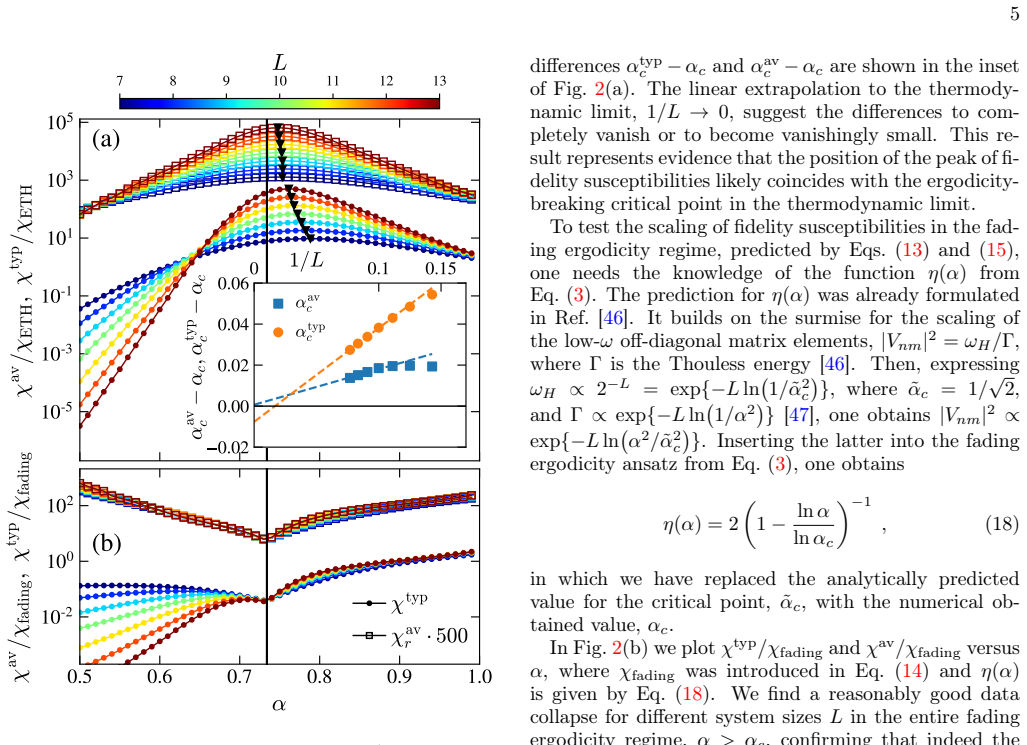
The central claim is that the breakdown of the conventional ETH at the interaction-driven ergodicity-breaking critical point of the quantum sun model produces a fidelity susceptibility whose peak coincides with the critical point and whose maximal value scales as χ ∝ ρ², saturating the upper bound (dubbed 'maximal chaos'). For the operator of the most distant spin, the typical susceptibility χ_typ and the regularized AGP norm χ_av both peak at values that extrapolate linearly in 1/L to αc = 0.734, the critical point obtained from entanglement-entropy data collapse. Away from mid-spectrum, the peak position α_max(ε) follows the many-body mobility edge αc(ε) from the analytical formula, and the peak height collapses as χ_typ_max(ε) ∝ ρ(ε)². The paper also extracts the fluctuation exponent η(α, ε) and finds its divergence tracks the mobility edge, showing fading ergodicity holds away from the middle of the spectrum.
Load-bearing premise
The key premise is that the thermodynamic critical point of the model is αc = 0.734, a value imported from a data collapse of single-site entanglement entropy in a companion preprint; the peak-position agreement is only as strong as that imported number and the linear-in-1/L extrapolations.
Editorial extensions
If this is right
- If correct, the peak of the typical or regularized-average fidelity susceptibility—not just spectral statistics—pinpoints the ergodicity-breaking critical point in the quantum sun model, with the agreement improving linearly in 1/L.
- At the critical point the susceptibility reaches its maximal possible scaling, χ ∝ ρ²; the same maximal scaling χ_typ_max ∝ ρ(ε)² holds at every energy density, so the mobility edge is itself a locus of maximal chaos.
- The fading ergodicity formula χ_fading ∝ ρ^{2−2/η} collapses data across the whole ergodic phase for transition-sensitive operators, and the divergence of η(α, ε) tracks the analytical mobility edge throughout the spectrum.
- Operators insensitive to the transition keep the ETH exponent ζ = 1 across the phase diagram, showing the effect requires a perturbation that couples to the ergodicity-breaking degrees of freedom.
Reading between the lines
- A natural, testable extension is to apply the same analysis to disordered spin chains with a well-characterized many-body localization transition: if the χ ∝ ρ² scaling is universal, fidelity susceptibility could replace level statistics as the primary finite-size probe of the transition.
- The fidelity susceptibility of a distant boundary spin can be read as the system's response to locally coupling the dot, suggesting a quantitative link between maximal chaos and the avalanche picture of ergodicity breaking.
- The asymmetry between χ_av (scale-invariant on both sides) and χ_typ (only on the ergodic side) hints at a distinction between mean and typical eigenstate sensitivity; explaining why typical sensitivity fails to collapse on the nonergodic side may require modeling rare resonant spots.
- If the heuristic exponent ν ≈ 1.3 needed to match the energy-resolved η(α, ε) is more than a fitting artifact, it would constitute a new universal exponent for the many-body mobility edge; checking its constancy across quantum sun variants would settle this.
Editorial analysis
A structured set of objections, weighed in public.
Referee Report
Summary. The paper studies the quantum sun model and reports that the fidelity susceptibility of excited eigenstates exhibits a peak at the interaction strength corresponding to the ergodicity-breaking critical point, and, at fixed energy away from mid-spectrum, at the many-body mobility edge. The authors interpret this within the 'fading ergodicity' framework, where the fluctuation exponent η(α) interpolates between the ETH value η=2 and η→∞ at the critical point. Their central quantitative claims are: (i) the peak positions α_c^typ and α_c^av extrapolate linearly in 1/L to the imported critical point α_c=0.734 (Fig. 2 and inset); (ii) the peak height scales as χ ∝ ρ^2, termed 'maximal chaos' (Figs. 3 and 6); and (iii) the same picture holds for energy-dependent mobility edges, with χ_typ^max(ϵ) ∝ ρ(ϵ)^2 and η(α,ϵ) diverging along the mobility edge (Figs. 4–7). The theoretical anchor is Eq. (14), χ_fading ∝ ρ^{2−2/η}, combined with η(α) from Eq. (18), and its energy-dependent generalization Eq. (22). The numerical tests use exact diagonalization up to L_tot=16, with multiple observables and with a non-ETH-sensitive operator as a control.
Significance. If the claims hold, the paper establishes fidelity susceptibility and adiabatic gauge potential norms as sharp, quantitative probes of ergodicity-breaking transitions and many-body mobility edges, and connects the fading ergodicity scenario to a specific 'maximal chaos' scaling. The work is numerically careful in several respects: it tests three different perturbation operators (Fig. 3), it provides a closed-form prediction Eq. (14) that collapes data in Fig. 2(b), and it extends the analysis to nonzero energy densities with a convincing ρ(ϵ)^2 scaling in Fig. 6. The mobility-edge heat map of η in Fig. 7(a) is visually compelling. However, the significance is conditional on the imported critical point α_c=0.734 and on the parameterization of η(α) and η(α,ϵ): the theoretical curves are not fully parameter-free, and the average-fidelity-susceptibility peak position is regulator dependent. These issues do not by themselves invalidate the main observation, but they need to be addressed for the quantitative claims to be fully convincing.
major comments (4)
- [Sec. IIA and Sec. IIIA (Figs. 2 and 5)] The central coincidence of the fidelity-susceptibility peak with the critical point is tested against α_c=0.734, which is imported from a same-group preprint (Ref. [80]) and not derived or independently verified in this manuscript. The extrapolations of α_c^typ−α_c and α_c^av−α_c in the inset of Fig. 2(a) and of α_max(ϵ)−α_c(ϵ) in Fig. 5 are linear in 1/L over L=9–13 with no reported uncertainty, so they cannot distinguish a zero difference from a small nonzero shift. Since Eq. (18) and Eq. (B1) also use this α_c, every quantitative comparison is anchored to the same value. I request that the authors either (a) provide an independent determination of α_c within this paper (e.g., from level statistics or entanglement entropy with error bars), or (b) perform a robustness analysis that treats α_c as a free parameter (e.g., over the range 0.72–0.75) and shows that the peak-coincidence and scaling conclusions are unchanged. Without this, the statement that the peak 'coincides' with the critical point is only as strong as the imported value.
- [Appendix A (Fig. 9)] The position of the peak of the average fidelity susceptibility χ_av depends on the regularization cutoff μ. Figure 9 shows that for μ>ω_H the peak approaches α_c from the right and for μ<ω_H from the left, and only the choice μ∝ω_H gives a peak near α_c with the weakest L-dependence. Consequently, the claim that 'the' fidelity susceptibility peaks at the critical point is not regulator independent for the χ_av branch; only χ_typ provides such a statement. The abstract and introduction should be phrased accordingly, and the analysis should either focus on χ_typ as the primary quantity or provide a principled criterion for μ∝ω_H beyond the observed weakest L-dependence.
- [Eqs. (18) and (22), Figs. 2(b), 3, and 7(b)] The 'prediction' curves for χ_fading and ζ_fading are not parameter-free: Eq. (18) is obtained by replacing the analytically predicted ᾱ_c=1/√2 with the numerically imported α_c=0.734, and Eq. (22) is further modified by a heuristic rescaling η(α,ϵ)→η(α,ϵ)^ν with fitted prefactor A∈(0.95,1.25) and ν≈1.3. As a result, the good data collapse in Fig. 2(b) and the agreement in Fig. 3 partly reflect that the same α_c is used both to locate the peak and to define the theoretical curve. I ask the authors to state explicitly which parameters are fitted and to show the comparison with α_c treated as an unknown (e.g., by plotting χ/χ_fading for several α_c values) or by deriving ν from a microscopic argument. The current presentation overstates the predictive content of the fading ergodicity ansatz.
- [Sec. IIIB and Appendix C (Eqs. (21)–(22), Figs. 7 and 12)] The energy-dependent generalization assumes that energy dependence enters only through ω_H(ϵ) and not through Γ(ϵ), as stated in Sec. IIIB. Moreover, the extraction of Γ in Appendix C relies on Lorentzian fits that deviate significantly from the coarse-grained matrix elements for ϵ≪0.5 (Fig. 12(a)–(c)), and the integrated-spectral-function method Γ_2 is used instead. Given these ambiguities, the claim that fading ergodicity 'accurately describes' the ETH breakdown at the mobility edge is supported mainly by the rescaled fit η(α,ϵ)^ν rather than by the a priori expression Eq. (22). The authors should quantify the fit quality (e.g., residuals or confidence intervals for ν and A) and show that the qualitative conclusions do not depend on the heuristic rescaling.
minor comments (7)
- [Abstract and Sec. I] The phrase 'gives rise to to the maximally divergent fidelity susceptibility' contains a duplicated 'to' that appears both in the abstract and in the introduction.
- [Fig. 4 caption and inset] The inset caption reads 'Inset of Fig. 4(b)' but there is only one panel in Fig. 4; this should be 'Inset of Fig. 4'.
- [Sec. II.B and Sec. III.A] The text says μ is set proportional to ω_H, while Sec. III.A reports the specific choice μ=√L_tot/D. The connection between this expression and ω_H for the 50% spectral window is only explained in Appendix A; it should be stated at the point of use.
- [Fig. 2(b) legend] The legend entry 'r · 500' is unexplained; it presumably denotes a scaled quantity or a typo, and should be clarified.
- [Sec. II.B (definition of maximal chaos)] The term 'maximal chaos' is used to describe χ ∝ ρ^2, but the formal upper bound that this saturates is not defined precisely. I suggest stating explicitly that χ_fading ≤ C ρ^2 with a constant C, so that 'maximal' is meaningful.
- [Appendix A (numerical details)] The determination of peak positions via fifth-order polynomial fits is mentioned repeatedly, but no details are given about the α-grid spacing, the number of fit points, or the statistical uncertainty of the fitted peak positions; adding this information would strengthen the extrapolations.
- [References] Reference [45] is an arXiv preprint (Lim et al.); if a published version now exists, it should be cited instead.
Circularity Check
No significant circularity: the central comparisons are anchored to an independent observable (entanglement entropy data collapse), and the calibrated η(α) is tested rather than fitted to the target data.
full rationale
The paper's central claims are that the fidelity susceptibility peak coincides with the ergodicity-breaking critical point and that the peak height scales as ρ^2. The critical point αc = 0.734 is imported from Ref. [80], a same-group preprint, but it was obtained from a data collapse of single-site entanglement entropy, an observable not used in the present fidelity susceptibility calculations. This is an independent anchor, not a fitted parameter of the present paper. Equation (18) explicitly replaces the analytic ᾱc with the numerical αc, but this calibration does not make the subsequent tests circular: the numerical χtyp and χav are computed directly from eigenstates via Eqs. (5)–(9), and the extracted exponents ζ in Fig. 3 and peak heights in Fig. 6 could have disagreed with Eqs. (14), (15), and (18). The mobility edge comparison likewise uses Eq. (B1) from Ref. [51], whose constants a and b are determined from bandwidth scaling, independent of the fidelity susceptibility data. No equation in the paper reduces by construction to its own input. The self-citations to Refs. [46], [51], and [80] are load-bearing, but they are backed by numerical evidence on separate observables, so they constitute real evidence rather than circularity. The acknowledged limitations—possible systematic bias in the imported αc, linear 1/L extrapolations with no error bars, and the µ-regularization sensitivity in Appendix A—are external-validity concerns, not circularity. The derivation chain is therefore self-contained with respect to its own target quantities: the predictions are tested against data that were not used to fit the predicted exponent or peak position.
Assumptions & free parameters
free parameters (5)
- αc = 0.734 =
0.734
- a =
1.05
- b =
0.45
- ν (and prefactor A) =
ν ≈ 1.3, A ∈ (0.95,1.25)
- µ =
√Ltot/D
assumptions (5)
- domain assumption Fading ergodicity ansatz for off-diagonal matrix elements: |Vnm|² ∝ ρ^{-2/η}
- domain assumption Surmise |Vnm|² = ωH/Γ with Γ ∝ exp{-L ln(1/α²)}
- domain assumption The mobility edge formula αc(ϵ) = αc exp(a²(ϵ-1/2)²/(4b²))
- domain assumption The integral in Eq. (10) is dominated by ω = µ, with µ ∝ ωH
- ad hoc to paper Energy dependence enters only through ωH(ϵ), not Γ(ϵ)
Cite this review
Pith. "Pith review of Fading ergodicity meets maximal chaos." pith.science (2026). https://pith.science/paper/O4LXXUMU
@misc{pith2026250209711,
  author       = {Pith},
  title        = {Pith review of: Fading ergodicity meets maximal chaos},
  year         = {2026},
  howpublished = {\url{https://pith.science/paper/O4LXXUMU}},
  note         = {Machine review of arXiv:2502.09711}
}
read the original abstract
Fading ergodicity provides a theoretical framework for understanding deviations from the eigenstate thermalization hypothesis (ETH) near ergodicity-breaking transitions. In this work, we demonstrate that the breakdown of the ETH at the interaction-driven ergodicity-breaking critical point in the quantum sun model gives rise to to the maximally divergent fidelity susceptibility. We further extend our analysis to the energy-driven ergodicity-breaking transition associated with the many-body mobility edge. Specifically, we show that fidelity susceptibilities at energies away from the middle of the spectrum exhibit a divergent peak near the mobility edge. Finally, we argue that fading ergodicity provides a simple and accurate description of the ETH breakdown in the quantum sun model, which is accompanied with the emergence of a peak in fidelity susceptibility and the onset of maximal chaos at the ergodicity-breaking critical point.
Figures


Figures from the paper (8 more)


Reference graph
Works this paper leans on
-
[80]
R. Świętek, M. Hopjan, C. Vanoni, A. Scardicchio, and L. Vidmar, Scaling theory of fading ergodicity, arXiv:2412.15331
-
[1]
D’Alessio, Y
L. D’Alessio, Y. Kafri, A. Polkovnikov, and M. Rigol, From quantum chaos and eigenstate thermalization to statistical mechanics and thermodynamics, Adv. Phys. 65, 239 (2016)
2016
-
[2]
T. Mori, T. N. Ikeda, E. Kaminishi, and M. Ueda, Ther- malization and prethermalization in isolated quantum systems: a theoretical overview, J. Phys. B51, 112001 (2018)
2018
-
[3]
Sierant, M
P. Sierant, M. Lewenstein, A. Scardicchio, L. Vidmar, and J. Zakrzewski, Many-body localization in the age of classical computing, Rep. Prog. Phys.88, 026502 (2025)
2025
-
[4]
Bohigas, M
O. Bohigas, M. J. Giannoni, and C. Schmit, Character- ization of chaotic quantum spectra and universality of level fluctuation laws, Phys. Rev. Lett.52, 1 (1984)
1984
-
[5]
Casati, F
G. Casati, F. Valz-Gris, and I. Guarnieri, On the connec- tion between quantization of nonintegrable systems and statistical theory of spectra, Lettere al Nuovo Cimento 28, 279 (1980)
1980
-
[6]
Montambaux, D
G. Montambaux, D. Poilblanc, J. Bellissard, and C. Sire, Quantum chaos in spin-fermion models, Phys. Rev. Lett. 70, 497 (1993)
1993
-
[7]
T. C. Hsu and J. C. Angle‘s d’Auriac, Level repulsion in integrable and almost-integrable quantum spin models, Phys. Rev. B47, 14291 (1993)
1993
Show all 92 references
-
[8]
Di Stasio and X
M. Di Stasio and X. Zotos, Connection between Low En- ergy Effective Hamiltonians and Energy Level Statistics, Phys. Rev. Lett.74, 2050 (1995)
1995
-
[9]
Prosen, Ergodic properties of a generic nonintegrable quantum many-body system in the thermodynamic limit, Phys
T. Prosen, Ergodic properties of a generic nonintegrable quantum many-body system in the thermodynamic limit, Phys. Rev. E60, 3949 (1999)
1999
-
[10]
L. F. Santos, Integrability of a disordered Heisenberg spin-1/2 chain, J. Phys. A.37, 4723 (2004)
2004
-
[11]
D. A. Rabson, B. N. Narozhny, and A. J. Millis, Crossover from Poisson to Wigner-Dyson level statistics in spin chains with integrability breaking, Phys. Rev. B 69, 054403 (2004)
2004
-
[12]
Rigol and L
M. Rigol and L. F. Santos, Quantum chaos and ther- malization in gapped systems, Phys. Rev. A82, 011604 (2010)
2010
-
[13]
J. M. Deutsch, Quantum statistical mechanics in a closed system, Phys. Rev. A43, 2046 (1991)
1991
-
[14]
Srednicki, Chaos and quantum thermalization, Phys
M. Srednicki, Chaos and quantum thermalization, Phys. Rev. E 50, 888 (1994)
1994
-
[15]
Srednicki, The approach to thermal equilibrium in quantized chaotic systems, J
M. Srednicki, The approach to thermal equilibrium in quantized chaotic systems, J. Phys. A.32, 1163 (1999)
1999
-
[16]
Rigol, V
M. Rigol, V. Dunjko, and M. Olshanii, Thermalization and its mechanism for generic isolated quantum systems, Nature (London) 452, 854 (2008)
2008
-
[17]
Sachdev, Quantum Phase Transitions (Cambridge University Press, New York, 2011)
S. Sachdev, Quantum Phase Transitions (Cambridge University Press, New York, 2011)
2011
-
[18]
H. T. Quan, Z. Song, X. F. Liu, P. Zanardi, and C. P. Sun, Decay of Loschmidt Echo Enhanced by Quantum Criticality, Phys. Rev. Lett.96, 140604 (2006)
2006
-
[19]
Zanardi, P
P. Zanardi, P. Giorda, and M. Cozzini, Information- Theoretic Differential Geometry of Quantum Phase Transitions, Phys. Rev. Lett.99, 100603 (2007)
2007
-
[20]
You, Y.-W
W.-L. You, Y.-W. Li, and S.-J. Gu, Fidelity, dynamic structure factor, and susceptibility in critical phenomena, Phys. Rev. E76, 022101 (2007)
2007
-
[21]
GU, Fidelity approach to quantum phase transi- tions, Int
S.-J. GU, Fidelity approach to quantum phase transi- tions, Int. J. Mod. Phys. B24, 4371 (2010)
2010
-
[22]
Cozzini, P
M. Cozzini, P. Giorda, and P. Zanardi, Quantum phase transitions and quantum fidelity in free fermion graphs, Phys. Rev. B75, 014439 (2007)
2007
-
[23]
Cozzini, R
M. Cozzini, R. Ionicioiu, and P. Zanardi, Quantum fi- delity and quantum phase transitions in matrix product states, Phys. Rev. B76, 104420 (2007)
2007
-
[24]
Buonsante and A
P. Buonsante and A. Vezzani, Ground-State Fidelity and Bipartite Entanglement in the Bose-Hubbard Model, Phys. Rev. Lett.98, 110601 (2007)
2007
-
[25]
Campos Venuti and P
L. Campos Venuti and P. Zanardi, Quantum Critical Scaling of the Geometric Tensors, Phys. Rev. Lett.99, 095701 (2007)
2007
-
[26]
S. Chen, L. Wang, Y. Hao, and Y. Wang, Intrinsic re- lation between ground-state fidelity and the characteri- zation of a quantum phase transition, Phys. Rev. A77, 032111 (2008)
2008
-
[27]
Gu, H.-M
S.-J. Gu, H.-M. Kwok, W.-Q. Ning, and H.-Q. Lin, Fi- delity susceptibility, scaling, and universality in quantum critical phenomena, Phys. Rev. B77, 245109 (2008)
2008
-
[28]
N. T. Jacobson, S. Garnerone, S. Haas, and P. Zanardi, Scaling of the fidelity susceptibility in a disordered quan- tum spin chain, Phys. Rev. B79, 184427 (2009)
2009
-
[29]
Schwandt, F
D. Schwandt, F. Alet, and S. Capponi, Quantum monte carlo simulations of fidelity at magnetic quantum phase transitions, Phys. Rev. Lett.103, 170501 (2009)
2009
-
[30]
A. F. Albuquerque, F. Alet, C. Sire, and S. Capponi, Quantum critical scaling of fidelity susceptibility, Phys. Rev. B 81, 064418 (2010)
2010
-
[31]
Wang, Y.-H
L. Wang, Y.-H. Liu, J. Imriška, P. N. Ma, and M. Troyer, Fidelity susceptibility made simple: A unified quantum monte carlo approach, Phys. Rev. X5, 031007 (2015)
2015
-
[32]
Sierant, A
P. Sierant, A. Maksymov, M. Kuś, and J. Zakrzewski, Fidelity susceptibility in Gaussian random ensembles, Phys. Rev. E99, 050102 (2019)
2019
-
[33]
Wei, Fidelity susceptibility in one-dimensional dis- ordered lattice models, Phys
B.-B. Wei, Fidelity susceptibility in one-dimensional dis- ordered lattice models, Phys. Rev. A99, 042117 (2019)
2019
-
[34]
Demirplak and S
M. Demirplak and S. A. Rice, Adiabatic population transfer with control fields, J. Phys. Chem. A107, 9937 (2003)
2003
-
[35]
Demirplak and S
M. Demirplak and S. A. Rice, Assisted adiabatic passage revisited, J. Phys. Chem. B109, 6838 (2005)
2005
-
[36]
M. V. Berry, Transitionless quantum driving, J. Phys. A 42, 365303 (2009)
2009
-
[37]
Kolodrubetz, D
M. Kolodrubetz, D. Sels, P. Mehta, and A. Polkovnikov, Geometry and non-adiabatic response in quantum and classical systems, Physics Reports697, 1 (2017)
2017
-
[38]
Pandey, P
M. Pandey, P. W. Claeys, D. K. Campbell, A. Polkovnikov, and D. Sels, Adiabatic eigenstate deformations as a sensitive probe for quantum chaos, Phys. Rev. X10, 041017 (2020)
2020
-
[39]
Sels and A
D. Sels and A. Polkovnikov, Dynamical obstruction to localization in a disordered spin chain, Phys. Rev. E104 (2021)
2021
-
[40]
LeBlond, D
T. LeBlond, D. Sels, A. Polkovnikov, and M. Rigol, Uni- versality in the onset of quantum chaos in many-body systems, Phys. Rev. B104, L201117 (2021)
2021
-
[41]
M. A. Skvortsov, M. Amini, and V. E. Kravtsov, Sen- sitivity of (multi)fractal eigenstates to a perturbation of the Hamiltonian, Phys. Rev. B106, 054208 (2022)
2022
-
[42]
D. K. Nandy, T. Čadež, B. Dietz, A. Andreanov, and D. Rosa, Delayed thermalization in the mass-deformed 14 Sachdev-Ye-Kitaev model, Phys. Rev. B 106, 245147 (2022)
2022
-
[43]
Kim and A
H. Kim and A. Polkovnikov, Integrability as an attractor of adiabatic flows, Phys. Rev. B109, 195162 (2024)
2024
-
[44]
Čadež, D
T. Čadež, D. K. Nandy, D. Rosa, A. Andreanov, and B. Dietz, The Rosenzweig–Porter model revisited for the three Wigner–Dyson symmetry classes, New J. Phys.26, 083018 (2024)
2024
-
[45]
C. Lim, K. Matirko, A. Polkovnikov, and M. O. Flynn, Defining classical and quantum chaos through adiabatic transformations, arXiv:2401.01927
-
[46]
Kliczkowski, R
M. Kliczkowski, R. Świętek, M. Hopjan, and L. Vidmar, Fading ergodicity, Phys. Rev. B110, 134206 (2024)
2024
-
[47]
Šuntajs and L
J. Šuntajs and L. Vidmar, Ergodicity Breaking Transi- tion in Zero Dimensions, Phys. Rev. Lett.129, 060602 (2022)
2022
-
[48]
Hopjan and L
M. Hopjan and L. Vidmar, Scale-invariant survival prob- ability at eigenstate transitions, Phys. Rev. Lett. 131, 060404 (2023)
2023
-
[49]
Hopjan and L
M. Hopjan and L. Vidmar, Scale-invariant critical dy- namics at eigenstate transitions, Phys. Rev. Res. 5, 043301 (2023)
2023
-
[50]
Šuntajs, M
J. Šuntajs, M. Hopjan, W. De Roeck, and L. Vidmar, Similarity between a many-body quantum avalanche model and the ultrametric random matrix model, Phys. Rev. Res. 6, 023030 (2024)
2024
-
[51]
Pawlik, P
K. Pawlik, P. Sierant, L. Vidmar, and J. Zakrzewski, Many-body mobility edge in quantum sun models, Phys. Rev. B 109, l180201 (2024)
2024
-
[52]
Delande and G
D. Delande and G. Orso, Mobility edge for cold atoms in laser speckle potentials, Phys. Rev. Lett.113, 060601 (2014)
2014
-
[53]
Pasek, G
M. Pasek, G. Orso, and D. Delande, Anderson localiza- tion of ultracold atoms: Where is the mobility edge?, Phys. Rev. Lett.118, 170403 (2017)
2017
-
[54]
H. P. Lüschen, S. Scherg, T. Kohlert, M. Schreiber, P. Bordia, X. Li, S. Das Sarma, and I. Bloch, Single- particle mobility edge in a one-dimensional quasiperiodic optical lattice, Phys. Rev. Lett.120, 160404 (2018)
2018
-
[55]
Li and S
X. Li and S. Das Sarma, Mobility edge and intermediate phase in one-dimensional incommensurate lattice poten- tials, Phys. Rev. B101, 064203 (2020)
2020
-
[56]
F. A. An, K. Padavić, E. J. Meier, S. Hegde, S. Gane- shan, J. H. Pixley, S. Vishveshwara, and B. Gadway, In- teractions and mobility edges: Observing the generalized aubry-andré model, Phys. Rev. Lett.126, 040603 (2021)
2021
-
[57]
Wang, J.-H
Y. Wang, J.-H. Zhang, Y. Li, J. Wu, W. Liu, F. Mei, Y. Hu, L. Xiao, J. Ma, C. Chin, and S. Jia, Observation of interaction-induced mobility edge in an atomic aubry- andré wire, Phys. Rev. Lett.129, 103401 (2022)
2022
-
[58]
Vu and S
D. Vu and S. Das Sarma, Generic mobility edges in several classes of duality-breaking one-dimensional quasiperiodic potentials, Phys. Rev. B 107, 224206 (2023)
2023
-
[59]
Y. Wang, X. Xia, L. Zhang, H. Yao, S. Chen, J. You, Q. Zhou, and X.-J. Liu, One-dimensional quasiperiodic mosaic lattice with exact mobility edges, Phys. Rev. Lett. 125, 196604 (2020)
2020
-
[60]
X.-C. Zhou, Y. Wang, T.-F. J. Poon, Q. Zhou, and X.- J. Liu, Exact new mobility edges between critical and localized states, Phys. Rev. Lett.131, 176401 (2023)
2023
-
[61]
Liu, W.-Y
Y.-B. Liu, W.-Y. Zhang, T.-C. Yi, L. Li, M. Liu, and W.-L. You, Quantum criticality of generalized Aubry- André models with exact mobility edges using fidelity susceptibility, Phys. Rev. E109, 054123 (2024)
2024
-
[62]
J. Gao, I. M. Khaymovich, X.-W. Wang, Z.-S. Xu, A. Io- van, G. Krishna, J. Jieensi, A. Cataldo, A. V. Balatsky, V. Zwiller, and A. W. Elshaari, Probing multi-mobility edges in quasiperiodic mosaic lattices, Science Bulletin 70, 58 (2025)
2025
-
[63]
B.L.Altshuler, Y.Gefen, A.Kamenev, andL.S.Levitov, Quasiparticle lifetime in a finite system: A nonperturba- tive approach, Phys. Rev. Lett.78, 2803 (1997)
1997
-
[64]
J. A. Kjäll, J. H. Bardarson, and F. Pollmann, Many- body localization in a disordered quantum ising chain, Phys. Rev. Lett.113, 107204 (2014)
2014
-
[65]
D.J.Luitz, N.Laflorencie, andF.Alet, Many-bodylocal- ization edge in the random-field heisenberg chain, Phys. Rev. B 91, 081103 (2015)
2015
-
[66]
Mondragon-Shem, A
I. Mondragon-Shem, A. Pal, T. L. Hughes, and C. R. Laumann, Many-body mobility edge due to symmetry- constraineddynamicsandstronginteractions, Phys.Rev. B 92, 064203 (2015)
2015
-
[67]
De Roeck, F
W. De Roeck, F. Huveneers, M. Müller, and M. Schiulaz, Absence of many-body mobility edges, Phys. Rev. B93, 014203 (2016)
2016
-
[68]
T. Enss, F. Andraschko, and J. Sirker, Many-body local- ization in infinite chains, Phys. Rev. B95, 045121 (2017)
2017
-
[69]
Villalonga, X
B. Villalonga, X. Yu, D. J. Luitz, and B. K. Clark, Ex- ploring one-particle orbitals in large many-body localized systems, Phys. Rev. B97, 104406 (2018)
2018
-
[70]
Chanda, P
T. Chanda, P. Sierant, and J. Zakrzewski, Many-body localization transition in large quantum spin chains: The mobility edge, Phys. Rev. Res.2, 032045 (2020)
2020
-
[71]
Lin, G.-C
X. Lin, G.-C. Guo, and M. Gong, Theory of mobility edge and non-ergodic extended phase in coupled random matrices (2023). 2311.08643
2023 arXiv
-
[72]
Łydżba, R
P. Łydżba, R. Świętek, M. Mierzejewski, M. Rigol, and L. Vidmar, Normal weak eigenstate thermalization, Phys. Rev. B110, 104202 (2024)
2024
-
[73]
Biroli, C
G. Biroli, C. Kollath, and A. M. Läuchli, Effect of rare fluctuations on the thermalization of isolated quantum systems, Phys. Rev. Lett.105, 250401 (2010)
2010
-
[74]
T. N. Ikeda and M. Ueda, How accurately can the mi- crocanonical ensemble describe small isolated quantum systems?, Phys. Rev. E92, 020102 (2015)
2015
-
[75]
Alba, Eigenstate thermalization hypothesis and in- tegrability in quantum spin chains, Phys
V. Alba, Eigenstate thermalization hypothesis and in- tegrability in quantum spin chains, Phys. Rev. B 91, 155123 (2015)
2015
-
[76]
LeBlond, K
T. LeBlond, K. Mallayya, L. Vidmar, and M. Rigol, Entanglement and matrix elements of observables in in- teracting integrable systems, Phys. Rev. E100, 062134 (2019)
2019
-
[77]
Brenes, T
M. Brenes, T. LeBlond, J. Goold, and M. Rigol, Eigen- state Thermalization in a Locally Perturbed Integrable System, Phys. Rev. Lett.125, 070605 (2020)
2020
-
[78]
De Roeck and F
W. De Roeck and F. Huveneers, Stability and instabil- ity towards delocalization in many-body localization sys- tems, Phys. Rev. B95, 155129 (2017)
2017
-
[79]
D. J. Luitz, F. Huveneers, and W. De Roeck, How a small quantum bath can thermalize long localized chains, Phys. Rev. Lett. 119, 150602 (2017)
2017
-
[81]
H. Kim, T. N. Ikeda, and D. A. Huse, Testing whether all eigenstates obey the eigenstate thermalization hypothe- sis, Phys. Rev. E90, 052105 (2014). 15
2014
-
[82]
Sharipov, E.Petrova, V
P.Orlov, A.Tiutiakina, R. Sharipov, E.Petrova, V. Grit- sev, and D. V. Kurlov, Adiabatic eigenstate deformations and weak integrability breaking of Heisenberg chain, Phys. Rev. B107, 184312 (2023)
2023
-
[83]
Pozsgay, R
B. Pozsgay, R. Sharipov, A. Tiutiakina, and I. Vona, Adi- abatic gauge potential and integrability breaking with free fermions, SciPost Phys.17, 075 (2024)
2024
-
[84]
P. Jung, R. W. Helmes, and A. Rosch, Transport in Al- most Integrable Models: Perturbed Heisenberg Chains, Phys. Rev. Lett.96, 067202 (2006)
2006
-
[85]
D. V. Kurlov, S. Malikis, and V. Gritsev, Quasiconserved quantities in the perturbed spin- 1 2 XXX model, Phys. Rev. B 105, 104302 (2022)
2022
-
[86]
F. M. Surace and O. Motrunich, Weak integrability breaking perturbations of integrable models, Phys. Rev. Res. 5, 043019 (2023)
2023
-
[87]
Vanovac, F
S. Vanovac, F. M. Surace, and O. I. Motrunich, Finite- size generators for weak integrability breaking perturba- tions in the Heisenberg chain, Phys. Rev. B110, 144309 (2024)
2024
-
[88]
[80], which remains an open question for further research
At α = 1 we note small deviations from the ETH ob- served for certain observables, see also Ref. [80], which remains an open question for further research
-
[90]
eurohpc-ju.europa.eu
-
[92]
Oganesyan and D
V. Oganesyan and D. A. Huse, Localization of interacting fermions at high temperature, Phys. Rev. B75, 155111 (2007)
2007
-
[93]
Y. Y. Atas, E. Bogomolny, O. Giraud, and G. Roux, Distribution of the ratio of consecutive level spacings in random matrix ensembles, Phys. Rev. Lett.110, 084101 (2013)
2013
-
[94]
Vidmar, B
L. Vidmar, B. Krajewski, J. Bonča, and M. Mierzejew- ski, Phenomenology of spectral functions in disordered spin chains at infinite temperature, Phys. Rev. Lett.127, 230603 (2021)
2021
Reviewed August 7, 2026 · model on record in the stance chip above.
Discussion (0). Continue with ORCID to comment.