REVIEW 4 major objections 5 minor 51 references
Hands-off Image Editing: Language-guided Editing without any Task-specific Labeling, Masking or even Training
T0 review · 4 major / 5 minor · reviewed 2026-08-07 · deepseek-v4-flash
Pith's one-line read Training-free method edits images by subtracting caption embeddings
desk verdict The paper's own ablation undercuts its central mechanism: the after-edit caption alone nearly matches the full edit-direction vector, so the claimed contribution needs a no-edit control and a precise conditioning recipe. read the letter →
The pith
A machine-rendered reading of the paper's core claim, the machinery that carries it, and where it could break.
The reading
What carries the argument
The load-bearing object is the edit-direction embedding: the vector obtained by subtracting the CLIP embedding of the BLIP before-edit caption from the CLIP embedding of the LLM-generated after-edit caption. The paper treats this vector, by analogy with classifier-free guidance, as pointing from the input image toward the output image in the shared text-image latent space, and uses it to condition the Stable Diffusion reconstruction of the DDIM-inverted input noise. Supporting machinery includes the prompt template that hands the LLM the before-edit caption and the edit instruction, the DDIM inversion that produces the noisy latents, and a weight on the edit-direction vector that trades edit strength against faithfulness.
What would settle it
On the MAGICBRUSH test set, ablate the edit-direction vector by reconstructing the DDIM-inverted image with the before-edit caption's embedding alone; if the requested edits still appear, the difference vector is not doing the claimed work, and if no edits appear, the vector is load-bearing.
Extended reading notes
Core claim
The central discovery is that a competitive instruction-guided image editor can be assembled entirely from pretrained inference: BLIP produces a before-edit caption, an LLM prompted with that caption plus the user instruction produces an after-edit caption, and the CLIP embedding difference between these captions serves as an edit-direction vector. The input image is first deconstructed into noise by DDIM inversion, then Stable Diffusion reconstructs it under the guidance of that vector, preserving content not touched by the edit. The paper reports that this setup, with Mistral as the LLM, scores 0.2904 CLIP-T on MAGICBRUSH, outperforming the supervised InstructPix2Pix (0.2764), HIVE (0.2752), and EMU-Edit (0.2630) and landing near MGIE (0.3040) and ZONE (0.3046); in a human evaluation annotators rated its outputs acceptable at a similar rate to those of ZONE and higher than those of InstructPix2Pix.
Load-bearing premise
The whole pipeline stands on the assumption that subtracting the CLIP embedding of the before-edit caption from that of the after-edit caption yields a vector that points in the actual visual direction of the requested edit inside Stable Diffusion's conditioning space, and section 3.2 describes this vector only verbally with no ablation isolating it.
Editorial extensions
If this is right
- Because every model runs at inference time only, the method can be applied to a new domain or a new language by swapping in a different captioner, LLM, or diffusion model, with no labeled edit triples.
- As the underlying pretrained models improve, the editing pipeline should improve automatically, which gives it a scaling path that supervised systems do not have.
- The edit direction is computed on the fly from a single before-edit caption and a single after-edit caption, avoiding the manual curation of roughly a thousand seed sentences used by pix2pix-zero-style difference-vector methods.
- Under CLIP-T on MAGICBRUSH, the method beats InstructPix2Pix, HIVE, and EMU-Edit and comes close to MGIE and ZONE even though those systems use task-specific training and datasets.
- The human evaluation shows the method's acceptable-output rate is close to ZONE's and higher than InstructPix2Pix's, and that a large share of outputs from all systems were judged not acceptable, indicating the remaining gap is task difficulty rather than supervision.
Reading between the lines
- One consequence the authors leave implicit is that the bottleneck shifts: with no labels or masks to collect, the two levers that most directly raise output quality are better before-edit captions and better inversion, because both feed the edit-direction and the reconstructed base image.
- The same caption-difference recipe should transfer to any conditional image generator whose conditioning space is shared by text and images; testing it with a different diffusion backbone would show how much of the result is due to Stable Diffusion's specific geometry rather than to the vector itself.
- The paper's metric argument implies that published CLIP-I rankings on MAGICBRUSH may be systematically unfavorable to training-free methods, since gold images were made by mask-infilling and can drop source details; a caption-based re-evaluation across systems would settle this.
- The authors' own limitations section notes that the before-edit caption often only loosely describes the image, that DDIM inversion removes details, and that tests used one dataset, one language, and one run; these are precisely the conditions under which the edit-direction assumption is most fragile, so failures there should not be read as evidence against the whole approach.
Editorial analysis
A structured set of objections, weighed in public.
Referee Report
Summary. The paper proposes 'Hands-off Image Editing,' a training-free pipeline for instruction-guided image editing. The input image is first encoded into a noise latent via DDIM inversion, using a BLIP-generated caption of the image. An off-the-shelf LLM is prompted with the inversion caption and the user's edit instruction to generate an after-edit caption. The CLIP text embeddings of the before- and after-edit captions are subtracted to form an 'edit-direction embedding,' which is then used to guide Stable Diffusion's reconstruction of the latent into the edited image. The authors evaluate on the MAGICBRUSH test set, reporting CLIP-T 0.2904 with Mistral (above InstructPix2Pix, HIVE, and EMU-Edit, and close to MGIE and ZONE), together with ablations over LLMs, numbers of captions, few-shot examples, and edit-direction weights, plus a small human study. An appendix adds meta-prompt optimization of the caption-generation prompt.
Significance. If the mechanism is exactly as claimed, the paper would be a valuable demonstration that instruction-guided image editing can be performed without task-specific supervision, masked inputs, or fine-tuning, using only off-the-shelf LLMs and a pre-trained diffusion model. The write-up is unusually honest about limitations, and the inclusion of multiple LLMs, ablations, a human evaluation, and a meta-prompting extension is a strength. However, the central quantitative claim is currently fragile: the edit-direction mechanism is described only verbally, the ablation evidence does not isolate the difference vector as the active ingredient, hyperparameters are selected on the test set, and the preferred metric is introduced in the same paper. These issues make the significance contingent on revisions that add a precise specification, missing controls, and a more rigorous evaluation protocol.
major comments (4)
- [Section 3.2] The edit-direction embedding is never specified precisely. The text states that the source and target embeddings are 'both vectors and subtracting them returns another vector' and that this vector is 'used to steer the image reconstruction,' but no equation or algorithmic step shows how the difference vector is injected into Stable Diffusion's conditioning path (e.g., whether it replaces the text embedding, is added to the unconditional embedding, is concatenated with the DDIM latent, or modulates cross-attention layers). Without this information, the method is not reproducible and the claimed novelty of the difference-vector mechanism cannot be assessed. Please provide the exact combination formula, including how the weight w is applied, and identify the conditioning injection point, or release code that specifies it.
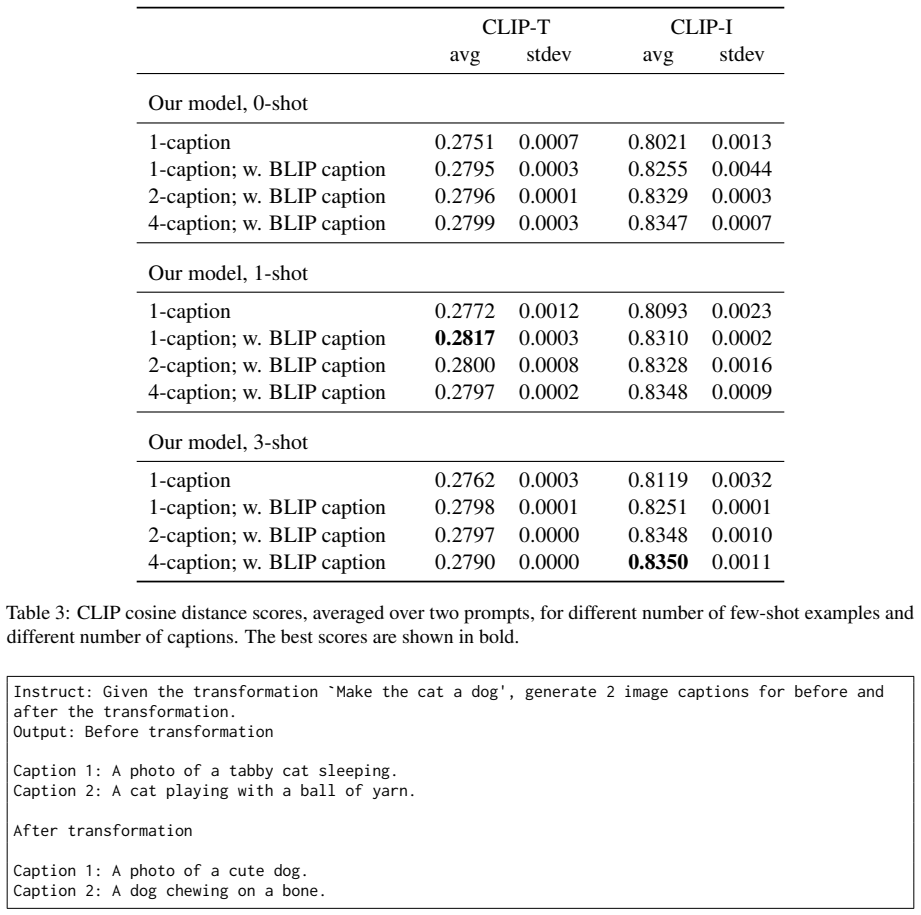
- [Table 1] The ablation 'After-edit caption only' gives CLIP-T 0.2897 versus 0.2904 for the full system, a gap of only 0.0007, while CLIP-I drops from 0.8268 to 0.8120. This means almost all of the improvement over 'Instruction only' (CLIP-T 0.2818) comes from the LLM-generated after-edit caption rather than from the subtraction operation that defines the edit-direction vector. There is no control condition with the before-edit BLIP caption as the sole text condition (i.e., no edit vector) or a plain DDIM reconstruction, so one cannot distinguish the contribution of the difference vector from the effect of the after-edit text prompt or from DDIM inversion drift. Please add these controls and report per-example paired differences with error bars or confidence intervals.
- [Sections 5.1, 5.3, Appendix C/D] All hyperparameter choices—number of captions, number of few-shot examples, prompt template, edit-direction weight w, Stable Diffusion version, and LLM—are selected by evaluating on the MAGICBRUSH test split, and Table 2 then compares the best selected configuration against published numbers on the same split. The paper also notes in Section 7.4(iii) that only one test run was performed. The reported CLIP-T of 0.2904 is therefore a test-set-selected maximum rather than a predicted result, and the differences from baselines (e.g., +0.014 over InstructPix2Pix) may lie within selection noise. Please use a held-out validation split for any hyperparameter search, or report uncertainty via bootstrapping or multiple runs, and state how the split was used.
- [Section 4.5] The choice of CLIP-T as the 'preferred metric' is motivated by dataset artifacts (mask infilling and DDIM inversion loss), and that argument has merit. However, the paper's central claim of competitive performance relies on CLIP-T, while under CLIP-I the method is clearly below several supervised baselines (0.8268 versus 0.8970, 0.9114, and 0.9269). Because the metric preference is introduced in the evaluation section of the same paper rather than pre-specified, the conclusion reads as selected post hoc. Please either pre-register the primary metric or present a balanced conclusion that explicitly weighs both metrics; at minimum, report the comparison under both metrics with the same level of scrutiny and discuss how the conclusions change.
minor comments (5)
- [Abstract] Typo: 'deliverring' should be 'delivering'.
- [Figure 1 caption] Typo: 'MAGICBRSUH' should be 'MAGICBRUSH'.
- [Section 3.2] The sentence 'one represents input and input images by means of captions' should read 'input and output images'.
- [Section 5.6] Typo: 'InstructPi2Pix' should be 'InstructPix2Pix'.
- [Appendix D] The term 'V AEs' appears with a stray space; use 'VAEs'.
Circularity Check
No circular derivation: the edit-direction vector is constructed from task inputs rather than from the evaluation target, and the self-citations are not load-bearing.
full rationale
The method's claimed chain is: BLIP before-caption plus LLM after-caption, a CLIP embedding difference, and a DDIM-inverted Stable Diffusion reconstruction conditioned on that difference. The output image is not a restatement of any fitted parameter or of the gold caption, and the evaluation reports multiple metrics plus human judgments rather than only a metric that mirrors the conditioning signal. The self-citations (Santos et al. 2022a/b, 2024) are background or implementation details, not load-bearing premises; no uniqueness theorem or central claim is imported from prior work by the same authors. The real concerns are empirical and methodological rather than circular: Section 3.2 never specifies how the edit-direction vector is injected into Stable Diffusion's conditioning path; Table 1's 'After-edit caption only' row (CLIP-T 0.2897 vs full 0.2904; CLIP-I 0.8120 vs 0.8268) shows that the difference vector is not isolated on the headline metric; there is no no-edit DDIM reconstruction control; and Section 5.1 selects hyperparameters using the test set while Section 4.5 adopts CLIP-T as the preferred metric. These are correctness and rigor issues, not reductions by construction, so the circularity score stays low.
Assumptions & free parameters
free parameters (7)
- edit-direction weight w =
1 or 1.25; exact final value not stated
- number of captions =
1
- few-shot examples for LLM =
1
- manual prompt template =
text in Section 5.2
- Stable Diffusion version =
SD 1.4
- LLM choice =
Mistral-7B-Instruct-v0.2
- meta-prompting hyperparameters =
20 steps, 8 examples, top-3 history, CLIP-I reward
assumptions (6)
- domain assumption DDIM inversion produces a noise latent from which Stable Diffusion can reconstruct the input image with enough fidelity.
- domain assumption The difference between CLIP text embeddings of the before and after captions is a meaningful direction in Stable Diffusion's conditioning space.
- domain assumption An off-the-shelf LLM can generate a faithful after-edit caption from the before caption and the edit instruction.
- domain assumption BLIP captions are accurate enough to support both inversion and edit-direction computation.
- domain assumption The MAGICBRUSH test set and the CLIP-T/CLIP-I metrics measure instruction-guided editing performance fairly.
- domain assumption Combining frozen pretrained models (BLIP, LLM, CLIP, Stable Diffusion) behaves compositionally enough for the pipeline to work.
Cite this review
Pith. "Pith review of Hands-off Image Editing: Language-guided Editing without any Task-specific Labeling, Masking or even Training." pith.science (2026). https://pith.science/paper/NCQ7BDLI
@misc{pith2026250210064,
  author       = {Pith},
  title        = {Pith review of: Hands-off Image Editing: Language-guided Editing without any Task-specific Labeling, Masking or even Training},
  year         = {2026},
  howpublished = {\url{https://pith.science/paper/NCQ7BDLI}},
  note         = {Machine review of arXiv:2502.10064}
}
read the original abstract
Instruction-guided image editing consists in taking an image and an instruction and deliverring that image altered according to that instruction. State-of-the-art approaches to this task suffer from the typical scaling up and domain adaptation hindrances related to supervision as they eventually resort to some kind of task-specific labelling, masking or training. We propose a novel approach that does without any such task-specific supervision and offers thus a better potential for improvement. Its assessment demonstrates that it is highly effective, achieving very competitive performance.
Figures


Figures from the paper (4 more)


Reference graph
Works this paper leans on
-
[1]
online" 'onlinestring :=
ENTRY address archivePrefix author booktitle chapter edition editor eid eprint eprinttype howpublished institution journal key month note number organization pages publisher school series title type volume year doi pubmed url lastchecked label extra.label sort.label short.list INTEGERS output.state before.all mid.sentence after.sentence after.block STRING...
-
[2]
write newline
" write newline "" before.all 'output.state := FUNCTION n.dashify 't := "" t empty not t #1 #1 substring "-" = t #1 #2 substring "--" = not "--" * t #2 global.max substring 't := t #1 #1 substring "-" = "-" * t #2 global.max substring 't := while if t #1 #1 substring * t #2 global.max substring 't := if while FUNCTION word.in bbl.in capitalize " " * FUNCT...
-
[3]
Rameen Abdal, Yipeng Qin, and Peter Wonka. 2020. Image2StyleGAN++ : How to edit the embedded images? arXiv preprint arXiv:1911.11544
work page Pith review arXiv 2020
-
[4]
AI@Meta. 2024. https://github.com/meta-llama/llama3/blob/main/MODEL_CARD.md Llama 3 model card
2024
-
[5]
State-of-the-Art in the Architecture, Methods and Applications of StyleGAN
Amit H. Bermano, Rinon Gal, Yuval Alaluf, Ron Mokady, Yotam Nitzan, Omer Tov, Or Patashnik, and Daniel Cohen-Or. 2022. State-of-the-art in the architecture, methods and applications of StyleGAN . arXiv preprint arXiv:2202.14020
work page Pith review arXiv 2022
-
[6]
Tim Brooks, Aleksander Holynski, and Alexei A Efros. 2023. InstructPix2Pix : Learning to follow image editing instructions. In Proceedings of the IEEE/CVF Conference on Computer Vision and Pattern Recognition, pages 18392--18402
work page 2023
-
[7]
Tom B Brown, Benjamin Mann, Nick Ryder, Melanie Subbiah, Jared Kaplan, Prafulla Dhariwal, Arvind Neelakantan, Pranav Shyam, Girish Sastry, Amanda Askell, et al. 2020. Language models are few-shot learners. arXiv preprint arXiv:2005.14165
arXiv 2020
-
[8]
Yu Cheng, Zhe Gan, Yitong Li, Jingjing Liu, and Jianfeng Gao. 2020. Sequential attention GAN for interactive image editing. In Proceedings of the 28th ACM international conference on multimedia, pages 4383--4391
work page 2020
Show all 51 references
-
[9]
Jacob Devlin, Ming-Wei Chang, Kenton Lee, and Kristina Toutanova. 2018. BERT : Pre-training of deep bidirectional transformers for language understanding. arXiv preprint arXiv:1810.04805
2018 arXiv
-
[10]
Prafulla Dhariwal and Alexander Nichol. 2021. Diffusion models beat GAN s on image synthesis. Advances in Neural Information Processing Systems, 34
2021
-
[11]
Alaaeldin El-Nouby, Shikhar Sharma, Hannes Schulz, Devon Hjelm, Layla El Asri, Samira Ebrahimi Kahou, Yoshua Bengio, and Graham W Taylor. 2019. Tell, draw, and repeat: Generating and modifying images based on continual linguistic instruction. In Proceedings of the IEEE/CVF Int...
2019
-
[12]
Tsu-Jui Fu, Wenze Hu, Xianzhi Du, William Yang Wang, Yinfei Yang, and Zhe Gan. 2023. Guiding instruction-based image editing via multimodal large language models. arXiv preprint arXiv:2309.17102
2023 arXiv
-
[13]
Yuying Ge, Sijie Zhao, Chen Li, Yixiao Ge, and Ying Shan. 2024. Seed-data-edit technical report: A hybrid dataset for instructional image editing. arXiv preprint arXiv:2405.04007
2024 arXiv
-
[14]
Ian Goodfellow, Jean Pouget-Abadie, Mehdi Mirza, Bing Xu, David Warde-Farley, Sherjil Ozair, Aaron Courville, and Yoshua Bengio. 2014. Generative adversarial nets. Advances in neural information processing systems, 27
2014
-
[15]
Suriya Gunasekar, Yi Zhang, Jyoti Aneja, et al. 2023. Textbooks are all you need. arXiv preprint arXiv:2306.11644
2023 arXiv
-
[16]
Qingyan Guo, Rui Wang, Junliang Guo, Bei Li, Kaitao Song, Xu Tan, Guoqing Liu, Jiang Bian, and Yujiu Yang. 2023. Connecting large language models with evolutionary algorithms yields powerful prompt optimizers. arXiv preprint arXiv:2309.08532
2023 arXiv
-
[17]
Amir Hertz, Ron Mokady, Jay Tenenbaum, et al. 2022. Prompt-to-Prompt image editing with cross attention control. arXiv preprint arXiv:2208.01626
2022 arXiv
-
[18]
Jonathan Ho and Tim Salimans. 2022. Classifier-free diffusion guidance. arXiv preprint arXiv:2207.12598
2022 arXiv
-
[19]
Mude Hui, Siwei Yang, Bingchen Zhao, Yichun Shi, Heng Wang, Peng Wang, Yuyin Zhou, and Cihang Xie. 2024. Hq-edit: A high-quality dataset for instruction-based image editing. arXiv preprint arXiv:2404.09990
2024 arXiv
-
[20]
Jiang, Alexandre Sablayrolles, Arthur Mensch, et al
Albert Q. Jiang, Alexandre Sablayrolles, Arthur Mensch, et al. 2023. Mistral 7B . arXiv preprint arXiv:2310.06825
2023 arXiv
-
[21]
Wentao Jiang, Ning Xu, Jiayun Wang, Chen Gao, Jing Shi, Zhe Lin, and Si Liu. 2021. Language-guided global image editing via cross-modal cyclic mechanism. In Proceedings of the IEEE/CVF International Conference on Computer Vision, pages 2115--2124
2021
-
[22]
Diederik P Kingma and Max Welling. 2013. Auto-encoding variational Bayes . arXiv preprint arXiv:1312.6114
2013 arXiv
-
[23]
Alexander Kirillov, Eric Mintun, Nikhila Ravi, Hanzi Mao, Chloe Rolland, Laura Gustafson, Tete Xiao, Spencer Whitehead, Alexander C Berg, Wan-Yen Lo, et al. 2023. Segment anything. In Proceedings of the IEEE/CVF International Conference on Computer Vision, pages 4015--4026
2023
-
[24]
Weize Kong, Spurthi Amba Hombaiah, Mingyang Zhang, Qiaozhu Mei, and Michael Bendersky. 2024. Prewrite: Prompt rewriting with reinforcement learning. arXiv e-prints, pages arXiv--2401
2024
-
[25]
Brian Lester, Rami Al-Rfou, and Noah Constant. 2021. The power of scale for parameter-efficient prompt tuning. In Proceedings of the 2021 Conference on Empirical Methods in Natural Language Processing, pages 3045--3059
2021
-
[26]
Junnan Li, Dongxu Li, Caiming Xiong, and Steven Hoi. 2022. BLIP : Bootstrapping language-image pre-training for unified vision-language understanding and generation. In International Conference on Machine Learning, pages 12888--12900. PMLR
2022
-
[27]
Shanglin Li, Bohan Zeng, Yutang Feng, Sicheng Gao, Xiuhui Liu, Jiaming Liu, Lin Li, Xu Tang, Yao Hu, Jianzhuang Liu, et al. 2024. Zone: Zero-shot instruction-guided local editing. In Proceedings of the IEEE/CVF Conference on Computer Vision and Pattern Recognition, pages 6254--6263
2024
-
[28]
Tsung-Yi Lin, Michael Maire, Serge Belongie, et al. 2014. Microsoft COCO : Common objects in context. In Proceedings of ECCV 2014: 13th European Conference on Computer Vision, pages 740--755. Springer
2014
-
[29]
Thomas Mesnard, Cassidy Hardin, Robert Dadashi, Surya Bhupatiraju, Shreya Pathak, Laurent Sifre, Morgane Rivi \`e re, Mihir Sanjay Kale, Juliette Love, et al. 2024. Gemma: Open models based on gemini research and technology. arXiv preprint arXiv:2403.08295
2024 arXiv
-
[30]
Ron Mokady, Amir Hertz, Kfir Aberman, et al. 2023. Null-text inversion for editing real images using guided diffusion models. In Proceedings of the IEEE/CVF Conference on Computer Vision and Pattern Recognition, pages 6038--6047
2023
-
[31]
Kishore Papineni, Salim Roukos, Todd Ward, and Wei-Jing Zhu. 2002. BLEU : a method for automatic evaluation of machine translation. In Proceedings of the 40th annual meeting of the Association for Computational Linguistics, pages 311--318
2002
-
[32]
Gaurav Parmar, Krishna Kumar Singh, Richard Zhang, et al. 2023. Zero-shot image-to-image translation. In ACM SIGGRAPH 2023 Conference Proceedings, pages 1--11
2023
-
[33]
Archiki Prasad, Peter Hase, Xiang Zhou, and Mohit Bansal. 2023. Grips: Gradient-free, edit-based instruction search for prompting large language models. In Proceedings of the 17th Conference of the European Chapter of the Association for Computational Linguistics, pages 3845--3864
2023
-
[34]
Aditya Ramesh, Prafulla Dhariwal, Alex Nichol, Casey Chu, and Mark Chen. 2022. Hierarchical text-conditional image generation with clip latents. arXiv preprint arXiv:2204.06125
2022 arXiv
-
[35]
Robin Rombach, Andreas Blattmann, Dominik Lorenz, et al. 2022. High-resolution image synthesis with latent diffusion models. In Proceedings of the IEEE/CVF Conference on Computer Vision and Pattern Recognition, pages 10684--10695
2022
-
[36]
Rodrigo Santos, Ant \'o nio Branco, and Jo \ a o Silva. 2022 a . Cost-effective language driven image editing with lx-drim. In Proceedings of the First Workshop on Performance and Interpretability Evaluations of Multimodal, Multipurpose, Massive-Scale Models, pages 31--43
2022
-
[37]
Rodrigo Santos, Ant \'o nio Branco, and Jo \ a o Silva. 2022 b . Language driven image editing via transformers. In 2022 IEEE 34th International Conference on Tools with Artificial Intelligence (ICTAI), pages 909--914. IEEE
2022
-
[38]
Rodrigo Santos, Jo \ a o Silva, and Ant \'o nio Branco. 2024. Leveraging llms for on-the-fly instruction guided image editing. In Progress in Artificial Intelligence (EPIA), pages 28--40
2024
-
[39]
Shelly Sheynin, Adam Polyak, Uriel Singer, Yuval Kirstain, Amit Zohar, Oron Ashual, Devi Parikh, and Yaniv Taigman. 2024. Emu edit: Precise image editing via recognition and generation tasks. In Proceedings of the IEEE/CVF Conference on Computer Vision and Pattern Recognition,...
2024
-
[40]
Jiaming Song, Chenlin Meng, and Stefano Ermon. 2020. Denoising diffusion implicit models. arXiv preprint arXiv:2010.02502
2020 arXiv
-
[41]
Aarohi Srivastava, Abhinav Rastogi, et al. 2023. Beyond the imitation game: Quantifying and extrapolating the capabilities of language models. Transactions on Machine Learning Research
2023
-
[42]
Hugo Touvron, Louis Martin, Kevin Stone, et al. 2023. LLaMA 2 : Open foundation and fine-tuned chat models. arXiv preprint arXiv:2307.09288
2023 arXiv
-
[43]
Ashish Vaswani, Noam Shazeer, Niki Parmar, Jakob Uszkoreit, Llion Jones, Aidan N Gomez, ukasz Kaiser, and Illia Polosukhin. 2017. Attention is all you need. In Advances in neural information processing systems, pages 5998--6008
2017
-
[44]
Navve Wasserman, Noam Rotstein, Roy Ganz, and Ron Kimmel. 2024. Paint by inpaint: Learning to add image objects by removing them first. arXiv preprint arXiv:2404.18212
2024 arXiv
-
[45]
Jason Wei, Xuezhi Wang, Dale Schuurmans, Maarten Bosma, Fei Xia, Ed Chi, Quoc V Le, Denny Zhou, et al. 2022. Chain-of-thought prompting elicits reasoning in large language models. Advances in neural information processing systems, 35:24824--24837
2022
-
[46]
Weihao Xia, Yulun Zhang, Yujiu Yang, Jing-Hao Xue, Bolei Zhou, and Ming-Hsuan Yang. 2022. GAN inversion: A survey. arXiv preprint arXiv:2101.05278
2022 arXiv
-
[47]
Chengrun Yang, Xuezhi Wang, Yifeng Lu, Hanxiao Liu, Quoc V Le, Denny Zhou, and Xinyun Chen. 2023. Large language models as optimizers. arXiv preprint arXiv:2309.03409
2023 arXiv
-
[48]
Shunyu Yao, Dian Yu, Jeffrey Zhao, Izhak Shafran, Tom Griffiths, Yuan Cao, and Karthik Narasimhan. 2024. Tree of thoughts: Deliberate problem solving with large language models. Advances in Neural Information Processing Systems, 36
2024
-
[49]
Kai Zhang, Lingbo Mo, Wenhu Chen, et al. 2024. MAGICBRUSH : A manually annotated dataset for instruction-guided image editing. Advances in Neural Information Processing Systems, 36
2024
-
[50]
Shu Zhang, Xinyi Yang, Yihao Feng, et al. 2023. HIVE : Harnessing human feedback for instructional visual editing. arXiv preprint arXiv:2303.09618
2023 arXiv
-
[51]
Yongchao Zhou, Andrei Ioan Muresanu, Ziwen Han, Keiran Paster, Silviu Pitis, Harris Chan, and Jimmy Ba. 2022. Large language models are human-level prompt engineers. In Proceedings of The Eleventh International Conference on Learning Representations
2022
Reviewed August 7, 2026 · model on record in the stance chip above.
Discussion (0). Sign in to comment.