REVIEW 4 major objections 4 minor 46 references
Direct Preference Optimization-Enhanced Multi-Guided Diffusion Model for Traffic Scenario Generation
T0 review · 4 major / 4 minor · reviewed 2026-08-07 · deepseek-v4-flash
Pith's one-line read MuDi-Pro shows DPO fine-tuning improves rule-following in guided traffic scenario generation.
desk verdict The DPO mechanism as written does not match what is implemented, so the central controllability claim is not supported, but the non-DPO backbone and ablations are solid enough to merit a careful revision. read the letter →
The pith
A machine-rendered reading of the paper's core claim, the machinery that carries it, and where it could break.
The reading
What carries the argument
The argument rests on three components. First, a scene-level diffusion transformer learns a traffic prior from real driving data, using classifier-free sampling and clean-trajectory guided sampling so that arbitrary guidance functions can steer the denoising process. Second, a guidance conditional layer, analogous to task-conditioning in multi-task learning, embeds the active guidance set into a latent vector that modulates the transformer blocks, letting one model handle many guidance combinations. Third, DPO fine-tuning optimizes preferences: for each prompt, the model samples a winning and a losing trajectory, scores them by the guidance loss, and updates through $L_{\text{DPO}} = -\log\sigma(-\beta(d_w - d_l))$, where $d_i$ is the difference in $L_2$ error between the current model and a frozen reference model against the stored trajectory. That surrogate replaces the log-probability ratio of the DPO objective with measurable trajectory errors, avoiding non-differentiable guidance gradients.
What would settle it
Compute the exact log-probabilities of the stored winning and losing trajectories under both the target and reference models, and compare the gradient of the true DPO loss to the gradient of the Algorithm 1 surrogate on the same sampled pairs; if the two disagree in sign or magnitude, the fine-tuning is not performing direct preference optimization. Alternatively, relabel the preference pairs with human-rated realism instead of guidance scores and check whether the rule-following improvements persist.
Extended reading notes
Core claim
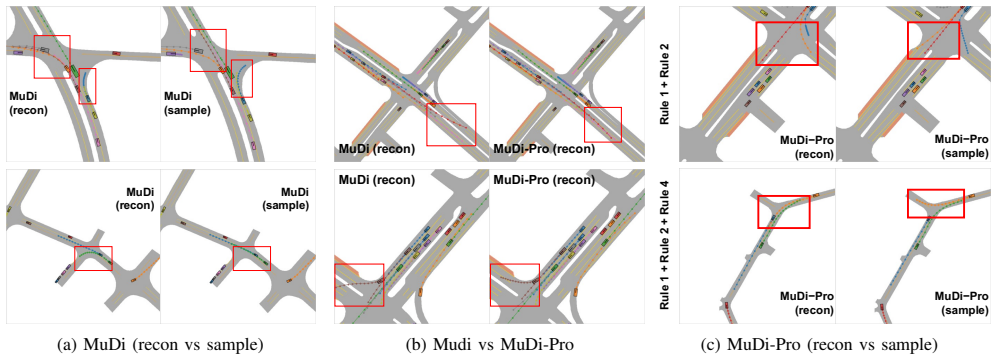
The paper's central claim is that fine-tuning a multi-guided diffusion model with DPO, using winning and losing trajectory pairs scored by the same guidance functions that drive sampling, makes guided sampling more effective. Concretely, MuDi-Pro is shown to reduce the rule metric from 52.4 to 43.5 and vehicle collisions from 0.20% to 0.03% for a combined no-collision and no-off-road rule, while keeping realism scores essentially unchanged, and also to improve over its backbone on a three-rule combination. The authors also claim that the guidance conditional layer, a multi-task-style addition that encodes which guidance is active, allows one model to serve many guidance combinations rather than requiring separate fine-tuning per rule.
Load-bearing premise
Algorithm 1 assumes the $L_2$ error between a sampled trajectory and a stored winning or losing sample can stand in for the model's log-probability of that trajectory, so that minimizing the difference of these errors is equivalent to optimizing the DPO objective; the paper does not derive or test this equivalence.
Editorial extensions
If this is right
- If MuDi-Pro is right, a single diffusion model can be fine-tuned once and then steer by many rule combinations, removing the need to train separate models per guidance.
- The DPO treatment of guidance preferences offers a generic recipe for fine-tuning guided generative models whenever guidance gradients are expensive or non-differentiable.
- The reported reductions in off-road and vehicle collision rates, with comparable realism, would make synthetic scenario generation more usable for safety testing of autonomous vehicles.
- The sample mode, which does not see future information, maintains diversity while improving controllability, so the gains are not limited to reconstruction settings.
Reading between the lines
- A limitation the paper does not dwell on: because the winning and losing labels come from the same guidance scores used as evaluation metrics, the reported rule-following improvements may partly reflect alignment with the metric rather than with genuinely realistic driving; a human-preference or independent-realness evaluation would separate these.
- The $L_2$ surrogate for log-probabilities in Algorithm 1 is the load-bearing approximation; if it breaks, the fine-tuning is no longer DPO, so testing the surrogate against exact likelihoods would clarify the mechanism.
- The authors note classifier-free sampling is limited to trajectory space; extending the same DPO fine-tuning to latent-space sampling would test whether the controllability gains carry over.
- If the surrogate is validated, the same fine-tuning scheme could apply to other domains where guidance is defined by rule-based losses, such as pedestrian or robot motion generation.
Editorial analysis
A structured set of objections, weighed in public.
Referee Report
Summary. The paper proposes MuDi-Pro, a traffic-scenario generation model built on a diffusion transformer, classifier-free sampling with reconstruction guidance, a guidance-conditional layer for multi-guided control, and a DPO-style fine-tuning stage intended to reduce the prior shift caused by guided sampling. Training is split into a backbone stage, a guidance-conditional-layer stage (MuDi), and a final preference fine-tuning stage (MuDi-Pro). Experiments on nuScenes compare the backbone, controllability, fine-tuned model, and ablations across metrics for stability, realism, controllability, and data-driven fidelity.
Significance. If the claimed mechanism worked as described, the paper would be a practically useful contribution to controllable traffic generation: the idea of conditioning one diffusion model on multiple guidance functions and then fine-tuning it to reduce guided-sampling distortion is attractive, and the paper includes useful ablations (unicycle dynamics, transformer backbone, data filtering, context design). The nuScenes data-filtering observation about parked agents with pre-existing collisions is also practically relevant. However, the central DPO mechanism is not actually derived or verified, the preference labels are the same quantities used as the controllability evaluation metric, and one of the headline claims in Section IV-B is contradicted by the paper's own Table I. The paper provides no code or other reproducibility artifact, so the empirical claims rest entirely on the textual description. The strengths do not outweigh these load-bearing concerns at the current stage.
major comments (4)
- [III-C, Eq. (5), Algorithm 1] Algorithm 1 does not implement the DPO objective in Eq. (5). Eq. (5) is the standard DPO loss over log-likelihood ratios of fixed winning and losing samples, while Algorithm 1 (lines 8-12) replaces the log-probability ratio with d_i = E_{i,theta} - E_{i,ref}, where E_{i,j} = L2(T_i, T_{i,j}) and T_{i,theta}, T_{i,ref} are freshly sampled trajectories from the target and reference models. The paper gives no derivation showing that an L2 error to a newly sampled trajectory estimates or proxies log p_theta(T_i|c) - log p_ref(T_i|c); for diffusion models, the log-likelihood is not an L2 distance to an arbitrary sample. Standard Diffusion-DPO, as in reference [34], optimizes denoising losses on fixed preference pairs, not random samples drawn from the current policy. Without a derivation or an ablation comparing this surrogate with the stated DPO objective, the controllability improvements in Table III cannot be attributed to direct preference optimization, which is the paper's central contribution.
- [III-C, Tables II and III] The preference dataset is constructed from guidance scores, and the 'rule' controllability metric in Tables II and III is the final guidance loss. Because the fine-tuning objective directly optimizes the same guidance scores that are later reported as the controllability metric, the reduction from 52.4 to 43.5 in Table III is partly a fitted result rather than independent evidence of improved rule-following. The paper needs either an external evaluation of controllability that was not used as a training signal, or an explicit statement that controllability is defined as this guidance loss and that the comparison is therefore a direct measure of training objective, not a downstream validation of rule compliance.
- [IV-B, Table I] The text in Section IV-B states that 'ours (sample) also outperforms baselines with all metrics except for the veh metric value,' but Table I directly contradicts this. Under the paper's own statement that lower pos and ang indicate better data-driven ability, Ours(sample) has pos=2.738 and ang=2.682, which are worse than every baseline, and map=4.84 is worse than CTG (2.31), CTG++ (3.92), and STRIVE(recon) (2.67). Only the real metric (2.0) is best among all compared entries. This false summary undermines the data-driven-ability claim for the sample mode and should be corrected.
- [IV-C, Table II] Section IV-C says the authors 'apply four single-rule cases and also conduct experiments with three multiple-rule cases,' but Table II reports only two multiple-rule combinations (rule 1+2 and rule 1+2+4). A third combination such as rule 1+2+5 appears in a figure caption but is not tabulated. Since multi-guidance handling is a core contribution, the experimental record is incomplete as presented and should be clarified or completed.
minor comments (4)
- [III-C, Eq. (5)] The notation 'pref' in Eq. (5) should be 'p_ref' for consistency with the surrounding text, and the subscript placement in the preference ratio should be made explicit to avoid confusion with multiplication.
- [Algorithm 1] Line 1 contains a typo ('lossing' should be 'losing'), and the notation 'i ∼ [w,l]' is not standard; the set should be written explicitly as i in {w,l}.
- [IV-E, Table IV] The ablation rows 'MuDi-Pro(decoder)' and 'MuDi-Pro(blocks)' are not defined in the text; it should be stated which parameters are fine-tuned in each variant and whether the guidance conditional layer is included.
- [IV, metrics] No standard deviations, confidence intervals, or multiple-seed comparisons are reported for any metric; given the small differences in some comparisons (e.g., real in Table III), this limits the statistical support for the empirical conclusions.
Circularity Check
MuDi-Pro's rule-controllability improvement is a re-measurement of its own DPO preference signal, making the headline controllability gain partly a fitted result.
-
fitted input called prediction
[Section III-C 'Fine-tuning via DPO' and Section IV-A 'Metrics'; Table III]
"We devise a preference dataset predicated on the guidance score, which is directly derived from the guidance loss during the diffusion model’s sampling phase, to provide heuristic-based preferences for intuitiveness... Controllability is assessed by how well the trajectories follow guidance, measured by the final guided loss (rule)."
The preference labels that define winning and losing samples are the guidance scores, and the controllability metric 'rule' is the same final guided loss. The DPO objective is trained to prefer the lower-guidance-loss sample, so the reported rule decreases in Table III (e.g., 52.4 to 43.5 for rule 1+2) are a re-measurement of the training signal itself. The evaluation metric is not independent of the optimized objective; the rule improvement is largely a fitted outcome of the preference construction rather than an independent prediction about controllability.
full rationale
The backbone comparison against CTG/STRIVE and the realism/diversity metrics are externally anchored on nuScenes and do not reduce to the training objective. However, the central controllability claim for MuDi-Pro is partially circular: the DPO preference dataset is constructed from guidance scores, and the 'rule' evaluation metric is the final guided loss from the same guidance functions. Consequently, the rule improvements in Table III substantially reflect the objective used for fine-tuning. The paper does not rely on self-citations. A separate non-circular concern is that Algorithm 1 replaces the log-probability ratio in Eq. (5) with L2 distances to sampled trajectories without derivation; this is a correctness gap rather than circularity, so it is not scored here. Overall, the controllability finding is partially forced by construction, giving a score of 6.
Assumptions & free parameters
free parameters (5)
- guidance strength alpha =
not reported
- CFS weight w =
1.0, 0.5, 0.0
- DPO scale beta =
not reported
- guidance rule weights =
not reported
- data filtering threshold =
agents with past collisions (13.9% of training set)
assumptions (5)
- standard math Diffusion forward and reverse process with a fixed variance schedule
- domain assumption Unicycle dynamics model
- domain assumption Future trajectories are available at test time in reconstruction mode
- ad hoc to paper Guidance-score preference is a valid proxy for controllability and realism
- domain assumption nuScenes dataset represents real-world traffic after filtering
Cite this review
Pith. "Pith review of Direct Preference Optimization-Enhanced Multi-Guided Diffusion Model for Traffic Scenario Generation." pith.science (2026). https://pith.science/paper/CZIS2VFK
@misc{pith2026250212178,
  author       = {Pith},
  title        = {Pith review of: Direct Preference Optimization-Enhanced Multi-Guided Diffusion Model for Traffic Scenario Generation},
  year         = {2026},
  howpublished = {\url{https://pith.science/paper/CZIS2VFK}},
  note         = {Machine review of arXiv:2502.12178}
}
read the original abstract
Diffusion-based models are recognized for their effectiveness in using real-world driving data to generate realistic and diverse traffic scenarios. These models employ guided sampling to incorporate specific traffic preferences and enhance scenario realism. However, guiding the sampling process to conform to traffic rules and preferences can result in deviations from real-world traffic priors and potentially leading to unrealistic behaviors. To address this challenge, we introduce a multi-guided diffusion model that utilizes a novel training strategy to closely adhere to traffic priors, even when employing various combinations of guides. This model adopts a multi-task learning framework, enabling a single diffusion model to process various guide inputs. For increased guided sampling precision, our model is fine-tuned using the Direct Preference Optimization (DPO) algorithm. This algorithm optimizes preferences based on guide scores, effectively navigating the complexities and challenges associated with the expensive and often non-differentiable gradient calculations during the guided sampling fine-tuning process. Evaluated using the nuScenes dataset our model provides a strong baseline for balancing realism, diversity and controllability in the traffic scenario generation.
Figures


Figures from the paper (1 more)
Reference graph
Works this paper leans on
-
[34]
Diffusion model alignment using direct preference optimization
Bram Wallace, Meihua Dang, Rafael Rafailov, Linqi Zhou, Aaron Lou, Senthil Purushwalkam, Stefano Ermon, Caiming Xiong, Shafiq Joty, and Nikhil Naik. Diffusion model alignment using direct preference optimization. arXiv preprint arXiv:2311.12908 , 2023
arXiv 2023
-
[1]
Data-driven Traffic Simulation: A Comprehensive Review
Di Chen, Meixin Zhu, Hao Yang, Xuesong Wang, and Yinhai Wang. Data-driven traffic simulation: A comprehensive review.arXiv preprint arXiv:2310.15975, 2023
work page Pith review arXiv 2023
-
[2]
Nidhi Kalra and Susan M Paddock. Driving to safety: How many miles of driving would it take to demonstrate autonomous vehicle reliability? Transportation Research Part A: Policy and Practice , 94:182–193, 2016
work page 2016
-
[3]
Language- guided traffic simulation via scene-level diffusion
Ziyuan Zhong, Davis Rempe, Yuxiao Chen, Boris Ivanovic, Yulong Cao, Danfei Xu, Marco Pavone, and Baishakhi Ray. Language- guided traffic simulation via scene-level diffusion. arXiv preprint arXiv:2306.06344, 2023
arXiv 2023
-
[4]
Reinforcement Learning with Human Feedback for Realistic Traffic Simulation
Yulong Cao, Boris Ivanovic, Chaowei Xiao, and Marco Pavone. Reinforcement learning with human feedback for realistic traffic simulation. arXiv preprint arXiv:2309.00709 , 2023
work page Pith review arXiv 2023
-
[5]
Realgen: Retrieval augmented generation for controllable traffic scenarios
Wenhao Ding, Yulong Cao, Ding Zhao, Chaowei Xiao, and Marco Pavone. Realgen: Retrieval augmented generation for controllable traffic scenarios. arXiv preprint arXiv:2312.13303 , 2023
arXiv 2023
-
[6]
Scenecontrol: Diffusion for controllable traffic scene generation
Jack Lu, Kelvin Wong, Chris Zhang, Simon Suo, and Raquel Urtasun. Scenecontrol: Diffusion for controllable traffic scene generation. In 2024 IEEE International Conference on Robotics and Automation (ICRA), pages 16908–16914. IEEE, 2024
work page 2024
-
[7]
Direct preference optimiza- tion: Your language model is secretly a reward model
Rafael Rafailov, Archit Sharma, Eric Mitchell, Christopher D Man- ning, Stefano Ermon, and Chelsea Finn. Direct preference optimiza- tion: Your language model is secretly a reward model. Advances in Neural Information Processing Systems , 36, 2024
work page 2024
Show all 46 references
-
[8]
Task switching network for multi-task learning
Guolei Sun, Thomas Probst, Danda Pani Paudel, Nikola Popovi ´c, Menelaos Kanakis, Jagruti Patel, Dengxin Dai, and Luc Van Gool. Task switching network for multi-task learning. In Proceedings of the IEEE/CVF international conference on computer vision , pages 8291– 8300, 2021
2021
-
[9]
Parameter-efficient multi-task fine-tuning for trans- formers via shared hypernetworks
Rabeeh Karimi Mahabadi, Sebastian Ruder, Mostafa Dehghani, and James Henderson. Parameter-efficient multi-task fine-tuning for trans- formers via shared hypernetworks. arXiv preprint arXiv:2106.04489 , 2021
2021 arXiv
-
[10]
nuscenes: A multimodal dataset for autonomous driving
Holger Caesar, Varun Bankiti, Alex H Lang, Sourabh V ora, Venice Erin Liong, Qiang Xu, Anush Krishnan, Yu Pan, Giancarlo Baldan, and Oscar Beijbom. nuscenes: A multimodal dataset for autonomous driving. In Proceedings of the IEEE/CVF conference on computer vision and pattern r...
2020
-
[11]
Toward benchmarking of microscopic traffic flow models
Elmar Brockfeld, Reinhart D K ¨uhne, Alexander Skabardonis, and Peter Wagner. Toward benchmarking of microscopic traffic flow models. Transportation research record, 1852(1):124–129, 2003
2003
-
[12]
Microscopic traffic simulation using sumo
Pablo Alvarez Lopez, Michael Behrisch, Laura Bieker-Walz, Jakob Erdmann, Yun-Pang Fl ¨otter¨od, Robert Hilbrich, Leonhard L ¨ucken, Johannes Rummel, Peter Wagner, and Evamarie Wießner. Microscopic traffic simulation using sumo. In 2018 21st international conference on intellig...
2018
-
[13]
Multipath: Multiple probabilistic anchor trajectory hypothe- ses for behavior prediction
Yuning Chai, Benjamin Sapp, Mayank Bansal, and Dragomir Anguelov. Multipath: Multiple probabilistic anchor trajectory hypothe- ses for behavior prediction. arXiv preprint arXiv:1910.05449 , 2019
1910 arXiv
-
[14]
Scept: Scene- consistent, policy-based trajectory predictions for planning
Yuxiao Chen, Boris Ivanovic, and Marco Pavone. Scept: Scene- consistent, policy-based trajectory predictions for planning. In Pro- ceedings of the IEEE/CVF Conference on Computer Vision and Pattern Recognition, pages 17103–17112, 2022
2022
-
[15]
Trajectron++: Dynamically-feasible trajectory forecasting with heterogeneous data
Tim Salzmann, Boris Ivanovic, Punarjay Chakravarty, and Marco Pavone. Trajectron++: Dynamically-feasible trajectory forecasting with heterogeneous data. In Computer Vision–ECCV 2020: 16th Eu- ropean Conference, Glasgow, UK, August 23–28, 2020, Proceedings, Part XVIII 16, pages...
2020
-
[16]
Trace and pace: Con- trollable pedestrian animation via guided trajectory diffusion
Davis Rempe, Zhengyi Luo, Xue Bin Peng, Ye Yuan, Kris Kitani, Karsten Kreis, Sanja Fidler, and Or Litany. Trace and pace: Con- trollable pedestrian animation via guided trajectory diffusion. In Proceedings of the IEEE/CVF Conference on Computer Vision and Pattern Recognition, ...
2023
-
[17]
Auto-encoding variational bayes
Diederik P Kingma and Max Welling. Auto-encoding variational bayes. arXiv preprint arXiv:1312.6114 , 2013
2013 arXiv
-
[18]
Denoising diffusion probabilistic models
Jonathan Ho, Ajay Jain, and Pieter Abbeel. Denoising diffusion probabilistic models. Advances in neural information processing systems, 33:6840–6851, 2020
2020
-
[19]
Motiondiffuser: Controllable multi- agent motion prediction using diffusion
Chiyu Jiang, Andre Cornman, Cheolho Park, Benjamin Sapp, Yin Zhou, Dragomir Anguelov, et al. Motiondiffuser: Controllable multi- agent motion prediction using diffusion. In Proceedings of the IEEE/CVF Conference on Computer Vision and Pattern Recognition , pages 9644–9653, 2023
2023
-
[20]
Scenedm: Scene-level multi-agent trajectory generation with consistent diffusion models
Zhiming Guo, Xing Gao, Jianlan Zhou, Xinyu Cai, and Botian Shi. Scenedm: Scene-level multi-agent trajectory generation with consistent diffusion models. arXiv preprint arXiv:2311.15736 , 2023
2023 arXiv
-
[21]
Generating driving scenes with diffusion
Ethan Pronovost, Kai Wang, and Nick Roy. Generating driving scenes with diffusion. arXiv preprint arXiv:2305.18452 , 2023
2023 arXiv
-
[22]
Scenario diffusion: Controllable driving scenario generation with diffusion
Ethan Pronovost, Meghana Reddy Ganesina, Noureldin Hendy, Zeyu Wang, Andres Morales, Kai Wang, and Nick Roy. Scenario diffusion: Controllable driving scenario generation with diffusion. Advances in Neural Information Processing Systems , 36, 2024
2024
-
[23]
Planning with diffusion for flexible behavior synthesis
Michael Janner, Yilun Du, Joshua B Tenenbaum, and Sergey Levine. Planning with diffusion for flexible behavior synthesis. arXiv preprint arXiv:2205.09991, 2022
2022 arXiv
-
[24]
Diffscene: Diffusion-based safety-critical scenario generation for au- tonomous vehicles
Chejian Xu, Ding Zhao, Alberto Sangiovanni-Vincentelli, and Bo Li. Diffscene: Diffusion-based safety-critical scenario generation for au- tonomous vehicles. In The Second Workshop on New Frontiers in Adversarial Machine Learning , 2023
2023
-
[25]
King: Generating safety-critical driving scenarios for robust imitation via kinematics gradients
Niklas Hanselmann, Katrin Renz, Kashyap Chitta, Apratim Bhat- tacharyya, and Andreas Geiger. King: Generating safety-critical driving scenarios for robust imitation via kinematics gradients. In European Conference on Computer Vision , pages 335–352. Springer, 2022
2022
-
[26]
A diffusion-model of joint interactive navigation
Matthew Niedoba, Jonathan Lavington, Yunpeng Liu, Vasileios Li- outas, Justice Sefas, Xiaoxuan Liang, Dylan Green, Setareh Dabiri, Berend Zwartsenberg, Adam Scibior, et al. A diffusion-model of joint interactive navigation. Advances in Neural Information Processing Systems, 36, 2024
2024
-
[27]
Behav- iorgpt: Smart agent simulation for autonomous driving with next-patch prediction
Zikang Zhou, Haibo Hu, Xinhong Chen, Jianping Wang, Nan Guan, Kui Wu, Yung-Hui Li, Yu-Kai Huang, and Chun Jason Xue. Behav- iorgpt: Smart agent simulation for autonomous driving with next-patch prediction. arXiv preprint arXiv:2405.17372 , 2024
2024 arXiv
-
[28]
Language-driven interactive traffic trajectory generation
Junkai Xia, Chenxin Xu, Qingyao Xu, Chen Xie, Yanfeng Wang, and Siheng Chen. Language-driven interactive traffic trajectory generation. arXiv preprint arXiv:2405.15388 , 2024
2024 arXiv
-
[29]
Dreambooth: Fine tuning text-to-image diffusion models for subject-driven generation
Nataniel Ruiz, Yuanzhen Li, Varun Jampani, Yael Pritch, Michael Rubinstein, and Kfir Aberman. Dreambooth: Fine tuning text-to-image diffusion models for subject-driven generation. In Proceedings of the IEEE/CVF Conference on Computer Vision and Pattern Recognition , pages 2250...
2023
-
[30]
An image is worth one word: Personalizing text-to-image generation using textual inversion
Rinon Gal, Yuval Alaluf, Yuval Atzmon, Or Patashnik, Amit H Bermano, Gal Chechik, and Daniel Cohen-Or. An image is worth one word: Personalizing text-to-image generation using textual inversion. arXiv preprint arXiv:2208.01618 , 2022
2022 arXiv
-
[31]
Adding conditional control to text-to-image diffusion models
Lvmin Zhang, Anyi Rao, and Maneesh Agrawala. Adding conditional control to text-to-image diffusion models. In Proceedings of the IEEE/CVF International Conference on Computer Vision, pages 3836– 3847, 2023
2023
-
[32]
Low-rank adaptation for fast text-to-image diffusion fine- tuning, 2023
Simo Ryu. Low-rank adaptation for fast text-to-image diffusion fine- tuning, 2023
2023
-
[33]
Svdiff: Compact parameter space for diffusion fine-tuning
Ligong Han, Yinxiao Li, Han Zhang, Peyman Milanfar, Dimitris Metaxas, and Feng Yang. Svdiff: Compact parameter space for diffusion fine-tuning. arXiv preprint arXiv:2303.11305 , 2023
2023 arXiv
-
[35]
Aligndiff: Aligning diverse human preferences via behavior-customisable diffu- sion model
Zibin Dong, Yifu Yuan, Jianye Hao, Fei Ni, Yao Mu, Yan Zheng, Yujing Hu, Tangjie Lv, Changjie Fan, and Zhipeng Hu. Aligndiff: Aligning diverse human preferences via behavior-customisable diffu- sion model. arXiv preprint arXiv:2310.02054 , 2023
-
[36]
Feedback efficient online fine- tuning of diffusion models
Masatoshi Uehara, Yulai Zhao, Kevin Black, Ehsan Hajiramezanali, Gabriele Scalia, Nathaniel Lee Diamant, Alex M Tseng, Sergey Levine, and Tommaso Biancalani. Feedback efficient online fine- tuning of diffusion models. arXiv preprint arXiv:2402.16359 , 2024
2024 arXiv
-
[37]
Guided conditional dif- fusion for controllable traffic simulation
Ziyuan Zhong, Davis Rempe, Danfei Xu, Yuxiao Chen, Sushant Veer, Tong Che, Baishakhi Ray, and Marco Pavone. Guided conditional dif- fusion for controllable traffic simulation. In 2023 IEEE International Conference on Robotics and Automation (ICRA) , pages 3560–3566. IEEE, 2023
2023
-
[38]
A. D. Luca, G. Oriolo, and C. Samson. Feedback Control of a Nonholonomic Car-Like Robot , pages 171–249. Springer, Berlin, Germany, 1988
1988
-
[39]
Improved denoising diffusion probabilistic models
Alexander Quinn Nichol and Prafulla Dhariwal. Improved denoising diffusion probabilistic models. In International Conference on Ma- chine Learning, pages 8162–8171. PMLR, 2021
2021
-
[40]
Jonathan Ho, Tim Salimans, Alexey Gritsenko, William Chan, Mo- hammad Norouzi, and David J. Fleet. Video diffusion models. arXiv preprint arXiv:2204.03458, 2022
2022 arXiv
-
[41]
Accurate, large minibatch sgd: Training imagenet in 1 hour
Priya Goyal, Piotr Doll ´ar, Ross Girshick, Pieter Noordhuis, Lukasz Wesolowski, Aapo Kyrola, Andrew Tulloch, Yangqing Jia, and Kaim- ing He. Accurate, large minibatch sgd: Training imagenet in 1 hour. arXiv preprint arXiv:1706.02677 , 2017
2017 arXiv
-
[42]
Scalable diffusion models with transformers
William Peebles and Saining Xie. Scalable diffusion models with transformers. In Proceedings of the IEEE/CVF International Confer- ence on Computer Vision , pages 4195–4205, 2023
2023
-
[43]
Using human feedback to fine-tune diffusion models without any reward model
Kai Yang, Jian Tao, Jiafei Lyu, Chunjiang Ge, Jiaxin Chen, Qimai Li, Weihan Shen, Xiaolong Zhu, and Xiu Li. Using human feedback to fine-tune diffusion models without any reward model. arXiv preprint arXiv:2311.13231, 2023
2023 arXiv
-
[44]
Exploration-driven policy optimization in rlhf: Theoretical insights on efficient data utilization
Yihan Du, Anna Winnicki, Gal Dalal, Shie Mannor, and R Srikant. Exploration-driven policy optimization in rlhf: Theoretical insights on efficient data utilization. arXiv preprint arXiv:2402.10342 , 2024
2024 arXiv
-
[45]
Bits: Bi-level imitation for traffic simulation
Danfei Xu, Yuxiao Chen, Boris Ivanovic, and Marco Pavone. Bits: Bi-level imitation for traffic simulation. In 2023 IEEE International Conference on Robotics and Automation (ICRA) , pages 2929–2936. IEEE, 2023
2023
-
[46]
Generating useful accident-prone driving scenarios via a learned traffic prior
Davis Rempe, Jonah Philion, Leonidas J Guibas, Sanja Fidler, and Or Litany. Generating useful accident-prone driving scenarios via a learned traffic prior. In Proceedings of the IEEE/CVF Conference on Computer Vision and Pattern Recognition, pages 17305–17315, 2022
2022
Reviewed August 7, 2026 · model on record in the stance chip above.
Discussion (0). Sign in to comment.