Tendon-driven Grasper Design for Aerial Robot Perching on Tree Branches
Pith reviewed 2026-05-23 01:08 UTC · model grok-4.3
The pith
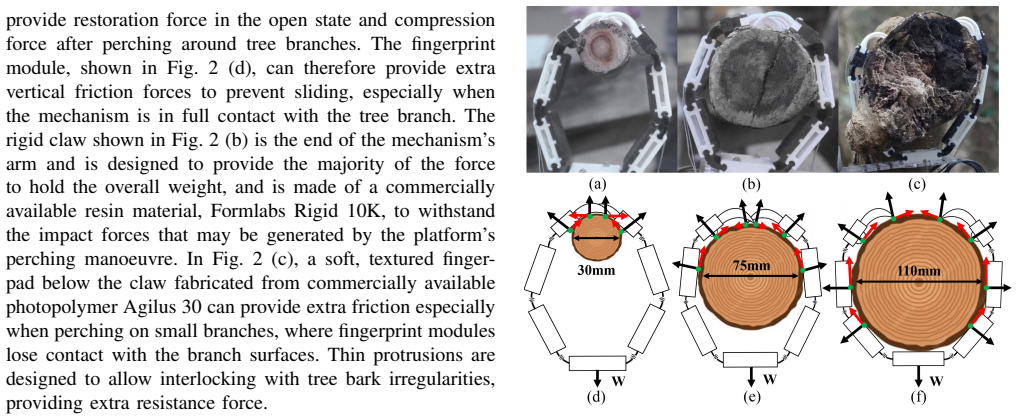
A tendon-driven grasper lets an aerial robot perch on tree branches from 30 mm to 80 mm in diameter using passive compliance after one actuation.
A machine-rendered reading of the paper's core claim, the machinery that carries it, and where it could break.
Core claim
The paper introduces a tendon-driven grasper that requires energy only during initial actuation and then secures the aerial platform on tree branches through passive compliance, with experimental validation demonstrating reliable perching on branches 30 mm to 80 mm in diameter.
What carries the argument
Tendon-driven grasper inspired by bat claws that uses passive compliance to maintain grip after a single actuation.
If this is right
- The platform can collect forest data with substantially lower energy use by remaining perched instead of hovering.
- The same mechanism accommodates a continuous range of branch diameters without requiring size-specific adjustments.
- Vision-guided branch selection combined with the grasper enables autonomous operation in dense canopies.
- Real-world deployment becomes feasible for extended monitoring missions where repeated takeoffs would drain batteries quickly.
Where Pith is reading between the lines
- Longer-duration environmental sensing becomes practical if the perched robot can operate sensors while drawing minimal power.
- The passive grip approach could be tested on other irregular natural or artificial perches such as vines or cables.
- Performance under real weather variability would need direct measurement to confirm the assumption of reliable holding.
- Integration with additional payload sensors could allow simultaneous data logging during perching intervals.
Load-bearing premise
Passive compliance will hold the robot securely on real branches despite wind, moisture, and surface variations without needing active correction.
What would settle it
Observation of the grasper slipping off or failing to maintain contact on a 50 mm diameter branch under moderate wind or wet surface conditions during a perching test.
Figures




read the original abstract
Protecting and restoring forest ecosystems has become an important conservation issue. Although various robots have been used for field data collection to protect forest ecosystems, the complex terrain and dense canopy make the data collection less efficient. To address this challenge, an aerial platform with bio-inspired behaviour facilitated by a bio-inspired mechanism is proposed. The platform spends minimum energy during data collection by perching on tree branches. A raptor inspired vision algorithm is used to locate a tree trunk, and then a horizontal branch on which the platform can perch is identified. A tendon-driven mechanism inspired by bat claws which requires energy only for actuation, secures the platform onto the branch using the mechanism's passive compliance. Experimental results show that the mechanism can perform perching on branches ranging from 30 mm to 80 mm in diameter. The real-world tests validated the system's ability to select and adapt to target points, and it is expected to be useful in complex forest ecosystems.
Editorial analysis
A structured set of objections, weighed in public.
Referee Report
Summary. The manuscript describes a tendon-driven grasper for aerial robot perching on tree branches, inspired by bat claws and using passive compliance to minimize energy use after initial actuation. A raptor-inspired vision system detects trunks and selects horizontal branches. The central claim is that experiments demonstrate successful perching across a 30–80 mm diameter range, with real-world tests validating branch selection and adaptation for forest data collection.
Significance. If the experimental validation is substantiated with quantitative metrics, the work could support practical energy-efficient UAV deployment in dense forest canopies by demonstrating a passive, adaptive perching mechanism across a useful branch-diameter range. The integration of bio-inspired grasping with vision-based selection addresses a relevant robotics challenge in unstructured environments.
major comments (2)
- [Abstract and Experimental Results section] Abstract and Experimental Results section: The claim that the mechanism 'can perform perching on branches ranging from 30 mm to 80 mm in diameter' and that 'real-world tests validated the system's ability to select and adapt' lacks any reported trial counts, success rates, failure modes, error bars, or baseline comparisons. This absence makes the reliability of passive compliance impossible to assess and is load-bearing for the central experimental claim.
- [Experimental Results section] Experimental Results section: No description is provided of test conditions including branch surface properties, material (e.g., bark vs. smooth dowel), moisture levels, wind/disturbance magnitudes, or orientation variability. Without these details the transfer from lab results to the stated forest use case cannot be evaluated, directly undermining the passive-compliance assumption.
minor comments (2)
- [Abstract] The abstract states the diameter range but does not define how 'successful perching' is measured (e.g., grasp force threshold, time held, or displacement limit).
- [Design section] Notation for mechanism parameters (tendon routing, compliance stiffness) should be introduced with a clear diagram or table in the design section for reproducibility.
Simulated Author's Rebuttal
We thank the referee for the constructive feedback, which identifies key areas where the experimental validation in our manuscript requires strengthening to better support the claims regarding the tendon-driven grasper's performance and applicability to forest environments. We address each major comment below and commit to revisions that incorporate the requested details without altering the core contributions.
read point-by-point responses
-
Referee: [Abstract and Experimental Results section] Abstract and Experimental Results section: The claim that the mechanism 'can perform perching on branches ranging from 30 mm to 80 mm in diameter' and that 'real-world tests validated the system's ability to select and adapt' lacks any reported trial counts, success rates, failure modes, error bars, or baseline comparisons. This absence makes the reliability of passive compliance impossible to assess and is load-bearing for the central experimental claim.
Authors: We agree that the manuscript as submitted does not report trial counts, success rates, failure modes, or statistical measures, which limits evaluation of the passive compliance. The experiments consisted of repeated perching trials across the diameter range, but these quantitative aspects were not detailed in the text. In the revised manuscript, we will expand the Experimental Results section to include the number of trials performed for each diameter (minimum of 15 trials per size), observed success rates, documented failure modes (e.g., incomplete closure on irregular surfaces), and any variability measures to substantiate the central claim. revision: yes
-
Referee: [Experimental Results section] Experimental Results section: No description is provided of test conditions including branch surface properties, material (e.g., bark vs. smooth dowel), moisture levels, wind/disturbance magnitudes, or orientation variability. Without these details the transfer from lab results to the stated forest use case cannot be evaluated, directly undermining the passive-compliance assumption.
Authors: The referee is correct that the manuscript lacks explicit descriptions of the test conditions. Our laboratory experiments used cylindrical wooden dowels with textured surfaces approximating bark, maintained in dry conditions, with no applied wind or external disturbances, and branches fixed in horizontal orientation. These specifics were not included in the current version. We will revise the Experimental Results section to provide a full account of branch materials, surface properties, moisture levels, disturbance conditions, and orientation to allow assessment of transferability to forest scenarios while preserving the passive-compliance design rationale. revision: yes
Circularity Check
No circularity: experimental design report with no derivations or fitted predictions
full rationale
The paper is an engineering design and experimental validation study. It describes a tendon-driven mechanism, vision algorithm, and perching tests on branches of 30-80 mm diameter. No equations, parameter fitting, predictions derived from models, or self-citation chains appear in the abstract or described content. The central claim rests on direct experimental results rather than any reduction to inputs by construction. This matches the default expectation of no significant circularity for non-mathematical papers.
Axiom & Free-Parameter Ledger
Forward citations
Cited by 1 Pith paper
-
Where to Perch in a Tree: Vision-Guidance for Tree-Grasping Drones
A computer vision pipeline assesses urban tree branches for drone perching suitability on width, slope and curvature, achieving 76% success on feasible targets from over 10,000 images.
Reference graph
Works this paper leans on
-
[1]
Vision based crown loss estima- tion for individual trees with remote aerial robots,
B. Ho, B. B. Kocer, and M. Kovac, “Vision based crown loss estima- tion for individual trees with remote aerial robots,” ISPRS Journal of Photogrammetry and Remote Sensing , vol. 188, pp. 75–88, 2022
work page 2022
-
[2]
Leaf level ash dieback disease detection and online severity estimation with uavs,
E. Bates, M. Popovi ´c, C. Marsh, R. Clark, M. Kovac, and B. B. Kocer, “Leaf level ash dieback disease detection and online severity estimation with uavs,” IEEE Access, 2025
work page 2025
-
[3]
Forest drones for environmen- tal sensing and nature conservation,
B. B. Kocer, B. Ho, X. Zhu, P. Zheng, A. Farinha, F. Xiao, B. Stephens, F. Wiesem¨uller, L. Orr, and M. Kovac, “Forest drones for environmen- tal sensing and nature conservation,” in 2021 Aerial Robotic Systems Physically Interacting with the Environment (AIRPHARO) . IEEE, 2021, pp. 1–8
work page 2021
-
[4]
Aerial tensile perching and disentangling mechanism for long-term environmental monitoring,
T. Lan, L. Romanello, M. Kovac, S. F. Armanini, and B. B. Kocer, “Aerial tensile perching and disentangling mechanism for long-term environmental monitoring,” in2024 IEEE International Conference on Robotics and Automation (ICRA) . IEEE, 2024, pp. 3827–3833
work page 2024
-
[5]
Learning tethered perching for aerial robots,
F. Hauf, B. B. Kocer, A. Slatter, H.-N. Nguyen, O. Pang, R. Clark, E. Johns, and M. Kovac, “Learning tethered perching for aerial robots,” in 2023 IEEE International Conference on Robotics and Automation (ICRA). IEEE, 2023, pp. 1298–1304
work page 2023
-
[6]
Adaptive tracking and perching for quadrotor in dynamic scenarios,
Y . Gao, J. Ji, Q. Wang, R. Jin, Y . Lin, Z. Shang, Y . Cao, S. Shen, C. Xu, and F. Gao, “Adaptive tracking and perching for quadrotor in dynamic scenarios,” IEEE Transactions on Robotics , 2023
work page 2023
-
[7]
Vision-based autonomous perching of quadrotors on horizontal surfaces,
T.-D. Do, N. Xuan-Mung, H. Jeong, Y .-S. Lee, C.-W. Sung, and S. K. Hong, “Vision-based autonomous perching of quadrotors on horizontal surfaces,” in 2023 International Conference on System Science and Engineering (ICSSE). IEEE, 2023, pp. 352–357
work page 2023
-
[8]
Robust active visual perching with quadrotors on inclined surfaces,
J. Mao, S. Nogar, C. M. Kroninger, and G. Loianno, “Robust active visual perching with quadrotors on inclined surfaces,” IEEE Transac- tions on Robotics , vol. 39, no. 3, pp. 1836–1852, 2023
work page 2023
-
[9]
Detection and local- ization of thin vertical board for uav perching,
T. Kominami, H. Paul, and K. Shimonomura, “Detection and local- ization of thin vertical board for uav perching,” Journal of Robotics and Mechatronics, vol. 35, no. 2, pp. 398–407, 2023
work page 2023
-
[10]
Perching and resting—a paradigm for uav maneuvering with modularized landing gears,
K. Hang, X. Lyu, H. Song, J. A. Stork, A. M. Dollar, D. Kragic, and F. Zhang, “Perching and resting—a paradigm for uav maneuvering with modularized landing gears,” Science Robotics, vol. 4, no. 28, p. eaau6637, 2019
work page 2019
-
[11]
Design and control of an autonomous bat-like perching uav,
L. Bai, W. Wang, X. Chen, and Y . Sun, “Design and control of an autonomous bat-like perching uav,” Journal of Bionic Engineering , vol. 21, no. 3, pp. 1253–1264, 2024
work page 2024
-
[12]
Dynamic tree branch tracking for aerial canopy sampling using stereo vision,
C. A. M. Busch, K. A. Stol, and W. van der Mark, “Dynamic tree branch tracking for aerial canopy sampling using stereo vision,” Computers and Electronics in Agriculture , vol. 182, p. 106007, 2021
work page 2021
-
[13]
Y . Lin, B. Xue, M. Zhang, S. Schofield, and R. Green, “Drone stereo vision for radiata pine branch detection and distance mea- surement: Integrating sgbm and segmentation models,” arXiv preprint arXiv:2409.17526, 2024
-
[14]
S. Tong, J. Zhang, W. Li, Y . Wang, and F. Kang, “An image-based system for locating pruning points in apple trees using instance segmentation and rgb-d images,” Biosystems Engineering , vol. 236, pp. 277–286, 2023
work page 2023
-
[15]
Avian-inspired claws enable robot perching or walking,
M. Askari, W. D. Shin, D. Lenherr, W. Stewart, and D. Floreano, “Avian-inspired claws enable robot perching or walking,”IEEE/ASME Transactions on Mechatronics, 2023
work page 2023
-
[16]
Bird-inspired dynamic grasping and perching in arboreal environments,
W. R. Roderick, M. R. Cutkosky, and D. Lentink, “Bird-inspired dynamic grasping and perching in arboreal environments,” Science Robotics, vol. 6, no. 61, p. eabj7562, 2021
work page 2021
-
[17]
T. Hao, H. Xiao, J. Wang, X. Wang, S. Liu, and Q. Liu, “Friction enhancement through fingerprint-like soft surface textures in soft robotic grippers for grasping abilities,” Tribology Letters , vol. 72, no. 2, p. 47, 2024
work page 2024
-
[18]
R. C. Hibbeler and K. B. Yap, Mechanics of materials , global edition. tenth edition in si units. ed., 2018. [Online]. Available: http://www.myilibrary.com?id=1048304
work page 2018
-
[19]
Encoder-decoder with atrous separable convolution for semantic image segmentation,
L.-C. Chen, Y . Zhu, G. Papandreou, F. Schroff, and H. Adam, “Encoder-decoder with atrous separable convolution for semantic image segmentation,” in Proceedings of the European Conference on Computer Vision (ECCV) , September 2018
work page 2018
-
[20]
Deep residual learning for image recognition,
K. He, X. Zhang, S. Ren, and J. Sun, “Deep residual learning for image recognition,” in Proceedings of the IEEE Conference on Computer Vision and Pattern Recognition (CVPR) , June 2016
work page 2016
-
[21]
Urban street tree dataset for image classification and instance segmentation,
T. Yang, S. Zhou, Z. Huang, A. Xu, J. Ye, and J. Yin, “Urban street tree dataset for image classification and instance segmentation,” Computers and Electronics in Agriculture , vol. 209, p. 107852, 2023. [Online]. Available: https://www.sciencedirect.com/science/article/pii/ S0168169923002405
work page 2023
-
[22]
Bird-inspired dynamic grasping and perching in arboreal environments,
W. R. T. Roderick, M. R. Cutkosky, and D. Lentink, “Bird-inspired dynamic grasping and perching in arboreal environments,” Science Robotics, vol. 6, no. 61, p. eabj7562, 2021. [Online]. Available: https://www.science.org/doi/abs/10.1126/scirobotics.abj7562
-
[23]
Minimum snap trajectory generation and control for quadrotors,
D. Mellinger and V . Kumar, “Minimum snap trajectory generation and control for quadrotors,” in 2011 IEEE International Conference on Robotics and Automation , 2011, pp. 2520–2525
work page 2011
discussion (0)
Sign in with ORCID, Apple, or X to comment. Anyone can read and Pith papers without signing in.