Siamese Foundation Models for Crystal Structure Prediction
Pith reviewed 2026-05-23 00:08 UTC · model grok-4.3
The pith
Pretrained Siamese foundation models generate crystal structures from composition that match experiments at 100 percent with 0.0012 atomic-position error while running over 2000 times faster than DFT.
A machine-rendered reading of the paper's core claim, the machinery that carries it, and where it could break.
Core claim
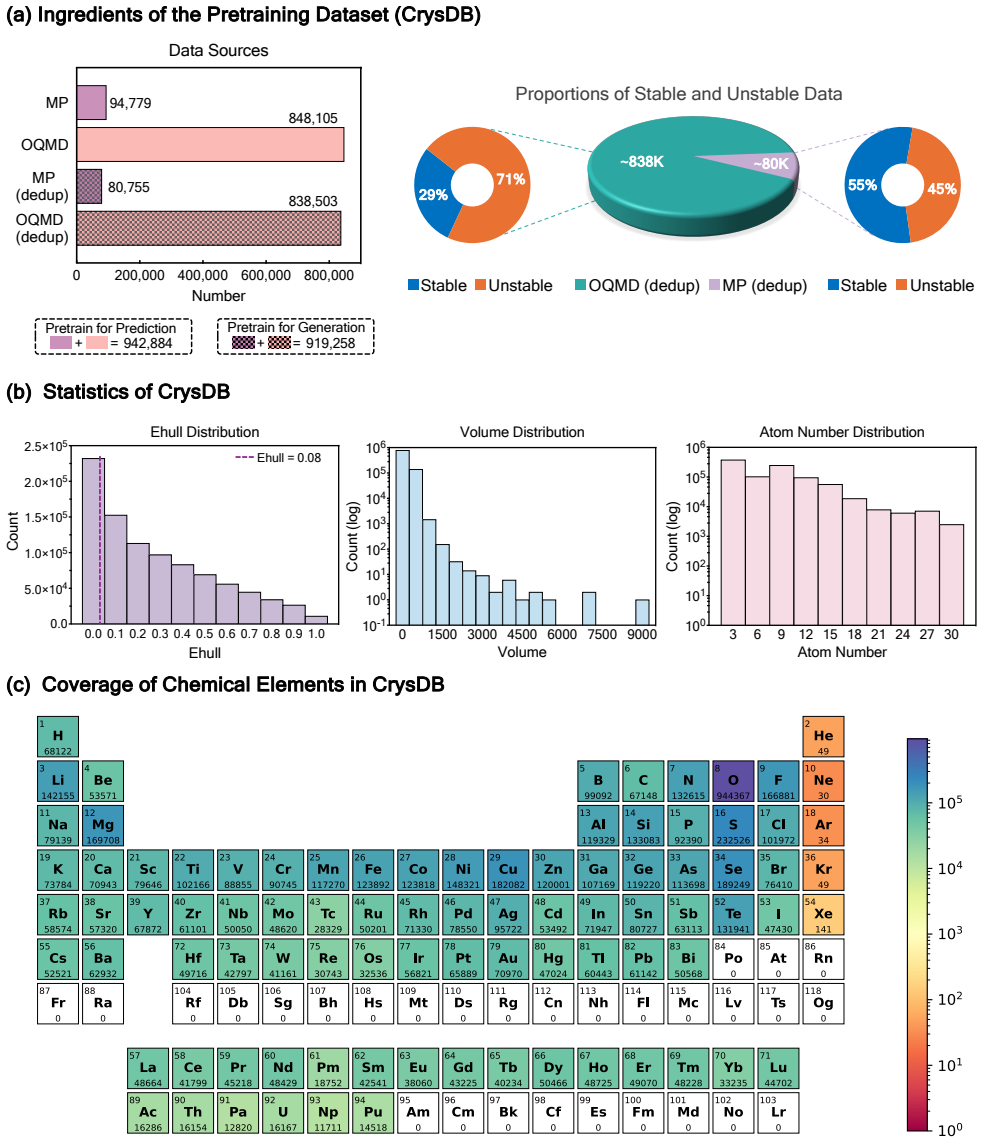
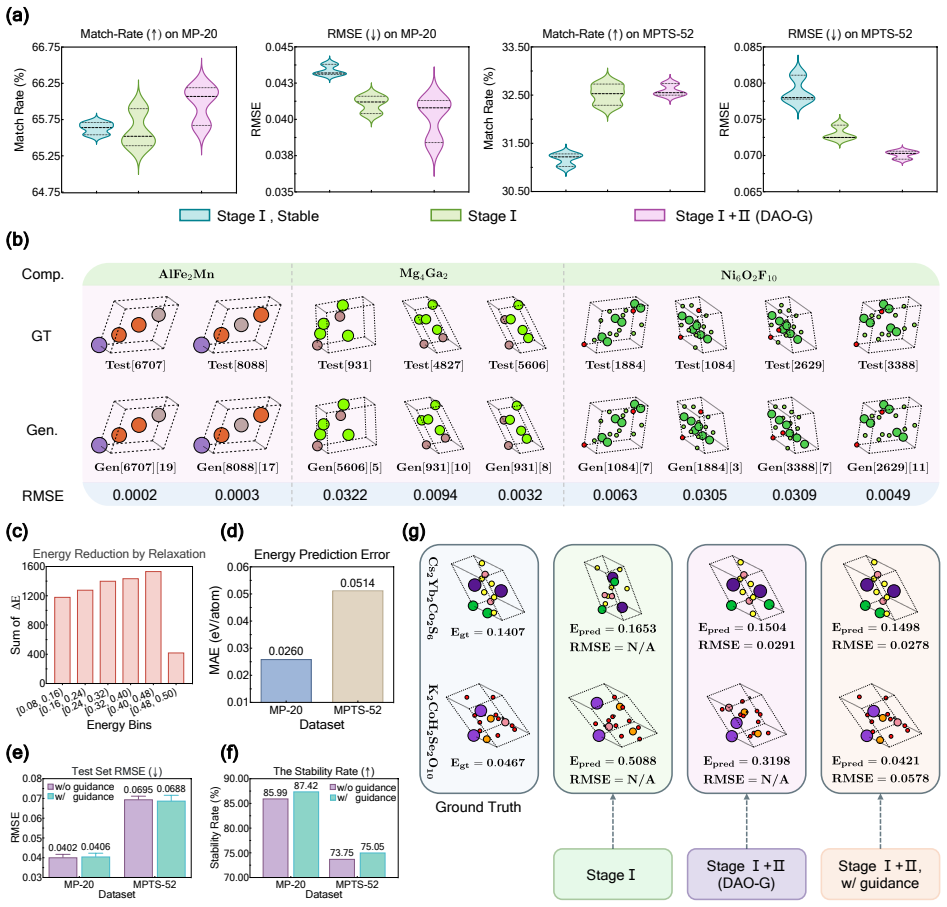
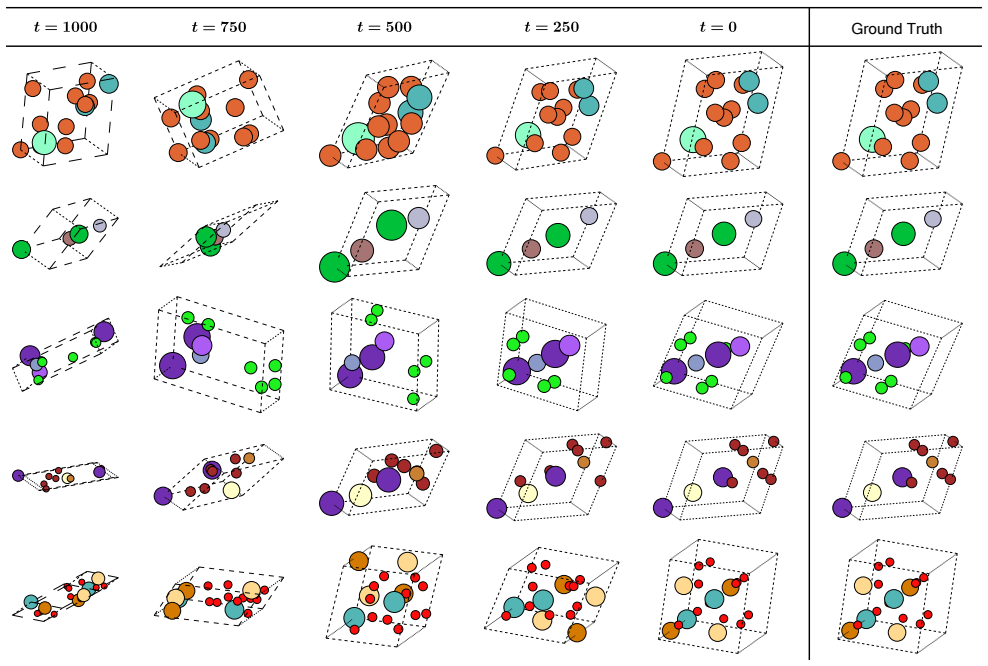
DAO integrates a diffusion-based structure generator and an energy predictor as Siamese foundation models. The generator is pretrained via a two-stage pipeline on a vast dataset of stable and unstable structures, with the predictor relaxing unstable configurations to guide generative sampling. Across benchmarks pretraining boosts performance on multiple backbones, and ablation studies confirm mutual benefit between the two models. On the real superconductor Cr6Os2 the method reaches 100 percent match with experimental references and 0.0012 atomic-position error under 20-shot generation, more than 2000 times faster per iteration than DFT-based predictors.
What carries the argument
The DAO framework of Siamese diffusion generator and energy predictor, where the predictor relaxes unstable structures to steer generative sampling.
If this is right
- Pretraining on stable and unstable data improves prediction accuracy across multiple backbone architectures on standard benchmarks.
- Ablation studies show the generator and predictor mutually reinforce each other.
- The same models reach 100 percent experimental match rate and 0.0012 position error on Cr6Os2 and comparable results on two other superconductors.
- Generation runs over 2000 times faster per iteration than DFT-based structure predictors.
Where Pith is reading between the lines
- The approach could be applied to screen far larger numbers of compositions for candidate materials before any DFT run.
- If the predictor generalizes, it might replace some relaxation steps inside existing high-throughput workflows.
- The same pretraining pattern could be tested on structure prediction tasks that involve temperature or external fields.
- Failure on a held-out real material would indicate the need for larger or more diverse pretraining sets.
Load-bearing premise
Models pretrained on the collection of stable and unstable structures will generalize accurately to real-world materials outside the training distribution.
What would settle it
A new composition whose experimentally determined structure differs substantially from any structure generated by the pretrained DAO model under the reported sampling protocol.
Figures



read the original abstract
Predicting crystal structures from chemical compositions is a fundamental challenge in materials discovery, complicated by complex 3D geometries that distinguish it from fields like protein folding. Here, we present Diffusion-based Crystal Omni (DAO), a pretrain-finetune framework for crystal structure prediction integrating two Siamese foundation models: a structure generator and an energy predictor. The generator is pretrained via a two-stage pipeline on a vast dataset of stable and unstable structures, leveraging the predictor to relax unstable configurations and guide the generative sampling. Across two well-known benchmarks, pretraining significantly enhances performance across multiple backbone architectures. Ablation studies confirm that the synergy between the generator and predictor mutually benefits both components. We further validate DAO on three real-world superconductors ($\text{Cr}_6\text{Os}_2$, $\text{Zr}_{16}\text{Rh}_8\text{O}_4$, and $\text{Zr}_{16}\text{Pd}_8\text{O}_4$) typically inaccessible to conventional computation. For $\text{Cr}_6\text{Os}_2$, DAO achieves a 100\% match rate with experimental references and an atomic-position error of 0.0012 under 20-shot generation, performing over 2000$\times$ faster per iteration than DFT-based structure predictors. These compelling results collectively highlight the potential of our approach for advancing materials science research.
Editorial analysis
A structured set of objections, weighed in public.
Referee Report
Summary. The manuscript presents Diffusion-based Crystal Omni (DAO), a pretrain-finetune framework that integrates two Siamese foundation models—a structure generator pretrained via a two-stage pipeline on stable and unstable structures and an energy predictor used to relax unstable configurations during generative sampling. The paper claims that pretraining enhances performance across multiple backbone architectures on two benchmarks, that ablation studies confirm mutual benefits between generator and predictor, and that the approach achieves 100% match rate with experimental references and 0.0012 atomic-position error for Cr6Os2 (plus results on two Zr-based superconductors) under 20-shot generation while being over 2000× faster per iteration than DFT-based predictors.
Significance. If the generalization claims hold, the work could meaningfully accelerate materials discovery for complex compositions by replacing expensive DFT relaxations with fast learned sampling and relaxation. The two-stage pretraining on both stable and unstable structures plus the Siamese predictor-generator coupling is a concrete technical idea whose value would be established by the reported benchmark gains and real-world matches.
major comments (2)
- [Results on real-world validation] Results section on real-world superconductors: the 100% match rate and 0.0012 position error for Cr6Os2 under 20-shot generation is offered as evidence that the framework works on materials “typically inaccessible to conventional computation,” yet no overlap statistics between the three test compositions and the pretraining distribution, no leave-one-family-out protocol, and no analysis of predictor behavior on out-of-manifold proposals are supplied; without these the numerical result cannot confirm the claimed extrapolation.
- [Methods on pretraining pipeline] Methods on the two-stage pretraining pipeline: the claim that the predictor “guides the generative sampling” by relaxing unstable configurations is central to the synergy argument, but the manuscript provides no quantitative characterization (e.g., predictor error distribution or success rate) of how the predictor behaves when the generator proposes structures far from the pretraining manifold.
minor comments (2)
- [Abstract] Abstract: the two “well-known benchmarks” are never named; this information should appear in the first paragraph of the results or methods.
- [Abstract] Abstract and methods: dataset sizes, exact model architectures, and training hyperparameters are omitted, which impedes immediate assessment of reproducibility even if the central claims are later supported.
Simulated Author's Rebuttal
We thank the referee for the constructive comments. We address each major point below and indicate where revisions will be made.
read point-by-point responses
-
Referee: [Results on real-world validation] Results section on real-world superconductors: the 100% match rate and 0.0012 position error for Cr6Os2 under 20-shot generation is offered as evidence that the framework works on materials “typically inaccessible to conventional computation,” yet no overlap statistics between the three test compositions and the pretraining distribution, no leave-one-family-out protocol, and no analysis of predictor behavior on out-of-manifold proposals are supplied; without these the numerical result cannot confirm the claimed extrapolation.
Authors: We agree that overlap statistics would better contextualize the results. In the revised manuscript we will add compositional similarity metrics (e.g., element-frequency overlap and space-group distribution) between Cr6Os2, Zr16Rh8O4, Zr16Pd8O4 and the pretraining set. A full leave-one-family-out protocol is not part of the standard benchmarks used in the field and would require new large-scale experiments; we will instead expand the discussion of chemical-family membership. For predictor behavior on out-of-manifold proposals, the two-stage pretraining on unstable structures is intended to improve robustness; we will add a quantitative error-distribution analysis on the generated real-world samples. revision: partial
-
Referee: [Methods on pretraining pipeline] Methods on the two-stage pretraining pipeline: the claim that the predictor “guides the generative sampling” by relaxing unstable configurations is central to the synergy argument, but the manuscript provides no quantitative characterization (e.g., predictor error distribution or success rate) of how the predictor behaves when the generator proposes structures far from the pretraining manifold.
Authors: We accept that additional quantitative detail is needed. The revised methods section will report the predictor’s error distribution and relaxation success rate on structures proposed by the generator during sampling, including cases distant from the pretraining manifold, using statistics collected from the ablation experiments already performed. revision: yes
Circularity Check
No circularity; empirical results on external benchmarks
full rationale
The paper describes a pretrain-finetune ML framework evaluated on standard benchmarks and three external experimental compositions (Cr6Os2 etc.). No equations, derivations, or first-principles steps are presented that reduce claimed performance metrics to fitted parameters or self-referential definitions by construction. Ablation studies and match-rate numbers are reported against held-out or real-world references, keeping the derivation chain independent of its own inputs.
Axiom & Free-Parameter Ledger
Reference graph
Works this paper leans on
-
[1]
https://doi.org/10.48505/nims.3739, 2022
Supercon database. https://doi.org/10.48505/nims.3739, 2022
-
[2]
Josh Abramson, Jonas Adler, Jack Dunger, Richard Evans, Tim Green, Alexander Pritzel, Olaf Ronneberger, Lindsay Willmore, Andrew J Ballard, Joshua Bambrick, et al. Accurate structure prediction of biomolecular interactions with alphafold 3.Nature, 630(8016):493–500, 2024
work page 2024
-
[3]
Josh Achiam, Steven Adler, Sandhini Agarwal, Lama Ahmad, Ilge Akkaya, Florencia Leoni Aleman, Diogo Almeida, Janko Altenschmidt, Sam Altman, Shyamal Anadkat, et al. Gpt-4 technical report. arXiv preprint arXiv:2303.08774, 2023
work page internal anchor Pith review Pith/arXiv arXiv 2023
-
[4]
Equivariant energy-guided sde for inverse molecular design
Fan Bao, Min Zhao, Zhongkai Hao, Peiyao Li, Chongxuan Li, and Jun Zhu. Equivariant energy-guided sde for inverse molecular design. InThe eleventh international conference on learning representations, 2022
work page 2022
-
[5]
Microscopic theory of superconductivity
John Bardeen, Leon N Cooper, and J Robert Schrieffer. Microscopic theory of superconductivity. Physical Review, 106(1):162, 1957
work page 1957
-
[6]
A foundation model for atomistic materials chemistry
Ilyes Batatia, Philipp Benner, Yuan Chiang, Alin M Elena, Dávid P Kovács, Janosh Riebesell, Xavier R Advincula, Mark Asta, Matthew Avaylon, William J Baldwin, et al. A foundation model for atomistic materials chemistry.arXiv preprint arXiv:2401.00096, 2023
work page internal anchor Pith review Pith/arXiv arXiv 2023
-
[7]
The inorganic crystal structure data base
Guenter Bergerhoff, R Hundt, R Sievers, and ID Brown. The inorganic crystal structure data base. Journal of chemical information and computer sciences, 23(2):66–69, 1983. 19/25
work page 1983
-
[8]
On the Opportunities and Risks of Foundation Models
Rishi Bommasani, Drew A Hudson, Ehsan Adeli, Russ Altman, Simran Arora, Sydney von Arx, Michael S Bernstein, Jeannette Bohg, Antoine Bosselut, Emma Brunskill, et al. On the opportunities and risks of foundation models.arXiv preprint arXiv:2108.07258, 2021
work page internal anchor Pith review Pith/arXiv arXiv 2021
-
[9]
Tom Brown, Benjamin Mann, Nick Ryder, Melanie Subbiah, Jared D Kaplan, Prafulla Dhariwal, Arvind Neelakantan, Pranav Shyam, Girish Sastry, Amanda Askell, et al. Language models are few-shot learners.Advances in neural information processing systems, 33:1877–1901, 2020
work page 1901
-
[10]
Chi Chen, Weike Ye, Yunxing Zuo, Chen Zheng, and Shyue Ping Ong. Graph networks as a universal machine learning framework for molecules and crystals.Chemistry of Materials, 31 (9):3564–3572, 2019
work page 2019
-
[11]
Learning superconductivity from ordered and disordered material structures
Pin Chen, Luoxuan Peng, Rui Jiao, Qing Mo, Zhen Wang, Wenbing Huang, Yang Liu, and Yutong Lu. Learning superconductivity from ordered and disordered material structures. Advances in Neural Information Processing Systems, 37:108902–108928, 2025
work page 2025
-
[12]
Kamal Choudhary and Brian DeCost. Atomistic line graph neural network for improved materials property predictions.npj Computational Materials, 7(1):185, 2021
work page 2021
-
[13]
Kamal Choudhary, Irina Kalish, Ryan Beams, and Francesca Tavazza. High-throughput identification and characterization of two-dimensional materials using density functional theory. Scientific reports, 7(1):5179, 2017
work page 2017
-
[14]
Kamal Choudhary, Kevin F Garrity, Andrew CE Reid, Brian DeCost, Adam J Biacchi, Angela R Hight Walker, Zachary Trautt, Jason Hattrick-Simpers, A Gilad Kusne, Andrea Centrone, et al. The joint automated repository for various integrated simulations (jarvis) for data-driven materials design.npj computational materials, 6(1):173, 2020
work page 2020
-
[15]
Kamal Choudhary, Daniel Wines, Kangming Li, Kevin F Garrity, Vishu Gupta, Aldo H Romero, Jaron T Krogel, Kayahan Saritas, Addis Fuhr, Panchapakesan Ganesh, et al. Jarvis-leaderboard: a large scale benchmark of materials design methods.npj Computational Materials, 10(1):93, 2024
work page 2024
-
[16]
Crystal stability and the theory of ferroelectricity.Advances in Physics, 9(36): 387–423, 1960
W Cochran. Crystal stability and the theory of ferroelectricity.Advances in Physics, 9(36): 387–423, 1960
work page 1960
-
[17]
Callum J Court, Batuhan Yildirim, Apoorv Jain, and Jacqueline M Cole. 3-d inorganic crystal structure generation and property prediction via representation learning.Journal of Chemical Information and Modeling, 60(10):4518–4535, 2020
work page 2020
-
[18]
Crysgnn: Distilling pre-trained knowledge to enhance property prediction for crystalline materials
Kishalay Das, Bidisha Samanta, Pawan Goyal, Seung-Cheol Lee, Satadeep Bhattacharjee, and Niloy Ganguly. Crysgnn: Distilling pre-trained knowledge to enhance property prediction for crystalline materials. InProceedings of the AAAI Conference on Artificial Intelligence, volume 37, pages 7323–7331, 2023
work page 2023
-
[19]
Valentin De Bortoli, Emile Mathieu, Michael Hutchinson, James Thornton, Yee Whye Teh, and Arnaud Doucet. Riemannian score-based generative modelling.Advances in Neural Information Processing Systems, 35:2406–2422, 2022. 20/25
work page 2022
-
[20]
Maarten De Jong, Wei Chen, Thomas Angsten, Anubhav Jain, Randy Notestine, Anthony Gamst, Marcel Sluiter, Chaitanya Krishna Ande, Sybrand Van Der Zwaag, Jose J Plata, et al. Charting the complete elastic properties of inorganic crystalline compounds.Scientific data, 2 (1):1–13, 2015
work page 2015
-
[21]
Cryptic crystallography.Nature materials, 1(2):77–79, 2002
Gautam R Desiraju. Cryptic crystallography.Nature materials, 1(2):77–79, 2002
work page 2002
-
[22]
Alexander Dunn, Qi Wang, Alex Ganose, Daniel Dopp, and Anubhav Jain. Benchmarking materials property prediction methods: the matbench test set and automatminer reference algorithm. npj Computational Materials, 6(1):138, 2020
work page 2020
-
[23]
Jun Ge, Pinyuan Wang, Ying Xing, Qiangwei Yin, Anqi Wang, Jie Shen, Hechang Lei, Ziqiang Wang, and Jian Wang. Charge-4 e and charge-6 e flux quantization and higher charge superconductivity in kagome superconductor ring devices.Physical Review X, 14(2):021025, 2024
work page 2024
-
[24]
Inverse design of 3d molecular structures with conditional generative neural networks
Niklas WA Gebauer, Michael Gastegger, Stefaan SP Hessmann, Klaus-Robert Müller, and Kristof T Schütt. Inverse design of 3d molecular structures with conditional generative neural networks. Nature communications, 13(1):973, 2022
work page 2022
-
[25]
Quantum espresso: a modular and open-source software project for quantumsimulations of materials
Paolo Giannozzi, Stefano Baroni, Nicola Bonini, Matteo Calandra, Roberto Car, Carlo Cavaz- zoni, Davide Ceresoli, Guido L Chiarotti, Matteo Cococcioni, Ismaila Dabo, et al. Quantum espresso: a modular and open-source software project for quantumsimulations of materials. Journal of physics: Condensed matter, 21(39):395502, 2009
work page 2009
-
[26]
Paolo Giannozzi, Oliviero Andreussi, Thomas Brumme, Oana Bunau, M Buongiorno Nardelli, Matteo Calandra, Roberto Car, Carlo Cavazzoni, Davide Ceresoli, Matteo Cococcioni, et al. Advanced capabilities for materials modelling with quantum espresso.Journal of physics: Condensed matter, 29(46):465901, 2017
work page 2017
-
[27]
Deep residual learning for image recognition
Kaiming He, Xiangyu Zhang, Shaoqing Ren, and Jian Sun. Deep residual learning for image recognition. In Proceedings of the IEEE conference on computer vision and pattern recognition, pages 770–778, 2016
work page 2016
-
[28]
Jonathan Ho, Ajay Jain, and Pieter Abbeel. Denoising diffusion probabilistic models.Advances in neural information processing systems, 33:6840–6851, 2020
work page 2020
-
[29]
Video diffusion models.Advances in Neural Information Processing Systems, 35:8633–8646, 2022
Jonathan Ho, Tim Salimans, Alexey Gritsenko, William Chan, Mohammad Norouzi, and David J Fleet. Video diffusion models.Advances in Neural Information Processing Systems, 35:8633–8646, 2022
work page 2022
-
[30]
Equivariant diffusion for molecule generation in 3d
Emiel Hoogeboom, Vıctor Garcia Satorras, Clément Vignac, and Max Welling. Equivariant diffusion for molecule generation in 3d. InInternational conference on machine learning, pages 8867–8887. PMLR, 2022
work page 2022
-
[31]
Jianjun Hu, Wenhui Yang, and Edirisuriya M Dilanga Siriwardane. Distance matrix-based crystal structure prediction using evolutionary algorithms.The Journal of Physical Chemistry A, 124(51):10909–10919, 2020. 21/25
work page 2020
-
[32]
Mdm: Molecular diffusion model for 3d molecule generation
Lei Huang, Hengtong Zhang, Tingyang Xu, and Ka-Chun Wong. Mdm: Molecular diffusion model for 3d molecule generation. In Proceedings of the AAAI Conference on Artificial Intelligence, volume 37, pages 5105–5112, 2023
work page 2023
-
[33]
The materials project: a materials genome approach to accelerating materials innovation
A Jain, SP Ong, G Hautier, W Chen, WD Richards, S Dacek, S Cholia, D Gunter, D Skinner, G Ceder, et al. The materials project: a materials genome approach to accelerating materials innovation. apl mater 1: 011002, 2013
work page 2013
-
[34]
Planning with diffusion for flexible behavior synthesis
Michael Janner, Yilun Du, Joshua Tenenbaum, and Sergey Levine. Planning with diffusion for flexible behavior synthesis. InInternational Conference on Machine Learning, pages 9902–9915. PMLR, 2022
work page 2022
-
[35]
Rui Jiao, Wenbing Huang, Peijia Lin, Jiaqi Han, Pin Chen, Yutong Lu, and Yang Liu. Crystal structure prediction by joint equivariant diffusion.Advances in Neural Information Processing Systems, 36, 2024
work page 2024
-
[36]
Space group constrained crystal generation
Rui Jiao, Wenbing Huang, Yu Liu, Deli Zhao, and Yang Liu. Space group constrained crystal generation. In The Twelfth International Conference on Learning Representations, 2024
work page 2024
-
[37]
Highly accurate protein structure prediction with alphafold.nature, 596(7873):583–589, 2021
John Jumper, Richard Evans, Alexander Pritzel, Tim Green, Michael Figurnov, Olaf Ron- neberger, Kathryn Tunyasuvunakool, Russ Bates, Augustin Žídek, Anna Potapenko, et al. Highly accurate protein structure prediction with alphafold.nature, 596(7873):583–589, 2021
work page 2021
-
[38]
Scott Kirklin, James E Saal, Bryce Meredig, Alex Thompson, Jeff W Doak, Muratahan Aykol, Stephan Rühl, and Chris Wolverton. The open quantum materials database (oqmd): assessing the accuracy of dft formation energies.npj Computational Materials, 1(1):1–15, 2015
work page 2015
-
[39]
Self-consistent equations including exchange and correlation effects
Walter Kohn and Lu Jeu Sham. Self-consistent equations including exchange and correlation effects. Physical review, 140(4A):A1133, 1965
work page 1965
-
[40]
Graph contrastive learning for materials.arXiv preprint arXiv:2211.13408, 2022
Teddy Koker, Keegan Quigley, Will Spaeth, Nathan C Frey, and Lin Li. Graph contrastive learning for materials.arXiv preprint arXiv:2211.13408, 2022
-
[41]
Quantum computers.nature, 464(7285):45–53, 2010
Thaddeus D Ladd, Fedor Jelezko, Raymond Laflamme, Yasunobu Nakamura, Christopher Monroe, and Jeremy Lloyd O’Brien. Quantum computers.nature, 464(7285):45–53, 2010
work page 2010
-
[42]
Jane H Larsen and Ib Chorkendorff. From fundamental studies of reactivity on single crystals to the design of catalysts.Surface Science Reports, 35(5-8):163–222, 1999
work page 1999
-
[43]
Statistical physics, course of theoretical physics
EM Lifshitz and LP Pitaevskii. Statistical physics, course of theoretical physics. InPart 2: Theory of the Condensed State, volume 9. Butterworth-Heinemann Pergamon, London, 1980
work page 1980
-
[44]
Equivariant diffusion for crystal structure prediction
Peijia Lin, Pin Chen, Rui Jiao, Qing Mo, Cen Jianhuan, Wenbing Huang, Yang Liu, Dan Huang, and Yutong Lu. Equivariant diffusion for crystal structure prediction. InForty-first International Conference on Machine Learning, 2024
work page 2024
-
[45]
Efficient ap- proximations of complete interatomic potentials for crystal property prediction
Yuchao Lin, Keqiang Yan, Youzhi Luo, Yi Liu, Xiaoning Qian, and Shuiwang Ji. Efficient ap- proximations of complete interatomic potentials for crystal property prediction. InInternational Conference on Machine Learning, pages 21260–21287. PMLR, 2023. 22/25
work page 2023
-
[46]
Flow Matching for Generative Modeling
Yaron Lipman, Ricky TQ Chen, Heli Ben-Hamu, Maximilian Nickel, and Matt Le. Flow matching for generative modeling.arXiv preprint arXiv:2210.02747, 2022
work page internal anchor Pith review Pith/arXiv arXiv 2022
-
[47]
DeepSeek-V2: A Strong, Economical, and Efficient Mixture-of-Experts Language Model
Aixin Liu, Bei Feng, Bin Wang, Bingxuan Wang, Bo Liu, Chenggang Zhao, Chengqi Dengr, Chong Ruan, Damai Dai, Daya Guo, et al. Deepseek-v2: A strong, economical, and efficient mixture-of-experts language model.arXiv preprint arXiv:2405.04434, 2024
work page internal anchor Pith review Pith/arXiv arXiv 2024
-
[48]
Aixin Liu, Bei Feng, Bing Xue, Bingxuan Wang, Bochao Wu, Chengda Lu, Chenggang Zhao, Chengqi Deng, Chenyu Zhang, Chong Ruan, et al. Deepseek-v3 technical report.arXiv preprint arXiv:2412.19437, 2024
work page internal anchor Pith review Pith/arXiv arXiv 2024
-
[49]
On the limited memory bfgs method for large scale optimization
Dong C Liu and Jorge Nocedal. On the limited memory bfgs method for large scale optimization. Mathematical programming, 45(1):503–528, 1989
work page 1989
-
[50]
Cheng Lu, Huayu Chen, Jianfei Chen, Hang Su, Chongxuan Li, and Jun Zhu. Contrastive energy prediction for exact energy-guided diffusion sampling in offline reinforcement learning. In International Conference on Machine Learning, pages 22825–22855. PMLR, 2023
work page 2023
-
[51]
One transformer can understand both 2d & 3d molecular data
Shengjie Luo, Tianlang Chen, Yixian Xu, Shuxin Zheng, Tie-Yan Liu, Liwei Wang, and Di He. One transformer can understand both 2d & 3d molecular data. InThe Eleventh International Conference on Learning Representations, 2022
work page 2022
-
[52]
Xiaoshan Luo, Zhenyu Wang, Jian Lv, Lei Wang, Yanchao Wang, and Yanming Ma. Crystalflow: A flow-based generative model for crystalline materials.arXiv preprint arXiv:2412.11693, 2024
-
[53]
Andriy O Lyakhov, Artem R Oganov, Harold T Stokes, and Qiang Zhu. New developments in evolutionary structure prediction algorithm uspex.Computer Physics Communications, 184 (4):1172–1182, 2013
work page 2013
-
[54]
Rishikesh Magar, Yuyang Wang, and Amir Barati Farimani. Crystal twins: self-supervised learning for crystalline material property prediction.npj Computational Materials, 8(1):231, 2022
work page 2022
-
[55]
Scaling deep learning for materials discovery.Nature, 624(7990):80–85, 2023
Amil Merchant, Simon Batzner, Samuel S Schoenholz, Muratahan Aykol, Gowoon Cheon, and Ekin Dogus Cubuk. Scaling deep learning for materials discovery.Nature, 624(7990):80–85, 2023
work page 2023
-
[56]
Benjamin Kurt Miller, Ricky T. Q. Chen, Anuroop Sriram, and Brandon M Wood. FlowMM: Generating materials with riemannian flow matching. InForty-first International Conference on Machine Learning, 2024
work page 2024
-
[57]
Self-supervised learning for crystal property prediction via denoising
Alexander New, Nam Q Le, Michael Pekala, and Christopher D Stiles. Self-supervised learning for crystal property prediction via denoising. InICML 2024 AI for Science Workshop, 2021
work page 2024
-
[58]
CrystalGAN: Learning to Discover Crystallographic Structures with Generative Adversarial Networks
Asma Nouira, Nataliya Sokolovska, and Jean-Claude Crivello. Crystalgan: learning to discover crystallographic structures with generative adversarial networks. arXiv preprint arXiv:1810.11203, 2018
work page internal anchor Pith review Pith/arXiv arXiv 2018
-
[59]
Artem R Oganov and Colin W Glass. Crystal structure prediction using ab initio evolutionary techniques: Principles and applications.The Journal of chemical physics, 124(24), 2006. 23/25
work page 2006
-
[60]
Python materials genomics (pymatgen): A robust, open-source python library for materials analysis
Shyue Ping Ong, William Davidson Richards, Anubhav Jain, Geoffroy Hautier, Michael Kocher, Shreyas Cholia, Dan Gunter, Vincent L Chevrier, Kristin A Persson, and Gerbrand Ceder. Python materials genomics (pymatgen): A robust, open-source python library for materials analysis. Computational Materials Science, 68:314–319, 2013
work page 2013
-
[61]
Jean Pannetier, J Bassas-Alsina, Juan Rodriguez-Carvajal, and Vincent Caignaert. Prediction of crystal structures from crystal chemistry rules by simulated annealing.Nature, 346(6282): 343–345, 1990
work page 1990
-
[62]
Pytorch: An imperative style, high-performance deep learning library
Adam Paszke, Sam Gross, Francisco Massa, Adam Lerer, James Bradbury, Gregory Chanan, Trevor Killeen, Zeming Lin, Natalia Gimelshein, Luca Antiga, et al. Pytorch: An imperative style, high-performance deep learning library. Advances in neural information processing systems, 32, 2019
work page 2019
-
[63]
Ioannis Petousis, David Mrdjenovich, Eric Ballouz, Miao Liu, Donald Winston, Wei Chen, Tanja Graf, Thomas D Schladt, Kristin A Persson, and Fritz B Prinz. High-throughput screening of inorganic compounds for the discovery of novel dielectric and optical materials. Scientific data, 4(1):1–12, 2017
work page 2017
-
[64]
Ab initio random structure searching.Journal of Physics: Condensed Matter, 23(5):053201, 2011
Chris J Pickard and RJ Needs. Ab initio random structure searching.Journal of Physics: Condensed Matter, 23(5):053201, 2011
work page 2011
-
[65]
Kristof Schütt, Pieter-Jan Kindermans, Huziel Enoc Sauceda Felix, Stefan Chmiela, Alexandre Tkatchenko, and Klaus-Robert Müller. Schnet: A continuous-filter convolutional neural network for modeling quantum interactions.Advances in neural information processing systems, 30, 2017
work page 2017
-
[66]
Andrew W Senior, Richard Evans, John Jumper, James Kirkpatrick, Laurent Sifre, Tim Green, Chongli Qin, Augustin Žídek, Alexander WR Nelson, Alex Bridgland, et al. Improved protein structure prediction using potentials from deep learning.Nature, 577(7792):706–710, 2020
work page 2020
-
[67]
Yang Song, Conor Durkan, Iain Murray, and Stefano Ermon. Maximum likelihood training of score-based diffusion models.Advances in neural information processing systems, 34:1415–1428, 2021
work page 2021
-
[68]
Attention is all you need.Advances in Neural Information Processing Systems, 2017
A Vaswani. Attention is all you need.Advances in Neural Information Processing Systems, 2017
work page 2017
-
[69]
David J Wales. Energy landscapes and structure prediction using basin-hopping.Modern Methods of Crystal Structure Prediction, pages 29–54, 2010
work page 2010
-
[70]
Organic semiconductor crystals
Chengliang Wang, Huanli Dong, Lang Jiang, and Wenping Hu. Organic semiconductor crystals. Chemical Society Reviews, 47(2):422–500, 2018
work page 2018
-
[71]
Protein conformation generation via force-guided se (3) diffusion models
Lihao Wang, Yuning Shen, Yiqun Wang, Huizhuo Yuan, Yue Wu, Quanquan Gu, et al. Protein conformation generation via force-guided se (3) diffusion models. InForty-first International Conference on Machine Learning, 2024
work page 2024
-
[72]
Calypso: A method for crystal structure prediction
Yanchao Wang, Jian Lv, Li Zhu, and Yanming Ma. Calypso: A method for crystal structure prediction. Computer Physics Communications, 183(10):2063–2070, 2012. 24/25
work page 2063
-
[73]
Observation of superconductivity and enhanced upper critical field ofη-carbide-type oxide zr4pd2o
Yuto Watanabe, Akira Miura, Chikako Moriyoshi, Aichi Yamashita, and Yoshikazu Mizuguchi. Observation of superconductivity and enhanced upper critical field ofη-carbide-type oxide zr4pd2o. Scientific Reports, 13(1):22458, 2023
work page 2023
-
[74]
Cambridge university press, 1991
David Williams.Probability with martingales. Cambridge university press, 1991
work page 1991
-
[75]
Tian Xie and Jeffrey C Grossman. Crystal graph convolutional neural networks for an accurate and interpretable prediction of material properties.Physical review letters, 120(14):145301, 2018
work page 2018
- [76]
-
[77]
On layer normalization in the transformer architecture
Ruibin Xiong, Yunchang Yang, Di He, Kai Zheng, Shuxin Zheng, Chen Xing, Huishuai Zhang, Yanyan Lan, Liwei Wang, and Tieyan Liu. On layer normalization in the transformer architecture. InInternational Conference on Machine Learning, pages 10524–10533. PMLR, 2020
work page 2020
-
[78]
Keqiang Yan, Yi Liu, Yuchao Lin, and Shuiwang Ji. Periodic graph transformers for crystal material property prediction.Advances in Neural Information Processing Systems, 35:15066– 15080, 2022
work page 2022
-
[79]
MatterSim: A Deep Learning Atomistic Model Across Elements, Temperatures and Pressures
Han Yang, Chenxi Hu, Yichi Zhou, Xixian Liu, Yu Shi, Jielan Li, Guanzhi Li, Zekun Chen, Shuizhou Chen, Claudio Zeni, et al. Mattersim: A deep learning atomistic model across elements, temperatures and pressures.arXiv preprint arXiv:2405.04967, 2024
work page internal anchor Pith review Pith/arXiv arXiv 2024
-
[80]
Haomin Yu, Yanru Song, Jilin Hu, Chenjuan Guo, and Bin Yang. A crystal-specific pre-training framework for crystal material property prediction.arXiv preprint arXiv:2306.05344, 2023
discussion (0)
Sign in with ORCID, Apple, or X to comment. Anyone can read and Pith papers without signing in.