Distinct Signatures of the Nature of Phase Transition in Binary Neutron Star Mergers
Pith reviewed 2026-05-22 22:49 UTC · model grok-4.3
The pith
A single control parameter on mixed-phase extent imprints unique peaks in post-merger gravitational-wave spectra and correlates with the prompt-collapse threshold mass.
A machine-rendered reading of the paper's core claim, the machinery that carries it, and where it could break.
Core claim
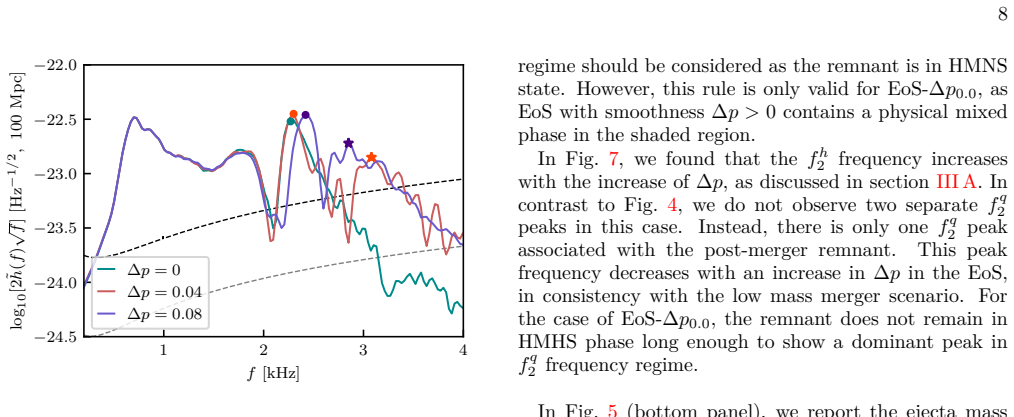
Using a polytropic family of equations of state parameterized by Δp that interpolates between Maxwell and Gibbs constructions for the hadron-quark phase transition, the post-merger gravitational-wave signals exhibit additional peaks in the power spectral density that arise exclusively from the presence of a mixed phase, and the spectrograms display characteristic two-folded patterns; moreover, smaller values of Δp correlate with higher threshold masses for prompt collapse, requiring Δp ≲ 0.04 for consistency with a long-lived or delayed-collapse remnant in GW170817.
What carries the argument
The control parameter Δp in a one-parameter polytropic family of equations of state that measures the extent of the mixed phase during the hadron-quark transition.
If this is right
- Additional peaks appear in the power spectral density exclusively when the remnant experiences a phase transition with mixed phases.
- The spectrogram displays a two-folded signature tied to the phase transition.
- A direct correlation is established between the value of Δp and the threshold mass for prompt collapse.
- If GW170817 formed a long-lived remnant or experienced delayed collapse, then Δp must be ≲ 0.04.
Where Pith is reading between the lines
- Future gravitational-wave detections could use the presence or absence of these peaks to infer the mixed-phase extent without full reconstruction of the equation of state.
- The correlation with prompt-collapse threshold may help interpret the outcomes of other merger events in terms of their interior composition.
- Extending the approach to other types of phase transitions could provide a general method for identifying phase changes through gravitational-wave data.
Load-bearing premise
The one-parameter polytropic family with Δp accurately represents the range of hadron-quark phase transitions and produces gravitational-wave signatures uniquely attributable to the mixed-phase extent.
What would settle it
A post-merger gravitational-wave signal from a binary neutron-star merger near the collapse threshold that lacks the additional power spectral density peaks predicted for mixed-phase equations of state would falsify the uniqueness of these signatures.
Figures




read the original abstract
Binary neutron-star mergers offer crucial insights into the matter properties of neutron stars. We present the possible imprints in the gravitational wave signal from the nature of phase transition from such events. Our study employs a one-parameter family of equation of states built using a polytropic approach with a control parameter $\Delta p$ surveying the features of hadron-quark phase transition, from Maxwell construction to the Gibbs construction. It allows us to explore the extent of mixed phases and analyse their direct impact on merger dynamics. Post-merger gravitational wave emissions reveal the expression of specific signatures in the spectrogram and power spectral density, serving as a distinct signature of equations of state with mixed phases. We found additional peaks in power spectral density that are exclusively generated from the post-merger remnant experiencing a phase transition. Additionally, the nature of phase transition leaves specific imprints on the spectrogram, leading to a two-folded signature from gravitational wave analysis. Furthermore, we establish the first correlation between $\Delta p$ and the threshold mass for prompt collapse. Our analysis shows that $\Delta p \lesssim 0.04$ is required if GW170817 formed a long-lived remnant or has experienced a delayed collapse into a black hole.
Editorial analysis
A structured set of objections, weighed in public.
Referee Report
Summary. The manuscript examines gravitational-wave imprints from binary neutron-star mergers using a one-parameter polytropic equation-of-state family controlled by Δp, which spans hadron-quark phase transitions from Maxwell to Gibbs constructions. It reports additional peaks in the post-merger power spectral density and specific spectrogram features attributed exclusively to the presence of mixed phases, establishes a correlation between Δp and the threshold mass for prompt collapse, and concludes that Δp ≲ 0.04 is required for consistency with GW170817 under long-lived-remnant or delayed-collapse scenarios.
Significance. If the reported PSD peaks and spectrogram features prove unique to the mixed-phase extent and the Δp–threshold-mass correlation survives tests against independent EOS families, the work would supply a concrete, observationally accessible diagnostic for the spatial extent of hadron-quark mixed phases, directly constraining the nature of the QCD phase transition in the density–temperature regime probed by mergers.
major comments (3)
- [Abstract] Abstract: the statement that additional PSD peaks are 'exclusively generated from the post-merger remnant experiencing a phase transition' is load-bearing for the central claim of distinct signatures, yet the one-parameter polytropic construction supplies no explicit comparison to purely hadronic EOS or to hybrid EOS constructed with different sound-speed or thermal-pressure profiles at the same post-merger densities; without such baselines the uniqueness cannot be assessed.
- [Abstract] Abstract: the reported correlation between Δp and the threshold mass for prompt collapse is presented as an independent result, but Δp is the sole control parameter that defines the entire EOS family; the correlation is therefore internal to the chosen parametrization rather than a falsifiable prediction that could be tested against other PT constructions.
- [Abstract] Abstract: the bound Δp ≲ 0.04 for GW170817 is derived from the threshold-mass correlation, but the mapping from remnant lifetime (long-lived vs. delayed collapse) to the specific value of Δp is not shown; the bound therefore rests on an unstated assumption about how the polytropic family translates into post-merger evolution timescales.
minor comments (1)
- The symbol Δp is introduced without an explicit functional definition or range; a short paragraph or equation early in the text would clarify its relation to the Maxwell–Gibbs interpolation.
Simulated Author's Rebuttal
We thank the referee for the constructive and detailed report. We address each major comment below with clarifications on the scope of our results and indicate revisions where appropriate to improve precision without overstating the findings.
read point-by-point responses
-
Referee: [Abstract] Abstract: the statement that additional PSD peaks are 'exclusively generated from the post-merger remnant experiencing a phase transition' is load-bearing for the central claim of distinct signatures, yet the one-parameter polytropic construction supplies no explicit comparison to purely hadronic EOS or to hybrid EOS constructed with different sound-speed or thermal-pressure profiles at the same post-merger densities; without such baselines the uniqueness cannot be assessed.
Authors: We agree that the claim of exclusivity would be strengthened by direct comparisons to a purely hadronic EOS and to other hybrid constructions. Within our family, the additional PSD peaks and spectrogram features appear only for Δp > 0 (indicating the presence of a mixed phase), while they are absent at the Maxwell limit (Δp = 0). We will revise the abstract and relevant sections to explicitly state that the signatures are distinct within this polytropic family and to note the limitation that other sound-speed or thermal profiles would require separate investigations. No new simulations are added at this stage. revision: partial
-
Referee: [Abstract] Abstract: the reported correlation between Δp and the threshold mass for prompt collapse is presented as an independent result, but Δp is the sole control parameter that defines the entire EOS family; the correlation is therefore internal to the chosen parametrization rather than a falsifiable prediction that could be tested against other PT constructions.
Authors: The correlation is derived within the chosen one-parameter family, as noted. However, it yields a specific, observationally testable relation between mixed-phase extent (via Δp) and the prompt-collapse threshold mass that can be confronted with GW data or tested by repeating the analysis on independent PT EOS families. We will revise the abstract and discussion to clarify that this is a prediction specific to polytropic constructions spanning Maxwell to Gibbs constructions, rather than a universal result. revision: partial
-
Referee: [Abstract] Abstract: the bound Δp ≲ 0.04 for GW170817 is derived from the threshold-mass correlation, but the mapping from remnant lifetime (long-lived vs. delayed collapse) to the specific value of Δp is not shown; the bound therefore rests on an unstated assumption about how the polytropic family translates into post-merger evolution timescales.
Authors: The bound follows directly from the reported Δp–threshold-mass correlation combined with the inferred total mass of GW170817 and the observational constraints on remnant lifetime. For Δp ≳ 0.04 the correlation predicts prompt collapse, which is inconsistent with the long-lived or delayed-collapse scenarios supported by the GW170817 signal. We will add explicit text (including a short derivation or reference to the relevant figure) in the results section and update the abstract to make this mapping transparent. revision: yes
Circularity Check
No significant circularity; derivation is simulation-driven mapping
full rationale
The paper defines a one-parameter polytropic EOS family controlled by input Δp, then runs numerical relativity simulations to extract post-merger GW features and the threshold mass for prompt collapse as functions of that input. The reported correlation Δp ≲ 0.04 with GW170817 is obtained by scanning the input parameter and recording the simulated threshold, which is an independent computational output rather than a quantity fitted to data and then re-predicted. No quoted step reduces an output to the input by algebraic identity, self-citation chain, or renaming. The assumption that the Δp family spans Maxwell-to-Gibbs constructions is stated explicitly as a modeling choice, not derived from the results themselves. The derivation therefore remains self-contained against external simulation benchmarks.
Axiom & Free-Parameter Ledger
free parameters (1)
- Δp
axioms (1)
- domain assumption A polytropic approach with one free parameter Δp suffices to survey the essential features of hadron-quark phase transitions.
Reference graph
Works this paper leans on
-
[1]
E. S. Fraga, A. Kurkela, and A. Vuorinen, Interacting quark matter equation of state for compact stars, The Astrophysical Journal 781, L25 (2014)
work page 2014
-
[2]
K. B. Fadafan, J. C. Rojas, and N. Evans, Deconfined, massive quark phase at high density and compact stars: A holographic study, Phys. Rev. D 101, 126005 (2020)
work page 2020
-
[3]
V. Dexheimer, L. T. T. Soethe, J. Roark, R. O. Gomes, S. O. Kepler, and S. Schramm, Phase transitions in neu- tron stars, International Journal of Modern Physics E 27, 1830008 (2018)
work page 2018
-
[4]
R. Somasundaram, I. Tews, and J. Margueron, Inves- tigating signatures of phase transitions in neutron-star cores, Phys. Rev. C 107, 025801 (2023)
work page 2023
-
[5]
Tolos, Dense hadronic matter in neutron stars, Acta Physica Polonica B 55, 1 (2024)
L. Tolos, Dense hadronic matter in neutron stars, Acta Physica Polonica B 55, 1 (2024)
work page 2024
-
[6]
C. Providˆ encia, T. Malik, M. B. Albino, and M. Ferreira, Relativistic description of the neutron star equation of state, in Nuclear Theory in the Age of Multimessenger Astronomy (CRC Press, 2024) p. 111–143
work page 2024
-
[7]
F. Weber, Quark matter in neutron stars, Journal of Physics G: Nuclear and Particle Physics 25, R195 (1999)
work page 1999
- [8]
-
[9]
N. Glendenning, Compact Stars: Nuclear Physics, Par- ticle Physics and General Relativity , Astronomy and As- trophysics Library (Springer New York, 2012)
work page 2012
-
[10]
H. T. Cromartie et al. , Relativistic shapiro delay mea- surements of an extremely massive millisecond pulsar, Nature Astronomy 4, 72 (2020)
work page 2020
-
[11]
M. C. Miller et al. , Psr j0030+0451 mass and radius from nicer data and implications for the properties of neutron star matter, The Astrophysical Journal Letters 887, L24 (2019)
work page 2019
-
[12]
T. E. Riley et al. , A nicer view of psr j0030+0451: Mil- lisecond pulsar parameter estimation, The Astrophysi- cal Journal 887, L21 (2019)
work page 2019
-
[13]
J. Antoniadis et al. , A massive pulsar in a com- pact relativistic binary, Science 340, 1233232 (2013), https://www.science.org/doi/pdf/10.1126/science.1233232
-
[14]
E. Fonseca et al. , Refined mass and geometric measure- ments of the high-mass psr j0740+6620, The Astrophys- ical Journal Letters 915, L12 (2021)
work page 2021
-
[15]
M. C. Miller et al. , The radius of psr j0740+6620 from nicer and xmm-newton data, The Astrophysical Journal Letters 918, L28 (2021)
work page 2021
-
[16]
T. E. Riley et al. , A nicer view of the massive pulsar psr j0740+6620 informed by radio timing and xmm-newton spectroscopy, The Astrophysical Journal Letters 918, L27 (2021)
work page 2021
-
[17]
N. K. Glendenning, First-order phase transitions with more than one conserved charge: Consequences for neu- tron stars, Phys. Rev. D 46, 1274 (1992)
work page 1992
-
[18]
M. Alford, Color-superconducting quark matter, An- nual Review of Nuclear and Particle Science 51, 131 (2001)
work page 2001
- [19]
-
[20]
high-mass twin compact stars, A&A 577, A40 (2015)
Beni´c, Sanjin, Blaschke, David, Alvarez-Castillo, David E., Fischer, Tobias, and Typel, Stefan, A new quark-hadron hybrid equation of state for astrophysics - i. high-mass twin compact stars, A&A 577, A40 (2015)
work page 2015
-
[21]
A. V. Olinto, On the conversion of neutron stars into strange stars, Physics Letters B 192, 71 (1987). 13
work page 1987
-
[22]
A. Bhattacharyya, S. K. Ghosh, P. S. Joarder, R. Mallick, and S. Raha, Conversion of a neutron star to a strange star: A two-step process, Phys. Rev. C 74, 065804 (2006)
work page 2006
-
[23]
A. Bhattacharyya, S. K. Ghosh, R. Mallick, and S. Raha, General relativistic effects on the conversion of nuclear to two-flavor quark matter in compact stars, Phys. Rev. C 76, 052801 (2007)
work page 2007
- [24]
- [25]
-
[26]
D. Blaschke, F. Sandin, T. Kl¨ ahn, and J. Berdermann, Sequential deconfinement of quark flavors in neutron stars, Phys. Rev. C 80, 065807 (2009)
work page 2009
-
[27]
V. A. Dexheimer and S. Schramm, Novel approach to modeling hybrid stars, Phys. Rev. C 81, 045201 (2010)
work page 2010
-
[28]
M. Orsaria, H. Rodrigues, F. Weber, and G. A. Con- trera, Quark deconfinement in high-mass neutron stars, Phys. Rev. C 89, 015806 (2014)
work page 2014
-
[29]
M. Ferreira, R. C. Pereira, and C. m. c. Providˆ encia, Neutron stars with large quark cores, Phys. Rev. D 101, 123030 (2020)
work page 2020
- [30]
- [31]
-
[32]
D. Guha Roy, A. Venneti, T. Malik, S. Bhattacharya, and S. Banik, Bayesian evaluation of hadron-quark phase transition models through neutron star observ- ables in light of nuclear and astrophysics data, Physics Letters B 859, 139128 (2024)
work page 2024
- [33]
-
[34]
H. Dimmelmeier, M. Bejger, P. Haensel, and J. L. Zdunik, Dynamic migration of rotating neutron stars due to a phase transition instability, Monthly Notices of the Royal Astronomical Society 396, 2269 (2009)
work page 2009
-
[35]
B. Franzon, R. O. Gomes, and S. Schramm, Effects of the quark-hadron phase transition on highly magnetized neutron stars, Monthly Notices of the Royal Astronom- ical Society 463, 571 (2016)
work page 2016
-
[36]
R. Prasad and R. Mallick, Dynamical phase transition in neutron stars, The Astrophysical Journal 859, 57 (2018)
work page 2018
-
[37]
R. Prasad and R. Mallick, Gravitational waves from the phase transition of ns to qs, The Astrophysical Journal 893, 151 (2020)
work page 2020
-
[38]
S. L. Liebling, C. Palenzuela, and L. Lehner, Effects of high density phase transitions on neutron star dynam- ics, Classical and Quantum Gravity 38, 115007 (2021)
work page 2021
-
[39]
S. Shashank, F. H. Nouri, and A. Gupta, f-mode oscil- lations of compact stars with realistic equations of state in dynamical spacetime, New Astronomy 104, 102067 (2023)
work page 2023
-
[40]
P. L. Espino and V. Paschalidis, Fate of twin stars on the unstable branch: Implications for the formation of twin stars, Phys. Rev. D 105, 043014 (2022)
work page 2022
- [41]
-
[42]
B. P. Abbott, R. Abbott, et al. (The LIGO Scientific Collaboration and the Virgo Collaboration), Gw170817: Measurements of neutron star radii and equation of state, Phys. Rev. Lett. 121, 161101 (2018)
work page 2018
-
[43]
B. P. Abbott et al. (LIGO Scientific Collaboration and Virgo Collaboration), Properties of the binary neutron star merger gw170817, Phys. Rev. X 9, 011001 (2019)
work page 2019
-
[44]
C. A. Raithel, F. ¨Ozel, and D. Psaltis, Tidal deforma- bility from gw170817 as a direct probe of the neutron star radius, The Astrophysical Journal Letters 857, L23 (2018)
work page 2018
-
[45]
S. De, D. Finstad, J. M. Lattimer, D. A. Brown, E. Berger, and C. M. Biwer, Tidal deformabilities and radii of neutron stars from the observation of gw170817, Phys. Rev. Lett. 121, 091102 (2018)
work page 2018
-
[46]
N. Sarin and P. D. Lasky, The evolution of binary neu- tron star post-merger remnants: a review, General Rel- ativity and Gravitation 53, 59 (2021)
work page 2021
-
[47]
L. Baiotti and L. Rezzolla, Binary neutron star merg- ers: a review of einstein’s richest laboratory, Reports on Progress in Physics 80, 096901 (2017)
work page 2017
-
[48]
L. Baiotti, Gravitational waves from neutron star merg- ers and their relation to the nuclear equation of state, Progress in Particle and Nuclear Physics 109, 103714 (2019)
work page 2019
- [49]
-
[50]
T. Dietrich, T. Hinderer, and A. Samajdar, Interpreting binary neutron star mergers: describing the binary neu- tron star dynamics, modelling gravitational waveforms, and analyzing detections, General Relativity and Grav- itation 53, 27 (2021)
work page 2021
-
[51]
A. Bauswein, R. Oechslin, and H.-T. Janka, Discrimi- nating strange star mergers from neutron star mergers by gravitational-wave measurements, Phys. Rev. D 81, 024012 (2010)
work page 2010
-
[52]
A. Bauswein and H.-T. Janka, Measuring neutron-star properties via gravitational waves from neutron-star mergers, Phys. Rev. Lett. 108, 011101 (2012)
work page 2012
- [53]
-
[54]
C. A. Raithel and E. R. Most, Characterizing the break- down of quasi-universality in postmerger gravitational waves from binary neutron star mergers, The Astro- physical Journal Letters 933, L39 (2022)
work page 2022
-
[55]
M. Hanauske, K. Takami, L. Bovard, L. Rezzolla, J. A. Font, F. Galeazzi, and H. St¨ ocker, Rotational proper- ties of hypermassive neutron stars from binary mergers, Phys. Rev. D 96, 043004 (2017)
work page 2017
-
[56]
L. Rezzolla and K. Takami, Gravitational-wave signal from binary neutron stars: A systematic analysis of the spectral properties, Phys. Rev. D 93, 124051 (2016)
work page 2016
- [57]
- [58]
-
[59]
J. S. Read et al. , Matter effects on binary neutron star waveforms, Phys. Rev. D 88, 044042 (2013)
work page 2013
-
[60]
S. D. Tootle, L. J. Papenfort, E. R. Most, and L. Rez- zolla, Quasi-universal behavior of the threshold mass in unequal-mass, spinning binary neutron star mergers, The Astrophysical Journal Letters 922, L19 (2021)
work page 2021
-
[61]
Y. Sekiguchi, K. Kiuchi, K. Kyutoku, and M. Shibata, Effects of hyperons in binary neutron star mergers, Phys. Rev. Lett. 107, 211101 (2011)
work page 2011
-
[62]
V. Vijayan, N. Rahman, A. Bauswein, G. Mart ´ ınez- Pinedo, and I. L. Arbina, Impact of pions on binary neutron star mergers, Phys. Rev. D 108, 023020 (2023)
work page 2023
-
[63]
A. Bauswein, H.-T. Janka, K. Hebeler, and A. Schwenk, Equation-of-state dependence of the gravitational-wave signal from the ring-down phase of neutron-star merg- ers, Phys. Rev. D 86, 063001 (2012)
work page 2012
-
[64]
A. Bauswein, N. Stergioulas, and H.-T. Janka, Reveal- ing the high-density equation of state through binary neutron star mergers, Phys. Rev. D 90, 023002 (2014)
work page 2014
-
[65]
A. Bauswein and N. Stergioulas, Unified picture of the post-merger dynamics and gravitational wave emis- sion in neutron star mergers, Phys. Rev. D 91, 124056 (2015)
work page 2015
- [66]
-
[67]
E. R. Most and A. A. Philippov, Electromagnetic pre- cursor flares from the late inspiral of neutron star bina- ries, Monthly Notices of the Royal Astronomical Society 515, 2710 (2022)
work page 2022
-
[68]
E. R. Most and A. A. Philippov, Electromagnetic pre- cursors to gravitational-wave events: Numerical simula- tions of flaring in pre-merger binary neutron star mag- netospheres, The Astrophysical Journal Letters 893, L6 (2020)
work page 2020
-
[69]
E. R. Most and E. Quataert, Flares, jets, and quasiperi- odic outbursts from neutron star merger remnants, The Astrophysical Journal Letters 947, L15 (2023)
work page 2023
-
[70]
M. Hanauske et al. , Neutron star mergers: Probing the eos of hot, dense matter by gravitational waves, Parti- cles 2, 44 (2019)
work page 2019
-
[71]
B. Giacomazzo, L. Rezzolla, and L. Baiotti, Accurate evolutions of inspiralling and magnetized neutron stars: Equal-mass binaries, Phys. Rev. D 83, 044014 (2011)
work page 2011
-
[72]
L. Rezzolla, B. Giacomazzo, L. Baiotti, J. Granot, C. Kouveliotou, and M. A. Aloy, The missing link: Merging neutron stars naturally produce jet-like struc- tures and can power short gamma-ray bursts, The As- trophysical Journal Letters 732, L6 (2011)
work page 2011
- [73]
-
[74]
Y. Sekiguchi, K. Kiuchi, K. Kyutoku, and M. Shibata, Gravitational waves and neutrino emission from the merger of binary neutron stars, Phys. Rev. Lett. 107, 051102 (2011)
work page 2011
- [75]
-
[76]
F. Foucart, Monte Carlo closure for moment-based transport schemes in general relativistic radiation hy- drodynamic simulations, Monthly Notices of the Royal Astronomical Society 475, 4186 (2018)
work page 2018
-
[77]
F. Foucart, M. D. Duez, F. Hebert, L. E. Kidder, H. P. Pfeiffer, and M. A. Scheel, Monte-carlo neutrino trans- port in neutron star merger simulations, The Astrophys- ical Journal Letters 902, L27 (2020)
work page 2020
-
[78]
S. Blacker, H. Kochankovski, A. Bauswein, A. Ramos, and L. Tolos, Thermal behavior as indicator for hyper- ons in binary neutron star merger remnants, Phys. Rev. D 109, 043015 (2024)
work page 2024
-
[79]
S. Blacker, A. Bauswein, and S. Typel, Exploring ther- mal effects of the hadron-quark matter transition in neu- tron star mergers, Phys. Rev. D 108, 063032 (2023)
work page 2023
-
[80]
O. Just, V. Vijayan, Z. Xiong, S. Goriely, T. Soultanis, A. Bauswein, J. Guilet, H.-T. Janka, and G. Mart ´ ınez- Pinedo, End-to-end kilonova models of neutron star mergers with delayed black hole formation, The Astro- physical Journal Letters 951, L12 (2023)
work page 2023
discussion (0)
Sign in with ORCID, Apple, or X to comment. Anyone can read and Pith papers without signing in.