Improved Strategies for Fermionic Quantum Simulation with Global Interactions
Pith reviewed 2026-05-22 21:16 UTC · model grok-4.3
The pith
Global Mølmer-Sørensen gates on ion traps reduce MS gate counts by factors of two and four for single and double fermionic excitations.
A machine-rendered reading of the paper's core claim, the machinery that carries it, and where it could break.
Core claim
The global MS interaction naturally suits the non-local structure of fermionic excitation operators under the Jordan-Wigner mapping and simultaneously provides optimal parallelism in their circuit decompositions, yielding MS gate counts reduced by factors of 2 and 4 for single and double excitations compared with previous ion-trap schemes.
What carries the argument
The global Mølmer-Sørensen (MS) gate interaction, which supplies collective entanglement across the ion chain and aligns directly with the non-local Pauli strings produced by Jordan-Wigner mapped fermionic operators.
If this is right
- Unitary coupled cluster circuits for electronic structure become executable with substantially fewer entangling operations on current ion-trap processors.
- Trotterized real-time evolution of molecular Hamiltonians incurs lower cumulative error for the same number of time steps.
- The reduced gate depth improves the feasibility of variational algorithms on hardware with limited coherence times.
- Parallelism in the decompositions allows more excitations to be handled simultaneously within a fixed circuit depth budget.
Where Pith is reading between the lines
- The same global-interaction strategy could be adapted to other platforms that offer collective entangling gates, such as neutral-atom arrays.
- Higher-order excitations or alternative fermion-to-qubit mappings might admit analogous parallel decompositions that further reduce gate overhead.
- The noise-model characterization suggests that experimental runs on linear ion traps could directly test the predicted error reduction by measuring fidelity on small molecular benchmarks.
Load-bearing premise
That the global MS gate can be applied and decomposed to match the required non-local fermionic operations exactly, without extra local gates or overhead that would erase the claimed savings.
What would settle it
An explicit gate count for a concrete double-excitation operator showing precisely one-quarter the MS gates of the best prior decomposition, or a noise-model simulation that fails to show lower error rates once the gate reduction is applied.
Figures





read the original abstract
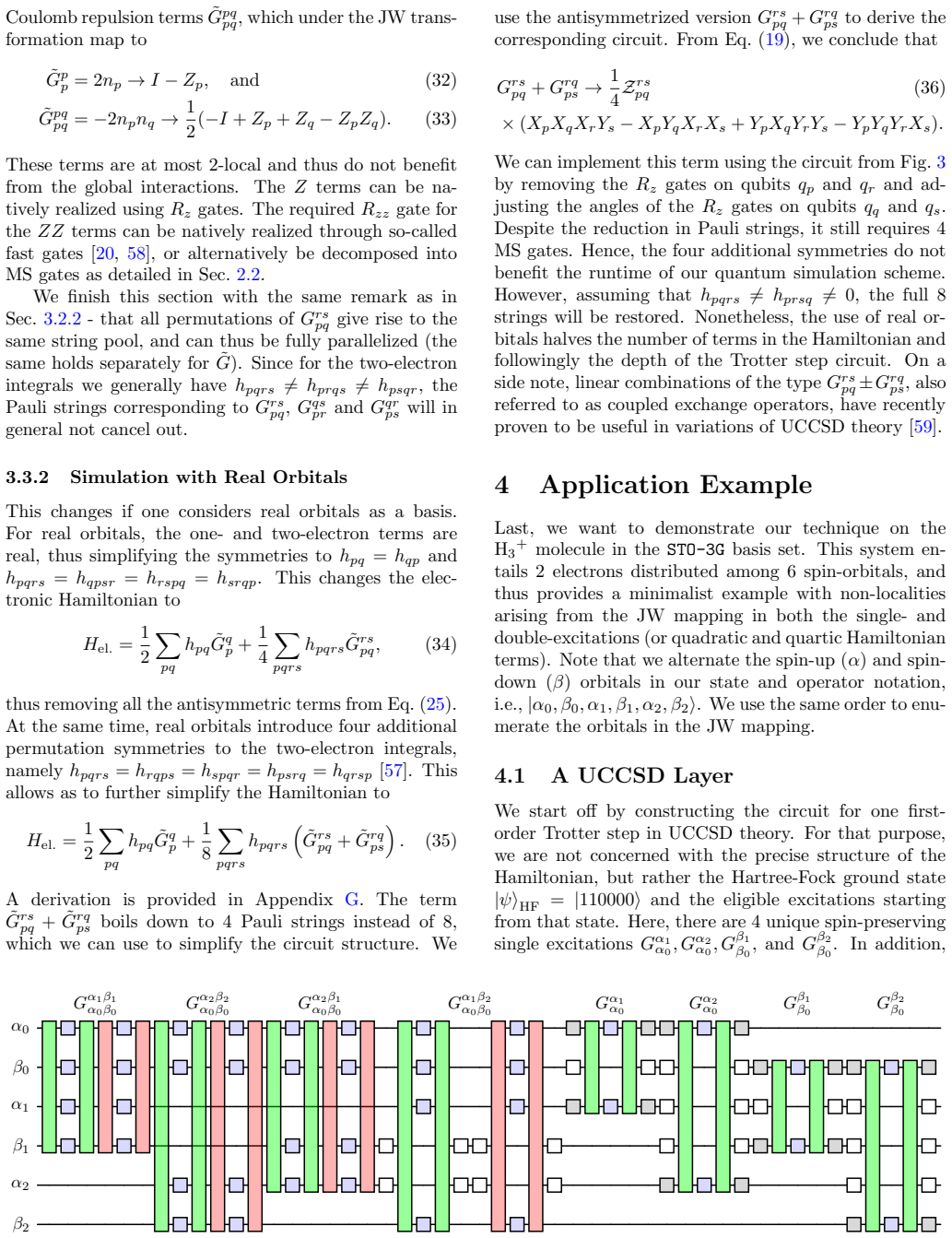
We present efficient quantum circuits for fermionic excitation operators tailored for ion trap quantum computers exhibiting the M{\o}lmer-S{\o}rensen (MS) gate. Such operators commonly arise in the study of static and dynamic properties in electronic structure problems using Unitary Coupled Cluster theory or Trotterized time evolution. We detail how the global MS interaction naturally suits the non-local structure of fermionic excitation operators under the Jordan-Wigner mapping and simultaneously provides optimal parallelism in their circuit decompositions. Compared to previous schemes on ion traps, our approach reduces the number of MS gates by factors of 2-, and 4, for single-, and double excitations, respectively. These improvements promise significant speedups and error reductions, which we demonstrate by characterizing our circuits under a realistic pulse-level noise model of a linear ion trap quantum processor.
Editorial analysis
A structured set of objections, weighed in public.
Referee Report
Summary. The manuscript develops quantum circuit decompositions for fermionic single- and double-excitation operators (arising in UCC or Trotterized dynamics) that are optimized for ion-trap hardware employing global Mølmer-Sørensen (MS) gates. Exploiting the non-local structure induced by the Jordan-Wigner mapping together with the global character of the MS interaction, the authors report explicit constructions that reduce the required MS-gate count by factors of 2 (single excitations) and 4 (double excitations) relative to earlier ion-trap schemes, and they characterize the resulting circuits under a pulse-level noise model of a linear ion trap.
Significance. If the reported gate-count reductions and noise-model results hold, the work would provide a concrete, hardware-aware improvement for simulating electronic-structure problems on current ion-trap platforms, lowering both depth and error accumulation. The explicit use of the global MS interaction for parallelism, together with the pulse-level simulation, supplies a practical bridge between abstract fermionic operators and near-term hardware.
minor comments (3)
- §3.2, Fig. 3: the circuit diagrams for the double-excitation operator are shown only for four qubits; an explicit statement of how the construction generalizes to N qubits (including the scaling of the MS-gate count) would strengthen the claim of a factor-of-4 reduction.
- §4.1, Eq. (8): the noise-model parameters (T1, T2, laser-intensity fluctuation) are stated but the precise numerical values used in the simulation are not tabulated; adding a short table would improve reproducibility.
- The abstract and §1 cite prior ion-trap schemes only by reference number; a one-sentence summary of the gate counts in those works would help readers immediately appreciate the improvement factors.
Simulated Author's Rebuttal
We thank the referee for the positive summary, significance assessment, and recommendation of minor revision. The referee's description correctly reflects the manuscript's focus on MS-gate-optimized decompositions for fermionic single- and double-excitation operators under the Jordan-Wigner mapping, together with the pulse-level noise characterization.
Circularity Check
No significant circularity detected
full rationale
The paper's central claims rest on explicit circuit constructions that decompose JW-mapped fermionic excitation operators using the global MS interaction native to ion traps. Gate-count reductions (factors of 2 and 4) are obtained directly from these constructions and validated by pulse-level noise simulation; no equations reduce to their inputs by definition, no parameters are fitted and then relabeled as predictions, and no load-bearing steps invoke self-citations or uniqueness theorems. The argument is self-contained against external benchmarks of standard JW mapping and hardware gate sets.
Axiom & Free-Parameter Ledger
axioms (2)
- standard math Jordan-Wigner mapping converts fermionic operators to qubit strings
- domain assumption Mølmer-Sørensen gate provides native global all-to-all interaction on linear ion traps
Reference graph
Works this paper leans on
-
[1]
Hardware-efficient varia- tional quantum eigensolver for small molecules and quantum magnets
Abhinav Kandala et al. “Hardware-efficient varia- tional quantum eigensolver for small molecules and quantum magnets”. In: nature 549.7671 (2017), pp. 242–246. doi: 10.1038/nature23879
-
[2]
P. J. J. O’Malley et al. “Scalable Quantum Simula- tion of Molecular Energies”. In: Phys. Rev. X 6 (3) (July 2016), p. 031007. doi: 10.1103/PhysRevX. 6.031007
-
[3]
Sam McArdle et al. “Quantum computational chemistry”. In: Rev. Mod. Phys. 92 (1) (Mar. 2020), p. 015003. doi: 10.1103/RevModPhys.92.015003
-
[4]
Prospects of quantum com- puting for molecular sciences
Hongbin Liu et al. “Prospects of quantum com- puting for molecular sciences”. In: Materials The- ory 6.1 (2022), p. 11. doi: 10.1186/s41313-021- 00039-z
-
[5]
Digital quantum simula- tion of molecular dynamics and control
Alicia B. Magann et al. “Digital quantum simula- tion of molecular dynamics and control”. In: Phys. Rev. Res. 3 (2) (June 2021), p. 023165. doi: 10. 1103/PhysRevResearch.3.023165
work page 2021
-
[6]
Molecular Quantum Dynamics: A Quantum Computing Perspective
Pauline J. Ollitrault, Alexander Miessen, and Ivano Tavernelli. “Molecular Quantum Dynamics: A Quantum Computing Perspective”. In: Accounts of Chemical Research 54.23 (2021), pp. 4229–4238. doi: 10.1021/acs.accounts.1c00514
-
[7]
Life and death of colloidal bonds control the rate-dependent rheology of gels
Laura Clinton et al. “Towards near-term quantum simulation of materials”. In: Nature Communica- tions 15.1 (2024), p. 211. doi: 10.1038/s41467- 023-43479-6
-
[8]
Recent Advances in Quantum Computing for Drug Discovery and Development
Pei-Hua Wang et al. “Recent Advances in Quantum Computing for Drug Discovery and Development”. In: IEEE Nanotechnology Magazine 17.2 (2023), pp. 26–30. doi: 10.1109/MNANO.2023.3249499
-
[9]
¨Uber das paulische ¨ aquivalenzverbot
Pascual Jordan and Eugene Paul Wigner. ¨Uber das paulische ¨ aquivalenzverbot. Springer, 1993. isbn: 978-3-662-02781-3. doi: 10 . 1007 / 978 - 3 - 662 - 02781-3_9
work page 1993
-
[10]
Sergey B. Bravyi and Alexei Yu. Kitaev. “Fermionic Quantum Computation”. In: Annals of Physics 298.1 (May 2002), pp. 210–226. issn: 0003-
work page 2002
-
[11]
doi: 10.1006/aphy.2002.6254
-
[12]
The Bravyi-Kitaev transformation for quan- tum computation of electronic structure
Jacob T Seeley, Martin J Richard, and Peter J Love. “The Bravyi-Kitaev transformation for quan- tum computation of electronic structure”. In: The Journal of chemical physics 137.22 (2012). doi: 10. 1063/1.4768229. 9
work page 2012
-
[13]
Bonsai Algorithm: Grow Your Own Fermion-to-Qubit Mappings
Aaron Miller et al. “Bonsai Algorithm: Grow Your Own Fermion-to-Qubit Mappings”. In:PRX Quan- tum 4 (3) (Aug. 2023), p. 030314. doi: 10.1103/ PRXQuantum.4.030314
work page 2023
-
[14]
Mitchell Chiew and Sergii Strelchuk. “Discover- ing optimal fermion-qubit mappings through algo- rithmic enumeration”. In: Quantum 7 (Oct. 2023), p. 1145. issn: 2521-327X. doi: 10.22331/q-2023- 10-18-1145
-
[15]
Kanav Setia and James D Whitfield. “Bravyi- Kitaev Superfast simulation of electronic struc- ture on a quantum computer”. In: The Journal of chemical physics 148.16 (2018). doi: 10.1063/1. 5019371
work page doi:10.1063/1 2018
-
[16]
Fermion- to-qubit mappings with varying resource require- ments for quantum simulation
Mark Steudtner and Stephanie Wehner. “Fermion- to-qubit mappings with varying resource require- ments for quantum simulation”. In: New Journal of Physics 20.6 (June 2018), p. 063010. doi: 10. 1088/1367-2630/aac54f
work page 2018
-
[19]
Treespilation: Architecture-and State-Optimised Fermion-to-Qubit Mappings
Aaron Miller, Adam Glos, and Zolt´ an Zimbor´ as. “Treespilation: Architecture-and State-Optimised Fermion-to-Qubit Mappings”. In: arXiv preprint (2024). doi: 10.48550/arXiv.2403.03992
-
[20]
Towards fault-tolerant quan- tum computing with trapped ions
Jan Benhelm et al. “Towards fault-tolerant quan- tum computing with trapped ions”. In: Nature Physics 4.6 (2008), pp. 463–466. doi: 10 . 1038 / nphys961
work page 2008
-
[21]
A study on fast gates for large-scale quantum simulation with trapped ions
Richard L Taylor et al. “A study on fast gates for large-scale quantum simulation with trapped ions”. In: Scientific Reports 7.1 (2017), p. 46197. doi: 10. 1038/srep46197
work page 2017
-
[22]
Quantum computation with ions in thermal motion
Anders Sørensen and Klaus Mølmer. “Quantum computation with ions in thermal motion”. In: Physical review letters 82.9 (1999), p. 1971. doi: 10.1103/PhysRevLett.82.1971
-
[24]
Simulating open quantum systems: from many-body interactions to stabilizer pump- ing
M M¨ uller et al. “Simulating open quantum systems: from many-body interactions to stabilizer pump- ing”. In: New Journal of Physics 13.8 (Aug. 2011), p. 085007. doi: 10 . 1088 / 1367 - 2630 / 13 / 8 / 085007
work page 2011
-
[25]
Quantum Simulation of Inter- acting Fermion Lattice Models in Trapped Ions
J. Casanova et al. “Quantum Simulation of Inter- acting Fermion Lattice Models in Trapped Ions”. In: Phys. Rev. Lett. 108 (19) (May 2012), p. 190502. doi: 10.1103/PhysRevLett.108.190502
-
[26]
Efficient quantum simulation of fermionic and bosonic models in trapped ions
Lucas Lamata et al. “Efficient quantum simulation of fermionic and bosonic models in trapped ions”. In: EPJ Quantum Technology 1 (2014), pp. 1–13. doi: 10.1140/epjqt9
-
[27]
Real-time dynamics of lattice gauge theories with a few-qubit quantum computer
Esteban A Martinez et al. “Real-time dynamics of lattice gauge theories with a few-qubit quantum computer”. In: Nature 534.7608 (2016), pp. 516–
work page 2016
-
[28]
doi: 10.1038/nature18318
-
[29]
Quantum Chemistry Cal- culations on a Trapped-Ion Quantum Simulator
Cornelius Hempel et al. “Quantum Chemistry Cal- culations on a Trapped-Ion Quantum Simulator”. In: Phys. Rev. X 8 (3) (July 2018), p. 031022. doi: 10.1103/PhysRevX.8.031022
-
[30]
Strategies for quantum computing molecular energies using the unitary coupled cluster ansatz
Jonathan Romero et al. “Strategies for quantum computing molecular energies using the unitary coupled cluster ansatz”. In: Quantum Science and Technology 4.1 (Oct. 2018), p. 014008. doi: 10 . 1088/2058-9565/aad3e4
work page 2018
-
[32]
The unitary coupled-cluster method , journal = cpl, volume =
Rodney J Bartlett, Stanislaw A Kucharski, and Jozef Noga. “Alternative coupled-cluster ans¨ atze II. The unitary coupled-cluster method”. In:Chem- ical physics letters 155.1 (1989), pp. 133–140. doi: 10.1016/S0009-2614(89)87372-5
-
[33]
A variational eigenvalue solver on a photonic quantum processor
Alberto Peruzzo et al. “A variational eigenvalue solver on a photonic quantum processor”. In: Na- ture communications 5.1 (2014), p. 4213. doi: 10. 1038/ncomms5213
work page 2014
-
[34]
A quantum computing view on unitary coupled cluster theory
Abhinav Anand et al. “A quantum computing view on unitary coupled cluster theory”. In: Chemical Society Reviews 51.5 (2022), pp. 1659–1684. doi: 10.1039/D1CS00932J
-
[35]
Use of global interactions in efficient quantum circuit construc- tions
Dmitri Maslov and Yunseong Nam. “Use of global interactions in efficient quantum circuit construc- tions”. In: New Journal of Physics 20.3 (Mar. 2018), p. 033018. doi: 10 . 1088 / 1367 - 2630 / aaa398
work page 2018
-
[37]
Efficient construction of three- and four-qubit quantum gates by global entan- gling gates
Svetoslav S. Ivanov, Peter A. Ivanov, and Niko- lay V. Vitanov. “Efficient construction of three- and four-qubit quantum gates by global entan- gling gates”. In: Phys. Rev. A 91 (3) (Mar. 2015), p. 032311. doi: 10.1103/PhysRevA.91.032311
-
[38]
Koen Groenland et al. “Signal processing tech- niques for efficient compilation of controlled rota- tions in trapped ions”. In: New Journal of Physics 22.6 (June 2020), p. 063006. doi: 10.1088/1367- 2630/ab8830. 10
-
[39]
Time-dependent Hamilto- nian simulation with L1-norm scaling
Dominic W Berry et al. “Time-dependent Hamilto- nian simulation with L1-norm scaling”. In: Quan- tum 4 (2020), p. 254. doi: 10.22331/q-2020-04- 20-254
-
[40]
Variational Quantum Simu- lation of Chemical Dynamics with Quantum Com- puters
Chee-Kong Lee et al. “Variational Quantum Simu- lation of Chemical Dynamics with Quantum Com- puters”. In: Journal of Chemical Theory and Com- putation 18.4 (2022), pp. 2105–2113.doi: 10.1021/ acs.jctc.1c01176
work page 2022
-
[41]
Mixed quantum-classical dynamics for near term quantum computers
Daniel Bultrini and Oriol Vendrell. “Mixed quantum-classical dynamics for near term quantum computers”. In: Nature, Communications Physics 6 (2023), p. 328. doi: 10 . 1038 / s42005 - 023 - 01451-2
work page 2023
-
[42]
Compiling quantum al- gorithms for architectures with multi-qubit gates
Esteban A Martinez et al. “Compiling quantum al- gorithms for architectures with multi-qubit gates”. In: New Journal of Physics 18.6 (June 2016), p. 063029. doi: 10 . 1088 / 1367 - 2630 / 18 / 6 / 063029
work page 2016
-
[43]
Shantanu Debnath et al. “Demonstration of a small programmable quantum computer with atomic qubits”. In: Nature 536.7614 (2016), pp. 63–66. doi: 10.1038/nature18648
-
[44]
Parallel entangling opera- tions on a universal ion-trap quantum computer
Caroline Figgatt et al. “Parallel entangling opera- tions on a universal ion-trap quantum computer”. In: Nature 572.7769 (2019), pp. 368–372. doi: 10. 1038/s41586-019-1427-5
work page 2019
-
[45]
Efficient arbitrary simul- taneously entangling gates on a trapped-ion quan- tum computer
Nikodem Grzesiak et al. “Efficient arbitrary simul- taneously entangling gates on a trapped-ion quan- tum computer”. In: Nature communications 11.1 (2020), p. 2963. doi: 10 . 1038 / s41467 - 020 - 16790-9
work page 2020
-
[46]
Available: https://link.aps.org/doi/10.1103/PhysRevA
V. Nebendahl, H. H¨ affner, and C. F. Roos. “Op- timal control of entangling operations for trapped- ion quantum computing”. In: Phys. Rev. A 79 (1) (Jan. 2009), p. 012312. doi: 10.1103/PhysRevA. 79.012312
-
[47]
Bryan T Gard et al. “Efficient symmetry- preserving state preparation circuits for the vari- ational quantum eigensolver algorithm”. In: npj Quantum Information 6.1 (2020), p. 10. doi: 10. 1038/s41534-019-0240-1
work page 2020
-
[48]
On the product of semi-groups of operators
Hale F Trotter. “On the product of semi-groups of operators”. In: Proceedings of the American Math- ematical Society 10.4 (1959), pp. 545–551. doi: 10. 2307/2033649
work page 1959
-
[49]
Masuo Suzuki. “Generalized Trotter’s formula and systematic approximants of exponential operators and inner derivations with applications to many- body problems”. In: Communications in Mathe- matical Physics 51.2 (1976), pp. 183–190. doi: 10. 1007/BF01609348
work page 1976
-
[50]
A Feasible Approach for Automat- ically Differentiable Unitary Coupled-Cluster on Quantum Computers
Jakob S. Kottmann, Abhinav Anand, and Al´ an Aspuru-Guzik. “A Feasible Approach for Automat- ically Differentiable Unitary Coupled-Cluster on Quantum Computers”. In: Chemical Science 12.10 (Mar. 2021), pp. 3497–3508. issn: 2041-6539. doi: 10.1039/D0SC06627C
-
[52]
Some improve- ments to product formula circuits for Hamiltonian simulation
Andre Kornell and Peter Selinger. “Some improve- ments to product formula circuits for Hamiltonian simulation”. In: arXiv preprint (2023). doi: 10 . 48550/arXiv.2310.12256
-
[53]
Generalized unitary coupled cluster wave functions for quantum computation
Joonho Lee et al. “Generalized unitary coupled cluster wave functions for quantum computation”. In: Journal of chemical theory and computation 15.1 (2018), pp. 311–324. doi: 10.1021/acs.jctc. 8b01004
-
[54]
Universal quantum circuits for quantum chemistry
Juan Miguel Arrazola et al. “Universal quantum circuits for quantum chemistry”. In: Quantum 6 (June 2022), p. 742. issn: 2521-327X. doi: 10 . 22331/q-2022-06-20-742
work page 2022
-
[55]
Extension of the trotter- ized unitary coupled cluster to triple excitations
Mohammad Haidar et al. “Extension of the trotter- ized unitary coupled cluster to triple excitations”. In: The Journal of Physical Chemistry A 127.15 (2023), pp. 3543–3550. doi: 10.1021/acs.jpca. 3c01753
-
[56]
W. J. Hehre, R. F. Stewart, and J. A. Pople. “Self- Consistent Molecular-Orbital Methods. I. Use of Gaussian Expansions of Slater-Type Atomic Or- bitals”. In: The Journal of Chemical Physics 51.6 (Sept. 1969), pp. 2657–2664. issn: 0021-9606. doi: 10.1063/1.1672392
-
[57]
Gaussian-Type functions for polyatomic systems. I
Sigeru Huzinaga. “Gaussian-Type functions for polyatomic systems. I”. In: The Journal of chem- ical physics 42.4 (1965), pp. 1293–1302. doi: 10. 1063/1.1696113
work page 1965
-
[58]
Low-Depth Quantum Simu- lation of Materials
Ryan Babbush et al. “Low-Depth Quantum Simu- lation of Materials”. In: Phys. Rev. X 8 (1) (Mar. 2018), p. 011044. doi: 10 . 1103 / PhysRevX . 8 . 011044
work page 2018
-
[59]
Modern quan- tum chemistry: introduction to advanced electronic structure theory
Attila Szabo and Neil S Ostlund. Modern quan- tum chemistry: introduction to advanced electronic structure theory . 1st. Dover Publications, 1996. isbn: 978-0-486-69186-2
work page 1996
-
[60]
J. J. Garc´ ıa-Ripoll, P. Zoller, and J. I. Cirac. “Speed Optimized Two-Qubit Gates with Laser Coherent Control Techniques for Ion Trap Quan- tum Computing”. In: Phys. Rev. Lett. 91 (15) (Oct. 2003), p. 157901. doi: 10.1103/PhysRevLett.91. 157901
-
[61]
Mafalda Ramˆ oa et al. “Reducing the Resources Re- quired by ADAPT-VQE Using Coupled Exchange Operators and Improved Subroutines”. In: arXiv preprint (2024). doi: 10 . 48550 / arXiv . 2407 . 08696
work page 2024
-
[62]
PySCF: the Python-based sim- ulations of chemistry framework
Qiming Sun et al. “PySCF: the Python-based sim- ulations of chemistry framework”. In: Wiley In- terdisciplinary Reviews: Computational Molecular Science 8.1 (2018), e1340. doi: 10 . 1002 / wcms . 1340. 11
work page 2018
-
[63]
Recent developments in the PySCF program package
Qiming Sun et al. “Recent developments in the PySCF program package”. In: The Journal of chemical physics 153.2 (2020). doi: 10 . 1063 / 5 . 0006074
work page 2020
-
[64]
Quantum dynamics of single trapped ions
D. Leibfried et al. “Quantum dynamics of single trapped ions”. In: Rev. Mod. Phys. 75 (1) (Mar. 2003), pp. 281–324. doi: 10 . 1103 / RevModPhys . 75.281
work page 2003
-
[65]
Gerald D Mahan. Many-particle physics. Springer Science & Business Media, 2013
work page 2013
-
[66]
Cesare Franchini et al. “Polarons in materials”. In: Nat Rev Mater 6 (2021), pp. 560–586. doi: 10 . 1038/s41578-021-00289-w
work page 2021
-
[67]
Perspective on High-Resolution Characterizations of Polarons in Halide Perovskites
Nuerbiya Aihemaiti, Zhenqin Li, and Siying Peng. “Perspective on High-Resolution Characterizations of Polarons in Halide Perovskites”. In: Chemistry of Materials 36.11 (2024), pp. 5297–5312. doi: 10. 1021/acs.chemmater.3c03012
work page 2024
-
[68]
Bela Bauer et al. “Quantum Algorithms for Quan- tum Chemistry and Quantum Materials Science”. In: Chemical Reviews 120.22 (2020), pp. 12685– 12717. doi: 10.1021/acs.chemrev.9b00829
-
[69]
Nonadiabatic Molecular Quan- tum Dynamics with Quantum Computers
Pauline J. Ollitrault, Guglielmo Mazzola, and Ivano Tavernelli. “Nonadiabatic Molecular Quan- tum Dynamics with Quantum Computers”. In: Phys. Rev. Lett. 125 (26) (2020), p. 260511. doi: 10.1103/PhysRevLett.125.260511
-
[71]
Efficient Long-Range Entan- glement Using Dynamic Circuits
Elisa B¨ aumer et al. “Efficient Long-Range Entan- glement Using Dynamic Circuits”. In: PRX Quan- tum 5 (3) (Aug. 2024), p. 030339. doi: 10.1103/ PRXQuantum.5.030339
work page 2024
-
[72]
An introduction to measurement based quantum computation
Elisa B¨ aumer and Stefan Woerner. “Measurement- Based Long-Range Entangling Gates in Constant Depth”. In: arXiv preprint (2024). doi: 10.48550/ arXiv.quant-ph/0508124
work page internal anchor Pith review Pith/arXiv arXiv 2024
-
[73]
Map- ping quantum circuits to shallow-depth measure- ment patterns based on graph states
Thierry N Kaldenbach and Matthias Heller. “Map- ping quantum circuits to shallow-depth measure- ment patterns based on graph states”. In: Quan- tum Science and Technology 10.1 (Oct. 2024), p. 015010. doi: 10.1088/2058-9565/ad802b
-
[74]
Variational ansatz-based quantum simulation of imaginary time evolution
Sam McArdle et al. “Variational ansatz-based quantum simulation of imaginary time evolution”. In: npj Quantum Information 5.1 (2019), p. 75. doi: 10.1038/s41534-019-0187-2
-
[75]
Alastair Kay. “Tutorial on the quantikz package”. In: arXiv preprint (2018). doi: 10.48550/arXiv. 1809.03842. 12 A The Backward MS Gate One can entirely avoid Backward MS Gates by exploiting that MS Gates are equivalent to their “forward” counterparts [23]. Here, we assume an MS interaction acting on n qubits. UMS(−θ, ϕ) = ( UMS(π − θ, ϕ), for n even, UMS...
work page internal anchor Pith review doi:10.48550/arxiv 2018
discussion (0)
Sign in with ORCID, Apple, or X to comment. Anyone can read and Pith papers without signing in.