Scrap Composition Estimation in EAF and BOF: State-Space Models, Hyperparameters, and Validation
Pith reviewed 2026-05-22 21:10 UTC · model grok-4.3
The pith
State-space models with Kalman filters deliver real-time scrap composition estimates in EAF and BOF steel production that outperform regression methods.
A machine-rendered reading of the paper's core claim, the machinery that carries it, and where it could break.
Core claim
The central claim is that linear and nonlinear state-space models, estimated respectively with the Kalman filter and unscented Kalman filter, accurately capture elemental transfer and partitioning in steelmaking, providing reliable real-time scrap composition estimates from standard process data that can also forecast future production outcomes.
What carries the argument
State-space models for elemental composition, with linear version for complete steel transfer and nonlinear for steel-slag partitioning, estimated via Kalman and unscented Kalman filters.
Load-bearing premise
The proposed models correctly describe the transfer and partitioning of elements between scrap, steel, and slag in real furnace conditions.
What would settle it
A set of new furnace runs where the estimated scrap composition leads to steel composition predictions that significantly deviate from actual measurements would falsify the models' accuracy.
Figures

read the original abstract
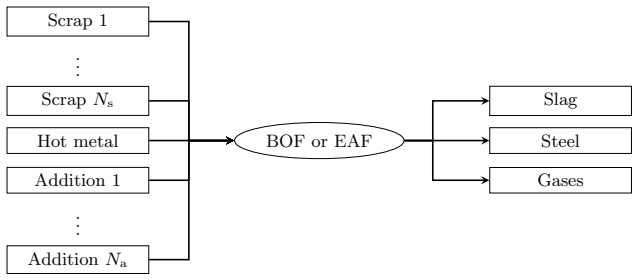
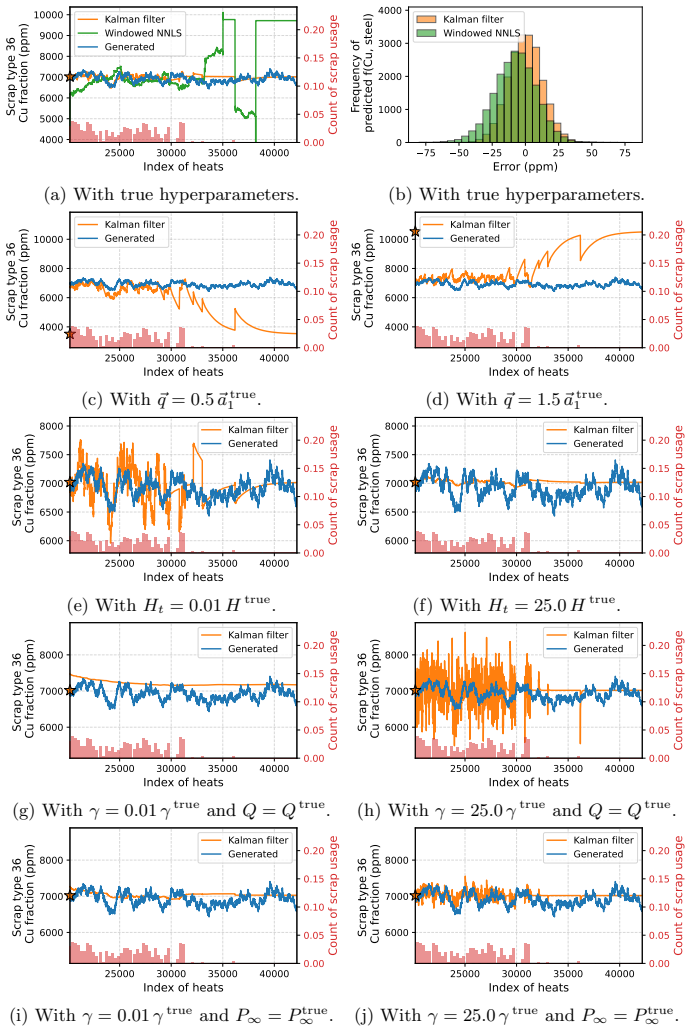
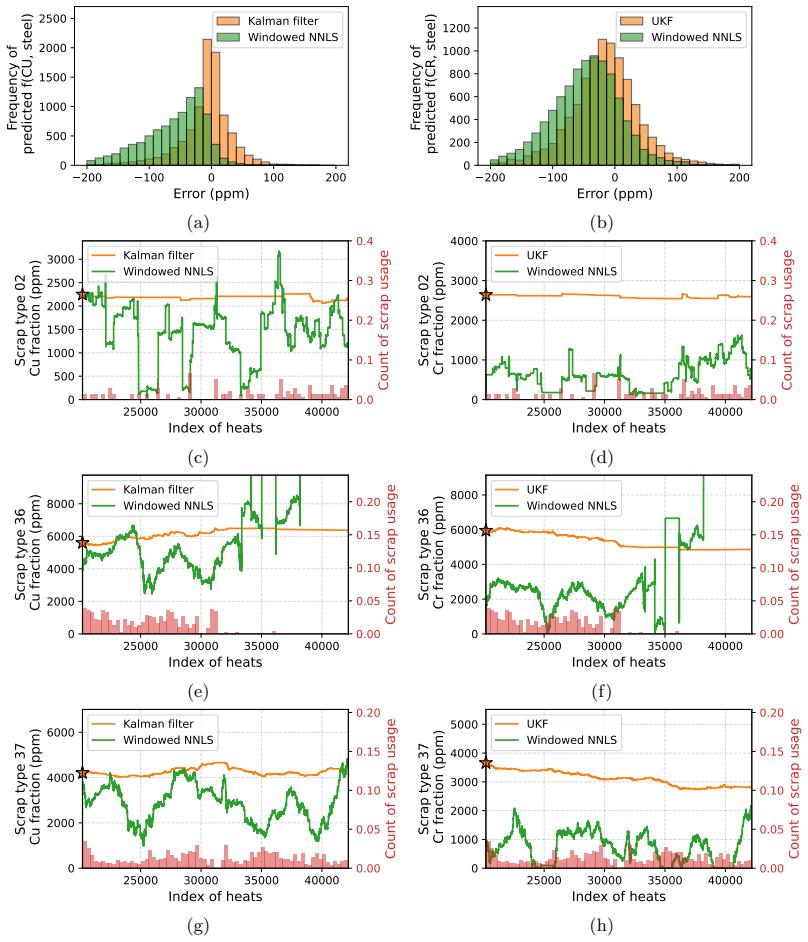
Accurate knowledge of scrap composition can increase the usage of recycled material to produce steel, reducing the need for raw ore extraction and minimizing environmental impact by conserving natural resources and lowering carbon emissions. First, we introduce two state-space models for the elemental composition of scrap in Electric Arc Furnaces (EAF) and Basic Oxygen Furnaces (BOF): a linear model for elements that transfer entirely into steel, and a non-linear model for elements that partition between steel and slag. The models are fitted with the Kalman filter and the unscented Kalman filter, respectively, using only data already collected in the standard steel production process. Crucially, the resulting scrap composition estimates can in turn be used to predict the elemental composition of future steel production. Second, we analyze how key hyperparameters affect estimation accuracy and stability, and we provide practical guidelines for tuning them from expert knowledge and historical data. Third, we validate the models on real BOF data from ArcelorMittal, using Cu and Cr as representative elements. Both filters outperform windowed non-negative least squares regression, a strong baseline method for scrap composition estimation, yielding reliable real-time estimates of scrap composition.
Editorial analysis
A structured set of objections, weighed in public.
Referee Report
Summary. The manuscript proposes linear and nonlinear state-space models for estimating the elemental composition of scrap in Electric Arc Furnaces (EAF) and Basic Oxygen Furnaces (BOF). The linear model, assuming complete transfer into steel, is estimated using the Kalman filter, while the nonlinear model, accounting for partitioning between steel and slag, uses the unscented Kalman filter. Hyperparameters are analyzed for their impact on accuracy and stability, with guidelines for tuning from historical data. Validation on real BOF data from ArcelorMittal for Cu and Cr demonstrates that both methods outperform windowed non-negative least squares regression, providing reliable real-time estimates.
Significance. If the central claims hold, this work could significantly improve scrap composition knowledge in steel production, facilitating higher recycled material usage and reducing environmental impacts such as carbon emissions. A key strength is the reliance on existing process measurements without additional instrumentation, along with the empirical validation using real industrial data. The analysis of hyperparameters and practical tuning guidelines add value for implementation.
major comments (2)
- [Model Description] The linear model assumes complete elemental transfer into steel, and the nonlinear model assumes specific partitioning behavior (as described in the model introduction and abstract). These structural assumptions are central to the KF and UKF performance claims. The validation on BOF data for Cu and Cr provides empirical support but does not fully address potential violations under varying operating conditions (e.g., temperature effects or slag carryover) across EAF and BOF regimes.
- [Hyperparameter Analysis] While guidelines for tuning from historical data are provided, the paper should demonstrate through additional experiments or analysis that such tuning does not introduce bias when the model structure is misspecified, as this is load-bearing for unbiased real-time estimates.
minor comments (2)
- [Abstract] The abstract mentions 'reliable real-time estimates' but could specify the quantitative metrics (e.g., error reduction percentages or RMSE values) used to support this.
- [Notation] Ensure consistent use of symbols for state variables and measurements throughout the manuscript to avoid confusion.
Simulated Author's Rebuttal
We thank the referee for the constructive feedback on our manuscript. We address each major comment point by point below, indicating where revisions will be made to strengthen the presentation while maintaining the integrity of the original contributions.
read point-by-point responses
-
Referee: [Model Description] The linear model assumes complete elemental transfer into steel, and the nonlinear model assumes specific partitioning behavior (as described in the model introduction and abstract). These structural assumptions are central to the KF and UKF performance claims. The validation on BOF data for Cu and Cr provides empirical support but does not fully address potential violations under varying operating conditions (e.g., temperature effects or slag carryover) across EAF and BOF regimes.
Authors: The linear and nonlinear models are grounded in established metallurgical principles for elemental behavior in steelmaking, with the assumptions explicitly stated in the model sections. The real-world validation on ArcelorMittal BOF data for Cu and Cr shows clear outperformance over the baseline, supporting the claims under industrial conditions. We agree that explicit discussion of robustness to varying conditions would improve the manuscript. In revision, we will add a dedicated paragraph in the discussion section addressing potential effects of temperature variations and slag carryover, supported by references to steelmaking literature, and clarifying the models' intended applicability to both EAF and BOF while noting data limitations for full cross-regime empirical testing. revision: partial
-
Referee: [Hyperparameter Analysis] While guidelines for tuning from historical data are provided, the paper should demonstrate through additional experiments or analysis that such tuning does not introduce bias when the model structure is misspecified, as this is load-bearing for unbiased real-time estimates.
Authors: The hyperparameter guidelines are derived directly from historical process data to promote stability and accuracy in practice. We recognize the value of explicitly demonstrating robustness to misspecification. In the revised manuscript, we will incorporate an additional analysis subsection that includes a controlled simulation study evaluating estimation bias under deliberate model misspecification scenarios, confirming that the recommended tuning procedure from historical data maintains acceptable bias levels. revision: yes
Circularity Check
No significant circularity; standard filtering applied to independent measurements
full rationale
The paper defines linear and nonlinear state-space models from physical assumptions on elemental transfer/partitioning, applies standard KF/UKF estimation, tunes hyperparameters on historical process data, and validates performance via direct comparison to windowed NNLS on held-out ArcelorMittal BOF measurements for Cu and Cr. No prediction or result reduces by the paper's equations to a quantity defined solely by the fitted parameters themselves; the reported reliability is an external empirical outcome.
Axiom & Free-Parameter Ledger
free parameters (1)
- Kalman filter hyperparameters
axioms (2)
- domain assumption Elemental transfer from scrap to steel or slag follows the proposed linear or nonlinear state-space dynamics
- domain assumption Process measurements are sufficient to update the state estimates in real time
Reference graph
Works this paper leans on
-
[1]
L. Angrisani, M. D’Apuzzo, and R. S. L. Moriello. The unscented transform: a powerful tool for measurement uncertainty evaluation. 29 In Proceedings of the 2005 IEEE International Workshop on Ad- vanced Methods for Uncertainty Estimation in Measurement, 2005. , pages 27–32. IEEE, 2005
work page 2005
-
[2]
N. Arzpeyma, M. Alam, R. Gyllenram, and P. J¨ onsson. Model de- velopment to study uncertainties in electric arc furnace plants to improve their economic and environmental performance. Metals, 11(6):892, 2021
work page 2021
-
[3]
T. Battle and R. Pehlke. Equilibrium partition coefficients in iron- based alloys. Metallurgical and Materials Transactions B , 20:149– 160, 1989
work page 1989
-
[4]
J. P. Birat, X. Le Coq, P. Russo, E. Gonzales, and J. J. Laraudo- goitia. Quality of heavy market scrap – Development of new and sim- ple methods for quality assessment and quality improvement – Final report. Publications Office of the European Commission, 2002
work page 2002
- [5]
-
[6]
J. Durbin and S. J. Koopman. Time series analysis by state space methods, volume 38. OUP Oxford, 2012
work page 2012
- [7]
-
[8]
A. Gauffin, A. Tilliander, and P. J¨ onsson. Alloy content in steel scrap by use of random sampling analysis and its impact on the electric arc furnace. In Proceedings of the Shechtman International Symposium, Cancun, Mexico, volume 29, 06 2014
work page 2014
-
[9]
G. Gaustad, P. Li, and R. Kirchain. Modeling methods for man- aging raw material compositional uncertainty in alloy production. Resources, Conservation and Recycling, 52(2):180–207, 2007
work page 2007
-
[10]
M. Grewal and A. Andrews. Kalman filtering: Theory and Practice with MATLAB. John Wiley & Sons, 2014
work page 2014
- [11]
-
[12]
S. Julier and J. Uhlmann. New extension of the Kalman filter to nonlinear systems. In Signal Processing, Sensor Fusion, and Target Recognition VI, volume 3068, pages 182–193. Spie, 1997
work page 1997
-
[13]
S. Julier and J. Uhlmann. Unscented filtering and nonlinear estima- tion. Proceedings of the IEEE, 92(3):401–422, 2004
work page 2004
-
[14]
I.-H. Jung. Overview of the applications of thermodynamic databases to steelmaking processes. Calphad, 34(3):332–362, 2010
work page 2010
-
[15]
R. E. Kalman. A new approach to linear filtering and prediction problems. Transactions of the ASME–Journal of Basic Engineering , 82(Series D):35–45, 1960
work page 1960
- [16]
-
[17]
H. Menegaz, J. Ishihara, G. Borges, and A. Vargas. A systematiza- tion of the unscented Kalman filter theory. IEEE Transactions on Automatic Control, 60(10):2583–2598, 2015
work page 2015
-
[18]
T. S. Naidu, C. M. Sheridan, and L. D. van Dyk. Basic oxygen furnace slag: Review of current and potential uses. Minerals Engineering, 149:106234, 2020
work page 2020
-
[19]
Y. Ono, N. Murai, and K. Ogi. Partition coefficients of alloying elements to primary austenite and eutectic phases of chromium irons for rolls. ISIJ International, 32(11):1150–1156, 1992
work page 1992
-
[20]
M. I. Ribeiro. Kalman and extended Kalman filters: Concept, deriva- tion and properties. Institute for Systems and Robotics , 43(46):3736– 3741, 2004
work page 2004
-
[21]
E. Sandberg, B. Lennox, and P. Undvall. Scrap management by sta- tistical evaluation of EAF process data. Control Engineering Prac- tice, 15(9):1063–1075, 2007
work page 2007
-
[22]
M. Slawski and M. Hein. Non-negative least squares for high- dimensional linear models: Consistency and sparse recovery without regularization. Electronic Journal of Statistics , 7:3004 – 3056, 2013
work page 2013
-
[23]
R. Torn, G. Hakim, and C. Snyder. Boundary conditions for limited- area ensemble Kalman filters.Monthly Weather Review, 134(9):2490– 2502, 2006
work page 2006
- [24]
discussion (0)
Sign in with ORCID, Apple, or X to comment. Anyone can read and Pith papers without signing in.