Hunting for Maxwell's Demon in the Wild
Pith reviewed 2026-05-22 20:24 UTC · model grok-4.3
The pith
A statistical estimator detects Maxwell-demon behavior in molecular motors from single observed trajectories.
A machine-rendered reading of the paper's core claim, the machinery that carries it, and where it could break.
Core claim
We derive a simple statistical estimator to infer both the direction and magnitude of subsystem heat flows, and thus determine whether -- and how strongly -- a motor operates as a Maxwell demon. The estimator uses only trajectory measurements for a single degree of freedom. Simulating both colloidal information engines and kinesin molecular motors, we show that our estimator can precisely and accurately detect Maxwell-demon behavior with experimentally accessible resolution and quantities of data. Moreover, we find that kinesin transitions to a Maxwell-demon mechanism in the presence of nonequilibrium noise, with a corresponding increase in velocity consistent with experiments.
What carries the argument
A statistical estimator for the direction and magnitude of subsystem heat flows, computed from single-degree-of-freedom trajectory data alone.
If this is right
- The estimator identifies Maxwell-demon operation with experimentally realistic data volumes and resolution.
- Kinesin switches to a demon mechanism when nonequilibrium noise is present.
- The switch produces a measurable velocity increase that aligns with existing single-molecule experiments.
- Molecular motors may exploit active fluctuations inside cells to improve performance.
Where Pith is reading between the lines
- The same estimator could be applied to trajectory data from other processive motors such as myosin or dynein.
- Artificial information engines could be tuned by adding controlled noise to induce demon-like operation.
- Cellular environments rich in active noise may have shaped the evolution of motor step sizes and gating.
Load-bearing premise
Trajectory data from a single observed degree of freedom suffices to infer subsystem heat flows without needing direct measurements of hidden degrees of freedom or strong unobservable couplings.
What would settle it
Applying the estimator to real experimental kinesin trajectories recorded under controlled nonequilibrium noise and finding neither a transition to negative heat flows into the motor nor the expected velocity increase would falsify the central claim.
Figures



read the original abstract
The paradox of Maxwell's demon motivated the development of information thermodynamics and the creation of nanoscale information engines. We now understand that machines such as the molecular motors within cells can in principle harvest fluctuations and thereby operate as a Maxwell demon -- but do they? Answering this question would seemingly require simultaneous measurement of all system degrees of freedom, which is generally intractable in single-molecule experiments. Here, we derive a simple statistical estimator to infer both the direction and magnitude of subsystem heat flows, and thus determine whether -- and how strongly -- a motor operates as a Maxwell demon. The estimator uses only trajectory measurements for a single degree of freedom. Simulating both colloidal information engines and kinesin molecular motors, we show that our estimator can precisely and accurately detect Maxwell-demon behavior with experimentally accessible resolution and quantities of data. Moreover, we find that kinesin transitions to a Maxwell-demon mechanism in the presence of nonequilibrium noise, with a corresponding increase in velocity consistent with experiments. These findings suggest that molecular motors may have evolved to leverage active fluctuations within cells.
Editorial analysis
A structured set of objections, weighed in public.
Referee Report
Summary. The manuscript derives a statistical estimator from single-degree-of-freedom trajectory data alone to infer the sign and magnitude of subsystem heat flows, thereby identifying Maxwell-demon operation in information engines and molecular motors. Simulations of colloidal engines and kinesin are used to show that the estimator detects demon-like behavior with experimentally accessible data volumes and resolution; the kinesin case is reported to exhibit a transition to demon mechanics under nonequilibrium noise that produces a velocity increase consistent with prior experiments.
Significance. A validated single-observable estimator would enable direct experimental tests of information-thermodynamic effects in biological motors without requiring simultaneous access to hidden chemical or conformational states, which is a practically important capability in stochastic thermodynamics. The work supplies concrete simulation evidence and an experimental consistency check, though its impact hinges on whether the estimator remains accurate when unobserved degrees of freedom are strongly coupled.
major comments (2)
- [Derivation of the estimator (methods section)] The central derivation treats the observed trajectory as containing sufficient information to reconstruct subsystem heat flows and entropy production without explicit marginalization over hidden chemical states or strong non-Markovian couplings. This assumption is load-bearing for the kinesin claim; if the effective observed dynamics deviate from the full thermodynamic accounting, the reported transition to demon behavior and the associated velocity increase could be an artifact of the reduced description rather than a genuine inference.
- [Kinesin simulation results] The kinesin simulations are reported to show accurate detection and a velocity increase, yet the manuscript provides no explicit validation against analytic cases with known hidden-state couplings or error analysis quantifying bias introduced by projecting onto a single mechanical coordinate. This leaves open whether the estimator recovers the correct sign and magnitude when ATP hydrolysis and conformational transitions are strongly coupled to the observed position.
minor comments (2)
- [Abstract and results] The abstract states that the estimator works with 'experimentally accessible resolution and quantities of data' but does not report the specific data lengths, noise levels, or statistical uncertainties used in the colloidal and kinesin simulations; these details should be added to the results section for reproducibility.
- [Methods] Notation for the estimator (e.g., how heat-flow sign is extracted from trajectory statistics) should be defined more explicitly with reference to the underlying stochastic-thermodynamic identities to avoid ambiguity when readers attempt to implement the method.
Simulated Author's Rebuttal
We thank the referee for the careful reading of our manuscript and the constructive comments. We address each major comment below and describe the revisions we will make to strengthen the presentation.
read point-by-point responses
-
Referee: [Derivation of the estimator (methods section)] The central derivation treats the observed trajectory as containing sufficient information to reconstruct subsystem heat flows and entropy production without explicit marginalization over hidden chemical states or strong non-Markovian couplings. This assumption is load-bearing for the kinesin claim; if the effective observed dynamics deviate from the full thermodynamic accounting, the reported transition to demon behavior and the associated velocity increase could be an artifact of the reduced description rather than a genuine inference.
Authors: The estimator is derived by applying the stochastic first law and fluctuation theorems directly to the effective Markovian dynamics of the single observed coordinate, without requiring explicit marginalization. This is intentional: the method is designed for experimental situations where only one mechanical degree of freedom is accessible. We will revise the methods section to state the assumptions more explicitly, discuss the regime of validity when hidden states are present (citing relevant literature on effective thermodynamics), and clarify that the kinesin results refer to demon-like behavior in the effective single-coordinate description, which matches what single-molecule experiments can measure. revision: yes
-
Referee: [Kinesin simulation results] The kinesin simulations are reported to show accurate detection and a velocity increase, yet the manuscript provides no explicit validation against analytic cases with known hidden-state couplings or error analysis quantifying bias introduced by projecting onto a single mechanical coordinate. This leaves open whether the estimator recovers the correct sign and magnitude when ATP hydrolysis and conformational transitions are strongly coupled to the observed position.
Authors: We agree that additional validation is needed. In the revised manuscript we will add (i) an analytic two-state model with known exact heat flows and hidden-state couplings, to which the estimator is applied and compared against ground truth, and (ii) a quantitative error analysis for the kinesin simulations that compares the estimator output to the full thermodynamic accounting wherever possible, thereby quantifying any bias arising from the projection onto the mechanical coordinate. These additions will be placed in a new subsection of the results. revision: yes
Circularity Check
No significant circularity; derivation remains independent of inputs
full rationale
The paper derives its statistical estimator directly from statistical mechanics applied to observed trajectories of a single degree of freedom, then validates it through simulations of colloidal engines and kinesin motors against independent experimental velocity data. No quoted step reduces a prediction to a fitted parameter by construction, nor does any load-bearing claim collapse to a self-citation or ansatz imported from prior author work. The central inference of demon-like behavior and velocity increase is presented as an output of the estimator rather than an input, with the single-DOF assumption treated as a testable modeling choice rather than a definitional tautology.
Axiom & Free-Parameter Ledger
axioms (1)
- domain assumption Trajectory data from a single observed degree of freedom suffices to infer subsystem heat flows
Forward citations
Cited by 1 Pith paper
-
Information thermodynamics of cellular ion pumps
Bipartite thermodynamic analysis of the Na-K pump finds substantial information flow with Maxwell-demon behavior in the ATP subsystem that inverts during depolarization.
Reference graph
Works this paper leans on
-
[1]
C. G. Knott, Life and Scientific Work of Peter Guthrie Tait (Cambridge University Press, London, 1911) p. 213
work page 1911
-
[2]
J. M. R. Parrondo, J. M. Horowitz, and T. Sagawa, Thermodynamics of information, Nature Phys. 11, 131 (2015)
work page 2015
-
[3]
R. Goerlich, L. Hoek, O. Chor, S. Rahav, and Y. Roich- man, Experimental realizations of information engines: Beyond proof of concept, EPL (Europhysics Letters) 149, 61001 (2025)
work page 2025
- [4]
-
[5]
´E. Rold´ an, I. A. Mart´ ınez, J. M. R. Parrondo, and D. Petrov, Universal features in the energetics of sym- metry breaking, Nature Phys. 10, 457 (2014)
work page 2014
- [6]
- [7]
-
[8]
T. K. Saha, J. N. Lucero, J. Ehrich, D. A. Sivak, and J. Bechhoefer, Maximizing power and velocity of an in- formation engine, Proc. Natl. Acad. Sci. U.S.A 118, e2023356118 (2021)
work page 2021
-
[9]
J. J. Thorn, E. A. Schoene, T. Li, and D. A. Steck, Experimental realization of an optical one-way barrier for neutral atoms, Phys. Rev. Lett. 100, 240407 (2008)
work page 2008
-
[10]
M. D. Vidrighin, O. Dahlsten, M. Barbieri, M. S. Kim, V. Vedral, and I. A. Walmsley, Photonic Maxwell’s de- mon, Phys. Rev. Lett. 116, 050401 (2016)
work page 2016
-
[11]
A. Kumar, T.-Y. Wu, F. Giraldo, and D. S. Weiss, Sort- ing ultracold atoms in a three-dimensional optical lat- tice in a realization of Maxwell’s demon, Nature 561, 83 (2018)
work page 2018
-
[12]
J. V. Koski, V. F. Maisi, J. P. Pekola, and D. V. Averin, Experimental realization of a Szilard engine with a sin- gle electron, Proc. Natl. Acad. Sci. U.S.A. 111, 13786 (2014)
work page 2014
-
[13]
J. V. Koski, A. Kutvonen, I. M. Khaymovich, T. Ala- Nissila, and J. P. Pekola, On-Chip Maxwell’s Demon as an Information-Powered Refrigerator, Phys. Rev. Lett. 115, 260602 (2015)
work page 2015
- [14]
-
[15]
M. Ribezzi-Crivellari and F. Ritort, Large work extrac- tion and the Landauer limit in a continuous Maxwell demon, Nature Phys. 15, 660 (2019)
work page 2019
- [16]
- [17]
-
[18]
O. Chor, A. Sohachi, R. Goerlich, E. Rosen, S. Rahav, and Y. Roichman, Many-body Szil´ ard engine with giant number fluctuations, Phys. Rev. Res. 5, 043193 (2023)
work page 2023
-
[19]
J. du Buisson, D. A. Sivak, and J. Bechhoefer, Perfor- mance limits of information engines, Adv. Phys. X 9, 2352112 (2024)
work page 2024
-
[20]
A. I. Brown and D. A. Sivak, Theory of nonequilibrium free energy transduction by molecular machines, Chem. Rev. 120, 434 (2019)
work page 2019
-
[21]
M. P. Leighton and D. A. Sivak, Flow of energy and information in molecular machines, Annual Review of 7 Physical Chemistry 76 (2025)
work page 2025
-
[22]
Howard, Mechanics of motor proteins, in Physics of bio-molecules and cells
J. Howard, Mechanics of motor proteins, in Physics of bio-molecules and cells. Physique des biomol´ ecules et des cellules (Springer, 2002) pp. 69–94
work page 2002
- [23]
-
[24]
T. K. Saha, J. Ehrich, M. Gavrilov, S. Still, D. A. Sivak, and J. Bechhoefer, Information Engine in a Nonequilib- rium Bath, Phys. Rev. Lett. 131, 057101 (2023)
work page 2023
-
[25]
M. P. Leighton, J. Ehrich, and D. A. Sivak, Information arbitrage in bipartite heat engines, Phys. Rev. X 14, 041038 (2024)
work page 2024
-
[26]
P. Pietzonka, A. C. Barato, and U. Seifert, Universal bound on the efficiency of molecular motors, JSTAT Mech. 2016, 124004 (2016)
work page 2016
-
[27]
M. P. Leighton and D. A. Sivak, Inferring subsystem efficiencies in bipartite molecular machines, Phys. Rev. Lett. 130, 178401 (2023)
work page 2023
-
[28]
I. Di Terlizzi, M. Gironella, D. Herraez-Aguilar, T. Betz, F. Monroy, M. Baiesi, and F. Ritort, Variance sum rule for entropy production, Science 383, 971 (2024)
work page 2024
-
[29]
J. Ehrich and D. Sivak, Energy and information flows in autonomous systems, Front. Phys. 11, 1108357 (2023)
work page 2023
-
[30]
T. M. Cover and J. A. Thomas, Elements of Informa- tion Theory, 2nd ed. (Wiley-Interscience, Hoboken, NJ, 2006)
work page 2006
-
[31]
J. M. Horowitz and M. Esposito, Thermodynamics with continuous information flow, Phys. Rev. X 4, 031015 (2014)
work page 2014
-
[32]
R. S´ anchez, J. Splettstoesser, and R. S. Whitney, Nonequilibrium system as a demon, Phys. Rev. Lett. 123, 216801 (2019)
work page 2019
-
[33]
S. Ciliberto, Autonomous out-of-equilibrium Maxwell’s demon for controlling the energy fluxes produced by thermal fluctuations, Phys. Rev. E 102, 050103 (2020)
work page 2020
-
[34]
N. Freitas and M. Esposito, Characterizing autonomous Maxwell demons, Phys. Rev. E 103, 032118 (2021)
work page 2021
-
[35]
Seifert, Stochastic thermodynamics, fluctuation the- orems and molecular machines, Rep
U. Seifert, Stochastic thermodynamics, fluctuation the- orems and molecular machines, Rep. Prog. Phys. 75, 126001 (2012)
work page 2012
-
[36]
M. J. Schnitzer and S. M. Block, Kinesin hydrolyses one ATP per 8-nm step, Nature 388, 386 (1997)
work page 1997
-
[37]
J. O. Wirth, L. Scheiderer, T. Engelhardt, J. Engelhardt, J. Matthias, and S. W. Hell, Minflux dissects the unim- peded walking of kinesin-1, Science 379, 1004 (2023)
work page 2023
-
[38]
J. N. E. Lucero, J. Ehrich, J. Bechhoefer, and D. A. Sivak, Maximal Fluctuation Exploitation in Gaussian In- formation Engines, Phys. Rev. E 104, 044122 (2021)
work page 2021
-
[39]
T. K. Saha, J. N. Lucero, J. Ehrich, D. A. Sivak, and J. Bechhoefer, Bayesian information engine that opti- mally exploits noisy measurements, Phys. Rev. Lett. 129, 130601 (2022)
work page 2022
- [40]
- [41]
-
[42]
Exactly solvable model illustrating far-from-equilibrium predictions
O. Mazonka and C. Jarzynski, Exactly solvable model illustrating far-from-equilibrium predictions, arXiv preprint cond-mat/9912121 (1999). Appendix A: Additional details and extensions of the heat estimator
work page internal anchor Pith review Pith/arXiv arXiv 1999
-
[43]
First we rewrite the definition of heat (4) in a more convenient form
Detailed derivation of the heat estimator Here we show the calculations leading to the result (6), relating the experimentally measurable MSD of the bead to the steady-state heat flow without requiring knowledge of the steady-state distribution p(x, y). First we rewrite the definition of heat (4) in a more convenient form. Given a steady-state distributio...
-
[44]
Bias of the heat estimator The heat estimator (8) is unbiased up to first order in ∆ t. To show this, we insert into the estimator (8) the full expressions for the MSDs (A8) and ⟨∆x2⟩eq = 2σ2(1 − e−∆t/τr), expand around ∆ t = 0, and subtract the true heat flow from both sides to obtain: βd˙QX − β ˙QX = − 1 2τ β ˙QX∆t + O(∆t2). (A10)
-
[45]
We begin by considering the estimator for the MSD, \⟨∆x2⟩ = 1 N NX i=1 ∆x2 i
Precision of the heat estimator The precision of the heat estimator requires a more involved calculation. We begin by considering the estimator for the MSD, \⟨∆x2⟩ = 1 N NX i=1 ∆x2 i . (A11) The variance of this estimator is Var \⟨∆x2⟩ = \⟨∆x2⟩ − D \⟨∆x2⟩ E 2 (A12a) = * " 1 N NX i=1 ∆x2 i # − ∆x2 !2+ (A12b) = * 1 N NX i=1 ∆x2 i !2+ − 2 * 1 N NX i=1 ∆x2 i ...
-
[46]
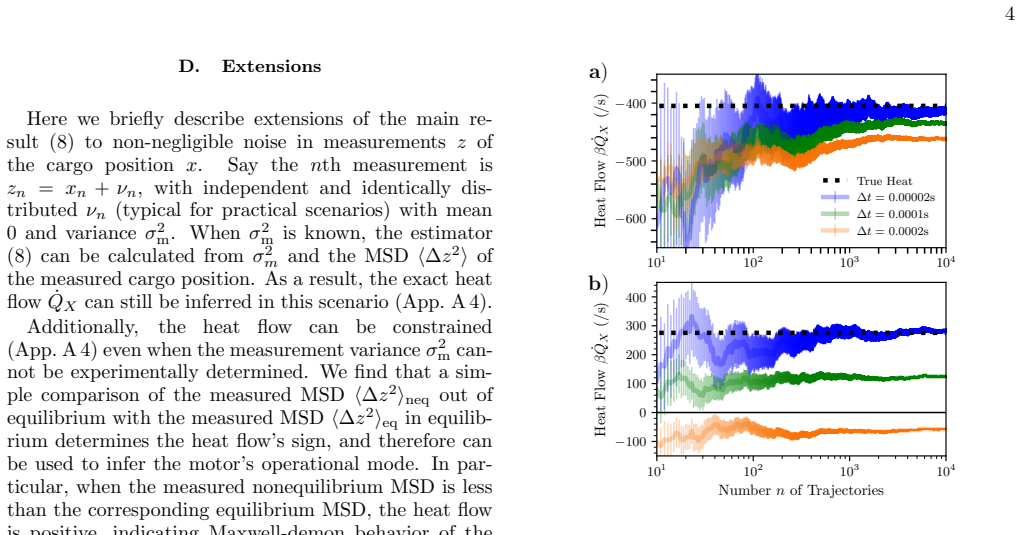
Heat estimator with measurement noise Here we provide mathematical justification for the statements made in Sec. III D. We consider the case where the error in measurements of the bead position is not negligible, with the nth measurement related to the true bead position xn by zn = xn + νn , (A15) with the νn being independent and identically distributed ...
-
[47]
Direct heat estimator and its properties A key feature of heat estimator (8) is that it does not require knowledge of any of the parameters that govern the dynamics of the cargo X, relying instead on comparing measured MSDs for nonequilibrium and equilibrium dynamics. If instead these parameters (specifically the cargo diffusivity Deq and linker stiffness...
-
[48]
Heat estimator with nonequilibrium noise In Sec. V we consider kinesin pulling a cargo with additional nonequilibrium noise, such that the cargo dynamics follow the overdamped Langevin equation ˙x = γ−1 [f + κ(y − x)] + p 2Deq ξ(t)| {z } equilibrium noise + p 2Dneq ξneq(t)| {z } nonequilibrium noise . (A22) The nonequilibrium noise is characterized by a m...
-
[49]
The dynamics (in dimensionless 11 units) are y(t) = vt, (B1a) ˙x = (y − x) + √ 2 ξ(t)
Constant-velocity conventional engine As a simple example in which the heat flow and estimator can be calculated exactly, consider a constant-velocity conventional engine pulling a diffusive cargo, with respective positions y(t) and x(t). The dynamics (in dimensionless 11 units) are y(t) = vt, (B1a) ˙x = (y − x) + √ 2 ξ(t) . (B1b) The distribution for x(t...
-
[50]
Discrete model for kinesin dynamics To model the dynamics of a kinesin motor we use the two-state discrete model from [40], which was parameterized by fitting to experimental force-velocity curves. This model, while fit to dynamics with only equilibrium noise, has previously been shown to reproduce the experimentally observed velocity increase in the pres...
-
[51]
The estimator behaves as we calculated in Sec
Additional simulation results Figure 5 shows the estimator’s performance as a function of the number n of trajectories, for different values of the sampling time ∆ t, benchmarked against the true heat flow calculated from full knowledge of both cargo and motor dynamics. The estimator behaves as we calculated in Sec. III C, with bias decreasing with smalle...
discussion (0)
Sign in with ORCID, Apple, or X to comment. Anyone can read and Pith papers without signing in.