Probing Quantum Anomalous Hall States in Twisted Bilayer WSe2 via Attractive Polaron Spectroscopy
Pith reviewed 2026-05-22 20:03 UTC · model grok-4.3
The pith
Polarization-resolved spectroscopy detects spontaneous ferromagnetism and Chern number 1 in twisted bilayer WSe2 at hole filling 1.
A machine-rendered reading of the paper's core claim, the machinery that carries it, and where it could break.
Core claim
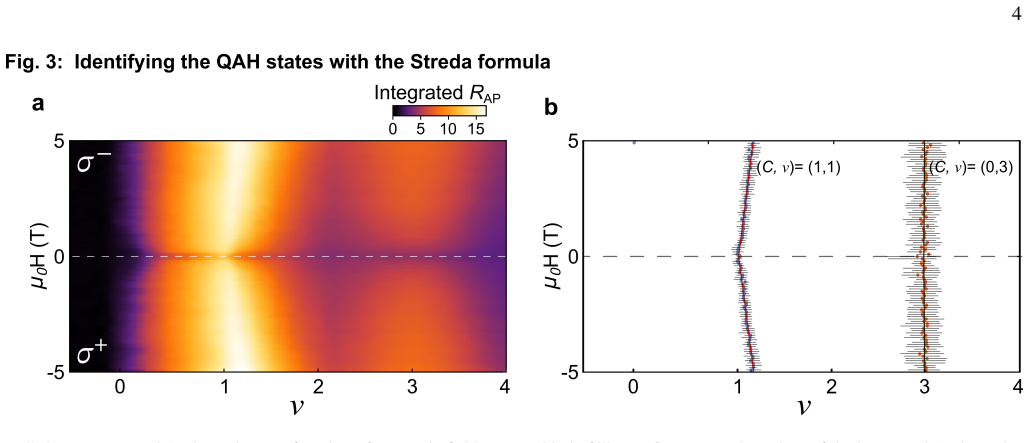
The authors report the first direct evidence of QAH states in tWSe2 with spontaneous ferromagnetism. Polarization-resolved attractive polaron spectroscopy detects spontaneous time-reversal symmetry breaking at hole filling ν = 1. Combined with Streda formula analysis yielding Chern number C = 1, the magnetized state is identified as topological. These topological and magnetic properties are tunable by a finite displacement field, switching between a QAH ferromagnetic state and an antiferromagnetic state.
What carries the argument
Polarization-resolved attractive polaron spectroscopy that tracks polarization-dependent spectral shifts to detect spontaneous time-reversal symmetry breaking, paired with Streda formula analysis to extract the Chern number from Landau level shifts.
If this is right
- The QAH state carries Chern number C = 1 at hole filling ν = 1.
- Spontaneous ferromagnetism is the direct signature of time-reversal symmetry breaking in this state.
- A finite displacement field switches the system between the QAH ferromagnetic state and an antiferromagnetic state.
- Twisted bilayer WSe2 functions as a stable, optically addressable platform for topological order and strong correlations.
Where Pith is reading between the lines
- The optical readout method could be applied to other moiré transition-metal dichalcogenide bilayers to search for hidden magnetic topological phases.
- The demonstrated displacement-field tunability suggests device architectures that electrically switch between ferromagnetic and antiferromagnetic topological regimes.
- Temperature and twist-angle dependence of the same spectral features could map the stability window of the QAH state.
Load-bearing premise
The polarization dependence in the attractive polaron spectra unambiguously signals spontaneous ferromagnetism rather than other possible ordered or disordered phases, and the Streda formula extracts C = 1 without significant disorder or multi-band contributions.
What would settle it
Observation of zero spontaneous magnetization hysteresis or a measured Chern number other than 1 at ν = 1 under the reported gating and twist conditions would falsify the QAH ferromagnetic identification.
Figures



read the original abstract
Moir\'e superlattices in semiconductors exhibit a rich variety of interaction-induced topological states, including quantum anomalous Hall (QAH) effects. A recent study hinted that twisted WSe2 homobilayer (tWSe2) could host a QAH state but lacked direct evidence of ferromagnetism, a key hallmark of this phase. Here, we report the first direct evidence of QAH states in tWSe2 with spontaneous ferromagnetism. Specifically, we employ polarization-resolved attractive polaron spectroscopy on a dual-gated, 2 degree tWSe2 and observe direct signatures of spontaneous time-reversal symmetry breaking at hole filling \nu = 1. Together with a Chern number measurement via Streda formula analysis, we identify this magnetized state as a topological state, characterized by C = 1. Furthermore, we demonstrate that these topological and magnetic properties are tunable via a finite displacement field, between a QAH ferromagnetic state and an antiferromagnetic state. Our findings position tWSe2 as a highly versatile, stable, and optically addressable platform for investigating topological order and strong correlations in two-dimensional landscapes.
Editorial analysis
A structured set of objections, weighed in public.
Referee Report
Summary. The paper claims to report the first direct evidence of quantum anomalous Hall (QAH) states in twisted bilayer WSe2 (tWSe2) with spontaneous ferromagnetism. Using polarization-resolved attractive polaron spectroscopy on a dual-gated 2-degree twisted sample, they observe signatures of spontaneous time-reversal symmetry breaking at hole filling ν=1. Combined with a Chern number measurement via the Streda formula yielding C=1, and tunability via displacement field to an antiferromagnetic state, they position tWSe2 as a versatile platform for topological order studies.
Significance. If validated, these findings would significantly advance the field by providing direct optical evidence linking ferromagnetism and topology in moiré semiconductors, building on prior hints in tWSe2. The attractive polaron spectroscopy method offers a promising probe for magnetic and topological properties in such systems, potentially enabling further studies of correlated states.
major comments (2)
- [Polarization-resolved attractive polaron spectra at ν=1] The zero-field polarization contrast in the attractive polaron resonance at ν=1 is interpreted as direct evidence for spontaneous net magnetization (ferromagnetism), but the manuscript does not supply explicit controls such as hysteresis loop measurements or calibrated external B-field comparisons to distinguish this from valley-polarized antiferromagnetic order or extrinsic valley Zeeman effects from strain/residual fields.
- [Streda formula analysis for Chern number] In the Streda formula analysis of the filling factor versus magnetic field slope used to extract C=1, potential corrections from disorder-induced localized states inside the interaction gap or from the multi-valley moiré band structure are not quantified, which could affect the reliability of the Chern number assignment.
minor comments (3)
- Include error bars on extracted quantities such as polaron resonance positions, polarization contrasts, and Streda slopes, along with details on the fitting procedures employed.
- Provide more precise information on the displacement field range and values used to tune between the QAH ferromagnetic and antiferromagnetic states.
- Add a short discussion of sample quality indicators, such as estimates of disorder strength or mobility, to contextualize the observed gap and topological features.
Simulated Author's Rebuttal
We thank the referee for their careful reading of the manuscript and for the constructive comments. We respond to each major comment below and indicate the revisions we will make in the next version of the manuscript.
read point-by-point responses
-
Referee: [Polarization-resolved attractive polaron spectra at ν=1] The zero-field polarization contrast in the attractive polaron resonance at ν=1 is interpreted as direct evidence for spontaneous net magnetization (ferromagnetism), but the manuscript does not supply explicit controls such as hysteresis loop measurements or calibrated external B-field comparisons to distinguish this from valley-polarized antiferromagnetic order or extrinsic valley Zeeman effects from strain/residual fields.
Authors: We agree that explicit controls strengthen the claim. The polarization contrast is observed exclusively at ν=1, vanishes at other integer fillings, and is suppressed by a finite displacement field that stabilizes the antiferromagnetic state; these dependencies are difficult to reconcile with extrinsic strain or residual-field effects. In the revised manuscript we add a dedicated paragraph comparing the zero-field contrast to the response under small calibrated B fields (to extract an effective g-factor) and explain why full hysteresis loops are not accessible in the present optical geometry. We retain the interpretation of spontaneous ferromagnetism while acknowledging that these additions provide a more complete distinction from alternative scenarios. revision: partial
-
Referee: [Streda formula analysis for Chern number] In the Streda formula analysis of the filling factor versus magnetic field slope used to extract C=1, potential corrections from disorder-induced localized states inside the interaction gap or from the multi-valley moiré band structure are not quantified, which could affect the reliability of the Chern number assignment.
Authors: We thank the referee for highlighting this point. In the revised manuscript we include a quantitative estimate (now in the supplementary information) showing that the density of localized states inferred from the gap size and sample mobility contributes negligibly to the observed Streda slope. We also clarify that the relevant moiré band is energetically isolated from other valleys within the magnetic-field range used for the measurement, so that the extracted slope directly reflects the Chern number of the topological band. These additions address the concern without altering the C=1 assignment. revision: yes
Circularity Check
No circularity: experimental claims rest on standard formulas and observations
full rationale
The paper reports experimental signatures from polarization-resolved attractive polaron spectroscopy at ν=1 and applies the standard Streda formula to extract C=1. These steps invoke established physical relations (polarization contrast for TRS breaking; density-B slope for Chern number) without any self-referential fitting, parameter renaming, or load-bearing self-citation that reduces the central result to its own inputs. The prior hint cited in the abstract is not used to justify the new measurements or their interpretation. The derivation chain is therefore self-contained against external benchmarks.
Axiom & Free-Parameter Ledger
axioms (2)
- domain assumption Polarization-resolved attractive polaron spectroscopy can detect spontaneous time-reversal symmetry breaking associated with ferromagnetism in moiré systems.
- domain assumption The Streda formula applies directly to extract Chern number from the density dependence of the spectroscopic features in this gated device.
Forward citations
Cited by 2 Pith papers
-
Topological Edge States Emerging from Twisted Moir\'e Bands
A new projection technique in continuum moiré models yields chiral, layer-polarized edge states in twisted WSe2 nanoribbons that match bulk Chern numbers and are electrically tunable.
-
False Vacuum Decay in Flat-Band Ferromagnets: Role of Quantum Geometry and Chiral Edge States
False vacuum decay in flat-band ferromagnets shows that quantum geometry governs magnetization bubble dynamics in metals and allows dynamical access to chiral edge modes in quantum Hall ferromagnets.
Reference graph
Works this paper leans on
-
[1]
J. Cai, E. Anderson, C. Wang, X. Zhang, X. Liu, W. Holtzmann, Y . Zhang, F. Fan, T. Taniguchi, K. Watanabe,et al., Signatures of fractional quantum anomalous hall states in twisted mote2, Nature622, 63 (2023)
work page 2023
-
[2]
Y . Zeng, Z. Xia, K. Kang, J. Zhu, P. Kn ¨uppel, C. Vaswani, K. Watanabe, T. Taniguchi, K. F. Mak, and J. Shan, Thermo- dynamic evidence of fractional chern insulator in moir´e mote2, Nature622, 69 (2023)
work page 2023
-
[3]
H. Park, J. Cai, E. Anderson, Y . Zhang, J. Zhu, X. Liu, C. Wang, W. Holtzmann, C. Hu, Z. Liu,et al., Observation of fractionally quantized anomalous hall effect, Nature622, 74 (2023)
work page 2023
-
[4]
F. Xu, Z. Sun, T. Jia, C. Liu, C. Xu, C. Li, Y . Gu, K. Watanabe, T. Taniguchi, B. Tong,et al., Observation of integer and frac- tional quantum anomalous hall effects in twisted bilayer mote 2, Physical Review X13, 031037 (2023)
work page 2023
-
[5]
Z. Ji, H. Park, M. E. Barber, C. Hu, K. Watanabe, T. Taniguchi, J.-H. Chu, X. Xu, and Z.-X. Shen, Local probe of bulk and edge states in a fractional chern insulator, Nature635, 578 (2024)
work page 2024
-
[6]
E. Redekop, C. Zhang, H. Park, J. Cai, E. Anderson, O. Sheekey, T. Arp, G. Babikyan, S. Salters, K. Watanabe, et al., Direct magnetic imaging of fractional chern insulators in twisted mote2, Nature635, 584 (2024)
work page 2024
-
[7]
F. Xu, X. Chang, J. Xiao, Y . Zhang, F. Liu, Z. Sun, N. Mao, N. Peshcherenko, J. Li, K. Watanabe,et al., Interplay between topology and correlations in the second moir ´e band of twisted bilayer mote2, Nature Physics , 1 (2025)
work page 2025
-
[8]
H. Park, J. Cai, E. Anderson, X.-W. Zhang, X. Liu, W. Holtz- mann, W. Li, C. Wang, C. Hu, Y . Zhao,et al., Ferromagnetism and topology of the higher flat band in a fractional chern insu- lator, Nature Physics , 1 (2025)
work page 2025
-
[9]
B. A. Foutty, C. R. Kometter, T. Devakul, A. P. Reddy, K. Watanabe, T. Taniguchi, L. Fu, and B. E. Feldman, Map- ping twist-tuned multiband topology in bilayer wse2, Science 384, 343 (2024)
work page 2024
-
[10]
Y . Xia, Z. Han, K. Watanabe, T. Taniguchi, J. Shan, and K. F. Mak, Superconductivity in twisted bilayer wse2, Nature637, 833 (2025)
work page 2025
-
[11]
Y . Guo, J. Pack, J. Swann, L. Holtzman, M. Cothrine, K. Watan- abe, T. Taniguchi, D. G. Mandrus, K. Barmak, J. Hone,et al., Superconductivity in 5.0° twisted bilayer wse2, Nature637, 839 (2025)
work page 2025
- [12]
-
[13]
E. C. Regan, D. Wang, C. Jin, M. I. Bakti Utama, B. Gao, X. Wei, S. Zhao, W. Zhao, Z. Zhang, K. Yumigeta, M. Blei, J. D. Carlstr ¨om, K. Watanabe, T. Taniguchi, S. Tongay, M. Crommie, A. Zettl, and F. Wang, Mott and generalized Wigner crystal states in WSe2/WS2 moir´e superlattices, Nature 2020 579:7799579, 359 (2020)
work page 2020
-
[14]
Y . Tang, L. Li, T. Li, Y . Xu, S. Liu, K. Barmak, K. Watanabe, T. Taniguchi, A. H. MacDonald, J. Shan,et al., Simulation of hubbard model physics in wse2/ws2 moir´e superlattices, Nature 579, 353 (2020)
work page 2020
- [15]
-
[16]
B. Gao, D. G. Su ´arez-Forero, S. Sarkar, T.-S. Huang, D. Ses- sion, M. J. Mehrabad, R. Ni, M. Xie, P. Upadhyay, J. Vannucci, et al., Excitonic mott insulator in a bose-fermi-hubbard system of moir´e ws2/wse2 heterobilayer, Nature Communications15, 2305 (2024)
work page 2024
-
[17]
Y . Xu, S. Liu, D. A. Rhodes, K. Watanabe, T. Taniguchi, J. Hone, V . Elser, K. F. Mak, and J. Shan, Correlated insulating states at fractional fillings of moir ´e superlattices, Nature587, 214 (2020)
work page 2020
-
[18]
Y . Zhou, J. Sung, E. Brutschea, I. Esterlis, Y . Wang, G. Scuri, R. J. Gelly, H. Heo, T. Taniguchi, K. Watanabe,et al., Bilayer wigner crystals in a transition metal dichalcogenide heterostruc- ture, Nature595, 48 (2021)
work page 2021
-
[19]
K. Kang, B. Shen, Y . Qiu, Y . Zeng, Z. Xia, K. Watanabe, T. Taniguchi, J. Shan, and K. F. Mak, Evidence of the frac- tional quantum spin hall effect in moir´e mote2, Nature628, 522 (2024)
work page 2024
-
[20]
T. Li, S. Jiang, B. Shen, Y . Zhang, L. Li, Z. Tao, T. Devakul, K. Watanabe, T. Taniguchi, L. Fu,et al., Quantum anoma- lous hall effect from intertwined moir´e bands, Nature600, 641 (2021)
work page 2021
-
[21]
L. Ciorciaro, T. Smole ´nski, I. Morera, N. Kiper, S. Hiestand, M. Kroner, Y . Zhang, K. Watanabe, T. Taniguchi, E. Demler, et al., Kinetic magnetism in triangular moir ´e materials, Nature 623, 509 (2023)
work page 2023
-
[22]
F. Wu, T. Lovorn, E. Tutuc, I. Martin, and A. MacDonald, Topo- logical insulators in twisted transition metal dichalcogenide ho- mobilayers, Physical review letters122, 086402 (2019)
work page 2019
-
[23]
L. Wang, E.-M. Shih, A. Ghiotto, L. Xian, D. A. Rhodes, C. Tan, M. Claassen, D. M. Kennes, Y . Bai, B. Kim,et al., Correlated electronic phases in twisted bilayer transition metal dichalcogenides, Nature materials19, 861 (2020)
work page 2020
-
[24]
H. Pan, F. Wu, and S. Das Sarma, Band topology, hubbard model, heisenberg model, and dzyaloshinskii-moriya interac- tion in twisted bilayer wse 2, Physical Review Research2, 033087 (2020)
work page 2020
-
[25]
J. Zang, J. Wang, J. Cano, and A. J. Millis, Hartree-fock study of the moir´e hubbard model for twisted bilayer transition metal dichalcogenides, Physical Review B104, 075150 (2021)
work page 2021
-
[26]
D. Mu ˜noz-Segovia, V . Cr´epel, R. Queiroz, and A. J. Millis, Twist-angle evolution of the intervalley-coherent antiferromag- net in twisted wse 2, Physical Review B112, 085111 (2025)
work page 2025
-
[27]
Y . Xie, A. T. Pierce, J. M. Park, D. E. Parker, E. Khalaf, P. Led- with, Y . Cao, S. H. Lee, S. Chen, P. R. Forrester,et al., Frac- tional chern insulators in magic-angle twisted bilayer graphene, Nature600, 439 (2021)
work page 2021
-
[28]
K. P. Nuckolls, M. Oh, D. Wong, B. Lian, K. Watanabe, T. Taniguchi, B. A. Bernevig, and A. Yazdani, Strongly corre- lated chern insulators in magic-angle twisted bilayer graphene, Nature588, 610 (2020)
work page 2020
-
[29]
E. M. Spanton, A. A. Zibrov, H. Zhou, T. Taniguchi, K. Watan- abe, M. P. Zaletel, and A. F. Young, Observation of fractional chern insulators in a van der waals heterostructure, Science360, 62 (2018)
work page 2018
- [30]
-
[31]
T. Devakul, V . Cr´epel, Y . Zhang, and L. Fu, Magic in twisted transition metal dichalcogenide bilayers, Nature communica- tions12, 6730 (2021)
work page 2021
-
[32]
P. Kn ¨uppel, J. Zhu, Y . Xia, Z. Xia, Z. Han, Y . Zeng, K. Watan- abe, T. Taniguchi, J. Shan, and K. F. Mak, Correlated states controlled by a tunable van hove singularity in moir ´e wse2 bi- layers, Nature Communications16, 1959 (2025)
work page 1959
-
[33]
K. Kang, Y . Qiu, K. Watanabe, T. Taniguchi, J. Shan, and K. F. Mak, Double quantum spin hall phase in moir´e wse2, Nano Let- ters24, 14901 (2024)
work page 2024
-
[34]
A. Abouelkomsan and L. Fu, Non-abelian spin hall insulator, Physical Review Research7, 023083 (2025)
work page 2025
-
[35]
E. Anderson, F.-R. Fan, J. Cai, W. Holtzmann, T. Taniguchi, K. Watanabe, D. Xiao, W. Yao, and X. Xu, Programming corre- lated magnetic states with gate-controlled moir´e geometry, Sci- ence381, 325 (2023)
work page 2023
-
[36]
V . Cr´epel and L. Fu, Anomalous hall metal and fractional chern insulator in twisted transition metal dichalcogenides, Physical Review B107, L201109 (2023)
work page 2023
-
[37]
X. Chang, F. Liu, F. Xu, C. Xu, J. Xiao, Z. Sun, P. Jiao, Y . Zhang, S. Wang, B. Shen, R. He, K. Watanabe, T. Taniguchi, R. Zhong, J. Jia, Z. Shi, X. Liu, Y . Zhang, D. Qian, T. Li, and S. Jiang, Emergent charge-transfer ferromagnetism and frac- tional chern states in moir ´e mote 2 (2025), arXiv:2503.13213 [cond-mat.mes-hall]
-
[38]
Y . Wang, J. Choe, E. Anderson, W. Li, J. Ingham, E. A. Ar- senault, Y . Li, X. Hu, T. Taniguchi, K. Watanabe, X. Roy, D. Basov, D. Xiao, R. Queiroz, J. C. Hone, X. Xu, and X. Y . Zhu, Hidden states and dynamics of fractional fillings in tmote2 moir´e superlattices (2025), arXiv:2502.21153 [cond-mat.str- el]
-
[39]
E. Anderson, H. Park, K. Yang, J. Cai, T. Taniguchi, K. Watan- abe, L. Fu, T. Cao, D. Xiao, and X. Xu, Magnetoelectric con- trol of helical light emission in a moir ´e chern magnet (2025), arXiv:2503.02810 [cond-mat.mes-hall]
-
[40]
F. Xu, Z. Sun, J. Li, C. Zheng, C. Xu, J. Gao, T. Jia, K. Watan- abe, T. Taniguchi, B. Tong, L. Lu, J. Jia, Z. Shi, S. Jiang, Y . Zhang, Y . Zhang, S. Lei, X. Liu, and T. Li, Signatures of unconventional superconductivity near reentrant and fractional quantum anomalous hall insulators (2025), arXiv:2504.06972 [cond-mat.mes-hall]
work page internal anchor Pith review Pith/arXiv arXiv 2025
-
[41]
M. Xie, M. Hafezi, and S. Das Sarma, Long-lived topologi- cal flatband excitons in semiconductor moir ´e heterostructures: A bosonic kane-mele model platform, Physical Review Letters 133, 136403 (2024)
work page 2024
-
[42]
H. Park, J. Zhu, X. Wang, Y . Wang, W. Holtzmann, T. Taniguchi, K. Watanabe, J. Yan, L. Fu, T. Cao,et al., Dipole ladders with large hubbard interaction in a moir´e exciton lattice, Nature Physics19, 1286 (2023)
work page 2023
-
[43]
Z. Lian, Y . Meng, L. Ma, I. Maity, L. Yan, Q. Wu, X. Huang, D. Chen, X. Chen, X. Chen,et al., Valley-polarized excitonic mott insulator in ws2/wse2 moir ´e superlattice, Nature Physics 20, 34 (2024)
work page 2024
- [44]
-
[45]
G. M ¨oller and N. R. Cooper, Composite fermion theory for bosonic quantum hall states on lattices, Physical Review Let- ters103, 105303 (2009)
work page 2009
-
[46]
Y .-F. Wang, Z.-C. Gu, C.-D. Gong, and D. Sheng, Fractional quantum hall effect of hard-core bosons in topological flat bands, Physical review letters107, 146803 (2011)
work page 2011
-
[47]
N. Regnault and B. A. Bernevig, Fractional chern insulator, Physical Review X1, 021014 (2011)
work page 2011
-
[48]
T. Neupert, L. Santos, C. Chamon, and C. Mudry, Fractional quantum hall states at zero magnetic field, Physical review let- ters106, 236804 (2011). 9
work page 2011
-
[49]
D. Sheng, Z.-C. Gu, K. Sun, and L. Sheng, Fractional quantum hall effect in the absence of landau levels, Nature communica- tions2, 389 (2011)
work page 2011
-
[50]
E. Tang, J.-W. Mei, and X.-G. Wen, High-temperature frac- tional quantum hall states, Physical review letters106, 236802 (2011)
work page 2011
-
[51]
K. Sun, Z. Gu, H. Katsura, and S. Das Sarma, Nearly flatbands with nontrivial topology, Physical review letters106, 236803 (2011)
work page 2011
- [52]
-
[53]
D. N. Basov, R. D. Averitt, D. Van Der Marel, M. Dressel, and K. Haule, Electrodynamics of correlated electron materials, Re- views of Modern Physics83, 471 (2011)
work page 2011
-
[54]
M. McGinley, M. Fava, and S. Parameswaran, Signatures of fractional statistics in nonlinear pump-probe spectroscopy, Physical Review Letters132, 066702 (2024)
work page 2024
-
[55]
G. Nambiar, A. Grankin, and M. Hafezi, Diagnosing electronic phases of matter using photonic correlation functions, Physical Review X15, 041020 (2025)
work page 2025
-
[56]
J. R. Vannucci,Magneto-optical response of WSe 2 excitons in sub-Kelvin regime, Ph.d. dissertation, University of Maryland, College Park, College Park, USA (2022)
work page 2022
discussion (0)
Sign in with ORCID, Apple, or X to comment. Anyone can read and Pith papers without signing in.