REVIEW 4 major objections 6 minor 26 references
Embodied Neuromorphic Control Applied on a 7-DOF Robotic Manipulator
T0 review · 4 major / 6 minor · reviewed 2026-08-16 · deepseek-v4-flash
Pith's one-line read An LSM-based spiking neural network with delta encoding solves the 7-DOF inverse dynamics problem, cutting average torque-prediction error by at least 60%.
desk verdict A credible 7-DOF neuromorphic control result whose headline 60% error reduction is likely confounded by the proposed network receiving the previous true torque while baselines do not. read the letter →
The pith
A machine-rendered reading of the paper's core claim, the machinery that carries it, and where it could break.
The reading
What carries the argument
The central object is the Liquid State Machine (LSM), a recurrent network of spiking neurons with random, fixed connections whose internal states act as a spatiotemporal feature extractor. Input joint positions, velocities, and accelerations are first converted to spike trains by delta encoding, with each input dimension mapped to two neurons that fire on positive or negative change, then fed into the liquid layer; the readout is an MLP that also receives the previous actual torque as input. The LSM retains historical state through recurrent connections, and its structure is tuned by particle swarm optimization at initialization. This machinery is what captures the temporal continuity of motion data that the paper argues is missing in feed-forward and sample-independent baselines.
What would settle it
A re-run of the Baxter and iCub experiments where PC-ESN, GPR, and v-SVR are also given the previous torque as an input feature; if the 60% error reduction shrinks substantially or disappears, the central quantitative claim fails. Comparing the LSM-SNN with an MLP that receives the same delta-encoded features but no spiking dynamics would similarly isolate the contribution of the liquid state machine.
Extended reading notes
Core claim
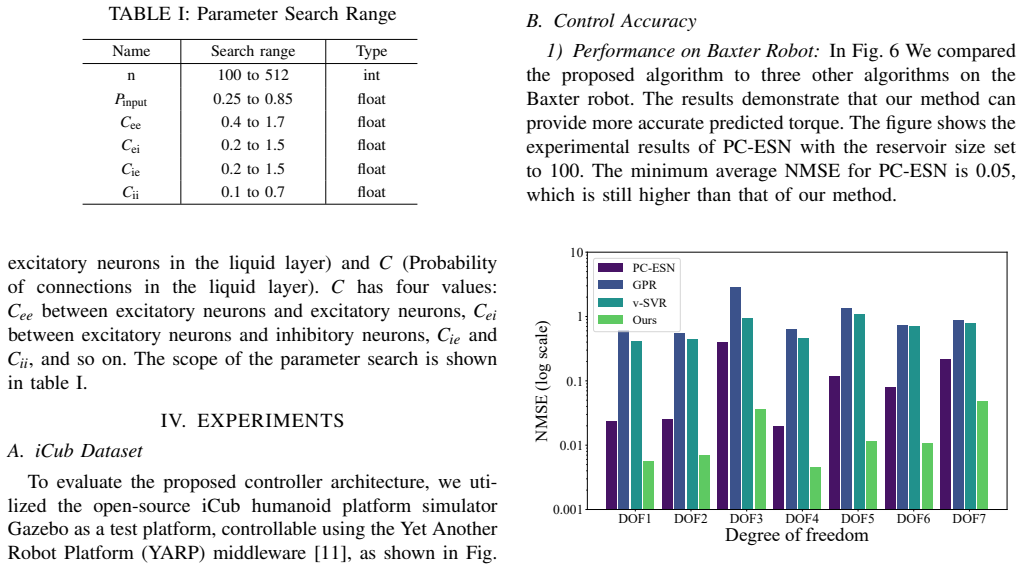
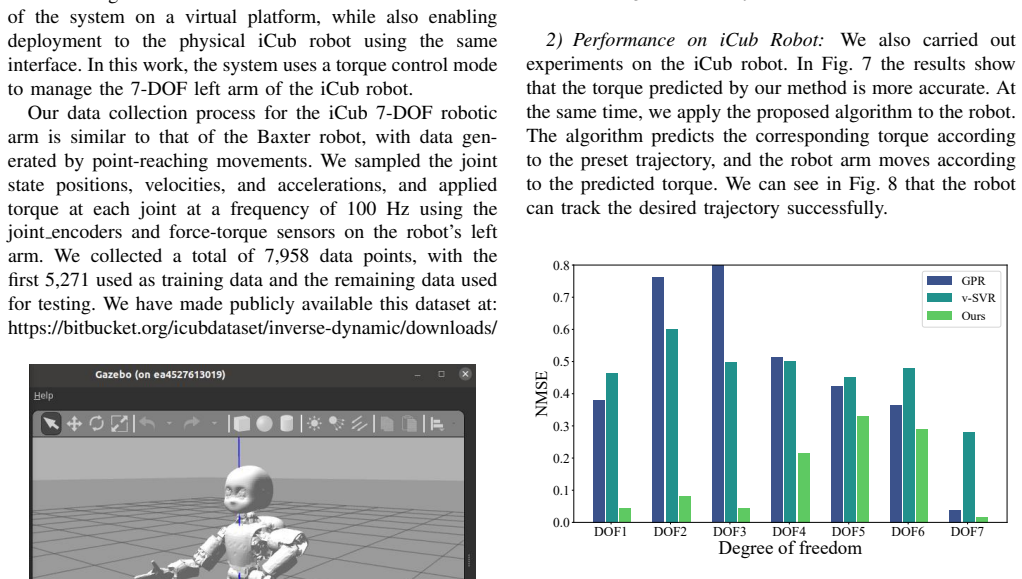
The paper's central claim is that an LSM-based SNN with delta encoding solves the 7-DOF inverse dynamics problem and produces more accurate torque predictions than PC-ESN, GPR, and v-SVR, with an average NMSE reduction of at least 60% on two platforms, Baxter and iCub. The authors also claim the delta encoding scheme, which fires spikes only on change in the input signal, outperforms rate and direct encoding by up to 36% in mean squared error. A closed-loop trajectory tracking experiment on the iCub simulator shows the predicted torques drive the arm along the desired trajectory.
Load-bearing premise
The comparison with baselines assumes that all methods receive the same input features; in particular, the paper does not state whether PC-ESN, GPR, and v-SVR also receive the previous actual torque that the proposed architecture feeds to its MLP readout, so the 60% error reduction may be due to the extra input signal rather than to the spiking network.
Editorial extensions
If this is right
- Torque prediction error on 7-DOF arms can be reduced by at least 60% relative to PC-ESN, GPR, and v-SVR when using an LSM-based spiking network with delta encoding.
- Delta encoding of the joint state outperforms rate and direct encoding on inverse-dynamics prediction, with up to 36% lower MSE.
- The LSM structure and connection probability can be automatically searched by PSO, removing the need for manual tuning of network parameters.
- The same framework can be deployed on two different 7-DOF platforms, Baxter and iCub, and used for closed-loop trajectory tracking.
Reading between the lines
- The reported 60% reduction may be partly attributable to the fact that the proposed architecture feeds the previous actual torque into the MLP readout; the paper does not state whether PC-ESN, GPR, or v-SVR also receive this autoregressive input.
- A fair comparison would give all methods the same input features, which would isolate whether the gain comes from the spiking network or from the extra torque signal.
- If delta encoding plus LSM proves robust across more platforms and physical robots, a natural extension is to run the same network on neuromorphic hardware, where the event-driven property could yield real energy savings.
- The released iCub dataset could become a standard benchmark for inverse-dynamics learning on high-DOF arms, enabling other spiking and non-spiking methods to be compared on identical data.
Signed reviews
Editorial analysis
A structured set of objections, weighed in public.
Referee Report
Summary. The manuscript proposes an embodied neuromorphic control framework for 7-DOF robotic manipulators. It uses a liquid state machine (LSM) with delta spike encoding and an MLP readout to learn the inverse dynamics mapping from joint state (positions, velocities, accelerations) to joint torques. The authors report experiments on the Baxter robot and the iCub humanoid simulator, claiming torque prediction error reduction of at least 60% relative to PC-ESN, GPR, and v-SVR, together with successful trajectory tracking on the iCub. The paper also introduces a publicly available iCub inverse dynamics dataset and uses particle swarm optimization to search over LSM structural hyperparameters.
Significance. If the empirical claims hold, the paper would be a useful step demonstrating that spiking LSMs can scale to a 7-DOF inverse dynamics problem and control task, and the released dataset is a positive contribution. The combination of delta coding, an LSM, and an MLP readout is a plausible and reasonably novel architecture for exploiting temporal continuity. Strengths include the public dataset, the use of two robotic platforms, and the comparison with multiple baselines and with alternative spike encodings. However, the central quantitative claim is currently undermined by a likely input mismatch between the proposed model and the baselines, and by the lack of aggregate statistics and statistical tests, as detailed below.
major comments (4)
- [III-B, Fig. 4b, Eq. (5)] The proposed network receives the previous actual torque τ(t−1) as an input to the MLP (Section III-B: “the actual torque applied to the robotic arm is directly encoded and provided to the network to assist in predicting the torque for the subsequent moment”; Fig. 4b caption: “The MLP combines the torque value applied to the robotic arm in the previous time step to predict the torque”), whereas the problem is defined in Eq. (5) as τ = f(x) + ε with x = [q, ˙q, ¨q] and no autoregressive torque term. The manuscript never states whether PC-ESN, GPR, and v-SVR were given this same τ(t−1) input. Since robot torques at 100 Hz sampling are highly autocorrelated, the reported “at least 60%” error reduction may be due to the extra input feature rather than to the LSM/delta-encoding spiking mechanism. The authors must either (a) provide the same τ(t−1) input to all baselines, (b) run an ablation of the proposed model without τ(t−1), or (c) clearly justify and re-frame the comparison accordingly. This is the load-bearing issue for the abstract's central claim.
- [IV-B, Figs. 6–7, Table II] The abstract and conclusions claim a reduction in average NMSE of at least 60%, but Figs. 6 and 7 show only per-DOF NMSE values without error bars, number of trials, or an aggregate statistic. Table II reports MSE for different encoding schemes, but this is not reconciled with the NMSE figures, and the averaging procedure behind the “average NMSE” claim is not described. To support the central quantitative claim, the paper should report mean and standard deviation over multiple independent runs, specify exactly how the per-DOF, per-platform errors are combined, and include a statistical significance test or at least confidence intervals.
- [III-C, Table I, Fig. 9] The PSO procedure searches the LSM structural hyperparameters n, P_input, C_ee, C_ei, C_ie, and C_ii included in Table I, but the objective function used for the search and the data split on which that objective is evaluated are not specified. If the test set or the final validation set influenced the PSO search, the reported generalization results are circular. The authors should state explicitly that PSO was applied only to a training/validation split, describe the objective, and provide this detail in the experimental section.
- [I, III-C, Eq. (7)] The contribution states that the method “eliminate[s] manual parameters tuning,” but the framework still requires the user to set the spike scaling hyperparameter θ in Eq. (7), the PSO search ranges in Table I, the number of liquid neurons, and the MLP training hyperparameters. This claim is overstated and should be reframed as reducing manual tuning or replacing direct search with automated PSO-based selection.
minor comments (6)
- [III-A, Eq. (5)] The domain in Eq. (5), R3N×17, appears to be a typo; the intended domain is likely R^{3N} or R^{3N×1}. Please correct the notation.
- [II-A, Eqs. (1)–(2)] The time constants τ1, τ2, and τ3 are not defined, and the use of τ both for these constants and for the torque vector in Eq. (4) is confusing. Please use distinct symbols, such as τ_m, τ_s, and τ_i.
- [IV-A, Table II] Table II lists a dataset labeled “BaxterRand,” but the text never defines this dataset or explains how it differs from the Baxter experiments described in Section IV-B. The origin and constitution of this dataset should be described.
- [IV-A, Conclusions] The experiments on iCub appear to be performed in the Gazebo simulator rather than on the physical robot. This limitation should be stated explicitly in the abstract and conclusions, where the phrase “two robotic platforms” might be misread as two physical robots.
- [IV-D, Fig. 9] The y-axis of Fig. 9 is labeled “Average NMSE,” but it is unclear whether this is training error, validation error, or test error, and how the average is computed across joints. Please clarify the reporting protocol.
- [V, Conclusions] The Conclusions contain a typo: “targel-tracking” should be “target-tracking.” Also, the phrase “reduce the average NMSE by 36%” in the Conclusions refers to the encoding comparison, but Table II reports MSE, not NMSE; please use consistent metrics throughout.
Circularity Check
full rationale
The paper's central claim is an empirical regression result: an LSM-based SNN with delta encoding is trained to predict joint torques from robot states, and its held-out NMSE is compared with PC-ESN, GPR, and v-SVR. Nothing in the method defines the predicted torque in terms of the target torque by construction, and no equation reduces the output to an input. The problem statement in Eq. 5 defines inverse dynamics as tau = f(x) + epsilon, and Section IV-B reports errors on test portions of the data (e.g., the iCub split is explicitly 5,271 training points and the remainder for testing). The only notable issue is that Section III-B and Fig. 4b show the previous actual torque tau_{t-1} being fed into the MLP alongside LSM features, while the paper does not state whether the baselines received the same autoregressive input. At 100 Hz sampling, tau_{t-1} is strongly predictive of tau_t, so the reported 'at least 60%' reduction could be inflated if the baselines were not given this feature. That is a confounded-comparison or experimental-fairness problem, not a circularity: the prediction is not equivalent to its input, and the loss is not minimized by re-emitting a fitted value. No load-bearing self-citation was found: the cited works (LSM, delta coding, YARP, Baxter, iCub) are standard tools and none is invoked as an unverified premise that forces the paper's conclusion. Therefore the derivation chain is not circular, and the score is 0.
Assumptions & free parameters
free parameters (3)
- Delta encoding spike count scale theta =
not reported
- LSM hyperparameters (n, P_input, C_ee, C_ei, C_ie, C_ii) =
not reported
- MLP and readout weights =
not reported
assumptions (3)
- domain assumption The rigid-body inverse dynamics model tau = M(q) q_ddot + C(q, q_dot) + G(q) captures the torque generation of the arms.
- domain assumption A fixed random LSM reservoir provides a sufficient feature representation for a linear readout to regress torque.
- domain assumption The PSO hyperparameter search is evaluated on training or validation data, not on the test set.
Cite this review
Pith. "Pith review of Embodied Neuromorphic Control Applied on a 7-DOF Robotic Manipulator." pith.science (2026). https://pith.science/paper/S3Q663DL
@misc{pith2026250412702,
  author       = {Pith},
  title        = {Pith review of: Embodied Neuromorphic Control Applied on a 7-DOF Robotic Manipulator},
  year         = {2026},
  howpublished = {\url{https://pith.science/paper/S3Q663DL}},
  note         = {Machine review of arXiv:2504.12702}
}
read the original abstract
The development of artificial intelligence towards real-time interaction with the environment is a key aspect of embodied intelligence and robotics. Inverse dynamics is a fundamental robotics problem, which maps from joint space to torque space of robotic systems. Traditional methods for solving it rely on direct physical modeling of robots which is difficult or even impossible due to nonlinearity and external disturbance. Recently, data-based model-learning algorithms are adopted to address this issue. However, they often require manual parameter tuning and high computational costs. Neuromorphic computing is inherently suitable to process spatiotemporal features in robot motion control at extremely low costs. However, current research is still in its infancy: existing works control only low-degree-of-freedom systems and lack performance quantification and comparison. In this paper, we propose a neuromorphic control framework to control 7 degree-of-freedom robotic manipulators. We use Spiking Neural Network to leverage the spatiotemporal continuity of the motion data to improve control accuracy, and eliminate manual parameters tuning. We validated the algorithm on two robotic platforms, which reduces torque prediction error by at least 60% and performs a target position tracking task successfully. This work advances embodied neuromorphic control by one step forward from proof of concept to applications in complex real-world tasks.
Figures


Figures from the paper (5 more)



Reference graph
Works this paper leans on
- [25]
-
[1]
Nature communications 13(1), 1024 (2022)
Bartolozzi, C., Indiveri, G., Donati, E.: Embodied neuromorphic intelligence. Nature communications 13(1), 1024 (2022)
work page 2022
-
[2]
arXiv preprint arXiv:2003.02944 (2020)
Fang, H., Shrestha, A., Zhao, Z., Qiu, Q.: Exploiting neuron and synapse filter dynamics in spatial temporal learning of deep spiking neural network. arXiv preprint arXiv:2003.02944 (2020)
arXiv 2020
-
[3]
In: 2013 IEEE conference on technologies for practical robot applications (TePRA)
Fitzgerald, C.: Developing baxter. In: 2013 IEEE conference on technologies for practical robot applications (TePRA). pp. 1–6. IEEE (2013)
work page 2013
-
[4]
In: International Conference on Machine Learning
Gilra, A., Gerstner, W.: Non-linear motor control by local learning in spiking neural networks. In: International Conference on Machine Learning. pp. 1773–1782. PMLR (2018)
work page 2018
-
[5]
In: Pro- ceedings of the 1st annual conference on genetic programming
Gruau, F., Whitley, D., Pyeatt, L.: A comparison between cellular encoding and direct encoding for genetic neural networks. In: Pro- ceedings of the 1st annual conference on genetic programming. pp. 81–89 (1996)
work page 1996
-
[6]
Hartmann, C., Boedecker, J., Obst, O., Ikemoto, S., Asada, M.: Real- time inverse dynamics learning for musculoskeletal robots based on echo state gaussian process regression (2013)
work page 2013
-
[7]
In: IOP Confer- ence Series: Materials Science and Engineering
Hughes, J., Abdulali, A., Hashem, R., Iida, F.: Embodied artificial intelligence: Enabling the next intelligence revolution. In: IOP Confer- ence Series: Materials Science and Engineering. vol. 1261, p. 012001. IOP Publishing (2022)
work page 2022
Show all 26 references
-
[8]
Kapatsyn, A.: Real-time simulation of arm and hand dynamics using snn (2024)
2024
-
[9]
In: IJCAI
Liu, Q., Xing, D., Tang, H., Ma, D., Pan, G.: Event-based action recognition using motion information and spiking neural networks. In: IJCAI. pp. 1743–1749 (2021)
2021
-
[10]
Neural computation 14(11), 2531–2560 (2002)
Maass, W., Natschl ¨ager, T., Markram, H.: Real-time computing with- out stable states: A new framework for neural computation based on perturbations. Neural computation 14(11), 2531–2560 (2002)
2002
-
[11]
International Journal of Advanced Robotic Systems 3(1), 8 (2006)
Metta, G., Fitzpatrick, P., Natale, L.: Yarp: yet another robot platform. International Journal of Advanced Robotic Systems 3(1), 8 (2006)
2006
-
[12]
In: Proceedings of the 8th workshop on performance metrics for intelligent systems
Metta, G., Sandini, G., Vernon, D., Natale, L., Nori, F.: The icub humanoid robot: an open platform for research in embodied cognition. In: Proceedings of the 8th workshop on performance metrics for intelligent systems. pp. 50–56 (2008)
2008
-
[13]
In: 2010 IEEE international conference on robotics and automation
Nguyen-Tuong, D., Peters, J.: Using model knowledge for learning inverse dynamics. In: 2010 IEEE international conference on robotics and automation. pp. 2677–2682. IEEE (2010)
2010
-
[14]
Cognitive processing 12, 319–340 (2011)
Nguyen-Tuong, D., Peters, J.: Model learning for robot control: a survey. Cognitive processing 12, 319–340 (2011)
2011
-
[15]
In: European symposium on artificial neural networks (2008)
Nguyen-Tuong, D., Peters, J., Seeger, M., Sch ¨olkopf, B.: Learning inverse dynamics: a comparison. In: European symposium on artificial neural networks (2008)
2008
-
[16]
In: 2009 IEEE/RSJ International Conference on Intelligent Robots and Systems
Nguyen-Tuong, D., Sch ¨olkopf, B., Peters, J.: Sparse online model learning for robot control with support vector regression. In: 2009 IEEE/RSJ International Conference on Intelligent Robots and Systems. pp. 3121–3126. IEEE (2009)
2009
-
[17]
Advanced Robotics 23(15), 2015–2034 (2009)
Nguyen-Tuong, D., Seeger, M., Peters, J.: Model learning with local gaussian process regression. Advanced Robotics 23(15), 2015–2034 (2009)
2009
-
[18]
In: Proceedings of the 8th International Conference of Control Systems, and Robotics (CDSR’21), Virtual
Patel, R., Zeinali, M., Passi, K.: Deep learning-based robot control using recurrent neural networks (lstm; gru) and adaptive sliding mode control. In: Proceedings of the 8th International Conference of Control Systems, and Robotics (CDSR’21), Virtual. pp. 23–25 (2021)
2021
-
[19]
In: 2015 IEEE/RSJ Inter- national Conference on Intelligent Robots and Systems (IROS)
Polydoros, A.S., Nalpantidis, L., Kr ¨uger, V .: Real-time deep learning of robotic manipulator inverse dynamics. In: 2015 IEEE/RSJ Inter- national Conference on Intelligent Robots and Systems (IROS). pp. 3442–3448. IEEE (2015)
2015
-
[20]
Sensors 17(2), 311 (2017)
Reinhart, R.F., Shareef, Z., Steil, J.J.: Hybrid analytical and data-driven modeling for feed-forward robot control. Sensors 17(2), 311 (2017)
2017
-
[21]
arXiv preprint arXiv:2110.15245 (2021)
Roy, N., Posner, I., Barfoot, T., Beaudoin, P., Bengio, Y ., Bohg, J., Brock, O., Depatie, I., Fox, D., Koditschek, D., et al.: From machine learning to robotics: Challenges and opportunities for embodied intel- ligence. arXiv preprint arXiv:2110.15245 (2021)
2021 arXiv
-
[22]
In: 2017 IEEE- RAS 17th International Conference on Humanoid Robotics (Hu- manoids)
Rueckert, E., Nakatenus, M., Tosatto, S., Peters, J.: Learning inverse dynamics models in o (n) time with lstm networks. In: 2017 IEEE- RAS 17th International Conference on Humanoid Robotics (Hu- manoids). pp. 811–816. IEEE (2017)
2017
-
[23]
Journal of computational neuroscience 2, 149–162 (1995)
Theunissen, F., Miller, J.P.: Temporal encoding in nervous systems: a rigorous definition. Journal of computational neuroscience 2, 149–162 (1995)
1995
-
[24]
Vijayakumar, S., D’Souza, A., Schaal, S.: Lwpr: A scalable method for incremental online learning in high dimensions (2005)
2005
-
[26]
IEEE Journal on Emerging and Selected Topics in Circuits and Systems 10(4), 546–556 (2020)
Zhao, J., Risi, N., Monforte, M., Bartolozzi, C., Indiveri, G., Donati, E.: Closed-loop spiking control on a neuromorphic processor imple- mented on the icub. IEEE Journal on Emerging and Selected Topics in Circuits and Systems 10(4), 546–556 (2020)
2020
Reviewed August 16, 2026 · model on record in the stance chip above.
Discussion (0). Continue with ORCID to comment.