REVIEW 4 major objections 6 minor 75 references
Krysalis Hand: A Lightweight, High-Payload, 18-DoF Anthropomorphic End-Effector for Robotic Learning and Dexterous Manipulation
T0 review · 4 major / 6 minor · reviewed 2026-08-16 · deepseek-v4-flash
Pith's one-line read The paper claims a 790 gram, 18-DoF five-finger hand whose self-locking leadscrews let it passively hold over 10 lbs while each fingertip actively pushes about 10 N.
desk verdict A serious lightweight 18-DoF hand whose self-locking leadscrew design is sound and well-demonstrated, but whose headline '>10 lbs' payload spec currently rests on an unreported FEA and a single capped test. read the letter →
The pith
A machine-rendered reading of the paper's core claim, the machinery that carries it, and where it could break.
The reading
What carries the argument
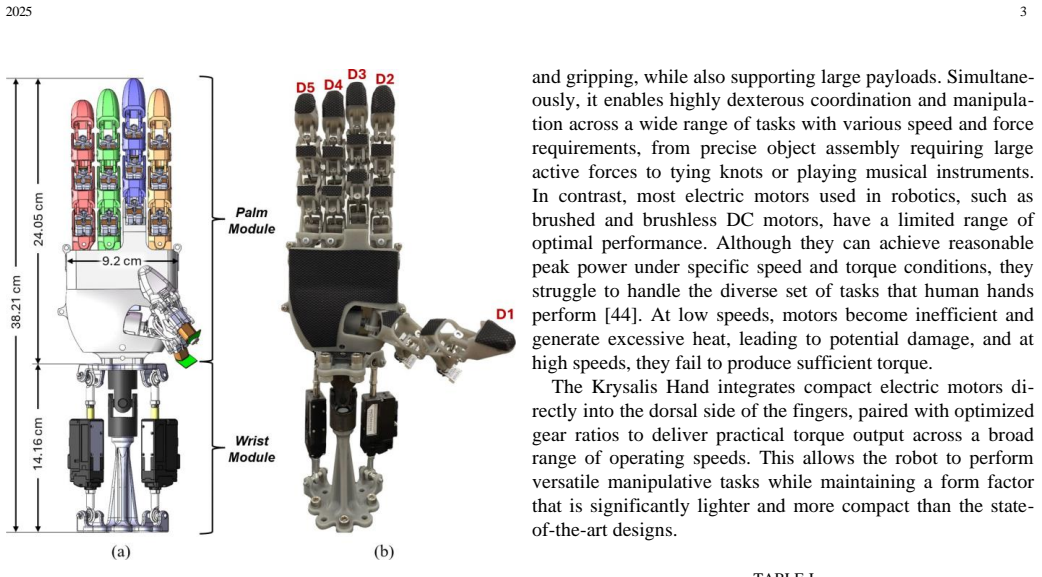
The load-bearing element is the self-locking leadscrew actuator repeated at every finger joint (DIP, PIP, and MCP) plus the worm-gear set at the thumb carpometacarpal joint. Self-locking is the condition $\phi_s > \alpha$: the friction angle of the screw-nut pair exceeds the lead angle of the screw thread, so an external load cannot rotate the screw backward. For the finger leadscrews the paper computes $\alpha = 2.55^\circ$ and $\phi_s \approx 21.83^\circ$; for the thumb CMC worm gear it computes $\alpha = 4.80^\circ$ and $\phi_s = 24.7^\circ$. This mechanism carries the argument by converting holding torque from a motor burden into a structural one: the hand bears large passive loads with the motors off, while active fingertip force comes from the same screw driving a sliding nut that rotates the phalange through a two-link rocker.
What would settle it
Measure the load at which an unpowered, fully flexed Krysalis Hand joint first back-drives or fractures under a steadily increasing suspended weight, and compare it with the FEA-predicted failure load. If any joint creeps, back-drives, or breaks below 4.53 kg, the passive-payload claim is false; if the hand holds well beyond 10 lbs, the claim is supported.
Extended reading notes
Core claim
The central claim of the paper is that a fully actuated, non-tendon-driven five-finger hand can be both light and strong if each joint uses a self-locking leadscrew. Because the screw cannot be back-driven when the friction angle exceeds the lead angle, the hand holds a fixed pose without motor power; the passive payload limit then depends on the structural strength of the frame, not on the torque of its motors. The authors report a 790 g hand with 18 DoF that sustained a 10 lb static hold, nearly 10 N active force per fingertip, full thumb opposition to all four fingers, an average range of motion 11.2% greater than the human hand across the measured joints, and successful teleoperated grasping. The significance the authors draw is that payload capacity and actuation force are decoupled, so smaller and cheaper motors can be used while keeping high holding capacity.
Load-bearing premise
The whole 'over 10 lbs' passive-payload figure rests on an unreported finite-element analysis; the only direct measurement is a single 10 lb static hold, deliberately capped to avoid breaking the hand.
Editorial extensions
If this is right
- A hand built this way can hold a heavy object indefinitely without drawing motor current, which removes the overheating and power-consumption penalty of sustained grasps.
- Because the motors only need to supply about 10 N per finger, the actuator set can be small and cheap enough to fit inside the 790 g hand, making the hand usable on low-payload collaborative arms.
- With 18 DoF, thumb opposition to all fingertips, and two wrist axes, the hand covers precision, power, and tripod grasps over a range of everyday and industrial objects.
- The demonstrated teleoperation pipeline offers a route for collecting human demonstrations in learning-from-demonstration systems without requiring a large, expensive, tendon-driven hand.
Reading between the lines
- The paper reports only a single capped 10 lb static test and refers to an unreported finite-element analysis for the true failure load; a natural next experiment is to load the unpowered hand to failure and confirm that FEA prediction, since the 'exceeding 10 lbs' claim rests entirely on that simulation.
- The same self-locking screw-and-worm approach could plausibly be carried over to other energy-hungry joints, such as an elbow or waist, wherever sustained load holding matters, though dynamic loading and fatigue life would require separate validation.
- If the passive/active decoupling holds up under repeated grasps and long-duration loads, the design could lower the cost of high-DoF hands enough to make dexterous manipulation practical for small-batch assembly and household robots, not only well-funded laboratories.
Signed reviews
Editorial analysis
A structured set of objections, weighed in public.
Referee Report
Summary. The paper introduces the Krysalis Hand, a five-finger, 18-DoF anthropomorphic robotic end-effector with all actuators integrated into the fingers, palm, and a two-DoF wrist. The core design idea is a leadscrew-based finger actuation whose thread geometry is chosen to be self-locking, so that large external loads can be held passively without continuous motor torque. The reported specifications are a total mass of 790 g, a passive payload capacity greater than 10 lbs, an active fingertip force of about 10 N, and a finger speed of 91.5°/s. The manuscript describes the mechanical design, the self-locking analysis, the thumb CMC worm-gear mechanism, the coupled abduction-adduction drive, the wrist module, materials and electronics, and then presents experimental sections on fingertip force, thumb opposability, joint range of motion, grasping capability, and teleoperation via a MANUS glove and ROS 2. The central claimed contribution is that the passive payload limit is shifted from motor torque to structural strength, enabling lighter and cheaper motors while retaining high holding capacity.
Significance. If the specifications are substantiated, the design would be a valuable contribution to dexterous manipulation hardware: the self-locking leadscrew principle is clean, the hand is lightweight, and the proposed decoupling of passive payload from active motor force is genuinely useful for robot-learning applications. The analytical self-locking check in Section III-B is internally coherent, follows directly from the published geometry and a handbook friction coefficient, and does not use fitted constants; the release of control and teleoperation code is also a strength. However, the headline quantitative claims—especially the passive payload capacity greater than 10 lbs and the 10 N active force—currently rest on very limited experimental evidence, and the dexterity and teleoperation evaluations are qualitative. With additional experiments and reporting, the contribution could meet the bar for a strong hardware paper; in its present form the verification is too thin for the central specifications.
major comments (4)
- [Section VI-A and Table I] The specification 'Passive Payload Capacity > 4.53 kg (10 lbs)' is supported only by a single static hold of a 10 lb dumbbell, a test that the authors state was deliberately capped to avoid damage, plus an FEA that is mentioned but not reported. The FEA is not described in any reproducible detail: there is no mesh, no material model for the SLA Tough 1500 resin, no boundary conditions, no load case, no failure criterion, and no safety factor. Because the headline 'high-payload' claim depends on the assertion that structural failure occurs at 'significantly higher loading conditions,' this missing information is load-bearing. Please provide the full FEA setup and results, and support the specification with either repeated overload tests to failure or repeated capped tests with measured deflection and a conservative safety factor.
- [Section VI-A and Fig. 10] The active fingertip force of 'nearly 10 N' is reported from a single time trace with no repeated trials, no error bars, and no description of the test protocol: the joint configuration, the fingertip contact point, the force sensor mounting, and whether the finger was stalled or moving at constant speed are not stated. Since Table I lists 10 N as a specification and the claim is used to argue that the hand decouples payload from active force, please report repeated trials with statistics and a precise protocol.
- [Sections VI-B and VI-D] The dexterity and grasping evaluations are qualitative. Thumb opposition is reported as 'visually verified' contact success with no quantitative measure of accuracy or repeatability, and the grasping assessment consists of photographs categorized into precision, power, and tripod grasps without success rates, number of trials, or grasp-robustness metrics. Given that the introduction positions the hand for robotic learning and dexterous manipulation, quantitative task metrics (e.g., success rates over repeated trials, force during grasp, and object-feature coverage) are necessary to support these claims.
- [Section VI-F] The teleoperation section demonstrates a working pipeline but does not report any quantitative performance: there is no latency measurement, no tracking error between the MANUS glove and the hand joints, and no success rate for teleoperated manipulation. The text claims 'high-precision teleoperation,' which is not supported by the presented data. Please add either quantitative tracking/latency measurements or reframe the claim as a feasibility demonstration.
minor comments (6)
- [Abstract and Section VI-A] The abstract and Table I state that the passive payload is 'exceeding 10 lbs,' but the only direct test was capped at 10 lbs; please rephrase to 'at least 10 lbs' until overload data are provided.
- [Section V] The sentence 'Each phalange in the fingers D1 to D5 ... is driven by a micro DC motor with with embedded encoder' contains a duplicated 'with'; please correct.
- [Table II] The row formatting in Table II is inconsistent: for example, the 'Middle' finger block appears to have its joint labels shifted, and the 'Total RoM' under the Thumb block seems to belong to the Index block. Please recheck the alignment and labeling of all rows.
- [References] Reference [29] contains the placeholder '[insert page numbers]'; please complete the citation.
- [Section IV and GitHub] The manuscript says the GitHub repository contains control and teleoperation code, but it does not mention CAD or STL files for the mechanical parts. For a hardware paper, publishing the CAD files would substantially improve reproducibility; please state whether these files are available.
- [Section III-B] Equations (1) and (2) use a handbook friction coefficient for stainless steel rather than a measured value for the specific surface finish and nut material. The large margin (21.83° vs. 2.55°) makes the self-locking conclusion robust, but please state this assumption explicitly and briefly discuss the sensitivity to lubrication or wear.
Circularity Check
No significant circularity: the self-locking derivation is textbook screw statics with external friction data, and the unreported FEA behind the >10 lb payload claim is a verification gap, not a circular reduction.
full rationale
The paper's central load-bearing derivation is Section III-B: Eq. (1) computes the lead angle alpha = tan^-1(l/(pi d)) = 2.55 degrees from the measured lead (0.35 mm) and mean diameter (2.50 mm) of an M2.5 leadscrew, and Eq. (2) computes the friction angle phi_s = tan^-1(mu) = 21.83 degrees from a cited dry stainless-steel friction coefficient (mu = 0.42, engineering toolbox). The self-locking conclusion phi_s > alpha follows directly from that textbook condition; no parameter is fitted to the hand's payload specification and no target quantity is used as an input. The thumb CMC self-locking check in Section III-C repeats the same external-condition argument with a literature aluminum friction coefficient. The active 10 N finger force is a direct load-cell measurement (Section VI-A, Fig. 10), and the passive payload claim is a 10 lb static hold (Fig. 11) plus an unshown FEA that is claimed to indicate failure at significantly higher loads. That unreported FEA is a genuine missing-support and reproducibility limitation for the headline '>10 lbs' specification, but it is not circularity: the FEA is an external simulation, not a renaming of the paper's own measured result, and there is no fitted parameter being re-presented as a prediction. There are also no load-bearing self-citations: the reference list consists of textbooks, standards, material datasheets, and prior hardware systems, so no argument reduces to the authors' own prior claims. Accordingly, no circular step is present.
Assumptions & free parameters
assumptions (4)
- standard math The standard lead-screw self-locking condition, friction angle greater than lead angle, is the correct criterion for the joints.
- domain assumption The friction coefficients taken from engineering tables, 0.42 for stainless leadscrew/nut and 0.46 for the printed aluminum worm pair, describe the actual manufactured surfaces under load.
- domain assumption The unreported FEA model accurately predicts structural failure at loads substantially above 10 lbs.
- domain assumption SLA-printed Tough 1500 resin parts have sufficient structural stiffness and strength for the advertised passive loads.
Cite this review
Pith. "Pith review of Krysalis Hand: A Lightweight, High-Payload, 18-DoF Anthropomorphic End-Effector for Robotic Learning and Dexterous Manipulation." pith.science (2026). https://pith.science/paper/NANXRAGZ
@misc{pith2026250412967,
  author       = {Pith},
  title        = {Pith review of: Krysalis Hand: A Lightweight, High-Payload, 18-DoF Anthropomorphic End-Effector for Robotic Learning and Dexterous Manipulation},
  year         = {2026},
  howpublished = {\url{https://pith.science/paper/NANXRAGZ}},
  note         = {Machine review of arXiv:2504.12967}
}
read the original abstract
This paper presents the Krysalis Hand, a five-finger robotic end-effector that combines a lightweight design, high payload capacity, and a high number of degrees of freedom (DoF) to enable dexterous manipulation in both industrial and research settings. This design integrates the actuators within the hand while maintaining an anthropomorphic form. Each finger joint features a self-locking mechanism that allows the hand to sustain large external forces without active motor engagement. This approach shifts the payload limitation from the motor strength to the mechanical strength of the hand, allowing the use of smaller, more cost-effective motors. With 18 DoF and weighing only 790 grams, the Krysalis Hand delivers an active squeezing force of 10 N per finger and supports a passive payload capacity exceeding 10 lbs. These characteristics make Krysalis Hand one of the lightest, strongest, and most dexterous robotic end-effectors of its kind. Experimental evaluations validate its ability to perform intricate manipulation tasks and handle heavy payloads, underscoring its potential for industrial applications as well as academic research. All code related to the Krysalis Hand, including control and teleoperation, is available on the project GitHub repository: https://github.com/Soltanilara/Krysalis_Hand
Figures


Figures from the paper (1 more)

Reference graph
Works this paper leans on
-
[1]
Chutima, ”A comprehensive review of robotic assembly line balancing problem,” J
P. Chutima, ”A comprehensive review of robotic assembly line balancing problem,” J. Intell. Manuf., vol. 33, no. 1, pp. 1-34, 2022
work page 2022
-
[2]
A. Hanna, et al., ”Industrial challenges when planning and preparing col - laborative and intelligent automation systems for final assembly stations,” in 2019 24th IEEE Int. Conf. Emerging Technol. Factory Autom. (ETFA), 2019
work page 2019
-
[3]
A. Billard and D. Kragic, ”Trends and challenges in robot manipulation,” Science, vol. 364, no. 6446, Jun. 2019, doi: 10.1126/science.aat8414
-
[4]
J. Hernandez, et al., ”Current designs of robotic arm grippers: A com - prehensive systematic review,” Robotics, vol. 12, no. 1, p. 5, 2023
work page 2023
-
[5]
Q. Mao, et al., ”Multimodal tactile sensing fused with vision for dexterous robotic housekeeping,” Nature Communications, vol. 15, no. 1, p. 6871, 2024
work page 2024
-
[6]
A. Lee, et al., ”InterACT: Inter-dependency Aware Action Chunking with Hierarchical Attention Transformers for Bimanual Manipulation,” arXiv preprint arXiv:2409.07914, 2024
arXiv 2024
-
[7]
Z. Hu, W. Wan, K. Koyama, and K. Harada, ”A Mechanical Screwing Tool for Parallel Grippers —Design, Optimization, and Manipulation Policies,” IEEE Trans. Robot., vol. 38, no. 2, pp. 1139–1159, 2022
work page 2022
-
[8]
J. Ringwald, et al., ”Towards task-specific modular gripper fingers: Auto- matic production of fingertip mechanics,” IEEE Robotics and Automation Letters, vol. 8, no. 3, pp. 1866-1873, 2023
work page 2023
Show all 75 references
-
[9]
Hughes, et al., ”Flexible, adaptive industrial assembly: driving inno - vation through competition: Flexible manufacturing,” Intelligent Service Robotics, vol
J. Hughes, et al., ”Flexible, adaptive industrial assembly: driving inno - vation through competition: Flexible manufacturing,” Intelligent Service Robotics, vol. 13, no. 1, pp. 169-178, 2020
2020
-
[10]
24, 2024
Viv, ”Shadow Dexterous Hand Series - Research and Develop- ment Tool,” Shadow Robot , Jun. 24, 2024. [Online]. Available: www. shadowrobot.com/dexterous-hand-series. Accessed: Apr. 7, 2025
2024
-
[11]
Kru¨ger, T
J. Kru¨ger, T. K. Lien, and A. Verl, ”Cooperation of human and machines in assembly lines,” CIRP Annals, vol. 58, no. 2, pp. 628-646, 2009
2009
-
[12]
Spatola, S
N. Spatola, S. Monceau, and L. Ferrand, ”Cognitive impact of social robots: How anthropomorphism boosts performances,” IEEE Robotics & Automation Magazine, vol. 27, no. 3, pp. 73-83, 2019
2019
-
[13]
Z. Fu, T. Z. Zhao, and C. Finn, ”Mobile aloha: Learning bimanual mobile manipulation with low -cost whole -body teleoperation,” arXiv preprint arXiv:2401.02117, 2024
2024 arXiv
-
[14]
Chuang, et al., ”Active Vision Might Be All You Need: Exploring Active Vision in Bimanual Robotic Manipulation,” arXiv, 2024
I. Chuang, et al., ”Active Vision Might Be All You Need: Exploring Active Vision in Bimanual Robotic Manipulation,” arXiv, 2024. [Online]. Available: https://arxiv.org/abs/2409.17435. [Accessed: Apr. 2025]
2024 arXiv
-
[15]
Sannapaneni, M
B. Sannapaneni, M. Shaswat, and A. A. Nippun Kumaar, ”Learn- ing from demonstration algorithm for cloth folding manipulator,” in 2017 International Conference on Advances in Computing, Com - munications and Informatics (ICACCI) , 2017, pp. 1222 -1227. doi: 10.1109/ICACCI.2017.8141973
2017
-
[16]
Zhang, et al., ”Prediction -based human-robot collaboration in assem- bly tasks using a learning from demonstration model,” Sensors, vol
Z. Zhang, et al., ”Prediction -based human-robot collaboration in assem- bly tasks using a learning from demonstration model,” Sensors, vol. 22, no. 11, p. 4279, 2022. doi: 10.3390/s22114279. 2025 11
2022 doi
-
[17]
Sanchez, et al., ”Robotic manipulation and sensing of deformable ob - jects in domestic and industrial applications: a survey,” The International Journal of Robotics Research, vol
J. Sanchez, et al., ”Robotic manipulation and sensing of deformable ob - jects in domestic and industrial applications: a survey,” The International Journal of Robotics Research, vol. 37, no. 7, pp. 688-716, 2018
2018
-
[18]
S. R. Iyer, et al., ”Household navigation and manipulation for everyday object rearrangement tasks,” in 2023 Seventh IEEE International Confer- ence on Robotic Computing (IRC), 2023
2023
-
[19]
Fang, et al., ”Survey of imitation learning for robotic manipulation,” International Journal of Intelligent Robotics and Applications, vol
B. Fang, et al., ”Survey of imitation learning for robotic manipulation,” International Journal of Intelligent Robotics and Applications, vol. 3, pp. 362-369, 2019
2019
-
[20]
H. Kim, Y. Ohmura, and Y. Kuniyoshi, ”Goal-Conditioned Dual-Action Imitation Learning for Dexterous Dual -Arm Robot Manipulation,” IEEE Trans. Robot., vol. 40, pp. 2287–2305, 2024
2024
-
[21]
Ali, et al., ”Explainable Artificial Intelligence (XAI): What we know and what is left to attain Trustworthy Artificial Intelligence,” Information Fusion, vol
S. Ali, et al., ”Explainable Artificial Intelligence (XAI): What we know and what is left to attain Trustworthy Artificial Intelligence,” Information Fusion, vol. 99, p. 101805, 2023
2023
-
[22]
Guo and M
M. Guo and M. Bu¨rger, ”Geometric Task Networks: Learning Efficient and Explainable Skill Coordination for Object Manipulation,” IEEE Trans. Robot., vol. 38, no. 3, pp. 1723–1734, 2022
2022
-
[23]
Barekatain, H
A. Barekatain, H. Habibi, and H. Voos, ”A practical roadmap to learning from demonstration for robotic manipulators in manufacturing,” Robotics, vol. 13, no. 7, p. 100, 2024
2024
-
[24]
Liu, et al., ”Human -Humanoid Robots Cross -Embodiment Behavior- Skill Transfer Using Decomposed Adversarial Learning from Demonstra- tion,” arXiv preprint arXiv:2412.15166, 2024
J. Liu, et al., ”Human -Humanoid Robots Cross -Embodiment Behavior- Skill Transfer Using Decomposed Adversarial Learning from Demonstra- tion,” arXiv preprint arXiv:2412.15166, 2024
2024 arXiv
-
[25]
R. C. Joshi, et al., ”Optimized Inverse Kinematics Modeling and Joint Angle Prediction for Six -Degree-of-Freedom Anthropomorphic Robots with Explainable AI,” ISA transactions, 2024
2024
-
[26]
R. R. Ma and A. M. Dollar, ”On dexterity and dexterous manipulation,” in 2011 15th International Conference on Advanced Robotics (ICAR) , 2011
2011
-
[27]
Nazma and S
E. Nazma and S. Mohd, ”Tendon driven robotic hands: A review,” Int. J. Mech. Eng. Robot. Res., vol. 1, no. 3, pp. 350-357, 2012
2012
-
[28]
Ozawa, H
R. Ozawa, H. Kobayashi, and K. Hashirii, ”Analysis, Classification, and Design of Tendon-Driven Mechanisms,” IEEE Trans. Robot., vol. 30, no. 2, pp. 396–410, 2014
2014
-
[29]
Sultanov, et al., ”A review on collaborative robots in industrial and service sectors,” in 2022 International Siberian Conference on Control and Communications (SIBCON), 2022, pp
R. Sultanov, et al., ”A review on collaborative robots in industrial and service sectors,” in 2022 International Siberian Conference on Control and Communications (SIBCON), 2022, pp. [insert page numbers]
2022
-
[30]
Park and D
H. Park and D. Kim, ”An open -source anthropomorphic robot hand system: HRI hand,” HardwareX, vol. 7, p. e00100, 2020
2020
-
[31]
LEDDY, ”Underactuated Hand With Cable-driven Fingers,” WO2024073138A1, 4 Apr
M. LEDDY, ”Underactuated Hand With Cable-driven Fingers,” WO2024073138A1, 4 Apr. 2024. [Online]. Available: https://patentimages.storage.googleapis.com/e4/d0/9f/4ebc9a8480c938/ WO2024073138A1.pdf
2024
-
[32]
K. Shaw, A. Agarwal, and D. Pathak, ”Leap hand: Low-cost, effi- cient, and anthropomorphic hand for robot learning,” arXiv preprint arXiv:2309.06440, 2023
2023 arXiv
-
[33]
Kadalagere Sampath, et al., ”Review on human -like robot manipula- tion using dexterous hands,” Cognitive Computation and Systems, vol
S. Kadalagere Sampath, et al., ”Review on human -like robot manipula- tion using dexterous hands,” Cognitive Computation and Systems, vol. 5, no. 1, pp. 14-29, 2023
2023
-
[34]
Kim, et al., ”Integrated linkage -driven dexterous anthropomorphic robotic hand,” Nature Communications, vol
U. Kim, et al., ”Integrated linkage -driven dexterous anthropomorphic robotic hand,” Nature Communications, vol. 12, no. 1, pp. 1-13, 2021
2021
-
[35]
Available: https:// www.roscomponents.com/product/shadow-dexterous-robotic-hand/
”Shadow Dexterous,” ROS Components , [Online]. Available: https:// www.roscomponents.com/product/shadow-dexterous-robotic-hand/. [Ac- cessed: 10-Apr-2025]
2025
-
[36]
[Online]
”How Much Does a Robot Hand Cost?”, Shadow Robot, 5-Dec-2022. [Online]. Available: www.shadowrobot.com/blog/ how-much-does-a-robot-hand-cost/. [Accessed: 10-Apr-2025]
2022
-
[37]
Available: https://schunk.com/de/de/greiftechnik/spezialgreifer/svh/c/PGR 3161
SVH Servoelektrische 5-Finger-Greifhand, [Online]. Available: https://schunk.com/de/de/greiftechnik/spezialgreifer/svh/c/PGR 3161. [Accessed: 10-Apr-2025]
2025
-
[38]
S. W. Ruehl et al. , ”Experimental evaluation of the Schunk 5 -finger gripping hand for grasping tasks,” in Proc. 2014 IEEE Int. Conf. Robot. Biomimetics (ROBIO) , 2014, pp. 2439 –2444, doi: 10.1109/RO - BIO.2014.7090629
2014
-
[39]
Cerulo et al., ”Teleoperation of the SCHUNK S5FH under -actuated anthropomorphic hand using human hand motion tracking,” Robotics Auton
I. Cerulo et al., ”Teleoperation of the SCHUNK S5FH under -actuated anthropomorphic hand using human hand motion tracking,” Robotics Auton. Syst., vol. 89, pp. 75–84, 2017, doi: 10.1016/j.robot.2016.12.011
2017 doi
-
[40]
Mayer, ”Fact sheet SCHUNK platform for robot manipulation learning,” Technical University of Munich, [Online]
M. Mayer, ”Fact sheet SCHUNK platform for robot manipulation learning,” Technical University of Munich, [Online]. Available: https://www.ce.cit.tum.de/fileadmin/w00cgn/rsi/Files/ICRA19 workshop/ fact sheet schunk.pdf. [Accessed: Apr. 9, 2025]
2025
-
[41]
Y. Liu, Q. Cheng, W. Wang, and D. Ming, ”Grip -force modulation in multi-finger prehension during wrist flexion and extension,” Exp. Brain Res., vol. 227, pp. 509–522, 2013
2013
-
[42]
S. S. Ambike, F. Paclet, M. L. Latash, et al., ”Effects of wrist configura- tion and finger combination on translational range of bimanual precision manipulation,” in Lecture Notes in Computer Science, vol. 13015, 2021
2021
-
[43]
H. Fan, G. Wei, and L. Ren, ”Prosthetic and robotic wrists comparing with the intelligently evolved human wrist: A review,” Robotica, vol. 40, no. 11, pp. 4169–4191, 2022
2022
-
[44]
Riener, L
R. Riener, L. Rabezzana, and Y. Zimmermann, ”Do robots outperform humans in human-centered domains?,” Front. Robot. AI, vol. 10, Art. no. 1223946, 2023
2023
-
[45]
J. T. Belter, J. L. Segil, and B. S. Sm, ”Mechanical design and perfor - mance specifications of anthropomorphic prosthetic hands: A review,” J. Rehabil. Res. Dev., vol. 50, no. 5, pp. 599, 2013
2013
-
[46]
Xiong et al., ”Design and implementation of an anthropomorphic hand for replicating human grasping functions,” IEEE Trans
C.-H. Xiong et al., ”Design and implementation of an anthropomorphic hand for replicating human grasping functions,” IEEE Trans. Robot., vol. 32, no. 3, pp. 652–671, 2016
2016
-
[47]
C. A. Nelson et al., ”Design of a compliant underactuated robotic finger with coordinated stiffness,” in Proc. ASME Int. Des. Eng. Tech. Conf. Comput. Inf. Eng. Conf., vol. 55942, 2013
2013
-
[48]
L. Wu, K. Yanxuan, and L. Xiali, ”A fully rotational joint underactuated finger mechanism and its kinematics analysis,” Int. J. Adv. Robot. Syst. , vol. 13, no. 5, Art. no. 1729881416663373, 2016
2016
-
[49]
Sun et al
B.-Y. Sun et al. , ”Design Principle of a Dual -Actuated Robotic Hand With Anthropomorphic Self-Adaptive Grasping and Dexterous Manipula- tion Abilities,” IEEE Trans. Robot., vol. 38, no. 4, pp. 2322–2340, 2022
2022
-
[50]
G. P. Kontoudis et al., ”An adaptive actuation mechanism for anthropo- morphic robot hands,” Front. Robot. AI, vol. 6, Art. no. 47, 2019
2019
-
[51]
D. W. Baker and W. Haynes, Engineering Statics: Open and Interactive, 2020
2020
-
[52]
Available: https://www.engineeringtoolbox.com/friction-coefficients-d 778.html
Friction - Friction Coefficients and Calculator, [Online]. Available: https://www.engineeringtoolbox.com/friction-coefficients-d 778.html. [Accessed: Apr. 9, 2025]
2025
-
[53]
[Online]
Institute for Quality and Efficiency in Health Care (IQWiG), ”In brief: How do hands work?,” InformedHealth.org - NCBI Bookshelf , May 20, 2021. [Online]. Available: https://www.ncbi.nlm.nih.gov/books/ NBK279362. [Accessed: Apr. 9, 2025]
2021
-
[54]
Wang et al., ”Selective laser melting of aluminum and its alloys,” Materials, vol
Z. Wang et al., ”Selective laser melting of aluminum and its alloys,” Materials, vol. 13, no. 20, p. 4564, 2020
2020
-
[55]
T. A. R. Schreuders, J. W. Brandsma, and H. J. Stam, ”Functional anatomy and biomechanics of the hand,” in Hand Function , Springer, Cham, 2019
2019
-
[56]
P. H. Thakur, A. J. Bastian, and S. S. Hsiao, ”Multidigit movement synergies of the human hand in an unconstrained haptic exploration task,” J. Neurosci., vol. 28, no. 6, pp. 1271–1281, 2008
2008
-
[57]
W. Wang, D. Wang, and C. Lai, ”The three-dimensional movement cor- relations between elbow and wrist joint and anthropometric determinants,” J. Mech. Med. Biol., vol. 18, no. 2, p. 1850013, 2018
2018
-
[58]
”Form 3B+: An Advanced Desktop 3D Printer Designed for the Health- care Industry.” Formlabs, https://formlabs.com/3d-printers/form-3b
-
[59]
com/store/materials/tough-1500-resin/?srsltid= AfmBOorw7iuqktleSoUumEflH535NFclSTk4YN88FwEo-oXqwbqLX9IC
”Tough 1500 Resin.” Formlabs, https://formlabs. com/store/materials/tough-1500-resin/?srsltid= AfmBOorw7iuqktleSoUumEflH535NFclSTk4YN88FwEo-oXqwbqLX9IC
-
[60]
Cosmi and A
F. Cosmi and A. Dal Maso, ”A mechanical characterization of SLA 3D- printed specimens for low-budget applications,” Mater. Today Proc., vol. 32, pp. 194–201, 2020
2020
-
[61]
Hague et al., ”Materials analysis of stereolithography resins for use in rapid manufacturing,” J
R. Hague et al., ”Materials analysis of stereolithography resins for use in rapid manufacturing,” J. Mater. Sci. , vol. 39, no. 7, pp. 2457 –2464, 2004
2004
-
[62]
Li et al., ”Isotropic stereolithography resin toughened by core -shell particles,” Chem
Y. Li et al., ”Isotropic stereolithography resin toughened by core -shell particles,” Chem. Eng. J., vol. 394, p. 124873, 2020
2020
-
[63]
Validating Isotropy in SLA 3D Printing
“Validating Isotropy in SLA 3D Printing.” Formlabs, formlabs.com/blog/isotropy-in-SLA-3D-printing
-
[64]
Rachaveti et al., ”Thumbs up: Movements made by the thumb are smoother and larger than fingers in finger-thumb opposition tasks,” PeerJ, vol
D. Rachaveti et al., ”Thumbs up: Movements made by the thumb are smoother and larger than fingers in finger-thumb opposition tasks,” PeerJ, vol. 6, p. e5763, 2018
2018
-
[65]
G. V. Lawry et al. , Fam’s Musculoskeletal Examination and Joint Injection Techniques: Expert Consult. Elsevier Health Sciences, 2010
2010
-
[66]
Gutie´rrez-Mart´ınez et al., ”System to measure the range of motion of the joints of the human hand,” Rev
J. Gutie´rrez-Mart´ınez et al., ”System to measure the range of motion of the joints of the human hand,” Rev. Invest. Clin., vol. 66, pp. S122–S130, 2014
2014
-
[67]
Erdogan and S
K. Erdogan and S. Bakirci, ”Evaluation of the abduction angles between hand fingers,” Medicine Science, vol. 12, no. 1, 2023
2023
-
[68]
Luttgens and N
K. Luttgens and N. P. Hamilton, Kinesiology: Scientific Basis of Human Motion. United States: Brown & Benchmark, 1997
1997
-
[69]
Feix et al., ”The grasp taxonomy of human grasp types,” IEEE Trans
T. Feix et al., ”The grasp taxonomy of human grasp types,” IEEE Trans. Human-Mach. Syst., vol. 46, no. 1, pp. 66–77, 2015. 2025 12
2015
-
[70]
Hand anthropometry of U.S. Army personnel,
T. M. Greiner and U.S. Army Natick Research Development and Engineering Center, “Hand anthropometry of U.S. Army personnel,” DTIC, [Online]. Available: https://apps.dtic.mil/sti/citations/ADA244533
-
[71]
Shaw, et al., ”Bimanual dexterity for complex tasks,” arXiv preprint arXiv:2411.13677, 2024
K. Shaw, et al., ”Bimanual dexterity for complex tasks,” arXiv preprint arXiv:2411.13677, 2024
2024 arXiv
-
[72]
Kawasaki and T
H. Kawasaki and T. Mouri, ”Design and Control of Five-Fingered Haptic Interface Opposite to Human Hand,” IEEE Trans. Robot., vol. 23, no. 5, pp. 909–918, 2007
2007
-
[73]
Available: https://www.manus-meta.com/products/quantum-metagloves
Quantum Metagloves by MANUS , ”Motion Capture Gloves,” [Online]. Available: https://www.manus-meta.com/products/quantum-metagloves. [Accessed: Apr. 7, 2025]
2025
-
[74]
Available: https://github.com/micro-ROS/micro ros raspberrypi pico sdk/tree/humble
micro-ROS Team, micro-ROS Raspberry Pi Pico SDK (Humble), GitHub, [Online]. Available: https://github.com/micro-ROS/micro ros raspberrypi pico sdk/tree/humble. [Accessed: Apr. 8, 2025]. VIII. BIOGRAPHY SECTION Al Arsh Basheer received his B.S. in Mechanical and Aerospace Engin...
2025
-
[2021]
in Robotics in 2023 from the University of California, Davis, USA
Later, he obtained his M.S. in Robotics in 2023 from the University of California, Davis, USA. His research focuses on developing high -dexterity humanoid robots to innovate automation across elec- tronics and aerospace industries. Justin Chang is a current 3rd -year undergrad...
2023
Reviewed August 16, 2026 · model on record in the stance chip above.
Discussion (0). Continue with ORCID to comment.