REVIEW 5 major objections 6 minor 39 references
Pose and Facial Expression Transfer by using StyleGAN
T0 review · 5 major / 6 minor · reviewed 2026-08-16 · deepseek-v4-flash
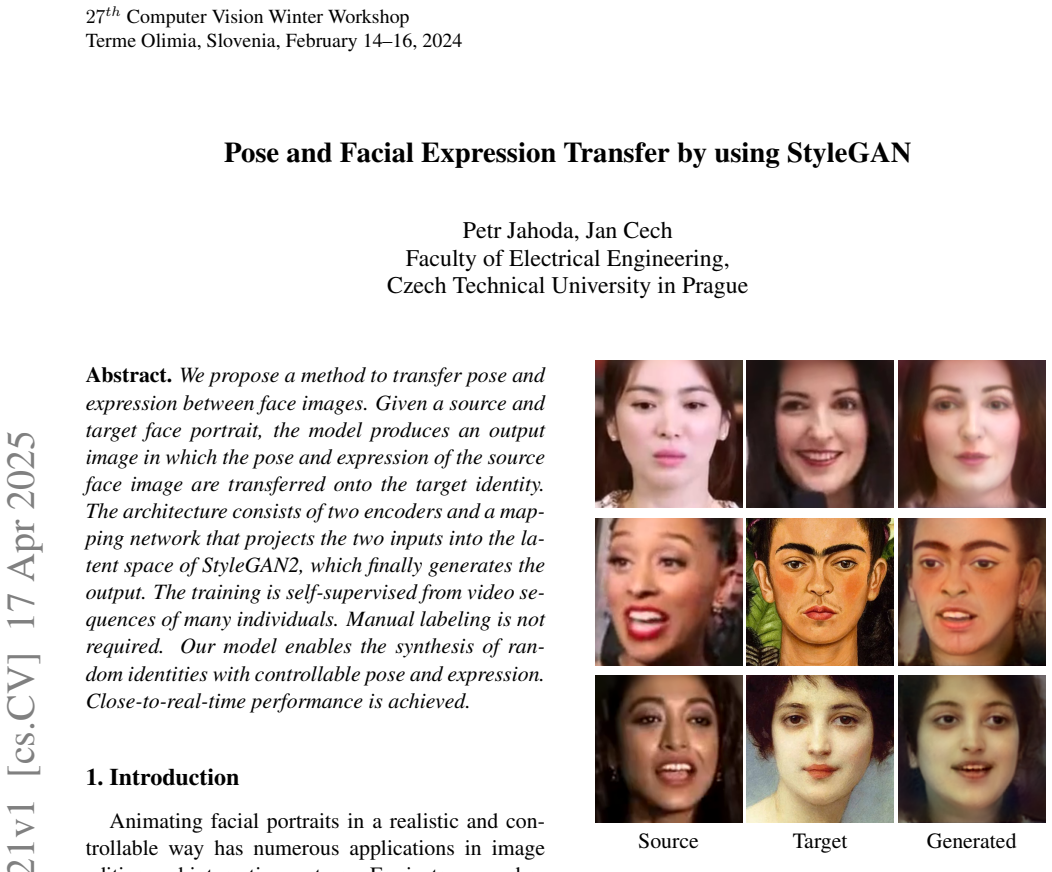
Pith's one-line read Given a source and a target face portrait, this paper claims a single linear mapping in StyleGAN2's latent space can transfer the source's pose and expression onto the target's identity, trained without labels.
desk verdict The architecture is simple and the write-up is honest, but in the best configuration nothing directly supervises cross-identity pose/expression transfer, so the central claim rests on an unverified disentanglement assumption. read the letter →
The pith
A machine-rendered reading of the paper's core claim, the machinery that carries it, and where it could break.
The reading
What carries the argument
The load-bearing component is the mapping network $M$: a single fully connected linear layer that takes the concatenation of the motion embedding $E_m(s)$ and the identity embedding $E_i(t)$, both living in the extended latent space $W^+$ of dimension $18\times 512$, and produces the StyleGAN2 latent code that generates the output. Because the generator $G$ and the identity encoder $E_i$ are frozen, the entire learning problem reduces to finding a linear projection that mixes motion and identity without confusing them; the motion encoder $E_m$ is the only other trained part. The identity encoder is a pretrained ReStyle iteration of the pSp encoder, chosen after the authors found the alternative e4e configuration struggled to preserve identity. A practical detail is that the L2 and LPIPS losses are computed on a central $188\times 188$ crop, which the authors report was important for faithful expression transfer, since the surrounding hair and background otherwise distracted training.
What would settle it
Take a video of one person, feed each frame through the fixed identity encoder, and train a linear classifier or regressor to predict head pose (yaw/pitch) from the resulting identity embeddings; if pose can be predicted well above chance from those embeddings, the claimed identity-motion separation fails, and the linear mapping cannot be expected to transfer pose independently across identities.
Extended reading notes
Core claim
The central claim is that pose and expression form an identity-independent motion code that can be extracted from one face and re-injected into another face's identity code, all inside StyleGAN2's latent space, without any explicit 3D face model. Formally, the system computes $g_{s\rightarrow t}=G(M(E_m(s)\oplus E_i(t)))$, where $E_m$ embeds the source's motion, $E_i$ embeds the target's identity with a fixed pretrained encoder, the linear mapping $M$ mixes the two, and the fixed generator $G$ renders the image. The motion encoder and mapping are trained on VoxCeleb2 video clips by reconstructing same-identity pairs with L2 and LPIPS losses applied to a central crop, by enforcing identity preservation with ArcFace cosine similarity, and optionally by a CosFace contrastive loss that pulls together motion embeddings of the same expression and pushes apart different ones. The final model reports mean absolute pose error of 7.67 on yaw and pitch, facial-landmark expression correlation of 0.62, and identity cosine similarity of 0.80, beating the latent-arithmetic baselines on pose and identity. The authors also show the same pipeline can impose a source's pose and expression onto randomly generated StyleGAN identities, which makes the motion code usable as a control signal for synthesizing new faces.
Load-bearing premise
The load-bearing assumption is that the pretrained identity encoder produces an embedding that contains identity only, cleanly separated from pose and expression, so a single linear mapping over the concatenated codes can swap motion without disturbing identity; the paper does not measure how entangled the identity code actually is.
Editorial extensions
If this is right
- A single target still plus any driving video yields a reenacted video: after one half-second inversion of the target, the model renders up to 20 frames per second.
- Identity similarity of 0.80 versus a 0.83 inversion ceiling means the transfer step costs almost no identity fidelity, so the encoder is the bottleneck rather than the mapping.
- Because the generator is frozen, the method inherits StyleGAN2's coverage; expressions the generator cannot render, such as fully closed eyes, will fail until the generator is fine-tuned or regularized.
- The method beats both ReStyle-based latent-arithmetic baselines on pose error and identity preservation, so the proposed mapping is a more reliable way to reenact faces than direct vector arithmetic in the latent space.
- Random StyleGAN identities can be driven by the same motion code, so pose and expression control extends beyond real photographs to synthetic faces.
Reading between the lines
- If the identity code from the pretrained encoder is genuinely free of pose and expression, the motion code could be driven by non-image inputs such as audio or body landmarks, since the mapping accepts any vector in the motion-embedding space; the paper only demonstrates image-driven motion.
- The linearity of the mapping suggests that simple vector arithmetic on motion embeddings, such as averaging several source expressions or interpolating between poses, would transfer cleanly across identities; the paper does not test this, but it follows from the architecture.
- The paper's expression metric is a proxy based on landmark aspect ratios, so it may understate the method on asymmetric expressions or eye movements; a FAU-based evaluation on data with strong activations could reveal where the proxy misleads.
- Because random identities must be rendered and then inverted to enter the model's operating subspace, applications that need arbitrary StyleGAN latent codes would have to round-trip through the encoder, suggesting the mapping lives in a restricted subspace of $W^+$.
Signed reviews
Editorial analysis
A structured set of objections, weighed in public.
Referee Report
Summary. The paper proposes a one-shot face reenactment method that transfers pose and expression from a source face image onto the identity of a target face image. The architecture consists of a motion encoder (ResNet-IR SE50), a fixed identity encoder (ReStyle pSp), a single linear mapping network, and a fixed pre-trained StyleGAN2 generator. Em and M are trained self-supervised on unlabeled VoxCeleb2 video sequences using a composite loss: L2 and LPIPS losses on same-identity reconstruction outputs, an ArcFace identity loss on cross-identity outputs, an optional CosFace motion-alignment loss that is disabled in the best configuration, and cropped variants of the reconstruction losses. Experiments on a VoxCeleb2 test split report pose MAE of 7.67 degrees, expression landmark cross-correlation of 0.62, and identity cosine similarity of 0.80, with two latent-space-editing baselines. The paper also describes a procedure for transferring pose/expression to randomly sampled StyleGAN2 identities and reports close-to-real-time inference after a one-time identity encoding step.
Significance. If the claims hold, the main contribution is a simple, fast, and reproducible pipeline built from open-source pretrained components that demonstrates how a linear fusion of separate motion and identity embeddings can drive StyleGAN2 for pose/expression transfer. The self-supervised video-based training, the use of standard components, and the reported inference speed are genuine strengths. However, the quantitative evidence is not yet conclusive: the cross-identity output is never directly supervised for pose and expression, the quantitative evaluation lacks statistical validation and a strong single-image baseline, and the expression metric is a coarse proxy. The paper is a plausible workshop-level result, but for a journal version the evaluation and the architectural justification need substantial reinforcement.
major comments (5)
- [Sec. 3.2 and Sec. 3.4, Eqs. (1)-(6)] The cross-identity output g_{sA->tB} is supervised only by the ArcFace identity loss L_ID (Eq. 3); the L2 and LPIPS losses and their cropped variants are defined only for the same-identity output g_{sA->tA}, and the CosFace loss is disabled in the best model (w_cos = 0). Consequently, the central claim that the source pose and expression are transferred onto the target identity is not directly trained. The method instead relies on the untested assumption that Ei(t) is free of pose/expression information and that a single linear layer on Em(s) concatenated with Ei(t) yields a valid latent code. This assumption is load-bearing: if Ei(t) leaks pose or expression, the cross-identity output can satisfy Eq. (3) while retaining the target's own pose and expression, and the reported pose/expression transfer would be an artifact of the evaluation setup. The authors should provide a disentanglement analysis, e.g., train a linear probe on Ei(t) to predict yaw/pitch and expression, and should ablate by adding a mild reconstruction or LPIPS loss on the cross-identity output or by engaging the CosFace loss, reporting the effect on all Table 1 metrics. Without such evidence, the mechanism behind the transfer remains unjustified.
- [Table 1 and Sec. 4.3] The quantitative comparison does not report error bars, confidence intervals, significance tests, or the number of evaluated frames/videos. The differences among methods are small in absolute terms (pose MAE: 7.673 vs. 7.968 vs. 8.491; expression FL CORR: 0.620 vs. 0.656 for Base pSp), and the expression metric is actually lower for the proposed method than for Base pSp. Without per-video standard errors and a paired significance test over the 120 test identities, the claim that the proposed method improves pose transfer over the baselines is not statistically supported. The authors should report the mean and standard error over videos (or bootstrap confidence intervals) and conduct a paired test (e.g., Wilcoxon signed-rank) between the methods.
- [Sec. 4.1] The baseline comparison is not a single-image reenactment comparison: the baseline does not use the actual target image but a frontalized, average-expression reconstruction computed from a video of the target identity (via vertical flipping and averaging latent codes). This gives the baseline two disadvantages unrelated to the core task: it requires a video rather than a single image, and the averaged frontal frame may itself be a poor proxy for the target's identity and expression. The comparison therefore does not isolate the benefit of the proposed method over latent-space editing for the stated one-shot setting. The authors should either replace the baseline with a true single-image latent-editing baseline (e.g., applying the edit vector computed from a matched source frame pair directly to the target latent code) or clearly delimit the claim to the video-based latent-arithmetic setting and explain why the baseline is appropriate.
- [Sec. 4.3, expression fidelity metric] The FL statistic is a proxy that computes cross-correlations of aspect ratios of eyes, mouth, and eyebrows, and the paper itself acknowledges it cannot capture asymmetric expressions, eyeball movements, or many subtle expression changes. The reported value of 0.62 is not anchored to human perception or to a known-good reference, so it is unclear what level of correlation constitutes successful expression transfer. The authors should supplement this with a user study, a facial action unit detector, or an expression classification metric to substantiate the expression-transfer claim, or at least calibrate the metric on a trivial baseline (e.g., correlation between the source and an identity-preserving but expression-frozen reconstruction).
- [Sec. 4.3, ID CSIM] The identity metric reported in Table 1 is the ArcFace cosine similarity, and the training loss L_ID in Eq. (3) is exactly its complement. The ID CSIM of 0.80 therefore partly reflects direct optimization of the evaluation metric, not an independent verification of identity preservation. The authors should explicitly acknowledge this circularity or report a second identity metric based on a different face recognition model to strengthen the claim.
minor comments (6)
- [Sec. 3.3 vs. Sec. 3.1] The paper states in Sec. 3.1 that input images are 'aligned and resized to 256 x 256 pixels,' but Sec. 3.3 says the official StyleGAN preprocessing script normalizes images to 224 x 224 pixels. This inconsistency should be resolved or clarified.
- [Sec. 3.2, Eqs. (4)-(5)] The CosFace loss is typeset in a way that is hard to read: the expression 'd(zi,z j)' and the fraction in Eq. (5) would benefit from standard mathematical notation and consistent subscript spacing.
- [Sec. 3.2] There is a typo: 'In praticular' should be 'In particular'.
- [Sec. 4.3, FL statistic] The description of the facial-landmark aspect ratios and the cross-correlation computation is vague; please provide the exact formulas and state whether the cross-correlation is normalized (e.g., Pearson correlation) and how the reported average is computed over videos.
- [Sec. 4.3, dataset size] The paper should state the number of test videos, frames, and source-target pairs used for the numbers in Table 1, and whether the metrics are averaged over frames, videos, or identities.
- [Sec. 2] The related work discusses X2Face [33] and MegaPortraits [9], but the experiments include no comparison with these methods; a sentence explaining why they are not compared (e.g., no public code, different input requirements) would improve the framing.
Circularity Check
No load-bearing circularity; one minor overlap: the identity-preservation score is exactly the ArcFace training objective.
-
fitted input called prediction
[This occurs in Section 3.2, Equation (3), and in Section 4.3 / Table 1.]
"Identity loss . To ensure that the generated image preserves the identity of the target image, we employ the pre-trained facial recognition model ArcFace [8]. ... LID = 1−⟨D(tB),D (gsA→tB )⟩ ... For the evaluation of identity preservation, we use the ArcFace [8]. The ID error is the cosine similarity between the generated and the target (identity) frame descriptors."
The reported identity metric ID(CSIM)=0.801 in Table 1 is the same cosine similarity that the training loss L_ID maximizes. Therefore the identity-preservation number is partly the training objective evaluated on the test split, not an independently derived validation of identity preservation. This overlap is minor rather than load-bearing because the central pose/expression transfer claim is evaluated with external pose and landmark metrics that are not training losses.
full rationale
The central claim of pose and expression transfer is not circular: the pose error uses an external CNN head-pose estimator and the expression fidelity uses Dlib facial landmarks, neither of which appears in the training objective. The cross-identity output is trained only with the ArcFace identity loss while the CosFace motion-alignment loss is disabled in the best model, but that is an empirical weakness about unverified disentanglement of the fixed ReStyle identity encoder, not a circular derivation. The self-citations in the paper, such as the architectural inspiration from [25] and the landmark aspect-ratio evaluation from [24], are not load-bearing; they support component choices and an evaluation proxy rather than proving the transfer result. The only quantitative overlap is the identity metric: Eq. (3) trains with ArcFace cosine similarity and Sec. 4.3 reports the same cosine similarity as ID(CSIM). Since the test identities are disjoint and the pose/expression results rest on independent external estimators, the paper is largely self-contained and the score is low.
Assumptions & free parameters
free parameters (4)
- Loss weights (w_LPIPS, w_ID, w_L2_crop, w_LPIPS_crop; w_L2=0, w_cos=0) =
0.05, 0.3, 2, 0.3; 0, 0 (final model)
- CosFace margin parameters a and b =
a=5, b=0.2
- Central crop size 188x188 =
188x188
- Training frame sampling and extreme-pose filtering threshold =
10 frames at half-second intervals; extreme poses eliminated
assumptions (5)
- domain assumption Pretrained StyleGAN2 can generate faces over the required range of poses, expressions, and identities, including closed eyes.
- domain assumption ReStyle pSp encoder maps real images to a W+ subspace that is compatible with the mapping network and preserves identity.
- domain assumption VoxCeleb2 provides sufficient identity and pose/expression diversity for the self-supervised task.
- domain assumption ArcFace cosine similarity is a valid proxy for identity preservation in both the loss and the evaluation.
- domain assumption The facial-landmark aspect-ratio cross-correlation is a valid proxy for expression transfer fidelity.
Cite this review
Pith. "Pith review of Pose and Facial Expression Transfer by using StyleGAN." pith.science (2026). https://pith.science/paper/JFDNXVOP
@misc{pith2026250413021,
  author       = {Pith},
  title        = {Pith review of: Pose and Facial Expression Transfer by using StyleGAN},
  year         = {2026},
  howpublished = {\url{https://pith.science/paper/JFDNXVOP}},
  note         = {Machine review of arXiv:2504.13021}
}
read the original abstract
We propose a method to transfer pose and expression between face images. Given a source and target face portrait, the model produces an output image in which the pose and expression of the source face image are transferred onto the target identity. The architecture consists of two encoders and a mapping network that projects the two inputs into the latent space of StyleGAN2, which finally generates the output. The training is self-supervised from video sequences of many individuals. Manual labeling is not required. Our model enables the synthesis of random identities with controllable pose and expression. Close-to-real-time performance is achieved.
Figures


Figures from the paper (1 more)

Reference graph
Works this paper leans on
- [1]
- [2]
- [3]
- [4]
-
[5]
V . Blanz and T. Vetter. A morphable model for the synthesis of 3d faces. In Proceedings of the 26th annual conference on Computer graphics and inter- active techniques, pages 187–194, 1999. 2
work page 1999
-
[6]
J. S. Chung, A. Nagrani, and A. Zisserman. V ox- Celeb2: Deep Speaker Recognition. In Proc. Inter- speech 2018, pages 1086–1090, 2018. 4, 7
work page 2018
-
[7]
A. Creswell and A. A. Bharath. Inverting the Gen- erator of a Generative Adversarial Network. IEEE transactions on neural networks and learning sys- tems, 30(7):1967–1974, 2018. 2
work page 1967
-
[8]
J. Deng, J. Guo, N. Xue, and S. Zafeiriou. Arc- face: Additive Angular Margin Loss for Deep Face Recognition. In Proceedings of the IEEE/CVF con- ference on computer vision and pattern recognition, pages 4690–4699, 2019. 4, 7
work page 2019
Show all 39 references
-
[9]
Drobyshev, J
N. Drobyshev, J. Chelishev, T. Khakhulin, A. Ivakhnenko, V . Lempitsky, and E. Zakharov. Megaportraits: One-shot megapixel neural head avatars. arXiv preprint arXiv:2207.07621, 2022. 2, 4, 8
2022 arXiv
-
[10]
Ekman and W
P. Ekman and W. V . Friesen. Facial action coding system. Environmental Psychology & Nonverbal Be- havior, 1978. 7
1978
-
[11]
Goodfellow, J
I. Goodfellow, J. Pouget-Abadie, M. Mirza, B. Xu, D. Warde-Farley, S. Ozair, A. Courville, and Y . Ben- gio. Generative adversarial networks. InAdvances in Neural Information Processing Systems, volume 27, pages 2672–2680. Curran Associates, Inc., 2014. 1
2014
-
[12]
H ¨ark¨onen, A
E. H ¨ark¨onen, A. Hertzmann, J. Lehtinen, and S. Paris. Ganspace: Discovering interpretable gan controls. Advances in Neural Information Process- ing Systems, 33:9841–9850, 2020. 2
2020
-
[13]
Karras, S
T. Karras, S. Laine, and T. Aila. Flickr-faces- hq dataset (ffhq). https://github.com/ NVlabs/ffhq-dataset, 2019. 5
2019
-
[14]
Karras, S
T. Karras, S. Laine, M. Aittala, J. Hellsten, J. Lehti- nen, and T. Aila. Analyzing and Improving the Im- age Quality of StyleGAN. In Proceedings of the IEEE/CVF conference on computer vision and pat- tern recognition, pages 8110–8119, 2020. 1, 2
2020
-
[15]
D. E. King. Dlib-ml: A Machine Learning Toolkit. The Journal of Machine Learning Research, 10:1755–1758, 2009. 7
2009
-
[16]
Krizhevsky, I
A. Krizhevsky, I. Sutskever, and G. E. Hinton. Im- agenet classification with deep convolutional neural networks. In F. Pereira, C. Burges, L. Bottou, and K. Weinberger, editors, Advances in Neural Infor- mation Processing Systems, volume 25. Curran As- sociates, Inc., 2012. 3
2012
-
[17]
C. Luo, S. Song, W. Xie, L. Shen, and H. Gunes. Learning Multi-dimensional Edge Feature-based au Relation Graph for Facial Action Unit Recognition. arXiv preprint arXiv:2205.01782, 2022. 7
2022 arXiv
-
[18]
Petr ˇzelkov´a
N. Petr ˇzelkov´a. Face image editing in latent space of generative adversarial networks, Prague, 2021. Bachelor thesis. CTU in Prague, Faculty of Electri- cal Engineering, Department of Cybernetics. 2
2021
-
[19]
Radford, L
A. Radford, L. Metz, and S. Chintala. Unsu- pervised representation learning with deep convo- lutional generative adversarial networks. arXiv preprint arXiv:1511.06434, 2015. 2
2015 arXiv
-
[20]
Richardson, Y
E. Richardson, Y . Alaluf, O. Patashnik, Y . Nitzan, Y . Azar, S. Shapiro, and D. Cohen-Or. Encoding in Style: a StyleGAN Encoder for Image-to-Image Translation. In Proceedings of the IEEE/CVF con- ference on computer vision and pattern recognition, pages 2287–2296, 2021. 2, 3, 5
2021
-
[21]
Roich, R
D. Roich, R. Mokady, A. H. Bermano, and D. Cohen-Or. Pivotal Tuning for Latent-based Edit- ing of Real Images. ACM Transactions on Graphics (TOG), 42(1):1–13, 2022. 2
2022
-
[22]
N. Ruiz, E. Chong, and J. M. Rehg. Fine-grained head pose estimation without keypoints. InProceed- ings of the IEEE conference on computer vision and pattern recognition workshops , pages 2074–2083,
-
[23]
Y . Shen, J. Gu, X. Tang, and B. Zhou. Interpreting the Latent Space of GANs for Semantic Face Edit- ing. In Proceedings of the IEEE/CVF conference on computer vision and pattern recognition , pages 9243–9252, 2020. 2
2020
-
[24]
Soukupova and J
T. Soukupova and J. Cech. Eye blink detection us- ing facial landmarks. In 21st computer vision winter workshop, Rimske Toplice, Slovenia , page 2, 2016. 7
2016
-
[25]
Subrtova, J
A. Subrtova, J. Cech, and V . Franc. Hairstyle trans- fer between face images. 2021 16th IEEE Interna- tional Conference on Automatic Face and Gesture Recognition (FG 2021), pages 1–8, 2021. 3
2021
-
[26]
Thies, M
J. Thies, M. Zollh ¨ofer, M. Nießner, L. Valgaerts, M. Stamminger, and C. Theobalt. Real-time Expres- sion Transfer for Facial Reenactment. ACM Trans. Graph., 34(6):183–1, 2015. 2
2015
-
[27]
Thies, M
J. Thies, M. Zollhofer, M. Stamminger, C. Theobalt, and M. Nießner. Face2Face: Real-time Face Capture and Reenactment of RGB Videos. In Proceedings of the IEEE conference on computer vision and pattern recognition, pages 2387–2395, 2016. 2
2016
-
[28]
O. Tov, Y . Alaluf, Y . Nitzan, O. Patashnik, and D. Cohen-Or. Designing an Encoder for StyleGAN Image Manipulation. ACM Transactions on Graph- ics (TOG), 40(4):1–14, 2021. 2, 3, 5
2021
-
[29]
Tzaban, R
R. Tzaban, R. Mokady, R. Gal, A. Bermano, and D. Cohen-Or. Stitch it in Time: GAN-based Facial Editing of Real Videos. In SIGGRAPH Asia 2022 Conference Papers, pages 1–9, 2022. 2
2022
-
[30]
ˇSubrtov´a, D
A. ˇSubrtov´a, D. Futschik, J. ˇCech, M. Luk ´aˇc, E. Shechtman, and D. S ´ykora. ChunkyGAN: Real image inversion via segments. InProceedings of Eu- ropean Conference on Computer Vision, pages 189– 204, 2022. 2
2022
-
[31]
H. Wang, Y . Wang, Z. Zhou, X. Ji, D. Gong, J. Zhou, Z. Li, and W. Liu. Cosface: Large Margin Cosine Loss For Deep Face Recognition. In Proceedings of the IEEE conference on computer vision and pattern recognition, pages 5265–5274, 2018. 4
2018
-
[32]
T.-C. Wang, A. Mallya, and M.-Y . Liu. One-shot Free-view Neural Talking-head Synthesis for Video Conferencing. In Proceedings of the IEEE/CVF con- ference on computer vision and pattern recognition, pages 10039–10049, 2021. 2
2021
-
[33]
Wiles, A
O. Wiles, A. Koepke, and A. Zisserman. X2face: A Network For Controlling Face Generation Using Im- ages, Audio, and Pose Codes. In Proceedings of the European conference on computer vision (ECCV) , pages 670–686, 2018. 2
2018
-
[34]
Wright and N
L. Wright and N. Demeure. Ranger21: a synergis- tic deep learning optimizer. CoRR, abs/2106.13731,
-
[35]
Yang and S.-N
C. Yang and S.-N. Lim. Unconstrained facial ex- pression transfer using style-based generator. arXiv preprint arXiv:1912.06253, 2019. 3
1912 arXiv
-
[36]
Zakharov, A
E. Zakharov, A. Shysheya, E. Burkov, and V . Lem- pitsky. Few-shot adversarial learning of realistic neural talking head models. In Proceedings of the IEEE/CVF international conference on computer vi- sion, pages 9459–9468, 2019. 2
2019
-
[37]
Zhang, P
R. Zhang, P. Isola, A. A. Efros, E. Shechtman, and O. Wang. The Unreasonable Effectiveness of Deep Features as a Perceptual Metric. In Proceedings of the IEEE conference on computer vision and pattern recognition, pages 586–595, 2018. 3
2018
-
[38]
J.-Y . Zhu, P. Kr¨ahenb¨uhl, E. Shechtman, and A. A. Efros. Generative visual manipulation on the natural image manifold. In Computer Vision–ECCV 2016: 14th European Conference, Amsterdam, The Nether- lands, October 11-14, 2016, Proceedings, Part V 14, pages 597–613. Springer, 2016. 2
2016
-
[39]
P. Zhu, R. Abdal, Y . Qin, J. Femiani, and P. Wonka. Improved StyleGAN Embedding: Where are the Good Latents? arXiv preprint arXiv:2012.09036 ,
2012 arXiv
Reviewed August 16, 2026 · model on record in the stance chip above.
Discussion (0). Continue with ORCID to comment.