REVIEW 3 major objections 5 minor 1 cited by
Ascribe New Dimensions to Scientific Data Visualization with VR
T0 review · 3 major / 5 minor · reviewed 2026-08-16 · deepseek-v4-flash
Pith's one-line read ASCRIBE-VR is a Meta Quest–based VR platform that lets scientists move through, manipulate, and share 3D scientific images, and it claims to consume the output of AI segmentation pipelines.
desk verdict A straightforward VR viewer demo whose abstract promises an AI integration the paper never shows; the system description is plausible but the contribution is mostly a feature combination. read the letter →
The pith
A machine-rendered reading of the paper's core claim, the machinery that carries it, and where it could break.
The reading
What carries the argument
The central object is the ASCRIBE-VR virtual environment itself, implemented in Unreal Engine and accessed through OpenXR-compatible Meta Quest controllers. The mechanism that carries the argument is the mapping from segmented image volumes to interactive polygonal meshes: the Filter and Segment stages of the ASCRIBE pipeline produce volumes of interest, which are converted into meshes that can be imported into the VR scene and manipulated. Around that core sit the virtual menu functions—Push and Pull, Resize Mesh, Teleport—and the Import Mesh and Images interfaces, which define what a user can actually do with data once it is inside the environment. The mesh conversion is handled through the Real Time Import/Export Mesh plugin, and the multiplayer feature extends the same objects to several users, making the shared scene the unit of collaboration.
What would settle it
Open ASCRIBE-VR and attempt to load a segmentation result—for example, a label volume or probability map from RhizoNet or a Gaussian-process classifier—using only the Import Mesh and Images interfaces described in Section 4; if the only supported inputs are FBX, OBJ, and STL meshes plus raw image stacks, with no importer or API path from segmentation tensors to meshes, the central claim about consuming AI outputs fails.
Extended reading notes
Core claim
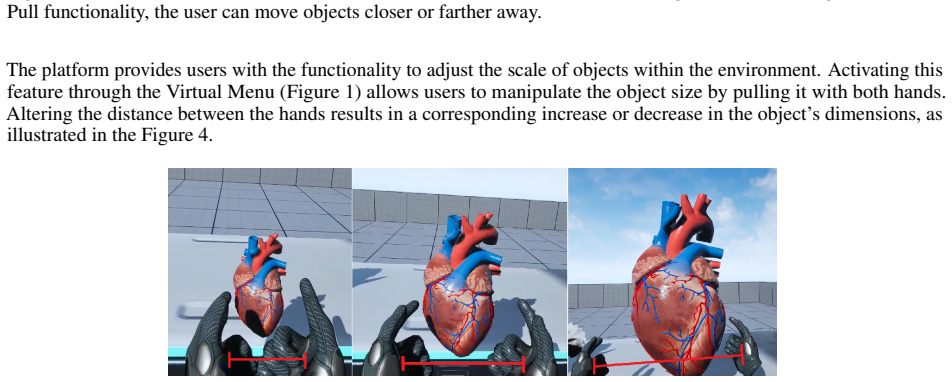
On its own terms, the paper's discovery is a working VR interaction environment, ASCRIBE-VR, built with Unreal Engine for Meta Quest headsets and OpenXR, that turns scientific image data into objects a researcher can handle directly. Users can navigate by joystick or teleport, grab and rotate objects, push or pull them along a controller ray, resize them by moving their hands apart, import meshes from FBX, OBJ, and STL files, scroll through image stacks with a slider or joystick, change object textures, and collaborate with other users in the same scene. The authors pair this environment with their ASCRIBE pipeline, whose filter-segment-quantify-immerse-interact structure is intended to feed AI segmentation results into the VR scene as volume-of-interest meshes for human verification. As a demonstration of the scientific rendering, the platform displays the PBCV-1 giant virus, with capsid and internal proteins reconstructed from fluctuation X-ray scattering data.
Load-bearing premise
The claim stands or falls on whether the AI analysis results can actually be loaded into the virtual-reality scene; if no software path connects a segmentation result to the objects shown in the headset, the platform is a mesh viewer, not an AI-connected explorer.
Editorial extensions
If this is right
- Researchers could replace slice-by-slice 2D inspection of X-ray CT, MRI, or synthetic volumes with direct 3D examination in a headset, reducing the cognitive load of reconstructing structure from flat images.
- If the AI-to-VR data flow is realized, segmentation outputs from Gaussian-process, CNN, transformer, or random-forest models could be reviewed in place as volume-of-interest meshes, giving human experts a natural way to catch errors.
- The import of FBX, OBJ, and STL meshes plus image stacks means existing materials and biology datasets can enter the VR scene without bespoke conversion, and imported multi-part meshes can be manipulated component by component.
- Multiplayer sessions would allow several researchers to inspect the same structure simultaneously in one virtual scene, which the paper positions as valuable for team research and presentations.
- The platform is a step toward digital twins in materials research, where the human-in-the-loop verification of segmentation feeds back into the model.
Reading between the lines
- The paper leaves the segmentation-to-mesh data format unspecified; a natural extension would be to expose a standard file or API path from any segmentation output to the mesh importer, then measure how much faster a scientist can spot a mislabeled region in VR than on a 2D slice.
- The 'digital twin' language is aspirational relative to the demonstrated features; a concrete next step would be to connect ASCRIBE-VR to a live simulation or instrument feed so the virtual scene updates as new data arrive, rather than showing static meshes.
- The comparison with other VR tools is a feature checklist; a head-to-head user study on a common tomography dataset would turn the feature list into an empirical advantage.
- Because the paper's AI methods are drawn from prior work, the platform could serve as a general viewer for any segmentation pipeline, not only the authors' own, if the import conventions are made open.
Signed reviews
Editorial analysis
A structured set of objections, weighed in public.
Referee Report
Summary. The paper introduces ASCRIBE-VR, a virtual reality platform built on Unreal Engine and Meta Quest hardware, intended for immersive visualization and exploration of large-scale three-dimensional scientific images, with applications in materials science and biology. The platform is organized around five functionalities (filter, segment, quantify, immerse, interact), and the paper describes in Section 4 a set of VR interactions including object push/pull, resize, teleport, mesh import (FBX, OBJ, STL), image stack viewing, texture changes, and multiplayer collaboration, illustrated with screenshots. The abstract further claims that the VR tools can consume outputs of the authors' AI-based segmentation and iterative feedback processes, thereby bridging AI analysis and human-in-the-loop validation. Section 2 surveys existing VR visualization tools, and Section 5.1 compares ASCRIBE-VR with those tools. The paper concludes with future work and a disclosure that generative AI assisted with text organization.
Significance. If the central claims are substantiated, ASCRIBE-VR would be a useful contribution to the growing area of immersive scientific visualization, particularly for human-in-the-loop verification of AI segmentation results. The platform's use of OpenXR and commercial off-the-shelf hardware (Meta Quest) is practical, and the emphasis on large-scale 3D imaging is relevant. However, the paper does not provide a user study, performance measurements, or a technical description of the AI-to-VR integration, which the abstract presents as a main feature. The comparison with existing tools in Section 5.1 is based on informal assertions rather than systematic benchmarking, and several of the claimed capabilities already exist in commercial products such as ZEISS arivis Pro VR. The paper is best read as a preliminary software demonstration, but as submitted it does not establish the research claims advanced in the abstract. The honest disclosure of generative-AI assistance in Section 7 is good practice, but it does not compensate for the missing evidence.
major comments (3)
- [Abstract and Section 3] The abstract states that ASCRIBE-VR 'can consume the output of our AI-based segmentation and iterative feedback processes to enable seamless exploration of large-scale 3D images,' but no mechanism for this integration is described. Section 3 lists AI algorithms (Gaussian Processes, CNNs, Vision Transformers, Random Forests, RhizoNet, transformer architectures) without specifying a data format, an API, a serialization schema, or any pipeline connecting segmentation outputs to the Unreal Engine environment. Section 4 documents only manual import of FBX, OBJ, and STL files and raw image stacks; nothing in the Results section demonstrates that a segmentation output can be loaded, rendered, or validated inside the VR environment. This is the paper's central promise, and as written it is unsupported.
- [Section 4 (Results)] The paper contains no quantitative evaluation. Section 4 is a sequence of screenshots and qualitative descriptions of menu interactions (Figures 1-9) and one scientific visualization example (Figure 10). There is no user study, no task-completion time measurement, no frame-rate or latency data, and no scalability test for 'large-scale 3D images,' a phrase central to the abstract. Without any performance or usability evidence, the reader cannot assess whether the platform meets its stated goal of enabling 'seamless exploration' of large datasets.
- [Section 5.1 (Features Comparison)] The comparative claims in Section 5.1 are not backed by reproducible evidence. For instance, the statement that ASCRIBE-VR supports 'data fusion in real time' is not defined or demonstrated anywhere in the paper, and the assertion that Immersive ParaView (Tomviz) and WorldViz Vizard 'seem to support all' the advanced functionalities is presented as a casual observation rather than the result of a structured comparison. These unsupported assertions weaken the discussion and should either be substantiated with concrete demonstrations or removed.
minor comments (5)
- [Section 3] The sentence 'This platform leverages also leverages our previous work' contains a duplicated verb and should be rewritten.
- [Section 3] The term 'V olumes of Interest' appears with an erroneous space inside a word; it should read 'Volumes of Interest.' The same section also introduces 'digital twin' and 'human-in-the-loop' without defining how they apply to the described platform.
- [Section 4 and figure captions] Several sentences refer to 'the subsequent image' or 'the following figure' without consistent figure-number labels; for example, 'as shown in the subsequent image' after Figure 1 and 'as depicted in the subsequent figure' after Figure 2. The captions should be self-contained with explicit references.
- [References] Reference [21] is listed with 'Unknown Author' and a YouTube link; this is not an appropriate formal citation for a journal submission. Please provide the actual author and source or remove the reference.
- [General] The paper does not mention the availability of the ASCRIBE-VR software, a source-code repository, or any demo materials. If the platform is intended for community use, a link or availability statement would help reproducibility.
Circularity Check
No circularity: ASCRIBE-VR is a software/application description whose VR features are demonstrated independently; the cited AI segmentation work is external context, not a derivation input.
full rationale
This paper contains no derivation chain, equations, fitted parameters, or quantitative predictions. ASCRIBE-VR's contributions are software features (mesh import, resize, teleport, image stacks, multiplayer, texture changes) documented with implementation descriptions and figures. The self-cited AI segmentation methods (RhizoNet [18], transformer architectures [17], Gaussian Processes [12]) are presented as prior independent tools that ASCRIBE-VR might eventually integrate, not as inputs from which the VR platform's behavior is derived. The abstract's statement that the VR tools 'can consume the output of our AI-based segmentation' is an integration claim without a demonstrated data contract or API, but that is an evidentiary gap or overclaim, not circularity: there is no reduction of the claim to its own inputs, no fitted value renamed as a prediction, and no self-definitional equivalence. Self-citation here is normal scholarly reference to the authors' earlier segmentation work and is not load-bearing for the VR functionality described in Section 4. Section 7's generative-AI disclosure is unrelated to circularity. Accordingly, no circular step can be exhibited, and the honest finding is score 0.
Assumptions & free parameters
assumptions (4)
- domain assumption VR immersion enhances intuitive comprehension of scientific data.
- domain assumption Meta Quest 3S and Unreal Engine provide sufficient rendering performance for large-scale scientific volumes.
- domain assumption The Real Time Import/Export Mesh plugin correctly converts FBX, OBJ, and STL files into manipulable meshes.
- ad hoc to paper AI segmentation outputs are in a format consumable by ASCRIBE-VR.
Cite this review
Pith. "Pith review of Ascribe New Dimensions to Scientific Data Visualization with VR." pith.science (2026). https://pith.science/paper/CRFFDYTD
@misc{pith2026250413448,
  author       = {Pith},
  title        = {Pith review of: Ascribe New Dimensions to Scientific Data Visualization with VR},
  year         = {2026},
  howpublished = {\url{https://pith.science/paper/CRFFDYTD}},
  note         = {Machine review of arXiv:2504.13448}
}
read the original abstract
For over half a century, the computer mouse has been the primary tool for interacting with digital data, yet it remains a limiting factor in exploring complex, multi-scale scientific images. Traditional 2D visualization methods hinder intuitive analysis of inherently 3D structures. Virtual Reality (VR) offers a transformative alternative, providing immersive, interactive environments that enhance data comprehension. This article introduces ASCRIBE-VR, a VR platform of Autonomous Solutions for Computational Research with Immersive Browsing \& Exploration, which integrates AI-driven algorithms with scientific images. ASCRIBE-VR enables multimodal analysis, structural assessments, and immersive visualization, supporting scientific visualization of advanced datasets such as X-ray CT, Magnetic Resonance, and synthetic 3D imaging. Our VR tools, compatible with Meta Quest, can consume the output of our AI-based segmentation and iterative feedback processes to enable seamless exploration of large-scale 3D images. By merging AI-generated results with VR visualization, ASCRIBE-VR enhances scientific discovery, bridging the gap between computational analysis and human intuition in materials research, connecting human-in-the-loop with digital twins.
Figures


Figures from the paper (7 more)


Forward citations
Cited by 1 Pith paper
-
ASCRIBE-XR: Virtual Reality for Visualization of Scientific Imagery
ASCRIBE-XR is a Godot-based VR platform for collaborative visualization of 3D volumetric and mesh scientific data, designed for synchrotron and microscopy experiments.
Reference graph
Works this paper leans on
-
[1]
Castruita, William Seeley, Helmut Heinsen, Daniela Ushizima, and Lea T
Maryana Alegro, Panagiotis Theofilas, Austin Nguy, Patricia A. Castruita, William Seeley, Helmut Heinsen, Daniela Ushizima, and Lea T. Grinberg. Automating cell detection and classification in human brain fluorescent microscopy images using dictionary learning and sparse coding. Journal of Neuroscience Methods, 282:20–33, 2017
work page 2017
-
[2]
System requirements for arivis pro vr/visionvr, n.d
Arivis. System requirements for arivis pro vr/visionvr, n.d. URL https://kb.arivis.com/ vision-vr-system-requirements . Accessed March 26, 2025
work page 2025
-
[3]
Validation of deep learning segmentation of ct images of fiber-reinforced composites
Aly Badran, Dula Parkinson, Daniela Ushizima, David Marshall, and Emmanuel Maillet. Validation of deep learning segmentation of ct images of fiber-reinforced composites. Journal of Composites Science, 6(2), 2022. ISSN 2504-477X. doi: 10.3390/jcs6020060. URL https://www.mdpi.com/2504-477X/6/2/60
-
[4]
Jeffrey J. Donatelli, Peter H. Zwart, and James A. Sethian. Iterative phasing for fluctuation x-ray scattering. Proceedings of the National Academy of Sciences, 112(33):10286–10291, 2015. doi: 10.1073/pnas.1513738112. URL https://doi.org/10.1073/pnas.1513738112
-
[5]
Chris Holdgraf, Aaron Culich, Ariel Rokem, Fatma Deniz, Maryana Alegro, and Dani Ushizima. Portable learning environments for hands-on computational instruction: Using container- and cloud-based technology to teach data science. In PEARC ’17: Practice and Experience in Advanced Research Computing 2017: Sustainability, Success and Impact , pages 1–9, New Y...
-
[6]
New vr software allows scientists to ’walk’ inside cells, n.d
Lab Manager. New vr software allows scientists to ’walk’ inside cells, n.d. URL https://www.labmanager. com/new-vr-software-allows-scientists-to-walk-inside-cells-24085 . Accessed March 26, 2025. 9 VR for Scientific Images
work page 2025
-
[7]
Nanome virtual reality for academic researchers, educators, and students, n.d
Nanome. Nanome virtual reality for academic researchers, educators, and students, n.d.. URL https://home.nanome.ai/academic?utm_campaign=Science%20Article&utm_content=245235886& utm_medium=social&utm_source=facebook&hss_channel=fbp-1465626137063360. Accessed March 26, 2025
work page 2025
-
[8]
Nanome. Nanome on steam, n.d.. URL https://store.steampowered.com/app/493430/Nanome/. Ac- cessed March 26, 2025
work page 2025
Show all 32 references
-
[9]
Nanome - unicorner, n.d
Nanome. Nanome - unicorner, n.d.. URL https://read.unicorner.news/p/nanome. Accessed March 26, 2025
2025
-
[10]
Virtual reality for drug design and molecular visualization, n.d
Nanome. Virtual reality for drug design and molecular visualization, n.d.. URLhttps://nanome.ai/. Accessed March 26, 2025
2025
-
[11]
Nanome enables scientific breakthroughs on the new meta quest pro - yahoo finance - navigatevc, n.d
NavigateVC. Nanome enables scientific breakthroughs on the new meta quest pro - yahoo finance - navigatevc, n.d. URL https://www.navigatevc.com/ nanome-enables-scientific-breakthroughs-on-the-new-meta-quest-pro-yahoo-finance/ . Accessed March 26, 2025
2025
-
[12]
Gaussian processes for autonomous data acquisition at large-scale x-ray and neutron scattering facilities
Marcus Noack, Petrus Zwart, Daniela Ushizima, Masafumi Fukuto, Kevin Yager, Katherine Elbert, Christopher Murray, Aaron Stein, Gregory Doerk, Esther Tsai, Guillaume Freychet Ruipeng Li, Mikhail Zhernenkov, Hoi-Ying Holman, Steven Lee, Liang Chen, Eli Rotenberg, Tobias Weber, Y...
2021
-
[13]
Material science applications, n.d
ParaView. Material science applications, n.d. URL https://www.paraview.org/material-science/. Retrieved April 8, 2025
2025
-
[14]
Crystal viewpoints: Virtual reality viewpoint design for analytical measurement of crystal structures in materials science and engineering
Timothy Pham, Alyssa Curran, Shuyu Wang, Jaskirat Singh Batra, Sarah Razook, and Edgar Rojas-Muñoz. Crystal viewpoints: Virtual reality viewpoint design for analytical measurement of crystal structures in materials science and engineering. In 2023 IEEE Frontiers in Education C...
2023
-
[15]
Zenyuk, and Daniela Ushizima
Jerome Quenum, Iryna V . Zenyuk, and Daniela Ushizima. Lithium metal battery quality control via trans- former–cnn segmentation. Journal of Imaging, 9(6), 2023. ISSN 2313-433X. doi: 10.3390/jimaging9060111. URL https://www.mdpi.com/2313-433X/9/6/111
2023 doi
-
[16]
G. L. B. Ramalho, D. S. Ferreira, A. G. C. Bianchi, C. M. Carneiro, F. N. S. Medeiros, and D. M. Ushizima. Cell reconstruction under V oronoi and enclosing ellipses from 3d microscopy.IEEE International Symposium on Biomedical Imaging (ISBI), April 2015
2015
-
[17]
Heras Rivera, Agamdeep S
Juampablo E. Heras Rivera, Agamdeep S. Chopra, Tianyi Ren, Hitender Oswal, Yutong Pan, Zineb Sordo, Sophie Walters, William Henry, Hooman Mohammadi, Riley Olson, Fargol Rezayaraghi, Tyson Lam, Akshay Jaikanth, Pavan Kancharla, Jacob Ruzevick, Daniela Ushizima, and Mehmet Kurt....
2024 arXiv
-
[18]
RhizoNet segments plant roots to assess biomass and growth for enabling self-driving labs
Zineb Sordo, Peter Andeer, James Sethian, Trent Northen, and Daniela Ushizima. RhizoNet segments plant roots to assess biomass and growth for enabling self-driving labs. Scientific Reports, 14(1):12907, June 2024
2024
-
[19]
A review on generative ai for text-to-image and image-to- image generation and implications to scientific images, 2025
Zineb Sordo, Eric Chagnon, and Daniela Ushizima. A review on generative ai for text-to-image and image-to- image generation and implications to scientific images, 2025. URL https://arxiv.org/abs/2502.21151
2025 arXiv
-
[20]
Simon Su, William Sherman, Israel Lopez Coto, Kamran Sayrafian, and Judith E. Terrill. Im- mersive paraview: An immersive scientific workflow for the advancement of measurement sci- ence. In 21st IEEE International Symposium on Mixed and Augmented Reality (ISMAR) . IEEE,
-
[21]
Virtual reality and 3d printing for materials science research - youtube, n.d
Unknown Author. Virtual reality and 3d printing for materials science research - youtube, n.d. URL https: //www.youtube.com/watch?v=XbveWMbd-Bw. Accessed March 26, 2025
2025
-
[22]
Materials data science for microstructural characterization of archaeological concrete
Daniela Ushizima, Ke Xu, and Paulo Monteiro. Materials data science for microstructural characterization of archaeological concrete. MRS Advancements - special issue: Materials Data Science, pages 1–14, 2020. URL https://datadryad.org/stash/share/F4QzduiCUoL8AHTPfU3A8ZFr1MOCgV...
2020
-
[23]
Deep learning for alzheimer’s disease: Mapping large-scale histological tau protein for neuroimaging biomarker validation
Daniela Ushizima, Hanbo Chen, Manuel Alegro, Ifigeneia Ovando, Raif Eser, Jungsuk Lee, Connor Poon, Kartik Shankar, Arvind Kantamneni, Nirav Satrawada, Edson Amaro Jr, Helmut Heinsen, Duygu Tosun, and Lea T Grinberg. Deep learning for alzheimer’s disease: Mapping large-scale h...
2022
-
[24]
Forsberg, David H
Andries van Dam, Andrew S. Forsberg, David H. Laidlaw, Joseph J. LaViola Jr., and Rosemary M. Simpson. Immersive vr for scientific visualization: A progress report. IEEE Computer Graphics and Applications, 20(6): 26–52, 2000. doi: 10.1109/38.851744. URL https://www.researchgat...
-
[25]
vlume: 3d virtual reality for single-molecule localization microscopy
vLUME Team. vlume: 3d virtual reality for single-molecule localization microscopy. PubMed Central (PMC),
-
[26]
Worldviz - virtual reality labs for research and training, n.d
WorldViz. Worldviz - virtual reality labs for research and training, n.d. URL https://www.worldviz.com/. Accessed March 26, 2025
2025
-
[27]
Ushizima, Victor C
Ke Xu, Qingxu Jin, Jiaqi Li, Daniela M. Ushizima, Victor C. Li, Kimberly E. Kurtis, and Paulo J.M. Monteiro. In-situ microtomography image segmentation for characterizing strain-hardening cementitious composites under tension using machine learning. Cement and Concrete Researc...
2023
-
[28]
Zeiss arivis pro software, n.d
ZEISS. Zeiss arivis pro software, n.d.. URL https://www.zeiss.com/microscopy/us/products/ software/arivis-pro.html. Accessed March 26, 2025
2025
-
[29]
Collaboration, visualization and analysis with zeiss arivis pro and the vr toolkit, n.d
ZEISS. Collaboration, visualization and analysis with zeiss arivis pro and the vr toolkit, n.d.. URL https://www.zeiss.com/microscopy/en/resources/insights-hub/life-sciences/ zeiss-arivis-pro-vr-capabilities.html . Accessed March 26, 2025
2025
-
[30]
Zeiss institutional licenses, n.d
ZEISS. Zeiss institutional licenses, n.d.. URL https://www.zeiss.com/microscopy/us/ service-support/services-and-maintenance-agreements/institutional-licenses.html . Ac- cessed March 26, 2025. 11
2025
-
[2020]
Accessed March 26, 2025
URL https://pmc.ncbi.nlm.nih.gov/articles/PMC7612967/. Accessed March 26, 2025
2025
-
[2022]
URL https://www.nist.gov/publications/ immersive-paraview-immersive-scientific-workflow-advancement-measurement-science
doi: 10.1109/ISMAR-Adjunct57072.2022.00034. URL https://www.nist.gov/publications/ immersive-paraview-immersive-scientific-workflow-advancement-measurement-science
2022
Reviewed August 16, 2026 · model on record in the stance chip above.
Discussion (0). Continue with ORCID to comment.