REVIEW 3 major objections 6 minor 1 cited by
Amplify Initiative: Building A Localized Data Platform for Globalized AI
T0 review · 3 major / 6 minor · reviewed 2026-08-16 · deepseek-v4-flash
Pith's one-line read A pilot with 155 local experts produced 8,091 annotated adversarial queries in seven languages, giving model developers a way to test AI safety and cultural relevance beyond English.
desk verdict A credible participatory dataset paper whose core 'adversarial' claim is asserted, not yet demonstrated; deserving of peer review with room to strengthen. read the letter →
The pith
A machine-rendered reading of the paper's core claim, the machinery that carries it, and where it could break.
The reading
What carries the argument
The mechanism that carries the argument is the Amplify methodology, a seven-step pipeline for co-creating structured local-language datasets with domain experts. Its load-bearing parts are the expert selection process, the adversarial-query writing guidelines, and the annotation taxonomy of domains, themes (hate speech, stereotypes, specialized advice, public interest, misinformation or disinformation), and sensitive characteristics (age, gender, tribe, religion, disability, and others). These pieces turn open-ended local knowledge into structured records that can be retrieved, analyzed, and used as evaluation items. An Android app operationalizes the pipeline by training experts, unlocking query creation, blocking duplicates, and collecting annotations in a privacy-preserving way.
What would settle it
Take a random sample of, say, 300 queries from the released dataset and have independent fluent speakers of each of the seven languages rate each query on the paper's own four validation principles—coherence, semantic uniqueness, groundedness, and relevance—and also judge whether it is genuinely adversarial; if a substantial share (for example, over 20 percent) fails, the claim that the dataset is ready to serve as an evaluation benchmark is undermined.
Extended reading notes
Core claim
The pilot's central discovery is that a structured, expert-led co-creation process can produce a substantial corpus of adversarial queries that capture local concerns rather than generic English internet content. The methodology proceeds through seven steps: forming partnerships with local researchers; choosing sensitive domains, topics, and experts; defining themes and sensitive characteristics; training experts; having them write and annotate queries in a purpose-built Android app; rewarding and recognizing contributors; and validating the collected data. The resulting dataset contains 8,091 queries annotated by domain, theme, and sensitive characteristic, so that a query about HIV misinformation in Uganda can be retrieved alongside its context. The paper shows, through five qualitative findings, that the data carry country-specific texture: health misinformation dominates, mental-health queries are gendered, disability concerns cluster in education, specific tribes appear as social groups, and cultural practices such as widow inheritance and healing dances surface across languages. The intended use is to evaluate large language models for safety and cultural relevance in these seven languages.
Load-bearing premise
The dataset's value as safety-evaluation material rests on the assumption that the validation step actually caught the incoherent, duplicate, mislabeled, or non-adversarial queries, leaving a corpus that is genuinely fit for evaluating models.
Editorial extensions
If this is right
- The 8,091-query dataset can be used directly to evaluate large language models for safety and cultural relevance in Luganda, Swahili, Chichewa, Igbo, Akan, and Nigerian Pidgin.
- The seven-step methodology provides a template for collecting similar localized evaluation data in other regions with minimal adaptation.
- Because queries are annotated by domain, theme, and sensitive characteristic, the dataset supports targeted probing of specific harms, such as gendered mental-health stereotypes or health misinformation.
- The structured, ontologically organized annotations can serve as a foundation for generating and validating synthetic data in these languages.
- The pilot's training and recognition model—certificates, compensation, and data authorship—offers a pattern for sustainably engaging expert communities in data work.
Reading between the lines
- One implication the paper leaves implicit: if the dataset holds up under independent review, adversarial evaluation for low-resource languages can be produced without first building NLP tools for those languages, because the expert authors supply the linguistic judgment the tools would otherwise provide.
- A testable next step the paper does not run is an audio-first version of the same pipeline, since the pilot itself notes many participants would rather speak than write, which might yield more naturalistic adversarial phrasing.
- The annotation grid could serve as a cross-cultural diagnostic: rerunning the same domain, theme, and sensitive-characteristic structure in a different region would allow direct comparison of how harms like health misinformation are expressed across cultures.
Signed reviews
Editorial analysis
A structured set of objections, weighed in public.
Referee Report
Summary. The paper introduces Amplify Initiative, a data platform and methodology for co-creating localized, culturally grounded datasets with domain experts. It reports on a pilot conducted in Ghana, Kenya, Malawi, Nigeria, and Uganda, in which 155 experts produced 8,091 annotated adversarial queries in seven languages, targeting sensitive domains such as health, education, finance, and legal rights. The paper describes the seven-step methodology, the annotation taxonomy, the Android app used for collection, and provides descriptive statistics on language, domain, theme, and sensitive-characteristic distributions, along with qualitative examples of queries. The authors claim the resulting dataset can be used to evaluate LLM safety and cultural relevance in African contexts. The paper also candidly discusses practical challenges and limitations encountered during recruitment, training, validation, and scaling.
Significance. If the central claim can be substantiated, the paper would make a valuable contribution: it addresses a real gap in localized adversarial evaluation data for African languages, and it offers a participatory, community-centered methodology that is a useful template for other regions. The authors are transparent about limitations, and the paper includes concrete examples that give the reader a sense of the data's cultural specificity. The main strength is the process and the dataset's potential; the main weakness is that the paper provides no empirical outcome evidence that the queries actually function as adversarial safety-evaluation items. The significance of the contribution therefore hinges on whether the validation and quality assurance claims can be demonstrated, which the current manuscript does not do.
major comments (3)
- [Section 4, Step 7; Appendix E] The validation step described in Section 4 (Step 7) and the validation principles in Appendix E (coherence, semantic uniqueness, groundedness, relevancy) are defined, but no results of the validation are reported. There are no pass/fail counts, no per-language or per-annotator quality rates, no inter-annotator agreement, and no rejection rate. Without these numbers, the claim that the 8,091 queries form a high-quality adversarial dataset is unsupported. This is load-bearing for the paper's central claim because the dataset's value as an evaluation benchmark depends on the queries being coherent, non-duplicative, grounded, and correctly annotated.
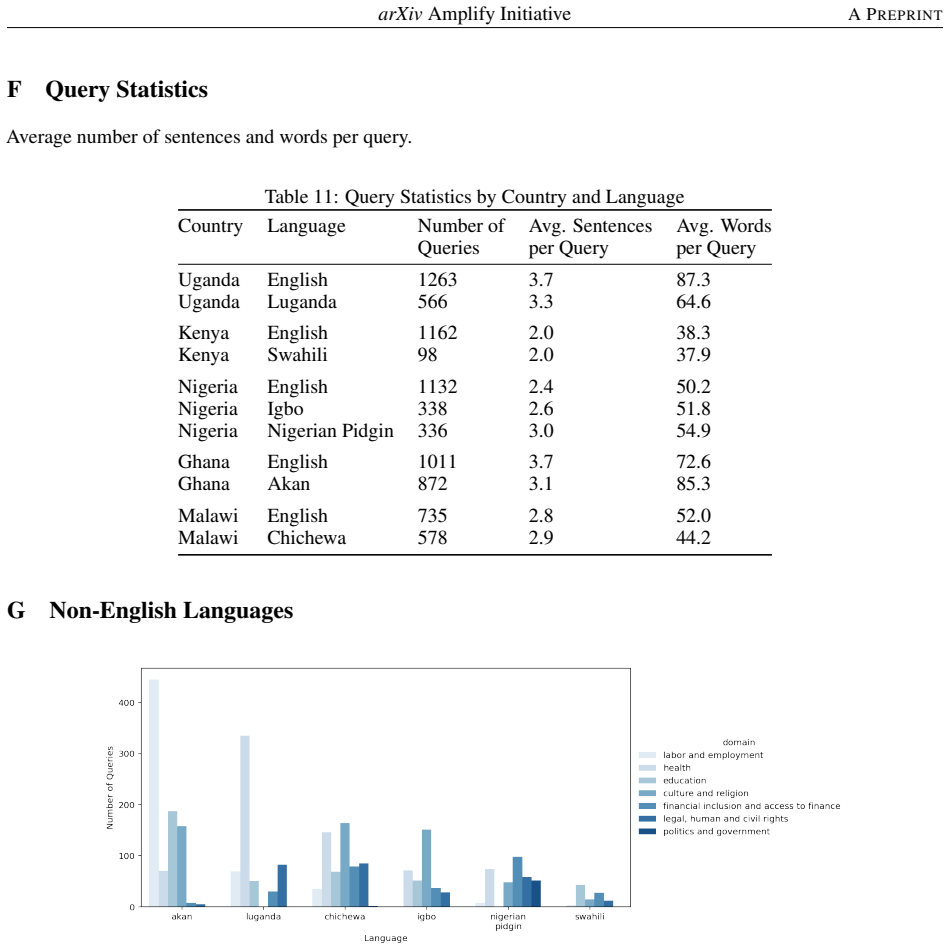
- [Section 6.2.2; Table 11] Section 6.2.2 states that validating data in languages like Luganda and Igbo was challenging due to the limited availability of digital dictionaries and NLP tools. Table 11 shows these languages account for 566 (Luganda) and 338 (Igbo) queries, over 11% of the dataset combined. The paper does not explain how the validation difficulties for these languages were resolved, nor does it provide any quality assurance evidence for them. This is concerning because the least-validated languages constitute a material portion of the data, and the paper gives no indication that the final dataset for these languages meets the same quality bar as the rest.
- [Section 5, first paragraph; Section 6.5.3] The paper asserts in Section 5 that the queries 'are adversarial in nature and have a high likelihood of producing unsafe responses from a large language model.' No empirical evidence is provided for this assertion: there is no benchmark run against any LLM, no safety classifier measurement, no comparison with non-adversarial or non-contextual prompts, and no measurement of the rate at which the queries actually elicit unsafe or policy-violating responses. Section 6.5.3 mentions future work to expand the dataset into a benchmarking suite, but the current claim of usability for safety evaluation is unsupported. The dataset could be coherent, culturally relevant, and well-annotated yet still not adversarially effective, so this missing evidence undermines the central claim.
minor comments (6)
- [Author affiliation list] The affiliation for the Kenya-based author is listed as 'Jommo Kenyatta University Agriculture & Technology'; the standard spelling is 'Jomo Kenyatta University of Agriculture and Technology.'
- [Section 5.2] In the sentence about Niger-Congo branches, 'V olta' contains a stray space and should be 'Volta.'
- [Table 4] The Igbo example query contains unusual dot separations (e.g., 'u. fo. du. ndi.'). If this reflects the tokenization or orthography, the presentation should be clarified; if it is a typographical artifact, it should be corrected.
- [Section 6.3.1] The paper mentions social desirability bias as a concern during the pilot but does not discuss any mitigation strategies or how it might affect the diversity of the collected queries.
- [Abstract and Dataset Link] The abstract and Section 4 mention that the dataset and code are accessible via a link, but in the preprint no URL or DOI is actually visible, which hinders reproducibility and clarity about the dataset's availability.
- [Appendix H] The list of data authors is not formatted consistently (mixed capitalization, some entries with middle names, others with first name only). A consistent alphabetical list with full names would improve readability and credit attribution.
Circularity Check
No significant circularity: the paper reports a community-driven data-collection process, and its self-citations are contextual rather than load-bearing.
full rationale
The paper does not contain a formal derivation, fitted parameter, or predicted quantity that reduces to its inputs. Its central claims describe a data-collection pilot: experts were recruited, trained, and asked to write adversarial queries; the paper then reports the resulting dataset and its descriptive statistics. The statement in Section 5 that the queries 'are adversarial in nature and have a high likelihood of producing unsafe responses' restates the instruction given to experts in Section 4, Step 5, but it is a process description rather than a derived result, and no benchmark or safety evaluation is claimed to have been performed. The validation criteria in Appendix E are reported as a procedure, but no validation outcomes are reported; that is an evidentiary gap, not circularity. The self-citations to Baguma et al. (2024) are used to motivate the selection of sensitive domains and the partnership's shared interests, but they do not establish the content or quality of the collected dataset. Since the dataset was created by external expert contributors through an app-based workflow, the findings are not equivalent to their inputs by construction. A score of 1 reflects the presence of minor self-citation for background motivation, without any load-bearing circular step.
Assumptions & free parameters
assumptions (3)
- domain assumption Expert knowledge leads to high-quality adversarial queries representative of typical user interactions.
- domain assumption Validation principles (coherence, uniqueness, groundedness, relevance) can be reliably applied across languages the validators do not speak.
- domain assumption Taxonomies derived from international sources (WHO, ILO, UNESCO, etc.) map to locally salient concerns in all five countries.
Cite this review
Pith. "Pith review of Amplify Initiative: Building A Localized Data Platform for Globalized AI." pith.science (2026). https://pith.science/paper/4OU34EU3
@misc{pith2026250414105,
  author       = {Pith},
  title        = {Pith review of: Amplify Initiative: Building A Localized Data Platform for Globalized AI},
  year         = {2026},
  howpublished = {\url{https://pith.science/paper/4OU34EU3}},
  note         = {Machine review of arXiv:2504.14105}
}
read the original abstract
Current AI models often fail to account for local context and language, given the predominance of English and Western internet content in their training data. This hinders the global relevance, usefulness, and safety of these models as they gain more users around the globe. Amplify Initiative, a data platform and methodology, leverages expert communities to collect diverse, high-quality data to address the limitations of these models. The platform is designed to enable co-creation of datasets, provide access to high-quality multilingual datasets, and offer recognition to data authors. This paper presents the approach to co-creating datasets with domain experts (e.g., health workers, teachers) through a pilot conducted in Sub-Saharan Africa (Ghana, Kenya, Malawi, Nigeria, and Uganda). In partnership with local researchers situated in these countries, the pilot demonstrated an end-to-end approach to co-creating data with 155 experts in sensitive domains (e.g., physicians, bankers, anthropologists, human and civil rights advocates). This approach, implemented with an Android app, resulted in an annotated dataset of 8,091 adversarial queries in seven languages (e.g., Luganda, Swahili, Chichewa), capturing nuanced and contextual information related to key themes such as misinformation and public interest topics. This dataset in turn can be used to evaluate models for their safety and cultural relevance within the context of these languages.
Figures


Figures from the paper (4 more)


Forward citations
Cited by 1 Pith paper
-
The Illusion of Cross-Lingual Safety in Low-Resource Languages
Safety mechanisms trained in English largely fail to activate for harmful prompts in four low-resource African languages, even when models understand the meaning.
Reference graph
Works this paper leans on
-
[1]
Jannik Brinkmann, Chris Wendler, Christian Bartelt, and Aaron Mueller. Large language models share representations of latent grammatical concepts across typologically diverse languages. arXiv preprint arXiv:2501.06346,
-
[3]
Viet Dac Lai, Nghia Trung Ngo, Amir Pouran Ben Veyseh, Hieu Man, Franck Dernoncourt, Trung Bui, and Thien Huu Nguyen. Chatgpt beyond english: Towards a comprehensive evaluation of large language models in multilingual learning. arXiv preprint arXiv:2304.05613,
-
[6]
URL https://aclanthology.org/2022.amta-research.21/
Association for Machine Translation in the Americas. URL https://aclanthology.org/2022.amta-research.21/. Arthur Gwagwa, Emre Kazim, Patti Kachidza, Airlie Hilliard, Kathleen Siminyu, Matthew Smith, and John Shawe- Taylor. Road map for research on responsible artificial intelligence for development (ai4d) in african countries: The case study of agricultur...
work page 2022
-
[8]
com/chart/26884/languages-on-the-internet/
URL https://www.statista. com/chart/26884/languages-on-the-internet/ . 16 arXiv Amplify Initiative A PREPRINT Lindsey Dewitt Prat, Olivia Nercy Ndlovu Lucas, Christopher Golias, and Mia Lewis. Decolonizing llms: An ethnographic framework for ai in african contexts. In Ethnographic Praxis in Industry Conference Proceedings, volume 2024, pages 46–85. Wiley ...
work page 2024
-
[9]
Understanding what africans say
Lameck Mbangula Amugongo. Understanding what africans say. In Extended Abstracts of the 2018 CHI Conference on Human Factors in Computing Systems , CHI EA ’18, page 1–6, New York, NY , USA,
work page 2018
-
[11]
URL http://dx.doi.org/10.18653/v1/2024.acl-long.44
doi:10.18653/v1/2024.acl-long.44. URL http://dx.doi.org/10.18653/v1/2024.acl-long.44. David Ifeoluwa Adelani, Jessica Ojo, Israel Abebe Azime, Jian Yun Zhuang, Jesujoba O. Alabi, Xuanli He, Millicent Ochieng, Sara Hooker, Andiswa Bukula, En-Shiun Annie Lee, Chiamaka Chukwuneke, Happy Buzaaba, Blessing Sibanda, Godson Kalipe, Jonathan Mukiibi, Salomon Kabo...
-
[12]
Tuka Alhanai, Adam Kasumovic, Mohammad Ghassemi, and Guillaume Chabot-Couture
URL https://arxiv.org/abs/2406.03368. Tuka Alhanai, Adam Kasumovic, Mohammad Ghassemi, and Guillaume Chabot-Couture. Expanding reasoning benchmarks in low-resourced african languages: Winogrande and clinical mmlu in afrikaans, xhosa, and zulu. 2024a. Jessica Ojo, Kelechi Ogueji, Pontus Stenetorp, and David Ifeoluwa Adelani. How good are large language mod...
-
[13]
Edward Bayes, Israel Abebe Azime, Jesujoba O
URL https://arxiv.org/abs/2311.07978. Edward Bayes, Israel Abebe Azime, Jesujoba O. Alabi, Jonas Kgomo, Tyna Eloundou, Elizabeth Proehl, Kai Chen, Imaan Khadir, Naome A. Etori, Shamsuddeen Hassan Muhammad, Choice Mpanza, Igneciah Pocia Thete, Dietrich Klakow, and David Ifeoluwa Adelani. Uhura: A benchmark for evaluating scientific question answering and t...
Show all 23 references
-
[14]
Fiifi Dawson, Zainab Mosunmola, Sahil Pocker, Raj Abhijit Dandekar, Rajat Dandekar, and Sreedath Panat
URL https://arxiv.org/abs/2412.00948. Fiifi Dawson, Zainab Mosunmola, Sahil Pocker, Raj Abhijit Dandekar, Rajat Dandekar, and Sreedath Panat. Evaluating cultural awareness of llms for yoruba, malayalam, and english,
-
[15]
URL https://arxiv.org/abs/2410. 01811. Tuka Alhanai, Adam Kasumovic, Mohammad Ghassemi, Aven Zitzelberger, Jessica Lundin, and Guillaume Chabot- Couture. Bridging the gap: Enhancing llm performance for low-resource african languages with new benchmarks, fine-tuning, and cultur...
-
[16]
The ghost in the machine has an american accent: value conflict in gpt-3
Rebecca L Johnson, Giada Pistilli, Natalia Menédez-González, Leslye Denisse Dias Duran, Enrico Panai, Julija Kalpokiene, and Donald Jay Bertulfo. The ghost in the machine has an american accent: value conflict in gpt-3. arXiv preprint arXiv:2203.07785,
-
[17]
Do large language models have an english accent? evaluating and improving the naturalness of multilingual llms
Yanzhu Guo, Simone Conia, Zelin Zhou, Min Li, Saloni Potdar, and Henry Xiao. Do large language models have an english accent? evaluating and improving the naturalness of multilingual llms. arXiv preprint arXiv:2410.15956,
-
[18]
culture
Muhammad Farid Adilazuarda, Sagnik Mukherjee, Pradhyumna Lavania, Siddhant Singh, Alham Fikri Aji, Jacki O’Neill, Ashutosh Modi, and Monojit Choudhury. Towards measuring and modeling" culture" in llms: A survey. arXiv preprint arXiv:2403.15412,
-
[22]
Participatory research for low-resourced machine translation: A case study in african languages
Wilhelmina Nekoto, Vukosi Marivate, Tshinondiwa Matsila, Timi Fasubaa, Tajudeen Kolawole, Taiwo Fagbohungbe, Solomon Oluwole Akinola, Shamsuddeen Hassan Muhammad, Salomon Kabongo, Salomey Osei, et al. Participatory research for low-resourced machine translation: A case study i...
2010 arXiv
-
[2006]
Semi-automatic detection of cross-lingual marketing blunders based on pragmatic label propagation in wiktionary
Christian M Meyer, Judith Eckle-Kohler, and Iryna Gurevych. Semi-automatic detection of cross-lingual marketing blunders based on pragmatic label propagation in wiktionary. InProceedings of COLING 2016, the 26th International Conference on Computational Linguistics: Technical ...
2016
-
[2015]
Randomness, not representation: The unreliability of evaluating cultural alignment in llms
Ariba Khan, Stephen Casper, and Dylan Hadfield-Menell. Randomness, not representation: The unreliability of evaluating cultural alignment in llms. arXiv preprint arXiv:2503.08688,
-
[2018]
doi:10.1145/3170427.3180301
Association for Computing Machinery. doi:10.1145/3170427.3180301. URL https://doi.org/10.1145/3170427.3180301. Lucas Bandarkar, Davis Liang, Benjamin Muller, Mikel Artetxe, Satya Narayan Shukla, Donald Husa, Naman Goyal, Abhinandan Krishnan, Luke Zettlemoyer, and Madian Khabsa...
-
[2020]
Ethiollm: Multilingual large language models for ethiopian languages with task evaluation
Atnafu Lambebo Tonja, Israel Abebe Azime, Tadesse Destaw Belay, Mesay Gemeda Yigezu, Moges Ahmed Mehamed, Abinew Ali Ayele, Ebrahim Chekol Jibril, Michael Melese Woldeyohannis, Olga Kolesnikova, Philipp Slusallek, et al. Ethiollm: Multilingual large language models for ethiopi...
-
[2021]
Pratik Joshi, Sebastin Santy, Amar Budhiraja, Kalika Bali, and Monojit Choudhury
doi:10.1016/j.patter.2021.100381. Pratik Joshi, Sebastin Santy, Amar Budhiraja, Kalika Bali, and Monojit Choudhury. The state and fate of linguistic diversity and inclusion in the nlp world. arXiv preprint arXiv:2004.09095,
2021
-
[2022]
Joaquim Mussandi and Andreas Wichert
URL https://arxiv.org/abs/2203.08351. Joaquim Mussandi and Andreas Wichert. NLP tools for African languages: Overview. In Pablo Gamallo, Daniela Claro, António Teixeira, Livy Real, Marcos Garcia, Hugo Gonçalo Oliveira, and Raquel Amaro, editors,Proceedings of the 16th Internat...
-
[2023]
Easily accessible text-to-image generation amplifies demographic stereotypes at large scale
Federico Bianchi, Pratyusha Kalluri, Esin Durmus, Faisal Ladhak, Myra Cheng, Debora Nozza, Tatsunori Hashimoto, Dan Jurafsky, James Zou, and Aylin Caliskan. Easily accessible text-to-image generation amplifies demographic stereotypes at large scale. InProceedings of the 2023 A...
2023
-
[2024]
URL https://aclanthology
Association for Computational Lingustics. URL https://aclanthology. org/2024.propor-2.11/. Eric Peter Wairagala, Jonathan Mukiibi, Jeremy Francis Tusubira, Claire Babirye, Joyce Nakatumba-Nabende, Andrew Katumba, and Ivan Ssenkungu. Gender bias evaluation in Luganda-English ma...
2024
-
[2025]
Risks of cultural erasure in large language models
Rida Qadri, Aida M Davani, Kevin Robinson, and Vinodkumar Prabhakaran. Risks of cultural erasure in large language models. arXiv preprint arXiv:2501.01056,
Reviewed August 16, 2026 · model on record in the stance chip above.
Discussion (0). Continue with ORCID to comment.