REVIEW 3 major objections 5 minor 6 cited by
Seeing from Another Perspective: Evaluating Multi-View Understanding in MLLMs
T0 review · 3 major / 5 minor · reviewed 2026-08-16 · deepseek-v4-flash
Pith's one-line read The paper introduces All-Angles Bench, a 2,132-question multi-view benchmark, and shows that leading multimodal models—InternVL2.5-38B, Qwen2.5-VL-72B, Gemini-2.0-Flash—score 55–61 on a human-evaluated subset where humans average 82, with…
desk verdict A genuinely useful multi-view benchmark with a compelling main result, but the human-baseline statistics are too shaky to pin down the exact gap as reported. read the letter →
The pith
A machine-rendered reading of the paper's core claim, the machinery that carries it, and where it could break.
The reading
What carries the argument
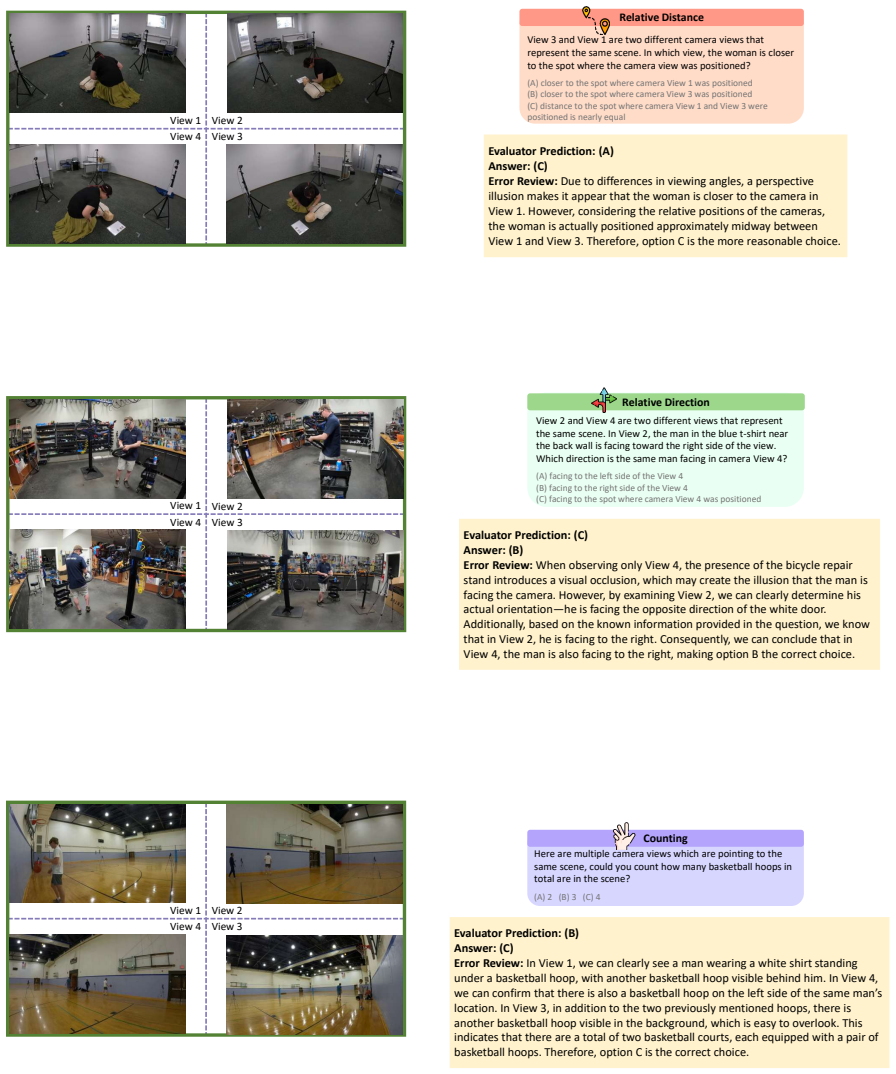
The load-bearing object is All-Angles Bench itself: 90 curated real-world scenes with 2,132 three-option multiple-choice questions, each refined and verified by eight PhD annotators. Its central design device is paired-question generation—each of 85.3% of questions has a twin that rephrases the wording or swaps the referenced views while preserving the same visual correspondence. Comparing success on the two versions yields an 'inconsistent' (IC) score, which exposes whether a model's correct answer reflects robust multi-view understanding or a brittle inference. A second analytical instrument is a visualization prompt that asks the model to lay out objects and camera positions on a 10×10 grid; this reveals systematic misalignment in camera coordinates and viewpoint transformation.
What would settle it
Run a fresh panel of at least five independent annotators on a randomly selected 250-question subset, computing inter-annotator agreement; if their average accuracy falls more than 10 points short of the paper's 82.0 human baseline, or if any MLLM reaches within 5 points of the new baseline on a held-out set, the central gap claim would be overturned.
Extended reading notes
Core claim
The central discovery, stated on the paper's own terms, is that current MLLMs remain far from human-level proficiency in multi-view understanding. On the 250-question human-evaluated subset, the human baseline is 82.0 average accuracy while the best model, InternVL2.5-38B, reaches 60.8, a gap of more than 20 points. The largest single failure is camera pose estimation: humans score 88.9, but the best MLLMs reach only the 30–50 range and many open-source models are at or below the 33.3% random-guess level. The paper also shows via a paired-question scheme that MLLMs often answer semantically equivalent rephrased questions inconsistently, meaning a correct answer is frequently a lucky guess rather than evidence of genuine multi-view understanding. The conclusion is that domain-specific refinements or modules that embed stronger multi-view awareness are necessary.
Load-bearing premise
For the measured 20-point gap to mean what the paper says, the human-written ground-truth answers must be correct on nearly every question, and the two-person human baseline of 82.0 must be a faithful estimate of human-level performance; if either fails, the gap and the conclusion could be inflated.
Editorial extensions
If this is right
- All-Angles Bench gives the community a shared yardstick for multi-view reasoning, so claims about embodied or spatial competence in MLLMs can be checked against a fixed, human-verified question set.
- Because camera pose estimation is where the biggest gap appears, camera-pose ordering can serve as a fast diagnostic test for multi-view geometric awareness in future model releases.
- The paired-question inconsistency score shows that single-question accuracy overstates multi-view understanding; reporting both accuracy and consistency becomes the norm for such benchmarks.
- The failure of chain-of-thought prompting to consistently help implies that the bottleneck is perceptual alignment across views rather than language-level reasoning, steering future work toward domain-specific training or geometric modules.
Reading between the lines
- An immediate editorial test: recruit a larger panel of independent annotators (say 20 or more) for a fresh subset and measure inter-annotator agreement; if agreement is low on the hardest items, the 82.0 human baseline may be optimistic and the 20-point gap somewhat shrinks.
- The paired-question design could be extended into a graded consistency metric—measuring how many view permutations and phrasing variants a model survives—which might predict reliability as an embodied agent better than raw accuracy.
- A direct test of the paper's proposed remedy: fine-tune one of the evaluated open-source families on synthetic multi-view data with explicit 3D ground truth and see whether its All-Angles score jumps past the current 60.8 ceiling; this would separate the 'training data' explanation from the 'architecture' explanation.
Signed reviews
Editorial analysis
A structured set of objections, weighed in public.
Referee Report
Summary. The paper introduces All-Angles Bench, a benchmark of over 2,100 human-annotated multi-view question-answer pairs across 90 real-world scenes, spanning six tasks: counting, attribute identification, relative distance, relative direction, object manipulation, and camera pose estimation. The authors evaluate 27 closed- and open-source MLLMs with greedy decoding and an LLM-based answer extractor, and compare against a human baseline on a 250-question subset. They report a substantial human–model gap, identify cross-view correspondence and camera pose estimation as the main failure modes, and show that chain-of-thought prompting yields limited and model-dependent improvements. The central claim is that current MLLMs remain far from human-level multi-view understanding.
Significance. If the benchmark is reliable, it fills a clear gap: most existing evaluations of spatial reasoning in MLLMs are single-view or temporal, whereas All-Angles Bench directly tests geometric correspondence and cross-view consistency. The public release, the breadth of models evaluated, the paired-question consistency design, and the careful annotation effort (eight PhD annotators, human refinement of LLM-generated questions, cross-checking) are concrete strengths. The identification of camera pose estimation as a systemic weakness, with many models below random guessing, is a valuable and falsifiable finding for the embodied-AI community. However, the quantitative headline, particularly the 82.0% human vs. roughly 60% best-MLLM gap, rests on a 250-question human baseline whose exact protocol is contradictory in the manuscript and for which no agreement or uncertainty measures are reported.
major comments (3)
- [§3.1 vs. Supplement §8.1] The human evaluation protocol is described inconsistently. §3.1 states that human annotators 'each of whom independently answers every question,' while Supplement §8.1 states that each of the two evaluators was assigned 125 questions, i.e., disjoint halves with no overlap. If the latter is correct, the per-task human accuracies in Table 1 are computed on very small subsets and inter-annotator agreement cannot be assessed at all. This is load-bearing for the headline claim of a 82.0 vs. ~60.8 human–model gap. Please clarify the exact protocol, provide the raw per-question human answers, and if overlap exists, report a chance-corrected agreement statistic. If the disjoint design is kept, the human baseline should be re-estimated with confidence intervals and the text should be corrected.
- [Table 1 and Table 2 (250-question subset)] All human and model accuracies on the 250-question subset are reported as point estimates without confidence intervals or significance tests. Based on the task distribution in Figure 4, per-task sample sizes are roughly 20–60 questions; for example, camera pose estimation has about 18 questions in this subset. Consequently, a difference of a few percentage points between models, and even the ordering of some models, may reflect sampling noise. The human–model gap is large enough to survive modest noise for several tasks, but the precise magnitudes (e.g., 82.0% vs. 60.8% on average, or 88.9% vs. 16.7% on camera pose) are not statistically supported as reported. Please provide binomial confidence intervals or a significance test for the key comparisons, especially for the human baseline and the top-performing models.
- [Supplement §7.3 (annotation reliability)] The ground-truth answers for relative distance, relative direction, and object manipulation are annotator judgments, and the full 2,132-question set relies on eight PhD annotators with cross-checking but no reported inter-annotator agreement number. The supplement states that disagreements were resolved through group discussion, but the frequency and nature of disagreements are not quantified. Because the entire evaluation compares model accuracy against these subjective labels, an ambiguous-question analysis (e.g., Cohen's kappa on a shared subset, or annotation confidence scores) is required to rule out the possibility that annotation noise inflates the measured human–model gap. This is a correctness-risk concern, not an assertion that the labels are wrong; the gap is probably large enough to survive some noise, but the reported exact values need this support.
minor comments (5)
- [Supplement §7.3] The text reads 'we hiredeight Ph.D. students' — a typo for 'hired eight'.
- [Abstract and Table 1] The model name 'LLaV A-Onevision' appears in Table 1 and elsewhere; the standard spelling is 'LLaVA-OneVision', which should be used consistently.
- [Abstract] The phrase 'benchmark on27 representative MLLMs' is missing a space between 'on' and '27'.
- [Figure 1 and Section 2] The phrase 'top-bottom view' should be 'top-down view' in the camera pose estimation task description and figures.
- [Figure 5] The plot labeled 'Averaged IC' would be easier to interpret if the caption stated explicitly whether the average is a macro-average over the six tasks or a micro-average over questions.
Circularity Check
No circularity: benchmark annotations, not model outputs, define ground truth; the human-evaluation protocol discrepancy is a reproducibility concern, not a circular derivation.
full rationale
This is an empirical benchmark paper rather than a derivational one, so the circularity burden is low and is not met. The only potentially looping element is that GPT-4o generated initial questions and GPT-4o is later evaluated on the benchmark, but the paper breaks that loop by construction: every generated question was reviewed, rephrased, and re-annotated by eight PhD annotators, with the correct answer finalized by humans, not by the generating model. As the paper states, 'We hire eight human annotators who carefully examine each question along with the associated multi-view images, removing invalid entries and refining question phrasing... finally annotating the single correct answer.' The MLLM therefore supplies draft text, not ground truth, so the models' scores are measured against independent human judgments. The paired-question inconsistency metric is an internal consistency diagnostic and is not used as a fitted target or as the source of the headline claim. The human baseline is an empirical measurement on a 250-question subset, and the discrepancy between the main text ('each of whom independently answers every question') and the supplement ('Each evaluator was assigned 125 questions') is a legitimate reproducibility and reliability concern about inter-annotator agreement, but that is a correctness risk, not circularity. No free parameters are fitted, no prediction is derived from the benchmark's own outputs, and no load-bearing self-citation chain is present. The central claim that current MLLMs lag humans on this benchmark is therefore self-contained as an evaluation result.
Assumptions & free parameters
assumptions (2)
- domain assumption Human-annotated answers are correct and unambiguous ground truth for multi-view understanding
- domain assumption The 250-question subset used for human comparison is representative of the full benchmark
Cite this review
Pith. "Pith review of Seeing from Another Perspective: Evaluating Multi-View Understanding in MLLMs." pith.science (2026). https://pith.science/paper/WSX4VCGE
@misc{pith2026250415280,
  author       = {Pith},
  title        = {Pith review of: Seeing from Another Perspective: Evaluating Multi-View Understanding in MLLMs},
  year         = {2026},
  howpublished = {\url{https://pith.science/paper/WSX4VCGE}},
  note         = {Machine review of arXiv:2504.15280}
}
read the original abstract
Multi-view understanding, the ability to reconcile visual information across diverse viewpoints for effective navigation, manipulation, and 3D scene comprehension, is a fundamental challenge in Multi-Modal Large Language Models (MLLMs) to be used as embodied agents. While recent MLLMs have shown impressive advances in high-level reasoning and planning, they frequently fall short when confronted with multi-view geometric consistency and cross-view correspondence. To comprehensively evaluate the challenges of MLLMs in multi-view scene reasoning, we propose All-Angles Bench, a benchmark of over 2,100 human carefully annotated multi-view question-answer pairs across 90 diverse real-world scenes. Our six tasks (counting, attribute identification, relative distance, relative direction, object manipulation, and camera pose estimation) specifically test model's geometric correspondence and the capacity to align information consistently across views. Our extensive experiments, benchmark on 27 representative MLLMs including Gemini-2.0-Flash, Claude-3.7-Sonnet, and GPT-4o against human evaluators reveals a substantial performance gap, indicating that current MLLMs remain far from human-level proficiency. Through in-depth analysis, we show that MLLMs are particularly underperforming under two aspects: (1) cross-view correspondence for partially occluded views and (2) establishing the coarse camera poses. These findings highlight the necessity of domain-specific refinements or modules that embed stronger multi-view awareness. We believe that our All-Angles Bench offers valuable insights and contribute to bridging the gap between MLLMs and human-level multi-view understanding. The project and benchmark are publicly available at https://danielchyeh.github.io/All-Angles-Bench/.
Figures


Figures from the paper (24 more)




Forward citations
Cited by 6 Pith papers
-
SpaceVista: All-Scale Visual Spatial Reasoning from mm to km
SpaceVista contributes a 1M-QA, 38K-video all-scale spatial reasoning dataset spanning mm to km, a manually verified benchmark, and a fine-tuned 7B MLLM with scale experts and progressive reward training.
-
Seeing Isn't Orienting: A Cognitively Informed Hierarchical Benchmark for Object Orientation in MLLMs
DORI shows state-of-the-art multimodal models perform near-random on fine-grained object orientation reasoning despite strong scores on broader spatial benchmarks.
-
Capek 0.5: An Execution-Centric Vision-Language Model for Embodied Intelligence
An execution-centric training recipe that specializes a vision-language model into four capability experts and consolidates them via weight merging and distillation yields a single embodied model with broad benchmark gains.
-
Cambrian-P: Pose-Grounded Video Understanding
Cambrian-P adds per-frame camera pose tokens and a regression head to video MLLMs, delivering 4.5-6.5% gains on spatial benchmarks, generalization to other video QA tasks, and SOTA streaming pose estimation on ScanNet.
-
BeliefNest: A Joint Action Simulator for Embodied Agents with Theory of Mind
BeliefNest represents nested beliefs as hierarchical Minecraft simulators and shows LLM agents can use them to pass false-belief tasks.
-
Physical Plausibility Reasoning via HCM-GRPO: Empowering Compact Model for Superior Performance
A 2B multimodal model trained with HCM-GRPO, a GRPO variant with partial-credit rewards and hard-case oversampling, outperforms larger models on the authors' private physical-plausibility test set.
Reference graph
Works this paper leans on
-
[1]
Claude, 2024
Anthropic. Claude, 2024. 2, 4, 5
2024
-
[2]
Digirl: Training in-the- wild device-control agents with autonomous reinforcement learning
Hao Bai, Yifei Zhou, Jiayi Pan, Mert Cemri, Alane Suhr, Sergey Levine, and Aviral Kumar. Digirl: Training in-the- wild device-control agents with autonomous reinforcement learning. Advances in Neural Information Processing Sys- tems, 37:12461–12495, 2025. 8
2025
-
[3]
Qwen-vl: A versatile vision-language model for un- derstanding, localization, text reading, and beyond
Jinze Bai, Shuai Bai, Shusheng Yang, Shijie Wang, Sinan Tan, Peng Wang, Junyang Lin, Chang Zhou, and Jingren Zhou. Qwen-vl: A versatile vision-language model for un- derstanding, localization, text reading, and beyond. 2023. 8
2023
-
[4]
Shuai Bai, Keqin Chen, Xuejing Liu, Jialin Wang, Wenbin Ge, Sibo Song, Kai Dang, Peng Wang, Shijie Wang, Jun Tang, et al. Qwen2. 5-vl technical report. arXiv preprint arXiv:2502.13923, 2025. 2, 4, 5
arXiv 2025
-
[5]
Hourvideo: 1-hour video-language understanding
Keshigeyan Chandrasegaran, Agrim Gupta, Lea M Hadzic, Taran Kota, Jimming He, Crist ´obal Eyzaguirre, Zane Du- rante, Manling Li, Jiajun Wu, and Fei-Fei Li. Hourvideo: 1-hour video-language understanding. Advances in Neural Information Processing Systems, 37:53168–53197, 2025. 8
2025
-
[6]
Spatialvlm: Endow- ing vision-language models with spatial reasoning capabili- ties
Boyuan Chen, Zhuo Xu, Sean Kirmani, Brain Ichter, Dorsa Sadigh, Leonidas Guibas, and Fei Xia. Spatialvlm: Endow- ing vision-language models with spatial reasoning capabili- ties. In Proceedings of the IEEE/CVF Conference on Com- puter Vision and Pattern Recognition , pages 14455–14465,
-
[7]
Longvila: Scaling long-context visual language models for long videos
Yukang Chen, Fuzhao Xue, Dacheng Li, Qinghao Hu, Ligeng Zhu, Xiuyu Li, Yunhao Fang, Haotian Tang, Shang Yang, Zhijian Liu, et al. Longvila: Scaling long-context visual language models for long videos. arXiv preprint arXiv:2408.10188, 2024. 8
arXiv 2024
-
[8]
Zhe Chen, Weiyun Wang, Yue Cao, Yangzhou Liu, Zhang- wei Gao, Erfei Cui, Jinguo Zhu, Shenglong Ye, Hao Tian, Zhaoyang Liu, et al. Expanding performance boundaries of open-source multimodal models with model, data, and test- time scaling. arXiv preprint arXiv:2412.05271, 2024. 4, 3
arXiv 2024
Show all 88 references
-
[9]
Internvl: Scaling up vision foundation mod- els and aligning for generic visual-linguistic tasks
Zhe Chen, Jiannan Wu, Wenhai Wang, Weijie Su, Guo Chen, Sen Xing, Muyan Zhong, Qinglong Zhang, Xizhou Zhu, Lewei Lu, et al. Internvl: Scaling up vision foundation mod- els and aligning for generic visual-linguistic tasks. In Pro- ceedings of the IEEE/CVF Conference on Computer...
2024
-
[10]
Spatial- rgpt: Grounded spatial reasoning in vision-language mod- els
An-Chieh Cheng, Hongxu Yin, Yang Fu, Qiushan Guo, Rui- han Yang, Jan Kautz, Xiaolong Wang, and Sifei Liu. Spatial- rgpt: Grounded spatial reasoning in vision-language mod- els. Advances in Neural Information Processing Systems , 37:135062–135093, 2025. 2
2025
-
[11]
Sft memorizes, rl generalizes: A compara- tive study of foundation model post-training
Tianzhe Chu, Yuexiang Zhai, Jihan Yang, Shengbang Tong, Saining Xie, Dale Schuurmans, Quoc V Le, Sergey Levine, and Yi Ma. Sft memorizes, rl generalizes: A compara- tive study of foundation model post-training. arXiv preprint arXiv:2501.17161, 2025. 8
2025 arXiv
-
[12]
Instructblip: Towards general- purpose vision-language models with instruction tuning
Wenliang Dai, Junnan Li, Dongxu Li, Anthony Meng Huat Tiong, Junqi Zhao, Weisheng Wang, Boyang Li, Pascale N Fung, and Steven Hoi. Instructblip: Towards general- purpose vision-language models with instruction tuning. In NeurIPS, 2024. 8
2024
-
[13]
Embodied question answer- ing
Abhishek Das, Samyak Datta, Georgia Gkioxari, Stefan Lee, Devi Parikh, and Dhruv Batra. Embodied question answer- ing. In Proceedings of the IEEE conference on computer vision and pattern recognition, pages 1–10, 2018. 2
2018
-
[14]
Palm-e: An embodied multimodal language model
Danny Driess, Fei Xia, Mehdi SM Sajjadi, Corey Lynch, Aakanksha Chowdhery, Ayzaan Wahid, Jonathan Tompson, Quan Vuong, Tianhe Yu, Wenlong Huang, et al. Palm-e: An embodied multimodal language model. 2023. 2, 8
2023
-
[15]
Vlmevalkit: An open-source toolkit for evaluating large multi-modality models
Haodong Duan, Junming Yang, Yuxuan Qiao, Xinyu Fang, Lin Chen, Yuan Liu, Xiaoyi Dong, Yuhang Zang, Pan Zhang, Jiaqi Wang, et al. Vlmevalkit: An open-source toolkit for evaluating large multi-modality models. In Proceedings of the 32nd ACM international conference on multimedia...
2024
-
[16]
Video-mme: The first-ever comprehensive evaluation benchmark of multi-modal llms in video analysis
Chaoyou Fu, Yuhan Dai, Yongdong Luo, Lei Li, Shuhuai Ren, Renrui Zhang, Zihan Wang, Chenyu Zhou, Yunhang Shen, Mengdan Zhang, et al. Video-mme: The first-ever comprehensive evaluation benchmark of multi-modal llms in video analysis. arXiv preprint arXiv:2405.21075, 2024. 8
2024 arXiv
-
[17]
Gemini, 2023
Google. Gemini, 2023. 2, 8
2023
-
[18]
Ego-exo4d: Understanding skilled human activity from first-and third-person perspectives
Kristen Grauman, Andrew Westbury, Lorenzo Torresani, Kris Kitani, Jitendra Malik, Triantafyllos Afouras, Kumar Ashutosh, Vijay Baiyya, Siddhant Bansal, Bikram Boote, et al. Ego-exo4d: Understanding skilled human activity from first-and third-person perspectives. In Proceedings...
2024
-
[19]
3d concept learn- ing and reasoning from multi-view images
Yining Hong, Chunru Lin, Yilun Du, Zhenfang Chen, Joshua B Tenenbaum, and Chuang Gan. 3d concept learn- ing and reasoning from multi-view images. In Proceedings of the IEEE/CVF Conference on Computer Vision and Pat- tern Recognition, pages 9202–9212, 2023. 2, 8
2023
-
[20]
Language models as zero-shot planners: Extract- ing actionable knowledge for embodied agents
Wenlong Huang, Pieter Abbeel, Deepak Pathak, and Igor Mordatch. Language models as zero-shot planners: Extract- ing actionable knowledge for embodied agents. In Interna- tional conference on machine learning , pages 9118–9147. PMLR, 2022. 2
2022
-
[21]
Gpt-4o system card
Aaron Hurst, Adam Lerer, Adam P Goucher, Adam Perel- man, Aditya Ramesh, Aidan Clark, AJ Ostrow, Akila Weli- hinda, Alan Hayes, Alec Radford, et al. Gpt-4o system card. arXiv preprint arXiv:2410.21276, 2024. 2, 7, 8
2024 arXiv
-
[22]
Conceptfusion: Open-set multimodal 3d mapping
Krishna Murthy Jatavallabhula, Alihusein Kuwajerwala, Qiao Gu, Mohd Omama, Tao Chen, Alaa Maalouf, Shuang Li, Ganesh Iyer, Soroush Saryazdi, Nikhil Keetha, et al. Conceptfusion: Open-set multimodal 3d mapping. arXiv preprint arXiv:2302.07241, 2023. 2
2023 arXiv
-
[23]
Sceneverse: Scaling 3d vision-language learning for grounded scene understanding
Baoxiong Jia, Yixin Chen, Huangyue Yu, Yan Wang, Xuesong Niu, Tengyu Liu, Qing Li, and Siyuan Huang. Sceneverse: Scaling 3d vision-language learning for grounded scene understanding. In European Conference on Computer Vision, pages 289–310. Springer, 2024. 2
-
[24]
Ego-humans: An ego- centric 3d multi-human benchmark
Rawal Khirodkar, Aayush Bansal, Lingni Ma, Richard New- combe, Minh V o, and Kris Kitani. Ego-humans: An ego- centric 3d multi-human benchmark. In Proceedings of the IEEE/CVF International Conference on Computer Vision , pages 19807–19819, 2023. 2, 3, 4, 1
2023
-
[25]
Openvla: An open-source vision-language-action model
Moo Jin Kim, Karl Pertsch, Siddharth Karamcheti, Ted Xiao, Ashwin Balakrishna, Suraj Nair, Rafael Rafailov, Ethan Foster, Grace Lam, Pannag Sanketi, et al. Openvla: An open-source vision-language-action model. arXiv preprint arXiv:2406.09246, 2024. 2
2024 arXiv
-
[26]
Seed-bench: Bench- marking multimodal large language models
Bohao Li, Yuying Ge, Yixiao Ge, Guangzhi Wang, Rui Wang, Ruimao Zhang, and Ying Shan. Seed-bench: Bench- marking multimodal large language models. In Proceedings of the IEEE/CVF Conference on Computer Vision and Pat- tern Recognition, pages 13299–13308, 2024. 8
2024
-
[28]
Llava-onevision: Easy visual task transfer
Bo Li, Yuanhan Zhang, Dong Guo, Renrui Zhang, Feng Li, Hao Zhang, Kaichen Zhang, Yanwei Li, Ziwei Liu, and Chunyuan Li. Llava-onevision: Easy visual task transfer. arXiv preprint arXiv:2408.03326, 2024. 4, 8
2024 arXiv
-
[29]
Mvbench: A comprehensive multi-modal video understand- ing benchmark
Kunchang Li, Yali Wang, Yinan He, Yizhuo Li, Yi Wang, Yi Liu, Zun Wang, Jilan Xu, Guo Chen, Ping Luo, et al. Mvbench: A comprehensive multi-modal video understand- ing benchmark. In Proceedings of the IEEE/CVF Conference on Computer Vision and Pattern Recognition, pages 22195–...
2024
-
[30]
Embodied agent inter- face: Benchmarking llms for embodied decision making
Manling Li, Shiyu Zhao, Qineng Wang, Kangrui Wang, Yu Zhou, Sanjana Srivastava, Cem Gokmen, Tony Lee, Er- ran Li Li, Ruohan Zhang, et al. Embodied agent inter- face: Benchmarking llms for embodied decision making. Advances in Neural Information Processing Systems , 37: 100428–...
2025
-
[31]
Moka: Open-vocabulary robotic manipulation through mark-based visual prompting
Fangchen Liu, Kuan Fang, Pieter Abbeel, and Sergey Levine. Moka: Open-vocabulary robotic manipulation through mark-based visual prompting. In First Workshop on Vision-Language Models for Navigation and Manipulation at ICRA 2024, 2024. 2
2024
-
[32]
Visual instruction tuning
Haotian Liu, Chunyuan Li, Qingyang Wu, and Yong Jae Lee. Visual instruction tuning. In NeurIPS, 2023. 8
2023
-
[33]
Improved baselines with visual instruction tuning
Haotian Liu, Chunyuan Li, Yuheng Li, and Yong Jae Lee. Improved baselines with visual instruction tuning. In CVPR,
-
[34]
Mmbench: Is your multi-modal model an all-around player? In ECCV, 2024
Yuan Liu, Haodong Duan, Yuanhan Zhang, Bo Li, Songyang Zhang, Wangbo Zhao, Yike Yuan, Jiaqi Wang, Conghui He, Ziwei Liu, et al. Mmbench: Is your multi-modal model an all-around player? In ECCV, 2024. 8
2024
-
[35]
Mathvista: Evaluating mathemat- ical reasoning of foundation models in visual contexts
Pan Lu, Hritik Bansal, Tony Xia, Jiacheng Liu, Chunyuan Li, Hannaneh Hajishirzi, Hao Cheng, Kai-Wei Chang, Michel Galley, and Jianfeng Gao. Mathvista: Evaluating mathemat- ical reasoning of foundation models in visual contexts. In ICLR, 2023. 8
2023
-
[36]
Ovis: Structural embed- ding alignment for multimodal large language model
Shiyin Lu, Yang Li, Qing-Guo Chen, Zhao Xu, Weihua Luo, Kaifu Zhang, and Han-Jia Ye. Ovis: Structural embed- ding alignment for multimodal large language model. arXiv preprint arXiv:2405.20797, 2024. 4, 5, 6
2024 arXiv
-
[37]
Egoschema: A diagnostic benchmark for very long- form video language understanding
Karttikeya Mangalam, Raiymbek Akshulakov, and Jitendra Malik. Egoschema: A diagnostic benchmark for very long- form video language understanding. Advances in Neural In- formation Processing Systems, 36:46212–46244, 2023. 8
2023
-
[38]
Chartqa: A benchmark for question an- swering about charts with visual and logical reasoning
Ahmed Masry, Do Xuan Long, Jia Qing Tan, Shafiq Joty, and Enamul Hoque. Chartqa: A benchmark for question an- swering about charts with visual and logical reasoning. In ACL, 2022. 8
2022
-
[39]
Llarva: Vision-action instruction tuning enhances robot learning
Dantong Niu, Yuvan Sharma, Giscard Biamby, Jerome Quenum, Yutong Bai, Baifeng Shi, Trevor Darrell, and Roei Herzig. Llarva: Vision-action instruction tuning enhances robot learning. arXiv preprint arXiv:2406.11815, 2024. 2
2024 arXiv
-
[40]
gpt4o, 2024
OpenAI. gpt4o, 2024. 2, 4, 6, 1, 3
2024
-
[41]
Zero: Memory optimizations toward training trillion parameter models
Samyam Rajbhandari, Jeff Rasley, Olatunji Ruwase, and Yuxiong He. Zero: Memory optimizations toward training trillion parameter models. In SC20: International Confer- ence for High Performance Computing, Networking, Storage and Analysis, pages 1–16. IEEE, 2020. 2
2020
-
[42]
Forgotten polygons: Multimodal large language models are shape-blind
William Rudman, Michal Golovanesky, Amir Bar, Vedant Palit, Yann LeCun, Carsten Eickhoff, and Ritambhara Singh. Forgotten polygons: Multimodal large language models are shape-blind. arXiv preprint arXiv:2502.15969, 2025. 2
2025 arXiv
-
[43]
One step at a time: Long-horizon vision-and-language navigation with milestones
Chan Hee Song, Jihyung Kil, Tai-Yu Pan, Brian M Sadler, Wei-Lun Chao, and Yu Su. One step at a time: Long-horizon vision-and-language navigation with milestones. InProceed- ings of the IEEE/CVF conference on computer vision and pattern recognition, pages 15482–15491, 2022. 2
2022
-
[44]
Embodied bert: A trans- former model for embodied, language-guided visual task completion
Alessandro Suglia, Qiaozi Gao, Jesse Thomason, Govind Thattai, and Gaurav Sukhatme. Embodied bert: A trans- former model for embodied, language-guided visual task completion. arXiv preprint arXiv:2108.04927, 2021. 2
2021 arXiv
-
[45]
Gemini: a family of highly capable multimodal models
Gemini Team, Rohan Anil, Sebastian Borgeaud, Jean- Baptiste Alayrac, Jiahui Yu, Radu Soricut, Johan Schalkwyk, Andrew M Dai, Anja Hauth, Katie Millican, et al. Gemini: a family of highly capable multimodal models. arXiv preprint arXiv:2312.11805, 2023. 2, 4, 5, 7
2023 arXiv
-
[46]
Cambrian- 1: A fully open, vision-centric exploration of multimodal llms
Shengbang Tong, Ellis Brown, Penghao Wu, Sanghyun Woo, Manoj Middepogu, Sai Charitha Akula, Jihan Yang, Shusheng Yang, Adithya Iyer, Xichen Pan, et al. Cambrian- 1: A fully open, vision-centric exploration of multimodal llms. In NeurIPS, 2024. 4, 8
2024
-
[47]
Metamorph: Multimodal understanding and generation via instruction tuning
Shengbang Tong, David Fan, Jiachen Zhu, Yunyang Xiong, Xinlei Chen, Koustuv Sinha, Michael Rabbat, Yann LeCun, Saining Xie, and Zhuang Liu. Metamorph: Multimodal understanding and generation via instruction tuning. arXiv preprint arXiv:2412.14164, 2024. 8
2024 arXiv
-
[48]
Eyes wide shut? exploring the visual shortcomings of multimodal llms
Shengbang Tong, Zhuang Liu, Yuexiang Zhai, Yi Ma, Yann LeCun, and Saining Xie. Eyes wide shut? exploring the visual shortcomings of multimodal llms. In CVPR, 2024. 8
2024
-
[49]
Mllm-tool: A multimodal large language model for tool agent learning
Chenyu Wang, Weixin Luo, Qianyu Chen, Haonan Mai, Jindi Guo, Sixun Dong, Zhengxin Li, Lin Ma, Shenghua Gao, et al. Mllm-tool: A multimodal large language model for tool agent learning. arXiv preprint arXiv:2401.10727 ,
-
[50]
Chi, Sharan Narang, Aakanksha Chowdhery, and Denny Zhou
Xuezhi Wang, Jason Wei, Dale Schuurmans, Quoc V Le, Ed H. Chi, Sharan Narang, Aakanksha Chowdhery, and Denny Zhou. Self-consistency improves chain of thought reasoning in language models. In ICLR, 2023. 3
2023
-
[51]
Chain-of-thought prompting elicits reasoning in large lan- guage models
Jason Wei, Xuezhi Wang, Dale Schuurmans, Maarten Bosma, Fei Xia, Ed Chi, Quoc V Le, Denny Zhou, et al. Chain-of-thought prompting elicits reasoning in large lan- guage models. In NeurIPS, 2022. 2
2022
-
[52]
Deepseek-vl2: Mixture-of- experts vision-language models for advanced multimodal understanding
Zhiyu Wu, Xiaokang Chen, Zizheng Pan, Xingchao Liu, Wen Liu, Damai Dai, Huazuo Gao, Yiyang Ma, Chengyue Wu, Bingxuan Wang, et al. Deepseek-vl2: Mixture-of- experts vision-language models for advanced multimodal understanding. arXiv preprint arXiv:2412.10302, 2024. 4
2024 arXiv
-
[53]
Cad-mllm: Unifying multimodality- conditioned cad generation with mllm
Jingwei Xu, Zibo Zhao, Chenyu Wang, Wen Liu, Yi Ma, and Shenghua Gao. Cad-mllm: Unifying multimodality- conditioned cad generation with mllm. arXiv preprint arXiv:2411.04954, 2024. 8
2024 arXiv
-
[54]
An Yang, Baosong Yang, Beichen Zhang, Binyuan Hui, Bo Zheng, Bowen Yu, Chengyuan Li, Dayiheng Liu, Fei Huang, Haoran Wei, et al. Qwen2. 5 technical report. arXiv preprint arXiv:2412.15115, 2024. 1
2024 arXiv
-
[55]
Thinking in space: How mul- timodal large language models see, remember, and recall spaces
Jihan Yang, Shusheng Yang, Anjali W Gupta, Rilyn Han, Li Fei-Fei, and Saining Xie. Thinking in space: How mul- timodal large language models see, remember, and recall spaces. arXiv preprint arXiv:2412.14171, 2024. 2, 6, 7, 8
2024 arXiv
-
[56]
Dynamic multimodal evalua- tion with flexible complexity by vision-language bootstrap- ping
Yue Yang, Shuibai Zhang, Wenqi Shao, Kaipeng Zhang, Yi Bin, Yu Wang, and Ping Luo. Dynamic multimodal evalua- tion with flexible complexity by vision-language bootstrap- ping. arXiv preprint arXiv:2410.08695, 2024. 4
2024 arXiv
-
[57]
Inst3d-lmm: Instance-aware 3d scene under- standing with multi-modal instruction tuning, 2025
Hanxun Yu, Wentong Li, Song Wang, Junbo Chen, and Jianke Zhu. Inst3d-lmm: Instance-aware 3d scene under- standing with multi-modal instruction tuning, 2025. 2
2025
-
[58]
Multi-target embodied question answering
Licheng Yu, Xinlei Chen, Georgia Gkioxari, Mohit Bansal, Tamara L Berg, and Dhruv Batra. Multi-target embodied question answering. In Proceedings of the IEEE/CVF Con- ference on Computer Vision and Pattern Recognition, pages 6309–6318, 2019. 2
2019
-
[59]
Mmmu: A massive multi-discipline multimodal understanding and reasoning benchmark for ex- pert agi
Xiang Yue, Yuansheng Ni, Kai Zhang, Tianyu Zheng, Ruoqi Liu, Ge Zhang, Samuel Stevens, Dongfu Jiang, Weiming Ren, Yuxuan Sun, et al. Mmmu: A massive multi-discipline multimodal understanding and reasoning benchmark for ex- pert agi. In CVPR, 2024. 8
2024
-
[60]
Mmmu: A massive multi-discipline multimodal understanding and reasoning benchmark for ex- pert agi
Xiang Yue, Yuansheng Ni, Kai Zhang, Tianyu Zheng, Ruoqi Liu, Ge Zhang, Samuel Stevens, Dongfu Jiang, Weiming Ren, Yuxuan Sun, et al. Mmmu: A massive multi-discipline multimodal understanding and reasoning benchmark for ex- pert agi. In Proceedings of the IEEE/CVF Conference on...
2024
-
[61]
Fine-tuning large vision-language models as decision-making agents via reinforcement learning
Yuexiang Zhai, Hao Bai, Zipeng Lin, Jiayi Pan, Shengbang Tong, Yifei Zhou, Alane Suhr, Saining Xie, Yann LeCun, Yi Ma, et al. Fine-tuning large vision-language models as decision-making agents via reinforcement learning. In NeurIPS, 2024. 8
2024
-
[62]
Vlm 2-bench: A closer look at how well vlms im- plicitly link explicit matching visual cues
Jianshu Zhang, Dongyu Yao, Renjie Pi, Paul Pu Liang, et al. Vlm 2-bench: A closer look at how well vlms im- plicitly link explicit matching visual cues. arXiv preprint arXiv:2502.12084, 2025. 2
2025 arXiv
-
[63]
Llava- next: A strong zero-shot video understanding model, 2024
Yuanhan Zhang, Bo Li, haotian Liu, Yong jae Lee, Liangke Gui, Di Fu, Jiashi Feng, Ziwei Liu, and Chunyuan Li. Llava- next: A strong zero-shot video understanding model, 2024. 4
2024
-
[64]
Transfusion: Pre- dict the next token and diffuse images with one multi-modal model
Chunting Zhou, Lili Yu, Arun Babu, Kushal Tirumala, Michihiro Yasunaga, Leonid Shamis, Jacob Kahn, Xuezhe Ma, Luke Zettlemoyer, and Omer Levy. Transfusion: Pre- dict the next token and diffuse images with one multi-modal model. arXiv preprint arXiv:2408.11039, 2024. 8
2024 arXiv
-
[65]
Llava-3d: A simple yet effective pathway to empowering lmms with 3d-awareness
Chenming Zhu, Tai Wang, Wenwei Zhang, Jiangmiao Pang, and Xihui Liu. Llava-3d: A simple yet effective pathway to empowering lmms with 3d-awareness. arXiv preprint arXiv:2409.18125, 2024. 2
2024 arXiv
-
[66]
Dynamic evaluation of large language models by meta probing agents
Kaijie Zhu, Jindong Wang, Qinlin Zhao, Ruochen Xu, and Xing Xie. Dynamic evaluation of large language models by meta probing agents. arXiv preprint arXiv:2402.14865,
-
[68]
Dataset Collection We manually selected 83 scenes from Ego-Exo4D [18] and 7 scenes from EgoHumans [24] to ensure the diversity of scenes
Construction and Annotation Pipeline 7.1. Dataset Collection We manually selected 83 scenes from Ego-Exo4D [18] and 7 scenes from EgoHumans [24] to ensure the diversity of scenes. Given the high density of viewpoints in some Ego- Humans scenes, we carefully curated a subset of...
-
[69]
Answer with the option’s letter from the given choices directly
Experiment Details 8.1. Evaluation Setup Our evaluation is conducted using the VLMEvalKit [15] framework. In order to ensure the reproducibility of our evaluation, we employ a greedy decoding strategy for all models, setting the temperature to 0 unless other- wise stated. The ...
-
[70]
Clarity & Relevance – The question must match the image/context and be easy to understand
-
[71]
Grammar & Precision – No errors or vague phrasing
-
[72]
What if the man with black pants in camera View 1 starts walking toward the view, what would be the trajectory of the man in camera View 3?
Answer Quality – The correct answer must be factually accurate, and distractors should be plausible yet clearly incorrect. Example Before & After: Original Question: “What if the man with black pants in camera View 1 starts walking toward the view, what would be the trajectory...
-
[73]
Verify the questions and options for plausibility and accuracy based on the images/data provided
-
[74]
Correct unclear wording, grammatical errors, or inaccuracies in the questions
-
[75]
toward the view
Finalize the correct answer. Common Mistakes to Avoid ✗ Vague phrasing (e.g., “toward the view”). ✗ Misleading or contradictory options. ✗ MLLM hallucinations (made-up facts or objects) Figure 10. The streamlined version of annotation guideline for annotators to follow.It outl...
-
[76]
While some questions do not require every view, we ensure that only the relevant ones are provided as input during inference
Visualization Results In this section, we present a comprehensive visualization of the scene across all available views for convenience and consistency. While some questions do not require every view, we ensure that only the relevant ones are provided as input during inference...
-
[77]
Internally generate a detailed description of each visible person|note their appearance, clothing, orientation, movements, and any nearby detailed described objects or people
-
[78]
Cross-check these detailed descriptions across all views to avoid double-counting the same individual
-
[79]
Important Instructions: - You should perform your step-by-step reasoning privately and not reveal it to the user
Arrive at the total number of unique people in the scene. Important Instructions: - You should perform your step-by-step reasoning privately and not reveal it to the user. Figure 13. Our proposed Identification CoT prompt. To design for counting tasks with partial-visibility, ...
-
[80]
Two seated individuals (2 people) consistently visible on the bench; 3
Basketball player (1 person) appears in multiple images; 2. Two seated individuals (2 people) consistently visible on the bench; 3. Two standing individuals (2 people) seen in the background in at least one view. The same basketball player is visible across multiple images; Th...
-
[81]
The Stove: The stove is visible in all images and is a key reference point
Identifying Common Elements: The Person: The person is the central figure in all images. The Stove: The stove is visible in all images and is a key reference point. The Kitchen Cabinets: The white kitchen cabinets are visible in all images and provide a backdrop. Tripods: Ther...
-
[82]
We can see another person in the background on the left
Analyzing Relative Positions: View 1: This view is from the front-left of the person, showing their face and the stove from an angle. We can see another person in the background on the left. View 2: This view is from the left side of the person, showing the side of their face ...
-
[83]
Reconstructing the Layout (Top-Down View): Based on the relative positions, here's a sketch of the camera layout:
-
[84]
Backward
Clockwise Order: Starting from the front-left (Image-1) and moving clockwise around the person: View 1 (Front-Left); View 2 (Left); View 4 (Back-Left); View 3 (Back) Therefore, the images in clockwise order are: View 1, View 2, View 4, View 3 View 1 (Front-Left) View 2 (Left) ...
-
[85]
Counting: Counting across multi-views Task Description: Could you count the amount on specific object (e.g., people, chair, cup) in the scene based on all the input camera views? Example: Question: Here are multiple camera views which are pointing to the same scene, could you ...
-
[86]
In View 1, there is a person in fencing who is facing to the spot where camera View 1 was positioned
Attribute Identification: Attribute identification across multiple views Task Description: Could you identify the same object / attribute across multiple camera views? Example: Question: View 1 and View 2 are two different views that represent the same scene. In View 1, there ...
-
[87]
Relative Distance: Object-camera relative distance Task Description: Could you measure the relative distance between the seen object and camera view position in the cross view scenario? Example: Question: View 1 and View 2 are two different camera views that represent the same...
-
[88]
Relative Direction: Object-camera relative direction Task Description: Could you measure the relative direction between the seen object and camera view position in the cross view scenario? Example: Question: View 1 and View 2 are two different camera views that represent the s...
-
[89]
The task-specific prompts used for generating five tasks with the MLLM
Manipulation: Relative object manipulation across views Task Description: Could you manipulate the seen objects (e.g., what if the person is walking to the left of the view), and design the Q&A based on the trajectory of object across views? Example: Question: What if the pers...
-
[2024]
4 Seeing from Another Perspective: Evaluating Multi-View Understanding in MLLMs Supplementary Material In these supplementary materials, we provide the following: • Details on the construction and annotation pipeline of All- Angles Bench (Section 7); • Evaluation setup, implem...
Reviewed August 16, 2026 · model on record in the stance chip above.
Discussion (0). Continue with ORCID to comment.