REVIEW 3 major objections 7 minor 2 cited by
Supermassive Binaries in Ultralight Dark Matter Solitons
T0 review · 3 major / 7 minor · reviewed 2026-08-16 · deepseek-v4-flash
Pith's one-line read Equal-mass supermassive black hole binaries inside an ultralight dark matter soliton decay faster than previous models predict, because the binary 'pinches' the core and amplifies the drag.
desk verdict A solid simulation campaign showing faster SMBH binary decay in ULDM solitons via soliton pinching, but the pinching mechanism lacks a convergence test and the PTA extrapolations lean on fit parameters without error bars. read the letter →
The pith
A machine-rendered reading of the paper's core claim, the machinery that carries it, and where it could break.
The reading
What carries the argument
The load-bearing object is the dynamical-friction torque felt by the binary from the soliton, computed from the Schrödinger-Poisson equations on an adaptive mesh with black holes represented as Plummer spheres. The paper's new physical ingredient is soliton 'pinching': the binary's own potential reshapes the soliton into a denser, steeper profile, so the density that enters the friction formula is not the unperturbed ground state but a time-averaged compressed one. A breathing mode excited by the binary's motion modulates the separation and leaves a damped periodic signature. Together the pinched profile and the quasi-static solver allow the simulations to run long enough to see the decay fall below one parsec, which is where the semi-analytic models and prior simulations diverged.
What would settle it
Run the same binary starting from a galaxy-merger configuration that includes the outer NFW halo and its granules; if the soliton's random walk re-heats the binary or the black holes stall outside the core, the predicted sub-parsec decay would not occur. Observationally, a pulsar-timing array spectrum that lacks the predicted low-frequency suppression would rule out soliton drag as the cause of the missing power.
Extended reading notes
Core claim
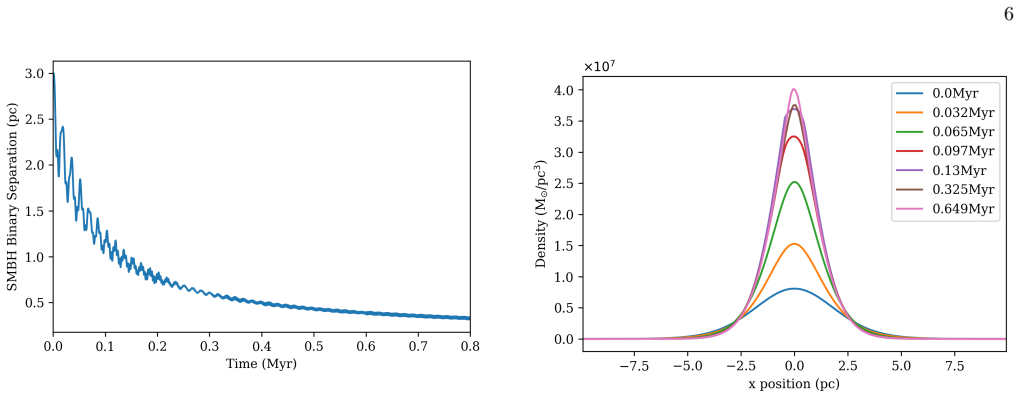
The paper's central claim is that an equal-mass, circular SMBH binary inside a ULDM soliton decays faster than either the semi-analytic dynamical-friction models or the earlier simulation of [25] predict. In the fiducial run -- a $10^9\,M_\odot$ soliton with particle mass $10^{-21}$ eV, two $10^8\,M_\odot$ black holes starting 3 pc apart -- the separation falls below 1 pc within 0.8 Myr. The fast decay is driven by 'pinching': the binary compresses the soliton, raising its central density from $\sim 8\times10^6$ to $\sim 4\times10^7\,M_\odot\,\mathrm{pc}^{-3}$ (up to an order of magnitude in some runs) and halving the core radius, which boosts the dynamical friction. The decay is monotonic with a damped periodic modulation from a soliton breathing mode, in contrast to the 'stone-skipping' seen for a single black hole. An empirical fit $D=A(1+Bt)^{-C}$ gives $C\approx 0.7$, whereas the semi-analytic laws scale as $D^{-5/2}$ and $D^{-11/4}$; folding the pinched profile into the semi-analytic calculation brings its exponent close to the simulated value.
Load-bearing premise
The simulations begin with two black holes already settled on a circular orbit inside a stationary, undisturbed soliton, and they omit the outer halo's stochastic density granules; the paper explicitly states that this implicitly assumes the disruption that could keep the black holes from reaching the soliton center has been overcome.
Editorial extensions
If this is right
- For the fiducial system, dynamical friction drives the binary from 1 pc to 0.076 pc in about 5.6 Myr, after which gravitational-wave emission alone merges it within $10^{10}$ yr; for $2\times10^7\,M_\odot$ black holes the same bridge takes about 477 Myr.
- The drag rises steeply with the ULDM particle mass because the central density scales as $m^6$, so the effect becomes significant for masses above roughly $10^{-21}$ eV.
- At pulsar-timing frequencies, soliton drag can dominate gravitational-wave-driven decay at the low end of the band, suppressing the stochastic gravitational wave background in a frequency-dependent way.
- In equal-mass binaries the separation decreases monotonically apart from a damped breathing modulation, so the 'stone-skipping' stalling seen for single black holes does not appear.
- The empirical decay exponent $C\approx 0.7$ differs from the semi-analytic power laws, so semi-analytic estimates need to include the pinched density profile to match simulations.
Reading between the lines
- The pinching feedback implies the decay is self-reinforcing only while the soliton stays centered on the binary; in a full halo the soliton performs a random walk, so the net merger rate depends on which effect wins, a balance this paper's setup deliberately sets aside.
- A testable extension: for sufficiently unequal mass ratios, the single-black-hole stone-skipping behavior should reappear, so the fast-decay and pulsar-timing suppression predictions should weaken as the mass ratio departs from unity.
- If the low-frequency suppression in the pulsar-timing background is real and caused by soliton drag, the ULDM particle mass must sit near the upper end of the allowed range, turning the predicted spectral shape into a concrete constraint on $m$.
Signed reviews
Editorial analysis
A structured set of objections, weighed in public.
Referee Report
Summary. The paper presents AxioNyx simulations of equal-mass supermassive black hole (SMBH) binaries on circular orbits inside ultralight dark matter (ULDM) solitons. The parameter study varies SMBH mass, soliton mass, and ULDM particle mass. The authors report that the binary's gravity 'pinches' the soliton, raising the central density by a factor of about five in the fiducial run and up to an order of magnitude in some cases, while shrinking the core radius. This back-reaction enhances dynamical friction, producing faster orbital decay than the semi-analytic model of Koo et al. and than previous numerical estimates. The decay curves are fit with an empirical power-law form and with the semi-analytic expression, and the fits are used to argue that ULDM dynamical friction can help alleviate the final parsec problem for 10^8 solar-mass black holes and can suppress gravitational wave emission at the low-frequency end of the pulsar timing array (PTA) band.
Significance. If the central result holds, the paper is a valuable contribution: it identifies a soliton back-reaction ('pinching') that is absent from semi-analytic treatments, and it quantifies a potentially observable suppression of the nanohertz gravitational wave background. The numerical campaign is careful in several respects: the convergence tests for the orbital separation cover resolution, box size, timestep, Plummer radius, and refinement-region width, and the mean decay in the fiducial case is shown to be robust to resolution changes (Figs. 2-6). The comparison with the single-black-hole 'stone-skipping' behavior is instructive, and the authors are explicit about several idealizations. However, the paper's headline mechanism is not directly convergence-tested, and the quantitative extrapolations to the final parsec and PTA band rest on fits without quoted uncertainties. These issues are addressable and do not, in my view, invalidate the core simulation result, but they need to be fixed before publication.
major comments (3)
- [§III, Figs. 5-6; §IV, Figs. 9-10] The 'pinching' enhancement of the central density is load-bearing for the claimed fast decay, but no convergence test for the soliton density profile is presented. The resolution tests in Figs. 2-4 and 6 validate the binary separation, not ρ(r) or mass conservation. For the fiducial 10^8 M⊙ run, Fig. 5 shows the worst energy conservation, and the text attributes the problem to mass flow across refinement boundaries; numerical mass conservation is never reported. With the finest grid spacing at roughly 0.1 pc and the pinched core radius at about 1.1 pc, the core is only about ten cells across, so a numerical density enhancement from mass-flow errors is not excluded. Please add a resolution study for the density profile and enclosed mass in the fiducial run, or otherwise demonstrate that the pinching factor is converged.
- [§V, Table I and §VI, Eqs. (18)-(21), Fig. 20] The quantitative conclusions—5.6 Myr to reach 0.076 pc and the PTA-band suppression—are extrapolations based on fits with no quoted uncertainties. The empirical fit (26) has free parameters A, B, C listed in Table I without error bars, and the PTA estimate switches to the Koo et al. exponent C=0.4 with K inferred from a fit, an extrapolation acknowledged at the end of Sec. V. Because the final parsec and PTA claims are headline results, the paper should report fit uncertainties and show how the conclusions vary under reasonable choices of α and C (e.g., using the empirical C≈0.7 versus C=0.4).
- [§II and §VII] The initial condition assumes an already circularized binary embedded in a stationary ground-state soliton, with the NFW halo and its stochastic granules omitted. The text acknowledges this 'implicitly assume[s] that this disruption is overcome' (Sec. II) and that halo granules would re-heat the binary (Sec. VII). These caveats mean the computed decay is an upper bound, and the statements about alleviating the final parsec problem should be framed as conditional on the binary having reached the soliton center. Please either temper the qualitative claims in the abstract and conclusions or add a quantitative estimate of the granule-driven random-walk heating.
minor comments (7)
- [§I] In the Introduction, 'idealiced symmetric configuration' should read 'idealized symmetric configuration'.
- [§IV, near Fig. 9] The sentence 'The is consistent with the narrower profile' contains a typo and should read 'This is consistent with the narrower profile'.
- [§VII] The phrase 'which will could re-heat the SMBH binary' is grammatically broken; it should read 'which could re-heat the SMBH binary'.
- [§V, Eq. (22)] The displayed power of m in Eq. (22) is confusing: as typeset, putting m^{-17/2} in the denominator gives a drag scaling as m^{17/2}, which seems inconsistent with the m^2 scaling of Eq. (19); please check against the original Annulli et al. expression.
- [Fig. 5 caption] The caption states that energy conservation is 'significantly worse' for the 10^8 M⊙ run; please give the actual numerical value rather than a qualitative description.
- [§VI] The sentence 'we also expect larger expect larger black holes in these systems' contains a duplicated phrase and should be corrected.
- [§III] The paper would benefit from a data-availability statement listing the AxioNyx version, input files, and analysis scripts to allow reproduction of the figures.
Circularity Check
No circularity: the central decay and pinching results come from the simulation, and all semi-analytic or PTA extrapolations are transparently labeled as fits or estimates.
full rationale
The paper's central result is the AMR Schrödinger-Poisson simulation of an equal-mass SMBH binary in a ULDM soliton: the orbital decay and the 'pinching' density enhancement are measured outputs of the simulation, not products of the semi-analytic formulas. The semi-analytic expressions (Eqs. 18-25) are used as comparison tools, with free parameters (α, κ, A, B, C) explicitly fitted to the same simulations and presented as fits rather than independent predictions. The PTA-band discussion extrapolates those fits, but the text labels them as extrapolations and estimates, for example 'The two solid lines extrapolate fits to simulations while the dashed lines are estimated from equation (19), taking α=0.208 from a fit to the simulation' (Sec. VI), so no fitted parameter is renamed as a prediction. Self-citations (e.g., Refs. 15, 22-24) are contextual, code-related, or complementary comparisons and are not load-bearing for the core claim; the core-halo relation is also attributed to external work (Schive et al., Ref. 32). No step of the derivation reduces to its inputs by construction. The numerical convergence concerns about the density profile are correctness or robustness risks, not circularity.
Assumptions & free parameters
free parameters (6)
- α (friction cutoff parameter) =
0.3027 (fiducial), 0.341 (PTA fit), 0.208 (2e-21 eV extrapolation)
- K (decay constant in Eq. 20) =
8.22 pc^-5/2 Myr^-1
- A (initial separation in empirical fit) =
2.94, 2.78, 2.72 pc for 2%, 5%, 10% mass ratios
- B (decay rate in empirical fit) =
3.12, 7.44, 22.7 Myr^-1 for 2%, 5%, 10%
- C (power-law index in empirical fit) =
0.662, 0.777, 0.733 for 2%, 5%, 10%
- κ (fitted coefficient for Annulli et al. model) =
12.16 pc^-11/4 Myr^-1
assumptions (6)
- domain assumption ULDM is governed by the non-relativistic Schrödinger-Poisson equations (Eqs. 1-2).
- domain assumption The initial soliton profile is the spherical ground state approximated by Eq. (4) (Schive et al. profile).
- ad hoc to paper The SMBH binary starts on a circular orbit inside the soliton, with the surrounding NFW halo and its stochastic granules omitted.
- domain assumption Black holes are modeled as Plummer spheres with softening a=0.001 pc.
- domain assumption The core-halo relation connects soliton mass to halo mass.
- domain assumption The Chandrasekhar-type dynamical friction formula (Eqs. 5-11) with a cutoff parameter α describes the drag at sub-pc separations.
Cite this review
Pith. "Pith review of Supermassive Binaries in Ultralight Dark Matter Solitons." pith.science (2026). https://pith.science/paper/WYP2U377
@misc{pith2026250416348,
  author       = {Pith},
  title        = {Pith review of: Supermassive Binaries in Ultralight Dark Matter Solitons},
  year         = {2026},
  howpublished = {\url{https://pith.science/paper/WYP2U377}},
  note         = {Machine review of arXiv:2504.16348}
}
abstract
Ultralight (or fuzzy) dark matter (ULDM) is an alternative to cold dark matter. A key feature of ULDM is the presence of solitonic cores at the centers of collapsed halos. These would potentially increase the drag experienced by supermassive black hole (SMBH) binaries, changing their merger dynamics and the resulting gravitational wave background. We perform detailed simulations of high-mass SMBH binaries in the soliton of a massive halo. We find more rapid decay than previous simulations and semi-analytic approximations. We confirm expectations that the drag depends strongly on the ULDM particle mass, finding masses greater than $10^{-21}$ eV could potentially alleviate the final parsec problem and that ULDM may even suppress gravitational wave production at lower frequencies in the pulsar timing band.
Figures


Figures from the paper (15 more)




Forward citations
Cited by 2 Pith papers
-
Stone Skipping Black Holes in Ultralight Dark Matter Solitons
Black holes in ultralight dark matter solitons undergo quasi-periodic stone-skipping orbits driven by soliton dipole excitations, modifying inspiral dynamics when the black hole is much lighter than the soliton.
-
Ultralight Boson Ionization from Comparable-Mass Binary Black Holes
Ionization of boson molecules bound to a black hole binary can dominate gravitational-wave losses during early inspiral, imprinting a turnover in the nanohertz GW background and circularizing the orbit.
Reference graph
Works this paper leans on
-
[1]
Preskill, M
J. Preskill, M. B. Wise, and F. Wilczek, Phys. Lett. B 120, 127 (1983)
1983
-
[2]
L. F. Abbott and P. Sikivie, Phys. Lett. B120, 133 (1983)
1983
-
[3]
W. Hu, R. Barkana, and A. Gruzinov, Phys. Rev. Lett. 85, 1158 (2000), arXiv:astro-ph/0003365
arXiv 2000
-
[4]
J. Lesgourgues, A. Arbey, and P. Salati, New Astron. Rev.46, 791 (2002)
work page 2002
-
[5]
A. Su´ arez, V. H. Robles, and T. Matos, Astrophys. Space Sci. Proc.38, 107 (2014), arXiv:1302.0903 [astro-ph.CO]
arXiv 2014
-
[6]
P. W. Graham, I. G. Irastorza, S. K. Lamoreaux, A. Lind- ner, and K. A. van Bibber, Ann. Rev. Nucl. Part. Sci.65, 485 (2015), arXiv:1602.00039 [hep-ex]
arXiv 2015
-
[7]
D. J. E. Marsh, Phys. Rept.643, 1 (2016), arXiv:1510.07633 [astro-ph.CO]
arXiv 2016
-
[8]
E. G. M. Ferreira, Astron. Astrophys. Rev.29, 7 (2021), arXiv:2005.03254 [astro-ph.CO]
arXiv 2021
Show all 76 references
-
[9]
Svrcek and E
P. Svrcek and E. Witten, JHEP06(), 051, arXiv:hep- th/0605206
-
[10]
Mayer, S
L. Mayer, S. Kazantzidis, P. Madau, M. Colpi, T. R. Quinn, and J. Wadsley, Science316, 1874 (2007), arXiv:0706.1562 [astro-ph]
2007 arXiv
-
[11]
Fang and H
Y. Fang and H. Yang, Mon. Not. Roy. Astron. Soc.523, 5120 (2023), arXiv:2209.14509 [gr-qc]
2023 arXiv
-
[12]
Milosavljevic and D
M. Milosavljevic and D. Merritt, AIP Conf. Proc.686, 201 (2003), arXiv:astro-ph/0212270
2003 arXiv
-
[13]
P. Mocz, M. Vogelsberger, V. H. Robles, J. Zavala, M. Boylan-Kolchin, A. Fialkov, and L. Hernquist, Mon. Not. Roy. Astron. Soc.471, 4559 (2017), arXiv:1705.05845 [astro-ph.CO]
2017 arXiv
-
[14]
Kendall and R
E. Kendall and R. Easther, Publ. Astron. Soc. Austral. 37, e009 (2020), arXiv:1908.02508 [astro-ph.CO]
2020 arXiv
-
[15]
J. L. Zagorac, E. Kendall, N. Padmanabhan, and R. Eas- ther, Phys. Rev. D107, 083513 (2023), arXiv:2212.09349 [astro-ph.CO]
2023 arXiv
-
[16]
Paredes and H
A. Paredes and H. Michinel, Phys. Dark Univ.12, 50 (2016), arXiv:1512.05121 [astro-ph.CO]
2016 arXiv
-
[17]
Bar-Or, J.-B
B. Bar-Or, J.-B. Fouvry, and S. Tremaine, Astrophys. J. 871, 28 (2019), arXiv:1809.07673 [astro-ph.GA]
2019 arXiv
-
[18]
Dalal and A
N. Dalal and A. Kravtsov, Phys. Rev. D106, 063517 (2022), arXiv:2203.05750 [astro-ph.CO]
2022 arXiv
-
[19]
Chandrasekhar, Astrophys
S. Chandrasekhar, Astrophys. J.97, 255 (1943)
1943
-
[20]
L. Hui, J. P. Ostriker, S. Tremaine, and E. Witten, Phys. Rev. D95, 043541 (2017), arXiv:1610.08297 [astro- ph.CO]
2017 arXiv
-
[21]
Lancaster, C
L. Lancaster, C. Giovanetti, P. Mocz, Y. Kahn, M. Lisanti, and D. N. Spergel, JCAP01(), 001, arXiv:1909.06381 [astro-ph.CO]
1909 arXiv
-
[22]
turnover
is clearly visible in the former but not in the latter. FIG. 12. Evolution of the trajectories for different black hole masses. larger soliton masses, presumably because radial modes are harder to excite in a more massive soliton. Since we include only the soliton our simulati...
2000
-
[23]
Wang and R
Y. Wang and R. Easther, Phys. Rev. D105, 063523 (2022), arXiv:2110.03428 [gr-qc]
2022 arXiv
-
[24]
R. Boey, Y. Wang, E. Kendall, and R. Easther, Phys. Rev. D109, 103526 (2024), arXiv:2403.09038 [astro- ph.CO]
2024 arXiv
-
[25]
Schwabe, M
B. Schwabe, M. Gosenca, C. Behrens, J. C. Niemeyer, and R. Easther, Phys. Rev. D102, 083518 (2020), arXiv:2007.08256 [astro-ph.CO]
2020 arXiv
-
[26]
H. Koo, D. Bak, I. Park, S. E. Hong, and J.-W. Lee, Phys. Lett. B856, 138908 (2024), arXiv:2311.03412 [astro- 14 ph.GA]
2024 arXiv
-
[27]
Annulli, V
L. Annulli, V. Cardoso, and R. Vicente, Phys. Rev. D 102, 063022 (2020), arXiv:2009.00012 [gr-qc]
2020 arXiv
-
[28]
E. Y. Davies and P. Mocz, Mon. Not. Roy. Astron. Soc. 492, 5721 (2020), arXiv:1908.04790 [astro-ph.GA]
2020 arXiv
-
[29]
V. H. Robles, J. S. Bullock, and M. Boylan-Kolchin, Mon. Not. Roy. Astron. Soc.483, 289 (2019), arXiv:1807.06018 [astro-ph.CO]
2019 arXiv
-
[30]
Schive, T
H.-Y. Schive, T. Chiueh, and T. Broadhurst, Phys. Rev. Lett.124, 201301 (2020), arXiv:1912.09483 [astro- ph.GA]
2020 arXiv
-
[31]
D. D. Chowdhury, F. C. van den Bosch, V. H. Robles, P. van Dokkum, H.-Y. Schive, T. Chiueh, and T. Broad- hurst, Astrophys. J.916, 27 (2021), arXiv:2105.05268 [astro-ph.GA]
2021 arXiv
-
[32]
B. C. Bromley, P. Sandick, and B. Shams Es Haghi, Phys. Rev. D110, 023517 (2024), arXiv:2311.18013 [astro- ph.GA]
2024 arXiv
-
[33]
Schive, T
H.-Y. Schive, T. Chiueh, and T. Broadhurst, Nature Phys.10, 496 (2014), arXiv:1406.6586 [astro-ph.GA]
2014 arXiv
-
[34]
Almgren, J
A. Almgren, J. Bell, M. Lijewski, Z. Lukic, and E. Van Andel, Astrophys. J.765, 39 (2013), arXiv:1301.4498 [astro-ph.IM]
2013 arXiv
-
[35]
Zhang, A
W. Zhang, A. Myers, K. Gott, A. Almgren, and J. Bell, The International Journal of High Per- formance Computing Applications35, 508 (2021), https://doi.org/10.1177/10943420211022811
2021 doi
-
[36]
Broadhurst, C
T. Broadhurst, C. Chen, T. Liu, and K.-F. Zheng, (2023), arXiv:2306.17821 [astro-ph.HE]
2023 arXiv
-
[37]
M. J. Koss et al., Astrophys. J. Lett.942, L24 (2023), arXiv:2301.03609 [astro-ph.GA]
2023 arXiv
-
[38]
Chen et al., Galaxy tomography with the gravitational wave background from supermassive black hole binaries (2024), arXiv:2411.05906 [astro-ph.HE]
Y. Chen et al., Galaxy tomography with the gravitational wave background from supermassive black hole binaries (2024), arXiv:2411.05906 [astro-ph.HE]
2024
-
[39]
Girelli, L
G. Girelli, L. Pozzetti, M. Bolzonella, C. Giocoli, F. Marulli, and M. Baldi, Astronomy & Astrophysics 634, A135 (2020)
2020
-
[40]
Schive, M.-H
H.-Y. Schive, M.-H. Liao, T.-P. Woo, S.-K. Wong, T. Chi- ueh, T. Broadhurst, and W. Y. P. Hwang, Phys. Rev. Lett.113, 261302 (2014), arXiv:1407.7762 [astro-ph.GA]
2014 arXiv
-
[41]
P. C. Peters, Phys. Rev.136, B1224 (1964)
1964
-
[42]
Agazie et al
G. Agazie et al. (NANOGrav), Astrophys. J. Lett.951, L8 (2023), arXiv:2306.16213 [astro-ph.HE]
2023 arXiv
-
[43]
Ellis, M
J. Ellis, M. Fairbairn, G. H¨ utsi, J. Raidal, J. Urru- tia, V. Vaskonen, and H. Veerm¨ ae, Phys. Rev. D109, L021302 (2024), arXiv:2306.17021 [astro-ph.CO]
2024 arXiv
-
[44]
G. M. Tomaselli, Phys. Rev. D111, 063075 (2025), arXiv:2501.00090 [gr-qc]
2025 arXiv
-
[45]
Edwards, E
F. Edwards, E. Kendall, S. Hotchkiss, and R. Easther, JCAP10(), 027, arXiv:1807.04037 [astro-ph.CO]
-
[46]
Ellis, M
J. Ellis, M. Fairbairn, G. H¨ utsi, M. Raidal, J. Urrutia, V. Vaskonen, and H. Veerm¨ ae, Astron. Astrophys.676, A38 (2023), arXiv:2301.13854 [astro-ph.CO]
2023 arXiv
-
[47]
Schwabe, J
B. Schwabe, J. C. Niemeyer, and J. F. Engels, Phys. Rev. D94, 043513 (2016), arXiv:1606.05151 [astro-ph.CO]
2016 arXiv
-
[48]
L. E. Padilla, T. Rindler-Daller, P. R. Shapiro, T. Matos, and J. A. V´ azquez, Phys. Rev. D103, 063012 (2021), arXiv:2010.12716 [astro-ph.GA]
2021 arXiv
-
[49]
Burkert, Astrophys
A. Burkert, Astrophys. J.904, 161 (2020), arXiv:2006.11111 [astro-ph.GA]
2020 arXiv
-
[50]
Nori and M
M. Nori and M. Baldi, Mon. Not. Roy. Astron. Soc.501, 1539 (2021), arXiv:2007.01316 [astro-ph.CO]
2021 arXiv
-
[51]
M. Mina, D. F. Mota, and H. A. Winther, Astron. Astro- phys.662, A29 (2022), arXiv:2007.04119 [astro-ph.CO]
2022 arXiv
-
[52]
Taruya and S
A. Taruya and S. Saga, Phys. Rev. D106, 103532 (2022), arXiv:2208.06562 [astro-ph.CO]
2022 arXiv
-
[53]
Kendall, M
E. Kendall, M. Gosenca, and R. Easther, Mon. Not. Roy. Astron. Soc.526, 1046 (2023), arXiv:2305.10340 [astro- ph.CO]
2023 arXiv
-
[54]
Schive, T
H.-Y. Schive, T. Chiueh, T. Broadhurst, and K.-W. Huang, Astrophys. J.818, 89 (2016), arXiv:1508.04621 [astro-ph.GA]
2016 arXiv
-
[55]
P. S. Corasaniti, S. Agarwal, D. J. E. Marsh, and S. Das, Phys. Rev. D95, 083512 (2017), arXiv:1611.05892 [astro- ph.CO]
2017 arXiv
-
[56]
Menci, A
N. Menci, A. Merle, M. Totzauer, A. Schneider, A. Grazian, M. Castellano, and N. G. Sanchez, Astro- phys. J.836, 61 (2017), arXiv:1701.01339 [astro-ph.CO]
2017 arXiv
-
[57]
Ni, M.-Y
Y. Ni, M.-Y. Wang, Y. Feng, and T. Di Mat- teo, Mon. Not. Roy. Astron. Soc.488, 5551 (2019), arXiv:1904.01604 [astro-ph.CO]
2019 arXiv
-
[58]
Winch, K
H. Winch, K. K. Rogers, R. Hloˇ zek, and D. J. E. Marsh, Astrophys. J.976, 40 (2024), arXiv:2404.11071 [astro- ph.CO]
2024 arXiv
-
[59]
Irˇ siˇ c, M
V. Irˇ siˇ c, M. Viel, M. G. Haehnelt, J. S. Bolton, and G. D. Becker, Phys. Rev. Lett.119, 031302 (2017), arXiv:1703.04683 [astro-ph.CO]
2017 arXiv
-
[60]
K. K. Rogers and H. V. Peiris, Phys. Rev. Lett.126, 071302 (2021), arXiv:2007.12705 [astro-ph.CO]
2021 arXiv
- [61]
-
[62]
E. O. Nadler et al. (DES), Phys. Rev. Lett.126, 091101 (2021), arXiv:2008.00022 [astro-ph.CO]
2021 arXiv
-
[63]
Banik, J
N. Banik, J. Bovy, G. Bertone, D. Erkal, and T. J. L. de Boer, JCAP10(), 043, arXiv:1911.02663 [astro- ph.GA]
1911 arXiv
-
[64]
Sipple, A
J. Sipple, A. Lidz, D. Grin, and G. Sun, Fuzzy Dark Mat- ter Constraints from the Hubble Frontier Fields (2024), arXiv:2407.17059 [astro-ph.CO]
2024 arXiv
-
[65]
Gosenca, A
M. Gosenca, A. Eberhardt, Y. Wang, B. Eggemeier, E. Kendall, J. L. Zagorac, and R. Easther, Phys. Rev. D107, 083014 (2023), arXiv:2301.07114 [astro-ph.CO]
2023 arXiv
-
[66]
H. N. Luu et al., Diverse dark matter haloes in Two- field Fuzzy Dark Matter (2024), arXiv:2408.00827 [astro- ph.CO]
2024 arXiv
- [67]
-
[68]
M. Jain, M. A. Amin, J. Thomas, and W. Wanich- wecharungruang, Phys. Rev. D108, 043535 (2023), arXiv:2304.01985 [astro-ph.CO]
2023 arXiv
-
[69]
Bamber, J
J. Bamber, J. C. Aurrekoetxea, K. Clough, and P. G. Fer- reira, Phys. Rev. D107, 024035 (2023), arXiv:2210.09254 [gr-qc]
2023 arXiv
-
[70]
J. C. Aurrekoetxea, K. Clough, J. Bamber, and P. G. Ferreira, Phys. Rev. Lett.132, 211401 (2024), arXiv:2311.18156 [gr-qc]
2024 arXiv
-
[71]
Singh, G
S. Singh, G. Brando de Oliveira, S. Savastano, and M. Zu- malac´ arregui, Gravitational wave lensing: probing Fuzzy Dark Matter with LISA (2025), arXiv:2502.10758 [astro- ph.CO]
2025 arXiv
-
[72]
Eggemeier, B
B. Eggemeier, B. Schwabe, J. C. Niemeyer, and R. East- her, Phys. Rev. D105, 023516 (2022), arXiv:2110.15109 [astro-ph.CO]
2022 arXiv
-
[73]
M. A. Amin and P. Mocz, Phys. Rev. D100, 063507 (2019), arXiv:1902.07261 [astro-ph.CO]
2019 arXiv
-
[74]
Musoke, S
N. Musoke, S. Hotchkiss, and R. Easther, Phys. Rev. Lett.124, 061301 (2020), arXiv:1909.11678 [astro- ph.CO]. 15
2020 arXiv
-
[75]
J. C. Niemeyer and R. Easther, JCAP07(), 030, arXiv:1911.01661 [astro-ph.CO]
1911 arXiv
-
[76]
Eggemeier, J
B. Eggemeier, J. C. Niemeyer, and R. Easther, Phys. Rev. D103, 063525 (2021), arXiv:2011.13333 [astro- ph.CO]
2021 arXiv
Reviewed August 16, 2026 · model on record in the stance chip above.
Discussion (0). Continue with ORCID to comment.