Recognition: 2 theorem links
· Lean TheoremStone Skipping Black Holes in Ultralight Dark Matter Solitons
Pith reviewed 2026-05-16 06:07 UTC · model grok-4.3
The pith
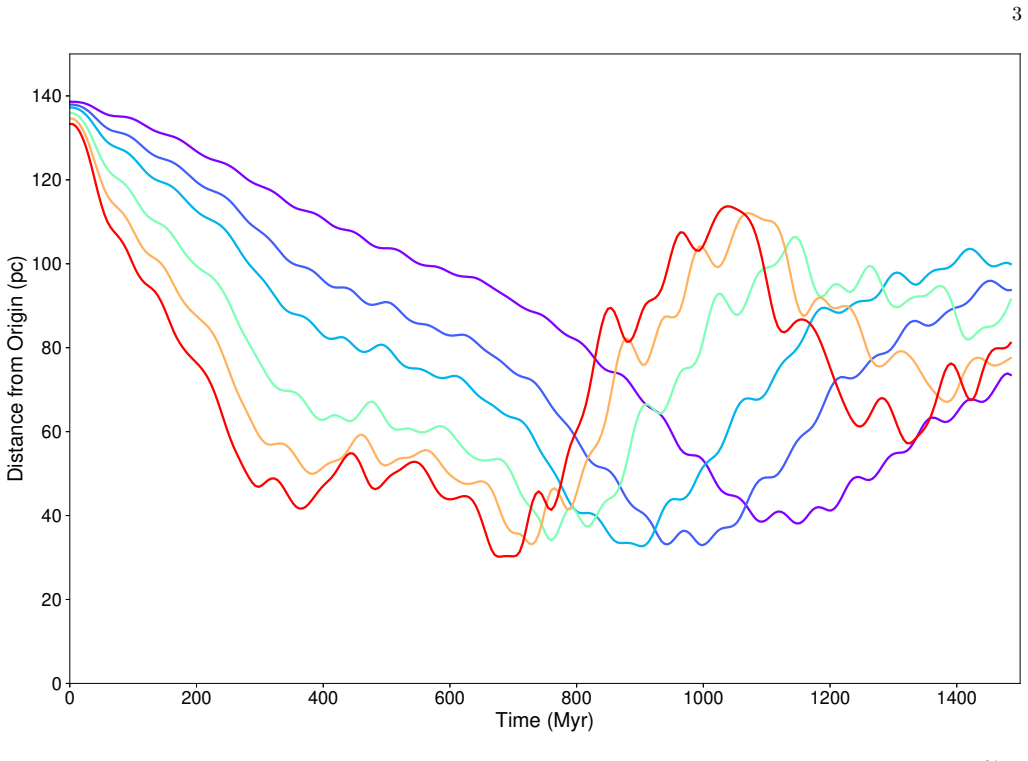
A black hole orbiting in an ultralight dark matter soliton can skip like a stone, with its orbital radius varying quasi-periodically instead of steadily decaying.
A machine-rendered reading of the paper's core claim, the machinery that carries it, and where it could break.
Core claim
The orbit of a black hole moving within an ultralight dark matter soliton undergoes stone skipping, with its orbital radius varying quasi-periodically. This is induced by the dipole excitation of the soliton, modeled as resonance in a forced, damped harmonic oscillator. The coherent response of the soliton can significantly modify the dynamics of objects orbiting within it when black-hole masses are much smaller than the soliton mass.
What carries the argument
Dipole excitation of the soliton, modeled as resonance in a forced, damped harmonic oscillator that drives the black hole's quasi-periodic orbital radius changes.
If this is right
- Inspiral timescales of black holes much lighter than the soliton are lengthened or modulated by the dipole perturbation.
- Supermassive black hole dynamics inside ultralight dark matter solitons are altered, affecting merger rates.
- The final parsec problem for black hole binaries receives a new modification in ultralight dark matter cosmologies.
- Gravitational wave signals from inspiraling black holes must incorporate these modified orbital evolutions.
Where Pith is reading between the lines
- Similar resonance-driven skipping could occur for stars or other low-mass objects inside self-gravitating dark matter structures.
- Astrometric observations might detect periodic radius oscillations as a signature of this effect.
- The forced-oscillator model suggests testable extensions to other self-interacting scalar-field systems with orbiting perturbers.
Load-bearing premise
The soliton responds coherently to the orbiting black hole via a dipole mode that can be accurately captured by a forced, damped harmonic-oscillator resonance, and this response significantly modifies dynamics when black-hole masses are much smaller than the soliton mass.
What would settle it
A numerical simulation in which the dipole mode is suppressed or the black hole mass approaches the soliton mass, showing only monotonic orbital decay without quasi-periodic radius oscillations.
Figures


read the original abstract
The orbit of a black hole moving within an ultralight dark matter (ULDM) soliton is naively expected to decay due to dynamical friction. However, single black holes can undergo ``stone skipping'', with their orbital radius varying quasi-periodically. We show that stone skipping is induced by the dipole excitation of the soliton. We model it as resonance in a forced, damped harmonic oscillator, demonstrating that the coherent response of the soliton can significantly modify the dynamics of objects orbiting within it. This suggests that a dipole perturbation of a soliton can modify inspiral timescales if the black holes masses are significantly less than the soliton mass, with implications for supermassive black hole dynamics, the final parsec problem and gravitational wave observations in a ULDM cosmology.
Editorial analysis
A structured set of objections, weighed in public.
Referee Report
Summary. The paper claims that single black holes orbiting inside ultralight dark matter solitons can exhibit 'stone skipping,' in which orbital radius varies quasi-periodically rather than decaying monotonically under dynamical friction. This behavior is attributed to resonant dipole excitation of the soliton, which the authors model as a forced, damped harmonic oscillator whose coherent back-reaction modifies inspiral timescales when the black-hole mass is much smaller than the soliton mass, with implications for the final-parsec problem and gravitational-wave signals in a ULDM cosmology.
Significance. If the effective-oscillator reduction is valid, the result identifies a previously unrecognized coherent channel that can alter dynamical-friction timescales inside solitons, potentially affecting supermassive-black-hole merger rates and the interpretation of pulsar-timing or LISA signals in ultralight-dark-matter cosmologies. The modeling approach is simple and falsifiable in principle, which is a strength if the mapping from the Schrödinger-Poisson system is shown to be accurate.
major comments (2)
- [resonance-model section] The central modeling step that reduces the soliton dipole response to a single forced, damped harmonic oscillator (abstract and resonance-model section) is load-bearing for the stone-skipping claim. In the Schrödinger-Poisson system, linear perturbations around the ground-state soliton produce a continuum of modes; the manuscript must demonstrate explicitly that projection onto the dipole yields a Markovian oscillator equation without significant non-Markovian memory, radiative damping, or coupling to higher multipoles at the orbital frequencies of interest. Without this derivation or supporting numerical evidence, the resonance-driven modification to inspiral cannot be trusted.
- [discussion of mass-ratio regime] The claim that the effect is important when black-hole masses are 'significantly less than the soliton mass' (abstract) requires a quantitative threshold. The manuscript should state the mass-ratio range over which the dipole back-reaction dominates dynamical friction and show that this range is reached for astrophysically relevant parameters (e.g., soliton core densities and orbital periods).
minor comments (2)
- The abstract would benefit from a one-sentence statement of the key parameters (soliton mass, black-hole mass ratio, orbital frequency relative to soliton natural frequency) that control the resonance.
- Figure captions should explicitly label the plotted quantities (e.g., orbital radius vs. time, dipole amplitude) and indicate whether the curves are from the oscillator model or from full Schrödinger-Poisson simulations.
Simulated Author's Rebuttal
We thank the referee for their careful reading and constructive comments, which have helped us improve the clarity and rigor of the manuscript. We address each major point below and will incorporate revisions to strengthen the justification of the effective model and the mass-ratio regime.
read point-by-point responses
-
Referee: [resonance-model section] The central modeling step that reduces the soliton dipole response to a single forced, damped harmonic oscillator (abstract and resonance-model section) is load-bearing for the stone-skipping claim. In the Schrödinger-Poisson system, linear perturbations around the ground-state soliton produce a continuum of modes; the manuscript must demonstrate explicitly that projection onto the dipole yields a Markovian oscillator equation without significant non-Markovian memory, radiative damping, or coupling to higher multipoles at the orbital frequencies of interest. Without this derivation or supporting numerical evidence, the resonance-driven modification to inspiral cannot be trusted.
Authors: We thank the referee for this important observation. The effective oscillator equation in the resonance-model section is obtained by linearizing the Schrödinger-Poisson system about the soliton ground state and projecting the perturbation onto the dipole mode (the lowest-lying excitation with the appropriate symmetry). At the low orbital frequencies of interest, which lie well below the soliton’s natural frequencies, higher multipoles and continuum modes are off-resonant and contribute only weakly to the effective damping; non-Markovian memory kernels decay rapidly on the orbital timescale. We will add an expanded derivation of this projection (including the explicit mode expansion and timescale separation argument) to the revised resonance-model section and appendix, together with a short discussion of why radiative damping and higher-multipole coupling remain negligible in the relevant regime. We will also include supporting numerical evidence from direct Schrödinger-Poisson simulations confirming the accuracy of the reduced oscillator description for the parameters studied. revision: yes
-
Referee: [discussion of mass-ratio regime] The claim that the effect is important when black-hole masses are 'significantly less than the soliton mass' (abstract) requires a quantitative threshold. The manuscript should state the mass-ratio range over which the dipole back-reaction dominates dynamical friction and show that this range is reached for astrophysically relevant parameters (e.g., soliton core densities and orbital periods).
Authors: We agree that a quantitative threshold is needed. In the revised manuscript we will derive the condition under which the coherent dipole back-reaction force exceeds the dynamical-friction drag, yielding a mass-ratio range m_BH/M_soliton ≲ 0.05–0.1 (depending on orbital frequency and soliton density). We will then insert explicit estimates using representative ULDM soliton core densities (∼10^7–10^9 M_⊙ pc^{-3}) and orbital periods (∼10^3–10^5 yr) appropriate to galactic centers, confirming that the stone-skipping regime is accessible for black holes well below the soliton mass and remains relevant to the final-parsec problem and gravitational-wave signals. revision: yes
Circularity Check
Standard harmonic-oscillator modeling of soliton dipole with minor self-citation; no reduction by construction
full rationale
The derivation models the soliton dipole response to an orbiting black hole as resonance in a forced, damped harmonic oscillator, which is a standard approximation drawn from dynamical friction and linear response theory rather than a self-referential fit or definition. No quoted step shows a prediction that equals its input parameter by construction, nor does a self-citation chain supply the central uniqueness or ansatz. The paper's claim that coherent dipole excitation induces quasi-periodic orbital variation therefore retains independent content from the Schrödinger-Poisson system, even if the oscillator reduction is an approximation whose accuracy is debatable on physical grounds.
Axiom & Free-Parameter Ledger
axioms (1)
- domain assumption The soliton supports a coherent dipole excitation that responds linearly to the orbiting black hole and can be modeled as a forced, damped harmonic oscillator.
Lean theorems connected to this paper
-
IndisputableMonolith/Cost/FunctionalEquation.leanwashburn_uniqueness_aczel unclear?
unclearRelation between the paper passage and the cited Recognition theorem.
We model it as resonance in a forced, damped harmonic oscillator... the time-dependent dipole provides periodic driving, while dynamical friction acts as dissipation.
-
IndisputableMonolith/Foundation/DimensionForcing.leanalexander_duality_circle_linking unclear?
unclearRelation between the paper passage and the cited Recognition theorem.
eigenmode decomposition... dipole modes... stone skipping
What do these tags mean?
- matches
- The paper's claim is directly supported by a theorem in the formal canon.
- supports
- The theorem supports part of the paper's argument, but the paper may add assumptions or extra steps.
- extends
- The paper goes beyond the formal theorem; the theorem is a base layer rather than the whole result.
- uses
- The paper appears to rely on the theorem as machinery.
- contradicts
- The paper's claim conflicts with a theorem or certificate in the canon.
- unclear
- Pith found a possible connection, but the passage is too broad, indirect, or ambiguous to say the theorem truly supports the claim.
Reference graph
Works this paper leans on
-
[1]
Lagrangian for the Black Hole We treat the black hole as a classical point particle of massMmoving in two-dimensional polar coordinates (r, ϕ) and confine its motion to the equatorial plane (θ= π/2) throughout. In polar coordinates, the position is X(t) =r(t) ˆe r (ϕ(t)).(B1) and the kinetic energy is then the usual sum of radial and azimuthal contributio...
-
[2]
Linearised quasi-circular expansion Once we include dynamical friction the orbits become quasi-circular. We write the perturbation as r(t) =r 0 +ξ(t), ϕ(t) = Ω 0t+η(t),(B30) where the perturbationsξ, ηare first order, or|ξ| ≪r 0 and|η| ≪1. Under these assumptions we expand r ˙ϕ2, the derivative of the spherically symmetric poten- tial Φ ′ 0 (r), and the d...
-
[3]
resonant amplification of the radial amplitude
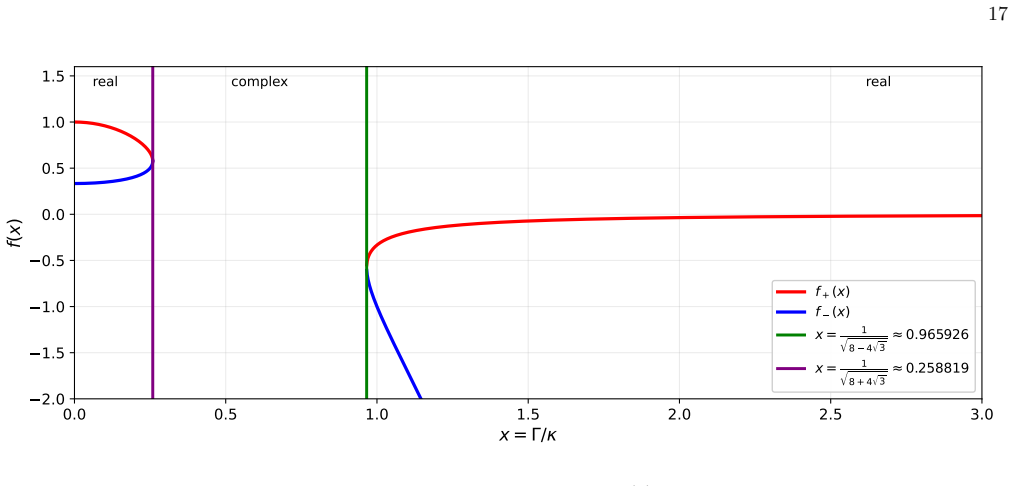
F orced damped harmonic oscillator Eq. (B52) contains a term proportional toξin addition to derivatives up to third order, it cannot, in general, be cast into the standard form of a forced damped harmonic oscillator equation foru= ˙ξ, ¨u+ 2Γ ˙u+κ2 u=F(t).(B54) On closer inspection, the situation simplifies considerably if we keepγ r ̸= 0 but setγ ϕ = 0. P...
-
[4]
Planck Collaboration, N. Aghanim,et al., Astron. Astro- phys.641, A6 (2020)
work page 2020
- [5]
-
[6]
C. S. Frenk and S. D. M. White, Annalen Phys.524, 507 (2012)
work page 2012
-
[7]
J. R. Primack, Annalen Phys.524, 535 (2012)
work page 2012
- [8]
-
[9]
W. J. G. de Blok, Adv. Astron.2010, 789293 (2010)
work page 2010
- [10]
-
[11]
J. S. Bullock and M. Boylan-Kolchin, Annu. Rev. Astron. Astrophys.55, 343 (2017)
work page 2017
-
[12]
D. H. Weinberg, J. S. Bullock, F. Governato, R. Kuzio de Naray, and A. H. G. Peter, Proc. Natl. Acad. Sci. U.S.A. 112, 12249 (2015)
work page 2015
-
[13]
M. Boylan-Kolchin, J. S. Bullock, and M. Kaplinghat, Mon. Not. R. Astron. Soc.415, L40 (2011)
work page 2011
-
[14]
D. N. Spergel and P. J. Steinhardt, Phys. Rev. Lett.84, 3760 (2000)
work page 2000
-
[15]
J. L. Feng, Annu. Rev. Astron. Astrophys.48, 495 (2010)
work page 2010
- [16]
-
[17]
W. Hu, R. Barkana, and A. Gruzinov, Phys. Rev. Lett. 85, 1158 (2000)
work page 2000
-
[18]
D. J. E. Marsh, Phys. Rep.643, 1 (2016)
work page 2016
-
[19]
L. Hui, J. P. Ostriker, S. Tremaine, and E. Witten, Phys. Rev. D95, 043541 (2017)
work page 2017
-
[20]
E. G. M. Ferreira, Astron. Astrophys. Rev.29, 7 (2021)
work page 2021
-
[21]
A. Eberhardt and E. G. M. Ferreira, Ultralight fuzzy dark matter review (2025), arXiv:2507.00705 [astro-ph.CO]
-
[22]
A. Arvanitaki, S. Dimopoulos, S. Dubovsky, N. Kaloper, and J. March-Russell, Phys. Rev. D81, 123530 (2010)
work page 2010
- [23]
- [24]
-
[25]
L. M. Widrow and N. Kaiser, Astrophys. J. Lett.416, L71 (1993)
work page 1993
- [26]
-
[27]
Cosmic Structure as the Quantum Interference of a Coherent Dark Wave
H.-Y. Schive, T. Chiueh, and T. Broadhurst, Nat. Phys. 10, 496 (2014), arXiv:1406.6586 [astro-ph.GA]
work page internal anchor Pith review Pith/arXiv arXiv 2014
-
[28]
H.-Y. Schive, M.-H. Liao, T.-P. Woo, S.-K. Wong, T. Chi- ueh, T. Broadhurst, and W.-Y. P. Hwang, Phys. Rev. Lett.113, 261302 (2014)
work page 2014
- [29]
-
[30]
B. Schwabe, J. C. Niemeyer, and J. F. Engels, Phys. Rev. D94, 043513 (2016)
work page 2016
-
[31]
J. Veltmaat, J. C. Niemeyer, and B. Schwabe, Phys. Rev. D98, 043509 (2018)
work page 2018
- [32]
- [33]
-
[34]
K. K. Rogers and H. V. Peiris, Phys. Rev. Lett.126, 071302 (2021)
work page 2021
- [35]
- [36]
- [37]
-
[38]
A. Eberhardt, M. Gosenca, and L. Hui, arXiv preprint (2025), 2510.17079 [astro-ph.CO]
- [39]
- [40]
-
[41]
J. Binney and S. Tremaine,Galactic Dynamics: Second Edition, 2nd ed. (Princeton University Press, Princeton, NJ, 2008)
work page 2008
-
[42]
L. Lancaster, C. Giovanetti, P. Mocz, Y. Kahn, M. Lisanti, and D. N. Spergel, J. Cosmol. Astropart. Phys.2020, 001 (2020), arXiv:1909.06381 [astro-ph.CO]
-
[43]
Relaxation in a Fuzzy Dark Matter Halo
B. Bar-Or, J.-B. Fouvry, and S. Tremaine, Astrophys. J. 871, 28 (2019), arXiv:1809.07673 [astro-ph.GA]
work page internal anchor Pith review Pith/arXiv arXiv 2019
-
[44]
E. C. Ostriker, Astrophys. J.513, 252 (1999)
work page 1999
-
[45]
A. Just, F. M. Khan, P. Berczik, A. Ernst, and R. Spurzem, Mon. Not. R. Astron. Soc.411, 653 (2011)
work page 2011
-
[46]
PyUltraLight: A Pseudo-Spectral Solver for Ultralight Dark Matter Dynamics
F. Edwards, E. Kendall, S. Hotchkiss, and R. Eas- ther, J. Cosmol. Astropart. Phys.2018, 027 (2018), arXiv:1807.04037 [astro-ph]
work page internal anchor Pith review Pith/arXiv arXiv 2018
- [47]
- [48]
- [49]
- [50]
-
[51]
The NANOGrav 15-year Data Set: Search for Signals from New Physics
G. Agazieet al.(NANOGrav), Astrophys. J. Lett.951, L11 (2023), arXiv:2306.16219 [astro-ph.HE]
work page internal anchor Pith review Pith/arXiv arXiv 2023
-
[53]
Antoniadiset al.(EPTA Collaboration), Astron
J. Antoniadiset al.(EPTA Collaboration), Astron. As- trophys.678, A50 (2023)
work page 2023
-
[54]
D. J. Reardonet al.(PPTA Collaboration), Astrophys. J. Lett.951, L6 (2023)
work page 2023
-
[55]
S. Tiruvaskar, R. Boey, R. Easther, and C. Gordon, arXiv (2025), arXiv:2512.15292 [astro-ph.CO]
-
[56]
M. Milosavljevi´ c and D. Merritt, AIP Conf. Proc.686, 201 (2003)
work page 2003
-
[57]
M. C. Begelman, R. D. Blandford, and M. J. Rees, Nature 287, 307 (1980)
work page 1980
-
[58]
L. Z. Kelleyet al., Mon. Not. R. Astron. Soc.471, 4508 (2017)
work page 2017
-
[59]
F. M. Khanet al., Astrophys. J.773, 100 (2013)
work page 2013
- [60]
- [61]
-
[62]
H. Koo, D. Bak, I. Park, S. E. Hong, and J. Lee, Phys. Lett. B856, 138908 (2024)
work page 2024
-
[63]
G. Alonso- ´Alvarez, J. M. Cline, and C. Dewar, Phys. Rev. Lett.133, 021401 (2024)
work page 2024
- [64]
-
[65]
B. C. Bromley, P. Sandick, and B. Shams Es Haghi, Phys. Rev. D110, 023517 (2024)
work page 2024
-
[66]
M. D. Weinberg, Mon. Not. R. Astron. Soc.239, 549 (1989)
work page 1989
-
[67]
M. D. Weinberg, Astrophys. J.421, 481 (1994)
work page 1994
- [68]
-
[69]
S. Tremaine and M. D. Weinberg, Mon. Not. R. Astron. Soc.209, 729 (1984)
work page 1984
- [70]
-
[71]
J. L. Zagorac, I. Sands, N. Padmanabhan, and R. East- her, Phys. Rev. D105, 103506 (2022)
work page 2022
-
[72]
The NANOGrav 15-year Data Set: Evidence for a Gravitational-Wave Background
G. Agazieet al.(NANOGrav), Astrophys. J. Lett.951, L8 (2023), arXiv:2306.16213 [astro-ph.HE]
work page internal anchor Pith review Pith/arXiv arXiv 2023
- [73]
- [74]
-
[75]
A. Widmark, T. D. Yavetz, and X. Li, JCAP03(03), 052, arXiv:2309.00039 [astro-ph.GA]
-
[76]
B. Schwabe, M. Gosenca, C. Behrens, J. C. Niemeyer, and R. Easther, Phys. Rev. D102, 083518 (2020), arXiv:2007.08256 [astro-ph.CO]
- [77]
- [78]
- [79]
-
[80]
M. Gosenca, A. Eberhardt, Y. Wang, B. Eggemeier, E. Kendall, J. L. Zagorac, and R. Easther, Phys. Rev. D107, 083014 (2023), arXiv:2301.07114 [astro-ph.CO]
discussion (0)
Sign in with ORCID, Apple, or X to comment. Anyone can read and Pith papers without signing in.