REVIEW 2 major objections 5 minor 29 references
Mixing Data-Driven and Physics-Based Constitutive Models using Uncertainty-Driven Phase Fields
T0 review · 2 major / 5 minor · reviewed 2026-08-16 · deepseek-v4-flash
Pith's one-line read A finite-element simulation can run a fast surrogate model in most of the domain and switch locally to the full physics model only where the surrogate's uncertainty demands it, cutting costly evaluations while staying accurate.
desk verdict A genuinely useful adaptive surrogate-mixing method with honest experiments; the main soft spot is the unvalidated assumption that GP variance flags error during history-dependent local unloading. read the letter →
The pith
A machine-rendered reading of the paper's core claim, the machinery that carries it, and where it could break.
The reading
What carries the argument
The load-bearing mechanism is the coupled phase-field/mechanical system, with the scalar field $\varphi \in [0,1]$ acting as a switch between constitutive models. The field is updated from the previous converged state by solving the variational form $F(\varphi,v)=\int_\Omega[-U v + b v + \epsilon^2 \nabla\varphi\cdot\nabla v + \omega \varphi(1-\varphi)(1-2\varphi)v]\,d\Omega$, where $U$ is the driving force, $b$ an opposing threshold, $\epsilon$ the interface-width parameter, and $\omega$ the double-well strength. Once $\varphi$ is known, the mechanical problem is solved with the mixture constitutive law $\mathcal{C}_{\mathrm{mix}}$ that is pure surrogate below $\tau$, pure high-fidelity above $1-\tau$, and a weighted average in between; when a point switches to the high-fidelity model, the plastic history is re-traced from stored converged strains to initialize internal variables. The pair is solved in a staggered loop repeated up to $k_{\max}$ times per load step, which removes the time-step-size dependence of the switch.
What would settle it
Take an integration point that has yielded and then unloads elastically back into a strain region densely covered by the GP's training data; the predictive variance there is small, so $\varphi$ stays below $\tau$ and the mixture returns the GP's linear-elastic correction instead of the plastic stress of the full model. Running the notched-plate problem under monotonic global loading and comparing the hybrid stress field to the full-model solution at such a point would settle whether the variance criterion can be fooled.
Extended reading notes
Core claim
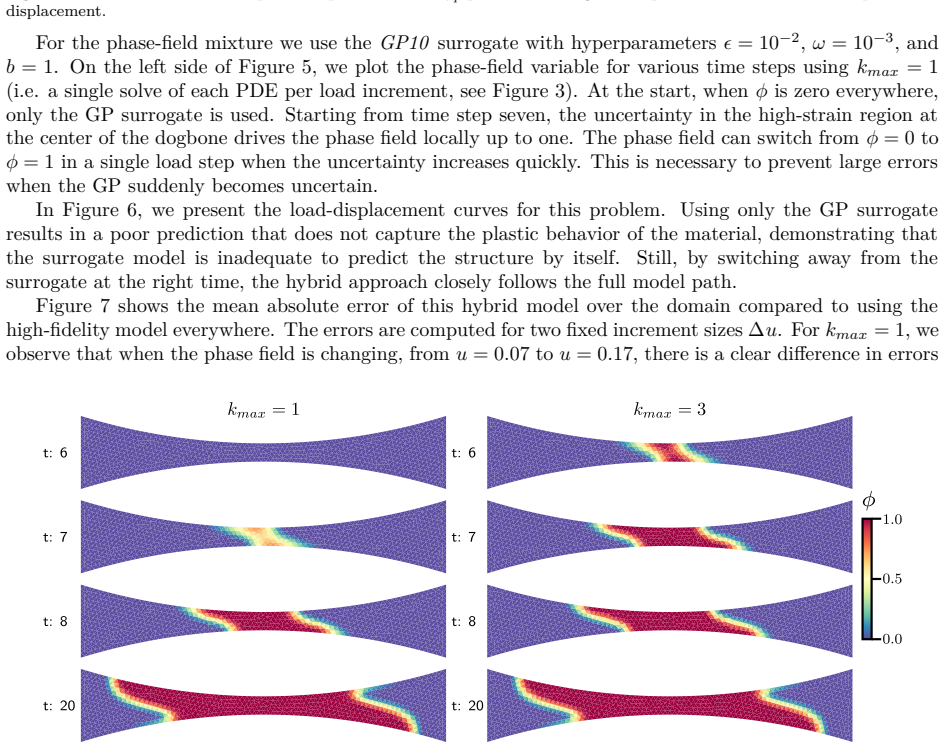
The central claim is that a probabilistic surrogate and the physics-based model it approximates can be combined adaptively in a single finite-element simulation without retraining and without requiring the surrogate to be globally accurate. At each quadrature point a phase-field variable $\varphi$ selects the Gaussian-process surrogate when $\varphi<\tau$, the high-fidelity model when $\varphi>1-\tau$, and a weighted average $\boldsymbol{\sigma}=\varphi\boldsymbol{\sigma}_{\mathrm{HF}}+(1-\varphi)\boldsymbol{\sigma}_{\mathrm{GP}}$ in the transition zone. The phase field is driven by $U=\max_i\sqrt{\mathrm{var}[\mathrm{GP}_i(\boldsymbol{\varepsilon})]}$, the largest predictive standard deviation across the stress components, against a constant opposing force $b$; interface energy and a double-well potential set the width and sharpness of the switch. The results show that this adaptive mixture closely follows the full-model force-displacement response while reducing high-fidelity evaluations, and that the smooth interface is what makes the switching stable: the purely local rule uses the uncertainty directly and can cut evaluations further, but needs more Newton iterations and fails for higher thresholds.
Load-bearing premise
The whole scheme depends on the Gaussian-process variance, computed from the current strain tensor alone, being a trustworthy alarm for when the surrogate's stress prediction is wrong, even though the elasto-plastic material is history-dependent and local unloading can occur near notches; if the variance stays low while the prediction is wrong, the phase field will not switch and the error goes unnoticed.
Editorial extensions
If this is right
- The hybrid approach tracks the full-model path even when the surrogate alone is badly wrong, as in the dogbone case where the GP-only response misses plasticity entirely.
- More training data shrinks the high-fidelity phase and lowers the number of high-fidelity evaluations, but the savings plateau once strains exceed the training range, so data coverage decisions still matter.
- Performing several staggered iterations per load step ($k_{\max}=3$) removes the time-step-size dependence of the phase-field update; the extra Newton iterations are the price of robustness.
- Widening the interface (larger $\epsilon$) stabilizes the mechanical problem and reduces Newton iterations, but a very wide interface degrades accuracy by preventing the phase field from switching fully in small high-uncertainty regions.
- Because the method only needs a surrogate with an uncertainty estimate, the same phase-field wrapper can accelerate any probabilistic surrogate, including ones used inside FE2 multiscale simulations.
Reading between the lines
- The phase field's interface width should be tied to the local mesh size: the paper observes convergence requires the interface to span at least one element, which suggests an adaptive $\epsilon$ field on variable meshes as a natural extension.
- The monotonic-loading restriction could be lifted by giving the surrogate memory (e.g., recurrent or history-augmented inputs); if the surrogate could represent unloading, the phase field would only need to switch on genuinely unseen regimes, possibly making cyclic loading tractable.
- The phase-field region where $\varphi>\tau$ is, in effect, a map of where the training data is insufficient, so the approach could double as an online data-collection guide: after the simulation, retrain the surrogate preferentially on the visited high-uncertainty states.
- False confidence is the method's open flank: a surrogate that is smoothly wrong near its training data will report low variance and never trigger the high-fidelity model, so any practical deployment should combine the variance trigger with a residual check on conserved quantities.
Signed reviews
Editorial analysis
A structured set of objections, weighed in public.
Referee Report
Summary. The paper proposes an adaptive hybrid constitutive modeling framework for finite element simulations in which a Gaussian process surrogate is mixed with a high-fidelity elasto-plastic constitutive model. A phase-field variable, driven by the maximum predictive standard deviation of the GP stress components (Eq. 7), determines locally whether the surrogate, the high-fidelity model, or a weighted average of both is used (Eq. 4, Algorithm 1). The authors analyze the staggered update scheme and time-step consistency, study the influence of the phase-field parameters b, omega, and epsilon, and compare the phase-field approach with a purely local switching rule. Three numerical examples (dogbone, notched plate, plate with holes) demonstrate that the hybrid model can reduce the number of high-fidelity constitutive evaluations relative to running the full model everywhere, while the force-displacement response closely follows the full-model path. The paper concludes that the spatial smoothness introduced by the phase field improves numerical robustness compared with local switching.
Significance. If the switching criterion is trustworthy, the paper offers an original and practical mechanism for adaptive model mixing: the surrogate does not need to be globally accurate, and the diffuse interface provides a tunable transition zone that can stabilize the mechanical solve. The paper is carefully organized and transparent: it provides open-source code, quantifies high-fidelity evaluation counts, compares against a local-switching baseline, and explicitly identifies the limitation that its GP surrogate cannot capture elastic unloading. The main strength is the systematic demonstration that a phase-field transition zone improves robustness relative to sharp local switching. However, the central accuracy and cost claims rest on an unvalidated assumption: that the GP predictive variance reliably flags prediction error for a history-dependent material. Because the manuscript itself reports that local unloading occurs near notch tips and asserts without quantitative evidence that its impact is minimal, this gap must be closed before the conclusions can be considered established.
major comments (2)
- [Section 3.3, Eq. (7) and Section 4.3.1] The switching rule is the load-bearing component of the method, but its reliability is not demonstrated for the history-dependent material studied. The driving force U in Eq. (7) is the maximum component of the GP predictive standard deviation, which via Eq. (A.6) measures the distance in strain space from the query strain to the training inputs. The GP in Eq. (6) has no internal variables, so a strain that was visited during loading and is revisited during unloading can have low predictive variance even when the predicted stress is wrong. The paper restricts attention to monotonically increasing global loads, but Section 4.3.1 states that local unloading nevertheless occurs near the notch tips and asserts that this has "minimal impact" without providing quantitative evidence. Because the phase field switches to the high-fidelity model only when U exceeds b, a locally unloading region with low U will remain in the surrogate phase and the error will go undetected. The accuracy and evaluation-count results in Figures 14, 19, and 21 therefore depend on an assumption that is currently unverified. I ask for a dedicated experiment: for example, report the number and magnitude of locally unloading integration points in the notched-plate runs, and compare the default result with a run in which the phase field is forced to switch to the high-fidelity model at all locally unloading points. If the assumption fails, the claims must be narrowed to loading paths without local unloading.
- [Section 4.1 and Section 5] The paper deliberately uses an analytical elasto-plastic model instead of an FE2 model and measures acceleration by the number of high-fidelity constitutive evaluations rather than by wall-clock time. This is a reasonable first-order proxy for FE2, where each constitutive evaluation is a microscale solve, but the proxy does not capture the full cost of the proposed algorithm: the staggered iterations in Figure 3 require additional global mechanical solves, the re-tracing step in Algorithm 1 replays the full strain history, and the method must store converged strain values at every integration point for all time steps. The concluding claim that the framework can "accelerate multiscale simulations" is therefore an extrapolation from the evaluation-count reductions shown in Figures 9 and 21. I would not require a full FE2 implementation, but the manuscript should either present a cost model that accounts for these overheads or explicitly restrict the claim to "reduction in high-fidelity evaluations" and discuss how the overheads would scale in an FE2 setting.
minor comments (5)
- [Eq. (5)] If the double-well potential is W = omega * phi^2 * (1-phi)^2, its derivative with respect to phi is 2 * omega * phi * (1-phi) * (1-2*phi); the written term lacks the factor 2. Since omega is tuned as a free parameter, this does not affect the conclusions, but the expression should be corrected or the convention should be stated explicitly.
- [Section 2] In the description of the adaptive load-stepping strategy, "If it convergences" should read "If it converges."
- [Figures 14 and 20] The note that the x-axis is linear from zero to one and then logarithmic is difficult to read on the plots; consider using a clear axis break or labeling the two regimes directly on the axis.
- [Section 4.5 and Figure 21] The plot shows the average of five runs with different training datasets but no spread. Since the random training-data choice can strongly affect the surrogate, please add error bars or at least a min-max band.
- [Algorithm 1] The condition "Re-trace alpha to the current timestep if it is outdated" is not fully specified. Please define exactly when the internal variables are considered outdated and what information is stored to perform the re-tracing.
Circularity Check
No circular reasoning: the acceleration and accuracy claims are measured against the full-model baseline, and the uncertainty-driven phase field is an algorithmic construction rather than a fitted prediction.
full rationale
I walked the derivation chain and found no step in which a predicted quantity is identical to an input by construction. The paper's central claims are (i) the hybrid model reduces the number of high-fidelity constitutive evaluations relative to running the full model everywhere, and (ii) the phase-field transition zone improves robustness relative to a purely local switching rule. Both are evaluated by direct comparison: HF evaluations are counted in Figures 9 and 21, and error is computed by comparing force-displacement curves against the full-model solution (Section 4.3.1). The phase-field evolution (Eq. 5) and mixture rule (Eq. 4) define the method; they are not outputs derived from fitted constants. The parameters b, epsilon, and omega are manually set and their influence is studied by parameter sweeps (Sections 4.3.2-4.3.4), so they are not fitted to the reported errors and then renamed as predictions. The driving force U = max_i sqrt(var[GP_i(epsilon)]) (Eq. 7) is an assumed reliability indicator, and the paper explicitly limits global loading to monotonic increase because the GP 'is unable to capture elastic unloading' (Section 3.3). A limitation is also asserted in Section 4.3.1: local unloading occurs near notch tips, and the authors state 'we empirically find that the limited local unloading has minimal impact on the results and does not affect our conclusions' without a dedicated quantitative test. That is a robustness/correctness risk, not circularity, because U is not defined in terms of the errors the method is meant to prevent. Self-citations appear (references [11], [15], [24] overlap with the authors), but they are used for prior-method context, a transition-zone technique, and material properties respectively; none is invoked as a uniqueness theorem, and none carries the central claim. No circular step can therefore be exhibited.
Assumptions & free parameters
free parameters (7)
- b (phase-field opposing force) =
1 (default)
- omega (double-well coefficient) =
1e-3 (default)
- epsilon (interface width) =
1e-2 (default)
- tau (pure-model cutoff) =
0.01
- kmax (max staggered iterations) =
3
- GP hyperparameters (signal variance, length scale, noise) =
fitted by maximum likelihood per GP
- GP training dataset size =
10, 30, 100 load curves of 20 steps up to 10% strain
assumptions (6)
- standard math Balance of linear momentum, strain-displacement compatibility, and a constitutive relation (Eqs. 1-3).
- domain assumption Von Mises elasto-plasticity with isotropic hardening is a valid high-fidelity constitutive model.
- domain assumption The Gaussian process posterior variance is a reliable measure of predictive uncertainty for extrapolation.
- domain assumption The phase-field variational form (Eq. 5) produces stable solutions that can be used to select the constitutive model.
- ad hoc to paper Local unloading that the GP cannot capture has minimal impact on the results.
- ad hoc to paper The number of high-fidelity evaluations is an adequate proxy for computational cost in FE2.
Cite this review
Pith. "Pith review of Mixing Data-Driven and Physics-Based Constitutive Models using Uncertainty-Driven Phase Fields." pith.science (2026). https://pith.science/paper/KG4A5BIN
@misc{pith2026250416713,
  author       = {Pith},
  title        = {Pith review of: Mixing Data-Driven and Physics-Based Constitutive Models using Uncertainty-Driven Phase Fields},
  year         = {2026},
  howpublished = {\url{https://pith.science/paper/KG4A5BIN}},
  note         = {Machine review of arXiv:2504.16713}
}
read the original abstract
There is a high interest in accelerating multiscale models using data-driven surrogate modeling techniques. Creating a large training dataset encompassing all relevant load scenarios is essential for a good surrogate, yet the computational cost of producing this data quickly becomes a limiting factor. Commonly, a pre-trained surrogate is used throughout the computational domain. Here, we introduce an alternative adaptive mixture approach that uses a fast probabilistic surrogate model as constitutive model when possible, but resorts back to the true high-fidelity model when necessary. The surrogate is thus not required to be accurate for every possible load condition, enabling a significant reduction in the data collection time. We achieve this by creating phases in the computational domain corresponding to the different models. These phases evolve using a phase-field model driven by the surrogate uncertainty. When the surrogate uncertainty becomes large, the phase-field model causes a local transition from the surrogate to the high-fidelity model, maintaining a highly accurate simulation. We discuss the requirements of this approach to achieve accurate and numerically stable results and compare the phase-field model to a purely local approach that does not enforce spatial smoothness for the phase mixing. Using a Gaussian Process surrogate for an elasto-plastic material, we demonstrate the potential of this mixture of models to accelerate multiscale simulations.
Figures


Figures from the paper (17 more)


Reference graph
Works this paper leans on
-
[1]
X. W. J. Ghaboussi, J.H. Garrett Jr., Knowledge-based modeling of material behavior with neural networks, Journal of Engineering Mechanics 117 (1) (1991) 132–153
work page 1991
-
[2]
Ghavamian, A
F. Ghavamian, A. Simone, Accelerating multiscale finite element simulations of history-dependent materials using a recurrent neural network, Computer Methods in Applied Mechanics and Engineering 357 (2019) 112594
2019
-
[3]
Raissi, P
M. Raissi, P. Perdikaris, G. E. Karniadakis, Physics-informed neural networks: A deep learning framework for solving forward and inverse problems involving nonlinear partial differential equations, Journal of Computational physics 378 (2019) 686–707
2019
-
[4]
L. Lu, P. Jin, G. Pang, Z. Zhang, G. E. Karniadakis, Learning nonlinear operators via deeponet based on the universal approximation theorem of operators, Nature machine intelligence 3 (3) (2021) 218–229
2021
-
[5]
N. N. Vlassis, W. Sun, Geometric learning for computational mechanics part ii: Graph embedding for interpretable multiscale plasticity, Computer Methods in Applied Mechanics and Engineering 404 (2023) 115768
work page 2023
-
[6]
J. N. Fuhg, G. A. Padmanabha, N. Bouklas, B. Bahmani, W. Sun, N. N. Vlassis, M. Flaschel, P. Carrara, L. De Lorenzis, A review on data-driven constitutive laws for solids, arXiv preprint arXiv:2405.03658 (2024)
arXiv 2024
-
[7]
X. Liu, S. Tian, F. Tao, W. Yu, A review of artificial neural networks in the constitutive modeling of composite materials, Composites Part B: Engineering 224 (2021) 109152
work page 2021
-
[8]
M. Maia, I. Rocha, P. Kerfriden, F. van der Meer, Physically recurrent neural networks for path-dependent heterogeneous materials: embedding constitutive models in a data-driven surrogate, arXiv preprint arXiv:2209.07320 (2022)
work page Pith review arXiv 2022
Show all 29 references
-
[9]
D. K. Klein, R. Ortigosa, J. Mart´ ınez-Frutos, O. Weeger, Nonlinear electro-elastic finite element analysis with neural network constitutive models, arXiv preprint arXiv:2402.07007 (2024)
2024 arXiv
-
[10]
Dornheim, L
J. Dornheim, L. Morand, H. J. Nallani, D. Helm, Neural networks for constitutive modeling: From universal function approximators to advanced models and the integration of physics, Archives of Computational Methods in Engineering 31 (2) (2024) 1097–1127
2024
-
[11]
Rocha, P
I. Rocha, P. Kerfriden, F. van der Meer, On-the-fly construction of surrogate constitutive models for concurrent multiscale mechanical analysis through probabilistic machine learning, Journal of Computational Physics: X 9 (2021) 100083
2021
-
[12]
K. A. Kalina, L. Linden, J. Brummund, M. K¨ astner, Fe ann: an efficient data-driven multiscale approach based on physics-constrained neural networks and automated data mining, Computational Mechanics 71 (5) (2023) 827–851
2023
-
[13]
M.-J. Li, Y. Lian, Z. Cheng, L. Li, Z. Wang, R. Gao, D. Fang, A clustering adaptive gaussian process regression method: Response patterns based real-time prediction for nonlinear solid mechanics problems, Computer Methods in Applied Mechanics and Engineering 436 (2025) 117669
2025
-
[14]
Fritzen, M
F. Fritzen, M. Fern´ andez, F. Larsson, On-the-fly adaptivity for nonlinear twoscale simulations using artificial neural networks and reduced order modeling, Frontiers in Materials 6 (2019) 75
2019
-
[15]
I. B. Rocha, F. P. van der Meer, L. A. Moror´ o, L. J. Sluys, Accelerating crack growth simulations through adaptive model order reduction, International Journal for Numerical Methods in Engineering 121 (10) (2020) 2147–2173
2020
-
[16]
R. A. Jacobs, M. I. Jordan, S. J. Nowlan, G. E. Hinton, Adaptive mixtures of local experts, Neural computation 3 (1) (1991) 79–87
1991
-
[17]
P. K. Rajaraman, T. Manteuffel, M. Belohlavek, J. J. Heys, Combining existing numerical models with data assimila- tion using weighted least-squares finite element methods, International Journal for Numerical Methods in Biomedical Engineering 33 (1) (2017) e02783
2017
-
[18]
W. J. Boettinger, J. A. Warren, C. Beckermann, A. Karma, Phase-field simulation of solidification, Annual review of materials research 32 (1) (2002) 163–194
2002
-
[19]
Chen, Phase-field models for microstructure evolution, Annual review of materials research 32 (1) (2002) 113–140
L.-Q. Chen, Phase-field models for microstructure evolution, Annual review of materials research 32 (1) (2002) 113–140. 16
2002
-
[20]
J.-Y. Wu, V. P. Nguyen, C. T. Nguyen, D. Sutula, S. Sinaie, S. P. Bordas, Phase-field modeling of fracture, Advances in applied mechanics 53 (2020) 1–183
2020
-
[21]
Gerasimov, L
T. Gerasimov, L. De Lorenzis, A line search assisted monolithic approach for phase-field computing of brittle fracture, Computer Methods in Applied Mechanics and Engineering 312 (2016) 276–303
2016
-
[22]
Luo, Fast staggered schemes for the phase-field model of brittle fracture based on the fixed-stress concept, Computer Methods in Applied Mechanics and Engineering 404 (2023) 115787
C. Luo, Fast staggered schemes for the phase-field model of brittle fracture based on the fixed-stress concept, Computer Methods in Applied Mechanics and Engineering 404 (2023) 115787
2023
-
[23]
Y. Gal, Z. Ghahramani, Dropout as a bayesian approximation: Representing model uncertainty in deep learning, in: international conference on machine learning, PMLR, 2016, pp. 1050–1059
2016
-
[24]
Rocha, Numerical and experimental investigation of hygrothermal aging in laminated composites (2019)
I. Rocha, Numerical and experimental investigation of hygrothermal aging in laminated composites (2019)
2019
-
[25]
I. A. Baratta, J. P. Dean, J. S. Dokken, M. Habera, J. S. Hale, C. N. Richardson, M. E. Rognes, M. W. Scroggs, N. Sime, G. N. Wells, DOLFINx: the next generation FEniCS problem solving environment, preprint (2023). doi: 10.5281/zenodo.10447666
2023 doi
-
[26]
Bleyer, dolfinx materials: A Python package for advanced material modelling (Oct
J. Bleyer, dolfinx materials: A Python package for advanced material modelling (Oct. 2024). doi:10.5281/zenodo. 13882183. URL https://doi.org/10.5281/zenodo.13882183
2024 doi
-
[27]
Balay, S
S. Balay, S. Abhyankar, M. F. Adams, S. Benson, J. Brown, P. Brune, K. Buschelman, E. M. Constantinescu, L. Dalcin, A. Dener, V. Eijkhout, J. Faibussowitsch, W. D. Gropp, V. Hapla, T. Isaac, P. Jolivet, D. Karpeev, D. Kaushik, M. G. Knepley, F. Kong, S. Kruger, D. A. May, L. C...
2024
-
[28]
Goswami, C
S. Goswami, C. Anitescu, T. Rabczuk, Adaptive phase field analysis with dual hierarchical meshes for brittle fracture, Engineering Fracture Mechanics 218 (2019) 106608
2019
-
[29]
Williams, C
C. Williams, C. Rasmussen, Gaussian processes for regression, Advances in neural information processing systems 8 (1995). 17 Appendix A. Gaussian Process regression A comprehensive treatment of GPs can be found in [29]. A Gaussian Process is a collection of random variables, a...
1995
Reviewed August 16, 2026 · model on record in the stance chip above.
Discussion (0). Continue with ORCID to comment.