REVIEW 3 major objections 5 minor 1 cited by
Thermal Emission and Confirmation of the Frigid White Dwarf Exoplanet WD 1856+534b
T0 review · 3 major / 5 minor · reviewed 2026-08-16 · deepseek-v4-flash
Pith's one-line read WD 1856+534 b, a Jupiter-sized planet orbiting a white dwarf, emits detectable thermal radiation with a brightness temperature of 186 K, making it the coldest exoplanet whose light has ever been directly observed and the first intact…
desk verdict First direct thermal emission detection of a white-dwarf planet, with a solid mass confirmation - but the significance is slightly overstated and the mid-IR model extrapolation could use a control-sample check. read the letter →
The pith
A machine-rendered reading of the paper's core claim, the machinery that carries it, and where it could break.
The reading
What carries the argument
The load-bearing mechanism is the mid-infrared excess method: because a white dwarf is only about the size of Earth and emits little mid-infrared light, a Jupiter-sized planet in a 0.02 AU orbit can contribute a measurable fraction of the system's flux at 15\ndash 18 microns. The argument works by constructing a precise spectral energy distribution for the white dwarf alone, a model atmosphere fit to out-of-transit NIRSpec data with a hydrogen-to-helium ratio of 4.1 and an effective temperature of 4920 K, computing the flux this model predicts in each MIRI band, and subtracting those predictions from the measured blended photometry. A blackbody fit with a Gaussian prior on the planet's radius from the transit depth converts the residual flux into a brightness temperature, and planetary evolution models plus the white dwarf's cooling age convert that temperature into a mass.
What would settle it
Take a medium-resolution MIRI spectrum of WD 1856 from 5 to 28 microns, fit the white-dwarf continuum to the short-wavelength end only, and check whether flux longward of 13 microns exceeds the extrapolated model by the reported 2-4 microjansky excess; if no such excess appears, or if it does not vary with the planet's 1.41-day orbit, the thermal-emission detection is refuted.
Extended reading notes
Core claim
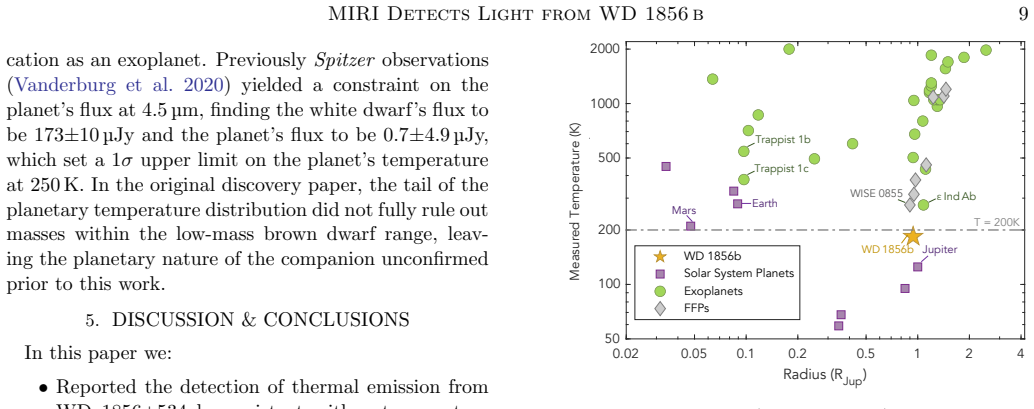
The paper claims that WD 1856+534 b has been directly detected in thermal emission: MIRI photometry in seven bands, after subtraction of a white-dwarf model anchored to NIRSpec spectroscopy, shows excess flux at 15 and 18 microns (11% and 17.9% of the white dwarf's flux, at 3.9 $\sigma$ each, 5.7 $\sigma$ combined) that matches a planet with a mid-infrared brightness temperature of $186^{+6}_{-7}$ K and an effective temperature of $184\pm8$ K. Using this temperature with the system's age of 7.4\ndash 10 Gyr and planetary cooling models, the companion's mass is $5.2^{+0.7}_{-0.8}$ Jupiter masses if insolation is negligible, and no more than 5.9 Jupiter masses otherwise, below the 13-Jupiter-mass deuterium-burning limit. The authors therefore conclude that the object is a giant planet, not a brown dwarf, and that it is the first intact exoplanet confirmed inside a white dwarf's forbidden zone, the region engulfed when the host star was a red giant, demonstrating that planets can migrate into close orbits around white dwarfs.
Load-bearing premise
The planet's flux is measured as the difference between observed MIRI flux and a model white-dwarf spectrum, so the entire detection rests on that model predicting the true 15-18 micron flux to within the assumed 2 percent systematic uncertainty, and the result would be spurious if cool white dwarfs harbor unrecognized spectral features at those wavelengths.
Editorial extensions
If this is right
- WD 1856+534 b becomes the coldest exoplanet with directly detected light, at about 186 K, roughly 60 K warmer than Jupiter and 25 K cooler than Mars.
- The mass bound of 0.84\ndash 5.9 Jupiter masses (or $5.2^{+0.7}_{-0.8}$ if insolation is negligible) firmly places the object below the deuterium-burning limit, confirming it as a planet rather than a brown dwarf.
- As the first intact exoplanet confirmed inside a white dwarf's forbidden zone, it demonstrates that giant planets can survive the host star's red-giant phase and migrate into close orbits around the remnant.
- The same JWST MIRI technique should detect even colder gas giants around nearby white dwarfs, down to roughly 75 K for spatially resolved planets, making solar-system-like giants accessible to direct characterization.
- The system's age of 7.4\ndash 10 Gyr and lack of strong ultraviolet irradiation make it a testbed for gas-giant atmospheric chemistry with minimal photochemistry.
Reading between the lines
- Editorial extension: the measured temperature sits roughly 20 K above the equilibrium temperature, so the planet likely carries internal heat from slow cooling; phase-resolved observations could separate a hotter dayside from genuinely internal luminosity.
- Editorial extension: if the white-dwarf model is tinted by weak unrecognized mid-infrared features, the mass bound would shift; a direct spectroscopic measurement of the white dwarf's 15\ndash 18 micron continuum would settle this more cheaply than waiting for more photometry.
- Editorial extension: the same MIRI excess approach, anchored to NIRSpec spectra, could be applied to other nearby white dwarfs to build a census of temperate giant planets in tight orbits without needing coronagraphs.
- Editorial extension: a dynamical mass measurement from future astrometry or timing would test the cooling-model mass estimate, since the 5.2-Jupiter-mass value assumes insolation is negligible.
Signed reviews
Editorial analysis
A structured set of objections, weighed in public.
Referee Report
Summary. The paper reports JWST MIRI imaging photometry of the white dwarf WD 1856+534 in seven bands from 5.6 to 18.0 µm. After subtracting a white-dwarf model anchored to independent NIRSpec PRISM data, the authors find excess flux at 15 and 18 µm that they attribute to thermal emission from the known transiting giant planet WD 1856+534b. A blackbody fit to the excess yields a brightness temperature of 186+6−7 K, and evolutionary models combined with the system age give a mass of 5.2+0.7−0.8 MJup if insolation is negligible, or an upper limit of 5.9 MJup otherwise. The paper concludes that WD 1856+534b is a planet rather than a brown dwarf, making it the coldest exoplanet with directly detected light and the first intact planet confirmed within a white dwarf's 'forbidden zone.' The analysis includes a comparison with the MEOW survey of white dwarfs and a discussion of possible false positives.
Significance. If the detection holds, this is a landmark result: it would be the first direct detection of thermal emission from a planet colder than 200 K, the first confirmation of an intact planet orbiting a white dwarf in a close-in orbit, and a demonstration of JWST's ability to characterize very cold, old planets. The paper's strengths include the use of a white-dwarf model anchored to independent NIRSpec data, a physically motivated interpretation with a blackbody and a simple atmospheric retrieval that agree, and a careful attempt to rule out background sources. The availability of the custom reduction code (MEOW) on GitHub is a positive reproducibility feature. The main weaknesses are an apparent arithmetic error in the claimed detection significance and a need for stronger validation of the white-dwarf model at 15–18 µm, which is the regime where the excess is claimed.
major comments (3)
- [Section 3.3, Table 2] The individual detection significances quoted in the text (3.9σ at F1500W and F1800W) are not reproduced by the values in Table 2: the excess at F1500W is 2.01/0.57 ≈ 3.5σ and at F1800W is 2.31/0.70 ≈ 3.3σ. Combining these two independent bands gives roughly 4.8σ, and including F1280W (0.82/0.56 ≈ 1.5σ) gives about 5.0σ, not 5.7σ as stated. Please correct the significance calculation, specify the combination method (e.g., inverse-variance weighting of the excess fluxes), and report the revised overall significance. This is load-bearing because the detection confidence is a central claim of the paper.
- [Sections 3.2 and 3.3] The 2% systematic floor that is added to the photometric errors is justified by the agreement of field white dwarfs with models, but those comparisons are anchored at 7.7 µm (as explicitly stated for the MEOW sample) and therefore may not constrain wavelength-dependent errors at 15–18 µm. The argument that adjustments to the white-dwarf model cannot introduce a slope in the mid-infrared is cited from Limbach et al. 2024a but is not demonstrated for this star with a parameter exploration. Because the entire excess is a subtraction of a synthetic Rayleigh–Jeans tail, a model error that grows slowly with wavelength (e.g., 10% at 18 µm) could in principle mimic the observed pattern. Please provide a more direct estimate of the model uncertainty at 15–18 µm—for example, by comparing NIRSpec-anchored models of a control sample of cool DA white dwarfs to their 15–18 µm photometry, or by exploring the sensitivity of the predicted spectral slope to plausible variations in Teff, H/He ratio, and model assumptions. If the model uncertainty at these wavelengths is larger than 2%, the detection significance and the derived temperature and mass would need to be revised accordingly.
- [Section 3.3, final paragraph] The paper argues that if poorly understood mid-infrared features existed in cool white dwarfs (Blouin et al. 2024), they would have appeared as deviations in the NIRSpec data. This argument is not fully compelling because the NIRSpec PRISM data used for anchoring cover only 0.6–4.5 µm, whereas the excess is observed at 15–18 µm. The possibility of features that appear only longward of 4.5 µm is not addressed. Please either present additional evidence that the white-dwarf SED is featureless at 15–18 µm (e.g., from other DA white dwarfs with long-wavelength photometry and NIRSpec coverage) or explicitly acknowledge this as a residual systematic risk in the interpretation.
minor comments (5)
- [Section 1, paragraph 2] The statement that 'no planets cooler than 275 K have been directly detected' is slightly ambiguous because ϵ Ind Ab has a measured temperature of 275 K. Consider rephrasing to 'no planets cooler than 275 K' with a citation to Matthews et al. (2024) at that point.
- [Table 1, planet mass row] The mass value is labeled 'Upper limit' in the table, but the value 5.2+0.7−0.8 MJup is a point estimate under the assumption of negligible insolation. The actual upper limit is 5.9 MJup. Please relabel the row to avoid confusion, for example 'Mass (assuming negligible insolation)' and list the upper limit in a footnote.
- [Section 3.2, paragraph 4] The sentence 'The median discrepancy between the model and fit, binned to 0.7 µm bandwidths ... is 1.05%' should clarify whether this is the median absolute residual and whether it is computed within the fitting region (0.6–4.5 µm) or over the full range including the extrapolated region.
- [Figure 1 and Section 3.3] The comparison to MEOW white dwarfs is useful, but the different anchoring schemes (NIRSpec for WD 1856 versus 7.7 µm for the MEOW sample) should be explicitly discussed in the main text as a limitation. The caption already notes the difference, but the main text implies a direct comparison without this caveat.
- [Appendix B] The analysis of day-night temperature differences in Appendix B is speculative and relies on hot-Jupiter scalings. Consider shortening it or clearly marking it as preliminary, since it does not affect the main conclusions but may distract readers.
Circularity Check
No significant circularity: the white dwarf model is fitted to NIRSpec data and the planetary flux is an independent residual; the one self-citation (Limbach et al. 2024a) is auxiliary, not definitional.
full rationale
The derivation is self-contained on the key steps. The white dwarf model is fit to NIRSpec PRISM observations over 0.6–4.5 µm, determining Teff, solid angle, and H/He ratio independently of the MIRI data. The model is then used to compute the white dwarf flux in each MIRI band, and the planet flux is measured as a residual: observed MIRI photometry minus the modeled white dwarf flux (Table 2). This is a measurement by subtraction, not a fitted quantity renamed as a prediction; the model is not adjusted to match the 15–18 µm excess. The paper's test refitting with <2.5 µm data is an internal consistency check, not a fit to the target bands. The brightness temperature of 186 K comes from a blackbody fit to that residual with a Gaussian radius prior from transit measurements plus the independently derived white dwarf radius. The effective temperature from the POSEIDON retrieval is consistent, and the mass constraint follows from evolutionary models and an independently estimated system age. The one potentially load-bearing self-citation is Limbach et al. (2024a), invoked to argue that adjusting the white dwarf model cannot introduce the observed mid-infrared slope. This is a self-citation used to reject a model-error alternative, and it is somewhat load-bearing for interpretation, but it does not make the detection circular by construction: the 5.7σ significance is computed directly from photometry residuals, and the cited claim is an external, falsifiable model-behavior result rather than an input of the present derivation. Concerns about extrapolating the white dwarf model to 18 µm are correctness risks, not circularity.
Assumptions & free parameters
free parameters (4)
- Mid-IR brightness temperature (T_bright) =
186+6-7 K
- Atmospheric retrieval parameters (T_top, T_base, log NH3, log CH4, reference radius) =
not reported individually; effective temperature 184 +/- 8 K
- White dwarf model parameters (Teff, H/He ratio, solid angle) =
Teff 4920 +/- 50 K, log g 8.05 +/- 0.02, H/He = 4.1
- Assumed 2% absolute photometric systematic floor =
2% of measured flux
assumptions (5)
- domain assumption White dwarf atmosphere models (Blouin et al.) predict the photospheric SED of WD 1856 in the mid-infrared to within about 1%.
- domain assumption MIRI absolute photometric calibration is accurate to 2% and the aperture photometry plus dither combination recovers true flux.
- domain assumption The excess emission originates from the known transiting planet, not a debris disk, background source, or additional companion.
- domain assumption Planetary evolution cooling models (Fortney et al., Marley et al.) map the measured temperature and system age to mass.
- domain assumption The system age of 7.4-10 Gyr from white dwarf cooling models is correct.
Cite this review
Pith. "Pith review of Thermal Emission and Confirmation of the Frigid White Dwarf Exoplanet WD 1856+534b." pith.science (2026). https://pith.science/paper/LANMGRWK
@misc{pith2026250416982,
  author       = {Pith},
  title        = {Pith review of: Thermal Emission and Confirmation of the Frigid White Dwarf Exoplanet WD 1856+534b},
  year         = {2026},
  howpublished = {\url{https://pith.science/paper/LANMGRWK}},
  note         = {Machine review of arXiv:2504.16982}
}
abstract
We report the detection of thermal emission from and confirm the planetary nature of WD 1856+534b, the first transiting planet known to orbit a white dwarf star. Observations with JWST's Mid-Infrared Instrument (MIRI) reveal excess mid-infrared emission from the white dwarf, consistent with a closely-orbiting Jupiter-sized planet with a temperature of $186^{+6}_{-7}$ K. We attribute this excess flux to the known giant planet in the system, making it the coldest exoplanet from which light has ever been directly observed. These measurements constrain the planet's mass to no more than six times that of Jupiter, confirming its planetary nature and ruling out previously unexcluded low-mass brown dwarf scenarios. WD 1856+534b is now the first intact exoplanet confirmed within a white dwarf's "forbidden zone", a region where planets would have been engulfed during the star's red giant phase. Its presence provides direct evidence that planetary migration into close orbits, including the habitable zone, around white dwarfs is possible. With an age nearly twice that of the Solar System and a temperature akin to our own gas giants, WD 1856+534b demonstrates JWST's unprecedented ability to detect and characterize cold, mature exoplanets, opening new possibilities for imaging and characterizing these worlds in the solar neighborhood.
Figures


Figures from the paper (2 more)

Forward citations
Cited by 1 Pith paper
-
Modelling the 3D atmospheric structure of the cold Jupiter WD1856+534b orbiting a white dwarf
A 3D atmosphere simulation of the cold Jupiter WD 1856+534 b produces temperature, chemistry, wind, and emission-spectrum predictions across six metallicity and internal-heat scenarios.
Reference graph
Works this paper leans on
-
[1]
2011, ApJL, 731, L31, doi: 10.1088/2041-8205/731/2/L31
Agol, E. 2011, ApJL, 731, L31, doi: 10.1088/2041-8205/731/2/L31
-
[2]
2009, A&A, 501, L23, doi: 10.1051/0004-6361/200912505 12 Limbach et al
Alonso, R., Guillot, T., Mazeh, T., et al. 2009, A&A, 501, L23, doi: 10.1051/0004-6361/200912505 12 Limbach et al
-
[3]
2021, A&A, 649, A131, doi: 10.1051/0004-6361/202140359 Astropy Collaboration, Robitaille, T
Alonso, R., Rodr´ ıguez-Gil, P., Izquierdo, P., et al. 2021, A&A, 649, A131, doi: 10.1051/0004-6361/202140359 Astropy Collaboration, Robitaille, T. P., Tollerud, E. J., et al. 2013, A&A, 558, A33, doi: 10.1051/0004-6361/201322068 Astropy Collaboration, Price-Whelan, A. M., Sip˝ ocz, B. M., et al. 2018, AJ, 156, 123, doi: 10.3847/1538-3881/aabc4f Astropy C...
-
[4]
Barber, S. D., Patterson, A. J., Kilic, M., et al. 2012, ApJ, 760, 26, doi: 10.1088/0004-637X/760/1/26
-
[5]
2013, Astrobiology, 13, 279, doi: 10.1089/ast.2012.0867
Barnes, R., & Heller, R. 2013, Astrobiology, 13, 279, doi: 10.1089/ast.2012.0867
arXiv 2013
-
[6]
Bauer, E. B. 2023, ApJ, 950, 115, doi: 10.3847/1538-4357/acd057
-
[7]
Becker, J., Seligman, D. Z., Adams, F. C., & Styczinski, M. J. 2023, ApJL, 945, L24, doi: 10.3847/2041-8213/acbe44
-
[8]
E., Farihi, J., Jura, M., et al
Becklin, E. E., Farihi, J., Jura, M., et al. 2005, ApJL, 632, L119, doi: 10.1086/497826 B´ edard, A., Bergeron, P., Brassard, P., & Fontaine, G. 2020, ApJ, 901, 93, doi: 10.3847/1538-4357/abafbe
doi:10.1086/497826 2005
Show all 80 references
-
[9]
W., Beaulieu, J
Blackman, J. W., Beaulieu, J. P., Bennett, D. P., et al. 2021, Nature, 598, 272, doi: 10.1038/s41586-021-03869-6
2021 doi
-
[10]
Blouin, S., Dufour, P., & Allard, N. F. 2018a, ApJ, 863, 184, doi: 10.3847/1538-4357/aad4a9
-
[11]
F., & Kilic, M
Blouin, S., Dufour, P., Allard, N. F., & Kilic, M. 2018b, ApJ, 867, 161, doi: 10.3847/1538-4357/aae53a
- [12]
-
[13]
J., Koch, D., Jenkins, J., et al
Borucki, W. J., Koch, D., Jenkins, J., et al. 2009, Science, 325, 709, doi: 10.1126/science.1178312
2009 doi
-
[14]
O., et al
Bouchet, P., Garc´ ıa-Mar´ ın, M., Lagage, P. O., et al. 2015, PASP, 127, 612, doi: 10.1086/682254
2015 doi
-
[15]
A., Carter, A., et al
Bowens-Rubin, R., Limbach, M. A., Carter, A., et al. 2024, Cool kids on the block: The direct detection of cold ice giants and gas giants orbiting young low-mass neighbors, JWST Proposal. Cycle 3, ID. #6122
2024
-
[16]
G., Nordhaus, J., & Wilson, E
Chamandy, L., Blackman, E. G., Nordhaus, J., & Wilson, E. 2021, MNRAS, 502, L110, doi: 10.1093/mnrasl/slab017
2021 doi
-
[17]
E., Megeath, S
Charbonneau, D., Allen, L. E., Megeath, S. T., et al. 2005, ApJ, 626, 523, doi: 10.1086/429991
2005 doi
-
[18]
J., Tremblay, P.-E., et al
Cunningham, T., Wheatley, P. J., Tremblay, P.-E., et al. 2022, Nature, 602, 219, doi: 10.1038/s41586-021-04300-w
2022 doi
-
[19]
H., & Sigurdsson, S
Debes, J. H., & Sigurdsson, S. 2002, ApJ, 572, 556, doi: 10.1086/340291
2002 doi
-
[20]
H., Sigurdsson, S., & Woodgate, B
Debes, J. H., Sigurdsson, S., & Woodgate, B. E. 2005, ApJ, 633, 1168, doi: 10.1086/491640
2005 doi
-
[21]
J., & Harrington, J
Deming, D., Seager, S., Richardson, L. J., & Harrington, J. 2005, Nature, 434, 740, doi: 10.1038/nature03507
2005 doi
-
[22]
Farihi, J., Zuckerman, B., & Becklin, E. E. 2008, ApJ, 674, 431, doi: 10.1086/521715
2008 doi
-
[23]
P., & Bridges, M
Feroz, F., Hobson, M. P., & Bridges, M. 2009, MNRAS, 398, 1601, doi: 10.1111/j.1365-2966.2009.14548.x
2009
-
[24]
N., Greathouse, T
Fletcher, L. N., Greathouse, T. K., Orton, G. S., et al. 2016, Icarus, 278, 128, doi: 10.1016/j.icarus.2016.06.008
2016 doi
-
[25]
J., Marley, M
Fortney, J. J., Marley, M. S., & Barnes, J. W. 2007, ApJ, 659, 1661, doi: 10.1086/512120
2007 doi
-
[26]
A., et al
Fossati, L., Bagnulo, S., Haswell, C. A., et al. 2012, ApJL, 757, L15, doi: 10.1088/2041-8205/757/1/L15 G¨ ansicke, B. T., Schreiber, M. R., Toloza, O., et al. 2019, Nature, 576, 61, doi: 10.1038/s41586-019-1789-8
2012 doi
- [27]
-
[28]
D., Bohlin, R., Sloan, G
Gordon, K. D., Bohlin, R., Sloan, G. C., et al. 2022, AJ, 163, 267, doi: 10.3847/1538-3881/ac66dc
2022 doi
- [29]
-
[30]
2015, SOLAR SYSTEM/SUN,
Haberle, R. 2015, SOLAR SYSTEM/SUN,
2015
-
[31]
Hanel, R., Conrath, B., Herath, L., Kunde, V., & Pirraglia, J. 1981, J. Geophys. Res., 86, 8705, doi: 10.1029/JA086iA10p08705
1981 doi
-
[32]
K., & Winget, D
Kilic, M., von Hippel, T., Leggett, S. K., & Winget, D. E. 2005, ApJL, 632, L115, doi: 10.1086/497825
2005 doi
-
[33]
K., et al
Kiman, R., Xu, S., Faherty, J. K., et al. 2022, AJ, 164, 62, doi: 10.3847/1538-3881/ac7788
2022 doi
-
[34]
A., Charbonneau, D., Allen, L
Knutson, H. A., Charbonneau, D., Allen, L. E., et al. 2007, Nature, 447, 183, doi: 10.1038/nature05782
2007 doi
-
[35]
D., & Showman, A
Komacek, T. D., & Showman, A. P. 2016, ApJ, 821, 16, doi: 10.3847/0004-637X/821/1/16
2016 doi
-
[36]
Kozakis, T., Kaltenegger, L., & Hoard, D. W. 2018, ApJ, 862, 69, doi: 10.3847/1538-4357/aacbc7
2018 doi
-
[37]
2020, ApJL, 894, L6, doi: 10.3847/2041-8213/ab6f6a
Kozakis, T., Lin, Z., & Kaltenegger, L. 2020, ApJL, 894, L6, doi: 10.3847/2041-8213/ab6f6a
2020 doi
-
[38]
2023, MNRAS, 521, 4679, doi: 10.1093/mnras/stad766
Kubiak, S., Vanderburg, A., Becker, J., et al. 2023, MNRAS, 521, 4679, doi: 10.1093/mnras/stad766
2023 doi
-
[39]
R., Zorotovic, M., et al
Lagos, F., Schreiber, M. R., Zorotovic, M., et al. 2021, MNRAS, 501, 676, doi: 10.1093/mnras/staa3703
2021 doi
-
[40]
M., Bonnefoy, M., Chauvin, G., et al
Lagrange, A. M., Bonnefoy, M., Chauvin, G., et al. 2010, Science, 329, 57, doi: 10.1126/science.1187187
2010 doi
-
[41]
2023, A&A, 675, A184, doi: 10.1051/0004-6361/202245827 MIRI Detects Light from WD 1856 b 13
Ledda, S., Danielski, C., & Turrini, D. 2023, A&A, 675, A184, doi: 10.1051/0004-6361/202245827 MIRI Detects Light from WD 1856 b 13
2023 doi
-
[42]
A., Vanderburg, A., Stevenson, K
Limbach, M. A., Vanderburg, A., Stevenson, K. B., et al. 2022, MNRAS, 517, 2622, doi: 10.1093/mnras/stac2823
2022 doi
-
[43]
A., Vanderburg, A., Blouin, S., et al
Limbach, M. A., Vanderburg, A., Blouin, S., et al. 2023, The MIRI survey for Exoplanets Orbiting White-dwarfs (MEOW), JWST Proposal. Cycle 2, ID. #3964
2023
-
[44]
A., Vanderburg, A., Venner, A., et al
Limbach, M. A., Vanderburg, A., Venner, A., et al. 2024a, ApJL, 973, L11, doi: 10.3847/2041-8213/ad74ed
-
[45]
2013, MNRAS, 432, L11, doi: 10.1093/mnrasl/slt026
Loeb, A., & Maoz, D. 2013, MNRAS, 432, L11, doi: 10.1093/mnrasl/slt026
2013 doi
-
[46]
L., Burgasser, A
Luhman, K. L., Burgasser, A. J., & Bochanski, J. J. 2011, ApJL, 730, L9, doi: 10.1088/2041-8205/730/1/L9
2011 doi
-
[47]
L., Tremblin, P., Alves de Oliveira, C., et al
Luhman, K. L., Tremblin, P., Alves de Oliveira, C., et al. 2024, AJ, 167, 5, doi: 10.3847/1538-3881/ad0b72
2024 doi
-
[48]
MacDonald, R. J. 2023, The Journal of Open Source Software, 8, 4873, doi: 10.21105/joss.04873
2023 doi
-
[49]
J., & Madhusudhan, N
MacDonald, R. J., & Madhusudhan, N. 2017, MNRAS, 469, 1979, doi: 10.1093/mnras/stx804
2017 doi
-
[50]
J., Batalha, N., Foote, T
MacDonald, R. J., Batalha, N., Foote, T. O., et al. 2021, Under the Light of a Dead Star: Revealing the Atmospheric Composition of a White Dwarf Planet, JWST Proposal. Cycle 1, ID. #2358
2021
-
[51]
F., Villaver, E., Mustill, A
Maldonado, R. F., Villaver, E., Mustill, A. J., Ch´ avez, M., & Bertone, E. 2021, MNRAS, 501, L43, doi: 10.1093/mnrasl/slaa193
2021 doi
-
[52]
S., Saumon, D., Visscher, C., et al
Marley, M. S., Saumon, D., Visscher, C., et al. 2021, ApJ, 920, 85, doi: 10.3847/1538-4357/ac141d
2021 doi
-
[53]
M., Macintosh, B., & Barman, T
Marois, C., Zuckerman, B., Konopacky, Q. M., Macintosh, B., & Barman, T. 2010, Nature, 468, 1080, doi: 10.1038/nature09684
2010 doi
-
[54]
C., Carter, A
Matthews, E. C., Carter, A. L., Pathak, P., et al. 2024, Nature, 633, 789, doi: 10.1038/s41586-024-07837-8 Molli` ere, P., Molyarova, T., Bitsch, B., et al. 2022, ApJ, 934, 74, doi: 10.3847/1538-4357/ac6a56 Mu˜ noz, D. J., & Petrovich, C. 2020, ApJL, 904, L3, doi: 10.3847/2041...
2024 doi
- [55]
-
[56]
Nordhaus, J., & Spiegel, D. S. 2013a, MNRAS, 432, 500, doi: 10.1093/mnras/stt569 —. 2013b, MNRAS, 432, 500, doi: 10.1093/mnras/stt569 O’Connor, C. E., Liu, B., & Lai, D. 2021, MNRAS, 501, 507, doi: 10.1093/mnras/staa3723
2021 doi
- [57]
-
[58]
Perez-Becker, D., & Showman, A. P. 2013, ApJ, 776, 134, doi: 10.1088/0004-637X/776/2/134
2013 doi
-
[59]
2024, AJ, 167, 257, doi: 10.3847/1538-3881/ad374c
Poulsen, S., Debes, J., Cracraft, M., et al. 2024, AJ, 167, 257, doi: 10.3847/1538-3881/ad374c
2024 doi
-
[60]
P., Ottiger, M., Fontanet, E., et al
Quanz, S. P., Ottiger, M., Fontanet, E., et al. 2022, A&A, 664, A21, doi: 10.1051/0004-6361/202140366
2022 doi
-
[61]
2007, Nature, 445, 892, doi: 10.1038/nature05636
Harrington, J. 2007, Nature, 445, 892, doi: 10.1038/nature05636
2007 doi
-
[62]
2018, ApJ, 857, 56, doi: 10.3847/1538-4357/aab713
Rolland, B., Bergeron, P., & Fontaine, G. 2018, ApJ, 857, 56, doi: 10.3847/1538-4357/aab713
2018 doi
-
[63]
Roman, M. T. 2023, Remote Sensing, 15, 1811, doi: 10.3390/rs15071811
2023 doi
-
[64]
K., Mukherjee, S., et al
Rustamkulov, Z., Sing, D. K., Mukherjee, S., et al. 2023, Nature, 614, 659, doi: 10.1038/s41586-022-05677-y
2023 doi
-
[65]
P., & Guillot, T
Showman, A. P., & Guillot, T. 2002, A&A, 385, 166, doi: 10.1051/0004-6361:20020101
2002 doi
-
[66]
B., Hansen, B
Sigurdsson, S., Richer, H. B., Hansen, B. M., Stairs, I. H., & Thorsett, S. E. 2003, Science, 301, 193, doi: 10.1126/science.1086326 Smithsonian Astrophysical Observatory. 2000, SAOImage DS9: A utility for displaying astronomical images in the X11 window environment, Astrophys...
2003 doi
-
[67]
Snellen, I. A. G., de Mooij, E. J. W., & Albrecht, S. 2009, Nature, 459, 543, doi: 10.1038/nature08045
2009 doi
-
[68]
S., Burrows, A., & Milsom, J
Spiegel, D. S., Burrows, A., & Milsom, J. A. 2011, ApJ, 727, 57, doi: 10.1088/0004-637X/727/1/57
2011 doi
-
[69]
P., Naoz, S., & Gaudi, B
Stephan, A. P., Naoz, S., & Gaudi, B. S. 2021, ApJ, 922, 4, doi: 10.3847/1538-4357/ac22a9
2021 doi
-
[70]
Stevenson, K. B. 2020, ApJL, 898, L35, doi: 10.3847/2041-8213/aba68c
2020 doi
-
[71]
E., Arzoumanian, Z., & Taylor, J
Thorsett, S. E., Arzoumanian, Z., & Taylor, J. H. 1993, ApJL, 412, L33, doi: 10.1086/186933 van der Walt, S., Colbert, S. C., & Varoquaux, G. 2011, Computing in Science Engineering, 13, 22, doi: 10.1109/MCSE.2011.37
1993 doi
-
[72]
C., Daylan, T., et al
Vanderburg, A., Becker, J. C., Daylan, T., et al. 2021, Thermal Emission from the First Planet Transiting a White Dwarf, JWST Proposal. Cycle 1, ID. #2507
2021
-
[73]
A., Xu, S., et al
Vanderburg, A., Rappaport, S. A., Xu, S., et al. 2020, Nature, 585, 363–367, doi: 10.1038/s41586-020-2713-y
2020 doi
-
[74]
2021, Planetary Systems Around White Dwarfs
Veras, D. 2021, Planetary Systems Around White Dwarfs. https://arxiv.org/abs/2106.06550
2021 arXiv
-
[75]
2000, A&AS, 143, 9, doi: 10.1051/aas:2000332
Wenger, M., Ochsenbein, F., Egret, D., et al. 2000, A&AS, 143, 9, doi: 10.1051/aas:2000332
2000 doi
-
[76]
J., et al
Xu, S., Diamond-Lowe, H., MacDonald, R. J., et al. 2021, AJ, 162, 296, doi: 10.3847/1538-3881/ac2d26
2021 doi
- [77]
-
[78]
2024, Nature Astronomy, 8, 1575, doi: 10.1038/s41550-024-02375-9
Zhang, K., Zang, W., El-Badry, K., et al. 2024, Nature Astronomy, 8, 1575, doi: 10.1038/s41550-024-02375-9
2024 doi
-
[79]
Zuckerman, B., & Becklin, E. E. 1987, Nature, 330, 138, doi: 10.1038/330138a0
1987 doi
-
[80]
2010, ApJ, 722, 725, doi: 10.1088/0004-637X/722/1/725
Zuckerman, B., Melis, C., Klein, B., Koester, D., & Jura, M. 2010, ApJ, 722, 725, doi: 10.1088/0004-637X/722/1/725
2010 doi
Reviewed August 16, 2026 · model on record in the stance chip above.
Discussion (0). Continue with ORCID to comment.