REVIEW 5 major objections 5 minor 51 references
Revisiting Reset Mechanisms in Spiking Neural Networks for Sequential Modeling: Specialized Discretization for Binary Activated RNN
T0 review · 5 major / 5 minor · reviewed 2026-08-16 · deepseek-v4-flash
Pith's one-line read The paper claims that reset and refractory mechanisms in spiking neural networks can be replaced by a fixed refractory period, because spikes only transmit information between layers and do not store history.
desk verdict An honest SSM+PSN baseline with a fresh but unsupported theory; Theorem 4.1 fails on standard hard-reset LIF. read the letter →
The pith
A machine-rendered reading of the paper's core claim, the machinery that carries it, and where it could break.
The reading
What carries the argument
The carrying object is the spike encoding function $S[f(t)]$ of Theorem 4.1, which expresses any reset-and-refractory spiking scheme as firing exactly when the memory output $f(t)$ crosses the threshold $\theta$ and has stayed below it for the preceding $m(t)$ timesteps. The paper's move is to set $m(t)$ to a constant, removing reset and accumulation while keeping a fixed refractory period; because the next layer sums identical binary spikes linearly, the refractory function's shape cannot be perceived, so the fixed period is information-preserving. Theorem 4.2 supplies the parallel-training mechanism: if the memory output is constant over an interval of length $r$, the interval's effect equals one scaled input at the interval start, so a strided temporal convolution can merge the interval and satisfy the spike pattern with a single computation. The whole architecture is an SSM memory module followed by this fixed-refractory spiking module.
What would settle it
Take a fixed input sequence, generate two spike trains with identical spike times but different refractory functions, one fixed and one LIF-style, and feed both into a second layer whose synaptic integration is nonlinear in spike timing, such as a saturating or multiplicative synaptic model; if the two downstream outputs differ, the claim that the refractory function's shape is unobservable is false. A positive control would show identical outputs when the second layer is linear.
Extended reading notes
Core claim
The paper's central claim is that a sequence-modeling spiking neural network is a binary-activated recurrent network with two independent components: a linear memory module, equivalent to a state-space model, and a spiking module that only transmits the memory module's output between layers. It formalizes reset and refractory mechanisms as a time-varying spike-encoding function $S[f(t)]$ that fires when the memory output crosses the threshold and has not fired for the preceding $m(t)$ steps; this dependence on past spikes is what blocks training across timesteps. The paper then asserts that since every spike is perceived identically by the next layer, $m(t)$ can be fixed to a constant, giving a fixed refractory period with no reset and no accumulation; sparse spiking is preserved and training becomes a fixed convolution. A second theorem shows that when the memory output is constant over an interval, a single computation represents the whole interval. The resulting spikingPssm, an SSM memory followed by a specialized parallel spiking module, reaches 85.5% accuracy on Sequential CIFAR-10, which the paper presents as evidence that LIF/IF encoding with reset is not required.
Load-bearing premise
The argument stands on the premise that every spike is received by the next layer as the same binary value added linearly, so the shape of the refractory period cannot matter; if precise spike timing or the refractory waveform itself carries information, a fixed refractory period loses that information.
Editorial extensions
If this is right
- Reset and refractory mechanisms can be replaced by a fixed refractory period without changing what a downstream layer perceives, provided spikes are binary and post-synaptic integration is linear.
- Because the refractory period is fixed, spike suppression no longer depends on previous outputs, so training can run all timesteps in parallel through a fixed convolution.
- SNN sequence models split cleanly into a memory module and a spiking module; any memory system usable in an ANN, such as state-space or linear attention, can be paired with the same spiking module.
- Sparse spiking can be achieved by temporal output sharing: if the memory output is constant over an interval, compute once and reuse the pattern, which yields the same energy savings as suppressing spikes.
- A simple SSM plus spiking module reaches 85.5% on Sequential CIFAR-10, so many complex nonlinear neuronal dynamics in current SNNs are not necessary for competitive sequence classification.
Reading between the lines
- If the refractory-shape claim is right, neuromorphic hardware could drop per-neuron reset state and refractory-timing logic, replacing it with a single global fixed-pause rule; a testable extension is benchmarking such hardware-level simplification against reset-based designs.
- The distribution-sampling framing suggests a new evaluation: compare the spike train's ability to reconstruct the memory module's continuous output, for instance by a distance between the original and spike-sampled sequences; this would measure information loss more directly than classification accuracy.
- The argument implies the decoupling should transfer to any memory module, including attention-based or linear-attention memories; a natural test is swapping the SSM memory for linear attention and checking whether the fixed-refractory spiking module still matches reset-LIF baselines.
- Because the central equivalence depends on linear integration, nonlinear post-synaptic effects such as dendritic saturation or timing-dependent plasticity are where the claim would likely break; measuring those effects in a spiking network is a direct stress test.
Signed reviews
Editorial analysis
A structured set of objections, weighed in public.
Referee Report
Summary. The paper proposes viewing spiking neural networks as binary-activated recurrent neural networks for sequence modeling, decoupling them into a memory module (modeled by state space models) and a spiking transmission module. Its central theoretical claim is that reset and refractory mechanisms in SNNs act only as a special discretization or sparse sampling of the memory output, so that a fixed refractory period suffices and the spiking mechanism contributes no historical memory. On this basis the paper proposes two parallel-trainable architectures, spikingFRssm and spikingPssm, and reports accuracy on Sequential CIFAR-10.
Significance. If the central claim were correct, the paper would make a useful conceptual contribution: it would justify replacing reset-based LIF dynamics with a fixed refractory period, enabling parallel training while retaining sparse spike trains, and it would clarify the role of spikes in SSM-based sequence models. The paper is commendably candid about its limitations, provides implementation details in Algorithm 1, and Theorem 4.2 is a correct elementary calculation. However, the significance is substantially limited by the correctness problem in Theorem 4.1, by the informal 'distribution sampling' framework, and by the narrow empirical support.
major comments (5)
- [§4.2, Theorem 4.1 / Eq. (17)] Theorem 4.1 is not universal for the LIF model the paper claims to analyze. For the hard-reset LIF of Eq. (5) with V_reset = 0, θ = 1, and constant suprathreshold input I = 2, the neuron fires at every timestep because U(t+1) = (1 - 1/τ)V(t) + 2 = 2 at both t and t+1. Equation (17) requires f(t - Δt) ≤ θ, so it predicts no second spike. The theorem describes a threshold-and-blank encoder applied to the current memory output f(t), not an integrate-and-fire neuron whose firing depends on accumulated membrane potential. Since the fixed-refractory architecture in §4.2 is derived from this 'universal' encoding, the central claim that reset and refractory mechanisms do not contribute to historical memory is unsupported.
- [§4.2, refractory-function premise] The assertion that 'the choice of refractory function does not affect the system's perception of the spikes' assumes that the receiving layer sums binary spikes linearly and that spike timing within a timestep carries no information. This assumption is not derived from Theorem 4.1; it is an additional modeling premise. In the proposed spikingPssm itself, the spiking module applies a learnable temporal convolution in Eq. (32), so the refractory/window function shape changes the output. The premise therefore cannot support the conclusion that a fixed refractory period is information-lossless in general.
- [§5.3, Table 2] The empirical evaluation rests on a single dataset (Sequential CIFAR-10) with no error bars, no multiple-seed statistics, and no ablation isolating the fixed-refractory mechanism from the other components (SSM memory, GLU, learnable kernel). The comparative discussion in §5.3 makes claims such as 'SpikingPssm outperforms P-SpikeSSM... and PMSN' on the basis of a single number per method. This is insufficient support for the paper's architectural conclusions.
- [§4.3.1, Eq. (23)] The definition of the fixed convolutional kernel in Eq. (23) is garbled by inserted non-ASCII text and does not specify the kernel values beyond the final 1.0. As this kernel is the central implementation of the parallel training mechanism, the manuscript as written is not reproducible at this load-bearing point. The text around Eqs. (23)-(27) should be cleaned and the kernel fully specified.
- [§4.3.2, Theorem 4.2] Theorem 4.2 assumes the memory-module output x(t) is constant on the interval [0, r], and the theorem is then used to claim that 'it is entirely feasible to construct a sparse spiking neural network state-space model using regular discrete time steps.' For general inputs, which are not piecewise constant, the equivalence does not hold. The actual spikingPssm architecture uses a learnable convolutional kernel in Eq. (32) that approximates the desired aggregation rather than implementing this theorem exactly. The justification should be stated as a heuristic approximation, not as a feasibility proof.
minor comments (5)
- [Abstract] 'an another alternative perspective' should be 'another alternative perspective', and the comma before 'viewing' is misplaced.
- [Figure 6 caption] 'Persperctive' should be 'Perspective'.
- [§4.2] 'LIF models with either hard or soft resists cannot be directly parallelized' should read 'hard or soft reset'.
- [§4.1] The statement that a rigorous definition of the distribution interpretation is unnecessary sits awkwardly with the load the paper places on that interpretation; a formal definition or a precise approximation statement would strengthen the paper.
- [Table 2] Several baseline parameter counts are reported as 'N/A'; if the values are unavailable, this should be stated in the text rather than implied.
Circularity Check
Theorem 4.1 defines a threshold-and-refractory encoder and then 'derives' that fixed refractory suffices; the architecture instantiates that definition, so the central theoretical claim is partially circular.
-
self definitional
[Section 4.2, Theorem 4.1 / Eq. (17); applied in Section 4.3.1, Eqs. (18)-(27)]
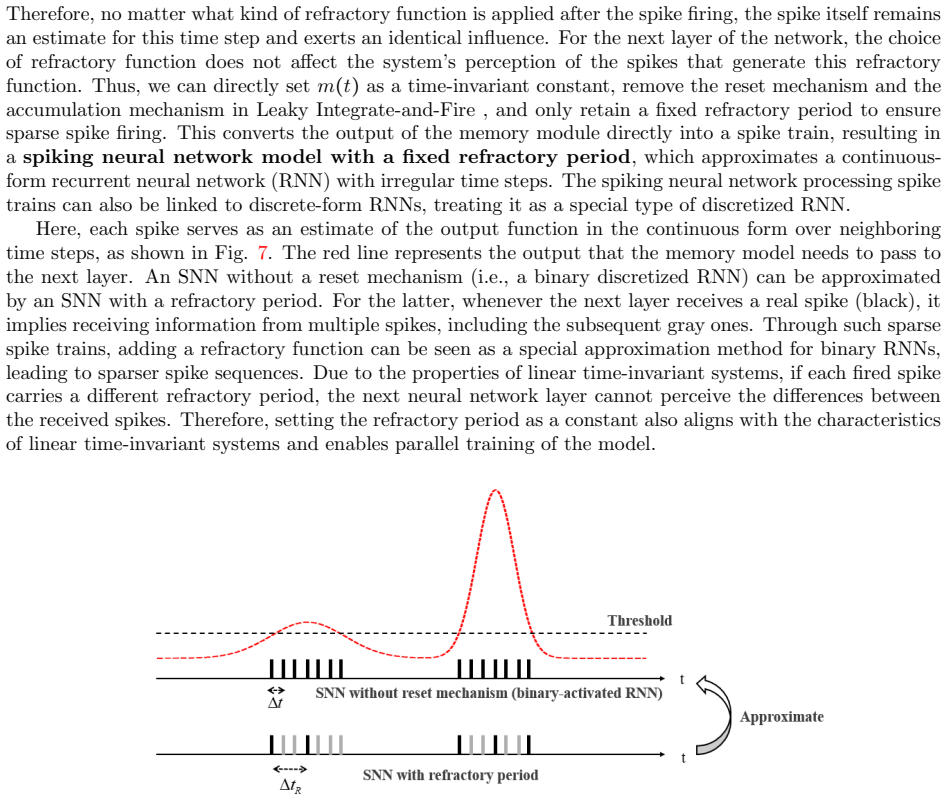
"This theorem universally describes the spike encoding scheme for all spiking neural networks with reset mechanisms and refractory periods, where different m(t) values correspond to different reset and refractory configurations. ... Thus, we can directly set m(t) as a time-invariant constant, remove the reset mechanism and the accumulation mechanism in Leaky Integrate-and-Fire , and only retain a fixed refractory period to ensure sparse spike firing."
Eq. (17) is not derived from the LIF dynamics in Eq. (5); it defines S[f(t)] as a spike only when f(t) crosses theta and the previous m(t) values were below theta. That condition is precisely a refractory/blanking mechanism, and setting m(t) constant is the fixed refractory period later implemented in Eqs. (22)-(27). The paper's own hard-reset LIF in Eq. (5) can fire on consecutive timesteps under constant suprathreshold input (e.g., Vreset=0, input=2, theta=1 gives U=2 at both t and t+1), so the claimed universality is an assumption about what spiking is, not a consequence of the LIF equations.
-
renaming known result
[Section 4.2, final summary paragraph (Fig. 8 discussion)]
"The sequence mapping of spiking neural networks can essentially be viewed as updating real-time memory for sequences and emitting spikes at irregular discrete time steps, approximating the output distribution of traditional continuous-form RNNs in the form of sampled points. The use of reset mechanisms and refractory periods constitutes this special discretization approach, distinguishing it from traditional RNNs with regular discrete time steps."
The paper's Section 1 already frames the project by saying: 'We interpret these mechanisms as performing additional sparse sampling on discrete sampling points to achieve sparsity. This perspective leads to our fixed-refractory-period SNN model.' The Section 4.2 summary restates that same interpretive framing as a conclusion: SNNs are 'irregularly discretized' RNNs and reset/refractory are 'this special discretization approach.' Because the conclusion is identical to the initial framing, it does not provide independent support for the fixed-refractory architecture; the new terminology ('special discretization,' 'sampling points') does the explanatory work by renaming the known phenomenon of irregular spike emission.
full rationale
The principal circularity is in the theoretical derivation. Theorem 4.1 is introduced as a universal description of reset/refractory SNNs, but Eq. (17) is a definition of a threshold-and-blank encoder, and the fixed-refractory spiking module in Eqs. (18)-(27) is built to match that definition. The paper's claim that reset and refractory mechanisms are 'a specialized form of discretization' and that a fixed refractory period suffices is therefore substantially an unpacking of its initial interpretive framework rather than a result derived from the LIF dynamics in Eq. (5). The experimental comparisons on Sequential CIFAR-10 are real, and the paper honestly states that the model is simple and not state-of-the-art, so the empirical section is not fabricated; however, the experiments do not independently test the decoupling claim, since the architecture was designed from that claim. The self-citation to the author's prior work [49] in the appendix is not load-bearing for the central argument. Overall, one central definitional step plus a renaming-as-explanation yields partial circularity, score 6.
Assumptions & free parameters
free parameters (3)
- spiking threshold theta =
0.5 (spikingFRssm), 0 (spikingPssm)
- refractory period length r =
5 (also tested 3)
- surrogate gradient constants =
h=0.15, l=gamma=0.5, sigma=l, sigma'=6l
assumptions (3)
- domain assumption The entire input sequence can be treated as a distribution, and spikes as discrete sampling points of that distribution.
- domain assumption The next layer cannot perceive differences between spikes produced under different refractory functions, because each spike produces the same post-synaptic potential.
- domain assumption When resets are disregarded, an SNN is a linear dynamical system whose memory is equivalent to an SSM.
Cite this review
Pith. "Pith review of Revisiting Reset Mechanisms in Spiking Neural Networks for Sequential Modeling: Specialized Discretization for Binary Activated RNN." pith.science (2026). https://pith.science/paper/VMKJK62O
@misc{pith2026250417751,
  author       = {Pith},
  title        = {Pith review of: Revisiting Reset Mechanisms in Spiking Neural Networks for Sequential Modeling: Specialized Discretization for Binary Activated RNN},
  year         = {2026},
  howpublished = {\url{https://pith.science/paper/VMKJK62O}},
  note         = {Machine review of arXiv:2504.17751}
}
read the original abstract
In the field of image recognition, spiking neural networks (SNNs) have achieved performance comparable to conventional artificial neural networks (ANNs). In such applications, SNNs essentially function as traditional neural networks with quantized activation values. This article focuses on an another alternative perspective,viewing SNNs as binary-activated recurrent neural networks (RNNs) for sequential modeling tasks. From this viewpoint, current SNN architectures face several fundamental challenges in sequence modeling: (1) Traditional models lack effective memory mechanisms for long-range sequence modeling; (2) The biological-inspired components in SNNs (such as reset mechanisms and refractory period applications) remain theoretically under-explored for sequence tasks; (3) The RNN-like computational paradigm in SNNs prevents parallel training across different timesteps. To address these challenges, this study conducts a systematic analysis of the fundamental mechanisms underlying reset operations and refractory periods in binary-activated RNN-based SNN sequence models. We re-examine whether such biological mechanisms are strictly necessary for generating sparse spiking patterns, provide new theoretical explanations and insights, and ultimately propose the fixed-refractory-period SNN architecture for sequence modeling.
Figures


Figures from the paper (11 more)




Reference graph
Works this paper leans on
-
[1]
Spatio-temporal backpropagation for training high-performance spiking neural networks
Yujie Wu, Lei Deng, Guoqi Li, Jun Zhu, and Luping Shi. Spatio-temporal backpropagation for training high-performance spiking neural networks. Frontiers in neuroscience, 12:331, 2018
2018
-
[2]
Man Yao, Jiakui Hu, Zhaokun Zhou, Li Yuan, Yonghong Tian, Bo Xu, and Guoqi Li. Spike-driven transformer. Advances in neural information processing systems , 36:64043–64058, 2023
work page 2023
-
[3]
Ternary spike-based neuromorphic signal processing system
Shuai Wang, Dehao Zhang, Ammar Belatreche, Yichen Xiao, Hongyu Qing, Wenjie Wei, Malu Zhang, and Yang Yang. Ternary spike-based neuromorphic signal processing system. Neural Networks , 187:107333, 2025
work page 2025
-
[4]
Spike-based neuromorphic model for sound source localization
Dehao Zhang, Shuai Wang, Ammar Belatreche, Wenjie Wei, Yichen Xiao, Haorui Zheng, Zijian Zhou, Malu Zhang, and Yang Yang. Spike-based neuromorphic model for sound source localization. In The Thirty-eighth Annual Conference on Neural Information Processing Systems , 2024
work page 2024
-
[5]
Hippo: Recurrent memory with optimal polynomial projections
Albert Gu, Tri Dao, Stefano Ermon, Atri Rudra, and Christopher R´ e. Hippo: Recurrent memory with optimal polynomial projections. Advances in neural information processing systems, 33:1474–1487, 2020
2020
-
[6]
Efficiently modeling long sequences with structured state spaces
Albert Gu, Karan Goel, and Christopher R´ e. Efficiently modeling long sequences with structured state spaces. arXiv preprint arXiv:2111.00396 , 2021
arXiv 2021
-
[7]
Resurrecting recurrent neural networks for long sequences
Antonio Orvieto, Samuel L Smith, Albert Gu, Anushan Fernando, Caglar Gulcehre, Razvan Pascanu, and Soham De. Resurrecting recurrent neural networks for long sequences. In International Conference on Machine Learning, pages 26670–26698. PMLR, 2023
2023
-
[8]
P-spikessm: Harnessing probabilistic spiking state space models for long-range dependency tasks
Malyaban Bal and Abhronil Sengupta. P-spikessm: Harnessing probabilistic spiking state space models for long-range dependency tasks. arXiv preprint arXiv:2406.02923 , 2024
arXiv 2024
Show all 51 references
-
[9]
Parallel spiking neurons with high efficiency and ability to learn long-term dependencies
Wei Fang, Zhaofei Yu, Zhaokun Zhou, Ding Chen, Yanqi Chen, Zhengyu Ma, Timoth´ ee Masquelier, and Yonghong Tian. Parallel spiking neurons with high efficiency and ability to learn long-term dependencies. Advances in Neural Information Processing Systems , 36:53674–53687, 2023. 23
2023
-
[10]
Attention is all you need
Ashish Vaswani, Noam Shazeer, Niki Parmar, Jakob Uszkoreit, Llion Jones, Aidan N Gomez, Lukasz Kaiser, and Illia Polosukhin. Attention is all you need. Advances in neural information processing systems, 30, 2017
2017
-
[11]
Attention-based deep spiking neural networks for temporal credit assignment problems
Lang Qin, Ziming Wang, Rui Yan, and Huajin Tang. Attention-based deep spiking neural networks for temporal credit assignment problems. IEEE Transactions on Neural Networks and Learning Systems , 2023
2023
-
[12]
Accurate and efficient time-domain classification with adaptive spiking recurrent neural networks
Bojian Yin, Federico Corradi, and Sander M Boht´ e. Accurate and efficient time-domain classification with adaptive spiking recurrent neural networks. Nature Machine Intelligence , 3(10):905–913, 2021
2021
-
[13]
Long short-term memory and learning-to-learn in networks of spiking neurons.Advances in neural information processing systems, 31, 2018
Guillaume Bellec, Darjan Salaj, Anand Subramoney, Robert Legenstein, and Wolfgang Maass. Long short-term memory and learning-to-learn in networks of spiking neurons.Advances in neural information processing systems, 31, 2018
2018
-
[14]
An adaptive threshold neuron for recur- rent spiking neural networks with nanodevice hardware implementation
Ahmed Shaban, Sai Sukruth Bezugam, and Manan Suri. An adaptive threshold neuron for recur- rent spiking neural networks with nanodevice hardware implementation. Nature Communications , 12(1):4234, 2021
2021
-
[15]
Spik- ing neural networks with adaptive membrane time constant for event-based tracking.IEEE Transactions on Image Processing, 2025
Jiqing Zhang, Malu Zhang, Yuanchen Wang, Qianhui Liu, Baocai Yin, Haizhou Li, and Xin Yang. Spik- ing neural networks with adaptive membrane time constant for event-based tracking.IEEE Transactions on Image Processing, 2025
2025
-
[16]
Mamba: Linear-time sequence modeling with selective state spaces
Albert Gu and Tri Dao. Mamba: Linear-time sequence modeling with selective state spaces. arXiv preprint arXiv:2312.00752, 2023
2023 arXiv
-
[17]
Com- bining recurrent, convolutional, and continuous-time models with linear state space layers
Albert Gu, Isys Johnson, Karan Goel, Khaled Saab, Tri Dao, Atri Rudra, and Christopher R´ e. Com- bining recurrent, convolutional, and continuous-time models with linear state space layers. Advances in neural information processing systems, 34:572–585, 2021
2021
-
[18]
Simplified state space layers for sequence modeling
Jimmy TH Smith, Andrew Warrington, and Scott W Linderman. Simplified state space layers for sequence modeling. arXiv preprint arXiv:2208.04933 , 2022
2022 arXiv
-
[19]
Hierarchically gated recurrent neural network for sequence modeling
Zhen Qin, Songlin Yang, and Yiran Zhong. Hierarchically gated recurrent neural network for sequence modeling. Advances in Neural Information Processing Systems , 36:33202–33221, 2023
2023
-
[20]
Transformers are rnns: Fast autoregressive transformers with linear attention
Angelos Katharopoulos, Apoorv Vyas, Nikolaos Pappas, and Fran¸ cois Fleuret. Transformers are rnns: Fast autoregressive transformers with linear attention. In International conference on machine learning, pages 5156–5165. PMLR, 2020
2020
-
[21]
Efficient attention: At- tention with linear complexities
Zhuoran Shen, Mingyuan Zhang, Haiyu Zhao, Shuai Yi, and Hongsheng Li. Efficient attention: At- tention with linear complexities. In Proceedings of the IEEE/CVF winter conference on applications of computer vision, pages 3531–3539, 2021
2021
-
[22]
Mega: Moving average equipped gated attention
Xuezhe Ma, Chunting Zhou, Xiang Kong, Junxian He, Liangke Gui, Graham Neubig, Jonathan May, and Luke Zettlemoyer. Mega: Moving average equipped gated attention. arXiv preprint arXiv:2209.10655 , 2022
2022 arXiv
-
[23]
Parallelizing linear transformers with the delta rule over sequence length
Songlin Yang, Bailin Wang, Yu Zhang, Yikang Shen, and Yoon Kim. Parallelizing linear transformers with the delta rule over sequence length. arXiv preprint arXiv:2406.06484 , 2024. 24
2024 arXiv
-
[24]
Tc-lif: A two- compartment spiking neuron model for long-term sequential modelling
Shimin Zhang, Qu Yang, Chenxiang Ma, Jibin Wu, Haizhou Li, and Kay Chen Tan. Tc-lif: A two- compartment spiking neuron model for long-term sequential modelling. In Proceedings of the AAAI conference on artificial intelligence , volume 38, pages 16838–16847, 2024
2024
-
[25]
Pmsn: A parallel multi-compartment spiking neuron for multi-scale temporal processing
Xinyi Chen, Jibin Wu, Chenxiang Ma, Yinsong Yan, Yujie Wu, and Kay Chen Tan. Pmsn: A parallel multi-compartment spiking neuron for multi-scale temporal processing. arXiv preprint arXiv:2408.14917, 2024
2024 arXiv
-
[26]
Temporal dendritic heterogeneity incorporated with spiking neural networks for learning multi-timescale dynamics
Hanle Zheng, Zhong Zheng, Rui Hu, Bo Xiao, Yujie Wu, Fangwen Yu, Xue Liu, Guoqi Li, and Lei Deng. Temporal dendritic heterogeneity incorporated with spiking neural networks for learning multi-timescale dynamics. Nature Communications, 15(1):277, 2024
2024
-
[27]
Learning long sequences in spiking neural networks
Matei-Ioan Stan and Oliver Rhodes. Learning long sequences in spiking neural networks. Scientific Reports, 14(1):21957, 2024
2024
-
[28]
Spike-ssm: A sparse, precise, and efficient spiking state space model for long sequences learning
Yan Zhong, Ruoyu Zhao, Chao Wang, Qinghai Guo, Jianguo Zhang, Zhichao Lu, and Luziwei Leng. Spike-ssm: A sparse, precise, and efficient spiking state space model for long sequences learning. arXiv preprint arXiv:2410.17268, 2024
-
[29]
Spikingssms: Learning long sequences with sparse and parallel spiking state space models
Shuaijie Shen, Chao Wang, Renzhuo Huang, Yan Zhong, Qinghai Guo, Zhichao Lu, Jianguo Zhang, and Luziwei Leng. Spikingssms: Learning long sequences with sparse and parallel spiking state space models. arXiv preprint arXiv:2408.14909 , 2024
2024 arXiv
-
[30]
Incorpo- rating learnable membrane time constant to enhance learning of spiking neural networks
Wei Fang, Zhaofei Yu, Yanqi Chen, Timoth´ ee Masquelier, Tiejun Huang, and Yonghong Tian. Incorpo- rating learnable membrane time constant to enhance learning of spiking neural networks. In Proceedings of the IEEE/CVF international conference on computer vision , pages 2661–2671, 2021
2021
-
[31]
Training high-performance low-latency spiking neural networks by differentiation on spike representation
Qingyan Meng, Mingqing Xiao, Shen Yan, Yisen Wang, Zhouchen Lin, and Zhi-Quan Luo. Training high-performance low-latency spiking neural networks by differentiation on spike representation. In Proceedings of the IEEE/CVF conference on computer vision and pattern recognition , p...
2022
-
[32]
A tandem learning rule for effective training and rapid inference of deep spiking neural networks
Jibin Wu, Yansong Chua, Malu Zhang, Guoqi Li, Haizhou Li, and Kay Chen Tan. A tandem learning rule for effective training and rapid inference of deep spiking neural networks. IEEE Transactions on Neural Networks and Learning Systems , 34(1):446–460, 2021
2021
-
[33]
High-performance deep spiking neural networks with 0.3 spikes per neuron
Ana Stanojevic, Stanis law Wo´ zniak, Guillaume Bellec, Giovanni Cherubini, Angeliki Pantazi, and Wul- fram Gerstner. High-performance deep spiking neural networks with 0.3 spikes per neuron. Nature Communications, 15(1):6793, 2024
2024
-
[34]
Temporal-coded spiking neural networks with dynamic firing threshold: Learning with event-driven backpropagation
Wenjie Wei, Malu Zhang, Hong Qu, Ammar Belatreche, Jian Zhang, and Hong Chen. Temporal-coded spiking neural networks with dynamic firing threshold: Learning with event-driven backpropagation. In Proceedings of the IEEE/CVF international conference on computer vision , pages 10...
2023
-
[35]
Lc-ttfs: Toward lossless network con- version for spiking neural networks with ttfs coding.IEEE Transactions on Cognitive and Developmental Systems, 16(5):1626–1639, 2023
Qu Yang, Malu Zhang, Jibin Wu, Kay Chen Tan, and Haizhou Li. Lc-ttfs: Toward lossless network con- version for spiking neural networks with ttfs coding.IEEE Transactions on Cognitive and Developmental Systems, 16(5):1626–1639, 2023. 25
2023
-
[36]
Rectified linear postsynaptic potential function for backpropagation in deep spiking neural networks
Malu Zhang, Jiadong Wang, Jibin Wu, Ammar Belatreche, Burin Amornpaisannon, Zhixuan Zhang, Venkata Pavan Kumar Miriyala, Hong Qu, Yansong Chua, Trevor E Carlson, et al. Rectified linear postsynaptic potential function for backpropagation in deep spiking neural networks. IEEE t...
1947
-
[37]
Deep declarative networks
Stephen Gould, Richard Hartley, and Dylan Campbell. Deep declarative networks. IEEE Transactions on Pattern Analysis and Machine Intelligence , 44(8):3988–4004, 2021
2021
-
[38]
Neural ordinary differ- ential equations
Ricky TQ Chen, Yulia Rubanova, Jesse Bettencourt, and David K Duvenaud. Neural ordinary differ- ential equations. Advances in neural information processing systems , 31, 2018
2018
-
[39]
Augmented neural odes
Emilien Dupont, Arnaud Doucet, and Yee Whye Teh. Augmented neural odes. Advances in neural information processing systems, 32, 2019
2019
-
[40]
Deep residual learning for image recognition
Kaiming He, Xiangyu Zhang, Shaoqing Ren, and Jian Sun. Deep residual learning for image recognition. In Proceedings of the IEEE conference on computer vision and pattern recognition, pages 770–778, 2016
2016
-
[41]
nmode: neural memory ordinary differential equation
Zhang Yi. nmode: neural memory ordinary differential equation. Artificial Intelligence Review , 56(12):14403–14438, 2023
2023
-
[42]
Momentum residual neural networks
Michael E Sander, Pierre Ablin, Mathieu Blondel, and Gabriel Peyr´ e. Momentum residual neural networks. In International Conference on Machine Learning , pages 9276–9287. PMLR, 2021
2021
-
[43]
Training feedback spiking neural networks by implicit differentiation on the equilibrium state
Mingqing Xiao, Qingyan Meng, Zongpeng Zhang, Yisen Wang, and Zhouchen Lin. Training feedback spiking neural networks by implicit differentiation on the equilibrium state. Advances in neural infor- mation processing systems, 34:14516–14528, 2021
2021
-
[44]
Diagonal state spaces are as effective as structured state spaces
Ankit Gupta, Albert Gu, and Jonathan Berant. Diagonal state spaces are as effective as structured state spaces. Advances in Neural Information Processing Systems , 35:22982–22994, 2022
2022
-
[45]
Universality of linear recurrences followed by non-linear projections: finite-width guarantees and benefits of complex eigenvalues
Antonio Orvieto, Soham De, Caglar Gulcehre, Razvan Pascanu, and Samuel L Smith. Universality of linear recurrences followed by non-linear projections: finite-width guarantees and benefits of complex eigenvalues. arXiv preprint arXiv:2307.11888 , 2023
2023 arXiv
-
[46]
Language modeling with gated convolutional networks
Yann N Dauphin, Angela Fan, Michael Auli, and David Grangier. Language modeling with gated convolutional networks. In International conference on machine learning , pages 933–941. PMLR, 2017
2017
-
[47]
State-space models with layer-wise nonlinearity are universal approxima- tors with exponential decaying memory
Shida Wang and Beichen Xue. State-space models with layer-wise nonlinearity are universal approxima- tors with exponential decaying memory. Advances in Neural Information Processing Systems, 36:74021– 74038, 2023
2023
-
[48]
On the parameterization and initialization of diagonal state space models
Albert Gu, Karan Goel, Ankit Gupta, and Christopher R´ e. On the parameterization and initialization of diagonal state space models. Advances in Neural Information Processing Systems , 35:35971–35983, 2022
2022
-
[49]
Research on spiking neural network with additional time dimension for sequential modeling
Enqi Zhang. Research on spiking neural network with additional time dimension for sequential modeling. In 2024 21st International Computer Conference on Wavelet Active Media Technology and Information Processing (ICCWAMTIP), pages 01–05. IEEE, 2024. 26
2024
-
[50]
Deep equilibrium models
Shaojie Bai, J Zico Kolter, and Vladlen Koltun. Deep equilibrium models. Advances in neural infor- mation processing systems, 32, 2019
2019
-
[51]
Integration of neuromorphic ai in event-driven distributed digitized systems: Concepts and research directions
Mattias Nilsson, Olov Schel´ en, Anders Lindgren, Ulf Bodin, Cristina Paniagua, Jerker Delsing, and Fredrik Sandin. Integration of neuromorphic ai in event-driven distributed digitized systems: Concepts and research directions. Frontiers in Neuroscience, 17:1074439, 2023. 27 A...
2023
Reviewed August 16, 2026 · model on record in the stance chip above.
Discussion (0). Continue with ORCID to comment.