Tomographic Alcock-Paczynski Test with Marked Correlation Functions
Pith reviewed 2026-05-22 18:53 UTC · model grok-4.3
The pith
Marked correlation functions with multiple density weights improve tomographic Alcock-Paczynski constraints on matter density and dark energy equation of state by 48 and 45 percent.
A machine-rendered reading of the paper's core claim, the machinery that carries it, and where it could break.
Core claim
Integrating marked correlation functions into the tomographic Alcock-Paczynski test shows that multiple density weights outperform the traditional two-point correlation function, cutting uncertainties on Omega_m by 48 percent and on w by 45 percent. The introduced PCA compression scheme projects high-dimensional statistical measurements into compact eigenmodes while preserving most cosmological information, delivering an additional roughly 40 percent reduction in error margins compared with lossy coarse binning. The combined approach remains robust when realistic redshift errors from future surveys are included and continues to produce tight constraints.
What carries the argument
Marked correlation functions using multiple density weights together with principal component analysis compression inside tomographic Alcock-Paczynski tests.
If this is right
- Tighter bounds on Omega_m and w become available from the same survey volume when density-weighted statistics replace standard correlations.
- Nonlinear scales contribute usable information while redshift-distortion contamination is still controlled through tomography.
- High-dimensional data vectors can be compressed efficiently without the information loss that occurs when adjacent bins are simply averaged.
- Redshift errors typical of slitless spectroscopy produce only modest degradation in the final constraints.
Where Pith is reading between the lines
- Density-weighting methods of this type could be tested on other large-scale structure statistics such as the bispectrum or void statistics.
- Application to existing or upcoming datasets from wide-field spectroscopic surveys would produce updated parameter limits that can be compared directly with the mock-based forecasts.
- The PCA compression technique may generalize to joint analyses that combine the AP test with other probes like weak lensing or baryon acoustic oscillations.
- Because the method is less sensitive to redshift errors, it could be adapted for photometric or low-resolution spectroscopic samples where precise redshifts are unavailable.
Load-bearing premise
The selected density weights and PCA eigenmodes add cosmological information without introducing unmodeled systematics or correlations that the tomographic test cannot separate from redshift-space distortions.
What would settle it
Running the tomographic AP analysis on the same mock catalogs once with the standard two-point correlation function and once with MCFs plus PCA, then comparing the resulting error bars on Omega_m and w, would test whether the reported reductions in uncertainty are recovered.
Figures


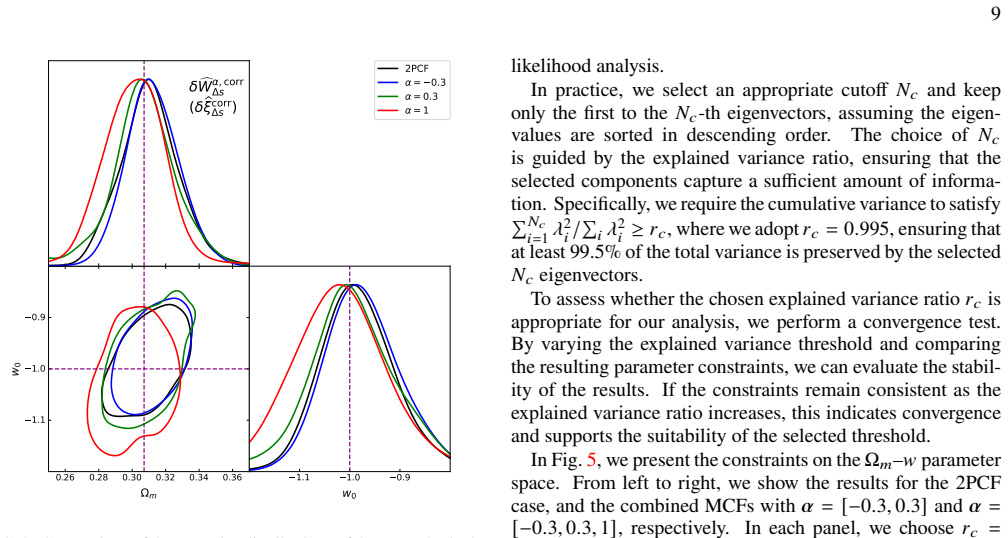
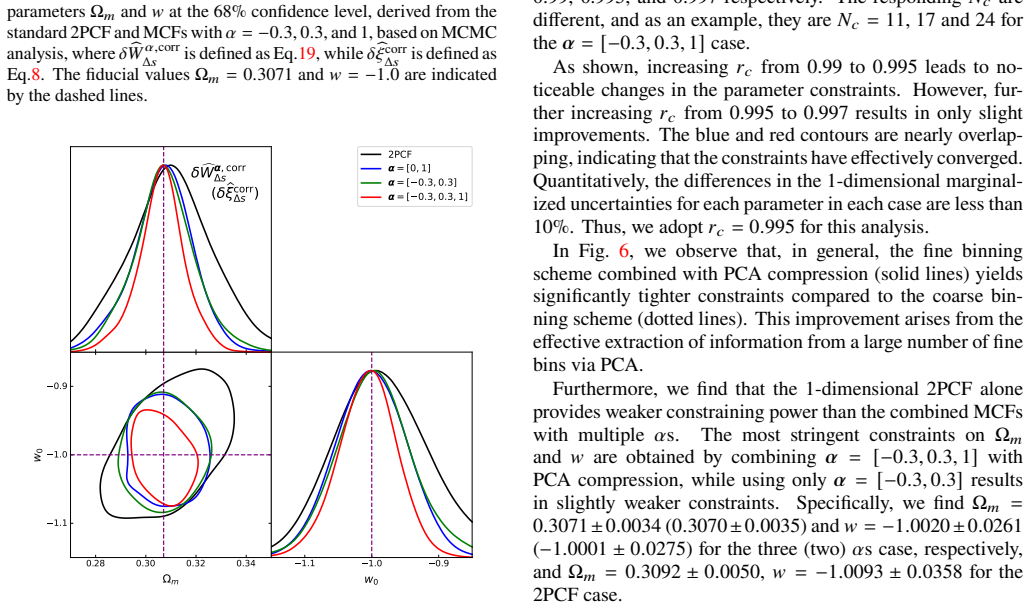


read the original abstract
The tomographic Alcock-Paczynski(AP) method, developed over the past decade, exploits redshift evolution for cosmological determination, aiming to mitigate contamination from redshift distortions and capture nonlinear scale information. Marked Correlation Functions (MCFs) extend information beyond the two-point correlation. For the first time, this study integrated the tomographic AP test with MCFs to constrain the flat $w$CDM cosmology model. Our findings show that multiple density weights in MCFs outperform the traditional two-point correlation function, reducing the uncertainties of the matter density parameter $\Omega_m$ and dark energy equation of state $w$ by 48\% and 45\%, respectively. Furthermore, we introduce a novel principal component analysis (PCA) compression scheme that efficiently projects high-dimensional statistical measurements into a compact set of eigenmodes while preserving most of the cosmological information. This approach retains significantly more information than traditional coarse binning methods, which simply average adjacent bins in a lossy manner, yielding an additional $\sim 40\%$ reduction in error margins. To assess robustness, we incorporate realistic redshift errors expected in future spectroscopic surveys. While these errors modestly degrade cosmological constraints, our combined framework, which utilizes MCFs and PCA compression within tomographic AP tests, is less affected and always yields tight cosmological constraints. This scheme remains highly promising for upcoming slitless spectroscopic surveys, such as the Chinese Space Station Telescope (CSST).
Editorial analysis
A structured set of objections, weighed in public.
Referee Report
Summary. The manuscript integrates the tomographic Alcock-Paczynski (AP) test with Marked Correlation Functions (MCFs) employing multiple density weights, together with a novel PCA-based compression of the high-dimensional measurements, to constrain the flat wCDM model. It reports that the MCF approach reduces the uncertainties on Ω_m and w by 48% and 45% relative to the standard two-point correlation function, that the PCA scheme yields an additional ~40% improvement over simple bin averaging, and that the combined framework remains robust when realistic redshift errors are included.
Significance. If the claimed information gains prove robust, the work would provide a practical route to extract additional AP-sensitive information from future slitless spectroscopic surveys such as CSST while mitigating redshift-space distortion contamination. The explicit treatment of redshift errors and the comparison against traditional binning are positive features that could make the method useful for upcoming data sets.
major comments (2)
- [Abstract / Results section] The headline 48% and 45% reductions in Ω_m and w uncertainties (abstract) are presented without any description of the mock catalog specifications, the number of realizations used for covariance estimation, or the precise scale and redshift cuts applied to the MCF measurements. These details are load-bearing for the central claim that multiple density weights extract cleanly separable cosmological information beyond the 2PCF.
- [Methodology / Robustness tests] The statement that the MCF+PCA framework “is less affected and always yields tight cosmological constraints” even after adding realistic redshift errors (abstract) rests on the untested assumption that the chosen density weights and fixed PCA eigenmodes introduce no parameter-dependent systematics or covariance mis-estimation that the tomographic AP test cannot marginalize. Explicit validation against AP-signal leakage or RSD correlations is required.
minor comments (2)
- [Section 2] Notation for the density weights and the precise definition of the marked correlation function should be introduced earlier and used consistently throughout.
- [Section 3.2] The PCA compression is described as retaining “most of the cosmological information”; a quantitative comparison (e.g., Fisher information or posterior volume) between the full data vector and the retained eigenmodes would strengthen the claim.
Simulated Author's Rebuttal
We thank the referee for their careful reading and constructive comments on our manuscript. We have addressed each major point below and will incorporate revisions to improve clarity and robustness.
read point-by-point responses
-
Referee: [Abstract / Results section] The headline 48% and 45% reductions in Ω_m and w uncertainties (abstract) are presented without any description of the mock catalog specifications, the number of realizations used for covariance estimation, or the precise scale and redshift cuts applied to the MCF measurements. These details are load-bearing for the central claim that multiple density weights extract cleanly separable cosmological information beyond the 2PCF.
Authors: We agree that the abstract would benefit from these details to allow readers to better assess the headline claims. The mock catalog specifications, number of realizations (1000), covariance estimation procedure, and the precise scale (10-150 Mpc/h) and redshift (z = 0.5-1.5) cuts are fully described in Sections 3 and 4 of the manuscript. In the revised version we will add a concise clause to the abstract summarizing the mock setup and analysis cuts while referring readers to the main text for complete information. revision: yes
-
Referee: [Methodology / Robustness tests] The statement that the MCF+PCA framework “is less affected and always yields tight cosmological constraints” even after adding realistic redshift errors (abstract) rests on the untested assumption that the chosen density weights and fixed PCA eigenmodes introduce no parameter-dependent systematics or covariance mis-estimation that the tomographic AP test cannot marginalize. Explicit validation against AP-signal leakage or RSD correlations is required.
Authors: We thank the referee for this important observation. Our existing tests show only modest degradation under realistic redshift errors and that the MCF+PCA combination remains tighter than the 2PCF. However, we have not yet performed explicit checks for cosmology-dependent shifts in the PCA eigenmodes or for residual AP-signal leakage into RSD modes after redshift-error convolution. In the revision we will add these validation tests: (i) recomputing PCA modes on mocks spanning a range of Ω_m and w, (ii) quantifying any AP-RSD cross-talk in the compressed data vector, and (iii) verifying that the tomographic AP marginalization remains unbiased. Results will be reported in a new subsection; if any systematics are found we will discuss their impact. revision: yes
Circularity Check
No significant circularity; constraints derived from mocks without self-referential reduction
full rationale
The paper applies the tomographic AP test to marked correlation functions with multiple density weights and introduces a PCA compression on high-dimensional measurements. Reported improvements (48%/45% error reduction, plus ~40% from PCA) are presented as numerical outcomes from analysis on simulated catalogs, with robustness checks against redshift errors. No equations or steps in the abstract reduce a claimed prediction or result to a fitted parameter or self-citation by construction; the derivation remains self-contained against external mock benchmarks rather than tautological.
Axiom & Free-Parameter Ledger
free parameters (1)
- density weights
axioms (1)
- domain assumption Standard flat wCDM background cosmology and linear bias model for galaxy clustering
Lean theorems connected to this paper
-
IndisputableMonolith/Cost/FunctionalEquation.leanwashburn_uniqueness_aczel unclear?
unclearRelation between the paper passage and the cited Recognition theorem.
MCFs extend the standard 2PCF... w(x)=ρ_nNB^α ... combined MCFs with different α ... PCA compression scheme that efficiently projects high-dimensional statistical measurements into a compact set of eigenmodes
-
IndisputableMonolith/Foundation/DimensionForcing.leanalexander_duality_circle_linking unclear?
unclearRelation between the paper passage and the cited Recognition theorem.
tomographic AP test... δbξ^Δs(μ) = bξ^Δs(z1,μ) − bξ^Δs(z2,μ) ... redshift evolution of LSS anisotropy
What do these tags mean?
- matches
- The paper's claim is directly supported by a theorem in the formal canon.
- supports
- The theorem supports part of the paper's argument, but the paper may add assumptions or extra steps.
- extends
- The paper goes beyond the formal theorem; the theorem is a base layer rather than the whole result.
- uses
- The paper appears to rely on the theorem as machinery.
- contradicts
- The paper's claim conflicts with a theorem or certificate in the canon.
- unclear
- Pith found a possible connection, but the passage is too broad, indirect, or ambiguous to say the theorem truly supports the claim.
Reference graph
Works this paper leans on
-
[1]
Constraints from 1D angular 2PCF and MCFs Due to the limited number of mock realizations, the co- variance matrices cannot be accurately estimated, particularly for eigenvectors associated with small or near-zero eigenval- ues. This leads to numerical instability when inverting the covariance matrix during likelihood evaluations. The coarse binning method...
-
[2]
Constraints from 2-dimensional 2PCF and MCFs using PCA For the full 2-dimensional 2PCF and MCFs, there are34× 116=3944bins (34 bins in𝑠and 116 bins in𝜇) for each of them. Duetothehighdimensionalityofthesefinebinsandthe limitednumberofmockrealizations,itbecomeschallengingto accuratelyestimatethecovariancematrix. Therefore,weapply PCA to compress the data a...
-
[3]
found that the change in the cosmological constraints is not significant(≲0.2𝜎for a SDSS-like survey) even ignoring the systematic effect and do not correct it in the joint-analysis with 2PCF. In any case, since we adopt a new methodology based on MCFs and PCA, it is necessary to conduct a preliminary as- sessmentofsystematicuncertainties,togainatleastaqu...
-
[4]
The effect of tracer bias To investigate the effect of tracer bias on the systematic estimation, wechangethehalosandsubhalosmassthresholds to: 𝑚𝐻 ∈ ( [3.0×10 12,2.6×10 13]𝑀 ⊙/ℎ, 𝑧=1.0 [3.9×10 12,2.2×10 13]𝑀 ⊙/ℎ, 𝑧=0.6069 (31) 12 0.29 0.30 0.31 0.32 0.33 m 2PCF=[ 0.3,0.3] =[ 0.3,0.3,1] 2PCF + PCA=[ 0.3,0.3]+PCA =[ 0.3,0.3,1]+PCA 2PCF + 2D + PCA =[ 0.3,0.3]...
-
[5]
Mis-specified redshift errors In this section, we examine the effect on constraints of mis- specifiedredshifterrors,withtheformof𝜎 𝑧 =0.002(1+𝑧) 1.01 while the fiducial redshift errors are𝜎𝑧 =0.002(1+𝑧). The effect on cosmological constraints is shown in Fig.11. Still, except the case of 2-dimensional combined MCFs with PCA compression, the impact is limi...
work page 2021
-
[6]
M. Colless, B. A. Peterson, C. Jackson, J. A. Peacock, S. Cole, P. Norberg, I. K. Baldry, C. M. Baugh, J. Bland-Hawthorn, T.Bridges,R.Cannon,C.Collins,W.Couch,N.Cross,G.Dal- ton, and others, arXiv Astrophysics e-prints (2003), astro- ph/0306581
-
[7]
The 6dF Galaxy Survey: z \approx 0 measurement of the growth rate and sigma_8
F. Beutler, C. Blake, M. Colless, D. H. Jones, L. Staveley- Smith, G. B. Poole, L. Campbell, Q. Parker, W. Saunders, and F. Watson, Monthly Notices of the Royal Astronomical Society 423, 3430 (2012), arXiv:1204.4725
work page internal anchor Pith review Pith/arXiv arXiv 2012
-
[8]
The WiggleZ Dark Energy Survey: the growth rate of cosmic structure since redshift z=0.9
C. Blake, S. Brough, M. Colless, C. Contreras, W. Couch, S. Croom, T. Davis, M. J. Drinkwater, K. Forster, D. Gilbank, M. Gladders, K. Glazebrook, B. Jelliffe, R. J. Jurek, I.-H. Li, andothers,MonthlyNoticesoftheRoyalAstronomicalSociety 415, 2876 (2011), arXiv:1104.2948
work page internal anchor Pith review Pith/arXiv arXiv 2011
-
[9]
C. Blake, K. Glazebrook, T. M. Davis, S. Brough, M. Col- less, C. Contreras, W. Couch, S. Croom, M. J. Drinkwater, K. Forster, D. Gilbank, M. Gladders, B. Jelliffe, R. J. Jurek, I.-H.Li,andothers,MonthlyNoticesoftheRoyalAstronomical Society418, 1725 (2011), arXiv:1108.2637
work page internal anchor Pith review Pith/arXiv arXiv 2011
-
[10]
D. G. York, J. Adelman, J. E. Anderson, Jr., S. F. Anderson, J.Annis,N.A.Bahcall,J.A.Bakken,R.Barkhouser,S.Bastian, E.Berman,W.N.Boroski,S.Bracker,C.Briegel,J.W.Briggs, J. Brinkmann, and others, The Astronomical Journal120, 1579 (2000), astro-ph/0006396
work page internal anchor Pith review Pith/arXiv arXiv 2000
- [11]
-
[12]
W.J.Percival,S.Cole,D.J.Eisenstein,R.C.Nichol,J.A.Pea- cock,A.C.Pope,andA.S.Szalay,MonthlyNoticesoftheRoyal Astronomical Society381, 1053 (2007), arXiv:0705.3323
work page internal anchor Pith review Pith/arXiv arXiv 2007
-
[13]
L. Anderson, E. Aubourg, S. Bailey, D. Bizyaev, M. Blanton, A. S. Bolton, J. Brinkmann, J. R. Brownstein, A. Burden, A. J. Cuesta, L. A. N. da Costa, K. S. Dawson, R. de Putter, D. J. Eisenstein,J.E.Gunn,andothers,MonthlyNoticesoftheRoyal Astronomical Society427, 3435 (2012), arXiv:1203.6594
work page internal anchor Pith review Pith/arXiv arXiv 2012
-
[14]
S.Alam,M.Ata,S.Bailey,F.Beutler,D.Bizyaev,J.A.Blazek, A. S. Bolton, J. R. Brownstein, A. Burden, C.-H. Chuang, J.Comparat,A.J.Cuesta,K.S.Dawson,D.J.Eisenstein,S.Es- coffier, and others, Monthly Notices of the Royal Astronomical Society470, 2617 (2017), arXiv:1607.03155. 16
work page internal anchor Pith review Pith/arXiv arXiv 2017
- [15]
-
[16]
X.-D. Li, C. Park, J. E. Forero-Romero, and J. Kim, Astrophys. J.796, 137 (2014), arXiv:1412.3564 [astro-ph.CO]
work page internal anchor Pith review Pith/arXiv arXiv 2014
-
[17]
X.-D. Li, C. Park, C. G. Sabiu, and J. Kim, Monthly No- tices of the Royal Astronomical Society450, 807 (2015), arXiv:1504.00740
work page internal anchor Pith review Pith/arXiv arXiv 2015
- [18]
-
[19]
X.-D. Li, C. Park, C. G. Sabiu, H. Park, D. H. Weinberg, D. P. Schneider,J.Kim,andS.E.Hong,Astrophys.J.832,103(2016), arXiv:1609.05476 [astro-ph.CO]
work page internal anchor Pith review Pith/arXiv arXiv 2016
-
[20]
X.-D. Li, C. G. Sabiu, C. Park, Y. Wang, G.-b. Zhao, H. Park, A. Shafieloo, J. Kim, and S. E. Hong, Astrophys. J.856, 88 (2018), arXiv:1803.01851 [astro-ph.CO]
work page internal anchor Pith review Pith/arXiv arXiv 2018
-
[21]
Non-parametric dark energy reconstruction using the tomographic Alcock-Paczynski test
Z. Zhang, G. Gu, X. Wang, Y.-H. Li, C. G. Sabiu, H. Park, H. Miao, X. Luo, F. Fang, and X.-D. Li, Astrophys. J.878, 137 (2019), arXiv:1902.09794
work page internal anchor Pith review Pith/arXiv arXiv 2019
-
[22]
X.-D. Li, H. Miao, X. Wang, X. Zhang, F. Fang, X. Luo, Q.-G. Huang, and M. Li, Astrophys. J.875, 92 (2019), arXiv:1903.04757 [astro-ph.CO]
work page internal anchor Pith review Pith/arXiv arXiv 2019
- [23]
- [24]
-
[25]
F. Dong, C. Park, S. E. Hong, J. Kim, H. S. Hwang, H. Park, and S. Appleby, The Astrophysical Journal953, 98 (2023)
work page 2023
-
[26]
A. G. Adame, J. Aguilar, S. Ahlen, S. Alam, D. M. Alexander, M. Alvarez, O. Alves, A. Anand, U. Andrade, E. Armengaud, S.Avila,A.Aviles,H.Awan,B.Bahr-Kalus,S.Bailey,andoth- ers,JournalofCosmologyandAstroparticlePhysics2025,021 (2025), arXiv:2404.03002 [astro-ph.CO]
work page internal anchor Pith review Pith/arXiv arXiv 2025
-
[27]
DESI DR2 Results II: Measurements of Baryon Acoustic Oscillations and Cosmological Constraints
DESI Collaboration, M. Abdul-Karim, J. Aguilar, S. Ahlen, S. Alam, L. Allen, C. Allende Prieto, O. Alves, A. Anand, U. Andrade, E. Armengaud, A. Aviles, S. Bailey, C. Baltay, P.Bansal,andothers,arXive-prints,arXiv:2503.14738(2025), arXiv:2503.14738 [astro-ph.CO]
work page internal anchor Pith review Pith/arXiv arXiv 2025
-
[28]
Extended Dark Energy analysis using DESI DR2 BAO measurements
K. Lodha, R. Calderon, W. L. Matthewson, A. Shafieloo, M. Ishak, J. Pan, C. Garcia-Quintero, D. Huterer, G. Valogian- nis,L.A.Ureña-López,N.V.Kamble,D.Parkinson,A.G.Kim, G. B. Zhao, J. L. Cervantes-Cota, and others, arXiv e-prints , arXiv:2503.14743 (2025), arXiv:2503.14743 [astro-ph.CO]
work page internal anchor Pith review Pith/arXiv arXiv 2025
-
[29]
Stoyan, Mathematische Nachrichten116, 197 (1984)
D. Stoyan, Mathematische Nachrichten116, 197 (1984)
work page 1984
-
[30]
Luminosity- and morphology-dependent clustering of galaxies
C. Beisbart and M. Kerscher, Astrophys. J.545, 6 (2000), arXiv:astro-ph/0003358 [astro-ph]
work page internal anchor Pith review Pith/arXiv arXiv 2000
-
[31]
C. Beisbart, M. Kerscher, and K. Mecke, Mark Correlations: Relating Physical Properties to Spatial Distributions, inMor- phology of Condensed Matter, Vol. 600, edited by K. Mecke and D. Stoyan (2002) pp. 358–390
work page 2002
-
[32]
Spatial distribution of galactic halos and their merger histories
S. Gottlöber, M. Kerscher, A. V. Kravtsov, A. Faltenbacher, A. Klypin, and V. Müller, Astronomy & Astrophysics387, 778 (2002), arXiv:astro-ph/0203148 [astro-ph]
work page internal anchor Pith review Pith/arXiv arXiv 2002
-
[33]
R. K. Sheth and G. Tormen, Monthly Notices of the Royal As- tronomical Society350, 1385 (2004), arXiv:astro-ph/0402237 [astro-ph]
work page internal anchor Pith review Pith/arXiv arXiv 2004
-
[34]
R.K.Sheth,A.J.Connolly,andR.Skibba,Markedcorrelations in galaxy formation models (2005), arXiv:astro-ph/0511773 [astro-ph]
work page internal anchor Pith review Pith/arXiv arXiv 2005
-
[35]
R.Skibba,R.K.Sheth,A.J.Connolly,andR.Scranton,Monthly Notices of the Royal Astronomical Society369, 68 (2006), arXiv:astro-ph/0512463 [astro-ph]
work page internal anchor Pith review Pith/arXiv arXiv 2006
-
[36]
Breaking Halo Occupation Degeneracies with Marked Statistics
M. White and N. Padmanabhan, Monthly Notices of the RoyalAstronomicalSociety395,2381(2009),arXiv:0812.4288 [astro-ph]
work page internal anchor Pith review Pith/arXiv arXiv 2009
-
[37]
M.White,JournalofCosmologyandAstroparticlePhysics2016 (11), 057
-
[38]
S. Satpathy, R. A C Croft, S. Ho, and B. Li, Monthly No- tices of the Royal Astronomical Society484, 2148 (2019), arXiv:1901.01447 [astro-ph.CO]
work page internal anchor Pith review Pith/arXiv arXiv 2019
-
[39]
E. Massara, F. Villaescusa-Navarro, S. Ho, N. Dalal, and D. N. Spergel, arXiv e-prints , arXiv:2001.11024 (2020), arXiv:2001.11024 [astro-ph.CO]
-
[41]
E. Massara, F. Villaescusa-Navarro, C. Hahn, M. M. Abidi, M. Eickenberg, S. Ho, P. Lemos, A. Moradinezhad Diz- gah, and B. R.-S. Blancard, Astrophys. J.951, 70 (2023), arXiv:2206.01709 [astro-ph.CO]
- [42]
- [43]
- [44]
- [45]
-
[46]
E. Massara, C. Hahn, M. Eickenberg, S. Ho, J. Hou, P. Lemos, C.Modi,A.MoradinezhadDizgah,L.Parker,andB.R.-S.Blan- card, arXiv e-prints (2024), arXiv:2404.04228 [astro-ph.CO]
-
[47]
Y. Yang and others, Astrophys. J.900, 6 (2020), arXiv:2007.03150 [astro-ph.CO]
-
[48]
X. Xiao, Y. Yang, X. Luo, J. Ding, Z. Huang, X. Wang, Y. Zheng, C. G. Sabiu, J. Forero-Romero, H. Miao, and X.-D. Li, Monthly Notices of the Royal Astronomical Soci- ety513, 595 (2022), https://academic.oup.com/mnras/article- pdf/513/1/595/43426298/stac879.pdf
work page 2022
-
[49]
L. Lai and others, Sci. China Phys. Mech. Astron.67, 289512 (2024), arXiv:2312.03244 [astro-ph.CO]
- [50]
-
[51]
D.HutererandG.Starkman,Phys.Rev.Lett.90,031301(2003), arXiv:astro-ph/0207517
work page internal anchor Pith review Pith/arXiv arXiv 2003
-
[52]
R. G. Crittenden, L. Pogosian, and G.-B. Zhao, JCAP12, 025, arXiv:astro-ph/0510293
work page internal anchor Pith review Pith/arXiv arXiv
- [53]
-
[54]
Euclid Definition Study Report
R. Laureijs, J. Amiaux, S. Arduini, J. L. Auguères, J. Brinch- mann, R. Cole, M. Cropper, C. Dabin, L. Duvet, and A. Ealet, arXiv e-prints , arXiv:1110.3193 (2011), arXiv:1110.3193 [astro-ph.CO]
work page internal anchor Pith review Pith/arXiv arXiv 2011
-
[55]
L. Xiao, Z. Huang, Y. Zheng, X. Wang, and X.-D. Li, Monthly Notices of the Royal Astronomical Soci- ety518, 6253 (2022), https://academic.oup.com/mnras/article- pdf/518/4/6253/48012059/stac2996.pdf
work page 2022
-
[56]
A.Klypin,G.Yepes,S.Gottlöber,F.Prada,andS.Heß,Monthly Notices of the Royal Astronomical Society457, 4340 (2016), arXiv:1411.4001
work page internal anchor Pith review Pith/arXiv arXiv 2016
- [57]
-
[58]
P.S.Behroozi,R.H.Wechsler,andH.-Y.Wu,Astrophys.J.762, 109 (2013), arXiv:1110.4372 [astro-ph.CO]
work page internal anchor Pith review Pith/arXiv arXiv 2013
-
[59]
S. D. Landy and A. S. Szalay, Astrophys. J.412, 64 (1993)
work page 1993
-
[60]
Q.Ma,Y.Guo,X.-D.Li,X.Wang,H.Miao,Z.Li,C.G.Sabiu, and H. Park, Astrophys. J.890, 92 (2020), arXiv:1908.10595 17 [astro-ph.CO]
-
[61]
R.A.GingoldandJ.J.Monaghan,MonthlyNoticesoftheRoyal Astronomical Society181, 375 (1977)
work page 1977
-
[62]
L. B. Lucy, The Astronomical Journal82, 1013 (1977)
work page 1977
-
[63]
D. Foreman-Mackey, D. W. Hogg, D. Lang, and J. Goodman, PASP125, 306 (2013), 1202.3665
work page internal anchor Pith review Pith/arXiv arXiv 2013
- [64]
-
[65]
A. F. Heavens, R. Jimenez, and O. Lahav, Monthly Notices of the Royal Astronomical Society317, 965 (2000), https://academic.oup.com/mnras/article- pdf/317/4/965/3505248/317-4-965.pdf
work page 2000
-
[66]
H. Miao, Y. Gong, X. Chen, Z. Huang, X.-D. Li, and H. Zhan, Monthly Notices of the Royal Astronomical Soci- ety519, 1132 (2022), https://academic.oup.com/mnras/article- pdf/519/1/1132/48375772/stac3583.pdf
work page 2022
-
[67]
Convolution Lagrangian perturbation theory for biased tracers
J. Carlson, B. Reid, and M. White, Monthly Notices of the RoyalAstronomicalSociety429,1674(2013),arXiv:1209.0780 [astro-ph.CO]
work page internal anchor Pith review Pith/arXiv arXiv 2013
-
[68]
B. Hu, M. Raveri, N. Frusciante, and A. Silvestri, Physical Re- view D89, 10.1103/physrevd.89.103530 (2014)
-
[69]
J. Bloomfield, E. E. Flanagan, M. Park, and S. Watson, Journal of Cosmology and Astroparticle Physics2013(08), 010–010
-
[70]
F. Piazza and F. Vernizzi, Classical and Quantum Gravity30, 214007 (2013)
work page 2013
-
[71]
B. A. Reid and M. White, Monthly Notices of the Royal As- tronomical Society417, 1913 (2011), arXiv:1105.4165 [astro- ph.CO]
work page internal anchor Pith review Pith/arXiv arXiv 1913
-
[72]
L. Wang, B. Reid, and M. White, Monthly Notices of the Royal AstronomicalSociety437,588(2014),arXiv:1306.1804[astro- ph.CO]
work page internal anchor Pith review Pith/arXiv arXiv 2014
- [73]
-
[74]
H. A. Winther and P. G. Ferreira, Physical Review D91, 10.1103/physrevd.91.123507 (2015). Appendix A: Some tests about insignificant cosmological dependence of redshift evolution of RSD It is a core assumption that the cosmological dependence of redshift evolution of RSD is slight, and therefore we can ignore it and just estimate the systematic correction...
discussion (0)
Sign in with ORCID, Apple, or X to comment. Anyone can read and Pith papers without signing in.