Computer-assisted construction of SU(2)-invariant negative Einstein metrics
Pith reviewed 2026-05-22 18:07 UTC · model grok-4.3
The pith
A two-parameter family of new SU(2)-invariant negative Einstein metrics exists on the complex line bundle O(-4) over CP1.
A machine-rendered reading of the paper's core claim, the machinery that carries it, and where it could break.
Core claim
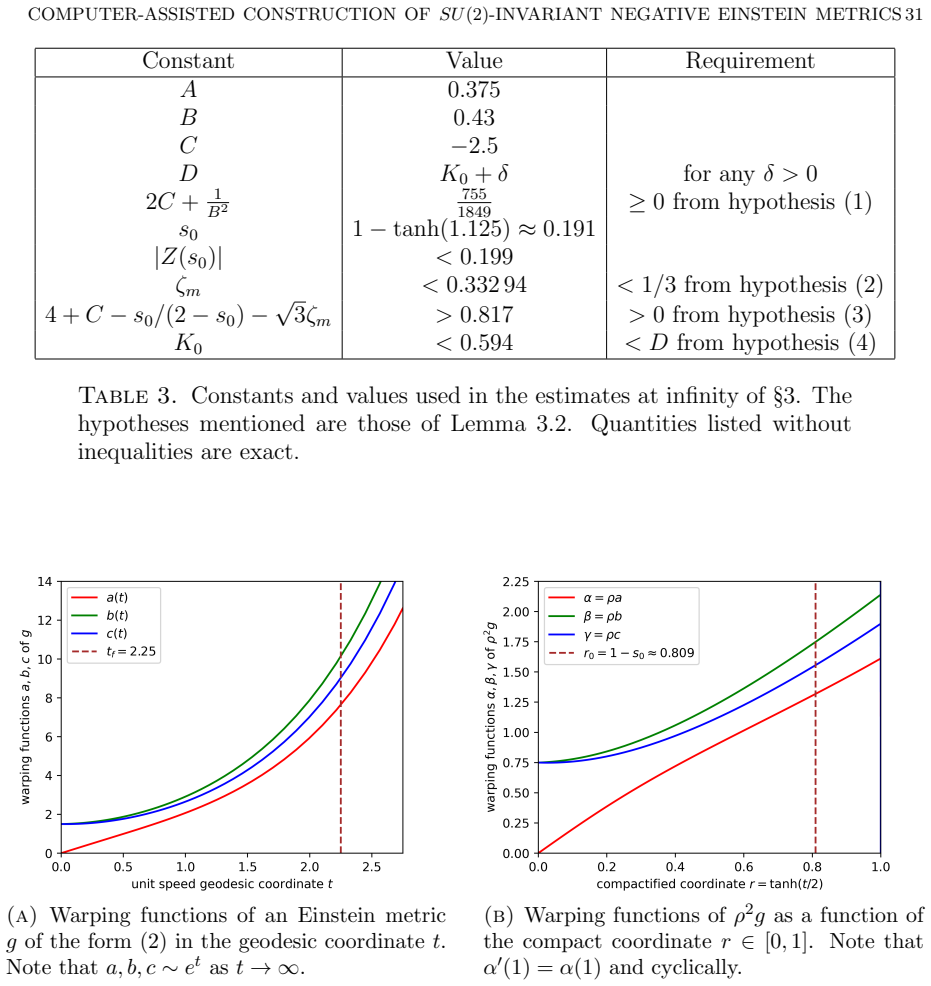
We construct a 2-parameter family of new triaxial SU(2)-invariant complete negative Einstein metrics on the complex line bundle O(-4) over CP1. The metrics are conformally compact and neither Kähler nor self-dual. The proof involves using rigorous numerics to produce an approximate Einstein metric to high precision in a bounded region containing the bolt, which is then perturbed to a genuine Einstein metric using fixed-point methods. At the boundary of this region, the latter metric is sufficiently close to hyperbolic space for us to show that it indeed extends to a complete, asymptotically hyperbolic Einstein metric.
What carries the argument
Rigorous numerical approximation of an Einstein metric near the bolt, followed by fixed-point perturbation to obtain an exact solution whose boundary data is close enough to hyperbolic space for a complete asymptotically hyperbolic extension.
If this is right
- The construction yields new examples of conformally compact negative Einstein manifolds that carry SU(2) symmetry and are neither Kähler nor self-dual.
- The resulting metrics are complete and asymptotically hyperbolic.
- The method succeeds for triaxial (as opposed to biaxial) symmetry classes.
- Computer-assisted approximation plus fixed-point perturbation can establish existence for negative Einstein metrics on complex line bundles.
Where Pith is reading between the lines
- The same numerical-plus-fixed-point strategy could be tested on line bundles of other degrees or on manifolds with different symmetry groups.
- The new metrics supply concrete points in the moduli space of asymptotically hyperbolic Einstein structures that can be studied for stability or deformation properties.
- Refinements in the numerical precision or in the choice of the bounded region might allow construction of metrics with additional continuous parameters.
Load-bearing premise
The numerically computed approximate metric is sufficiently close in a suitable norm to a genuine solution inside the bounded region so that the fixed-point argument produces an exact Einstein metric whose boundary data is close enough to hyperbolic space to guarantee a complete asymptotically hyperbolic extension.
What would settle it
A more precise error analysis or independent computation showing that the numerical approximation lies outside the ball in which the fixed-point theorem guarantees a solution, or that the perturbed metric fails to approach hyperbolic space sufficiently closely at the boundary of the region.
Figures

read the original abstract
We construct a 2-parameter family of new triaxial $SU(2)$-invariant complete negative Einstein metrics on the complex line bundle $\mathcal{O}(-4)$ over $\mathbb{C}P^1$. The metrics are conformally compact and neither K\"ahler nor self-dual. The proof involves using rigorous numerics to produce an approximate Einstein metric to high precision in a bounded region containing the singular orbit or "bolt", which is then perturbed to a genuine Einstein metric using fixed-point methods. At the boundary of this region, the latter metric is sufficiently close to hyperbolic space for us to show that it indeed extends to a complete, asymptotically hyperbolic Einstein metric.
Editorial analysis
A structured set of objections, weighed in public.
Referee Report
Summary. The paper constructs a 2-parameter family of triaxial SU(2)-invariant complete negative Einstein metrics on the complex line bundle O(-4) over CP^1. These metrics are conformally compact and neither Kähler nor self-dual. The proof proceeds by using rigorous high-precision numerics to obtain an approximate Einstein metric on a compact region containing the bolt, applying a fixed-point theorem to perturb it to an exact solution, and then extending the metric to a complete asymptotically hyperbolic Einstein metric by matching to hyperbolic space at the boundary of the region.
Significance. If the error bounds and contraction estimates are rigorously validated, the result supplies new explicit examples of negative Einstein metrics with SU(2) symmetry on a non-compact 4-manifold, illustrating the viability of computer-assisted methods that combine numerical approximation with analytic perturbation techniques. Such constructions can serve as concrete test cases for questions about the moduli space of Einstein metrics and the behavior of asymptotically hyperbolic solutions.
major comments (1)
- [Section describing the rigorous numerics and fixed-point argument] The fixed-point perturbation step requires that the residual ||Ein(g_approx)||_X be strictly less than 1/(2C) where C is the operator norm of the inverse of the linearized Einstein operator D Ein(g_approx) from Y to X. The manuscript states that the numerical approximation is “sufficiently close” but does not supply explicit interval-arithmetic bounds on this residual and on C in the precise weighted Hölder (or Sobolev) spaces adapted to the SU(2) symmetry and bolt regularity. This verification is load-bearing for the existence claim.
minor comments (2)
- [Abstract] The abstract and introduction could include a brief statement of the achieved numerical precision (e.g., number of digits or interval width) and the software library employed, to aid reproducibility.
- [Fixed-point section] Notation for the Banach spaces X and Y used in the contraction mapping should be introduced once and used consistently when stating the smallness condition on the residual.
Simulated Author's Rebuttal
We thank the referee for their careful reading of the manuscript and for identifying the need for more explicit verification in the fixed-point argument. We address the major comment below and will incorporate the requested details in a revised version.
read point-by-point responses
-
Referee: [Section describing the rigorous numerics and fixed-point argument] The fixed-point perturbation step requires that the residual ||Ein(g_approx)||_X be strictly less than 1/(2C) where C is the operator norm of the inverse of the linearized Einstein operator D Ein(g_approx) from Y to X. The manuscript states that the numerical approximation is “sufficiently close” but does not supply explicit interval-arithmetic bounds on this residual and on C in the precise weighted Hölder (or Sobolev) spaces adapted to the SU(2) symmetry and bolt regularity. This verification is load-bearing for the existence claim.
Authors: We agree that the current presentation does not include sufficiently explicit interval-arithmetic bounds on the residual and on the operator norm C in the weighted Hölder spaces respecting the SU(2) symmetry and bolt conditions. In the revision we will add a new subsection (or appendix) that reports the concrete interval enclosures obtained for ||Ein(g_approx)||_X together with a rigorous upper bound for the norm of the inverse of the linearized operator, computed via validated numerics on a finite-dimensional projection plus tail estimates. These bounds will be shown to satisfy the strict inequality required for the contraction mapping, thereby closing the existence argument. revision: yes
Circularity Check
No circularity: existence via rigorous numerics plus fixed-point theorem
full rationale
The derivation proceeds by first computing a high-precision approximate Einstein metric on a compact region containing the bolt using rigorous numerics, then invoking a fixed-point theorem in suitable Banach spaces to obtain an exact solution whose boundary values are close enough to hyperbolic space to guarantee a complete asymptotically hyperbolic extension. This chain relies on external analytic tools (contraction mapping, weighted Hölder/Sobolev norms) and independently validated numerical error control rather than any self-definitional reduction, fitted parameter renamed as prediction, or load-bearing self-citation. No equation or step in the provided abstract or description reduces the claimed existence result to its own inputs by construction.
Axiom & Free-Parameter Ledger
free parameters (1)
- two continuous parameters of the family
axioms (2)
- domain assumption The Einstein equation Ric(g) = -3g admits solutions with the given symmetry and asymptotic behavior.
- standard math Fixed-point theorems apply once the numerical error is below a computable threshold.
Lean theorems connected to this paper
-
IndisputableMonolith/Foundation/RealityFromDistinction.leanreality_from_one_distinction unclear?
unclearRelation between the paper passage and the cited Recognition theorem.
We construct a 2-parameter family of new triaxial SU(2)-invariant complete negative Einstein metrics on the complex line bundle O(-4) over CP1 ... using rigorous numerics to produce an approximate Einstein metric ... then perturbed to a genuine Einstein metric using fixed-point methods.
-
IndisputableMonolith/Cost/FunctionalEquation.leanwashburn_uniqueness_aczel unclear?
unclearRelation between the paper passage and the cited Recognition theorem.
the tangential Einstein equation ... conservation law ... singular initial value problem ... fixed-point theorem 5.4
What do these tags mean?
- matches
- The paper's claim is directly supported by a theorem in the formal canon.
- supports
- The theorem supports part of the paper's argument, but the paper may add assumptions or extra steps.
- extends
- The paper goes beyond the formal theorem; the theorem is a base layer rather than the whole result.
- uses
- The paper appears to rely on the theorem as machinery.
- contradicts
- The paper's claim conflicts with a theorem or certificate in the canon.
- unclear
- Pith found a possible connection, but the passage is too broad, indirect, or ambiguous to say the theorem truly supports the claim.
Reference graph
Works this paper leans on
-
[1]
Hitchin, The geometry and dynamics of magnetic monopoles , M
Michael Atiyah and Nigel J. Hitchin, The geometry and dynamics of magnetic monopoles , M. B. Porter Lectures, Princeton University Press, Princeton, NJ, 1988
work page 1988
-
[2]
Lionel B´ erard Bergery,Sur de nouvelles vari´ et´ es riemanniennes d’Einstein, Institut ´Elie Cartan, 6, Inst. ´Elie Cartan, vol. 6, Univ. Nancy, Nancy, 1982, pp. 1–60
work page 1982
-
[3]
Christoph B¨ ohm, Inhomogeneous Einstein metrics on low-dimensional spheres and other low- dimensional spaces, Invent. Math. 134 (1998), no. 1, 145–176
work page 1998
- [4]
-
[5]
Chang and Yuxin Ge, On conformally compact Einstein manifolds , Rev
Sun-Yung A. Chang and Yuxin Ge, On conformally compact Einstein manifolds , Rev. Un. Mat. Argentina 64 (2022), no. 1, 199–213
work page 2022
-
[6]
M. Cvetiˇ c, G. W. Gibbons, H. L¨ u, and C. N. Pope,Bianchi IX self-dual Einstein metrics and singular G2 manifolds, Classical Quantum Gravity 20 (2003), no. 19, 4239–4268
work page 2003
-
[7]
Andrew S. Dancer and Ian A. B. Strachan, K¨ ahler-Einstein metrics withSU(2) action, Math. Proc. Cambridge Philos. Soc. 115 (1994), no. 3, 513–525
work page 1994
-
[8]
Andrew S. Dancer and McKenzie Y. Wang, The cohomogeneity one Einstein equations from the Hamiltonian viewpoint, J. Reine Angew. Math. 524 (2000), 97–128
work page 2000
- [9]
-
[10]
Hanson, Self-dual solutions to Euclidean gravity , Ann
Tohru Eguchi and Andrew J. Hanson, Self-dual solutions to Euclidean gravity , Ann. Physics 120 (1979), no. 1, 82–106
work page 1979
-
[11]
J.-H. Eschenburg and McKenzie Y. Wang, The initial value problem for cohomogeneity one Einstein metrics, J. Geom. Anal. 10 (2000), no. 1, 109–137
work page 2000
-
[12]
Lorenzo Foscolo and Mark Haskins, New G2-holonomy cones and exotic nearly K¨ ahler structures on S6 and S3 × S3, Ann. of Math. (2) 185 (2017), no. 1, 59–130
work page 2017
-
[13]
G. W. Gibbons and C. N. Pope, The positive action conjecture and asymptotically Euclidean metrics in quantum gravity , Comm. Math. Phys. 66 (1979), no. 3, 267–290
work page 1979
-
[14]
C. Robin Graham and John M. Lee, Einstein metrics with prescribed conformal infinity on the ball , Adv. Math. 87 (1991), no. 2, 186–225
work page 1991
-
[15]
Hitchin, Twistor spaces, Einstein metrics and isomonodromic deformations , J
Nigel J. Hitchin, Twistor spaces, Einstein metrics and isomonodromic deformations , J. Differential Geom. 42 (1995), no. 1, 30–112
work page 1995
-
[16]
F. Johansson, Arb: efficient arbitrary-precision midpoint-radius interval arithmetic , IEEE Transac- tions on Computers 66 (2017), 1281–1292
work page 2017
- [17]
- [18]
-
[19]
Page, A compact rotating gravitational instanton, Physics Letters B 79 (1978), no
Don N. Page, A compact rotating gravitational instanton, Physics Letters B 79 (1978), no. 3, 235–238
work page 1978
-
[20]
, Taub-NUT instanton with an horizon , Physics Letters B 78 (1978), no. 2, 249–251
work page 1978
-
[21]
Pedersen, Eguchi-Hanson metrics with cosmological constant, Classical Quantum Gravity 2 (1985), no
H. Pedersen, Eguchi-Hanson metrics with cosmological constant, Classical Quantum Gravity 2 (1985), no. 4, 579–587
work page 1985
- [22]
-
[23]
Wang and Wolfgang Ziller, Existence and nonexistence of homogeneous Einstein metrics, Invent
McKenzie Y. Wang and Wolfgang Ziller, Existence and nonexistence of homogeneous Einstein metrics, Invent. Math. 84 (1986), no. 1, 177–194. Mathematical Institute, University of Oxford, Oxford, OX2 6GG, United Kingdom Email address : wangqs@maths.ox.ac.uk
work page 1986
discussion (0)
Sign in with ORCID, Apple, or X to comment. Anyone can read and Pith papers without signing in.