REVIEW 3 major objections 4 minor 1 cited by
Can planet-planet binaries survive in star-forming regions?
T0 review · 3 major / 4 minor · reviewed 2026-08-16 · deepseek-v4-flash
Pith's one-line read N-body simulations show that 50–90 per cent of planet–planet binaries with JuMBO-like properties are destroyed within a few Myr in dense star-forming regions, so the 42 observed JuMBOs require a much larger primordial population.
desk verdict First explicit N-body survival fractions for JuMBO-scale binaries; the core dynamical result is credible, but the leap to 'many more must form' skips a check against the observed single planet-mass inventory. read the letter →
The pith
A machine-rendered reading of the paper's core claim, the machinery that carries it, and where it could break.
The reading
What carries the argument
The argument is carried by the substellar binary fraction, $f_{\rm bin}=B/(S+B)$, where $B$ is the number of binary systems and $S$ the number of singles among objects below the hydrogen-burning mass limit, tracked over time. The simulations place $N_{\rm sys}=1500$ systems in a box-fractal (substructured, filament-like) configuration with fractal dimension $D=1.6$ and subvirial velocities (virial ratio $\alpha_{\rm vir}=0.3$), assigning 10 per cent of systems to be planet–planet binaries whose component masses and separations are drawn from the observed JuMBO catalogue, or in two runs from a flat 50–500 au distribution. Each setup is evolved for 10 Myr with an N-body integrator, and the binary fraction and cumulative separation distribution are recorded. Because stellar evolution, gas, and stellar binaries are not included, any change in these quantities is attributable to dynamical encounters in the cluster.
What would settle it
Take multi-epoch astrometry and spectroscopy of the 42 JuMBO candidates and compare their proper motions and colours with Orion Nebula Cluster members; if most are consistent with reddened background stars rather than young cluster members, the premise that they are primordial planet–planet binaries fails and the calculated destruction fractions no longer apply to them. A complementary test would be a deep JWST survey of another dense young cluster that finds wide planet–planet binaries surviving at high frequency, which would contradict the predicted destruction.
Extended reading notes
Core claim
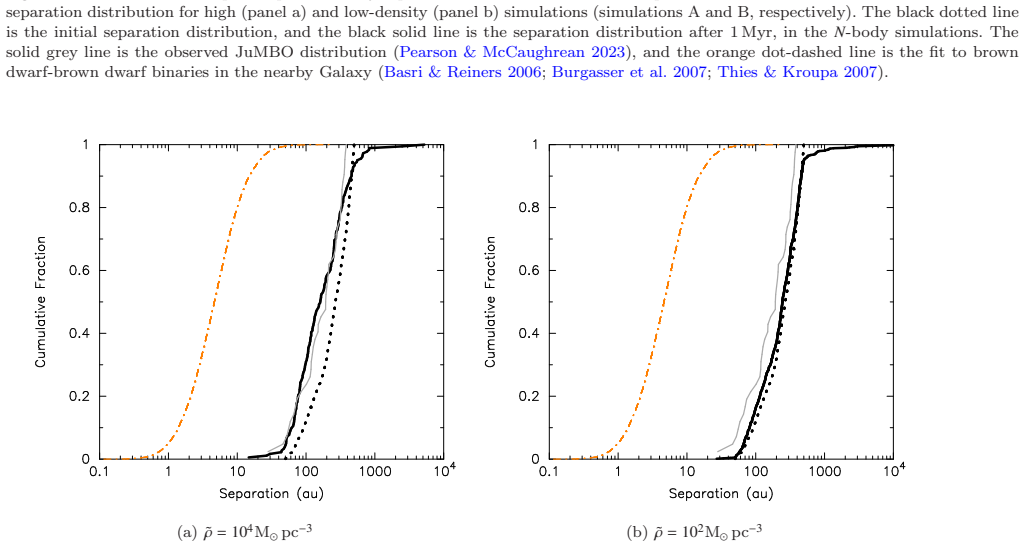
The central claim is that dynamical encounters in star-forming regions destroy most planet–planet binaries with JuMBO-like properties within a few Myr. In the dense simulations (initial median density $10^4\,M_\odot\,\mathrm{pc}^{-3}$) the substellar binary fraction drops from 1.0 to 0.1 within 1 Myr; in the lower-density runs ($10^2\,M_\odot\,\mathrm{pc}^{-3}$) it drops to 0.5. The authors therefore conclude that between 50 and 90 per cent of such binaries are destroyed, and that the observed population of 42 JuMBOs must have been drawn from a much larger primordial population. They further show that, in the dense case, the surviving systems are preferentially the closer ones, so the observed separation distribution has been dynamically sculpted; the initial JuMBO separations would have extended to roughly 500 au.
Load-bearing premise
The calculation assumes the 42 JuMBO candidates are real, initially circular, bound planet–planet binaries with the exact masses and separations from the observed catalogue, placed in a cluster with a 10 per cent binary fraction, no stellar binaries, and no gas; if the candidates are background contaminants or the initial conditions differ, the destruction fractions change.
Editorial extensions
If this is right
- The 42 observed JuMBOs must represent only part of the primordial population: in the dense case the implied initial number is about ten times larger, and in the lower-density case at least double.
- If the Orion Nebula Cluster formed at a density near $10^4$ solar masses per cubic parsec, the present-day JuMBO separation distribution is not primordial; wide systems out to about 500 au must have existed and been preferentially destroyed.
- If the cluster's initial density was instead similar to its present-day value near $10^2$ solar masses per cubic parsec, the shape of the separation distribution is roughly preserved even though half the binaries still die.
- Because destruction preferentially removes the widest, most weakly bound systems, the surviving separation distribution shifts toward shorter separations, and any observational incompleteness at wide separations strengthens the need for a large primordial population.
Reading between the lines
- Extending beyond the paper, rerunning the same setup with nonzero eccentricities, stellar binaries, and a gas potential would probably raise the destruction rate, so the quoted 50–90 per cent is more likely a lower bound than an upper bound on dynamical loss.
- A decisive test is astrometric: if multi-epoch imaging shows that most JuMBO candidates are reddened background stars rather than members of the Orion Nebula Cluster, then the survival calculation applies to a population that is not actually there.
- The same method could predict how the wide planet–planet binary fraction should vary across clusters of different density and age, giving JWST surveys outside Orion a quantitative target to confirm or refute the destruction rates.
- If the large inferred primordial population is real, formation mechanisms that produce many wide, weakly bound pairs at once become more attractive than mechanisms that produce them rarely.
Signed reviews
Editorial analysis
A structured set of objections, weighed in public.
Referee Report
Summary. The paper presents N-body simulations of subvirial, fractal star-forming regions in which 10 per cent of systems are initially planet--planet binaries whose component masses and separations are drawn from the 42 JuMBO candidates in the Orion Nebula Cluster. From the evolution of the substellar binary fraction, the authors find that 50--90 per cent of these binaries are destroyed within 1 Myr for initial median densities of 10^2 and 10^4 M_sun pc^-3 (simulations A--C), and that the surviving separation distribution is shifted to smaller separations in the dense case. They conclude that the observed JuMBO population requires a substantially larger primordial population of planet--planet binaries, and that if the ONC was initially dense, the initial separation distribution must have been wider than observed, possibly resembling a flat 50--500 au distribution. The paper is candid about its simplifications, including zero eccentricities, no stellar binaries, and no gas potential, and it explicitly acknowledges the alternative background-contamination interpretation of Luhman (2024).
Significance. If the dynamical destruction fractions are correct, the paper provides the first quantitative constraint on the survival of wide planet--planet binaries in star-forming regions, and it sharpens the challenge that the JuMBO candidate population poses to formation theories. The design has genuine strengths: it uses the actual observed masses and separations where available, it brackets the plausible density range of the ONC, it includes a brown-dwarf-bearing variant (simulation C), and it checks sensitivity to the initial separation distribution (simulations D and E). The central simulation result—that wide, low-mass binaries are efficiently ionized in dense environments—is physically plausible and internally consistent. The main weakness is not the N-body calculation itself but the leap from the destruction fractions to the inference that 'many more must form', which is not tested against the observable inventory of liberated single planetary-mass objects in the same JWST fields.
major comments (3)
- [Section 3 and Section 4(ii), Fig. 1] The inference that 'a significantly higher number of primordial systems must have been present' is not checked against the observable single-planetary-mass-object budget. Ionized binaries do not disappear; their components become single planetary-mass objects that enter the denominator of fbin in Eq. (2) and should be detectable in the same JWST fields. Taking the dense-case survival fraction of ~0.1 at face value, the 42 observed binaries imply ~420 primordial binaries and ~756 liberated singles after 1 Myr. The paper does not compare this predicted retained single population, nor the implied total planetary-mass inventory, with the observed number of free-floating planetary-mass objects in the ONC, nor does it quote a retention fraction within the observed field. Without such a consistency check, the conclusion that many more JuMBOs must have formed is not self-consistently supported, even though the simulated survival fractions may be correct.
- [Section 2, paragraph on eccentricities] Setting all eccentricities to zero is a strong assumption that likely biases the destruction fractions. For a given semi-major axis, an eccentric binary spends part of its orbit at larger physical separations, increasing its collisional cross-section and susceptibility to ionization; conversely, circular orbits maximize binding energy per unit angular momentum for a given semi-major axis. The observed JuMBO separations are projected separations, not semi-major axes, so the mapping from observation to initial condition is also uncertain. Since the headline 50--90 per cent destruction fractions are the paper's central quantitative output, the sensitivity to eccentricity should be tested (e.g., with a thermal or uniform eccentricity distribution) or the authors should justify why the zero-eccentricity choice is conservative.
- [Section 3, Figs. 3 and 4] The claim that dynamical processing in the dense case with a flat 50--500 au initial distribution 'would reproduce the observed JuMBO distribution' (Fig. 4a) is made by visual inspection of cumulative distributions. The paper provides no quantitative comparison, such as a Kolmogorov--Smirnov or Anderson--Darling test, between the evolved simulated distribution and the observed JuMBO sample, nor error bars on the simulated distributions across the ten realizations. Because conclusion (iii)—that the observed distribution has been dynamically sculpted and the initial distribution must contain wider systems—rests on this comparison, a statistical test is needed to establish whether the agreement is meaningful and whether the low-density case (Fig. 4b) is truly excluded.
minor comments (4)
- [Throughout] Several typos should be corrected: 'poper motion' in Section 4, 'therough' in Section 3, 'he observed' in conclusion (ii), 'showns' in the Fig. 2 caption, and 'inital' in conclusion (iii).
- [Section 2, Table 1] The text states that 10 per cent of systems are randomly selected to be planet--planet binaries, but it is not stated whether this 10 per cent applies independently in simulation C, where the IMF also produces brown dwarfs down to 0.01 M_sun, or whether the reported initial fbin of 0.29 follows from the IMF sampling. A sentence clarifying the construction of the initial substellar population in C would help.
- [Section 3, paragraph after Fig. 2] The observation that the JuMBO separation histogram 'shows an increasing trend to higher separations' is used to argue for incompleteness and an even larger primordial population. This is an interesting point, but it should be quantified or referenced to the completeness limits of the Pearson & McCaughrean (2023) catalogue, since observational incompleteness is otherwise not discussed in detail.
- [Section 2, paragraph on gas potential] The absence of a background gas potential is acknowledged, but its effect on the early evolution of a subvirial fractal is not discussed. Including the gas potential would deepen the potential and could increase or decrease the effective destruction rate depending on the collapse timescale; a brief justification that the two density choices bracket the relevant behavior would strengthen the presentation.
Circularity Check
No circularity: survival fractions are forward-model outputs; the observed JuMBO catalogue is an input, not a fitted target.
full rationale
The paper's survival fractions are genuine forward-model outputs of an N-body integration (kira/Starlab): no parameter is tuned to reproduce the observed JuMBO counts or separation histogram, so there is no fitted-input-called-prediction step. The observed JuMBO catalogue enters only as the initial separation/mass distribution for simulations A-C, and the statement that 'many more must form' is simply the arithmetic consequence of the simulated survival fraction and the observed count, not a quantity that was put in by construction. The inferred widening of the initial separation distribution in the dense case is also a forward-model comparison (simulation D with 50-500 au initial separations evolves to resemble the observed distribution) rather than a fit to the observed final histogram; while the match is qualitative, it is not circular. Self-citations (Goodwin & Whitworth 2004 for the box-fractal method; Daffern-Powell & Parker 2020 for D=1.6; Parker et al. for reverse-engineered densities) are used to justify initial conditions, but the paper brackets the density uncertainty by running both 100 and 10^4 M_sun pc^-3, so no conclusion is forced by a single self-cited choice. The omission of a check against the observed single planetary-mass object budget is a completeness/correctness concern, not a circular reduction of the derivation to its inputs. No circular step meets the quoted-equation or by-construction standard.
Assumptions & free parameters
free parameters (7)
- initial planet-planet binary fraction =
10 per cent of systems
- binary eccentricity =
e = 0
- fractal dimension =
D = 1.6
- virial ratio =
alpha_vir = 0.3
- initial density =
10^4 and 10^2 M_sun pc^-3
- IMF lower mass limit =
0.08 M_sun (runs A,B,D,E); 0.01 M_sun (run C)
- stellar binary fraction =
0
assumptions (6)
- domain assumption JuMBO candidates are bound planetary-mass binaries in the ONC rather than background stars or unrelated line-of-sight pairs.
- domain assumption The Maschberger (2013) IMF with alpha=2.3, beta=1.4, mu=0.2 M_sun, m_up=50 M_sun describes the stellar population in the simulated cluster.
- domain assumption The box fractal algorithm of Goodwin and Whitworth (2004) with D=1.6 and subvirial velocities provides a realistic initial spatial and kinematic structure for young star-forming regions.
- standard math The kira/Starlab Hermite integration correctly resolves the relevant binary-single encounters over 10 Myr.
- domain assumption Dynamical encounters with the stellar population dominate disruption, while gas, stellar evolution, stellar binaries, and physical collisions can be neglected.
- domain assumption The reverse-engineered initial densities of up to 10^4 M_sun pc^-3 are plausible for the ONC.
Cite this review
Pith. "Pith review of Can planet-planet binaries survive in star-forming regions?." pith.science (2026). https://pith.science/paper/K2LDGLZI
@misc{pith2026250500762,
  author       = {Pith},
  title        = {Pith review of: Can planet-planet binaries survive in star-forming regions?},
  year         = {2026},
  howpublished = {\url{https://pith.science/paper/K2LDGLZI}},
  note         = {Machine review of arXiv:2505.00762}
}
read the original abstract
Significant numbers of free-floating planetary-mass objects have been discovered in nearby star-forming regions by the James Webb Space Telescope, including a substantial number (42) of Jupiter Mass Binary Objects ('JuMBOs') in the Orion Nebula Cluster. The JuMBOs have much wider separations than other populations of substellar binaries, and their existence challenges conventional theories of substellar and planetary-mass object formation. Whilst several theories have been proposed to explain their formation, there has yet to be a study that determines whether they could survive the dynamical encounters prevalent within a dense star-forming region. We place a population of planet-planet binaries in N-body simulations of dense star-forming regions and calculate their binary fraction over time. We find that between 50-90 per cent of planet-planet binaries are destroyed on timescales of a few Myr, which implies that many more must form if we are to observe them in their current numbers. Furthermore, if the ONC was much more dense at formation, the initial separation distribution of the JuMBOs must have been even wider (and less similar to other substellar binaries) than the observed distribution.
Figures


Forward citations
Cited by 1 Pith paper
-
JWST's Constraints on the Substellar IMF in NGC 2024
JWST NIRSpec spectroscopy of NGC 2024 members yields no evidence for a substellar IMF turnover below 12 Mjup, contrary to a prior photometric-only claim.
Reference graph
Works this paper leans on
-
[1]
Allison R. J., Goodwin S. P., Parker R. J., Portegies Zwart S. F., de Grijs R., 2010, MNRAS, 407, 1098
work page 2010
-
[2]
Andr \'e P., Di Francesco J., Ward-Thompson D., Inutsuka S.-I., Pudritz R. E., Pineda J. E., 2014, @doi [Protostars and Planets VI] 10.2458/azu_uapress_9780816531240-ch002 , http://adsabs.harvard.edu/abs/2014prpl.conf...27A pp 27--51
-
[3]
Basri G., Reiners A., 2006, AJ, 132, 663
work page 2006
- [4]
-
[5]
Beccari G., et al., 2017, @doi [ ] 10.1051/0004-6361/201730432 , https://ui.adsabs.harvard.edu/abs/2017A&A...604A..22B 604, A22
-
[6]
Bell C. P. M., Naylor T., Mayne N. J., Jeffries R. D., Littlefair S. P., 2013, @doi [MNRAS] 10.1093/mnras/stt1075 , http://adsabs.harvard.edu/abs/2013MNRAS.434..806B 434, 806
-
[7]
Burgasser A. J., Reid I. N., Siegler N., Close L., Allen P., Lowrance P., Gizis J., 2007, in Reipurth B., Jewitt D., Keil K., eds, Protostars and Planets V . pp 427--441
work page 2007
-
[8]
P., 2004, MNRAS, 348, 589
Cartwright A., Whitworth A. P., 2004, MNRAS, 348, 589
2004
Show all 56 references
-
[9]
Coleman G. A. L., 2024, @doi [ ] 10.1093/mnras/stae903 , https://ui.adsabs.harvard.edu/abs/2024MNRAS.530..630C 530, 630
2024 doi
-
[10]
C., Parker R
Daffern-Powell E. C., Parker R. J., 2020, @doi [ ] 10.1093/mnras/staa575 , https://ui.adsabs.harvard.edu/abs/2020MNRAS.493.4925D 493, 4925
2020 doi
-
[11]
E., Ercolano B., Bonnell I
Dale J. E., Ercolano B., Bonnell I. A., 2012, @doi [MNRAS] 10.1111/j.1365-2966.2012.21205.x , http://adsabs.harvard.edu/abs/2012MNRAS.424..377D 424, 377
2012
-
[12]
L., Parker R
Diamond J. L., Parker R. J., 2024, @doi [ ] 10.3847/1538-4357/ad8644 , https://ui.adsabs.harvard.edu/abs/2024ApJ...975..204D 975, 204
2024 doi
-
[13]
M., Kraus A
Factor S. M., Kraus A. L., 2023, @doi [ ] 10.3847/1538-3881/aca475 , https://ui.adsabs.harvard.edu/abs/2023AJ....165..130F 165, 130
2023 doi
-
[14]
B., et al., 2015, @doi [ApJ] 10.1088/0004-637X/799/2/136 , http://adsabs.harvard.edu/abs/2015ApJ...799..136F 799, 136
Foster J. B., et al., 2015, @doi [ApJ] 10.1088/0004-637X/799/2/136 , http://adsabs.harvard.edu/abs/2015ApJ...799..136F 799, 136
2015 doi
-
[15]
S., 2011, MNRAS, 413, 2741
Girichidis P., Federrath C., Banerjee R., Klessen R. S., 2011, MNRAS, 413, 2741
2011
-
[16]
J., Hewitt R., 1993, AJ, 105, 1927
Gomez M., Hartmann L., Kenyon S. J., Hewitt R., 1993, AJ, 105, 1927
1993
-
[17]
P., Whitworth A
Goodwin S. P., Whitworth A. P., 2004, A&A, 413, 929
2004
-
[18]
Hacar A., Tafalla M., Kauffmann J., Kov \'a cs A., 2013, A&A, 554, A55
2013
-
[19]
D., et al., 2016, @doi [ ] 10.1093/mnras/stw121 , http://adsabs.harvard.edu/abs/2016MNRAS.457.2675H 457, 2675
Henshaw J. D., et al., 2016, @doi [ ] 10.1093/mnras/stw121 , http://adsabs.harvard.edu/abs/2016MNRAS.457.2675H 457, 2675
2016 doi
-
[20]
D., Littlefair S
Jeffries R. D., Littlefair S. P., Naylor T., Mayne N. J., 2011, @doi [MNRAS] 10.1111/j.1365-2966.2011.19613.x , http://adsabs.harvard.edu/abs/2011MNRAS.418.1948J 418, 1948
2011
-
[21]
R., Parker R
King R. R., Parker R. J., Patience J., Goodwin S. P., 2012, MNRAS, 421, 2025
2012
-
[22]
G., McCaughrean M
Kroupa P., Petr M. G., McCaughrean M. J., 1999, New Astronomy, 4, 495
1999
-
[23]
Kuznetsova A., Hartmann L., Ballesteros-Paredes J., 2015, @doi [ApJ] 10.1088/0004-637X/815/1/27 , http://adsabs.harvard.edu/abs/2015ApJ...815...27K 815, 27
2015 doi
-
[24]
B., et al., 2024, @doi [ ] 10.3847/1538-3881/ad6f0c , https://ui.adsabs.harvard.edu/abs/2024AJ....168..179L 168, 179
Langeveld A. B., et al., 2024, @doi [ ] 10.3847/1538-3881/ad6f0c , https://ui.adsabs.harvard.edu/abs/2024AJ....168..179L 168, 179
2024 doi
-
[25]
B., 1981, MNRAS, 194, 809
Larson R. B., 1981, MNRAS, 194, 809
1981
-
[26]
Lazzoni C., Rice K., Zurlo A., Hinkley S., Desidera S., 2024, @doi [ ] 10.1093/mnras/stad3443 , https://ui.adsabs.harvard.edu/abs/2024MNRAS.527.3837L 527, 3837
2024 doi
-
[27]
C., 2015, @doi [ ] 10.1093/mnras/stv012 , https://ui.adsabs.harvard.edu/abs/2015MNRAS.448..344L 448, 344
Li G., Adams F. C., 2015, @doi [ ] 10.1093/mnras/stv012 , https://ui.adsabs.harvard.edu/abs/2015MNRAS.448..344L 448, 344
2015 doi
-
[28]
J., Davies M
Li D., Mustill A. J., Davies M. B., 2020, @doi [ ] 10.1093/mnras/staa2945 , https://ui.adsabs.harvard.edu/abs/2020MNRAS.499.1212L 499, 1212
2020 doi
-
[29]
L., 2024, @doi [ ] 10.3847/1538-3881/ad812a , https://ui.adsabs.harvard.edu/abs/2024AJ....168..230L 168, 230
Luhman K. L., 2024, @doi [ ] 10.3847/1538-3881/ad812a , https://ui.adsabs.harvard.edu/abs/2024AJ....168..230L 168, 230
2024 doi
-
[30]
L., et al., 2024a, @doi [ ] 10.3847/1538-3881/ad0b72 , https://ui.adsabs.harvard.edu/abs/2024AJ....167....5L 167, 5
Luhman K. L., et al., 2024a, @doi [ ] 10.3847/1538-3881/ad0b72 , https://ui.adsabs.harvard.edu/abs/2024AJ....167....5L 167, 5
-
[31]
L., Alves de Oliveira C., Baraffe I., Chabrier G., Geballe T
Luhman K. L., Alves de Oliveira C., Baraffe I., Chabrier G., Geballe T. R., Parker R. J., Pendleton Y. J., Tremblin P., 2024b, @doi [ ] 10.3847/1538-3881/ad00b7 , https://ui.adsabs.harvard.edu/abs/2024AJ....167...19L 167, 19
-
[32]
Marks M., Kroupa P., 2012, @doi [A&A] 10.1051/0004-6361/201118231 , 543, A8
2012 doi
-
[33]
Maschberger T., 2013, MNRAS, 429, 1725
2013
- [34]
-
[35]
C., 2011, @doi [ApJ] 10.1088/0004-637X/735/2/82 , http://adsabs.harvard.edu/abs/2011ApJ...735...82M 735, 82
Myers P. C., 2011, @doi [ApJ] 10.1088/0004-637X/735/2/82 , http://adsabs.harvard.edu/abs/2011ApJ...735...82M 735, 82
2011 doi
-
[36]
J., 2014, MNRAS, 445, 4037
Parker R. J., 2014, MNRAS, 445, 4037
2014
-
[37]
J., 2023, @doi [ ] 10.1093/mnras/stad2444 , https://ui.adsabs.harvard.edu/abs/2023MNRAS.525.2907P 525, 2907
Parker R. J., 2023, @doi [ ] 10.1093/mnras/stad2444 , https://ui.adsabs.harvard.edu/abs/2023MNRAS.525.2907P 525, 2907
2023 doi
-
[38]
J., Alves de Oliveira C., 2023, @doi [ ] 10.1093/mnras/stad2378 , https://ui.adsabs.harvard.edu/abs/2023MNRAS.525.1677P 525, 1677
Parker R. J., Alves de Oliveira C., 2023, @doi [ ] 10.1093/mnras/stad2378 , https://ui.adsabs.harvard.edu/abs/2023MNRAS.525.1677P 525, 1677
2023 doi
-
[39]
J., Goodwin S
Parker R. J., Goodwin S. P., 2011, MNRAS, 411, 891
2011
-
[40]
J., Goodwin S
Parker R. J., Goodwin S. P., Allison R. J., 2011, MNRAS, 418, 2565
2011
-
[41]
J., Wright N
Parker R. J., Wright N. J., Goodwin S. P., Meyer M. R., 2014, MNRAS, 438, 620
2014
- [42]
-
[43]
Portegies Zwart S., Hochart E., 2024, @doi [SciPost Astronomy] 10.21468/SciPostAstro.3.1.001 , https://ui.adsabs.harvard.edu/abs/2024ScPA....3....1P 3, 001
2024 doi
-
[44]
F., Makino J., McMillan S
Portegies Zwart S. F., Makino J., McMillan S. L. W., Hut P., 1999, A&A, 348, 117
1999
-
[45]
F., McMillan S
Portegies Zwart S. F., McMillan S. L. W., Hut P., Makino J., 2001, MNRAS, 321, 199
2001
-
[46]
R., Soderblom D
Reggiani M., Robberto M., Da Rio N., Meyer M. R., Soderblom D. R., Ricci L., 2011, @doi [A&A] 10.1051/0004-6361/201116946 , 534, A83
2011 doi
-
[47]
F., Loinard L., Zapata L., Ortiz-Leon G
Rodriguez L. F., Loinard L., Zapata L., Ortiz-Leon G. N., 2025, arXiv e-prints, https://ui.adsabs.harvard.edu/abs/2025arXiv250415519R p. arXiv:2504.15519
2025 arXiv
-
[48]
E., 1955, ApJ, 121, 161
Salpeter E. E., 1955, ApJ, 121, 161
1955
-
[49]
J., 2009, ApJ, 696, 2086
S \'a nchez N., Alfaro E. J., 2009, ApJ, 696, 2086
2009
-
[50]
S., 2006, @doi [A&A] 10.1051/0004-6361:20054464 , 449, 151
Schmeja S., Klessen R. S., 2006, @doi [A&A] 10.1051/0004-6361:20054464 , 449, 151
2006 doi
-
[51]
J., 2020, @doi [ ] 10.1093/mnras/staa1228 , https://ui.adsabs.harvard.edu/abs/2020MNRAS.tmp.1474S 495, 3104
Schoettler C., de Bruijne J., Vaher E., Parker R. J., 2020, @doi [ ] 10.1093/mnras/staa1228 , https://ui.adsabs.harvard.edu/abs/2020MNRAS.tmp.1474S 495, 3104
2020 doi
-
[52]
Thies I., Kroupa P., 2007, ApJ, 671, 767
2007
-
[53]
C., Zamora-Avil \'e s M., 2019, @doi [ ] 10.1093/mnras/stz2736 , https://ui.adsabs.harvard.edu/abs/2019MNRAS.490.3061V 490, 3061
V \'a zquez-Semadeni E., Palau A., Ballesteros-Paredes J., G \'o mez G. C., Zamora-Avil \'e s M., 2019, @doi [ ] 10.1093/mnras/stz2736 , https://ui.adsabs.harvard.edu/abs/2019MNRAS.490.3061V 490, 3061
2019 doi
-
[54]
Wang Y., Perna R., Zhu Z., 2024, @doi [Nature Astronomy] 10.1038/s41550-024-02239-2 , https://ui.adsabs.harvard.edu/abs/2024NatAs...8..756W 8, 756
2024 doi
-
[55]
P., Zinnecker H., 2004, A&A, 427, 299
Whitworth A. P., Zinnecker H., 2004, A&A, 427, 299
2004
-
[56]
write newline
" write newline "" before.all 'output.state := FUNCTION fin.entry write newline FUNCTION new.block output.state before.all = 'skip after.block 'output.state := if FUNCTION new.sentence output.state after.block = 'skip output.state before.all = 'skip after.sentence 'output.stat...
Reviewed August 16, 2026 · model on record in the stance chip above.
Discussion (0). Continue with ORCID to comment.