REVIEW 3 major objections 5 minor 1 cited by
The 2023 outburst of the Gaia alerted EXor Gaia23bab
T0 review · 3 major / 5 minor · reviewed 2026-08-16 · deepseek-v4-flash
Pith's one-line read This paper shows that during the 2023 outburst of the young star Gaia23bab, the mass accretion rate was roughly $2\times10^{-7}$ solar masses per year at two independent epochs, and that hydrogen line excitation conditions mark the system…
desk verdict Careful follow-up of a single EXor gives a solid ~2e-7 Msun/yr accretion rate, but the excitation temperatures and densities are shakier than the abstract suggests. read the letter →
The pith
A machine-rendered reading of the paper's core claim, the machinery that carries it, and where it could break.
The reading
What carries the argument
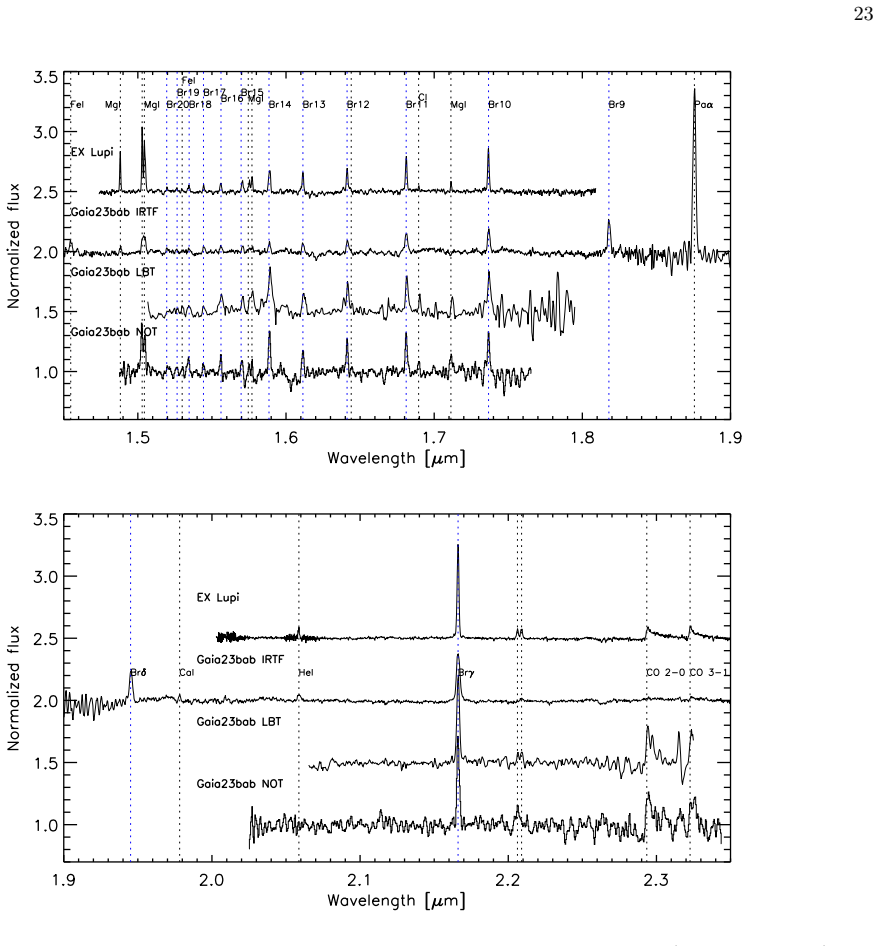
Multi-epoch near-infrared spectroscopy is the workhorse: Paschen and Brackett hydrogen lines, the Ca II triplet, He I, and O I are detected in spectra taken near maximum and during the fading phase, and the ratios of their fluxes are the observables that carry the argument. The accretion rate follows from converting extinction-corrected line luminosities ($L_{\rm line}=4\pi d^2 f_{\rm line}$) to accretion luminosities using the empirical relations of Alcalá et al. (2017) and then applying the magnetospheric accretion formula $\dot{M}_{\rm acc}=1.25\,L_{\rm acc}R_\star/(GM_\star)$ with an assumed inner-disk radius of $5R_\star$. The excitation analysis compares observed Brackett decrements to Case B recombination predictions (Hummer & Storey 1987), in which the plasma is opaque to Lyman-$\alpha$ and optically thin in higher lines so that line ratios depend mainly on temperature and density, and compares Balmer and Paschen decrements to the T Tauri wind and accretion models of Kwan & Fischer (2011) and Edwards et al. (2013), with $\chi^2$ minimization selecting best-fit temperature and density values.
What would settle it
A direct, method-independent measurement of the extinction toward Gaia23bab—for instance, fitting the quiescent optical and near-infrared spectrum with a stellar atmosphere plus a dust screen, or comparing an X-ray hydrogen column with the optical reddening—would settle whether $A_V = 3.6$ mag is right; a value outside $3.2 \pm 0.5$ mag would rescale all extinction-corrected line luminosities and could move the inferred accretion rate and excitation temperatures outside the EXor ranges claimed here.
Extended reading notes
Core claim
The paper establishes that during the 2023 outburst of Gaia23bab the mass accretion rate was $\sim 2.0\times10^{-7}\,M_\odot\,\mathrm{yr}^{-1}$, measured at two independent epochs with several tracers, and consistent with a third epoch from earlier work; the accretion rate did not change significantly while the star faded. The hydrogen Brackett, Paschen, and Balmer line ratios, compared with Case B recombination and accretion-flow models, yield excitation temperatures of roughly 5000--12500 K and hydrogen densities of $10^8$--$10^{11}\,\mathrm{cm}^{-3}$, with the Ca II line ratios pointing to a denser, cooler component ($n_H\sim10^{12}\,\mathrm{cm}^{-3}$, $T\lesssim7500$ K) likely associated with the disk boundary layer. On this basis the authors conclude that Gaia23bab is a prototypical EXor, matching EXor behavior in both its accretion rate and its emitting-gas conditions.
Load-bearing premise
The analysis assumes the star is reddened by an extinction of 3.6 magnitudes, a value chosen because it makes the accretion rates from different lines agree, and the same correction is then used to deredden the hydrogen line fluxes that set the temperatures and densities.
Editorial extensions
If this is right
- The accretion rate was essentially unchanged across three epochs (near maximum, mid-fade, and later fade), so the 2023 outburst maintained a roughly constant mass-feeding rate rather than spiking and decaying.
- Hydrogen line excitation conditions overlap those measured in other EXors, so Gaia23bab joins the class not only by accretion rate but by the physical state of its emitting gas.
- The two documented outbursts (2017 and 2023) show similar amplitudes and color behavior, implying the underlying disk or accretion instability repeats on similar timescales.
- The Ca II line ratios imply a higher-density, cooler component near the disk boundary layer, suggesting the accretion flow in Gaia23bab is structured rather than a single uniform medium.
- The non-detection of the CO bandhead and the weakening of Na I at the later epoch show that the disk's near-infrared emission faded faster than the accretion tracers, revealing which spectral features track the declining phase of an EXor outburst.
Reading between the lines
- A testable extension follows from the extinction assumption: if future independent measurements fix $A_V$, the same multi-line method can be turned into a calibration of EXor accretion rates that does not depend on a self-consistency choice.
- The Paγ/He I ratio above 1, unusual for classical T Tauri stars, may serve as a quick spectroscopic tag for EXor-type eruptive stars; checking it on a larger sample would show whether it separates burst-phase accretors from quiescent ones.
- Because the 2017 and 2023 bursts look similar in amplitude and color, Gaia23bab is a candidate for predicting recurrence from a single burst; monitoring through the next decline would test whether the color loop and the disappearance of CO emission repeat.
- If the accretion rate stayed constant while the continuum faded, then the optical decline is driven more by changing extinction or disk emission than by a drop in accretion power; this can be checked by correlating the color evolution with the accretion-tracer fluxes.
Signed reviews
Editorial analysis
A structured set of objections, weighed in public.
Referee Report
Summary. The paper reports a multi-wavelength photometric and spectroscopic study of the young eruptive star Gaia23bab during its 2023 outburst, triggered by a Gaia alert. The authors combine optical and near-infrared photometry, NIR spectra from NOT and IRTF, and archival data to characterize the outburst and previous activity. They derive revised stellar parameters (M1-type, Teff = 3630 K, L* = 0.72 L_sun, R* = 2.3 R_sun, M* = 0.40 M_sun), measure accretion rates at two epochs using several line tracers (Ca II, He I, Pa, and Br lines), and compare hydrogen line ratios to Case B theory and Kwan-Fischer models to infer excitation temperatures and densities. The main quantitative claim is that the accretion rate during the 2023 outburst was approximately 2 x 10^-7 M_sun/yr, consistent across epochs and with the independent LBT estimate of Giannini et al. (2024), and that the derived excitation conditions support the classification of Gaia23bab as a prototypical EXor.
Significance. If the central claim holds, the paper provides a well-observed example of an EXor with a stable accretion rate across three epochs of an outburst and a detailed comparison of multiple hydrogen-series diagnostics. The analysis combines original data with previously published LBT observations, and the revised stellar parameters (from a quiescent LBT spectrum) improve on earlier estimates. The authors are transparent about their assumptions, including the fitted extinction and the acknowledged limitations of Case B theory in T Tauri environments. The paper also documents a previous 2017 outburst and compares the two events, contributing to the growing sample of Gaia-alerted eruptive stars. However, the quantitative accretion rate relies on a fitted A_V at the IRTF epoch, and the quoted uncertainty omits several systematic contributions, so the precision of the central value is likely overstated.
major comments (3)
- [Sect. 3.4] The IRTF-epoch extinction A_V = 3.6 mag is determined by requiring that accretion rates from different lines agree, and the same dereddened fluxes are then used in Sect. 3.5 for the hydrogen-line excitation analysis. This makes the excitation analysis and the 'multiple independent tracers' description partially circular. The quoted error of 0.5 x 10^-7 M_sun/yr is only the standard deviation among tracers at a fixed A_V; it does not include the systematic contribution from the assumed A_V uncertainty, the distance uncertainty (900 ± 45 pc), or the uncertainties in R* and M*. I recommend propagating these and reporting a total systematic uncertainty, or at least explicitly stating that the quoted error is statistical only.
- [Sect. 3.4] The statement in the abstract and Sect. 4 that the accretion rate was 'measured independently with several line tracers' is stronger than the data support. At the NOT epoch, only Paβ and Brγ are available, and they give accretion rates of 1.9 x 10^-7 and 3.2 x 10^-7 M_sun/yr, which differ by a factor of about 1.7. Even at the IRTF epoch, the inter-tracer agreement is imposed by the fitted A_V. I suggest reporting the NOT-epoch rates separately and rephrasing the claim to 'consistent with about 2 x 10^-7 M_sun/yr across epochs' rather than implying fully independent multi-tracer agreement at each epoch.
- [Sect. 3.5] The Balmer decrement is best fitted with n_H = 10^8 cm^-3, while the Paschen decrement at the same epochs requires n_H = 10^11 cm^-3, a discrepancy of three orders of magnitude. The paper presents this without discussing whether it indicates two physically distinct emitting regions, model limitations, or an error in the extinction correction. Since this discrepancy bears on the claim that the derived temperatures and densities confirm the EXor classification, the authors should discuss its origin and its implications for the robustness of the excitation conditions.
minor comments (5)
- [Sect. 3.5.2] The sentence 'A temperature of 3750 K is unlikely since it is below the stellar temperature (see Sect. 3.3)' is incorrect: the stellar Teff quoted in Sect. 3.3 is 3630 K, so 3750 K is above it. The intended argument (that 3750 K is close to or below the photospheric temperature) still holds, but the wording should be corrected.
- [Sect. 3.4 and Table 2] The notation '1.9 ∼ 10−7 M⊙ yr−1 and 3.2 ∼ 10−7 M⊙ yr−1' should use multiplication signs (e.g., 1.9 × 10^-7) for consistency with the rest of the paper.
- [Fig. 3] The right-hand panel of Figure 3 uses 'JD−2450000' as the x-axis label, while the left-hand panel uses 'MJD−57000'; please use a consistent time axis for both panels.
- [Sect. 3.5.1] In the text, '109 cm−3' and '1010 cm−3' should be typeset as '10^9 cm^-3' and '10^10 cm^-3' to avoid confusion.
- [Sect. 2.1] The service BHTOM is first mentioned in the text as 'BHTOM service' and in the facilities line as 'BHTOM.space'; please unify the spelling.
Circularity Check
Mild fitted-input circularity: the IRTF-epoch A_V is chosen to force agreement among accretion tracers, and the same dereddened fluxes are reused for the excitation analysis; the central accretion-rate estimate remains externally benchmarked.
-
fitted input called prediction
[Section 3.4, 'Accretion parameters' (IRTF epoch)]
"For the IRTF epoch, we considered different AV values, as the accretion rates derived from the different lines are supposed to be the same for the right AV. There are only two accretion tracers at the NOT epoch, therefore we assume an AV of 3.2 ± 0.5 mag for this epoch, as was derived in Sect. 3.3."
The IRTF-epoch A_V=3.6 is not measured independently; it is the value that makes the Alcalá et al. (2017) accretion tracers agree, because the criterion for the 'right' A_V is stated to be equality of the tracer-derived accretion rates. The quoted 'average value based on all the accretion tracers observed in the IRTF spectrum' therefore reports an inter-tracer consistency that was imposed by the fit rather than independently observed. The absolute scale is still set by the line fluxes, distance, and stellar parameters, so this is a partial, not a total, circularity.
-
other
[Section 3.5, 'Hydrogen lines' (preamble)]
"We use extinction-corrected fluxes, for which we assume an AV of 3.6±0.4 mag, which is based on the accretion rate estimate at the IRTF epoch and the assumption that the AV did not change significantly between the epochs, which is consistent with the result of the fitting by a stellar template in Sect. 3.3."
The extinction applied to the hydrogen lines is the value fitted in Sect. 3.4 by requiring the accretion tracers to agree. The same corrected fluxes are then compared with Case B theory and the Kwan & Fischer (2011) grids to infer excitation temperatures and densities, so those excitation results inherit the fitted A_V and are not independent of the accretion-rate fit. This does not make the model-grid comparison itself circular, because the grids are external, but it makes the quoted temperature and density ranges conditional on an extinction value that was chosen to satisfy the accretion tracers.
full rationale
The paper's central quantitative claim is not equivalent to its inputs by definition. The accretion rate is derived from observed line fluxes via a measured distance (Kuhn et al. 2023, from Gaia DR3 cluster-member parallaxes) and standard empirical calibrations (Alcalá et al. 2017; Hartmann et al. 1998), none of which define the target result in terms of itself. At the NOT epoch, the two available tracers give separately quoted values of 1.9e-7 and 3.2e-7 M_sun/yr, so their disagreement is not hidden. The genuinely circular element is the IRTF-epoch A_V=3.6, which is fitted under the assumption that all tracers should yield the same accretion rate and then reused to deredden the same lines for the excitation analysis. The impact is limited: 3.6 is within 1 sigma of the independently fitted quiescent A_V=3.2±0.5 (Sect. 3.3), the near-IR extinction corrections are small, and the central value is independently reproduced by Giannini et al. (2024) at (2.5±0.6)e-7 M_sun/yr. Self-citations (Kuhn et al. 2023; Giannini et al. 2024) are used for distance and spectral classification, but both rest on external data (Gaia DR3 parallaxes, LBT spectroscopy) and are corroborated by this paper's own observations, so they are not load-bearing in a circular sense.
Assumptions & free parameters
free parameters (2)
- A_V (IRTF epoch) =
3.6 mag
- A_V (NOT epoch) =
3.2 mag
assumptions (5)
- domain assumption Case B recombination theory (Hummer & Storey 1987) describes the Brackett line emission from the accretion flow.
- domain assumption Kwan & Fischer (2011) and Edwards et al. (2013) local excitation models describe the Balmer and Paschen line ratios.
- domain assumption The accretion luminosity converts to accretion rate via Mdot = 1.25 L_acc R/(G M) with an inner-disk radius of 5 R_star.
- domain assumption The distance to Gaia23bab is 900 +/- 45 pc.
- domain assumption The extinction law of Cardelli et al. (1989) is used to deredden photometry and spectra.
Cite this review
Pith. "Pith review of The 2023 outburst of the Gaia alerted EXor Gaia23bab." pith.science (2026). https://pith.science/paper/EF4MMUEU
@misc{pith2026250502227,
  author       = {Pith},
  title        = {Pith review of: The 2023 outburst of the Gaia alerted EXor Gaia23bab},
  year         = {2026},
  howpublished = {\url{https://pith.science/paper/EF4MMUEU}},
  note         = {Machine review of arXiv:2505.02227}
}
abstract
Episodic accretion is a fundamental process in the build-up of the stellar mass. EX Lupi-type eruptive young stars (EXors) represent one of the main types of episodic accretion. We study the recently discovered EXor Gaia23bab during its 2023 outburst. We obtained optical and near-infrared photometry and spectroscopy to probe the variation of the physical properties of Gaia23bab during its recent outburst. We also collected archival photometry to study a previous outburst of the star. We used several accretion tracers, including the Ca II triplet, He I, and various hydrogen lines from the Paschen and Brackett series, to measure the accretion rate during the outburst. The accretion rate is consistent with $\sim 2.0 \times 10^{-7} M_\odot$ $\rm{yr}^{-1}$. Comparing the line fluxes of the hydrogen Brackett series to predictions of Case B theory suggests excitation temperatures of 5000 - 10000 K and electron densities of $10^9$-$10^{10}$ cm$^{-3}$. Comparison to the predictions of a model for T Tauri stars revealed that the fluxes of the Balmer series are consistent with temperatures of 5000 - 12500 K and a hydrogen density of $10^8$ cm$^{-3}$, while the fluxes of the Paschen series are consistent with temperatures in the range between 10000 and 12500 K and a hydrogen density of $10^{11}$ cm$^{-3}$. The derived temperatures and densities confirm that Gaia23bab is a prototypical EXor, not only due to its accretion rate, but also based on the best fit temperatures and densities revealed by the detected hydrogen lines.
Figures


Figures from the paper (12 more)




Forward citations
Cited by 1 Pith paper
-
Hot water emission during an outburst on a classical T Tauri star
V557 Mon, a classical T Tauri star, underwent a year-long EXor outburst during which transient hot water vapor emission traced an inner disk cooling from about 3000 K to 2000 K.
Reference graph
Works this paper leans on
-
[1]
, " * write output.state after.block = add.period write newline
ENTRY address archivePrefix author booktitle chapter doi edition editor eprint howpublished institution journal key month number organization pages publisher school series title misctitle type volume year version url label extra.label sort.label short.list INTEGERS output.state before.all mid.sentence after.sentence after.block FUNCTION init.state.consts ...
-
[2]
write newline
" write newline "" before.all 'output.state := FUNCTION format.url url empty "" new.block "" url * "" * if FUNCTION format.eprint eprint empty "" archivePrefix empty "" archivePrefix "arXiv" = new.block " " eprint * " " * new.block " " eprint * " " * if if if FUNCTION format.doi doi empty "" " " doi * " " * if FUNCTION format.pid doi empty eprint empty ur...
-
[3]
42݃/^:#4 rYMM.*E.*dz0 = ҄Ѐ& ڳ; ge= lg= ȵm
thebibliography [1] 20pt to REFERENCES 6pt =0pt -12pt 10pt plus 3pt =0pt =0pt =1pt plus 1pt =0pt =0pt -12pt =13pt plus 1pt =20pt =13pt plus 1pt \@M =10000 =-1.0em =0pt =0pt 0pt =0pt =1.0em @enumiv\@empty 10000 10000 `\.\@m \@noitemerr \@latex@warning Empty `thebibliography' environment \@ifnextchar \@reference \@latexerr Missing key on reference command E...
2021
-
[4]
Alcal \'a , J. M., Manara , C. F., Natta , A., et al. 2017, , 600, A20, 10.1051/0004-6361/201629929
-
[5]
Audard , M., \'A brah \'a m , P., Dunham , M. M., et al. 2014, in Protostars and Planets VI, ed. H. Beuther , R. S. Klessen , C. P. Dullemond , & T. Henning , 387, 10.2458/azu\_uapress\_9780816531240-ch017
doi:10.2458/azu 2014
-
[6]
2006, , 456, 225, 10.1051/0004-6361:20054315
Azevedo , R., Calvet , N., Hartmann , L., et al. 2006, , 456, 225, 10.1051/0004-6361:20054315
-
[7]
Bary , J. S., Matt , S. P., Skrutskie , M. F., et al. 2008, , 687, 376, 10.1086/591487
-
[8]
Bessell , M. S., & Brett , J. M. 1988, , 100, 1134, 10.1086/132281
doi:10.1086/132281 1988
Show all 73 references
-
[9]
A., Clayton , G
Cardelli , J. A., Clayton , G. C., & Mathis , J. S. 1989, , 345, 245, 10.1086/167900
1989 doi
-
[10]
S., & Greene , T
Connelley , M. S., & Greene , T. P. 2010, , 140, 1214, 10.1088/0004-6256/140/5/1214
2010 doi
-
[11]
2022, , 927, 125, 10.3847/1538-4357/ac477f
Cruz-S \'a enz de Miera , F., K \'o sp \'a l , \'A ., \'A brah \'a m , P., et al. 2022, , 927, 125, 10.3847/1538-4357/ac477f
2022 doi
-
[12]
2023, , 678, A88, 10.1051/0004-6361/202347063
Cruz-S \'a enz de Miera , F., K \'o sp \'a l , \'A ., Abrah \'a m , P., et al. 2023, , 678, A88, 10.1051/0004-6361/202347063
2023 doi
-
[13]
C., Vacca , W
Cushing , M. C., Vacca , W. D., & Rayner , J. T. 2004, , 116, 362, 10.1086/382907
2004 doi
-
[14]
M., Skrutskie , M
Cutri , R. M., Skrutskie , M. F., van Dyk , S., et al. 2003, 2MASS All Sky Catalog of point sources. (NASA/IPAC Infrared Science Archive)
2003
-
[15]
2013, , 778, 148, 10.1088/0004-637X/778/2/148
Edwards , S., Kwan , J., Fischer , W., et al. 2013, , 778, 148, 10.1088/0004-637X/778/2/148
2013 doi
-
[16]
2024, , 686, A160, 10.1051/0004-6361/202347777
Fiorellino , E., \'A brah \'a m , P., K \'o sp \'a l , \'A ., et al. 2024, , 686, A160, 10.1051/0004-6361/202347777
2024 doi
- [17]
-
[18]
Gaia Collaboration , Vallenari , A., Brown , A. G. A., et al. 2023, , 674, A1, 10.1051/0004-6361/202243940
2023 doi
-
[19]
P., et al
Ghosh , A., Sharma , S., Ninan , J. P., et al. 2022, , 926, 68, 10.3847/1538-4357/ac41c2
2022 doi
-
[20]
2020, , 637, A83, 10.1051/0004-6361/202037695
Giannini , T., Giunta , A., Lorenzetti , D., et al. 2020, , 637, A83, 10.1051/0004-6361/202037695
2020 doi
-
[21]
2022, , 929, 129, 10.3847/1538-4357/ac5a49
Giannini , T., Giunta , A., Gangi , M., et al. 2022, , 929, 129, 10.3847/1538-4357/ac5a49
2022 doi
-
[22]
2024, , 967, 41, 10.3847/1538-4357/ad39e2
Giannini , T., Schisano , E., Nisini , B., et al. 2024, , 967, 41, 10.3847/1538-4357/ad39e2
2024 doi
- [23]
-
[24]
1998, , 495, 385, 10.1086/305277
Hartmann , L., Calvet , N., Gullbring , E., & D'Alessio , P. 1998, , 495, 385, 10.1086/305277
1998 doi
-
[25]
Hartmann , L., & Kenyon , S. J. 1996, , 34, 207, 10.1146/annurev.astro.34.1.207
1996 doi
-
[26]
N., Tonry , J
Heinze , A. N., Tonry , J. L., Denneau , L., et al. 2018, , 156, 241, 10.3847/1538-3881/aae47f
2018 doi
-
[27]
A., Levine , S., Terrell , D., & Welch , D
Henden , A. A., Levine , S., Terrell , D., & Welch , D. L. 2015, in American Astronomical Society Meeting Abstracts, Vol. 225, American Astronomical Society Meeting Abstracts \#225, 336.16
2015
-
[28]
Herbig , G. H. 1977, , 217, 693, 10.1086/155615
1977 doi
- [29]
-
[30]
2008, , 135, 637, 10.1088/0004-6256/135/2/637
---. 2008, , 135, 637, 10.1088/0004-6256/135/2/637
2008 doi
-
[31]
A., Reipurth , B., Connelley , M., Cutri , R
Hillenbrand , L. A., Reipurth , B., Connelley , M., Cutri , R. M., & Isaacson , H. 2019, , 158, 240, 10.3847/1538-3881/ab4e16
2019 doi
-
[32]
A., Contreras Pe \ n a , C., Morrell , S., et al
Hillenbrand , L. A., Contreras Pe \ n a , C., Morrell , S., et al. 2018, , 869, 146, 10.3847/1538-4357/aaf414
2018 doi
-
[33]
W., Reipurth , B., Pettersson , B., et al
Hodapp , K. W., Reipurth , B., Pettersson , B., et al. 2019, , 158, 241, 10.3847/1538-3881/ab471a
2019 doi
-
[34]
W., Denneau , L., Tucker , M., et al
Hodapp , K. W., Denneau , L., Tucker , M., et al. 2020, , 160, 164, 10.3847/1538-3881/abad96
2020 doi
-
[35]
T., Harrison , D
Hodgkin , S. T., Harrison , D. L., Breedt , E., et al. 2021, , 652, A76, 10.1051/0004-6361/202140735
2021 doi
-
[36]
G., & Storey , P
Hummer , D. G., & Storey , P. J. 1987, , 224, 801, 10.1093/mnras/224.3.801
1987 doi
-
[37]
Z., Kochanek , C
Jayasinghe , T., Stanek , K. Z., Kochanek , C. S., et al. 2019, , 485, 961, 10.1093/mnras/stz444
2019 doi
-
[38]
2011, , 736, 72, 10.1088/0004-637X/736/1/72
K \'o sp \'a l , \'A ., \'A brah \'a m , P., Goto , M., et al. 2011, , 736, 72, 10.1088/0004-637X/736/1/72
2011 doi
-
[39]
D., Che , X., et al
Kraus , S., Monnier , J. D., Che , X., et al. 2012, , 744, 19, 10.1088/0004-637X/744/1/19
2012 doi
-
[40]
A., Benjamin , R
Kuhn , M. A., Benjamin , R. A., Ishida , E. E. O., et al. 2023, Research Notes of the American Astronomical Society, 7, 57, 10.3847/2515-5172/acc4c9
2023 doi
-
[41]
A., de Souza , R
Kuhn , M. A., de Souza , R. S., Krone-Martins , A., et al. 2021, , 254, 33, 10.3847/1538-4365/abe465
2021 doi
-
[42]
A., Hillenbrand , L
Kuhn , M. A., Hillenbrand , L. A., Connelley , M. S., et al. 2024, , 529, 2630, 10.1093/mnras/stae205
2024 doi
-
[43]
2011, , 411, 2383, 10.1111/j.1365-2966.2010.17863.x
Kwan , J., & Fischer , W. 2011, , 411, 2383, 10.1111/j.1365-2966.2010.17863.x
2011
-
[44]
M., Giannini , T., et al
Lorenzetti , D., Larionov , V. M., Giannini , T., et al. 2009, , 693, 1056, 10.1088/0004-637X/693/2/1056
2009 doi
-
[45]
2011, , 731, 53, 10.1088/0004-637X/731/1/53
Mainzer , A., Bauer , J., Grav , T., et al. 2011, , 731, 53, 10.1088/0004-637X/731/1/53
2011 doi
-
[46]
E., Torres , G., Prsa , A., et al
Mamajek , E. E., Torres , G., Prsa , A., et al. 2015, arXiv e-prints, arXiv:1510.06262. 1510.06262
2015 arXiv
-
[47]
Martin , S. C. 1996, , 470, 537, 10.1086/177886
1996 doi
-
[48]
V., Paladini , R., et al
Marton , G., T \'o th , L. V., Paladini , R., et al. 2016, , 458, 3479, 10.1093/mnras/stw398
2016 doi
-
[49]
J., Laher , R
Masci , F. J., Laher , R. R., Rusholme , B., et al. 2019, , 131, 018003, 10.1088/1538-3873/aae8ac
2019 doi
-
[50]
T., Gutermuth , R., Muzerolle , J., et al
Megeath , S. T., Gutermuth , R., Muzerolle , J., et al. 2012, , 144, 192, 10.1088/0004-6256/144/6/192
2012 doi
-
[51]
R., Calvet , N., & Hillenbrand , L
Meyer , M. R., Calvet , N., & Hillenbrand , L. A. 1997, , 114, 288, 10.1086/118474
1997 doi
-
[52]
2001, , 550, 944, 10.1086/319779
Muzerolle , J., Calvet , N., & Hartmann , L. 2001, , 550, 944, 10.1086/319779
2001 doi
-
[53]
2022, , 515, 1774, 10.1093/mnras/stac1915
Nagy , Z., \'A brah \'a m , P., K \'o sp \'a l , \'A ., et al. 2022, , 515, 1774, 10.1093/mnras/stac1915
2022 doi
-
[54]
2023, , 524, 3344, 10.1093/mnras/stad2019
Nagy , Z., Park , S., \'A brah \'a m , P., et al. 2023, , 524, 3344, 10.1093/mnras/stad2019
2023 doi
-
[55]
2004, , 421, 187, 10.1051/0004-6361:20034386
Nisini , B., Antoniucci , S., & Giannini , T. 2004, , 421, 187, 10.1051/0004-6361:20034386
2004 doi
-
[56]
2021, , 923, 171, 10.3847/1538-4357/ac29c4
Park , S., K \'o sp \'a l , \'A ., Cruz-S \'a enz de Miera , F., et al. 2021, , 923, 171, 10.3847/1538-4357/ac29c4
2021 doi
-
[57]
2022, , 941, 165, 10.3847/1538-4357/aca01e
Park , S., K \'o sp \'a l , \'A ., \'A brah \'a m , P., et al. 2022, , 941, 165, 10.3847/1538-4357/aca01e
2022 doi
-
[58]
J., & Mamajek , E
Pecaut , M. J., & Mamajek , E. E. 2013, , 208, 9, 10.1088/0067-0049/208/1/9
2013 doi
-
[59]
Podio , L., Garcia , P. J. V., Bacciotti , F., et al. 2008, , 480, 421, 10.1051/0004-6361:20078694
2008 doi
-
[60]
T., Toomey , D
Rayner , J. T., Toomey , D. W., Onaka , P. M., et al. 2003, , 115, 362, 10.1086/367745
2003 doi
-
[61]
J., Prieto , J
Shappee , B. J., Prieto , J. L., Grupe , D., et al. 2014, , 788, 48, 10.1088/0004-637X/788/1/48
2014 doi
-
[62]
W., Young , D
Shingles , L., Smith , K. W., Young , D. R., et al. 2021, Transient Name Server AstroNote, 7, 1
2021
-
[63]
2000, , 358, 593
Siess , L., Dufour , E., & Forestini , M. 2000, , 358, 593. astro-ph/0003477
2000 arXiv
-
[64]
A., K \'o sp \'a l , \'A ., et al
Siwak , M., Hillenbrand , L. A., K \'o sp \'a l , \'A ., et al. 2023, , 524, 5548, 10.1093/mnras/stad2135
2023 doi
-
[65]
W., Smartt , S
Smith , K. W., Smartt , S. J., Young , D. R., et al. 2020, , 132, 085002, 10.1088/1538-3873/ab936e
2020 doi
-
[66]
2020, , 899, 130, 10.3847/1538-4357/aba129
Szegedi-Elek , E., \'A brah \'a m , P., Wyrzykowski , ., et al. 2020, , 899, 130, 10.3847/1538-4357/aba129
2020 doi
-
[67]
2021, , 505, 5164, 10.1093/mnras/stab1496
Szil \'a gyi , M., Kun , M., & \'A brah \'a m , P. 2021, , 505, 5164, 10.1093/mnras/stab1496
2021 doi
-
[68]
1986, in Society of Photo-Optical Instrumentation Engineers (SPIE) Conference Series, Vol
Tody , D. 1986, in Society of Photo-Optical Instrumentation Engineers (SPIE) Conference Series, Vol. 627, Instrumentation in astronomy VI, ed. D. L. Crawford , 733, 10.1117/12.968154
1986 doi
-
[69]
L., Denneau , L., Heinze , A
Tonry , J. L., Denneau , L., Heinze , A. N., et al. 2018, , 130, 064505, 10.1088/1538-3873/aabadf
2018 doi
-
[70]
D., Cushing , M
Vacca , W. D., Cushing , M. C., & Rayner , J. T. 2003, , 115, 389, 10.1086/346193
2003 doi
- [71]
-
[72]
T., Bonito , R., Antoniucci , S., et al
Whelan , E. T., Bonito , R., Antoniucci , S., et al. 2014, , 565, A80, 10.1051/0004-6361/201322037
2014 doi
-
[73]
L., Eisenhardt , P
Wright , E. L., Eisenhardt , P. R. M., Mainzer , A. K., et al. 2010, , 140, 1868, 10.1088/0004-6256/140/6/1868
2010 doi
Reviewed August 16, 2026 · model on record in the stance chip above.
Discussion (0). Continue with ORCID to comment.