REVIEW 3 major objections 5 minor 1 cited by
Early evolution of super-Eddington accretion flow in tidal disruption events
T0 review · 3 major / 5 minor · reviewed 2026-08-16 · deepseek-v4-flash
Pith's one-line read This paper argues that the wide spread of observed tidal disruption event properties — X-ray and optical luminosities, temperatures, emission radii, and their evolution — is a viewing-angle effect of a single super-Eddington accretion…
desk verdict A credible but incremental TDE simulation paper: the viewing-angle story is already in the literature, and the quantitative claims hinge on an imposed inner-boundary spectrum. read the letter →
The pith
A machine-rendered reading of the paper's core claim, the machinery that carries it, and where it could break.
The reading
What carries the argument
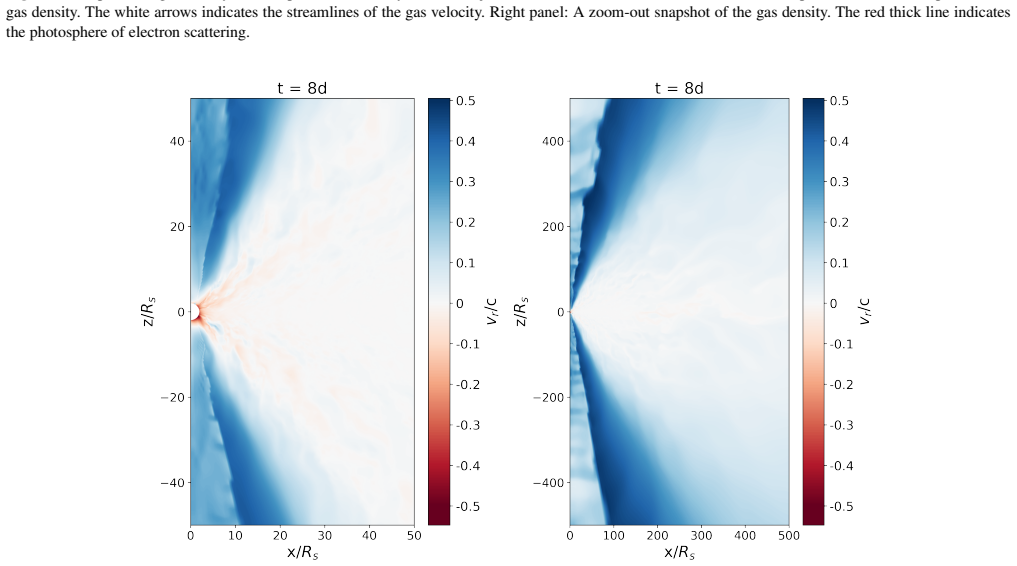
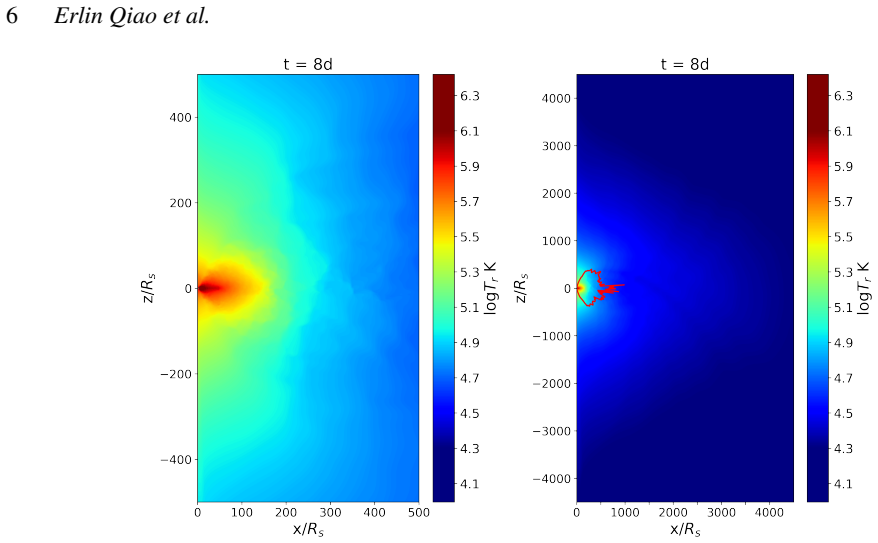
The central mechanism is the viewing-angle-dependent structure of the super-Eddington inflow/outflow system, organized by the critical angle $\theta_{\rm crit}\sim 15^\circ$ that separates an optically thin polar funnel from the optically thick equatorial outflow capped by an electron-scattering photosphere. The funnel allows soft X-rays from the inner region to escape nearly unabsorbed, while the thick outflow reprocesses that emission into the optical band on a roughly isotropic photosphere; this single geometry converts one bolometric engine into angle-dependent X-ray and optical luminosities, temperatures, radii, and their ratio. The load-bearing numerical machinery is the Athena++ radiation hydrodynamic simulation that produces the density, velocity, and radiation-temperature fields, combined with the PYTHON Monte Carlo radiative transfer code that recomputes the gas temperature under radiative equilibrium and traces photon bundles through the simulated outflow to produce the spectra.
What would settle it
Re-run the Monte Carlo transfer with the inner boundary condition replaced by a multi-temperature disk spectrum extending down to the innermost stable orbit: if the face-on X-ray luminosity or its decline with viewing angle changes by more than a factor of a few, the claimed 300-fold spread is set by the imposed seed spectrum rather than by the outflow geometry. Observationally, a TDE whose orientation is independently fixed by a resolved radio jet or polarization, and that is nearly face-on yet shows an X-ray luminosity far below about $10^{44}$ erg/s, would contradict the model.
Extended reading notes
Core claim
The paper reports a 32-day radiation hydrodynamic simulation of super-Eddington accretion in a TDE environment, with a mass supply rate injected at the circularization radius that follows $\dot{M}_{\rm inject}\propto t^{-5/3}$, starting at about 133.8 $\dot{M}_{\rm Edd}$ onto a $10^6\,M_\odot$ black hole. A significant fraction of the inflowing matter is blown off into an outflow whose density and velocity are strongly viewing-angle dependent, with a critical angle $\theta_{\rm crit}\sim 15^\circ$: inside that cone the outflow is optically thin, while outside it an electron-scattering photosphere forms and reprocesses the soft X-rays into optical and UV bands. The emergent spectra, computed with Monte Carlo radiative transfer, yield an X-ray luminosity $L_{X,0.3-2\,\rm keV}$ that drops from about $6\times10^{44}$ to $2\times10^{42}$ erg/s as the viewing angle goes from $0^\circ$ to $90^\circ$, an optical blackbody luminosity of about $10^{43}$ erg/s with at most a factor of four variation, an X-ray-to-optical ratio $L_X/L_O$ that falls from roughly 20 to 0.3, an X-ray blackbody temperature of $4$–$6\times10^5$ K, and an optical temperature of a few times $10^4$ K. The paper claims these values, and their evolution over the 32-day window, are crudely consistent with observations, and notes that the derived $R_{X,\rm BB}$ is about an order of magnitude larger than the observed values. It also points out that the extreme-UV-dominated spectra imply bolometric corrections of a few to a few hundred, which would revise the accreted-mass estimates inferred from X-ray light curves and ease the TDE missing-energy problem.
Load-bearing premise
The radiative-transfer calculation cuts the simulated flow off at 47 Schwarzschild radii and feeds in a single blackbody of a few times $10^5$ K as the seed X-ray field, so the predicted X-ray luminosity and its viewing-angle dependence inherit that imposed boundary condition instead of being computed self-consistently from the hottest inner disk.
Editorial extensions
If this is right
- The observed scatter in early-time TDE X-ray luminosity, roughly $10^{42}$–$10^{44}$ erg/s, can be produced by orientation alone without invoking a large spread in black hole mass or accretion rate.
- The X-ray-to-optical luminosity ratio, ranging from about 20 face-on to about 0.3 edge-on, explains why some TDEs appear X-ray bright and others optically dominated, matching the observed population.
- The near-isotropy of the optical luminosity supports the reprocessing picture in which the optical emission comes from a quasi-spherical outflow photosphere rather than directly from the disk.
- The X-ray light curve tracks the $t^{-5/3}$ fallback law even while the accretion flow is highly super-Eddington, so the classic decay law can survive the nonlinear dynamics of the inflow and outflow.
- The extreme-UV-dominated spectra imply bolometric corrections $k_{\rm bol}$ of a few to a few hundred, so earlier mass estimates that assumed $k_{\rm bol}\sim 1$ may substantially underestimate the accreted mass and the missing-energy problem may be less severe.
Reading between the lines
- If viewing angle is the dominant variable, the TDE population's X-ray luminosity function should be predictable from the intrinsic fallback evolution convolved with an assumed orientation distribution; a random orientation model predicts many more faint, edge-on X-ray TDEs than bright, face-on ones, a count ratio that multi-epoch surveys could test.
- The same funnel-versus-photosphere geometry suggests a dynamical sequence: as the outflow photosphere grows and then fades with the declining fallback rate, an individual source's X-ray-to-optical ratio should drift systematically, which repeated simultaneous UV/X-ray monitoring of one TDE could catch.
- The quantitative face-on X-ray predictions rest on the imposed inner boundary condition of a single blackbody seed field at $47\,R_S$; extending the radiative transfer to a multi-temperature inner disk down to the innermost stable orbit is the natural next test and could shift $L_X$ and $T_{X,\rm BB}$ by factors of a few.
- The same viewing-angle framework, applied to the bolometric corrections, implies that X-ray-selected and optical-selected TDE samples are biased toward different orientations, so the two selection channels may be probing systematically different parts of the same underlying population.
Signed reviews
Editorial analysis
A structured set of objections, weighed in public.
Referee Report
Summary. The paper presents 2D axisymmetric radiation hydrodynamic simulations of super-Eddington accretion in a TDE, using Athena++ with an alpha viscosity (α=0.1) and a pseudo-Newtonian potential, injecting mass at the circularization radius (≈47 Schwarzschild radii) with a t^-5/3 fallback rate and evolving to 32 days. The simulation output is post-processed with the Monte Carlo radiative transfer code PYTHON to produce emergent spectra at viewing angles 0°, 30°, 60°, and 90°. Fitting the X-ray (0.2–3 keV) and optical (3500–7800 Å) bands with single blackbodies, the paper finds that the X-ray luminosity decreases by roughly a factor of 300 from face-on to edge-on while the optical luminosity is nearly isotropic, and claims that the observed luminosities, temperatures, emission radii, X-ray-to-optical ratio, and their evolution can be explained by viewing-angle effects.
Significance. If the central claim were established, the paper would provide a single physical model in which viewing angle, rather than source-to-source variation in black hole mass or accretion rate, drives the observed diversity of TDE X-ray and optical properties. The simulation infrastructure and the emergent outflow geometry—a low-density funnel with θ_crit ≈ 15° and a quasi-isotropic photosphere—are valuable, and the qualitative prediction that face-on systems are X-ray bright while edge-on systems are dominated by optical/UV reprocessed emission is physically plausible. However, the quantitative match to observations is presently fragile because the face-on X-ray spectrum is controlled by an imposed boundary condition rather than by the simulated inner accretion flow. The paper also honestly reports a known discrepancy in the inferred X-ray emission radius, which further limits the strength of the central claim.
major comments (3)
- [Section 2.2] The radiative-transfer post-processing excises the region inside 47 Rs and injects seed photons as a single blackbody with a temperature of 'a few × 10^5 K' obtained by averaging the radiation temperature of the hydrodynamic simulation. Since the funnel at θ < 15° is nearly optically thin (Section 3.1), the face-on X-ray spectrum and the reported values LX(0°) ≈ 6 × 10^44 erg/s and TX,BB ≈ 6 × 10^5 K are essentially the boundary condition escaping the domain, not an emergent prediction of the accretion-flow model. This boundary condition therefore determines the normalization and, because the seed is single-temperature, the spectral shape of the X-ray emission and its dependence on viewing angle. The authors should either include the 2–47 Rs region in the radiative transfer or demonstrate that the results are insensitive to the seed temperature and luminosity, for example by using the accretion luminosity implied by Fig. A4.
- [Section 3.2, panel (4) of Fig. 7] The inferred X-ray blackbody radius RX,BB ≈ 5–20 Rs is an order of magnitude larger than the observed X-ray blackbody radii quoted by the authors. The abstract lists 'the corresponding emission radii' among the quantities that the model explains, so this mismatch contradicts the central claim. The authors acknowledge the discrepancy and argue that the observed values are problematic because they are smaller than the Schwarzschild radius; however, the discrepancy is more naturally explained by the excised inner boundary, which spreads the X-ray emission over the large funnel instead of the compact inner disk. The paper needs a quantitative treatment of this issue, such as recomputing RX,BB with the inner region included or re-scoping the claim about emission radii.
- [Section 3.3, panel (1) of Fig. 8] The evolution of LX,0.3–2keV roughly following t^-5/3 is not an emergent result but a direct consequence of the imposed mass-injection rate ˙Minject(t) ∝ (1 + t/tfb)^-5/3. The text in Section 3.3 states this explicitly. Since the abstract claims that 'the evolution of these quantities' is explained by the viewing-angle framework, the t^-5/3 light-curve evolution should not be counted as a success of the model. The authors should separate the evolution forced by the boundary condition from genuinely emergent features such as the photosphere expansion and TO,BB behavior.
minor comments (5)
- [Abstract and Introduction] The phrase 'Monto Carlo' should be 'Monte Carlo'.
- [Section 2.2, second paragraph] The code name PYTHON may be confused with the Python programming language; a brief clarification that PYTHON is a Monte Carlo radiative transfer code (Long & Knigge 2002) would help.
- [Section 3.2, last paragraph] In the sentence describing Fig. A7, 'OX, BB' appears to be a typo for 'RO, BB'.
- [Abstract and Section 1] The phrase 'a significant fraction of the matter in the accretion inflow are blowed off' should be 'a significant fraction of the matter in the accretion inflow is blown off'.
- [Section 2.1, viscosity formula] The definition of the dynamical viscosity parameter η appears to have a formatting issue in the denominator; please check that the expression is written with the correct algebraic grouping.
Circularity Check
The reported X-ray blackbody temperature and face-on X-ray luminosity are set by the imposed single-blackbody inner boundary at 47 Rs, so part of the central viewing-angle 'prediction' is an input by construction.
-
self definitional
[Section 2.2 (Monte Carlo radiative transfer setup), applied in Section 3.2 (Emergent spectra)]
"We select the radius where the θ-direction averaged velocity field transits from outflow to inflow as the inner boundary of the computational domain, which is found to be just the gas injection point in the simulation (i.e., 47 RS). ... The photons injected from the inner boundary in every iteration is assumed to a single blackbody with a temperature of a few×105K, which is calculated by averaging the radiation temperature of the hydrodynamic simulation. ... For θ < θcrit, there is no photosphere found. ..."
The post-processing excises the accretion flow inside 47 Rs and re-injects a single blackbody at a few×10^5 K as the seed. The polar funnel below θcrit≈15° has no electron-scattering photosphere, so the face-on X-ray spectrum is this seed blackbody escaping almost unchanged. The fitted X-ray blackbody temperature at θ=0° (6.0×10^5 K) is therefore the input boundary temperature by construction, not an independent emergent prediction. The face-on LX≈6×10^44 erg/s and the reported ~300-fold decline with viewing angle also inherit the seed luminosity and the escape fraction through the funnel. Hence the claimed explanation of observed X-ray temperature and luminosity by viewing angle reduces in part to the imposed inner boundary condition.
full rationale
The paper is a forward radiation-hydrodynamic simulation with the standard t^-5/3 fallback law as an input; the fallback law and the simulation setup are not fitted to the observational quantities the paper claims to explain, so the overall framework is not circular. The optical emission isotropy, the LX/LO ratio trend, and the angular dependence of the outflow reprocessing are emergent from the simulated density and velocity structure, and the paper also cites prior independent simulations for the same viewing-angle effect. However, one headline prediction is partially self-definitional: the Monte Carlo post-processing starts at 47 Rs, exactly the gas injection point, and injects a single blackbody at a few×10^5 K computed from the simulation's radiation temperature; because the polar funnel is optically thin, the face-on X-ray spectrum and its fitted blackbody temperature are this imposed seed by construction, and the LX normalization inherits the seed luminosity. I do not count the t^-5/3 decay of LX as circular because the paper explicitly says it reflects the assumed fallback rate, which is an independent theoretical input; it weakens the novelty of the evolution 'prediction' but is not a circular derivation. The admitted RX,BB mismatch with observations is a further limitation, not a circular step. Overall the viewing-angle geometry claim retains independent content, but a central predicted quantity reduces to an imposed boundary condition, so the paper is partially circular (score 6).
Assumptions & free parameters
free parameters (2)
- alpha viscosity parameter =
0.1
- inner boundary seed blackbody temperature =
a few x 10^5 K
assumptions (5)
- domain assumption The fallback rate follows Mdot_inject(t) = (1/3)(M*/tfb)(1+t/tfb)^(-5/3) with immediate circularization at Rc=2RT.
- domain assumption Angular momentum transport is described by an alpha-viscosity prescription with alpha=0.1 and only the r-phi stress component.
- ad hoc to paper The inner region inside 47 Rs can be excised and represented by a single blackbody seed for the radiative transfer.
- domain assumption Axisymmetry in spherical coordinates captures the inflow/outflow structure of the super-Eddington flow.
- domain assumption A pseudo-Newtonian Paczynski-Wiita potential approximates general relativistic effects for a Schwarzschild black hole.
Cite this review
Pith. "Pith review of Early evolution of super-Eddington accretion flow in tidal disruption events." pith.science (2026). https://pith.science/paper/YIY4ANJ4
@misc{pith2026250502434,
  author       = {Pith},
  title        = {Pith review of: Early evolution of super-Eddington accretion flow in tidal disruption events},
  year         = {2026},
  howpublished = {\url{https://pith.science/paper/YIY4ANJ4}},
  note         = {Machine review of arXiv:2505.02434}
}
abstract
Tidal disruption events (TDEs) are luminous black hole (BH) transient sources, which are detected mainly in X-ray and optical bands. It is generally believed that the X-ray emission in TDEs is produced by an accretion disc formed as the stellar debris accreted onto the central BH. The origin of the optical emission is not determined, but could be explained by the `reprocessing' model with the X-ray emission reprocessed into optical band by a surrounding optically thick envelope or outflow. In this paper, we performed radiation hydrodynamic simulations of super-Eddington accretion flow with Athena++ code in the environment of TDEs, i.e., injecting a continuous mass flow rate at the circularization radius in the form of $\dot M_{\rm inject} \propto t^{-5/3}$ for the mass supply rate. We show that a significant fraction of the matter in the accretion inflow are blowed off forming outflow, and the properties of the outflow are viewing-angle dependent. We further calculate the emergent spectra of such an inflow/outflow system for different viewing angles with the method of Monto Carlo radiative transfer. Based on the emergent spectra, we show that the observed features of TDEs, such as the X-ray and optical luminosities, the blackbody temperature of X-ray and optical emission and the corresponding emission radii, the ratio of X-ray luminosity to optical luminosity, as well as the evolution of these quantities can be explained in the framework of viewing-angle effect of super-Eddington accretion around a BH.
Figures


Figures from the paper (5 more)


Forward citations
Cited by 1 Pith paper
-
Multi-messenger View of White Dwarf Tidal Disruption Events by Intermediate-Mass Black Holes: I. Gravitational Waves and Disk Photon and Neutrino Emissions
WD–IMBH tidal disruption disks are advection-dominated, radiate near-Eddington soft X-rays, can emit Galactic MeV neutrinos, and produce decihertz GW bursts.
Reference graph
Works this paper leans on
-
[1]
Abramowicz M. A., Czerny B., Lasota J. P., Szuszkiewicz E., 1988, @doi [ ] 10.1086/166683 , http://adsabs.harvard.edu/abs/1988ApJ...332..646A 332, 646
doi:10.1086/166683 1988
-
[2]
Arcavi I., et al., 2014, @doi [ ] 10.1088/0004-637X/793/1/38 , https://ui.adsabs.harvard.edu/abs/2014ApJ...793...38A 793, 38
-
[3]
Auchettl K., Guillochon J., Ramirez-Ruiz E., 2017, @doi [ ] 10.3847/1538-4357/aa633b , https://ui.adsabs.harvard.edu/abs/2017ApJ...838..149A 838, 149
-
[4]
Bade N., Komossa S., Dahlem M., 1996, , https://ui.adsabs.harvard.edu/abs/1996A&A...309L..35B 309, L35
1996
-
[5]
Bonnerot C., Lu W., 2020, @doi [ ] 10.1093/mnras/staa1246 , https://ui.adsabs.harvard.edu/abs/2020MNRAS.495.1374B 495, 1374
-
[6]
Bonnerot C., Stone N. C., 2021, @doi [ ] 10.1007/s11214-020-00789-1 , https://ui.adsabs.harvard.edu/abs/2021SSRv..217...16B 217, 16
-
[7]
Bonnerot C., Rossi E. M., Lodato G., 2017, @doi [ ] 10.1093/mnras/stw2547 , https://ui.adsabs.harvard.edu/abs/2017MNRAS.464.2816B 464, 2816
-
[8]
Bu D.-F., Qiao E., Yang X.-H., Liu J., Chen Z., Wu Y., 2022, @doi [ ] 10.1093/mnras/stac2399 , https://ui.adsabs.harvard.edu/abs/2022MNRAS.516.2833B 516, 2833
Show all 104 references
-
[9]
Bu D.-F., Qiao E., Yang X.-H., 2023, @doi [ ] 10.1093/mnras/stad1696 , https://ui.adsabs.harvard.edu/abs/2023MNRAS.523.4136B 523, 4136
2023 doi
-
[10]
P., 1982, @doi [ ] 10.1038/296211a0 , https://ui.adsabs.harvard.edu/abs/1982Natur.296..211C 296, 211
Carter B., Luminet J. P., 1982, @doi [ ] 10.1038/296211a0 , https://ui.adsabs.harvard.edu/abs/1982Natur.296..211C 296, 211
1982 doi
-
[11]
Chornock R., et al., 2014, @doi [ ] 10.1088/0004-637X/780/1/44 , https://ui.adsabs.harvard.edu/abs/2014ApJ...780...44C 780, 44
2014 doi
-
[12]
R., Begelman M
Coughlin E. R., Begelman M. C., 2014, @doi [ ] 10.1088/0004-637X/781/2/82 , https://ui.adsabs.harvard.edu/abs/2014ApJ...781...82C 781, 82
2014 doi
-
[13]
Curd B., Narayan R., 2019, @doi [ ] 10.1093/mnras/sty3134 , https://ui.adsabs.harvard.edu/abs/2019MNRAS.483..565C 483, 565
2019 doi
-
[14]
C., Roth N., Ramirez-Ruiz E., Miller M
Dai L., McKinney J. C., Roth N., Ramirez-Ruiz E., Miller M. C., 2018, @doi [ ] 10.3847/2041-8213/aab429 , https://ui.adsabs.harvard.edu/abs/2018ApJ...859L..20D 859, L20
2018 doi
-
[15]
L., Lodato G., Cheng R., 2021, @doi [ ] 10.1007/s11214-020-00747-x , https://ui.adsabs.harvard.edu/abs/2021SSRv..217...12D 217, 12
Dai J. L., Lodato G., Cheng R., 2021, @doi [ ] 10.1007/s11214-020-00747-x , https://ui.adsabs.harvard.edu/abs/2021SSRv..217...12D 217, 12
2021 doi
-
[16]
A., McClintock J
Esin A. A., McClintock J. E., Narayan R., 1997, @doi [ ] 10.1086/304829 , http://adsabs.harvard.edu/abs/1997ApJ...489..865E 489, 865
1997 doi
-
[17]
R., Kochanek C
Evans C. R., Kochanek C. S., 1989, @doi [ ] 10.1086/185567 , https://ui.adsabs.harvard.edu/abs/1989ApJ...346L..13E 346, L13
1989 doi
-
[18]
Falcke H., K \"o rding E., Markoff S., 2004, @doi [ ] 10.1051/0004-6361:20031683 , https://ui.adsabs.harvard.edu/abs/2004A&A...414..895F 414, 895
2004 doi
-
[19]
J., 1976, @doi [ ] 10.1093/mnras/176.3.633 , https://ui.adsabs.harvard.edu/abs/1976MNRAS.176..633F 176, 633
Frank J., Rees M. J., 1976, @doi [ ] 10.1093/mnras/176.3.633 , https://ui.adsabs.harvard.edu/abs/1976MNRAS.176..633F 176, 633
1976 doi
-
[20]
Gezari S., 2021, @doi [ ] 10.1146/annurev-astro-111720-030029 , https://ui.adsabs.harvard.edu/abs/2021ARA&A..59...21G 59, 21
2021 doi
-
[21]
Gezari S., et al., 2006, @doi [ ] 10.1086/509918 , https://ui.adsabs.harvard.edu/abs/2006ApJ...653L..25G 653, L25
2006 doi
-
[22]
Gezari S., et al., 2008, @doi [ ] 10.1086/529008 , https://ui.adsabs.harvard.edu/abs/2008ApJ...676..944G 676, 944
2008 doi
-
[23]
Gezari S., et al., 2009, @doi [ ] 10.1088/0004-637X/698/2/1367 , https://ui.adsabs.harvard.edu/abs/2009ApJ...698.1367G 698, 1367
2009 doi
-
[24]
Gezari S., et al., 2012, @doi [ ] 10.1038/nature10990 , https://ui.adsabs.harvard.edu/abs/2012Natur.485..217G 485, 217
2012 doi
-
[25]
Golightly E. C. A., Coughlin E. R., Nixon C. J., 2019a, @doi [ ] 10.3847/1538-4357/aafd2f , https://ui.adsabs.harvard.edu/abs/2019ApJ...872..163G 872, 163
-
[26]
Golightly E. C. A., Nixon C. J., Coughlin E. R., 2019b, @doi [ ] 10.3847/2041-8213/ab380d , https://ui.adsabs.harvard.edu/abs/2019ApJ...882L..26G 882, L26
- [27]
-
[28]
Guillochon J., Ramirez-Ruiz E., 2013, @doi [ ] 10.1088/0004-637X/767/1/25 , https://ui.adsabs.harvard.edu/abs/2013ApJ...767...25G 767, 25
2013 doi
-
[29]
B., Tokayer Y
Guolo M., Gezari S., Yao Y., van Velzen S., Hammerstein E., Cenko S. B., Tokayer Y. M., 2024, @doi [ ] 10.3847/1538-4357/ad2f9f , https://ui.adsabs.harvard.edu/abs/2024ApJ...966..160G 966, 160
2024 doi
-
[30]
G., Ozernoi L
Gurzadian V. G., Ozernoi L. M., 1979, @doi [ ] 10.1038/280214a0 , https://ui.adsabs.harvard.edu/abs/1979Natur.280..214G 280, 214
1979 doi
-
[31]
Hayasaki K., Stone N., Loeb A., 2013, @doi [ ] 10.1093/mnras/stt871 , https://ui.adsabs.harvard.edu/abs/2013MNRAS.434..909H 434, 909
2013 doi
-
[32]
S., Sim S
Higginbottom N., Knigge C., Long K. S., Sim S. A., Matthews J. H., 2013, @doi [ ] 10.1093/mnras/stt1658 , https://ui.adsabs.harvard.edu/abs/2013MNRAS.436.1390H 436, 1390
2013 doi
-
[33]
G., 1975, @doi [ ] 10.1038/254295a0 , https://ui.adsabs.harvard.edu/abs/1975Natur.254..295H 254, 295
Hills J. G., 1975, @doi [ ] 10.1038/254295a0 , https://ui.adsabs.harvard.edu/abs/1975Natur.254..295H 254, 295
1975 doi
-
[34]
G., 1988, @doi [ ] 10.1038/331687a0 , https://ui.adsabs.harvard.edu/abs/1988Natur.331..687H 331, 687
Hills J. G., 1988, @doi [ ] 10.1038/331687a0 , https://ui.adsabs.harvard.edu/abs/1988Natur.331..687H 331, 687
1988 doi
-
[35]
Holoien T. W. S., et al., 2014, @doi [ ] 10.1093/mnras/stu1922 , https://ui.adsabs.harvard.edu/abs/2014MNRAS.445.3263H 445, 3263
2014 doi
-
[36]
Holoien T. W. S., et al., 2016, @doi [ ] 10.1093/mnras/stv2486 , https://ui.adsabs.harvard.edu/abs/2016MNRAS.455.2918H 455, 2918
2016 doi
-
[37]
Jiang Y.-F., 2021, @doi [ ] 10.3847/1538-4365/abe303 , https://ui.adsabs.harvard.edu/abs/2021ApJS..253...49J 253, 49
2021 doi
-
[38]
M., Davis S
Jiang Y.-F., Stone J. M., Davis S. W., 2012, @doi [ ] 10.1088/0067-0049/199/1/14 , https://ui.adsabs.harvard.edu/abs/2012ApJS..199...14J 199, 14
2012 doi
-
[39]
M., Davis S
Jiang Y.-F., Stone J. M., Davis S. W., 2014, @doi [ ] 10.1088/0004-637X/796/2/106 , https://ui.adsabs.harvard.edu/abs/2014ApJ...796..106J 796, 106
2014 doi
-
[40]
Jiang Y.-F., Guillochon J., Loeb A., 2016, @doi [ ] 10.3847/0004-637X/830/2/125 , https://ui.adsabs.harvard.edu/abs/2016ApJ...830..125J 830, 125
2016 doi
-
[41]
M., Davis S
Jiang Y.-F., Stone J. M., Davis S. W., 2019, @doi [ ] 10.3847/1538-4357/ab29ff , https://ui.adsabs.harvard.edu/abs/2019ApJ...880...67J 880, 67
2019 doi
-
[42]
C., Schmitt H
Komossa S., 2004, in Storchi-Bergmann T., Ho L. C., Schmitt H. R., eds, Vol. 222, The Interplay Among Black Holes, Stars and ISM in Galactic Nuclei. pp 45--48, @doi 10.1017/S1743921304001425
2004 doi
-
[43]
Komossa S., 2015, @doi [Journal of High Energy Astrophysics] 10.1016/j.jheap.2015.04.006 , https://ui.adsabs.harvard.edu/abs/2015JHEAp...7..148K 7, 148
2015 doi
- [44]
- [45]
-
[46]
Komossa S., Halpern J., Schartel N., Hasinger G., Santos-Lleo M., Predehl P., 2004, @doi [ ] 10.1086/382046 , https://ui.adsabs.harvard.edu/abs/2004ApJ...603L..17K 603, L17
2004 doi
-
[47]
Komossa S., et al., 2008, @doi [ ] 10.1086/588281 , https://ui.adsabs.harvard.edu/abs/2008ApJ...678L..13K 678, L13
2008 doi
-
[48]
G., Jester S., Fender R., 2006, @doi [ ] 10.1111/j.1365-2966.2006.10954.x , https://ui.adsabs.harvard.edu/abs/2006MNRAS.372.1366K 372, 1366
K \"o rding E. G., Jester S., Fender R., 2006, @doi [ ] 10.1111/j.1365-2966.2006.10954.x , https://ui.adsabs.harvard.edu/abs/2006MNRAS.372.1366K 372, 1366
2006
-
[49]
Law-Smith J., Guillochon J., Ramirez-Ruiz E., 2019, @doi [ ] 10.3847/2041-8213/ab379a , https://ui.adsabs.harvard.edu/abs/2019ApJ...882L..25L 882, L25
2019 doi
-
[50]
Li L.-X., Narayan R., Menou K., 2002, @doi [ ] 10.1086/341890 , https://ui.adsabs.harvard.edu/abs/2002ApJ...576..753L 576, 753
2002 doi
-
[51]
F., Qiao E., 2022, @doi [iScience] 10.1016/j.isci.2021.103544 , https://ui.adsabs.harvard.edu/abs/2022iSci...25j3544L 25, 103544
Liu B. F., Qiao E., 2022, @doi [iScience] 10.1016/j.isci.2021.103544 , https://ui.adsabs.harvard.edu/abs/2022iSci...25j3544L 25, 103544
2022
-
[53]
R., Pringle J
Lodato G., King A. R., Pringle J. E., 2009, @doi [ ] 10.1111/j.1365-2966.2008.14049.x , https://ui.adsabs.harvard.edu/abs/2009MNRAS.392..332L 392, 332
2009
-
[54]
Loeb A., Ulmer A., 1997, @doi [ ] 10.1086/304814 , https://ui.adsabs.harvard.edu/abs/1997ApJ...489..573L 489, 573
1997 doi
-
[55]
S., Knigge C., 2002, @doi [ ] 10.1086/342879 , https://ui.adsabs.harvard.edu/abs/2002ApJ...579..725L 579, 725
Long K. S., Knigge C., 2002, @doi [ ] 10.1086/342879 , https://ui.adsabs.harvard.edu/abs/2002ApJ...579..725L 579, 725
2002 doi
-
[56]
B., Morel J
Lowrie R. B., Morel J. E., Hittinger J. A., 1999, @doi [ ] 10.1086/307515 , https://ui.adsabs.harvard.edu/abs/1999ApJ...521..432L 521, 432
1999 doi
-
[57]
Lu W., Bonnerot C., 2020, @doi [ ] 10.1093/mnras/stz3405 , https://ui.adsabs.harvard.edu/abs/2020MNRAS.492..686L 492, 686
2020 doi
-
[58]
P., Marck J
Luminet J. P., Marck J. A., 1985, @doi [ ] 10.1093/mnras/212.1.57 , https://ui.adsabs.harvard.edu/abs/1985MNRAS.212...57L 212, 57
1985 doi
-
[59]
J., 2003, @doi [ ] 10.1051/0004-6361:20031146 , http://adsabs.harvard.edu/abs/2003A
Maccarone T. J., 2003, @doi [ ] 10.1051/0004-6361:20031146 , http://adsabs.harvard.edu/abs/2003A
2003 doi
-
[60]
P., Ulmer M
Maksym W. P., Ulmer M. P., Eracleous M., 2010, @doi [ ] 10.1088/0004-637X/722/2/1035 , https://ui.adsabs.harvard.edu/abs/2010ApJ...722.1035M 722, 1035
2010 doi
-
[61]
H., Knigge C., Long K
Matthews J. H., Knigge C., Long K. S., Sim S. A., Higginbottom N., Mangham S. W., 2016, @doi [ ] 10.1093/mnras/stw323 , https://ui.adsabs.harvard.edu/abs/2016MNRAS.458..293M 458, 293
2016 doi
-
[62]
H., Knigge C., Long K
Matthews J. H., Knigge C., Long K. S., 2017, @doi [ ] 10.1093/mnras/stx231 , https://ui.adsabs.harvard.edu/abs/2017MNRAS.467.2571M 467, 2571
2017 doi
-
[63]
C., Tchekhovskoy A., Sadowski A., Narayan R., 2014, @doi [ ] 10.1093/mnras/stu762 , https://ui.adsabs.harvard.edu/abs/2014MNRAS.441.3177M 441, 3177
McKinney J. C., Tchekhovskoy A., Sadowski A., Narayan R., 2014, @doi [ ] 10.1093/mnras/stu762 , https://ui.adsabs.harvard.edu/abs/2014MNRAS.441.3177M 441, 3177
2014 doi
-
[64]
Merloni A., Heinz S., di Matteo T., 2003, @doi [ ] 10.1046/j.1365-2966.2003.07017.x , http://adsabs.harvard.edu/abs/2003MNRAS.345.1057M 345, 1057
2003
-
[65]
D., 2022, @doi [ ] 10.3847/2041-8213/ac90ba , https://ui.adsabs.harvard.edu/abs/2022ApJ...937L..12M 937, L12
Metzger B. D., 2022, @doi [ ] 10.3847/2041-8213/ac90ba , https://ui.adsabs.harvard.edu/abs/2022ApJ...937L..12M 937, L12
2022 doi
-
[66]
D., Stone N
Metzger B. D., Stone N. C., 2016, @doi [ ] 10.1093/mnras/stw1394 , https://ui.adsabs.harvard.edu/abs/2016MNRAS.461..948M 461, 948
2016 doi
-
[67]
F., Meyer-Hofmeister E., 2000a, , http://ads.bao.ac.cn/abs/2000A
Meyer F., Liu B. F., Meyer-Hofmeister E., 2000a, , http://ads.bao.ac.cn/abs/2000A
-
[68]
F., Meyer-Hofmeister E., 2000b, , http://ads.bao.ac.cn/abs/2000A
Meyer F., Liu B. F., Meyer-Hofmeister E., 2000b, , http://ads.bao.ac.cn/abs/2000A
-
[69]
C., 2015, @doi [ ] 10.1088/0004-637X/805/1/83 , https://ui.adsabs.harvard.edu/abs/2015ApJ...805...83M 805, 83
Miller M. C., 2015, @doi [ ] 10.1088/0004-637X/805/1/83 , https://ui.adsabs.harvard.edu/abs/2015ApJ...805...83M 805, 83
2015 doi
-
[70]
Moravec E., Svoboda J., Borkar A., Boorman P., Kynoch D., Panessa F., Mingo B., Guainazzi M., 2022, @doi [ ] 10.1051/0004-6361/202142870 , https://ui.adsabs.harvard.edu/abs/2022A&A...662A..28M 662, A28
2022 doi
-
[71]
Narayan R., Yi I., 1994, @doi [ ] 10.1086/187381 , http://ads.bao.ac.cn/abs/1994ApJ...428L..13N 428, L13
1994 doi
-
[72]
Narayan R., Yi I., 1995, @doi [ ] 10.1086/176343 , http://ads.bao.ac.cn/abs/1995ApJ...452..710N 452, 710
1995 doi
-
[73]
Ohsuga K., Mineshige S., 2011, @doi [ ] 10.1088/0004-637X/736/1/2 , https://ui.adsabs.harvard.edu/abs/2011ApJ...736....2O 736, 2
2011 doi
-
[74]
Ohsuga K., Mori M., Nakamoto T., Mineshige S., 2005, @doi [ ] 10.1086/430728 , https://ui.adsabs.harvard.edu/abs/2005ApJ...628..368O 628, 368
2005 doi
-
[75]
S., 1989, in Morris M., ed., Vol
Phinney E. S., 1989, in Morris M., ed., Vol. 136, The Center of the Galaxy. p. 543
1989
-
[76]
M., Shiokawa H., 2015, @doi [ ] 10.1088/0004-637X/806/2/164 , https://ui.adsabs.harvard.edu/abs/2015ApJ...806..164P 806, 164
Piran T., Svirski G., Krolik J., Cheng R. M., Shiokawa H., 2015, @doi [ ] 10.1088/0004-637X/806/2/164 , https://ui.adsabs.harvard.edu/abs/2015ApJ...806..164P 806, 164
2015 doi
-
[77]
F., 2013, @doi [ ] 10.1088/0004-637X/764/1/2 , http://ads.bao.ac.cn/abs/2013ApJ...764....2Q 764, 2
Qiao E., Liu B. F., 2013, @doi [ ] 10.1088/0004-637X/764/1/2 , http://ads.bao.ac.cn/abs/2013ApJ...764....2Q 764, 2
2013 doi
-
[78]
J., 1988, @doi [ ] 10.1038/333523a0 , https://ui.adsabs.harvard.edu/abs/1988Natur.333..523R 333, 523
Rees M. J., 1988, @doi [ ] 10.1038/333523a0 , https://ui.adsabs.harvard.edu/abs/1988Natur.333..523R 333, 523
1988 doi
-
[79]
A., McClintock J
Remillard R. A., McClintock J. E., 2006, @doi [ ] 10.1146/annurev.astro.44.051905.092532 , http://adsabs.harvard.edu/abs/2006ARA
2006 arXiv
-
[80]
M., Stone N
Rossi E. M., Stone N. C., Law-Smith J. A. P., Macleod M., Lodato G., Dai J. L., Mandel I., 2021, @doi [ ] 10.1007/s11214-021-00818-7 , https://ui.adsabs.harvard.edu/abs/2021SSRv..217...40R 217, 40
2021 doi
-
[81]
Roth N., Kasen D., Guillochon J., Ramirez-Ruiz E., 2016, @doi [ ] 10.3847/0004-637X/827/1/3 , https://ui.adsabs.harvard.edu/abs/2016ApJ...827....3R 827, 3
2016 doi
-
[82]
C., 2020a, @doi [ ] 10.3847/1538-4357/abb3cf , https://ui.adsabs.harvard.edu/abs/2020ApJ...904...98R 904, 98
Ryu T., Krolik J., Piran T., Noble S. C., 2020a, @doi [ ] 10.3847/1538-4357/abb3cf , https://ui.adsabs.harvard.edu/abs/2020ApJ...904...98R 904, 98
-
[83]
C., 2020b, @doi [ ] 10.3847/1538-4357/abb3cd , https://ui.adsabs.harvard.edu/abs/2020ApJ...904...99R 904, 99
Ryu T., Krolik J., Piran T., Noble S. C., 2020b, @doi [ ] 10.3847/1538-4357/abb3cd , https://ui.adsabs.harvard.edu/abs/2020ApJ...904...99R 904, 99
-
[84]
C., 2020c, @doi [ ] 10.3847/1538-4357/abb3ce , https://ui.adsabs.harvard.edu/abs/2020ApJ...904..100R 904, 100
Ryu T., Krolik J., Piran T., Noble S. C., 2020c, @doi [ ] 10.3847/1538-4357/abb3ce , https://ui.adsabs.harvard.edu/abs/2020ApJ...904..100R 904, 100
-
[85]
Sacchi A., Lodato G., 2019, @doi [ ] 10.1093/mnras/stz981 , https://ui.adsabs.harvard.edu/abs/2019MNRAS.486.1833S 486, 1833
2019 doi
-
[86]
Sadowski A., Narayan R., 2015, @doi [ ] 10.1093/mnras/stv1802 , https://ui.adsabs.harvard.edu/abs/2015MNRAS.453.3213S 453, 3213
2015 doi
-
[87]
C., Tchekhovskoy A., 2014, @doi [ ] 10.1093/mnras/stt2479 , https://ui.adsabs.harvard.edu/abs/2014MNRAS.439..503S 439, 503
S a dowski A., Narayan R., McKinney J. C., Tchekhovskoy A., 2014, @doi [ ] 10.1093/mnras/stt2479 , https://ui.adsabs.harvard.edu/abs/2014MNRAS.439..503S 439, 503
2014 doi
-
[88]
G., 2021, Correction to: X-Ray Properties of TDEs , Space Science Reviews, Volume 217, Issue 1, article id.18 ( @eprint arXiv 2103.15442 ), @doi 10.1007/s11214-020-00759-7
Saxton R., Komossa S., Auchettl K., Jonker P. G., 2021, Correction to: X-Ray Properties of TDEs , Space Science Reviews, Volume 217, Issue 1, article id.18 ( @eprint arXiv 2103.15442 ), @doi 10.1007/s11214-020-00759-7
2021 arXiv
-
[89]
H., Cheng R
Shiokawa H., Krolik J. H., Cheng R. M., Piran T., Noble S. C., 2015, @doi [ ] 10.1088/0004-637X/804/2/85 , https://ui.adsabs.harvard.edu/abs/2015ApJ...804...85S 804, 85
2015 doi
-
[91]
A., Proga D., Miller L., Long K
Sim S. A., Proga D., Miller L., Long K. S., Turner T. J., 2010b, @doi [ ] 10.1111/j.1365-2966.2010.17215.x , https://ui.adsabs.harvard.edu/abs/2010MNRAS.408.1396S 408, 1396
2010
-
[92]
C., 2024, @doi [ ] 10.1038/s41586-023-06875-y , https://ui.adsabs.harvard.edu/abs/2024Natur.625..463S 625, 463
Steinberg E., Stone N. C., 2024, @doi [ ] 10.1038/s41586-023-06875-y , https://ui.adsabs.harvard.edu/abs/2024Natur.625..463S 625, 463
2024 doi
-
[93]
R., Stone N
Steinberg E., Coughlin E. R., Stone N. C., Metzger B. D., 2019, @doi [ ] 10.1093/mnrasl/slz048 , https://ui.adsabs.harvard.edu/abs/2019MNRAS.485L.146S 485, L146
2019 doi
-
[94]
M., Tomida K., White C
Stone J. M., Tomida K., White C. J., Felker K. G., 2020, @doi [ ] 10.3847/1538-4365/ab929b , https://ui.adsabs.harvard.edu/abs/2020ApJS..249....4S 249, 4
2020 doi
-
[95]
E., Quataert E., 2009, @doi [ ] 10.1111/j.1365-2966.2009.15599.x , https://ui.adsabs.harvard.edu/abs/2009MNRAS.400.2070S 400, 2070
Strubbe L. E., Quataert E., 2009, @doi [ ] 10.1111/j.1365-2966.2009.15599.x , https://ui.adsabs.harvard.edu/abs/2009MNRAS.400.2070S 400, 2070
2009
-
[96]
E., Liu B
Taam R. E., Liu B. F., Yuan W., Qiao E., 2012, @doi [ ] 10.1088/0004-637X/759/1/65 , http://ads.bao.ac.cn/abs/2012ApJ...759...65T 759, 65
2012 doi
-
[97]
L., Kwan T
Thomsen L. L., Kwan T. M., Dai L., Wu S. C., Roth N., Ramirez-Ruiz E., 2022, @doi [ ] 10.3847/2041-8213/ac911f , https://ui.adsabs.harvard.edu/abs/2022ApJ...937L..28T 937, L28
2022 doi
-
[98]
Ulmer A., 1999, @doi [ ] 10.1086/306909 , https://ui.adsabs.harvard.edu/abs/1999ApJ...514..180U 514, 180
1999 doi
-
[99]
Vink \'o J., et al., 2015, @doi [ ] 10.1088/0004-637X/798/1/12 , https://ui.adsabs.harvard.edu/abs/2015ApJ...798...12V 798, 12
2015 doi
-
[100]
Wu Q., Gu M., 2008, @doi [ ] 10.1086/588187 , http://adsabs.harvard.edu/abs/2008ApJ...682..212W 682, 212
2008 doi
-
[101]
Yuan F., Narayan R., 2014, @doi [ ] 10.1146/annurev-astro-082812-141003 , http://adsabs.harvard.edu/abs/2014ARA
2014 doi
-
[102]
development team A., 2021, PrincetonUniversity/athena-public-version: Athena++ v21.0 , @doi 10.5281/zenodo.4455880 , https://doi.org/10.5281/zenodo.4455880
2021 doi
-
[103]
van Velzen S., et al., 2011, @doi [ ] 10.1088/0004-637X/741/2/73 , https://ui.adsabs.harvard.edu/abs/2011ApJ...741...73V 741, 73
2011 doi
-
[104]
van Velzen S., et al., 2016, @doi [Science] 10.1126/science.aad1182 , https://ui.adsabs.harvard.edu/abs/2016Sci...351...62V 351, 62
2016 doi
-
[105]
van Velzen S., Holoien T. W. S., Onori F., Hung T., Arcavi I., 2020, @doi [ ] 10.1007/s11214-020-00753-z , https://ui.adsabs.harvard.edu/abs/2020SSRv..216..124V 216, 124
2020 doi
-
[106]
van Velzen S., et al., 2021, @doi [ ] 10.3847/1538-4357/abc258 , https://ui.adsabs.harvard.edu/abs/2021ApJ...908....4V 908, 4
2021 doi
Reviewed August 16, 2026 · model on record in the stance chip above.
Discussion (0). Continue with ORCID to comment.