REVIEW 2 major objections 5 minor 296 references
White-dwarf tidal disruptions around intermediate-mass black holes produce soft X-rays near the Eddington limit, MeV neutrinos, and decihertz gravitational-wave bursts.
Reviewed by Pith at T0; open to challenge. T0 means a machine referee read the full paper against a public rubric. the ladder, T0–T4 →
T0 review · grok-4.5
2026-07-11 01:50 UTC pith:MZ3PT7YO
load-bearing objection Solid multi-messenger modeling paper for WD–IMBH TDEs: the soft-X-ray L~few L_Edd claim is robust; the real soft spots are face-on unreprocessed spectra and the neutrino/timescale dependence on rapid circularization. the 2 major comments →
Multi-messenger View of White Dwarf Tidal Disruption Events by Intermediate-Mass Black Holes: I. Gravitational Waves and Disk Photon and Neutrino Emissions
The pith
A machine-rendered reading of the paper's core claim, the machinery that carries it, and where it could break.
Core claim
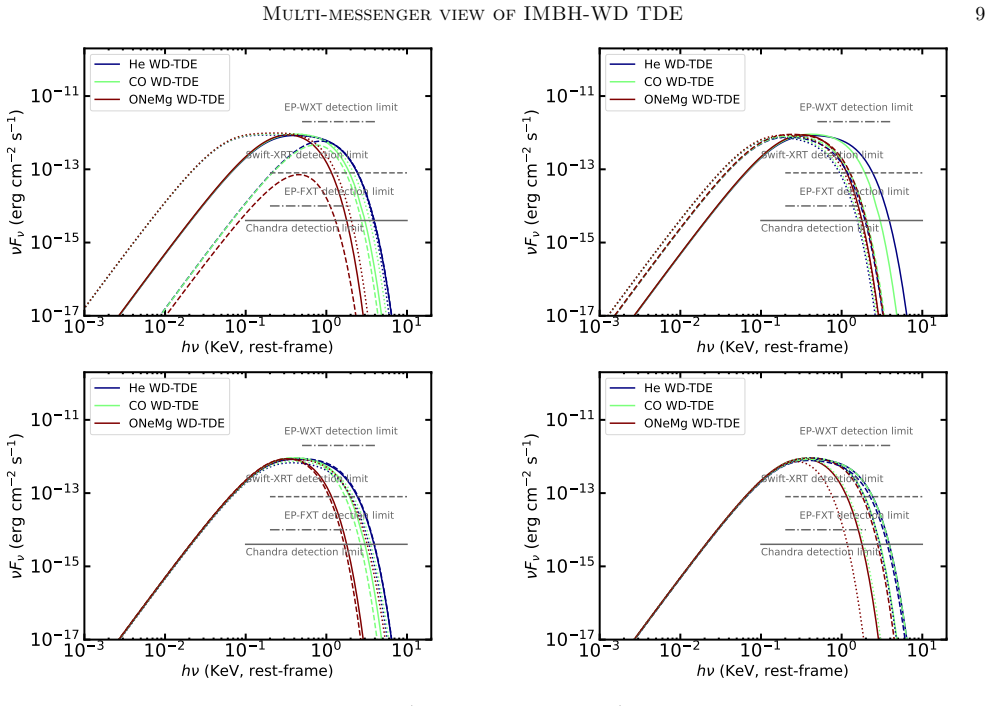
In the extremely super-Eddington regime of white-dwarf tidal disruptions, the newly formed disk is predominantly advection-dominated; consequently its thermal electromagnetic luminosity saturates only a few times above the intermediate-mass black hole’s Eddington luminosity and its spectrum peaks at approximately 0.1–1 keV, remaining nearly insensitive to the fallback rate. The same hot inner flow can produce a MeV neutrino burst reaching ~10^47 erg s^{-1} for oxygen–neon–magnesium white dwarfs around ~10^3 solar-mass black holes, while the pre-disruption gravitational-wave burst peaks at ~0.1–1 Hz.
What carries the argument
A steady, vertically integrated pair–nuclear accretion-disk (PNAD) model that balances viscous plus nuclear heating against radiative diffusion, advection, wind losses and optically thin pair-annihilation neutrino cooling, solved across white-dwarf compositions and black-hole masses to yield temperature, density, luminosity and multi-messenger spectra.
Load-bearing premise
The model assumes that debris circularizes quickly enough for the disk accretion rate to track the fallback rate, so that steady disk solutions at each fallback rate map directly onto the observable light curve.
What would settle it
A soft X-ray light curve of a confirmed white-dwarf tidal disruption whose luminosity continues to rise in lockstep with an independently measured super-Eddington fallback rate, or a non-detection of the predicted 0.1–1 keV thermal component once the jet has faded, would directly test the claimed luminosity saturation and spectral peak.
Editorial analysis
A structured set of objections, weighed in public.
Referee Report
Summary. This paper constructs a steady, vertically integrated accretion-disk model for white-dwarf tidal disruption events around intermediate-mass black holes, incorporating magnetic pressure, nuclear burning, wind mass loss, and e± pair-annihilation neutrino cooling (pair–nuclear accretion disks). At the extremely super-Eddington rates expected for WD–TDEs, the inner flow reaches T≳10^9 K and is predominantly advection-dominated; the thermal EM luminosity only mildly exceeds the IMBH Eddington luminosity and peaks at ∼0.1–1 keV, while ONeMg debris around ∼10^3 M_⊙ IMBHs can produce MeV neutrino bursts up to ∼10^47 erg s^{-1} (Galactic-only detectability). The authors also estimate the GW burst from the final parabolic passage (characteristic frequencies ∼0.1–1 Hz, accessible to proposed decihertz detectors) and a weaker precessing-disk GW signal (horizon ≲1 Mpc). Analytic advection/radiation-pressure scalings (Appendix D) are shown to match the numerical disk profiles, and a simplified global evolution model is used to check that Ṁ_acc tracks Ṁ_fb under wind-mediated viscous transport.
Significance. If the modeling holds, the work supplies a concrete multi-messenger baseline for WD–IMBH TDEs: a robust soft X-ray thermal component nearly independent of fallback rate in the super-Eddington regime, falsifiable MeV neutrino predictions limited to Galactic distances, and GW burst frequencies that place one-off WD–TDEs in the target band of DECIGO/BBO/ALIA. Strengths include explicit microphysical ingredients (pair pressure, Rosseland opacity with Klein–Nishina/pair corrections, neutrino emissivity fit validated against Itoh et al. 1989), analytic scalings that reproduce the numerical solutions, and clear parameter dependence of spectra and luminosities. The connection to the candidate EP250702a and the motivation for coordinated GW+EM+neutrino searches are timely. The companion-paper split (jets/coronae/winds deferred) is appropriate for scope control.
major comments (2)
- §4.1, Eqs. (13)–(15) and Fig. 8: All soft X-ray detectability comparisons (EP-WXT/FXT, Swift-XRT, Chandra) assume a face-on, unreprocessed blackbody disk with σ T_eff^4 = Q_rad. The manuscript itself notes that thick-disk geometry, GR effects, and wind reprocessing can obscure or reprocess the inner emission (citing Dai et al. 2018; Qiao et al. 2025), and §7.3 argues that the wind photosphere may dominate late-time optical emission. Because the multi-messenger detectability claim for current X-ray facilities rests on these face-on fluxes, the paper should either (i) quantify how inclination and wind reprocessing change the soft X-ray flux (e.g., a simple covering-factor or funnel model) or (ii) clearly reframe the claim as an upper-bound polar-view prediction and state the conditions under which the thermal component remains observable.
- §2 and emission calculations vs. §7.2: The load-bearing premise Ṁ_acc ≃ Ṁ_fb is used for all EM and neutrino maps, with only a simplified global evolution check later (Eq. 42; Figs. 18–19). That check is reassuring for wind-mediated viscous disks, but circularization efficiency and stream–disk dissipation remain open (§7.1). The bolometric L ~ few–10 L_Edd result is robust once the flow is super-Eddington (Eq. D26; Fig. 7), so the EM claim is not critically threatened; however, the neutrino peak luminosity and absolute timescales are sensitive to the true peak Ṁ_acc. A short quantitative statement of how incomplete circularization (e.g., Ṁ_acc = f Ṁ_fb with f < 1) rescales Ṁ_ν and the duration of the MeV burst would make the multi-messenger predictions more robust.
minor comments (5)
- Abstract and §4.2: Neutrino luminosity is quoted as up to ∼10^47 erg s^{-1} for ONeMg WD–TDEs, while Fig. 10 caption gives peak values ∼2.5×10^45 erg s^{-1} for M_h = 10^3 M_⊙. Please reconcile the abstract/text peak with the figure (or state the exact parameter combination that reaches 10^47).
- Fig. 17: The multi-messenger power histories are useful but dense; labeling the assumed jet efficiency (0.01 Ṁ_fb c^2 with radiative efficiency ∼0.01) more prominently in the caption would help readers separate model components from order-of-magnitude jet estimates.
- §5.2, Eq. (36)–(37): The precessing-disk GW power is extremely sensitive to R_out (∝ R_out^{-14}). Given that §7.2 finds only modest viscous spreading, a brief note that the horizon in Fig. 16 assumes R_out ≃ R_c (and degrades rapidly if the disk expands) would prevent over-interpretation.
- Notation: Ṁ_acc, Ṁ_in, Ṁ_fb, and Ṁ_BH are all used; a short glossary or consistent usage in §3–4 would reduce ambiguity when winds are active.
- Typos/formatting: “Gravitational W aves” in the title line; occasional missing spaces in units (e.g., erg s^{-1}); ensure arXiv identifiers and GCN citations are consistently formatted in the reference list.
Circularity Check
No significant circularity: EM/neutrino/GW outputs are computed from standard disk microphysics and free parameters; self-citations supply context and fallback scalings, not the load-bearing disk structure.
full rationale
The paper builds a steady, vertically integrated PNAD model from standard ingredients (alpha-viscosity, radiation+gas+magnetic pressure, advection, wind mass-loss with free s-index, pair-annihilation neutrino emissivity fitted to Itoh et al. 1989, nuclear rates from Caughlan & Fowler 1988). The strongest EM claim—that L_gamma only mildly exceeds L_Edd and peaks at ~0.1–1 keV, nearly independent of fallback rate—follows analytically from Q_vis ≃ Q_adv + Q_w with P ≃ P_rad (Appendix D, Eq. D26: L ≃ μ ln(R_out/R_in) L_Edd ≃ 9 L_Edd) and is confirmed numerically (Fig. 7). Neutrino luminosities and spectra are direct integrals of the same temperature structure (Eqs. 16–18); GW burst and precession signals use the Peters–Mathews quadrupole and Lense–Thirring torque with disk mass/size from the model. The premise ˙M_acc ≃ ˙M_fb is an explicit modeling assumption later checked with a simplified global evolution (Sec. 7.2, Figs. 18–19), not a fitted input re-labeled as prediction. Self-citations (Chen & Shen 2018, Chen et al. 2023/2024, Dai et al. 2018) provide TDE context, fallback scalings, and wind-reprocessing caveats; they are not uniqueness theorems that force the disk solutions. The EP250702a comparison is a post-hoc consistency check, not a fit. Score 1 only for ordinary non-load-bearing self-citation of prior TDE/GW work by the same group.
Axiom & Free-Parameter Ledger
free parameters (8)
- viscosity α
- IMBH spin a•
- wind mass-loss index s
- wind kinetic factor K
- disk outer radius R_out / R_in
- radiative efficiency η
- advection factor ξ
- disk tilt θ and precessing mass M_d for GW
axioms (8)
- domain assumption Steady, vertically integrated α-disk with zero-torque ISCO boundary and relativistic correction factor f from Page–Thorne/Riffert–Herold.
- domain assumption ˙M_acc closely tracks ˙M_fb once a disk forms, with wind-mediated mass loss ˙M_in∝R^s.
- domain assumption Neutrino cooling is optically thin pair annihilation only; nuclear captures and trapping negligible.
- domain assumption Magnetic pressure saturates at P_B≃ρ v_K c_gas and remains sub-dominant.
- ad hoc to paper Face-on blackbody disk spectrum from σ T_eff^4 = Q_rad without full GR transfer or wind reprocessing for the primary EM prediction.
- domain assumption Parabolic one-off disruption with R_p=R_t for the GW burst; Peters–Mathews/Berry–Gair energy spectrum.
- domain assumption Rigid-body Lense–Thirring precession of a thick disk with Σ∝R^ζ, ζ~−0.25 to −0.2, and constant tilt during super-Eddington phase.
- domain assumption Standard WD mass–radius relation and full-disruption energy spread Δε≃GM_h R_*/R_t^2.
invented entities (1)
-
Pair–nuclear accretion disk (PNAD)
no independent evidence
read the original abstract
White dwarf (WD) tidal disruption events (TDEs) provide a unique window onto intermediate-mass black holes (IMBHs). We present a multi-messenger view of these systems in two papers. In this paper, we develop an accretion-disk model for WD--TDEs in which the bound debris accretes at extremely super-Eddington rates, $\sim 10^5$--$10^9$ times higher than in typical (main-sequence) TDEs. The model includes magnetic pressure, nuclear-burning heating, wind mass loss, and neutrino production via $e^{\pm}$ pair annihilation. At such high accretion rates, the gas and radiation temperatures of the inner flow can reach $T\gtrsim 10^9\,\mathrm{K}$, enabling prolific pair production and MeV neutrino emission. We find that the disk is predominantly advection dominated over a broad range of accretion rates, while disk winds can partially cool the flow and reduce the inner temperature. The predicted thermal EM emission is nearly insensitive to the fallback rate in the super-Eddington regime: the luminosity only mildly exceeds the IMBH Eddington luminosity and the spectrum peaks at $\sim 0.1$--$1\,\mathrm{keV}$, implying detectability with current X-ray facilities such as Einstein Probe. For low-mass IMBHs ($\sim 10^3\,M_{\odot}$), the disk can also produce a burst of MeV neutrinos with luminosities up to $\sim 10^{47}\,\mathrm{erg\,s^{-1}}$ for ONeMg WD--TDEs, although detectability with current neutrino detectors (e.g., Super-Kamiokande and JUNO) is limited to Galactic distances. Finally, we estimate the GW burst produced during the final passage prior to disruption, which peaks at $\sim 0.1$--$1\,\mathrm{Hz}$, placing WD--TDEs in the target band of proposed decihertz detectors and motivating coordinated GW+EM+neutrino searches. We also present a first exploration of GWs from a precessing WD--TDE disk; this signal is much weaker, with a detection horizon $\lesssim 1\,\mathrm{Mpc}$ for these missions.
Figures




Reference graph
Works this paper leans on
-
[1]
Levan, A. and Tanvir, N. and Cenko, S. and Perley, D. and Wiersema, K. and Bloom, J. and Fruchter, A. and Postigo, A. and. 2011 , title=. doi:10.1126/Sci.1207143 , journal=
-
[2]
doi:10.1126/Sci.1207150 , journal=
2011 , title=. doi:10.1126/Sci.1207150 , journal=
-
[3]
Zauderer, B. and Berger, E. and Soderberg, A. and Loeb, A. and Narayan, R. and Frail, D. and Petitpas, G. and Brunthaler, A. and Chornock, R. and Carpenter, J. and Pooley, G. and Mooley, K. and Kulkarni, S. and Margutti, R. and Fox, D. and Nakar, E. and Patel, N. and Volgenau, N. and Culverhouse, T. and Bietenholz, M. and Rupen, M. and. 2011 , title=. doi...
-
[4]
doi:10.1038/nature10374 , journal=
2011 , title=. doi:10.1038/nature10374 , journal=
-
[6]
On the Survivability and Metamorphism of Tidally Disrupted Giant Planets: the Role of Dense Cores
On the Survivability and Metamorphism of Tidally Disrupted Giant Planets: The Role of Dense Cores. , keywords =. doi:10.1088/0004-637X/762/1/37 , archivePrefix =. 1211.1971 , primaryClass =
work page internal anchor Pith review Pith/arXiv arXiv doi:10.1088/0004-637x/762/1/37 1971
-
[7]
doi:10.1038/s41550-017-0224-z , abstract=
2017 , title=. doi:10.1038/s41550-017-0224-z , abstract=
- [8]
-
[9]
Cannizzo, J. K. and Lee, H. M. and Goodman, J. , pages=. The Disk Accretion of a Tidally Disrupted Star onto a Massive Black Hole , journal=. 1990 , volume=
work page 1990
-
[10]
doi:10.1086/117779 , abstract=
1995 , title=. doi:10.1086/117779 , abstract=
-
[11]
Holoien,. 2015 , title=. doi:10.1093/mnras/stv2486 , number=
-
[12]
doi:10.1086/312840 , abstract=
2000 , title=. doi:10.1086/312840 , abstract=
-
[13]
doi:10.1038/296211a0 , journal=
1982 , title=. doi:10.1038/296211a0 , journal=
-
[14]
2004 , title=. doi:10.1086/423299 , journal=
-
[15]
doi:10.3847/2041-8205/818/2/L32 , journal=
2016 , title=. doi:10.3847/2041-8205/818/2/L32 , journal=
-
[17]
doi:10.1103/PhysRevD.82.044039 , journal=
2010 , title=. doi:10.1103/PhysRevD.82.044039 , journal=
-
[18]
doi:10.1046/j.1365-8711.1999.02853.x , abstract=
1999 , title=. doi:10.1046/j.1365-8711.1999.02853.x , abstract=
-
[19]
doi:10.1088/0264-9381/30/24/244005 , journal=
2013 , title=. doi:10.1088/0264-9381/30/24/244005 , journal=
- [20]
-
[21]
Gezari, S. and Chornock, R. and Rest, A. and Huber, M. E. and Forster, K and Berger, E. and Challis, P. and Neill, J. D. and Martin,. Natur , title=. 2012 , doi=
work page 2012
-
[22]
Pasham, D. and Cenko, S. and Levan, A. and Bower, G. and Horesh, A. and Brown, G. and Dolan, S. and Wiersema, K. and Filippenko, A. and Fruchter, A. and Greiner, J. and. ApJ , title=. 2015 , doi=
work page 2015
- [23]
-
[24]
2009, title Clustering of luminous red galaxies - III
2009 , title=. doi:10.1111/j.1365-2966.2009.15599.x , journal=
-
[25]
ApJ , author=. 2014 , title=. doi:10.1088/0004-637X/784/2/87 , number=
- [26]
-
[27]
doi:10.1093/mnras/stv2081 , journal=
2015 , title=. doi:10.1093/mnras/stv2081 , journal=
-
[28]
doi:10.1093/mnras/sty585 , abstract=
2018 , title=. doi:10.1093/mnras/sty585 , abstract=
- [29]
-
[30]
Liu,. 2009 , title=. doi:10.1088/0004-637X/706/1/L133 , journal=
-
[31]
doi:10.1093/mnras/stx117 , journal=
2017 , title=. doi:10.1093/mnras/stx117 , journal=
-
[32]
Lin, D. and Guillochon, J. and Komossa, S. and. A likely decade-long sustained tidal disruption event , abstract=. 2017 , volume=
work page 2017
-
[33]
doi:10.1093/mnras/stw267 , abstract=
2015 , title=. doi:10.1093/mnras/stw267 , abstract=
-
[34]
doi:10.1093/mnras/stx1755 , abstract=
2016 , title=. doi:10.1093/mnras/stx1755 , abstract=
-
[35]
doi:10.1093/mnrasl/slx147 , abstract=
2017 , title=. doi:10.1093/mnrasl/slx147 , abstract=
-
[36]
doi:10.1088/2041-8205/812/2/L39 , journal=
2015 , title=. doi:10.1088/2041-8205/812/2/L39 , journal=
- [37]
-
[38]
doi:10.3847/0004-637X/830/2/125 , journal=
2016 , title=. doi:10.3847/0004-637X/830/2/125 , journal=
-
[39]
doi:10.3847/0004-637X/827/2/127 , journal=
2016 , title=. doi:10.3847/0004-637X/827/2/127 , journal=
-
[40]
doi:10.1093/mnrasl/slx200 , abstract=
2017 , title=. doi:10.1093/mnrasl/slx200 , abstract=
-
[41]
doi:10.1088/0004-637X/804/2/85 , journal=
2015 , title=. doi:10.1088/0004-637X/804/2/85 , journal=
-
[42]
Metzger, Brian and Vurm, Indrek and Hasco. 2014 , title=. doi:10.1093/mnras/stt1922 , journal=
- [43]
-
[44]
doi:10.1088/0004-637X/809/2/166 , journal=
2015 , title=. doi:10.1088/0004-637X/809/2/166 , journal=
-
[45]
doi:10.1088/0004-637X/783/1/23 , journal=
2014 , title=. doi:10.1088/0004-637X/783/1/23 , journal=
- [46]
-
[47]
doi:10.1093/mnras/stu1795 , journal=
2014 , title=. doi:10.1093/mnras/stu1795 , journal=
- [48]
-
[49]
MNRAS , title=. 2014 , author=. doi:10.1093/mnras/stu1922 , number=
-
[50]
MNRAS , title=. 2016 , author=. doi:10.1093/mnras/stw1928 , number=
-
[51]
doi:10.1093/mnras/stx033 , journal=
2017 , title=. doi:10.1093/mnras/stx033 , journal=
-
[52]
Brown, J. S. and Kochanek, C. S. and Holoien, T. 2018 , title=
work page 2018
-
[53]
Wyrzykowski, Łukasz and Zieliński, M and. 2016 , title=. doi:10.1093/mnrasl/slw213 , journal=
-
[54]
doi:10.1088/2041-8205/815/1/L5 , journal=
2015 , title=. doi:10.1088/2041-8205/815/1/L5 , journal=
-
[55]
Arcavi, Iair and. 2014 , title=. doi:10.1088/0004-637X/793/1/38 , journal=
-
[56]
Velzen, Sjoert and Farrar, Glennys and Gezari, Suvi and Morrell, Nidia and Zaritsky, Dennis and. 2011 , title=. doi:10.1088/0004-637X/741/2/73 , journal=
-
[57]
2003 , title=. doi:10.1086/375802 , journal=
- [58]
-
[59]
doi:10.1088/0004-637X/749/2/117 , journal=
2012 , title=. doi:10.1088/0004-637X/749/2/117 , journal=
-
[60]
2008 , title=. doi:10.1086/528738 , journal=
-
[61]
2008 , title=. doi:10.1086/590899 , journal=
-
[62]
doi:10.1088/0004-637X/743/2/134 , journal=
2011 , title=. doi:10.1088/0004-637X/743/2/134 , journal=
-
[63]
doi:10.1088/0004-637X/697/2/L77 , journal=
2009 , title=. doi:10.1088/0004-637X/697/2/L77 , journal=
- [64]
- [65]
- [66]
-
[67]
doi:10.1088/0004-637X/806/2/164 , journal=
2015 , title=. doi:10.1088/0004-637X/806/2/164 , journal=
-
[68]
doi:10.1093/mnras/stv2347 , journal=
2016 , title=. doi:10.1093/mnras/stv2347 , journal=
- [69]
-
[70]
doi:10.1093/mnras/stv1547 , journal=
2015 , title=. doi:10.1093/mnras/stv1547 , journal=
-
[71]
doi:10.1088/0004-637X/749/1/92 , journal=
2012 , title=. doi:10.1088/0004-637X/749/1/92 , journal=
- [72]
-
[73]
Cenko, S. and Krimm, H. and Horesh, A. and Rau, A. and Frail, D. and Kennea, J. and Levan, A. and Holland, S. and Butler, N. and Quimby, R. and Bloom, J. and Filippenko, A. and. ApJ , title=. 2012 , doi=
work page 2012
-
[74]
Brown, G and Levan, A and Stanway, E and Tanvir, N and Cenko, S and Berger, E and Chornock, R and Cucchiaria, A , volume=. MNRAS , title=. 2015 , doi=
work page 2015
- [75]
-
[76]
Komossa, S. and Bade, N. , volume=. The giant X-ray outbursts in. 1999 , journal=
work page 1999
-
[77]
Bade, N. and Komossa, S. and Dahlem, M. , volume=. Detection of an extremely soft X-ray outburt in the H2-like nucleus of. 1996 , journal=
work page 1996
-
[78]
Kommossa, S. and Greiner, J. , volume=. Discovery of a giant and luminous X-ray outburst from the optically inactive galaxy pair. 1999 , journal=
work page 1999
-
[79]
Esquej, P. and Saxton, R. D. and Komossa, S. and Read, A. M. and Freyberg, M. J. and Hasinger, G. , volume=. Evolution of tidal disruption candidates discovered by. 2008 , journal=
work page 2008
-
[80]
Maksym, W. and Ulmer, M. and Eracleous, M. , volume=. ApJ , title=. 2010 , doi=
work page 2010
-
[81]
Randall, S. and Nulsen, P. and Jones, C. and Forman, W. and Bulbul, E. and Clarke, T. and Kraft, R. and Blanton, E. and David, L. and Werner, N. and Sun, M. and Donahue, M. and Giacintucci, S. and Simionescu, A. , volume=. ApJ , title=. 2015 , doi=
work page 2015
-
[82]
Stern, D. and Dokkum, P and Nugent, P. and Sand, D and Ellis, R and Sullivan, M. and Bloom, J and Frail, D and Kneib, J and Koopmans, L and Treu, T. , volume=. ApJ , title=. 2004 , doi=
work page 2004
discussion (0)
Sign in with ORCID, Apple, or X to comment. Anyone can read and Pith papers without signing in.