REVIEW 3 major objections 4 minor 41 references
Demonstrating Dynamic Stability in Paul Traps: Exploring Rotating Saddles with Liquid Nitrogen Droplets
T0 review · 3 major / 4 minor · reviewed 2026-08-15 · deepseek-v4-flash
Pith's one-line read Liquid nitrogen droplets, levitating on their own vapor, behave like the frictionless point particles of rotating-saddle theory and trap with a sharp threshold at a critical rotation frequency.
desk verdict A genuinely useful classroom-demo paper about Leidenfrost-levitated LN2 droplets in a rotating saddle, but the quantitative claims are undercut by an internal factor-of-two inconsistency in the equations. read the letter →
The pith
A machine-rendered reading of the paper's core claim, the machinery that carries it, and where it could break.
The reading
What carries the argument
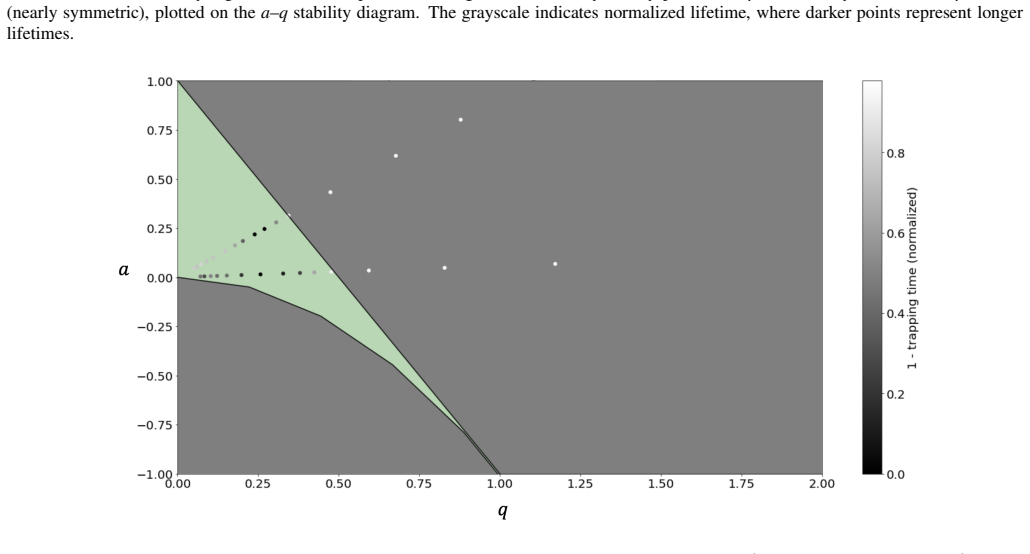
The load-bearing object is the Leidenfrost vapor cushion: a thin layer of nitrogen gas under each droplet that lets it slide without rolling contact, so the droplet's motion is governed by the saddle's rotating potential rather than by surface friction. The companion identities are the hyperbolic potential of Eq. (1), the coupled Mathieu-like equations of motion Eqs. (2) and (3), and the dimensionless stability parameters $a$ and $q$ of Eq. (4), whose triangular stability boundary in the $(a,q)$ plane is the theoretical threshold the experiments probe. With the vapor cushion in place, the equations become the entire dynamical content, and the measured abrupt jump in droplet lifetime at a critical rotation frequency is what the paper reports as the visible image of that boundary.
What would settle it
Record droplet trajectories and escape times as the saddle's rotation frequency is swept in small steps around 1.2 rps for the asymmetric saddle while varying initial droplet size and release position; if stable trapping appears gradually below that frequency, or if lifetimes depend strongly on droplet size or release point, the droplet is not behaving as a frictionless point particle and the sharp-threshold claim fails.
Extended reading notes
Core claim
The central claim is that a Leidenfrost liquid-nitrogen droplet on a rotating saddle is a faithful mechanical analog of an ideal point particle in an RF Paul trap. In the rotating frame, the saddle's gravitational potential takes the hyperbolic form of Eq. (1), and the dimensionless equations of motion reduce to the coupled Mathieu-like system of Eqs. (2) and (3), with stability parameters $a$ and $q$ defined by Eq. (4). The paper reports that measured droplet lifetimes, plotted in the $(a,q)$ plane, show a sharply defined stability boundary: trapping jumps from near-immediate ejection to average lifetimes beyond 15 seconds when the rotation frequency crosses roughly 1.2 rps on the asymmetric saddle with $\beta = 2.67$. Observed droplet trajectories retain the rotating, ponderomotive-like orbital structure predicted for a frictionless particle, while ball bearings show a broader, less distinct stability region and exponentially spiraling trajectories smoothed by friction and rolling. The conclusion is that the Leidenfrost droplet version is a cleaner experimental realization of rotating-saddle and Paul-trap dynamics.
Load-bearing premise
The paper assumes that a Leidenfrost liquid-nitrogen droplet behaves as a frictionless point particle in the rotating saddle potential, with negligible drag, deformation, vapor-layer coupling, and mass loss over the observation time, so that the measured sharp threshold is a clean test of the rotating-saddle model.
Editorial extensions
If this is right
- If LN2 droplets approximate frictionless point particles, the measured 1.2 rps transition is a direct experimental image of the theoretical stability boundary of the Mathieu-like equations, not an artifact of rolling friction.
- Because droplets trap even when released off-center or with some initial motion, instructors can dispense them casually and still obtain stable trapping, removing the precise placement required with ball bearings.
- The comparison shows why rolling friction distorts the classic demonstration: ball bearings display a broader and less distinct stable region and friction-smoothed spiral trajectories, so switching to Leidenfrost droplets should reduce student misconceptions about dynamic stability.
- Saddles with different asymmetry coefficients trace distinct straight lines in the $(a,q)$ stability plane, allowing the same apparatus to illustrate how small potential asymmetries in real Paul traps shift stability boundaries.
- The same lifetime-versus-frequency measurement could become a quantitative classroom exercise in which students map the boundary of the Mathieu stability region.
Reading between the lines
- A testable extension not pursued in the paper: high-speed video tracking of droplet center-of-mass motion would let one compare the measured orbital precession and growth rates with the analytic Mathieu solution, turning the demonstration into a quantitative experiment.
- Because droplet mass slowly decreases by evaporation over the reported 15-30 second lifetimes, the stability parameters drift during a long run; the paper does not assess whether this drift is negligible, so a careful quantitative study might need to account for it.
- The same apparatus could be swept downward through the threshold to look for hysteresis or a frequency-dependent transition, connecting the classroom demonstration to the way actual Paul traps are tuned through their stability diagram.
- If droplet size is varied deliberately, one could probe how finite-size and vapor-cushion effects depart from point-particle dynamics, offering a route to connect the demonstration to the broader physics of levitated droplets.
Signed reviews
Editorial analysis
A structured set of objections, weighed in public.
Referee Report
Summary. The paper presents a classroom demonstration of dynamic stability in rotating saddle potentials using liquid nitrogen (LN2) droplets that levitate via the Leidenfrost effect. The authors describe the theoretical background from a companion paper, a complete apparatus built from 3D-printed saddles and a stepper motor, practical demonstration procedures, and comparative measurements of trapping lifetimes and trajectories for LN2 droplets versus traditional ball bearings. Their central claims are that LN2 droplets exhibit a sharply defined stability threshold near 1.2 rps, that their trajectories more closely match theoretical predictions than do ball bearings, and that the demonstration is clearer and more pedagogically effective than existing rolling-object versions.
Significance. If the quantitative claims were fully supported, this would be a genuinely valuable contribution to undergraduate physics education: Leidenfrost droplets indeed eliminate rolling friction and internal rotation, potentially offering a cleaner mechanical analog of RF Paul trap dynamics than ball bearings. The paper is strong on practical reproducibility, providing a full materials list with costs, concrete fabrication instructions, a Python script for generating saddle geometry, and thoughtful guidance for classroom use, as well as explicit attribution to the companion theory paper. The sharp-threshold observation is an interesting experimental fact that motivates further study. However, the quantitative evidence for the paper's main claims is currently undermined by an internal inconsistency in the governing equations and by the absence of any statistical treatment of the lifetime data.
major comments (3)
- [II, Eqs. (4)-(5)] Equation (5) is inconsistent with Eq. (4) by a factor of 2. From Eq. (4), a/q = (β−1)/(β+1), so a = (β−1)/(β+1)q, not a = 2(β−1)/(β+1)q. Moreover, if q is defined as in Eq. (4), the equations of motion (2)–(3) contain q rather than 2q in the oscillatory terms; expanding the potential (1) into lab-frame coordinates yields a coefficient (β+1) for the time-dependent terms, and with q = gh0(β+1)/(r0²Ω²) the x-equation becomes x'' + a x + q cos(2τ) x + q sin(2τ) y = 0 (up to sign conventions). As a result, the printed mapping from measured rotation frequency to the (a,q) stability diagram is not well defined, and the statement that the 1.2 rps threshold 'closely matches theoretical predictions' is not supported by the printed equations. Please reconcile the definitions and equations, then re-plot Figs. 5–6 if necessary.
- [V.A, Figs. 4-6] The lifetime measurements are presented as single values per rotation frequency, with no error bars, no trial counts, and no statistical characterization. The central claim that LN2 droplets exhibit an abrupt stability threshold at ~1.2 rps while ball bearings show a gradual threshold at ~1.25–1.3 rps rests entirely on these data. Please report the number of trials per frequency, the range or standard deviation of measured lifetimes, and the criterion used to define a 'threshold' given the finite observation window.
- [V.B, Figs. 7-8] The predicted trajectories on the right-hand sides of Figs. 7 and 8 are generated from the same model that the paper is testing, using initial conditions taken from the observed runs, so the visual resemblance does not constitute an independent test of the model. A quantitative measure of agreement (e.g., time-averaged distance between observed and predicted trajectories) would be needed to support the claim that the LN2 droplet 'more closely resembles theoretical predictions' than the ball bearing. The authors should also explicitly discuss whether effects of the Leidenfrost vapor layer, droplet deformation, or mass loss over the 15–30 s observation times were considered, as these could materially affect the interpretation of the measured threshold.
minor comments (4)
- [IV (saddle description)] The sentence 'The nearly symmetric saddle (β = 1.06) corresponds to a vertical deviation of approximately 1.5 mm ... compared to a perfectly symmetric saddle (β = 1.06)' contains an obvious typo: the second β should be 1.0, not 1.06.
- [IV.B] The sentence 'The asymmetric saddle (β = 2.67) data points near the stability threshold correspond exactly to the sharp transition in trapping lifetime previously illustrated in Fig. 5' should refer to Fig. 4, not Fig. 5.
- [IV.B] The phrase 'correspond exactly to the sharp transition' overstates precision; the data points merely correspond to the transition shown in Fig. 4.
- [Fig. 1 caption] The statement 'For negative a, stability terminates at q = 1, a = −1' is ambiguous: it should specify whether this is a single point or a boundary segment, and the description is not clearly reflected in the figure as reproduced.
Circularity Check
No significant circularity: the threshold and lifetime claims are experimental measurements compared with a forward model whose parameters are fixed by geometry, not fitted to the data.
full rationale
The paper's quantitative claims rest on measured trapping lifetimes and observed trajectories. The rotation-frequency threshold near 1.2 rps is an experimental observation (Fig. 4), not a value derived from the theory and then compared back to the same theory. Re-plotting those measured lifetimes in the (a,q) plane uses Eq. (4) with the predetermined geometric parameters β, h0, and r0; no parameter is fitted to the lifetime data and then renamed a prediction. The theoretical trajectories in Figs. 7 and 8 are forward integrations of the stated Mathieu-like equations using initial conditions read from individual runs; using measured initial conditions is a standard model test and is not equivalent to fitting the model to the outcome. The stability boundary is standard material and is cited to both external literature [12] and the authors' companion paper [21]; although the companion citation is self-referential, the boundary is not an input calibrated to the present data, and the paper does not invoke any uniqueness theorem from that citation to force its interpretation. The observed sharp threshold and the experimental comparison therefore retain independent content. The notable algebraic inconsistency between Eq. (4) and Eq. (5) (a factor of 2), and between Eq. (4) and the 2q coefficients in Eqs. (2)-(3), is a correctness/consistency issue that would affect the printed quantitative mapping, but it is not circular reasoning: the equations are not defined in terms of the measurements, and the central threshold is an observed quantity rather than an output derived from those equations. Accordingly, no circular step is present.
Assumptions & free parameters
free parameters (2)
- Saddle asymmetry coefficient beta =
1.06 and 2.67
- Saddle height h0 and radius r0 =
h0 = 2.5 cm, r0 = 9 cm
assumptions (4)
- domain assumption The saddle surface is exactly the quadratic potential U = mgh0/r0^2 (beta x^2 - y^2) with no significant surface imperfections or deformation.
- domain assumption A Leidenfrost LN2 droplet behaves as a point particle with no rolling, negligible friction, no vapor-layer coupling, and no significant mass loss over the measured lifetime.
- standard math Eqs. (2)-(3) and the associated stability boundaries correctly describe the boundedness of ideal particle motion.
- domain assumption The stepper motor's commanded rotation frequency equals the actual saddle rotation frequency, and the measured geometry is exact.
Cite this review
Pith. "Pith review of Demonstrating Dynamic Stability in Paul Traps: Exploring Rotating Saddles with Liquid Nitrogen Droplets." pith.science (2026). https://pith.science/paper/Z6QYY6QO
@misc{pith2026250504035,
  author       = {Pith},
  title        = {Pith review of: Demonstrating Dynamic Stability in Paul Traps: Exploring Rotating Saddles with Liquid Nitrogen Droplets},
  year         = {2026},
  howpublished = {\url{https://pith.science/paper/Z6QYY6QO}},
  note         = {Machine review of arXiv:2505.04035}
}
read the original abstract
Rotating saddle potentials provide a compelling visual demonstration of dynamic stability, widely used in undergraduate physics as mechanical analogs to the RF Paul trap. Traditional demonstrations typically rely on rolling ball bearings, whose frictional effects and internal rotation obscure fundamental particle dynamics. We introduce a simple yet significant improvement by employing droplets of liquid nitrogen LN2, which levitate via the Leidenfrost effect, eliminating rolling dynamics and greatly reducing friction. LN2 droplets clearly illustrate the rotating ponderomotive-like force, producing trajectories closely consistent with theoretical predictions. Using experimental data, we compare the stability threshold and particle trajectories of LN2 droplets and traditional ball bearings. LN2 droplets exhibit a sharply defined and visually distinct stability threshold, transitioning abruptly from unstable to stable motion at a critical rotation frequency. In contrast, ball bearings demonstrate a more gradual threshold, accompanied by trajectories complicated by friction-induced deviations. We present detailed measurements of particle lifetimes and trajectories as functions of dimensionless stability parameters for both symmetric and intentionally asymmetric saddles. These improvements significantly enhance visual and conceptual clarity, reduce common misconceptions related to frictional dynamics, and provide natural opportunities for exploring related phenomena such as the Leidenfrost effect. We also offer practical guidance on assembling and implementing this enhanced demonstration for effective classroom and laboratory instruction.
Figures


Figures from the paper (5 more)



Reference graph
Works this paper leans on
-
[21]
T. D. Ladd, F. Jelezko, R. Laflamme, Y . Nakamura, C. Monroe, and J. L. O’Brien, Quantum computing, Nature 464, 45 (2010)
work page 2010
-
[1]
Dispensing liquid nitrogen onto the saddle Pipettes and other traditional dispensers often become clogged with condensation, making them unreliable for deliv- ering LN2 to a rotating saddle. The most consistent method we found involved an 8-ounce styrofoam cup with a small (approximately 2 mm-wide) hole punched near the lower rim. Holding the cup above th...
-
[2]
W. Paul, Electromagnetic traps for charged and neutral parti- cles, Reviews of Modern Physics 62, 531 (1990)
work page 1990
-
[3]
Rueckner et al., Rotating saddle paul trap, American Journal of Physics 63, 186 (1995)
W. Rueckner et al., Rotating saddle paul trap, American Journal of Physics 63, 186 (1995)
work page 1995
-
[4]
P. L. Kapitza, Dynamic stability of a pendulum when its point of suspension vibrates, Soviet Physics JETP 21, 588–598 (1951)
work page 1951
-
[5]
R. R. Whymark, Acoustic levitation of liquid drops, Nature254, 585–586 (1975)
work page 1975
-
[6]
E. L. Raab, M. Prentiss, A. Cable, S. Chu, and D. E. Pritchard, Trapping of neutral sodium atoms with radiation pressure, Physical Review Letters 59, 2631–2634 (1987)
work page 1987
-
[7]
I. Bialynicki-Birula, M. Kalinski, and J. H. Eberly, Lagrange Equilibrium Points in Celestial Mechanics and Nonspreading Wave Packets for Strongly Driven Rydberg Electrons, Physical Review Letters 73, 1777 (1994)
work page 1994
Show all 41 references
-
[8]
C. D. Murray and S. F. Dermott, Solar System Dynamics (Cam- bridge University Press, 1999)
1999
-
[9]
H. G. Dehmelt, Radiofrequency spectroscopy of stored ions i: Storage, Advances in Atomic and Molecular Physics 3, 53 (1967)
1967
-
[10]
Leibfried, R
D. Leibfried, R. Blatt, C. Monroe, and D. Wineland, Quantum dynamics of single trapped ions, Reviews of Modern Physics 75, 281 (2003)
2003
-
[11]
Abe and T
K. Abe and T. Hasegawa, Quantum mechanics in rotating- radio-frequency traps and penning traps with a quadrupole ro- tating field, Physical Review A 81, 033402 (2010)
2010
-
[12]
Kurmus, M
A. Kurmus, M. Zajacek, G. Kestin, and L. Deslauriers, Non- orbital particle trapping in binary black holes through dynamic stability (2025), arXiv:2503.17841 [astro-ph.HE]
2025 arXiv
-
[13]
R. I. Thompson, T. J. Harmon, and M. G. Ball, The rotating- saddle trap: a mechanical analogy to RF-electric-quadrupole ion trapping?, Canadian Journal of Physics 80, 1433 (2002)
2002
-
[14]
O. N. Kirillov and M. Levi, Rotating saddle trap as foucault’s pendulum, American Journal of Physics 84, 26 (2016)
2016
-
[15]
W. Fan, L. Du, S. Wang, and H. Zhou, Confining rigid balls by mimicking quadrupole ion trapping, American Journal of Physics 85, 821 (2017)
2017
-
[16]
A. V . Borisov, A. A. Kilin, and I. S. Mamaev, A nonholonomic model of the paul trap, Regular and Chaotic Dynamics 23, 339 (2018)
2018
-
[17]
Biance, C
A.-L. Biance, C. Clanet, and D. Quéré, Leidenfrost drops, Physics of Fluids 15, 1632 (2003)
2003
-
[18]
Quéré, Leidenfrost dynamics, Annual Review of Fluid Me- chanics 45, 197 (2013)
D. Quéré, Leidenfrost dynamics, Annual Review of Fluid Me- chanics 45, 197 (2013)
2013
-
[19]
Deslauriers, P
L. Deslauriers, P. C. Haljan, P. J. Lee, K.-A. Brickman, B. B. Blinov, M. J. Madsen, and C. Monroe, Zero-point cooling and low heating of trapped 111Cd+ ions, Physical Review A 70, 043408 (2004)
2004
-
[20]
C. W. Chou, D. B. Hume, T. Rosenband, and D. J. Wineland, Optical clocks and relativity, Science 329, 1630 (2010)
2010
-
[22]
Carey, L
A. Carey, L. Barnett, R. Hart, A. Klales, A. Kurmus, and L. Deslauriers, The asymmetric rotating saddle potential as a mechanical analog to the rf paul trap, arXiv preprint arXiv:2504.04095 (2025)
2025 arXiv
-
[23]
D. J. Wineland, C. Monroe, W. M. Itano, D. Leibfried, B. E. King, and D. M. Meekhof, Experimental issues in coherent quantum-state manipulation of trapped atomic ions, Journal of Research of the National Institute of Standards and Technology 103, 259 (1998). 8 TABLE I. Materia...
1998
-
[24]
Deslauriers, Cooling and Heating of the Quantum Motion of Trapped Cd Ions , Ph.d
L. Deslauriers, Cooling and Heating of the Quantum Motion of Trapped Cd Ions , Ph.d. dissertation, University of Michigan (2007)
2007
-
[25]
Miller, N
K. Miller, N. Lasry, B. Lukoff, J. Schell, and E. Mazur, Use of a scene-based interactive technique to promote active learning in large lecture classes, Physical Review Special Topics - Physics Education Research 10, 020103 (2014)
2014
-
[26]
Mazur, Peer Instruction: A User’s Manual (Prentice Hall, 1997)
E. Mazur, Peer Instruction: A User’s Manual (Prentice Hall, 1997)
1997
-
[27]
OpenAI, ChatGPT-4: Language Model for Dialogue, https: //www.openai.com/ (2023)
2023
-
[28]
S. K. Löfgren et al. , Rolling balls or trapping ions? how stu- dents relate models to real-world phenomena in the physics lab- oratory, Science Education 107, 1215 (2023)
2023
-
[29]
S. K. Löfgren, R. M. Fragoso, J. Weidow, and J. Enger, The mechanical paul trap: Introducing the concept of ion trapping, The Physics Teacher 61, 762 (2023)
2023
-
[30]
Häffner, C
H. Häffner, C. F. Roos, and R. Blatt, Quantum comput- ing with trapped ions, Physics Reports 469, 155 (2008), arXiv:0809.4368 [quant-ph]
2008 arXiv
-
[31]
Neslušan, On the global electrostatic charge of stars, Astron- omy and Astrophysics 372, 913 (2001)
L. Neslušan, On the global electrostatic charge of stars, Astron- omy and Astrophysics 372, 913 (2001)
2001
-
[32]
Zaja ˇcek, A
M. Zaja ˇcek, A. Tursunov, A. Eckart, and S. Britzen, On the charge of the Galactic centre black hole, MNRAS 480, 4408 (2018), arXiv:1808.07327 [astro-ph.GA]
2018 arXiv
-
[33]
R. M. Wald, Black hole in a uniform magnetic field, Physical Review D 10, 1680 (1974)
1974
-
[34]
Adari, R
P. Adari, R. Berens, and J. Levin, Charging up boosted black holes, Physical Review D 107, 044055 (2023)
2023
-
[35]
I. J. Araya, N. D. Padilla, M. E. Rubio, J. Sureda, J. Magaña, and L. Osorio, Dark matter from primordial black holes would hold charge, Journal of Cosmology and Astroparticle Physics 2023 (2), 030, arXiv:2207.05829 [astro-ph.CO]
2023 arXiv
-
[36]
Kehle and R
C. Kehle and R. Unger, Gravitational collapse to extremal black holes and the third law of black hole thermodynamics, arXiv e- prints , arXiv:2211.15742 (2022), arXiv:2211.15742 [gr-qc]
2022 arXiv
-
[37]
Banerjee and K
R. Banerjee and K. Jedamzik, Evolution of cosmic magnetic fields: From the very early Universe, to recombination, to the present, Phys. Rev. D 70, 123003 (2004), arXiv:astro- ph/0410032 [astro-ph]
2004
-
[38]
Cardoso, C
V . Cardoso, C. F. B. Macedo, P. Pani, and V . Ferrari, Black holes and gravitational waves in models of minicharged dark matter, Journal of Cosmology and Astroparticle Physics 2016 (5), 054, arXiv:1604.07845 [hep-ph]
2016 arXiv
-
[39]
Zajacek and A
M. Zajacek and A. Tursunov, The Electric Charge of Black Holes: Is It Really Always Negligible, The Observatory 139, 231 (2019), arXiv:1904.04654 [astro-ph.GA]
2019 arXiv
-
[40]
Cox and M
G. Cox and M. Levi, The ponderomotive lorentz force, Nonlin- earity 33, 4030 (2020)
2020
-
[41]
O. N. Kirillov and M. Levi, A coriolis force in an inertial frame, Nonlinearity 30, 1109 (2017)
2017
Reviewed August 15, 2026 · model on record in the stance chip above.
Discussion (0). Continue with ORCID to comment.