REVIEW 3 major objections 5 minor 1 cited by
WATCH: Adaptive Monitoring for AI Deployments via Weighted-Conformal Martingales
T0 review · 3 major / 5 minor · reviewed 2026-08-15 · deepseek-v4-flash
Pith's one-line read The paper claims that weighted-conformal p-values are IID uniform under a null that allows modeled covariate shift, so test martingales built from them can adapt to benign shifts while keeping anytime-valid alarm control.
desk verdict Solid method paper with a real anytime-validity gap between the clean martingale theory and the implemented adaptive procedure; worth a serious referee but needs a joint treatment of the trigger. read the letter →
The pith
A machine-rendered reading of the paper's core claim, the machinery that carries it, and where it could break.
The reading
What carries the argument
The central object is the weighted-conformal p-value, a sum over calibration scores with likelihood-based weights $\tilde{w}_i$ replacing the uniform $1/(n+1)$ weights of a standard conformal p-value. The key identity is Theorem 3.1: when the weights equal the oracle weights under the null, the online p-value sequence is IID uniform on $[0,1]$. Feeding that sequence into a product of betting functions yields a nonnegative martingale, and a parallel input-only conformal test martingale triggers adaptation and helps diagnose whether an alarm is a concept shift or an extreme covariate shift.
What would settle it
Repeatedly simulate a long stream of data from a known discrete distribution, compute oracle weighted-conformal p-values exactly using the true joint probabilities of Eq. (10), and feed them through a fixed betting strategy; if the empirical p-value distribution deviates from IID Uniform[0,1], or if the fraction of runs whose martingale crosses threshold $c=100$ exceeds $1/100$, the paper's central theorem and anytime-valid guarantee are false, since this simulation has no weight-estimation error to mask the issue.
Extended reading notes
Core claim
Under a null hypothesis that either exchangeability holds or the covariate distribution shifts exactly as modeled by the estimated density-ratio weights while the label distribution stays invariant, the sequence of online weighted-conformal p-values is independent and uniform on $[0,1]$. Therefore a test martingale constructed by betting on those p-values is a nonnegative martingale under that null, and Ville's inequality gives $P(\text{alarm ever raised}) \le 1/c$ for any threshold $c$. This shifts the monitored null from 'the data distribution is identical over time' to 'the data distribution changes only in the anticipated way,' so a monitor can adapt to benign covariate shifts without sacrificing false-alarm control.
Load-bearing premise
The false-alarm guarantee holds only when the estimated density-ratio weights exactly match the true covariate shift and the calibration set is large enough that its score distribution exactly matches the source distribution, with the adaptation trigger treated as fixed rather than data-dependent.
Editorial extensions
If this is right
- A deployment monitor can adapt its conformal prediction sets to a mild covariate shift and keep target coverage without alarming, because the weighted p-values remain uniform under the modeled shift.
- Any violation of the modeled null, such as a concept shift or an unmodeled extreme covariate shift, will eventually inflate the weighted martingale, with probability of ever crossing threshold $c$ bounded by $1/c$.
- The same construction extends to any null hypothesis the user can express through oracle weights, not just covariate shift, as stated by the general Theorem 3.1.
- Running a Shiryaev-Roberts procedure on the weighted martingale gives average run length at least $c$, providing a stagewise alternative to anytime-valid alarms.
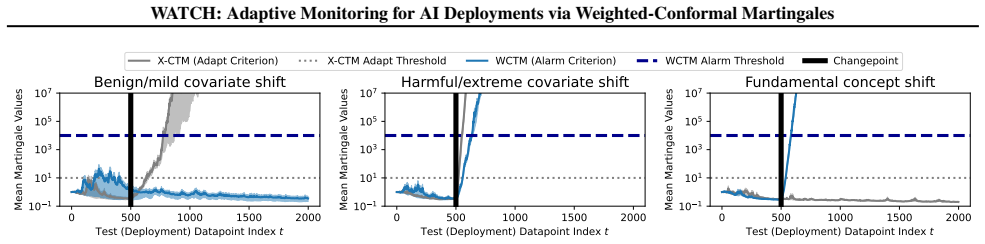
- Running a standard input-only X-CTM alongside the weighted martingale enables root-cause diagnosis: both alarm indicates extreme covariate shift, only the weighted martingale alarms indicates concept shift, and neither alarms while the X-CTM is active indicates a successfully adapted benign shift.
Reading between the lines
- The paper does not quantify how the false-alarm guarantee degrades when density-ratio estimates are only approximately correct; a natural extension is a robustness theorem bounding alarm inflation as a function of weight-estimation error.
- Because the X-CTM runs on inputs alone, the same machinery could provide a label-free early-warning layer that flags when the input stream has left the region where the estimated weights are trustworthy, before any labels arrive.
- One could close the monitoring loop by triggering retraining at the alarm and reinitializing the martingale with the updated model; this paper stops at detection and diagnosis.
- The alarm threshold $c$ could be tuned against deployment-specific costs of false versus missed alarms, treating the martingale value as a continuous evidence scale rather than a binary trigger.
Signed reviews
Editorial analysis
A structured set of objections, weighed in public.
Referee Report
Summary. The paper introduces weighted-conformal test martingales (WCTMs), built from sequences of online weighted-conformal p-values, as a generalization of conformal test martingales for testing nonparametric null hypotheses beyond exchangeability. The main theoretical result (Theorem 3.1) states that online weighted-conformal p-values are IID uniform under a null hypothesis H0(f-hat) that includes the accuracy of the user's modeling assumptions; Proposition 3.2 then gives anytime-valid false-alarm control via Ville's inequality, and Proposition 3.3 gives average-run-length control for a Shiryaev-Roberts variant. The proposed WATCH framework uses a secondary X-CTM to trigger adaptation to mild covariate shifts via online density-ratio estimation, raises alarms for extreme covariate shifts or concept shifts, and diagnoses the root cause. Experiments on tabular and image datasets compare WCTMs against standard CTMs and Podkopaev-Ramdas baselines in terms of detection delay, false alarms, coverage, and runtime.
Significance. If the guarantees hold as stated, the paper makes a substantial contribution to sequential nonparametric testing and AI monitoring: it extends conformal test martingales to composite nulls that accommodate modeled shifts, it provides a principled betting-based construction that adapts online, and it offers root-cause diagnostics. The paper is also commendable for shipping code, for running extensive experiments on multiple real datasets, and for giving a self-contained proof of the oracle-weight validity result. The appendix is unusually candid in acknowledging the finite-calibration idealization and the non-independence of the practical p-values; however, these acknowledgments reveal that the headline false-alarm guarantee for the implemented adaptive procedure is not actually established by the theorems.
major comments (3)
- [Section 3.6 and Proposition 3.2] The anytime-valid false-alarm guarantee is not transferred to the adaptive WATCH procedure. Proposition 3.2 assumes a WCTM built from weighted-conformal p-values that are IID uniform under a fixed null H0(f-hat), but the implementation in Section 3.6 makes the adaptation time tad a data-dependent stopping time: the secondary X-CTM triggers adaptation the first time its wealth crosses the adaptation threshold. The null H0(cs) in Eq. (23) and the modified null in Eq. (28) both treat tad as fixed, so they do not cover the event that the X-CTM falsely triggers under the no-harmful-shift null. Once a false trigger occurs, the main WCTM switches from uniform weights to estimated density-ratio weights bw(t)(x) from Eq. (17), and the resulting p-values need not be uniform. No joint anytime-valid bound over the trigger and the subsequent WCTM is supplied, so the claim that WATCH controls false alarms is not established for the implemented adaptive procedure. Please either prove a joint guarantee over the trigger and the WCTM, or state the conditional nature of the guarantee precisely and provide null simulations at the advertised 1/c rate.
- [Appendix B.1, Lemma B.1] The proof of Lemma B.1 assumes that the nonconformity score function is bijective, stating that 'because the score function bS is bijective, this further implies that Vt = vσ(t) = vi'. This is false for the scores used in the experiments, such as absolute residuals |y - bµ(x)| and one-minus-softmax scores, which map many data points to the same score value. When the score function is non-injective, the event {Vt = vi} does not identify a single data index, and the oracle weights in Eq. (19) do not equal the probabilities of the observed scores under the permutation distribution. The random tie-breaking with un+1 does not repair the proof as written because the argument needs injectivity to condition on the test score. Please provide a version of Lemma B.1 that handles non-injective score functions, for example by defining oracle weights on score atoms or via a randomized score-injection argument, or state exact validity only for injective scores and give a separate treatment of ties.
- [Appendix C, Eqs. (26)-(28)] The practical WCTM's false-alarm guarantee rests on the idealization bF_{[n+tad-1]}^V = F_V, i.e., that the empirical CDF of the calibration scores equals the true source score distribution, which the paper itself notes is 'of course true in the limit n → ∞'. For finite n this equality fails, so the implemented method does not achieve exact anytime-valid false-alarm control under H0(cs); it achieves control only in an idealized asymptotic regime. In addition, the permutation-restriction approximation in Eq. (26) means the p-values in Eq. (27) are not independent across times, as the paper acknowledges in the paragraph preceding Eq. (28), so Theorem 3.1 does not directly apply to the sequence actually used in WATCH. Please either modify the method to restore the requisite independence and prove the claimed guarantees for the modified method, or explicitly label the headline false-alarm statements as approximations that are empirically validated rather than as consequences of Theorem 3.1.
minor comments (5)
- [Section 5] The text contains several typos: 'deplyed' should be 'deployed', and in Section 3.2 'eactly accurate' should be 'exactly accurate'.
- [Figure 2 caption] The caption contains typos: 'ans Shiryaev-Roberts paths' should be 'and Shiryaev-Roberts paths', and 'simuluate' should be 'simulate'.
- [Section 3.6, Eq. (17)] The notation 'bw(t(Xi)' appears to be missing a closing parenthesis; it should presumably read 'bw(t)(Xi)'.
- [Figure 4] The legend item 'X-CTM (Adapt Criterion)' is unclear; please specify that the X-CTM's wealth crossing the adaptation threshold triggers the adaptation phase.
- [Section 4.3] The paper does not report the actual alarm threshold c used for the WCTM and SR-WCTM methods, nor the adaptation threshold for the X-CTM; please report these values so the anytime-valid claims can be checked against the stated rates.
Circularity Check
No circularity: WCTM false-alarm control follows from Ville's inequality once IID-uniform p-values are established; the adaptive-trigger and finite-calibration gaps are scope limitations, not construction-equivalence.
full rationale
The paper's central derivation is not circular. Theorem 3.1 (Eq. 12) is proven self-contained in Appendix B (Lemma B.1 and Eqs. 18-22) by a time-reversal/permutation argument generalizing Vovk et al. (2003) and Tibshirani et al. (2019); it shows that weighted-conformal p-values are IID uniform under a null H0(fhat) that includes exact accuracy of the estimated oracle weights. Proposition 3.2 (Eq. 14) then follows by Ville's inequality, with the betting strategy depending only on past p-values. No fitted parameter is used to force the p-values to look uniform, and the empirical p-value histograms are checks of whether the null holds, not inputs to the guarantee. The self-citations to Prinster et al. (2024) are for exposition of oracle weights (Eq. 10) and are not load-bearing: the underlying analysis is attributed to Tibshirani et al. (2019), and the theorem's proof is given in the appendix rather than imported. No uniqueness theorem from the authors is invoked to forbid alternative constructions. The limitations flagged by the skeptic are real scope gaps, not circularity. Appendix C explicitly concedes that Theorem 3.1 applies directly only at t = tad for the non-resampled procedure and patches the gap by strengthening the null to H0(cs) AND bF = FV (Eq. 28). The data-dependent trigger time tad (Sec. 3.6) is outside this fixed-tad null, so the anytime-valid guarantee is not established for the fully adaptive procedure; this is an unproven-validity issue, not an equivalence-by-construction. The finite-calibration idealization and the omitted full pseudocode (Appendix F) are additional reproducibility and validity caveats, but they do not make the derivation circular.
Assumptions & free parameters
free parameters (3)
- Online density-ratio estimator bw(t)(x) =
3-layer MLP trained online to distinguish source vs target data
- X-CTM adaptation threshold =
not specified in text
- Composite Jumper betting parameters =
J in {1e-4, 1e-3, 1e-2, 1e-1, 1}
assumptions (6)
- standard math Ville's inequality for nonnegative martingales
- domain assumption The joint density fZ exists (Radon-Nikodym derivative) and the oracle weights in Eq. (10) are well-defined
- domain assumption Covariate shift factorization: Y|X invariant, X marginal shifts with density ratio bw
- ad hoc to paper The per-point nonconformity score function is bijective
- ad hoc to paper Calibration set is effectively infinite, bF_V = F_V
- ad hoc to paper The adaptation time tad is fixed in advance or not data-dependent
Cite this review
Pith. "Pith review of WATCH: Adaptive Monitoring for AI Deployments via Weighted-Conformal Martingales." pith.science (2026). https://pith.science/paper/RCRPA4VY
@misc{pith2026250504608,
  author       = {Pith},
  title        = {Pith review of: WATCH: Adaptive Monitoring for AI Deployments via Weighted-Conformal Martingales},
  year         = {2026},
  howpublished = {\url{https://pith.science/paper/RCRPA4VY}},
  note         = {Machine review of arXiv:2505.04608}
}
read the original abstract
Responsibly deploying artificial intelligence (AI) / machine learning (ML) systems in high-stakes settings arguably requires not only proof of system reliability, but also continual, post-deployment monitoring to quickly detect and address any unsafe behavior. Methods for nonparametric sequential testing -- especially conformal test martingales (CTMs) and anytime-valid inference -- offer promising tools for this monitoring task. However, existing approaches are restricted to monitoring limited hypothesis classes or ``alarm criteria'' (e.g., detecting data shifts that violate certain exchangeability or IID assumptions), do not allow for online adaptation in response to shifts, and/or cannot diagnose the cause of degradation or alarm. In this paper, we address these limitations by proposing a weighted generalization of conformal test martingales (WCTMs), which lay a theoretical foundation for online monitoring for any unexpected changepoints in the data distribution while controlling false-alarms. For practical applications, we propose specific WCTM algorithms that adapt online to mild covariate shifts (in the marginal input distribution), quickly detect harmful shifts, and diagnose those harmful shifts as concept shifts (in the conditional label distribution) or extreme (out-of-support) covariate shifts that cannot be easily adapted to. On real-world datasets, we demonstrate improved performance relative to state-of-the-art baselines.
Figures


Figures from the paper (6 more)


Forward citations
Cited by 1 Pith paper
-
CUSUM-Shaped Inference-Time Monitoring and Targeted Re-Decoding for Quantized Small Language Model Reasoning
A monitoring-guided rollback controller produced a small and statistically uncertain accuracy gain on first-seen MATH-500 problems, and a larger exploratory gain on a historical-coverage set contaminated by manual thr...
Reviewed August 15, 2026 · model on record in the stance chip above.
Discussion (0). Continue with ORCID to comment.