REVIEW 6 major objections 5 minor 56 references
AI-Generated Fall Data: Assessing LLMs and Diffusion Model for Wearable Fall Detection
T0 review · 6 major / 5 minor · reviewed 2026-08-15 · deepseek-v4-flash
Pith's one-line read Synthetic fall data improves wearable fall detection only when the target dataset matches it in sensor placement and fall representation, with F1 gains up to +56.83 percent and the best-case loss at -4.05 percent on an incompatible dataset.
desk verdict Useful empirical map of synthetic fall data, but the headline numbers rest on a likely subject leak and a biased diffusion comparison. read the letter →
The pith
A machine-rendered reading of the paper's core claim, the machinery that carries it, and where it could break.
The reading
What carries the argument
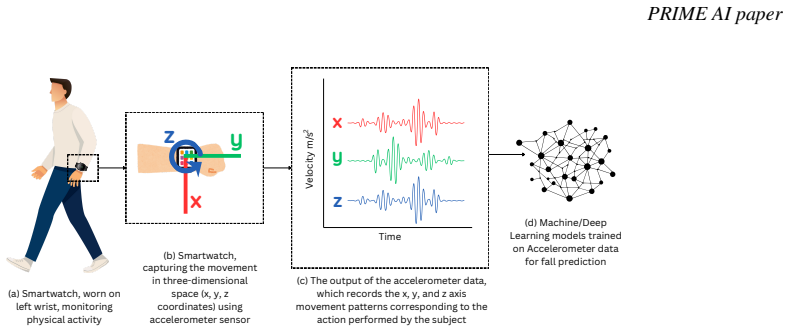
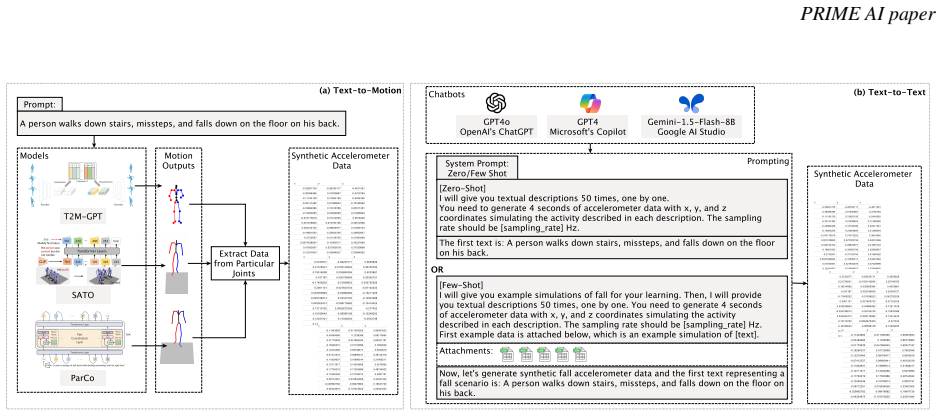
The load-bearing machinery is the conversion from generated 3D joint motion to accelerometer time series, together with the comparison protocol around it. Text-to-motion models (T2M, SATO, ParCo) produce 3D joint trajectories from prompts; the paper extracts specific joints from the SMPL 22-joint body model (left wrist index 20, right wrist index 21, waist/pelvis index 0) and computes synthetic acceleration as the discrete second derivative of position, $a(f) = (p(f+1) - p(f))/\Delta t^2$, with $\Delta t = 1/46$ s. Text-to-text LLMs are prompted directly for CSV accelerometer data, while Diffusion-TS is trained on real falls to generate synthetic time series. All synthetic sources are mixed into LSTM training at a 60% daily-activity / 20% real-fall / 20% synthetic-fall ratio and evaluated on held-out subjects with F1. The step doing the argumentative work is the assumption that these heterogeneous time bases—46 Hz generated frames versus 20, 32, 100, or 200 Hz real recordings—can be compared and combined without resampling or temporal alignment.
What would settle it
Resample each synthetic dataset to the sampling rate of its matching baseline (or low-pass filter real data to 23 Hz) and re-run the F1 comparisons; if the reported pattern of low-frequency datasets gaining and high-frequency datasets losing disappears or reverses, the sampling-rate conclusion is an artifact of mismatched time bases rather than a property of LLM-generated data.
Extended reading notes
Core claim
The paper's central claim is that the usefulness of LLM-generated synthetic fall data for training a wearable fall detector is set by the match between the synthetic data and the baseline dataset, not by the generator alone. Concretely, on UMAFall—a 20 Hz dataset with right-wrist sensor data and only three fall types—GPT-4 few-shot synthetic data raised LSTM F1 by 56.83% over training on real data alone, while on SmartFallMM—a 32 Hz left-wrist dataset whose fall windows contain only the impact phase—every synthetic source lowered F1, with the least damage being T2M's -4.05%. The authors attribute this to two dataset characteristics: sensor placement (left wrist captures low-variance motion, while waist and hip placements carry more fall-relevant movement) and fall representation (impact-only windows do not align with synthetic sequences that model gradual transitions into falls). They also find that text-to-motion models track joint-specific movement better than text-to-text models, that none of the LLMs encode age or gender differences in the generated signals, and that diffusion-based synthetic data aligns most closely with real distributions yet does not consistently improve detection.
Load-bearing premise
The whole comparison assumes that acceleration computed from 3D joint positions at a fixed 46 Hz frame rate is directly comparable to real accelerometer readings sampled at 20, 32, 100, or 200 Hz, with no resampling or temporal alignment.
Editorial extensions
If this is right
- Augmentation with synthetic LLM data should be recommended only after checking the target dataset's sensor site and fall-window structure; the paper's results show this is not a generator-only property.
- Text-to-motion models are the safer LLM family for synthetic falls because they preserve joint-specific movement, while text-to-text models should be reserved for low-rate baselines.
- High-frequency datasets are the failure mode for few-shot text-to-text data, which can lower F1 (for example GPT-4o few-shot on SisFall, -7.10%) even when zero-shot data from the same model helps.
- Diffusion-based synthetic data produces the best-aligned windows across all four baselines but does not reliably improve detection, so distributional alignment alone is not sufficient for an augmentation benefit.
- Fine-tuning text-to-motion models on real fall data, which the paper proposes as future work, is the most direct route to synthetic data that matches both sensor placement and fall dynamics.
Reading between the lines
- The paper leaves implicit that the 46 Hz frame rate of text-to-motion output band-limits synthetic acceleration below roughly 23 Hz, which may explain why high-frequency datasets reject synthetic data; resampling synthetic data to each baseline rate, or low-pass filtering real data to 23 Hz, would separate a time-base artifact from a real property of LLM-generated falls.
- A selection rule the paper does not propose is to choose the synthetic source with the lowest Jensen-Shannon divergence only when its fall-phase structure matches the baseline (impact-only versus gradual transition); this could turn the observed dataset dependence into a practical recipe.
- The ablation's sensor-placement result suggests a simple deployment guideline the paper stops short of stating: generate or extract synthetic data from the exact joint where the wearable will sit, rather than from a generic fall description.
- Because the paper's own applicability note says even the best F1 stays below 0.9 and quantization erodes gains, a more promising test than direct mixing is to use LLM synthetic data for pre-training or regularization and then fine-tune on a small amount of real data.
Signed reviews
Editorial analysis
A structured set of objections, weighed in public.
Referee Report
Summary. The paper evaluates the use of large language models (text-to-motion: T2M-GPT, SATO, ParCo; text-to-text: GPT-4o, GPT-4, Gemini-1.5-Flash-8B) and a time-series diffusion model (Diffusion-TS) to generate synthetic fall accelerometer data, and tests whether augmenting four real-world fall datasets (SmartFallMM, KFall, UMAFall, SisFall) with these synthetic data improves LSTM-based fall detection. The authors report that the effect of synthetic data depends on dataset characteristics: UMAFall improved by up to +56.83% with GPT-4 few-shot data, while all synthetic methods degraded SmartFallMM performance, with T2M showing the smallest decline (-4.05%). They also report that Diffusion-TS produces the closest distributional alignment to real data (lowest JSD, highest Coverage) but does not consistently improve downstream performance. An ablation study claims to show that sensor placement, prompt strategy, and synthetic data quantity influence results.
Significance. If the findings were supported, the paper would provide useful guidance for using generative models to augment scarce fall data in wearable health monitoring. The study is broad in scope, comparing multiple generation paradigms on four public datasets, and it includes an unusually candid limitations section (Section 7) acknowledging that the reported gains are insufficient for real-world deployment. However, the central dataset-dependent claim is currently undermined by a likely subject-leakage issue in the few-shot experiments, a structurally biased Diffusion-TS comparison, and a time-base mismatch in the text-to-motion pipeline. These issues are fixable in principle, but the quantitative conclusions as presented are not reliable. The paper would need a re-analysis with subject-disjoint few-shot sampling, with Diffusion-TS evaluated on held-out data, and with proper temporal alignment before the empirical claims can be accepted.
major comments (6)
- [Section 3.1.2 / Section 4] The few-shot synthetic data are generated by providing the LLM with fall samples from 'five randomly selected subjects' per baseline dataset (Sections 3.1.2 and 5.2), while classifier evaluation uses a leave-two-out subject split with 8 training, 2 validation, and 2 test subjects, re-randomized over five iterations (Section 4). The paper never states that the five shot subjects are excluded from the validation and test folds. Because the few-shot prompt includes actual accelerometer windows of those subjects, any test subject overlapping the shot set has its own fall patterns embedded in the synthetic training data, which the LSTM can memorize and exploit. This directly threatens the headline UMAFall GPT4-FS result (+56.83%, Table 3) and the dataset-dependent claim in Section 7. The experiment must be re-run with shot subjects chosen from the training fold only, and the results re-reported for all datasets.
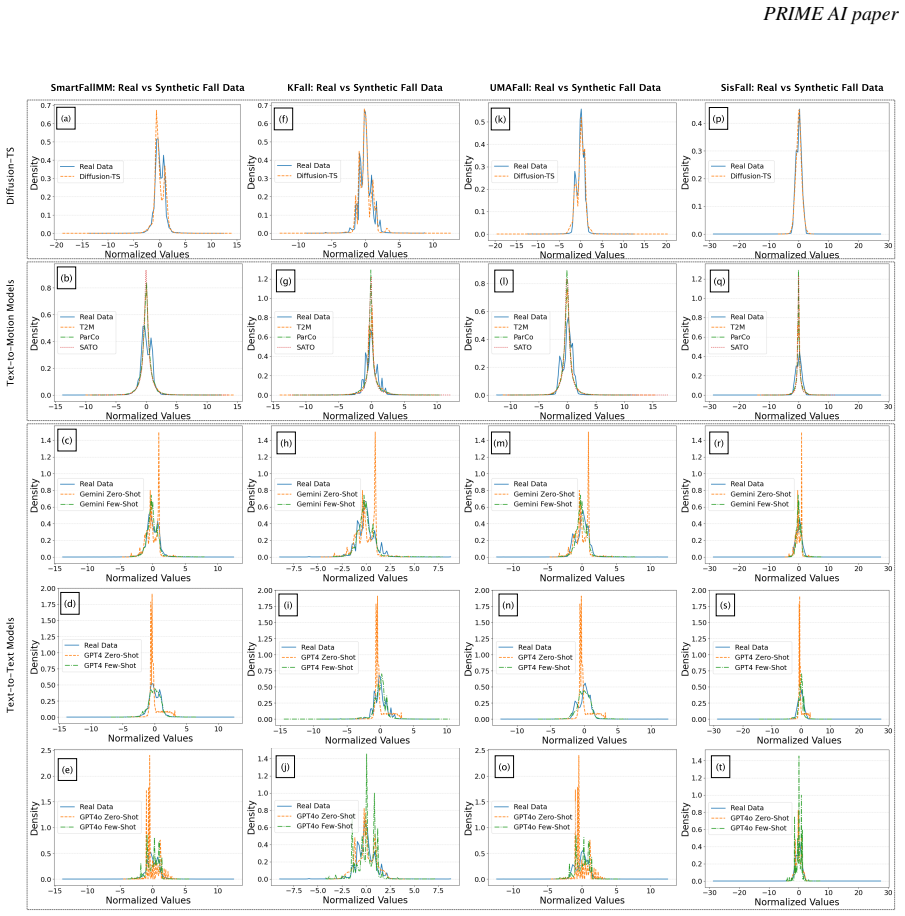
- [Section 3.2.2 / Section 5.2] Diffusion-TS is trained on the fall data of each real dataset and then evaluated for alignment with that same dataset (Section 3.2.2: 'We trained the Diffusion-TS model for each dataset'; Section 5.2 computes JSD and Coverage against the four real datasets). A generative model trained on the test distribution will naturally achieve low JSD and high Coverage; the finding that Diffusion-TS 'consistently outperforms' LLMs in alignment (Section 5.2 Findings) is therefore a property of training on the target data, not a general property of diffusion models. To support RQ2, the authors should compare all methods on held-out data, train Diffusion-TS only on a training subset and evaluate on a held-out split, or clearly reframe the claim as an upper-bound comparison rather than a model-level conclusion.
- [Section 5.1, Eq. (4)] Equation (4) defines acceleration as a(f) = (p(f+1) - p(f))/Δ t^2, which is dimensionally incorrect; this is a scaled forward difference, not a second derivative. A correct discrete second derivative would be (p(f+1) - 2p(f) + p(f-1))/Δ t^2. Additionally, the text-to-motion models output frames at Δ t = 1/46 s, and no resampling, filtering, or temporal alignment to the baseline sampling rates (20, 32, 100, 200 Hz) is described before the synthetic accelerometer data are compared with and added to the real windows. The frequency-dependent conclusions in Sections 5.2 and 7 (e.g., LLM data 'loses specificity' at higher sampling rates) may be artifacts of mismatched time bases rather than properties of the generators. The authors should correct the formula and describe or implement the necessary temporal alignment.
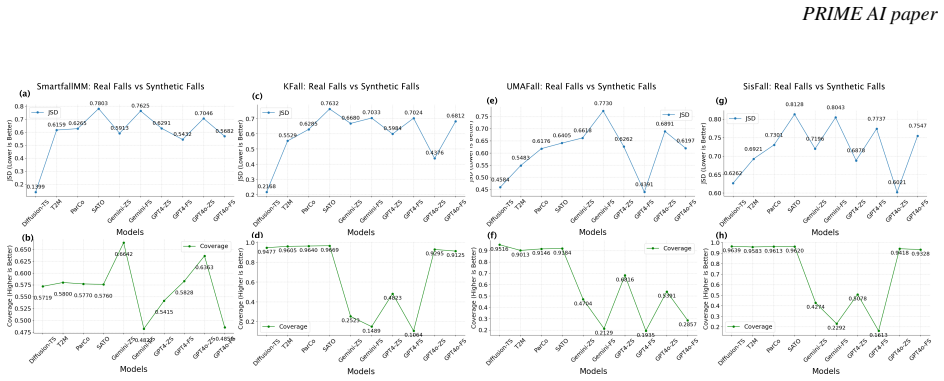
- [Section 5.3 / Figure 6] The text in Section 5.3 claims that SATO's high gains are 'justified by its lowest JSD' for UMAFall (0.6405) and SisFall (0.8128), but in Figure 6 SATO has the highest JSD among text-to-motion models on both datasets (UMAFall: T2M 0.5483, ParCo 0.6176, SATO 0.6405; SisFall: T2M 0.6921, ParCo 0.7301, SATO 0.8128). The stated numbers contradict the supporting text, so the explanatory link between distributional alignment and downstream F1 gains is not established as written. The authors should correct the misstatements and provide a quantitative analysis (e.g., a correlation or a controlled comparison) if they wish to claim such a link.
- [Section 6.1 / Table 4] The ablation in Section 6.1 changes the real baseline modality (SMM to right hip, UMAFall to waist) but for the text-to-text models it uses 'the same zero-shot synthetic data' and few-shot data generated with fall samples from the new datasets, without specifying that the prompt or output location was changed. Since the text-to-text pipeline generates left-wrist accelerometer data (Figure 2(b)), the synthetic text-to-text data remain wrist-specific while the real data are hip/waist; thus the experiment does not control sensor placement for text-to-text models. The conclusion that baseline dataset characteristics, including sensor placement, determine synthetic-data effectiveness is not supported for text-to-text models; the authors must either regenerate text-to-text data for the new sensor location or restrict the claim to text-to-motion and Diffusion-TS results.
- [Section 4 / Table 3] All conclusions are based on five iterations of an 8/2/2 subject split with 12 subjects, and Table 3 reports only average F1-scores with no standard deviations, confidence intervals, or significance tests. Many of the reported differences (e.g., SMM: T2M -4.05% vs Diffusion -8.11%; SisFall: several models within ±1-2%) are small relative to the likely variance from a two-subject test set, so the dataset-dependent ranking may not be stable. The authors should report per-fold results and perform a basic statistical comparison (e.g., paired bootstrap or Wilcoxon across folds) to support the claim that the ranking is not noise.
minor comments (5)
- [Title and Section 3.2.1] The title page has a typo ('AI-G ENERATED FALL DATA') and Section 3.2.1 has the heading 'Basline Datasets' instead of 'Baseline Datasets'.
- [Sections 3.2.3, 5.2, and Table 3] The counts of synthetic datasets and models are inconsistent: Section 3.2.3 says 13 augmented models per dataset (1 diffusion + 3 text-to-motion + 9 text-to-text), Section 5.2 says 28 synthetic datasets in total, but Table 3 lists 10 augmented models per dataset (1 + 3 + 6), which would be 40 across four datasets. Please correct the counts and clarify which text-to-text configurations were actually evaluated.
- [Throughout] Model names are used inconsistently: 'GPT-4', 'GPT4', and 'GPT-4o' appear interchangeably in the text, tables, and figures; please standardize the notation.
- [Section 5.2] The phrase '12 (4×3) sets of FS accelerometer data' is inconsistent with the six FS text-to-text conditions shown in Table 3; please clarify the intended number of few-shot datasets.
- [Section 5.1] The KS-test results are reported only as average p-values per model and condition; consider providing the full range or a compact table to indicate variability across axes and repetitions.
Circularity Check
Diffusion alignment result reduces to training on the evaluated data; few-shot protocol may leak test subjects into synthetic training.
-
fitted input called prediction
[Section 3.2.2 and Section 5.2 (Quantitative Analysis / Findings)]
"We trained the Diffusion-TS model for each dataset, and generated 2001 samples, giving us 4 sets of diffusion-generated data for SMM, KFall, UMAFall, and SisFall. ... The qualitative and quantitative analyses indicate that Diffusion-TS consistently outperforms LLM-generated data in aligning with real data across multiple datasets."
Diffusion-TS is trained separately on the real fall windows of each baseline dataset, and then its generated samples are compared to those same real windows using JSD and Coverage. A generative model trained on a distribution will, by construction, score well on that distribution, so the finding that 'Diffusion-TS aligns closest to real data' is not an independent comparison of generative methods: it is a fitted-input result. The LLM baselines, especially zero-shot text-to-text, never see the real windows, making the reported alignment gap a property of training on the evaluation data rather than evidence about diffusion versus LLM quality.
-
other
[Section 3.1.2, Section 4, and Section 5.2 (few-shot generation and subject split)]
"Specifically, we used data from five subjects in the baseline datasets in CSV documents ... as shots in the few-shot approach. ... to generate few-shot (FS) data, we provided each model with examples of falls from five randomly selected subjects per dataset. ... in each iteration, we randomly selected 8 subjects for training, 2 for validation, and 2 for testing."
The few-shot conditioning set is drawn from real subjects of the same dataset that is later split by leave-two-out subject evaluation. The paper never states that the five shot subjects are excluded from the validation or test subjects, so the synthetic training data can contain actual accelerometer windows from held-out subjects. In that case, the LSTM can memorize near-copies of test falls, and the largest reported gain (UMAFall GPT4-FS +56.83%) is not an independent estimate of synthetic-data quality but can be forced by test-set leakage built into the protocol.
full rationale
The central RQ3 claim that dataset characteristics determine synthetic-data effectiveness is not inherently circular: it rests on LSTM F1 comparisons and an ablation study, which are independent of the paper's own definitions. However, RQ2 is circular in an important way: Diffusion-TS is trained on each real dataset and then reported as the best-aligned with that same real data, making the 'diffusion aligns best' result a trained-on-the-evaluation-distribution artifact. A second, distinct concern is the few-shot protocol: examples are taken from five subjects of the same datasets used for leave-two-out evaluation, with no reported exclusion of validation or test subjects, so the headline UMAFall improvement can be inflated by subject leakage. The fixed Delta-t = 1/46 s time base in Eq. (4) and the first-difference acceleration formula are correctness risks rather than circularity. Self-citations such as [45] and [47] are not load-bearing for the central claims. Overall, the paper has partial circularity in the diffusion alignment result and a contamination risk in the largest few-shot result, warranting a score of 6.
Assumptions & free parameters
free parameters (5)
- Prompt subset =
50 prompts selected from 200 iterations
- Temporal step delta_t =
1/46 s
- Subject subset size =
12 subjects per dataset
- Data mix ratio =
60% ADLs / 20% real falls / 20% synthetic falls; ablation uses 50/10/40
- Few-shot shot subjects =
5 subjects per dataset
assumptions (4)
- domain assumption SMPL joint-index mapping applies to T2M, SATO, and ParCo outputs
- ad hoc to paper Second-order finite differences of motion-model positions produce wearable-comparable accelerometer data
- ad hoc to paper SMM real falls contain only impact phase while synthetic falls contain transitions
- domain assumption LSTM F1 differences reflect synthetic data quality rather than random subject variation
Cite this review
Pith. "Pith review of AI-Generated Fall Data: Assessing LLMs and Diffusion Model for Wearable Fall Detection." pith.science (2026). https://pith.science/paper/SVQNTTZB
@misc{pith2026250504660,
  author       = {Pith},
  title        = {Pith review of: AI-Generated Fall Data: Assessing LLMs and Diffusion Model for Wearable Fall Detection},
  year         = {2026},
  howpublished = {\url{https://pith.science/paper/SVQNTTZB}},
  note         = {Machine review of arXiv:2505.04660}
}
read the original abstract
Training fall detection systems is challenging due to the scarcity of real-world fall data, particularly from elderly individuals. To address this, we explore the potential of Large Language Models (LLMs) for generating synthetic fall data. This study evaluates text-to-motion (T2M, SATO, ParCo) and text-to-text models (GPT4o, GPT4, Gemini) in simulating realistic fall scenarios. We generate synthetic datasets and integrate them with four real-world baseline datasets to assess their impact on fall detection performance using a Long Short-Term Memory (LSTM) model. Additionally, we compare LLM-generated synthetic data with a diffusion-based method to evaluate their alignment with real accelerometer distributions. Results indicate that dataset characteristics significantly influence the effectiveness of synthetic data, with LLM-generated data performing best in low-frequency settings (e.g., 20Hz) while showing instability in high-frequency datasets (e.g., 200Hz). While text-to-motion models produce more realistic biomechanical data than text-to-text models, their impact on fall detection varies. Diffusion-based synthetic data demonstrates the closest alignment to real data but does not consistently enhance model performance. An ablation study further confirms that the effectiveness of synthetic data depends on sensor placement and fall representation. These findings provide insights into optimizing synthetic data generation for fall detection models.
Figures

Figures from the paper (3 more)

Reference graph
Works this paper leans on
-
[1]
World population prospects 2022: Summary of results, 2022
United Nations. World population prospects 2022: Summary of results, 2022. Accessed: 2024-08-29
work page 2022
-
[2]
World Health Organization. Ageing and health, 2023. Accessed: 2024-08-29
work page 2023
-
[3]
Ngu, Awatif Yasmin, Tarek Mahmud, Adnan Mahmood, and Quan Z
Anne H. Ngu, Awatif Yasmin, Tarek Mahmud, Adnan Mahmood, and Quan Z. Sheng. Demo: P-fall: Personal- ization pipeline for fall detection. In Proceedings of the 8th ACM/IEEE International Conference on Connected Health: Applications, Systems and Engineering Technologies , CHASE ’23, page 173–174, New York, NY , USA,
-
[4]
Large language models are few-shot health learners, 2023
Xin Liu, Daniel McDuff, Geza Kovacs, Isaac Galatzer-Levy, Jacob Sunshine, Jiening Zhan, Ming-Zher Poh, Shun Liao, Paolo Di Achille, and Shwetak Patel. Large language models are few-shot health learners, 2023
work page 2023
-
[5]
Zikang Leng, Hyeokhyen Kwon, and Thomas Plötz. Generating virtual on-body accelerometer data from virtual textual descriptions for human activity recognition, 2023. 21 PRIME AI paper
work page 2023
-
[6]
Using pretrained large language model with prompt engineering to answer biomedical questions, 2024
Wenxin Zhou and Thuy Hang Ngo. Using pretrained large language model with prompt engineering to answer biomedical questions, 2024
work page 2024
-
[7]
Penetrative ai: Making llms comprehend the physical world, 2024
Huatao Xu, Liying Han, Qirui Yang, Mo Li, and Mani Srivastava. Penetrative ai: Making llms comprehend the physical world, 2024
work page 2024
-
[8]
Where would i go next? large language models as human mobility predictors, 2024
Xinglei Wang, Meng Fang, Zichao Zeng, and Tao Cheng. Where would i go next? large language models as human mobility predictors, 2024
work page 2024
Show all 56 references
-
[9]
Synthetic sensor data for human activity recognition
Fayez Alharbi, Lahcen Ouarbya, and Jamie A Ward. Synthetic sensor data for human activity recognition. In 2020 International Joint Conference on Neural Networks (IJCNN) , pages 1–9, 2020
2020
-
[10]
Using synthetic data to improve the accuracy of human activity recognition
Majid Liaquat, Chris Nugent, and Ian Cleland. Using synthetic data to improve the accuracy of human activity recognition. In José Bravo and Gabriel Urzáiz, editors, Proceedings of the 15th International Conference on Ubiquitous Computing & Ambient Intelligence (UCAmI 2023) , p...
2023
-
[11]
Sequential models in the synthetic data vault
Synthetic Data Vault. Sequential models in the synthetic data vault. arXiv preprint arXiv:2207.14406, 2022
2022 arXiv
-
[12]
Time-series generative adversarial networks
Jinsung Yoon, Daniel Jarrett, and Mihaela van der Schaar. Time-series generative adversarial networks. arXiv preprint arXiv:1906.02806, 2019
1906 arXiv
-
[13]
Modeling tabular data using conditional gan
Lei Xu, Maria Skoularidou, Alfredo Cuesta-Infante, and Kalyan Veeramachaneni. Modeling tabular data using conditional gan. arXiv preprint arXiv:1907.00503, 2019
1907 arXiv
-
[14]
Creating a large-scale synthetic dataset for human activity recognition, 2020
Ollie Matthews, Koki Ryu, and Tarun Srivastava. Creating a large-scale synthetic dataset for human activity recognition, 2020
2020
-
[15]
Quo vadis, action recognition? a new model and the kinetics dataset, 2018
Joao Carreira and Andrew Zisserman. Quo vadis, action recognition? a new model and the kinetics dataset, 2018
2018
-
[16]
Eldersim: A synthetic data generation platform for human action recognition in eldercare applications, 2020
Hochul Hwang, Cheongjae Jang, Geonwoo Park, Junghyun Cho, and Ig-Jae Kim. Eldersim: A synthetic data generation platform for human action recognition in eldercare applications, 2020
2020
-
[17]
Interpretable classification of human exercise videos through pose estimation and multivariate time series analysis
Ashish Singh, Binh Thanh Le, Thach Le Nguyen, Darragh Whelan, Martin O’Reilly, Brian Caulfield, and Georgiana Ifrim. Interpretable classification of human exercise videos through pose estimation and multivariate time series analysis. In AI for Disease Surveillance and Pandemic...
2022
-
[18]
A comprehensive survey on human pose estimation approaches
Shradha Dubey and Manish Dixit. A comprehensive survey on human pose estimation approaches. Multimedia Systems, 29:167–195, 2023
2023
-
[19]
Hsu, Alexander Y
Jan Stenum, Melody M. Hsu, Alexander Y . Pantelyat, and Ryan T. Roemmich. Clinical gait analysis using video-based pose estimation: Multiple perspectives, clinical populations, and measuring change. PLOS Digital Health, 3(3):e0000467, 2024
2024
-
[20]
Guest editorial: special issue on human pose estimation and its applications
Wei Tang, Zhou Ren, and Jingdong Wang. Guest editorial: special issue on human pose estimation and its applications. Machine Vision and Applications, 34:120, 2023
2023
-
[21]
On the benefit of generative foundation models for human activity recognition, 2023
Zikang Leng, Hyeokhyen Kwon, and Thomas Plötz. On the benefit of generative foundation models for human activity recognition, 2023
2023
-
[22]
Gpt-4 technical report
OpenAI et al. Gpt-4 technical report. arXiv preprint arXiv:2303.08774, 2023
2023 arXiv
-
[23]
T2m-gpt: Generating human motion from textual descriptions with discrete representations, 2023
Jianrong Zhang, Yangsong Zhang, Xiaodong Cun, Shaoli Huang, Yong Zhang, Hongwei Zhao, Hongtao Lu, and Xi Shen. T2m-gpt: Generating human motion from textual descriptions with discrete representations, 2023
2023
-
[24]
Rethinking diffusion for text-driven human motion generation
Zichong Meng, Yiming Xie, Xiaogang Peng, Zeyu Han, and Huaizu Jiang. Rethinking diffusion for text-driven human motion generation. arXiv preprint arXiv:2411.16575, 2024
2024 arXiv
-
[25]
Neural discrete representation learning, 2018
Aaron van den Oord, Oriol Vinyals, and Koray Kavukcuoglu. Neural discrete representation learning, 2018
2018
-
[26]
Momask: Generative masked modeling of 3d human motions
Chuan Guo, Yuxuan Mu, Muhammad Gohar Javed, Sen Wang, and Li Cheng. Momask: Generative masked modeling of 3d human motions. arXiv preprint arXiv:2312.00063, 2023
2023 arXiv
-
[27]
Denoising diffusion probabilistic models
Jonathan Ho, Ajay Jain, and Pieter Abbeel. Denoising diffusion probabilistic models. In H. Larochelle, M. Ranzato, R. Hadsell, M.F. Balcan, and H. Lin, editors, NeurIPS, volume 33, pages 6840–6851. Curran Associates, Inc., 2020
2020
-
[28]
M2d2m: Multi-motion generation from text with discrete diffusion models
Seunggeun Chi, Hyung-gun Chi, Hengbo Ma, Nakul Agarwal, Faizan Siddiqui, Karthik Ramani, and Kwonjoon Lee. M2d2m: Multi-motion generation from text with discrete diffusion models. arXiv preprint arXiv:2407.14502, 2024
2024 arXiv
-
[29]
Mote: Learning motion-text diffusion model for multiple generation tasks
Yiming Wu, Wei Ji, Kecheng Zheng, Zicheng Wang, and Dong Xu. Mote: Learning motion-text diffusion model for multiple generation tasks. arXiv preprint arXiv:2411.19786, 2024. 22 PRIME AI paper
2024 arXiv
-
[30]
Does synthetic data generation of llms help clinical text mining? arXiv preprint arXiv:2303.04360, 2023
Ruixiang Tang, Xiaotian Han, Xiaoqian Jiang, and Xia Hu. Does synthetic data generation of llms help clinical text mining? arXiv preprint arXiv:2303.04360, 2023
2023 arXiv
-
[31]
Forward fall detection using inertial data and machine learning
Cristian Tufisi, Zeno-Iosif Praisach, Gilbert-Rainer Gillich, Andrade Ionut, Bichescu, and Teodora-Liliana Heler. Forward fall detection using inertial data and machine learning. Applied Sciences, 14(22):10552, 2024. Author to whom correspondence should be addressed: Zeno-Iosi...
2024
-
[32]
Sato: Stable text-to-motion framework
Wenshuo Chen, Hongru Xiao, Erhang Zhang, Lijie Hu, Lei Wang, Mengyuan Liu, and Chen Chen. Sato: Stable text-to-motion framework. arXiv preprint arXiv:2405.01461, 2024
2024 arXiv
-
[33]
Parco: Part-coordinating text-to-motion synthesis, 2024
Qiran Zou, Shangyuan Yuan, Shian Du, Yu Wang, Chang Liu, Yi Xu, Jie Chen, and Xiangyang Ji. Parco: Part-coordinating text-to-motion synthesis, 2024
2024
-
[34]
Improving language understanding by generative pre-training
Alec Radford, Karthik Narasimhan, Tim Salimans, and Ilya Sutskever. Improving language understanding by generative pre-training. In Advances in Neural Information Processing Systems (NeurIPS) , 2018
2018
-
[35]
Mo- tiondiffuse: Text-driven human motion generation with diffusion model
Mingyuan Zhang, Zhongang Cai, Liang Pan, Fangzhou Hong, Xinying Guo, Lei Yang, and Ziwei Liu. Mo- tiondiffuse: Text-driven human motion generation with diffusion model. arXiv preprint arXiv:2208.15001 , 2022
2022 arXiv
-
[36]
Generating diverse and natural 3d human motions from text
Chuan Guo, Shihao Zou, Xinxin Zuo, Sen Wang, Wei Ji, Xingyu Li, and Li Cheng. Generating diverse and natural 3d human motions from text. In 2022 IEEE/CVF Conference on Computer Vision and Pattern Recognition (CVPR), pages 5142–5151, 2022
2022
-
[37]
The kit motion-language dataset
Matthias Plappert, Christian Mandery, and Tamim Asfour. The kit motion-language dataset. Big Data , 4(4):236–252, December 2016
2016
-
[38]
OpenAI. Chatgpt. https://chat.openai.com, 2023
2023
-
[39]
Gpt-4o: A multimodal model for text, vision, and audio
OpenAI. Gpt-4o: A multimodal model for text, vision, and audio. https://openai.com/index/ hello-gpt-4o/, 2024
2024
-
[40]
Microsoft copilot
Microsoft. Microsoft copilot. https://www.microsoft.com/en-us/microsoft-365/copilot , 2023
2023
-
[41]
A large-scale open motion dataset (kfall) and benchmark algorithms for detecting pre-impact fall of the elderly using wearable inertial sensors
Xiaoqun Yu, Jaehyuk Jang, and Shuping Xiong. A large-scale open motion dataset (kfall) and benchmark algorithms for detecting pre-impact fall of the elderly using wearable inertial sensors. Frontiers in Aging Neuroscience, 13:692865, 2021
2021
-
[42]
Santoyo-Ramón, and Jose M
Eduardo Casilari, Jose A. Santoyo-Ramón, and Jose M. Cano-García. Umafall: A multisensor dataset for the research on automatic fall detection. In Proceedings of the 14th International Conference on Mobile Systems and Pervasive Computing (MobiSPC), pages 181–188. Elsevier, 2017
2017
-
[43]
Sisfall: A fall and movement dataset
Angela Sucerquia, José David López, and Jesús Francisco Vargas-Bonilla. Sisfall: A fall and movement dataset. Sensors, 17(1):198, 2017
2017
-
[44]
Diffusion-ts: Interpretable diffusion for general time series generation, 2024
Xinyu Yuan and Yan Qiao. Diffusion-ts: Interpretable diffusion for general time series generation, 2024
2024
-
[45]
Experimental study of long short-term memory and transformer models for fall detection on smartwatches
Syed Tousiful Haque, Minakshi Debnath, Awatif Yasmin, Tarek Mahmud, and Anne Hee Hiong Ngu. Experimental study of long short-term memory and transformer models for fall detection on smartwatches. Sensors, 24(19), 2024
2024
-
[46]
Long short-term memory
Sepp Hochreiter and Jürgen Schmidhuber. Long short-term memory. Neural Computation, 9(8):1735–1780, 1997
1997
-
[47]
A. H. H. Ngu and A. Yasmin. An empirical study on ai-powered edge computing architectures for real-time iot applications, 2024. Poster presented at the Health Scholar Showcase, Translational Health Research Center, San Marcos, Texas
2024
-
[48]
Fall detection with cnn-casual lstm network
Jiang Wu, Jiale Wang, Ao Zhan, and Chengyu Wu. Fall detection with cnn-casual lstm network. Information, 12(10):403, 2021
2021
-
[49]
Fall detection using lstm and transfer learning
Ayesha Butt, Sanam Narejo, Muhammad Rizwan Anjum, Muhammad Usman Yonus, Mashal Memon, and Arbab Ali Samejo. Fall detection using lstm and transfer learning. Wireless Personal Communications, 126:1733– 1750, 2022
2022
-
[50]
Fall detection using knowledge distillation based long short-term memory for offline embedded and low power devices
Hannah Zhou, Allison Chen, Celine Buer, Emily Chen, Kayleen Tang, Lauryn Gong, Zhiqi Liu, and Jianbin Tang. Fall detection using knowledge distillation based long short-term memory for offline embedded and low power devices. arXiv preprint arXiv:2308.12481, 2023
2023 arXiv
-
[51]
Deep learning using rectified linear units (relu)
Abien Fred Agarap. Deep learning using rectified linear units (relu). arXiv preprint arXiv:1803.08375, 2018
2018 arXiv
-
[52]
Matthew Loper, Naureen Mahmood, Javier Romero, Gerard Pons-Moll, and Michael J. Black. SMPL: A Skinned Multi-Person Linear Model. Association for Computing Machinery, New York, NY , USA, 1 edition, 2023. 23 PRIME AI paper
2023
-
[53]
Sulla determinazione empirica di una legge di distribuzione
Andrey Kolmogorov. Sulla determinazione empirica di una legge di distribuzione. Giornale dell’Istituto Italiano degli Attuari, 4:83–91, 1933
1933
-
[54]
Reliable fidelity and diversity metrics for generative models, 2020
Muhammad Ferjad Naeem, Seong Joon Oh, Youngjung Uh, Yunjey Choi, and Jaejun Yoo. Reliable fidelity and diversity metrics for generative models, 2020
2020
-
[55]
Endres and Johannes E
Dominik M. Endres and Johannes E. Schindelin. A new metric for probability distributions. IEEE Transactions on Information Theory, 49(7):1858–1860, 2003. 24
2003
-
[2024]
Association for Computing Machinery
Reviewed August 15, 2026 · model on record in the stance chip above.
Discussion (0). Continue with ORCID to comment.