REVIEW 4 major objections 6 minor 48 references
Score-based Self-supervised MRI Denoising
T0 review · 4 major / 6 minor · reviewed 2026-08-15 · deepseek-v4-flash
Pith's one-line read A self-supervised score-matching loss lets MRI denoisers learn the clean-image posterior mean from noisy data alone.
desk verdict C2S is a credible, useful self-supervised MRI denoiser, but the theory does not cover the t=tdata inference point or the sigma_ttarget>0 variant, and a few claims outrun the tables. read the letter →
The pith
A machine-rendered reading of the paper's core claim, the machinery that carries it, and where it could break.
The reading
What carries the argument
The load-bearing object is the GDSM loss $$J'(\$\theta$)=\mathbb{E}\left[\left\|\gamma'(\tau,\sigma_{t_{\mathrm{target}}})h_\$\theta$(X_t,t)+\delta'(\tau,\sigma_{t_{\mathrm{target}}})X_t - X_{t_{\mathrm{data}}}\right\|^2\right],$$ with $\gamma'(\tau,\sigma_{t_{\mathrm{target}}}) = \sigma_\tau^2 / (\sigma_\tau^2 + \sigma_{t_{\mathrm{data}}}^2 - \sigma_{t_{\mathrm{target}}}^2)$ and $\delta' = (\sigma_{t_{\mathrm{data}}}^2-\sigma_{t_{\mathrm{target}}}^2)/(\sigma_\tau^2+\sigma_{t_{\mathrm{data}}}^2-\sigma_{t_{\mathrm{target}}}^2)$. Re-expressing the doubly-noisy image from the perspective of both the observed image and the target image yields two score identities whose equality gives $\mathbb{E}[X_{t_{\mathrm{data}}}\mid X_t] = \gamma' \mathbb{E}[X_{t_{\mathrm{target}}}\mid X_t] + \delta' X_t$, so minimizing the loss against $X_{t_{\mathrm{data}}}$ forces $h_\theta$ to output $\mathbb{E}[X_{t_{\mathrm{target}}}\mid X_t]$. This coefficient identity, together with the skip connection $D_\theta = \lambda_{\mathrm{out}} h_\theta + \lambda_{\mathrm{skip}} X_t$ and the $\tau$-reparameterization, carries the whole method.
What would settle it
On a synthetic dataset with a known Gaussian prior for $X_0$ and known noise level, compute the posterior mean $\mathbb{E}[X_0\mid X_{t_{\mathrm{data}}}]$ by Monte Carlo, train C2S from noisy samples only, and compare the network output at $(X_{t_{\mathrm{data}}},t_{\mathrm{data}})$ with that posterior mean; a systematic error that persists when the network is trained only on $t>t_{\mathrm{data}}$ would show the inference step relies on extrapolation outside the theorem's range.
Extended reading notes
Core claim
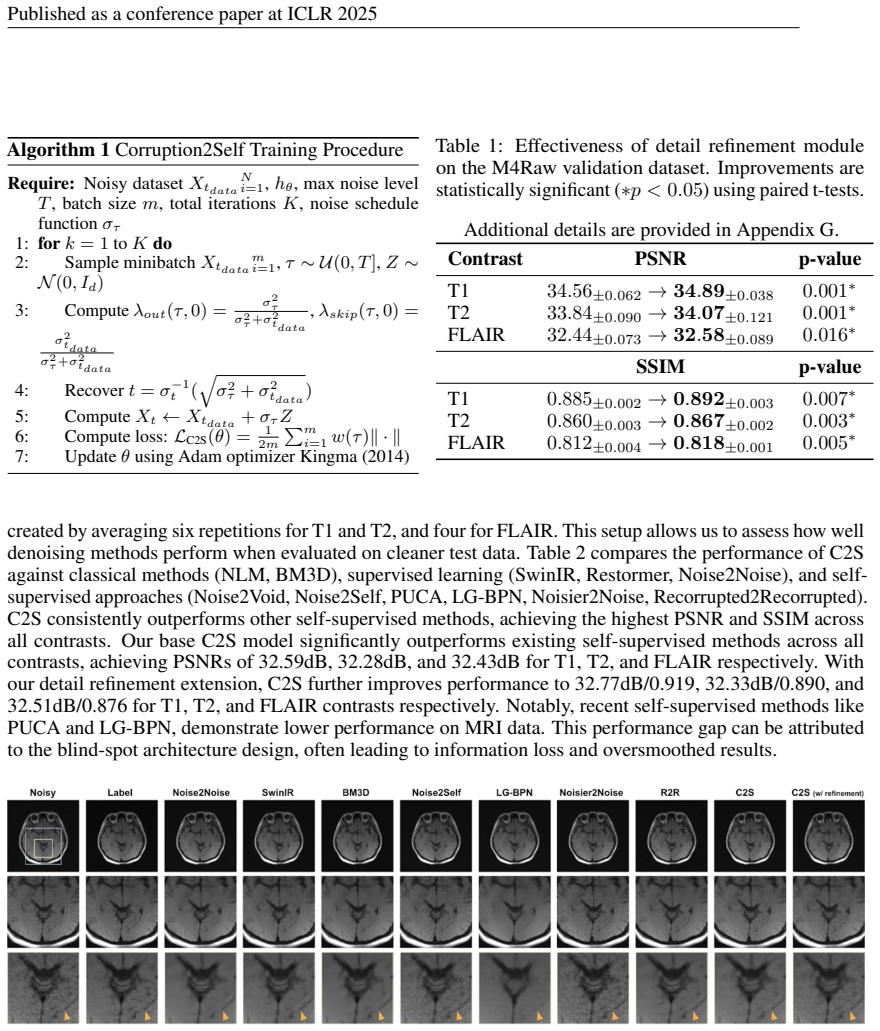
The central discovery is that denoising score matching does not need clean training images. By corrupting the observed noisy image $X_{t_{\mathrm{data}}}$ with additional independent Gaussian noise to form $X_t$, and training the network to predict $X_{t_{\mathrm{data}}}$ from $X_t$ through a specially weighted sum of the network output and the input, the minimizer of the GDSM loss satisfies $h_{\theta^*}(X_t,t) = \mathbb{E}[X_{t_{\mathrm{target}}} \mid X_t]$. When $t_{\mathrm{target}} = 0$, the right-hand side is $\mathbb{E}[X_0 \mid X_t]$, the minimum mean-square-error estimate of the clean image, so the network has effectively learned to denoise despite never seeing a clean image. A reparameterized noise scale $\tau$ with uniform sampling and a skip-blended output stabilizes training, and a detail-refinement variant with $\sigma_{t_{\mathrm{target}}} > 0$ retains fine textures. On the M4Raw and fastMRI datasets, the method attains the best PSNR and SSIM among self-supervised methods and competitive numbers against supervised ones, with multi-contrast C2S exceeding all baselines on M4Raw.
Load-bearing premise
The inference step evaluates the trained network at $t=t_{\mathrm{data}}$, but the theorem characterizes the loss minimizer only for $t>t_{\mathrm{data}}$; the method's clean-image estimate therefore rests on the network extrapolating the conditional expectation to the original noise level, and on the added noise being independent Gaussian so the score identity that defines GDSM actually holds.
Editorial extensions
If this is right
- A single noisy acquisition per image is enough to train a denoiser; no clean labels or paired noisy replicates are required, as long as the noise level is known or estimated.
- Because the target is the MMSE posterior mean rather than a label-mapped output, C2S generalizes to test data whose SNR is higher than the training labels, a regime where supervised networks trained on averaged labels lose accuracy.
- The same loss with $\sigma_{t_{\mathrm{target}}}>0$ yields a detail-preserving estimator, giving practitioners a direct trade-off between noise removal and texture retention.
- Feeding auxiliary MRI contrasts as conditioning inputs improves denoising of the target contrast, and on M4Raw the multi-contrast variant outperforms every supervised baseline tested.
- Noise-level misestimation within $\pm 50\%$ changes PSNR by at most about 0.1 dB, so the method works with standard noise estimators as a blind denoiser.
Reading between the lines
- If the same Gaussian score identity is validated outside MRI, the GDSM construction transfers directly to other imaging modalities with additive white noise, or to Rician data after a variance-stabilizing transform; the authors point to VST but do not test it.
- The theory's proof only covers $t > t_{\mathrm{data}}$, while inference evaluates the network at $t = t_{\mathrm{data}}$; a Monte Carlo check of $h_\theta(x,t_{\mathrm{data}})$ against the true posterior mean under a known Gaussian prior would quantify how much of the method's success depends on extrapolation.
- Because $\sigma_{t_{\mathrm{target}}}$ is sampled uniformly in detail refinement, treating it as a tunable per-contrast hyperparameter might improve texture retention beyond the reported default; this is a testable extension the paper does not explore.
Signed reviews
Editorial analysis
A structured set of objections, weighed in public.
Referee Report
Summary. This manuscript introduces Corruption2Self (C2S), a self-supervised MRI denoising method. The authors formulate a generalized denoising score matching (GDSM) loss whose minimizer is the conditional expectation E[X_ttarget | X_t] under stated assumptions, and train a U-Net with time conditioning and NVC-MSA using only noisy observations. They reparameterize noise levels, add a detail refinement stage, and extend the framework to multi-contrast inputs. Experiments on M4Raw and fastMRI compare against classical, supervised, and self-supervised baselines, reporting state-of-the-art self-supervised PSNR/SSIM and competitive supervised performance, with appendices on robustness to noise-level misestimation and additional ablations.
Significance. The core idea--learning conditional expectations of cleaner images from further corrupted noisy observations--is a natural and potentially useful extension of ADSM and Noisier2Noise, and the paper provides a broad experimental comparison on real and simulated MRI data, including low-field M4Raw, multiple contrasts, and multi-contrast fusion. Strengths include the explicit robustness study in Appendix H, the clear positioning relative to prior self-supervised methods, and the reproducibility-oriented details on datasets and training. If the theoretical gap at the inference point is fixed, the method would be a solid contribution to self-supervised MRI denoising; as written, the headline theoretical claim is incomplete in a way that affects the central inference operation.
major comments (4)
- [Section 3.1, Theorem 1/Corollary 2 vs. Section 3.2, Eq. (11)] The theorem is stated and proved for t sampled uniformly from (tdata, T], and the proof divides by gamma(t, sigma_ttarget), which is positive only for t > tdata. At t = tdata, gamma = 0 and delta = 1 in Eq. (3), so J(theta) = E[||Xtdata - Xtdata||^2] = 0 for every h_theta, and h_theta*(Xtdata, tdata) is unconstrained. Equation (11) nevertheless evaluates the network exactly at t = tdata and asserts it approximates E[X0 | Xtdata]. The paper needs an explicit continuity/limit argument as t decreases to tdata, or a modified training loss that also constrains t = tdata; as written, the central theoretical claim does not cover the inference operation.
- [Appendix B, Theorem 4 proof] For sigma_ttarget > 0, the proof uses the identity Xt = Xttarget + sqrt(sigma_t^2 - sigma_ttarget^2) Z2 with Z2 independent of Xttarget to write the score as (E[Xttarget | Xt] - Xt)/(sigma_t^2 - sigma_ttarget^2). This identity is a coupling assumption that is not stated in Assumptions 3-5: under the natural model Xttarget = X0 + sigma_ttarget Z_ttarget and Xt = X0 + sigma_t Z_t with Z_ttarget and Z_t independent, the conditional variance of Xt - Xttarget given Xttarget is sigma_t^2 + sigma_ttarget^2, not sigma_t^2 - sigma_ttarget^2. Consequently the detail-refinement extension, which relies on sigma_ttarget > 0, is not justified by the stated theorem.
- [Appendix G and Section 3.2, Eq. (11)] The detail-refinement stage trains the network to satisfy h_theta*(Xt, t) = E[Xttarget | Xt] with sigma_ttarget sampled from (0, sigma_tdata], while Eq. (11) evaluates h_theta*(Xtdata, tdata) as a clean estimate E[X0 | Xtdata]. These are different quantities, and the paper does not specify how the nonzero-target predictor is converted into the clean estimate whose PSNR/SSIM is reported in Tables 1-3. Please clarify the inference protocol for the refined model or add the missing derivation.
- [Appendix E, Table 6 and Section 4] The fastMRI reparameterization comparison reports a 'Without Reparam.' row described as 'estimated baseline results.' Since the main text presents reparameterization as an empirical improvement (Table 4a), the provenance of the estimated values should be disclosed in detail, and ideally the baseline should be run under identical conditions; otherwise the fastMRI reparameterization claim is not directly supported.
minor comments (6)
- [Section 3.1] The text says 'proof provided in Appendix 4' for Theorem 1 and 'proof provided in Appendix 5' for Corollary 2, but the appendices are lettered; update the cross-references.
- [Section 3.2, Eq. (10) and Algorithm 1] Equation (2) uses Xt for t > tdata, while Eq. (10) and Algorithm 1 construct X_tau from Xtdata + sigma_tau Z; the relationship between t and tau should be made explicit in the main text rather than only in Appendix B.
- [Table 1] The paired t-tests are reported without the number of validation subjects/slices or any correction for multiple contrasts; please provide these details.
- [Section 4 and Table 5] The Introduction claims multi-contrast C2S achieves state-of-the-art among supervised methods, but Table 5 only compares BM3D, Noise2Noise, and single-contrast C2S; supervised transformers from Table 2 are not included, so the claim should be qualified.
- [References and text] There are several typos, including 'Noise2V oid' in the text, 'F ouguier' in the references, and 't target' in Section 3 where 'sigma_ttarget' is meant.
- [Appendix J.1] The suggestion that T can be chosen as the maximum pairwise distance between training points is imported from score-based generative modeling; please discuss whether this bound is needed for the denoising objective rather than for generative score estimation.
Circularity Check
No circularity: C2S's clean-image estimate follows from Tweedie/score-matching identities applied to noisy targets, not from reusing a fitted quantity as a prediction.
full rationale
The claimed derivation is not circular. The GDSM loss (Eq. 3 / Eq. 12) is a mean-square regression of the combination gamma(t) h_theta(X_t,t) + delta(t) X_t onto the observed noisy image X_tdata. Lemma 3 (Appendix B) gives the usual conditional-expectation minimizer E[X_tdata | X_t]; Theorem 1 then algebraically rewrites this as E[X_ttarget | X_t] through two Tweedie score identities. The training target throughout is the noisy observation X_tdata, and the clean-image estimate is obtained by removing the added corruption through score matching, not by fitting a parameter to the target and relabeling it as a prediction. The noise level sigma_tdata is an estimated input, not a fitted prediction, and the paper reports a +/-50% robustness study plus held-out evaluation on M4Raw and fastMRI. Citations to ADSM and Noisier2Noise are external prior work; there are no load-bearing self-citations by Tu/Shi/Lam, and the paper explicitly acknowledges that sigma_ttarget = 0 recovers ADSM and the Noisier2Noise special case. The serious caveats are correctness gaps rather than circularity. Theorem 4 states h_theta*(X_t,t) = E[X_ttarget | X_t] for all t >= t_data, but at t = t_data the coefficient gamma in Eq. 12 is zero, so the loss is identically zero for every h_theta and the proof divides by gamma; Eq. 11 evaluates the network at exactly this unconstrained point. In addition, the score identity used for sigma_ttarget > 0 requires a coupling X_t = X_ttarget + sqrt(sigma_t^2 - sigma_ttarget^2) Z with Z independent of X_ttarget, which is not implied by Eqs. 1-2 when X_ttarget is defined using an independent noise N_0. These gaps weaken the stated guarantee of the headline estimate but do not make the derivation equivalent to its inputs by construction.
Assumptions & free parameters
free parameters (3)
- Data noise level sigma_tdata =
estimated per image via skimage noise estimation
- Maximum corruption level T =
T=10 for M4Raw T1, T=5 for fastMRI PD25; selected by validation
- Weighting exponent alpha in w(tau) =
not specified; w(tau)=(sigma_tau^2+sigma_tdata^2)^alpha
assumptions (4)
- domain assumption Gaussian noise model: Xtdata = X0 + sigma_tdata N with N ~ N(0,I)
- standard math Sufficient network expressiveness (universal approximation)
- domain assumption Variance-exploding forward process with independent increments
- ad hoc to paper Coupling of Xt and Xttarget along a common noise path for sigma_ttarget > 0
Cite this review
Pith. "Pith review of Score-based Self-supervised MRI Denoising." pith.science (2026). https://pith.science/paper/OJFQGTHC
@misc{pith2026250505631,
  author       = {Pith},
  title        = {Pith review of: Score-based Self-supervised MRI Denoising},
  year         = {2026},
  howpublished = {\url{https://pith.science/paper/OJFQGTHC}},
  note         = {Machine review of arXiv:2505.05631}
}
read the original abstract
Magnetic resonance imaging (MRI) is a powerful noninvasive diagnostic imaging tool that provides unparalleled soft tissue contrast and anatomical detail. Noise contamination, especially in accelerated and/or low-field acquisitions, can significantly degrade image quality and diagnostic accuracy. Supervised learning based denoising approaches have achieved impressive performance but require high signal-to-noise ratio (SNR) labels, which are often unavailable. Self-supervised learning holds promise to address the label scarcity issue, but existing self-supervised denoising methods tend to oversmooth fine spatial features and often yield inferior performance than supervised methods. We introduce Corruption2Self (C2S), a novel score-based self-supervised framework for MRI denoising. At the core of C2S is a generalized denoising score matching (GDSM) loss, which extends denoising score matching to work directly with noisy observations by modeling the conditional expectation of higher-SNR images given further corrupted observations. This allows the model to effectively learn denoising across multiple noise levels directly from noisy data. Additionally, we incorporate a reparameterization of noise levels to stabilize training and enhance convergence, and introduce a detail refinement extension to balance noise reduction with the preservation of fine spatial features. Moreover, C2S can be extended to multi-contrast denoising by leveraging complementary information across different MRI contrasts. We demonstrate that our method achieves state-of-the-art performance among self-supervised methods and competitive results compared to supervised counterparts across varying noise conditions and MRI contrasts on the M4Raw and fastMRI dataset.
Figures


Figures from the paper (9 more)


Reference graph
Works this paper leans on
-
[1]
Noise2self: Blind denoising by self-supervision
Joshua Batson and Lo \" c Royer. Noise2self: Blind denoising by self-supervision. In Proceedings of the 36th International Conference on Machine Learning, volume 97, pp.\ 524--533, 2019
work page 2019
-
[2]
Consistent diffusion meets tweedie: Training exact ambient diffusion models with noisy data
Giannis Daras, Alexandros G Dimakis, and Constantinos Daskalakis. Consistent diffusion meets tweedie: Training exact ambient diffusion models with noisy data. arXiv preprint arXiv:2404.10177, 2024
arXiv 2024
-
[3]
An image is worth 16x16 words: Transformers for image recognition at scale
Alexey Dosovitskiy, Lucas Beyer, Alexander Kolesnikov, Dirk Weissenborn, Xiaohua Zhai, Thomas Unterthiner, Mostafa Dehghani, Matthias Minderer, Georg Heigold, Sylvain Gelly, et al. An image is worth 16x16 words: Transformers for image recognition at scale. arXiv preprint arXiv:2010.11929, 2020
arXiv 2010
-
[4]
Patch2self: Denoising diffusion mri with self-supervised learning
Shreyas Fadnavis, Joshua Batson, and Eleftherios Garyfallidis. Patch2self: Denoising diffusion mri with self-supervised learning. Advances in Neural Information Processing Systems, 33: 0 16293--16303, 2020
work page 2020
-
[5]
Multi-contrast mri super-resolution via a multi-stage integration network
Chun-Mei Feng, Huazhu Fu, Shuhao Yuan, and Yong Xu. Multi-contrast mri super-resolution via a multi-stage integration network. In Medical Image Computing and Computer Assisted Intervention--MICCAI 2021: 24th International Conference, Strasbourg, France, September 27--October 1, 2021, Proceedings, Part VI 24, pp.\ 140--149. Springer, 2021
work page 2021
-
[6]
Noise estimation and removal in mr imaging: The variance-stabilization approach
Alessandro Foi. Noise estimation and removal in mr imaging: The variance-stabilization approach. In 2011 IEEE International symposium on biomedical imaging: from nano to macro, pp.\ 1809--1814. IEEE, 2011
work page 2011
-
[7]
Parameter-free fast pixelwise non-local means denoising
Jacques Froment. Parameter-free fast pixelwise non-local means denoising. Image Processing On Line, 4: 0 300--326, 2014
work page 2014
-
[8]
The rician distribution of noisy mri data
H \'a kon Gudbjartsson and Samuel Patz. The rician distribution of noisy mri data. Magnetic resonance in medicine, 34 0 (6): 0 910--914, 1995
work page 1995
Show all 48 references
-
[9]
Diffit: Diffusion vision transformers for image generation
Ali Hatamizadeh, Jiaming Song, Guilin Liu, Jan Kautz, and Arash Vahdat. Diffit: Diffusion vision transformers for image generation. arXiv preprint arXiv:2312.02139, 2023
2023 arXiv
-
[10]
Denoising diffusion probabilistic models
Jonathan Ho, Ajay Jain, and Pieter Abbeel. Denoising diffusion probabilistic models. Advances in neural information processing systems, 33: 0 6840--6851, 2020
2020
-
[11]
Neighbor2neighbor: Self-supervised denoising from single noisy images
Tao Huang, Songjiang Li, Xu Jia, Huchuan Lu, and Jianzhuang Liu. Neighbor2neighbor: Self-supervised denoising from single noisy images. In Proceedings of the IEEE/CVF conference on computer vision and pattern recognition, pp.\ 14781--14790, 2021
2021
-
[12]
Estimation of non-normalized statistical models by score matching
Aapo Hyv \"a rinen and Peter Dayan. Estimation of non-normalized statistical models by score matching. Journal of Machine Learning Research, 6 0 (4), 2005
2005
-
[13]
Puca: patch-unshuffle and channel attention for enhanced self-supervised image denoising
Hyemi Jang, Junsung Park, Dahuin Jung, Jaihyun Lew, Ho Bae, and Sungroh Yoon. Puca: patch-unshuffle and channel attention for enhanced self-supervised image denoising. Advances in Neural Information Processing Systems, 36, 2024
2024
-
[14]
Elucidating the design space of diffusion-based generative models
Tero Karras, Miika Aittala, Timo Aila, and Samuli Laine. Elucidating the design space of diffusion-based generative models. Advances in neural information processing systems, 35: 0 26565--26577, 2022
2022
-
[15]
Noise2score: tweedie’s approach to self-supervised image denoising without clean images
Kwanyoung Kim and Jong Chul Ye. Noise2score: tweedie’s approach to self-supervised image denoising without clean images. Advances in Neural Information Processing Systems, 34: 0 864--874, 2021
2021
-
[16]
Unsupervised training of denoisers for low-dose ct reconstruction without full-dose ground truth
Kwanyoung Kim, Shakarim Soltanayev, and Se Young Chun. Unsupervised training of denoisers for low-dose ct reconstruction without full-dose ground truth. IEEE Journal of Selected Topics in Signal Processing, 14 0 (6): 0 1112--1125, 2020
2020
-
[17]
Variational diffusion models
Diederik Kingma, Tim Salimans, Ben Poole, and Jonathan Ho. Variational diffusion models. Advances in neural information processing systems, 34: 0 21696--21707, 2021
2021
-
[18]
Adam: A method for stochastic optimization
Diederik P Kingma. Adam: A method for stochastic optimization. arXiv preprint arXiv:1412.6980, 2014
2014 arXiv
-
[19]
Noise2void-learning denoising from single noisy images
Alexander Krull, Tim-Oliver Buchholz, and Florian Jug. Noise2void-learning denoising from single noisy images. In Proceedings of the IEEE/CVF conference on computer vision and pattern recognition, pp.\ 2129--2137, 2019
2019
-
[20]
Noise2noise: Learning image restoration without clean data
Jaakko Lehtinen, Jacob Munkberg, Jon Hasselgren, Samuli Laine, Tero Karras, Miika Aittala, and Timo Aila. Noise2noise: Learning image restoration without clean data. In International Conference on Machine Learning, pp.\ 2965--2974. PMLR, 2018
2018
-
[21]
Swinir: Image restoration using swin transformer
Jingyun Liang, Jiezhang Cao, Guolei Sun, Kai Zhang, Luc Van Gool, and Radu Timofte. Swinir: Image restoration using swin transformer. In Proceedings of the IEEE/CVF international conference on computer vision, pp.\ 1833--1844, 2021
2021
-
[22]
Principles of magnetic resonance imaging
Zhi-Pei Liang and Paul C Lauterbur. Principles of magnetic resonance imaging. SPIE Optical Engineering Press Bellingham, 2000
2000
-
[23]
Ar-dae: towards unbiased neural entropy gradient estimation
Jae Hyun Lim, Aaron Courville, Christopher Pal, and Chin-Wei Huang. Ar-dae: towards unbiased neural entropy gradient estimation. In International Conference on Machine Learning, pp.\ 6061--6071. PMLR, 2020
2020
-
[24]
Swin transformer: Hierarchical vision transformer using shifted windows
Ze Liu, Yutong Lin, Yue Cao, Han Hu, Yixuan Wei, Zheng Zhang, Stephen Lin, and Baining Guo. Swin transformer: Hierarchical vision transformer using shifted windows. In Proceedings of the IEEE/CVF international conference on computer vision, pp.\ 10012--10022, 2021
2021
-
[25]
M4raw: A multi-contrast, multi-repetition, multi-channel mri k-space dataset for low-field mri research
Mengye Lyu, Lifeng Mei, Shoujin Huang, Sixing Liu, Yi Li, Kexin Yang, Yilong Liu, Yu Dong, Linzheng Dong, and Ed X Wu. M4raw: A multi-contrast, multi-repetition, multi-channel mri k-space dataset for low-field mri research. Scientific Data, 10 0 (1): 0 264, 2023
2023
-
[26]
Collaborative filtering of correlated noise: Exact transform-domain variance for improved shrinkage and patch matching
Ymir M \"a kinen, Lucio Azzari, and Alessandro Foi. Collaborative filtering of correlated noise: Exact transform-domain variance for improved shrinkage and patch matching. IEEE Transactions on Image Processing, 29: 0 8339--8354, 2020
2020
-
[27]
Noisier2noise: Learning to denoise from unpaired noisy data
Nick Moran, Dan Schmidt, Yu Zhong, and Patrick Coady. Noisier2noise: Learning to denoise from unpaired noisy data. In Proceedings of the IEEE/CVF Conference on Computer Vision and Pattern Recognition, pp.\ 12064--12072, 2020
2020
-
[28]
Evaluation of mri denoising methods using unsupervised learning
Marc Moreno L \'o pez, Joshua M Frederick, and Jonathan Ventura. Evaluation of mri denoising methods using unsupervised learning. Frontiers in Artificial Intelligence, 4: 0 642731, 2021
2021
-
[29]
Recorrupted-to-recorrupted: unsupervised deep learning for image denoising
Tongyao Pang, Huan Zheng, Yuhui Quan, and Hui Ji. Recorrupted-to-recorrupted: unsupervised deep learning for image denoising. In Proceedings of the IEEE/CVF conference on computer vision and pattern recognition, pp.\ 2043--2052, 2021
2021
-
[30]
Coil2coil: Self-supervised mr image denoising using phased-array coil images
Juhyung Park, Dongwon Park, Hyeong-Geol Shin, Eun-Jung Choi, Hongjun An, Minjun Kim, Dongmyung Shin, Se Young Chun, and Jongho Lee. Coil2coil: Self-supervised mr image denoising using phased-array coil images. arXiv preprint arXiv:2208.07552, 2022
2022 arXiv
-
[31]
Self-supervised mri denoising: leveraging stein’s unbiased risk estimator and spatially resolved noise maps
Laura Pfaff, Julian Hossbach, Elisabeth Preuhs, Fabian Wagner, Silvia Arroyo Camejo, Stephan Kannengiesser, Dominik Nickel, Tobias Wuerfl, and Andreas Maier. Self-supervised mri denoising: leveraging stein’s unbiased risk estimator and spatially resolved noise maps. Scientific...
2023
-
[32]
Training deep learning based denoisers without ground truth data
Shakarim Soltanayev and Se Young Chun. Training deep learning based denoisers without ground truth data. Advances in neural information processing systems, 31, 2018
2018
-
[33]
Generative modeling by estimating gradients of the data distribution
Yang Song and Stefano Ermon. Generative modeling by estimating gradients of the data distribution. Advances in neural information processing systems, 32, 2019
2019
-
[34]
Score-based generative modeling through stochastic differential equations
Yang Song, Jascha Sohl-Dickstein, Diederik P Kingma, Abhishek Kumar, Stefano Ermon, and Ben Poole. Score-based generative modeling through stochastic differential equations. arXiv preprint arXiv:2011.13456, 2020
2011 arXiv
-
[35]
The tenth ntire 2025 image denoising challenge report
Lei Sun, Hang Guo, Bin Ren, Luc Van Gool, Radu Timofte, Yawei Li, Xiangyu Kong, Hyunhee Park, Xiaoxuan Yu, Suejin Han, et al. The tenth ntire 2025 image denoising challenge report. arXiv preprint arXiv:2504.12276, 2025
2025 arXiv
-
[36]
scikit-image: image processing in python
Stefan Van der Walt, Johannes L Sch \"o nberger, Juan Nunez-Iglesias, Fran c ois Boulogne, Joshua D Warner, Neil Yager, Emmanuelle Gouillart, and Tony Yu. scikit-image: image processing in python. PeerJ, 2: 0 e453, 2014
2014
-
[37]
A connection between score matching and denoising autoencoders
Pascal Vincent. A connection between score matching and denoising autoencoders. Neural computation, 23 0 (7): 0 1661--1674, 2011
2011
-
[38]
Lg-bpn: Local and global blind-patch network for self-supervised real-world denoising
Zichun Wang, Ying Fu, Ji Liu, and Yulun Zhang. Lg-bpn: Local and global blind-patch network for self-supervised real-world denoising. In Proceedings of the IEEE/CVF Conference on Computer Vision and Pattern Recognition, pp.\ 18156--18165, 2023
2023
-
[39]
Self-supervised diffusion MRI denoising via iterative and stable refinement
Chenxu Wu, Qingpeng Kong, Zihang Jiang, and S Kevin Zhou. Self-supervised diffusion MRI denoising via iterative and stable refinement. In The Thirteenth International Conference on Learning Representations, 2025. URL https://openreview.net/forum?id=wxPnuFp8fZ
2025
-
[40]
ddm^2 : Self-supervised diffusion mri denoising with generative diffusion models
Tiange Xiang, Mahmut Yurt, Ali B Syed, Kawin Setsompop, and Akshay Chaudhari. ddm^2 : Self-supervised diffusion mri denoising with generative diffusion models. arXiv preprint arXiv:2302.03018, 2023
2023 arXiv
-
[41]
Noise2same: Optimizing a self-supervised bound for image denoising
Yaochen Xie, Zhengyang Wang, and Shuiwang Ji. Noise2same: Optimizing a self-supervised bound for image denoising. Advances in neural information processing systems, 33: 0 20320--20330, 2020
2020
-
[42]
Restormer: Efficient transformer for high-resolution image restoration
Syed Waqas Zamir, Aditya Arora, Salman Khan, Munawar Hayat, Fahad Shahbaz Khan, and Ming-Hsuan Yang. Restormer: Efficient transformer for high-resolution image restoration. In Proceedings of the IEEE/CVF conference on computer vision and pattern recognition, pp.\ 5728--5739, 2022
2022
-
[43]
fastmri: An open dataset and benchmarks for accelerated mri
Jure Zbontar, Florian Knoll, Anuroop Sriram, Tullie Murrell, Zhengnan Huang, Matthew J Muckley, Aaron Defazio, Ruben Stern, Patricia Johnson, Mary Bruno, et al. fastmri: An open dataset and benchmarks for accelerated mri. arXiv preprint arXiv:1811.08839, 2018
2018 arXiv
-
[44]
Beyond a gaussian denoiser: Residual learning of deep cnn for image denoising
Kai Zhang, Wangmeng Zuo, Yunjin Chen, Deyu Meng, and Lei Zhang. Beyond a gaussian denoiser: Residual learning of deep cnn for image denoising. IEEE Transactions on Image Processing, 26 0 (7): 0 3142--3155, 2017
2017
-
[45]
write newline
" write newline "" before.all 'output.state := FUNCTION n.dashify 't := "" t empty not t #1 #1 substring "-" = t #1 #2 substring "--" = not "--" * t #2 global.max substring 't := t #1 #1 substring "-" = "-" * t #2 global.max substring 't := while if t #1 #1 substring * t #2 gl...
-
[46]
@esa (Ref
\@ifxundefined[1] #1\@undefined \@firstoftwo \@secondoftwo \@ifnum[1] #1 \@firstoftwo \@secondoftwo \@ifx[1] #1 \@firstoftwo \@secondoftwo [2] @ #1 \@temptokena #2 #1 @ \@temptokena \@ifclassloaded agu2001 natbib The agu2001 class already includes natbib coding, so you should ...
-
[47]
\@lbibitem[] @bibitem@first@sw\@secondoftwo \@lbibitem[#1]#2 \@extra@b@citeb \@ifundefined br@#2\@extra@b@citeb \@namedef br@#2 \@nameuse br@#2\@extra@b@citeb \@ifundefined b@#2\@extra@b@citeb @num @parse #2 @tmp #1 NAT@b@open@#2 NAT@b@shut@#2 \@ifnum @merge>\@ne @bibitem@firs...
-
[48]
@open @close @open @close and [1] URL: #1 \@ifundefined chapter * \@mkboth \@ifxundefined @sectionbib * \@mkboth * \@mkboth\@gobbletwo \@ifclassloaded amsart * \@ifclassloaded amsbook * \@ifxundefined @heading @heading NAT@ctr thebibliography [1] @ \@biblabel @NAT@ctr \@bibset...
Reviewed August 15, 2026 · model on record in the stance chip above.
Discussion (0). Continue with ORCID to comment.