REVIEW 5 major objections 5 minor 1 cited by
Convert Language Model into a Value-based Strategic Planner
T0 review · 5 major / 5 minor · reviewed 2026-08-15 · deepseek-v4-flash
Pith's one-line read This paper claims that a pretrained LLM can be fine-tuned with the Bellman equation to act as a value-based strategist that picks the optimal emotional-support strategy and improves responses.
desk verdict A useful planning trick that is undercut by a Bellman target written as SARSA, not Q-learning; the claims outrun the objective as stated, but the idea and experiments deserve referee time. read the letter →
The pith
A machine-rendered reading of the paper's core claim, the machinery that carries it, and where it could break.
The reading
What carries the argument
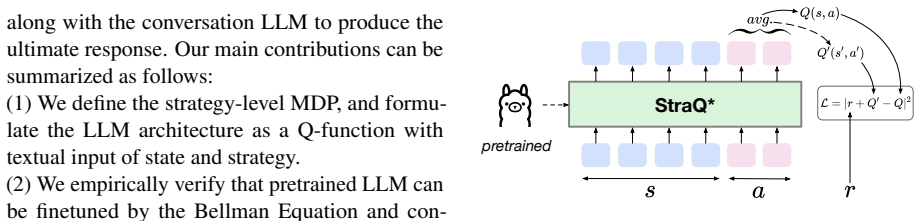
The load-bearing identity is $Q_\theta(s,a)$ defined as the averaged action-token logits of $\mathrm{LLM}_\theta(I(s)\oplus a)$, combined with the squared Bellman loss $L(\theta)=|r(s,a)+Q_\phi(s',a')-Q_\theta(s,a)|^2$. Because the transformer's causal masking lets many turns be updated in parallel, the same architecture used for language modeling can be trained directly on this residual. The instruction template is formatted as a multiple-choice question over the $K$ strategies, which makes the action values comparable across candidates and lets inference be a single arg-max over option logits rather than free-form generation. The target network $\phi$ is synchronized periodically, and the discount factor $\gamma$ encodes how far ahead the planner looks; the paper's sensitivity analysis shows $\gamma=0.9$ is best for strategy accuracy and $\gamma=0.85$ for response-similarity metrics.
What would settle it
Take a held-out set of emotional-support conversations whose true downstream outcome (for example, the seeker's self-reported relief after the conversation) is measured, and compare the outcomes of conversations whose next strategy was chosen by the highest Q-value against conversations where a random, frequency-matched strategy was used; if the arg-max strategy does not lead to better outcomes, the Q-values are not measuring long-term value.
Extended reading notes
Core claim
On the paper's own terms, the central discovery is that the Bellman equation can serve as the training loss for a language model used as a value function. Emotional support is formalized as a strategy-level Markov decision process in which the eight annotated support strategies (question, restatement, reflection, self-disclosure, affirmation, suggestion, information, others) are the actions. The Q-value of a state-action pair is computed as the average logit of the action tokens when the instruction $I(s)$ is concatenated with the strategy answer $a$: $Q_\theta(s,a) \leftarrow \mathrm{LLM}_\theta(I(s)\oplus a)$, and the optimal strategy is $a^\star = \arg\max_a \mathrm{LLM}(I(s)\oplus a)$. Training minimizes the squared Bellman residual with a periodically synchronized target network, and two reward types are tested: +1 for the dataset's annotated strategy with −1 for a randomly sampled alternative, and a teacher-model judge score on a 0–5 scale. The authors claim this yields higher strategy accuracy, lower preference bias, improved response-similarity metrics, and better human-evaluated satisfaction than the baselines, with the distilled reward generalizing better.
Load-bearing premise
The whole result rests on the assumption that the average score the model assigns to the words of a strategy name is a genuine measure of how valuable that strategy is, and that the next strategy written in the training dialogues is a faithful stand-in for the ideal next action; if either fails, the planner will fit the statistics of the corpus rather than improve the seeker's long-term state.
Editorial extensions
If this is right
- If the claim holds, a small value-based planner can be bolted onto an existing conversational LLM, steering it toward coherent long-horizon strategy progression without retraining the generator.
- Strategy selection can be trained purely from an offline dialogue corpus using either expert-imitation rewards or distilled judge rewards, and the report that distillation transfers better to out-of-domain conversations suggests a practical recipe for data-lean settings.
- Because the Q-network is an LLM, scaling the base model improves response quality, so the method tracks LLM capability improvements while still keeping the planner small.
- The pattern of higher averaged rewards and values for chosen strategies than for direct inference indicates that the planner is shifting the distribution toward what the judge rewards, not merely mimicking frequency.
Reading between the lines
- The identity between averaged logits and Q-values is not forced by theory; a natural stress test is to compare it with a learned scalar head on the same hidden states, and the paper's own ablation shows a value head underperforms, hinting that keeping the value on the token-logit scale preserves semantic comparability.
- The method should transfer to any dialogue or decision task with a small enumerable set of textual actions — tutoring strategies, medical interview moves, negotiation tactics — whenever a reward can be annotated or distilled, though the paper only tests emotional support.
- Since training is offline, the Q-values can only be as good as the coverage of the corpus; a testable extension would be to interleave straQ* with online self-play or seeker simulation and check whether Bellman updates continue to improve beyond the expert transitions in the training set.
- The reward definitions differ in an informative way: imitation rewards only distinguish the annotated action from a random one, while distillation rewards grade all actions, so the out-of-domain gap between the two variants suggests that reward granularity, not strategy taxonomy, drives generalization.
Signed reviews
Editorial analysis
A structured set of objections, weighed in public.
Referee Report
Summary. The paper proposes straQ*, a framework that converts a pretrained LLM into a value-based strategic planner for emotional support conversation (ESC). It defines a strategy-level MDP, represents Q(s,a) as averaged action-token logits of an LLM, fine-tunes the LLM with a squared Bellman loss on offline ESConv data, and selects strategies by argmax over the resulting Q function. Two reward mechanisms are studied: imitation rewards (+1/-1 for dataset actions) and distillation rewards (GPT-4 scores). Experiments on ESConv and EmpatheticDialogues compare against direct inference, self-refine, chain-of-thought, fine-tuning, and FSM baselines, reporting improvements in strategy accuracy, response similarity, human judgments, and GPT-4-evaluated returns.
Significance. The empirical setup is attractive in several ways: the planner is lightweight and plug-and-play, the code is released, two reward formulations are compared, evaluation includes cross-domain and human judgments, and ablations and sensitivity analyses are provided. If the theoretical framing were correct, the paper would offer a useful new way to inject long-term strategic value into LLM dialogue. However, the central Q-learning claim is compromised by the offline update in Eq. (2), which uses the logged next action rather than the max over actions, and by the unvalidated use of averaged logits as Q-values. The empirical gains are plausible but the contribution as stated overclaims.
major comments (5)
- [Section 2, Eq. (2)] The loss is written as L = |r(s,a) + Q_phi(s',a') - Q_theta(s,a)|^2, with no max over next actions, while Eq. (1) is the Bellman optimality equation. On offline data, a' is the dataset's next strategy, so this is a SARSA-style policy-evaluation update for the logging policy, not Q-learning. Consequently, greedy selection in Eq. (6) is not justified as optimizing long-term return, and contribution (2)'s 'converges to optimum returns' is unsupported. If the implementation actually computes max over the K strategies, the paper must say so explicitly and discuss offline overestimation; either way the current text is misleading.
- [Section 3.3, Eq. (5)] Averaged action-token logits are asserted to be Q(s,a), but no evidence is given that logit magnitudes lie on the scale of the rewards (0-5 for distill, +/-1 for imitation). Without calibration or a stated link between logits and value, minimizing the TD loss can simply fit the reward statistics of the training corpus. The definition of 'averaged action logits' is also ambiguous: which tokens are averaged, and how does variable-length strategy phrasing affect the average? Please specify the exact computation and justify the scale.
- [Section 4.4, Table 5] For straQ*-distill, the same GPT-4 judge supplies both the training reward and the reported average reward; the claim that straQ* 'statistically obtains higher returns' is therefore partly circular. Reporting an evaluation with a different judge, with human annotations, or on held-out reward labels would be needed to support the returns claim.
- [Section 4.3, Figure 4] The only evidence for 'converges to optimum returns' is a decreasing training loss curve. A loss curve does not show convergence of Q to Q*; the paper provides no convergence analysis, no evaluation of Bellman error on a held-out set, and no comparison of the learned Q function to Monte Carlo returns. Please either add such an evaluation or remove or weaken the convergence claim.
- [Table 6] The advantage of straQ*-imit over the auto-regressive ablation is small (Acc 46.83 vs 46.22; Q 43.15 vs 43.01; B 0.80 vs 0.69, which is worse since lower B is better; B-2 7.63 vs 7.25; R-L 17.03 vs 16.48). No significance tests are reported, so the statement that straQ* 'can better align with the strategy semantics' is not established by this table.
minor comments (5)
- [Abstract] The phrase 'might not define the diagram from the state model perspective' is unclear and should be rephrased, for example as 'might not formulate the problem from a state-model perspective'.
- [Eq. (5)] The notation '↢' is nonstandard; please define precisely what averaging over action logits means and which tokens are included.
- [Section 3.4] For the imitation reward, the paper states that a different action is randomly sampled and assigned r = -1; please specify whether the negative samples are drawn from the same state and whether this creates an unbalanced objective.
- [Section 4.4] The quantity <value> in Table 5 is not defined; please state the formula used to compute it, e.g., the discounted sum of GPT-4 rewards over subsequent turns.
- [Appendix C] The human evaluation was conducted by the authors' interns; the limitation statement mentions potential bias, but reporting inter-annotator agreement would strengthen the reliability of the human results.
Circularity Check
Table 5's 'returns' analysis reuses the GPT-4 judge that produced the training reward for straQ*-distill, so the reported higher returns are partly a fit to the training target; the rest of the evaluation uses independent metrics.
-
fitted input called prediction
[Section 3.4 (Distillation reward) and Section 4.3 (Returns of Strategies), Table 5]
"Distillation: for each (s,a) pair from the dataset, we let a strong-basis LLM ( e.g., GPT-4) to provide a judge score from 0 to 5 ... In this analysis, the rewards are provided by GPT-4. straQ* achieve both higher <reward> and <value> than direct inference of the base model, as well as the annotation of the original dataset. This result shows that straQ* statistically obtains higher returns, which is the primary purpose of Q-Learning."
For straQ*-distill, the Bellman loss in Eq. 2 is trained on GPT-4 judge scores, and Table 5 then reports the same GPT-4 judge score as the evaluation metric <reward> and <value>. The higher <reward> is therefore a measure of how well the model fitted the reward function that generated its training labels, not an independent check of long-term benefit. The 'converges to optimum returns' claim is thus partly a restatement of the training objective for this variant. Independent support for the central claim does exist elsewhere (automatic metrics, human evaluation), so the circularity is confined to the returns analysis.
full rationale
The core derivation is not definitionally circular: Q(s,a) is defined as averaged action logits (Eq. 5), trained by the TD loss in Eq. 2 against reward labels, and evaluated on held-out automatic metrics and human judgments that are not the training reward. The main circular element is the 'Returns of Strategies' analysis (Table 5): for straQ*-distill, the GPT-4 judge both creates the training reward and provides the reported reward/value, so the high <reward> is a fitted-input-called-prediction result. I also note a non-circular correctness gap: Eq. 2 omits the max over next actions from Eq. 1, so the update is SARSA-style evaluation of the logged policy rather than Q-learning, which weakens but does not definitionally circularize the 'optimal returns' claim. The imitation variant's +1/-1 reward is an acknowledged imitation objective, so its strategy accuracy is a fit to that objective, but the paper compares it against an auto-regressive baseline rather than presenting it as an independent optimality proof. No self-citation chain or imported uniqueness theorem is load-bearing.
Assumptions & free parameters
free parameters (4)
- Discount factor gamma =
0.85
- Target network update frequency =
10
- Replay buffer size =
12000
- Learning rate =
5e-6
assumptions (5)
- ad hoc to paper Averaged action-token logits from an LLM constitute a valid Q(s,a) value.
- domain assumption The offline ESConv dataset's transitions (seeker responses) are representative of real emotional support interactions.
- ad hoc to paper The TD target can be computed with the dataset's next action instead of the max over actions in the Bellman optimality equation.
- domain assumption GPT-4 judge scores (0-5) are a valid reward signal for emotional support quality in the distillation variant.
- domain assumption The MDP formulation of ESC with strategies as actions and session description/emotion/history as state is well-posed.
Cite this review
Pith. "Pith review of Convert Language Model into a Value-based Strategic Planner." pith.science (2026). https://pith.science/paper/6LW74HMS
@misc{pith2026250506987,
  author       = {Pith},
  title        = {Pith review of: Convert Language Model into a Value-based Strategic Planner},
  year         = {2026},
  howpublished = {\url{https://pith.science/paper/6LW74HMS}},
  note         = {Machine review of arXiv:2505.06987}
}
read the original abstract
Emotional support conversation (ESC) aims to alleviate the emotional distress of individuals through effective conversations. Although large language models (LLMs) have obtained remarkable progress on ESC, most of these studies might not define the diagram from the state model perspective, therefore providing a suboptimal solution for long-term satisfaction. To address such an issue, we leverage the Q-learning on LLMs, and propose a framework called straQ*. Our framework allows a plug-and-play LLM to bootstrap the planning during ESC, determine the optimal strategy based on long-term returns, and finally guide the LLM to response. Substantial experiments on ESC datasets suggest that straQ* outperforms many baselines, including direct inference, self-refine, chain of thought, finetuning, and finite state machines.
Figures


Figures from the paper (2 more)


Forward citations
Cited by 1 Pith paper
-
Towards Open-Ended Emotional Support Conversations in LLMs via Reinforcement Learning with Future-Oriented Rewards
An end-to-end RL framework that uses simulated future dialogue and a learned future-oriented reward model to fine-tune LLMs for open-ended emotional support, reporting improved success rates on ESConv and ExTES.
Reference graph
Works this paper leans on
-
[1]
online" 'onlinestring :=
ENTRY address archivePrefix author booktitle chapter edition editor eid eprint eprinttype howpublished institution journal key month note number organization pages publisher school series title type volume year doi pubmed url lastchecked label extra.label sort.label short.list INTEGERS output.state before.all mid.sentence after.sentence after.block STRING...
-
[2]
write newline
" write newline "" before.all 'output.state := FUNCTION n.dashify 't := "" t empty not t #1 #1 substring "-" = t #1 #2 substring "--" = not "--" * t #2 global.max substring 't := t #1 #1 substring "-" = "-" * t #2 global.max substring 't := while if t #1 #1 substring * t #2 global.max substring 't := if while FUNCTION word.in bbl.in capitalize " " * FUNCT...
-
[3]
AI@Meta. 2024. https://github.com/meta-llama/llama3/blob/main/MODEL_CARD.md Llama 3 model card
2024
-
[4]
Ralph Allan Bradley and Milton E Terry. 1952. Rank analysis of incomplete block designs: I. the method of paired comparisons. Biometrika, 39(3/4):324--345
1952
-
[5]
Clara E Hill. 2009. Helping Skills: Facilitating, Exploration, Insight, and Action. American Psychological Association
work page 2009
-
[6]
Jian Hu, Xibin Wu, Zilin Zhu, Xianyu, Weixun Wang, Dehao Zhang, and Yu Cao. 2024. Openrlhf: An easy-to-use, scalable and high-performance rlhf framework. arXiv preprint arXiv:2405.11143
arXiv 2024
-
[7]
Dongjin Kang, Sunghwan Kim, Taeyoon Kwon, Seungjun Moon, Hyunsouk Cho, Youngjae Yu, Dongha Lee, and Jinyoung Yeo. 2024. https://doi.org/10.18653/v1/2024.acl-long.813 Can large language models be good emotional supporter? mitigating preference bias on emotional support conversation . In Proceedings of the 62nd Annual Meeting of the Association for Computat...
- [8]
Show all 19 references
- [9]
-
[10]
Siyang Liu, Chujie Zheng, Orianna Demasi, Sahand Sabour, Yu Li, Zhou Yu, Yong Jiang, and Minlie Huang. 2021. https://doi.org/10.18653/v1/2021.acl-long.269 Towards emotional support dialog systems . In Proceedings of the 59th Annual Meeting of the Association for Computational ...
2021 doi
-
[11]
Aman Madaan, Niket Tandon, Prakhar Gupta, Skyler Hallinan, Luyu Gao, Sarah Wiegreffe, Uri Alon, Nouha Dziri, Shrimai Prabhumoye, Yiming Yang, Sean Welleck, Bodhisattwa Prasad Majumder, Shashank Gupta, Amir Yazdanbakhsh, and Peter Clark. 2023. https://api.semanticscholar.org/Co...
2023 arXiv
-
[12]
Stephen A Rains, Corey A Pavlich, Bethany Lutovsky, Eric Tsetsi, and Anjali Ashtaputre. 2020. Support seeker expectations, support message quality, and supportive interaction processes and outcomes: The case of the comforting computer program revisited. Journal of Social and P...
2020
-
[13]
Hannah Rashkin, Eric Michael Smith, Margaret Li, and Y-Lan Boureau. 2019. https://doi.org/10.18653/v1/P19-1534 Towards empathetic open-domain conversation models: A new benchmark and dataset . In Proceedings of the 57th Annual Meeting of the Association for Computational Lingu...
2019 doi
- [14]
- [15]
-
[16]
Jason Wei, Xuezhi Wang, Dale Schuurmans, Maarten Bosma, Fei Xia, Ed Chi, Quoc V Le, Denny Zhou, et al. 2022. Chain-of-thought prompting elicits reasoning in large language models. Advances in Neural Information Processing Systems, 35:24824--24837
2022
-
[17]
Weixiang Zhao, Yanyan Zhao, Shilong Wang, and Bing Qin. 2023. https://doi.org/10.18653/v1/2023.findings-acl.420 T rans ESC : Smoothing emotional support conversation via turn-level state transition . In Findings of the Association for Computational Linguistics: ACL 2023, pages...
2023 doi
-
[18]
Chujie Zheng, Sahand Sabour, Jiaxin Wen, Zheng Zhang, and Minlie Huang. 2023. https://doi.org/10.18653/v1/2023.findings-acl.99 A ug ESC : Dialogue augmentation with large language models for emotional support conversation . In Findings of the Association for Computational Ling...
2023 doi
- [19]
Reviewed August 15, 2026 · model on record in the stance chip above.
Discussion (0). Continue with ORCID to comment.