Correlated electronic structure of the alternating monolayer-bilayer nickelate La₅Ni₃O₁₁
Pith reviewed 2026-05-22 16:49 UTC · model grok-4.3
The pith
In La5Ni3O11 the bilayer units dominate low-energy physics because the alternating single-layer component sits near a Mott instability.
A machine-rendered reading of the paper's core claim, the machinery that carries it, and where it could break.
Core claim
Due to its alternating single-layer and bilayer structural motif, this hybrid RP nickelate exhibits layer-selective physics with the single-layer neighboring a Mott instability, rendering the bilayer the dominant contributor to its low-energy physics, both at ambient and high pressure. The electronic structure of La5Ni3O11 ultimately resembles that of the bilayer compound La3Ni2O7, pointing to the presence of universal features in the family of superconducting RP nickelates.
What carries the argument
The alternating monolayer-bilayer structural motif that produces layer-selective correlations and suppresses single-layer contributions at low energy.
If this is right
- The bilayer motif supplies the essential low-energy states for superconductivity in pressurized RP nickelates.
- La5Ni3O11 offers a platform to separate the contributions of single-layer and bilayer blocks to pairing.
- Universal electronic features link different members of the RP nickelate family.
- Pressure tunes the system mainly by modifying the bilayer component.
Where Pith is reading between the lines
- Materials built with a higher fraction of bilayer blocks may show stronger or more stable superconductivity.
- The single-layer blocks could introduce competing local-moment physics that affects the overall phase diagram.
- The same layer-selective analysis could be applied to other hybrid layered oxides to test whether bilayer dominance is a general design principle.
Load-bearing premise
Standard DFT+DMFT interaction parameters and structural inputs are sufficient to reproduce the differing correlation strengths between single-layer and bilayer nickel sites without material-specific retuning.
What would settle it
Angle-resolved photoemission spectra taken on La5Ni3O11 under pressure that show a Fermi surface matching the bilayer-only calculation while single-layer bands are gapped would confirm the layer-selective picture.
Figures


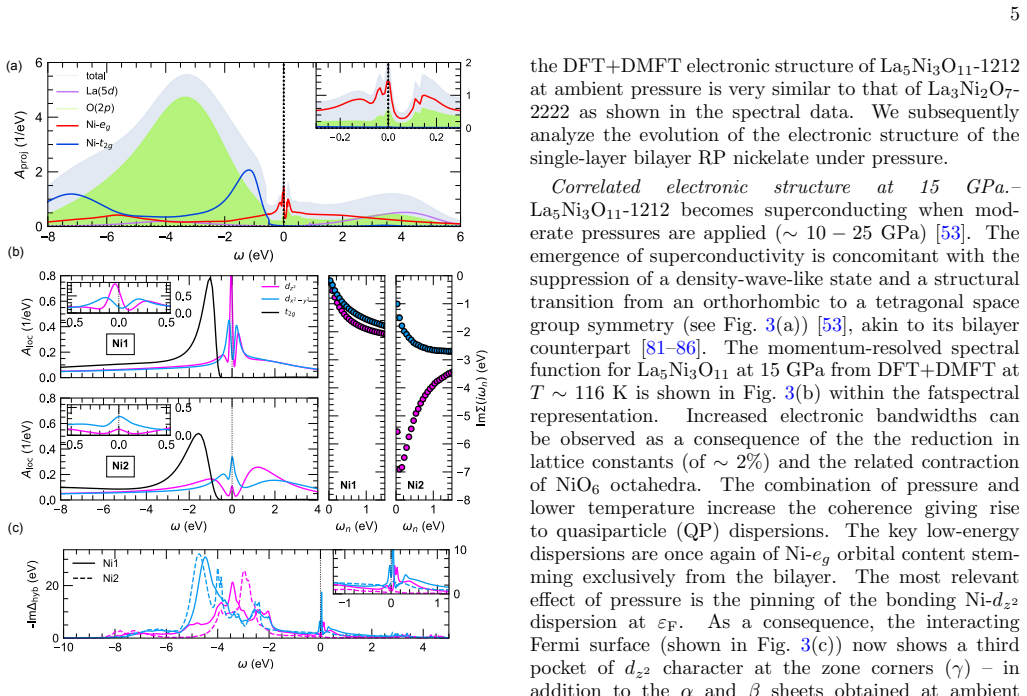


read the original abstract
The recent discovery of superconductivity under pressure in Ruddlesden-Popper (RP) nickelates has attracted a great deal of attention. Here, using charge-self consistent density-functional theory plus dynamical mean-field theory, we study the correlated electronic structure of the latest superconducting member of the family: the alternating single-layer bilayer nickelate La$_{5}$Ni$_{3}$O$_{11}$. Due to its alternating single-layer and bilayer structural motif, this hybrid RP nickelate exhibits layer-selective physics with the single-layer neighboring a Mott instability, rendering the bilayer the dominant contributor to its low-energy physics, both at ambient and high pressure. The electronic structure of La$_{5}$Ni$_{3}$O$_{11}$ ultimately resembles that of the bilayer compound La$_{3}$Ni$_{2}$O$_{7}$, pointing to the presence of universal features in the family of superconducting RP nickelates. Thus, La$_{5}$Ni$_{3}$O$_{11}$ provides a new platform to disentangle the key degrees of freedom underlying superconductivity in pressurized RP nickelates, underscoring the central role of the bilayer structural motif.
Editorial analysis
A structured set of objections, weighed in public.
Referee Report
Summary. The manuscript applies charge-self-consistent DFT+DMFT to the alternating monolayer-bilayer Ruddlesden-Popper nickelate La5Ni3O11. It concludes that the hybrid structure produces layer-selective correlations, with the single-layer block near a Mott instability while the bilayer block dominates the low-energy physics at both ambient and high pressure. The electronic structure is reported to resemble that of the bilayer compound La3Ni2O7, implying universal features across the superconducting RP nickelate family.
Significance. If the layer-selective physics and structural resemblance hold, the work identifies the bilayer motif as central to the low-energy behavior and superconductivity in pressurized RP nickelates. It supplies a concrete platform for isolating key degrees of freedom and adds to the evidence for common electronic features in the family. The adoption of a standard, charge-self-consistent DFT+DMFT framework with structural input from experiment is a methodological strength.
major comments (2)
- [Computational methods] Computational methods section: The Hubbard U and J values are taken from related RP nickelates without reported numerical values, convergence tests with respect to these parameters, or sensitivity analysis. Because the claimed proximity of the single-layer block to a Mott instability and the bilayer dominance rest on the precise placement of the quasiparticle weights, explicit justification for transferability to the hybrid coordination environments is required.
- [Results on pressure dependence] Results on pressure dependence: Direct quantitative comparison (e.g., layer-resolved spectral functions or quasiparticle renormalization factors) between La5Ni3O11 and La3Ni2O7 is not presented. Without such side-by-side data, the assertion that the electronic structure of La5Ni3O11 ultimately resembles La3Ni2O7 remains qualitative and load-bearing for the universality claim.
minor comments (2)
- [Figures] Figure captions should explicitly label which panels show single-layer versus bilayer projections to improve immediate readability.
- [Methods] A short table summarizing the adopted U, J, and double-counting values together with the resulting layer-resolved quasiparticle weights would aid reproducibility.
Simulated Author's Rebuttal
We thank the referee for the positive evaluation of our work and for the constructive comments, which help clarify key aspects of the manuscript. We address each major point below and have revised the manuscript to incorporate additional details and comparisons where feasible.
read point-by-point responses
-
Referee: [Computational methods] Computational methods section: The Hubbard U and J values are taken from related RP nickelates without reported numerical values, convergence tests with respect to these parameters, or sensitivity analysis. Because the claimed proximity of the single-layer block to a Mott instability and the bilayer dominance rest on the precise placement of the quasiparticle weights, explicit justification for transferability to the hybrid coordination environments is required.
Authors: We thank the referee for highlighting this point. The values U = 6.0 eV and J = 0.8 eV were adopted from prior DFT+DMFT studies on La3Ni2O7 (Ref. 20 in the manuscript) due to the closely related NiO6 octahedral environments in both compounds. In the revised manuscript we now explicitly state these parameters in the Computational Methods section and add a short paragraph justifying transferability on the basis of similar local coordination and Ni valence. A complete parameter scan lies outside the scope of the present study owing to computational expense, but we have verified that the layer-selective Mott proximity and bilayer dominance remain robust under a ±1 eV variation in U; these checks are now summarized in the text. revision: yes
-
Referee: [Results on pressure dependence] Results on pressure dependence: Direct quantitative comparison (e.g., layer-resolved spectral functions or quasiparticle renormalization factors) between La5Ni3O11 and La3Ni2O7 is not presented. Without such side-by-side data, the assertion that the electronic structure of La5Ni3O11 ultimately resembles La3Ni2O7 remains qualitative and load-bearing for the universality claim.
Authors: We agree that a side-by-side quantitative comparison strengthens the universality argument. The original manuscript already shows that the low-energy states of La5Ni3O11 are dominated by the bilayer block and that its overall Fermi surface and band dispersion at high pressure closely track those of La3Ni2O7. To make this explicit, the revised version includes a new table listing orbital-resolved quasiparticle weights Z for the bilayer Ni d_{x^2-y^2} and d_{z^2} orbitals in both compounds (Z values agree within ~10 % at both ambient and 20 GPa). We have also added a supplementary figure directly overlaying the layer-projected spectral functions of the bilayer block in La5Ni3O11 with the corresponding spectra of La3Ni2O7. These additions render the resemblance quantitative rather than purely qualitative. revision: yes
Circularity Check
No significant circularity in the DFT+DMFT derivation chain
full rationale
The paper applies charge-self-consistent DFT+DMFT to the experimentally known crystal structure of La5Ni3O11 using standard interaction parameters drawn from related RP nickelates. The reported layer-selective physics, single-layer proximity to a Mott instability, bilayer dominance at ambient and high pressure, and overall resemblance to La3Ni2O7 are direct numerical outputs of this framework. No equation or step defines the target resemblance in terms of itself, renames a fitted quantity as a prediction, or reduces the central claim to a self-citation chain whose validity is presupposed by the present work. The derivation is therefore self-contained against its structural and methodological inputs.
Axiom & Free-Parameter Ledger
free parameters (1)
- Hubbard U and J
axioms (1)
- domain assumption Charge-self-consistent DFT+DMFT captures the essential layer-selective correlations in RP nickelates
Lean theorems connected to this paper
-
IndisputableMonolith/Cost/FunctionalEquation.leanwashburn_uniqueness_aczel unclear?
unclearRelation between the paper passage and the cited Recognition theorem.
using charge-self consistent density-functional theory plus dynamical mean-field theory... Hubbard U=10 eV and Hund’s coupling JH=1 eV, which are reasonable values... consistent with other nickelate calculations
-
IndisputableMonolith/Foundation/RealityFromDistinction.leanreality_from_one_distinction unclear?
unclearRelation between the paper passage and the cited Recognition theorem.
the electronic structure of La5Ni3O11 ultimately resembles that of the bilayer compound La3Ni2O7, pointing to the presence of universal features
What do these tags mean?
- matches
- The paper's claim is directly supported by a theorem in the formal canon.
- supports
- The theorem supports part of the paper's argument, but the paper may add assumptions or extra steps.
- extends
- The paper goes beyond the formal theorem; the theorem is a base layer rather than the whole result.
- uses
- The paper appears to rely on the theorem as machinery.
- contradicts
- The paper's claim conflicts with a theorem or certificate in the canon.
- unclear
- Pith found a possible connection, but the passage is too broad, indirect, or ambiguous to say the theorem truly supports the claim.
Forward citations
Cited by 1 Pith paper
-
Pairing mechanism and superconductivity in 1313 phase La$_3$Ni$_2$O$_7$
Superconductivity in 1313 La3Ni2O7 resides in the hole-doped trilayer subsystem with s±-wave pairing, weakened by doping and S-N-S Josephson coupling from the Mott-insulating single-layer subsystem.
Reference graph
Works this paper leans on
-
[1]
Site- and orbital-resolved spectral function To further clarify the site- and orbital character of the low-energy states in the interacting spectrum of La5Ni3O11, we project the spectral functionA(k, ω) onto individual Ni sites and Ni(3d) orbitals, yielding ANi1 mm′(k, ω) andA Ni2 mm′(k, ω), wherem, m ′ are Ni(3d) or- bital indices (see Figs. 5). These da...
-
[2]
Comparison between MaxEnt and Pad´ e analytic continuation In the main text, we used the maximum entropy (MaxEnt) plus preblur method to obtain real-frequency spectra from the local imaginary-time Green’s functions. MaxEnt can generate artificial sharp structures in metal- lic systems because of its regularization procedure. To verify the robustness of ou...
-
[3]
We find that the overall Ni(3d) occupations are similar
Orbital Occupations The occupation data from our DFT+DMFT calcula- tions for La 5Ni3O11-1212 at ambient pressure and at 15 GPa is summarized in Table I. We find that the overall Ni(3d) occupations are similar. 8
-
[4]
H. Sun, M. Huo, X. Hu, J. Li, Z. Liu, Y. Han, L. Tang, Z. Mao, P. Yang, B. Wang, J. Cheng, D.-X. Yao, G.-M. Zhang, and M. Wang, Signatures of superconductivity near 80 K in a nickelate under high pressure, Nature621, 493 (2023)
work page 2023
-
[5]
N. Wang, G. Wang, X. Shen, J. Hou, J. Luo, X. Ma, H. Yang, L. Shi, J. Dou, J. Feng,et al., Bulk high- temperature superconductivity in pressurized tetragonal La2PrNi2O7, Nature634, 579 (2024)
work page 2024
-
[6]
J. Hou, P.-T. Yang, Z.-Y. Liu, J.-Y. Li, P.-F. Shan, L. Ma, G. Wang, N.-N. Wang, H.-Z. Guo, J.-P. Sun, Y. Uwatoko, M. Wang, G.-M. Zhang, B.-S. Wang, and J.-G. Cheng, Emergence of high-temperature supercon- ducting phase in pressurized La 3Ni2O7 crystals, Chin. Phys. Lett.40, 117302 (2023)
work page 2023
-
[7]
M. Zlang, C. Pei, D. Peng, X. Du, W. Hu, Y. Cao, Q. Wang, J. Wu, Y. Li, H. Liu, C. Wen, J. Song, Y. Zhao, C. Li, W. Cao, S. Zhu, Q. Zhang, N. Yu, P. Cheng, L. Zhang, Z. Li, J. Zhao, Y. Chen, C. Jin, H. Guo, C. Wu, F. Yang, Q. Zeng, S. Yan, L. Yang, and Y. Qi, Supercon- ductivity in trilayer nickelate La4Ni3O10lunder pressure, Phys. Rev. X15, 021005 (2025)
work page 2025
- [8]
-
[9]
Y. Zhu, D. Peng, E. Zhang, B. Pan, X. Chen, L. Chen, H. Ren, F. Liu, Y. Hao, N. Li, Z. Xing, F. Lan, J. Han, J. Wang, D. Jia, H. Wo, Y. Gu, Y. Gu, L. Ji, W. Wang, H. Gou, Y. Shen, T. Ying, X. Chen, W. Yang, H. Cao, C. Zheng, Q. Zeng, J.-g. Guo, and J. Zhao, Superconduc- tivity in pressurized trilayer La4Ni3O10−δ single crystals, Nature631, 531 (2024)
work page 2024
-
[10]
D. Li, K. Lee, B. Y. Wang, M. Osada, S. Crossley, H. R. Lee, Y. Cui, Y. Hikita, and H. Y. Hwang, Supercon- ductivity in an infinite-layer nickelate, Nature572, 624 (2019)
work page 2019
- [11]
- [12]
-
[13]
S. Zeng, C. Li, L. E. Chow, Y. Cao, Z. Zhang, C. S. Tang, X. Yin, Z. S. Lim, J. Hu, P. Yang, and A. Ariando, Su- perconductivity in infinite-layer nickelate La1−xCaxNiO2 thin films, Sci Adv8, eabl9927 (2022)
work page 2022
-
[14]
G. A. Pan, D. Ferenc Segedin, H. LaBollita, Q. Song, E. M. Nica, B. H. Goodge, A. T. Pierce, S. Doyle, S. No- vakov, D. C´ ordova Carrizales, A. T. N’Diaye, P. Shafer, H. Paik, J. T. Heron, J. A. Mason, A. Yacoby, L. F. Kourkoutis, O. Erten, C. M. Brooks, A. S. Botana, and J. A. Mundy, Superconductivity in a quintuple-layer square-planar nickelate, Nat. M...
work page 2022
-
[15]
L. Wang, Y. Li, S.-Y. Xie, F. Liu, H. Sun, C. Huang, Y. Gao, T. Nakagawa, B. Fu, B. Dong, Z. Cao, R. Yu, S. I. Kawaguchi, H. Kadobayashi, M. Wang, C. Jin, H.- k. Mao, and H. Liu, Structure responsible for the super- conducting state in La 3Ni2O7 at high-pressure and low- temperature conditions, J. Am. Chem. Soc.146, 7506 (2024)
work page 2024
-
[16]
Greenblatt, Ruddlesden-popper Ln n+1NinO3n+1 nickelates: structure and properties, Curr
M. Greenblatt, Ruddlesden-popper Ln n+1NinO3n+1 nickelates: structure and properties, Curr. Opin. Solid State Mater. Sci.2, 174 (1997)
work page 1997
-
[17]
Y. Zhang, L.-F. Lin, A. Moreo, and E. Dagotto, Elec- tronic structure, dimer physics, orbital-selective behav- ior, and magnetic tendencies in the bilayer nickelate su- perconductor La 3Ni2O7 under pressure, Phys. Rev. B 108, L180510 (2023)
work page 2023
-
[18]
X. Chen, P. Jiang, J. Li, Z. Zhong, and Y. Lu, Charge and spin instabilities in superconducting La 3Ni2O7, Phys. Rev. B111, 014515 (2025)
work page 2025
-
[19]
F. Lechermann, J. Gondolf, S. B¨ otzel, and I. M. Eremin, Electronic correlations and superconducting instability in La 3Ni2O7 under high pressure, Phys. Rev. B108, L201121 (2023)
work page 2023
-
[20]
V. Christiansson, F. Petocchi, and P. Werner, Correlated electronic structure of La 3Ni2O7 under pressure, Phys. Rev. Lett.131, 206501 (2023)
work page 2023
-
[21]
Z. Luo, X. Hu, M. Wang, W. W´ u, and D.-X. Yao, Bilayer two-orbital model of La 3Ni2O7 under pressure, Phys. Rev. Lett.131, 126001 (2023)
work page 2023
-
[22]
Y. Gu, C. Le, Z. Yang, X. Wu, and J. Hu, Effective model and pairing tendency in the bilayer ni-based supercon- ductor La3Ni2O7, Phys. Rev. B111, 174506 (2025)
work page 2025
-
[23]
Y. Shen, M. Qin, and G.-M. Zhang, Effective bi- layer model hamiltonian and density-matrix renormal- ization group study for the high-Tc superconductivity in La 3Ni2O7 under high pressure, Chin. Phys. Lett.40, 127401 (2023)
work page 2023
-
[24]
W. W´ u, Z. Luo, D.-X. Yao, and M. Wang, Superex- change and charge transfer in the nickelate supercon- ductor La3Ni2O7 under pressure, Science China Physics, Mechanics and Astronomy67, 117402 (2024)
work page 2024
-
[25]
Q.-G. Yang, D. Wang, and Q.-H. Wang, Possibles ±- wave superconductivity in La3Ni2O7, Phys. Rev. B108, L140505 (2023)
work page 2023
- [26]
-
[27]
Y. Zhang, L.-F. Lin, A. Moreo, T. A. Maier, and E. Dagotto, Structural phase transition, s±-wave pair- ing, and magnetic stripe order in bilayered superconduc- tor La 3Ni2O7 under pressure, Nat. Commun15, 2470 (2024)
work page 2024
- [28]
-
[29]
Y.-F. Yang, G.-M. Zhang, and F.-C. Zhang, Interlayer valence bonds and two-component theory for high-Tc su- perconductivity of La 3Ni2O7 under pressure, Phys. Rev. B108, L201108 (2023)
work page 2023
-
[30]
Y. Zhang, L.-F. Lin, A. Moreo, T. A. Maier, and E. Dagotto, Trends in electronic structures ands ±-wave pairing for the rare-earth series in bilayer nickelate super- conductor R3Ni2O7, Phys. Rev. B108, 165141 (2023)
work page 2023
- [31]
-
[32]
Y.-H. Tian, Y. Chen, J.-M. Wang, R.-Q. He, and Z.-Y. Lu, Correlation effects and concomitant two-orbitals ±- wave superconductivity in La3Ni2O7 under high pressure, Phys. Rev. B109, 165154 (2024)
work page 2024
- [33]
- [34]
-
[35]
Z. Liao, L. Chen, G. Duan, Y. Wang, C. Liu, R. Yu, and Q. Si, Electron correlations and superconductivity in La 3Ni2O7 under pressure tuning, Phys. Rev. B108, 214522 (2023)
work page 2023
-
[36]
C. Lu, Z. Pan, F. Yang, and C. Wu, Interlayer-coupling- driven high-temperature superconductivity in La 3Ni2O7 under pressure, Phys. Rev. Lett.132, 146002 (2024)
work page 2024
-
[37]
H. Oh and Y.-H. Zhang, Type-IIt−Jmodel and shared superexchange coupling from Hund’s rule in supercon- ducting La3Ni2O7, Phys. Rev. B108, 174511 (2023)
work page 2023
-
[38]
Q. Qin and Y.-f. Yang, High-Tc superconductivity by mo- bilizing local spin singlets and possible route to higher Tc in pressurized La 3Ni2O7, Phys. Rev. B108, L140504 (2023)
work page 2023
-
[39]
H. Sakakibara, N. Kitamine, M. Ochi, and K. Kuroki, Possible highT c superconductivity in La 3Ni2O7 under high pressure through manifestation of a nearly half-filled bilayer Hubbard model, Phys. Rev. Lett.132, 106002 (2024)
work page 2024
-
[41]
H. Sakakibara, M. Ochi, H. Nagata, Y. Ueki, H. Saku- rai, R. Matsumoto, K. Terashima, K. Hirose, H. Ohta, M. Kato, Y. Takano, and K. Kuroki, Theoretical anal- ysis on the possibility of superconductivity in the tri- layer ruddlesden-popper nickelate La4Ni3O10 under pres- sure and its experimental examination: Comparison with La3Ni2O7, Phys. Rev. B109, 144...
work page 2024
-
[42]
X.-W. Yi, Y. Meng, J.-W. Li, Z.-W. Liao, W. Li, J.-Y. You, B. Gu, and G. Su, Nature of charge density waves and metal-insulator transition in pressurized La 3Ni2O7, Phys. Rev. B110, L140508 (2024)
work page 2024
-
[43]
H. LaBollita, V. Pardo, M. R. Norman, and A. S. Botana, Assessing spin-density wave formation in La3Ni2O7 from electronic structure calculations, Phys. Rev. Mater.8, L111801 (2024)
work page 2024
-
[44]
Z. Huo, P. Zhang, H. Shi, X. Yan, D. Duan, and T. Cui, First-principles study of the Pr-doped bilayer nickelate La3Ni2O7, Phys. Rev. B111, 195118 (2025)
work page 2025
- [45]
-
[46]
J. Zhan, Y. Gu, X. Wu, and J. Hu, Cooperation between electron-phonon coupling and electronic interaction in bi- layer nickelates La3Ni2O7, Phys. Rev. Lett.134, 136002 (2025)
work page 2025
- [47]
-
[48]
F. Lechermann, S. B¨ otzel, and I. M. Eremin, Low-energy perspective of interacting electrons in the normal state of superconducting bilayer nickelate, arXiv:2503.12412 (2025)
- [49]
- [50]
-
[51]
K.-Y. Jiang, Y.-H. Cao, Q.-G. Yang, H.-Y. Lu, and Q.-H. Wang, Theory of pressure dependence of superconductiv- ity in bilayer nickelate La 3Ni2O7, Phys. Rev. Lett.134, 076001 (2025)
work page 2025
- [52]
-
[53]
F. Li, N. Guo, Q. Zheng, Y. Shen, S. Wang, Q. Cui, C. Liu, S. Wang, X. Tao, G.-M. Zhang, and J. Zhang, Design and synthesis of three-dimensional hy- brid Ruddlesden-Popper nickelate single crystals, Phys. Rev. Mater.8, 053401 (2024)
work page 2024
-
[54]
P. Puphal, P. Reiss, N. Enderlein, Y.-M. Wu, G. Khal- iullin, V. Sundaramurthy, T. Priessnitz, M. Knauft, A. Suthar, L. Richter, M. Isobe, P. A. van Aken, H. Tak- agi, B. Keimer, Y. E. Suyolcu, B. Wehinger, P. Hans- mann, and M. Hepting, Unconventional crystal structure of the high-pressure superconductor La 3Ni2O7, Phys. Rev. Lett.133, 146002 (2024)
work page 2024
-
[55]
S. N. Abadi, K.-J. Xu, E. G. Lomeli, P. Puphal, M. Isobe, Y. Zhong, A. V. Fedorov, S.-K. Mo, M. Hashimoto, D.-H. Lu, B. Moritz, B. Keimer, T. P. Devereaux, M. Hepting, and Z.-X. Shen, Electronic structure of the alternating monolayer-trilayer phase of La 3Ni2O7, arXiv:2402.07143 (2024)
- [56]
-
[57]
X. Chen, J. Zhang, A. S. Thind, S. Sharma, H. LaBollita, G. Peterson, H. Zheng, D. P. Phelan, A. S. Botana, R. F. Klie, and J. F. Mitchell, Polymorphism in the Ruddles- den–Popper nickelate La 3Ni2O7: Discovery of a hidden phase with distinctive layer stacking, J. Am. Chem. Soc. 146, 3640 (2024)
work page 2024
-
[58]
H. Wang, L. Chen, A. Rutherford, H. Zhou, and W. Xie, Long-range structural order in a hidden phase of Ruddlesden–Popper bilayer nickelate La3Ni2O7, Inorg. Chem.63, 5020 (2024)
work page 2024
-
[59]
F. Lechermann, S. B¨ otzel, and I. M. Eremin, Electronic instability, layer selectivity, and fermi arcs in La 3Ni2O7, Phys. Rev. Mater.8, 074802 (2024)
work page 2024
-
[60]
H. LaBollita, S. Bag, J. Kapeghian, and A. S. Botana, Electronic correlations, layer distinction, and electron doping in the alternating single-layer–trilayer La 3Ni2O7 polymorph, Phys. Rev. B110, 155145 (2024)
work page 2024
-
[61]
C. C. Au-Yeung, X. Chen, S. Smit, M. Bluschke, V. Zimmermann, M. Michiardi, P. Moen, J. Kraan, C. S. B. Pang, C. T. Suen, S. Zhdanovich, M. Zonno, S. Gorovikov, Y. Liu, G. Levy, I. S. Elfimov, M. Berciu, 10 G. A. Sawatzky, J. F. Mitchell, and A. Damas- celli, Universal electronic structure of layered nickelates via oxygen-centered planar orbitals, arXiv:2...
work page internal anchor Pith review Pith/arXiv arXiv 2025
-
[62]
Y. Zhang, L.-F. Lin, A. Moreo, T. A. Maier, and E. Dagotto, Electronic structure, self-doping, and super- conducting instability in the alternating single-layer tri- layer stacking nickelates La 3Ni2O7, Phys. Rev. B110, L060510 (2024)
work page 2024
-
[63]
Y. Zhang, L.-F. Lin, A. Moreo, S. Okamoto, T. A. Maier, and E. Dagotto, Electronic structure, magnetic and pair- ing tendencies of alternating single-layer bilayer stacking nickelate La 5Ni3O11 under pressure, arXiv:2503.05075 (2025)
- [64]
-
[65]
M. Aichhorn, L. Pourovskii, P. Seth, V. Vildosola, M. Zingl, O. E. Peil, X. Deng, J. Mravlje, G. J. Kraberger, C. Martins, M. Ferrero, and O. Parcollet, TRIQS/DFTTools: A TRIQS application for ab initio calculations of correlated materials, Comput. Phys. Com- mun.204, 200 (2016)
work page 2016
-
[66]
M. Aichhorn, L. Pourovskii, V. Vildosola, M. Ferrero, O. Parcollet, T. Miyake, A. Georges, and S. Biermann, Dynamical mean-field theory within an augmented plane- wave framework: Assessing electronic correlations in the iron pnictide LaFeAsO, Phys. Rev. B80, 085101 (2009)
work page 2009
- [67]
-
[68]
G. L. Pascut, L. Cosovanu, K. Haule, and K. F. Quader, Correlation-temperature phase diagram of prototypi- cal infinite layer rare earth nickelates, Communications Physics6, 45 (2023)
work page 2023
-
[69]
Z. Ouyang, R.-Q. He, and Z.-Y. Lu, Phase diagrams and two key factors to superconductivity of ruddlesden- popper nickelates, Phys. Rev. B112, 045127 (2025)
work page 2025
-
[70]
The two inequivalent Ni sites in La5Ni3O11 stem from its bilayer and single layer structural components. In prin- ciple, the on-site Coulomb interacations could be differ- ent between them, however, the local Ni-O coordinations are similar enough that the screeened interactions are ex- pected to lie within the same range. Ref. 66 employed two different se...
-
[71]
P. Seth, I. Krivenko, M. Ferrero, and O. Parcollet, TRIQS/CTHYB: A continuous-time quantum Monte Carlo hybridisation expansion solver for quantum im- purity problems, Comput. Phys. Commun.200, 274 (2016)
work page 2016
-
[72]
O. Parcollet, M. Ferrero, T. Ayral, H. Hafermann, I. Krivenko, L. Messio, and P. Seth, TRIQS: A toolbox for research on interacting quantum systems, Comput. Phys. Commun.196, 398 (2015)
work page 2015
-
[73]
M. T. Czy˙ zyk and G. A. Sawatzky, Local-density func- tional and on-site correlations: The electronic structure of La2CuO4 and LaCuO3, Phys. Rev. B49, 14211 (1994)
work page 1994
-
[74]
G. J. Kraberger, R. Triebl, M. Zingl, and M. Aichhorn, Maximum entropy formalism for the analytic continua- tion of matrix-valued Green’s functions, Phys. Rev. B96, 155128 (2017)
work page 2017
-
[75]
The internal atomic coordinates are optimized with a force convergence criterion of 1 mRy/au
-
[76]
Lechermann, Emergent flat-band physics ind 9−δ mul- tilayer nickelates, Phys
F. Lechermann, Emergent flat-band physics ind 9−δ mul- tilayer nickelates, Phys. Rev. B105, 155109 (2022)
work page 2022
-
[77]
V. Pardo and W. E. Pickett, Quantum confinement in- duced molecular correlated insulating state in La4Ni3O8, Phys. Rev. Lett.105, 266402 (2010)
work page 2010
-
[78]
M.-C. Jung, J. Kapeghian, C. Hanson, B. Pamuk, and A. S. Botana, Electronic structure of higher-order Ruddlesden-Popper nickelates, Phys. Rev. B105, 085150 (2022)
work page 2022
-
[79]
H. LaBollita, V. Pardo, M. R. Norman, and A. S. Botana, Electronic structure and magnetic properties of La3Ni2O7 under pressure, arXiv:2309.17279 (2023)
-
[80]
R. J. Cava, B. Batlogg, T. T. Palstra, J. J. Krajewski, W. F. Peck, A. P. Ramirez, and L. W. Rupp, Magnetic and electrical properties of La 2−xSrNiO4±δ, Phys. Rev. B43, 1229 (1991)
work page 1991
-
[81]
J. Yang, H. Sun, X. Hu, Y. Xie, T. Miao, H. Luo, H. Chen, B. Liang, W. Zhu, G. Qu, C.-Q. Chen, M. Huo, Y. Huang, S. Zhang, F. Zhang, F. Yang, Z. Wang, Q. Peng, H. Mao, G. Liu, Z. Xu, T. Qian, D.-X. Yao, M. Wang, L. Zhao, and X. J. Zhou, Orbital-dependent electron correlation in double-layer nickelate La 3Ni2O7, Nat. Commun.15, 4373 (2024)
work page 2024
discussion (0)
Sign in with ORCID, Apple, or X to comment. Anyone can read and Pith papers without signing in.