REVIEW 5 major objections 5 minor 1 cited by
YuLan-OneSim: Towards the Next Generation of Social Simulator with Large Language Models
T0 review · 5 major / 5 minor · reviewed 2026-08-15 · deepseek-v4-flash
Pith's one-line read YuLan-OneSim claims that a social scientist can go from a plain-language research topic to a running 100,000-agent simulation, complete with an auto-drafted report, without writing simulation code.
desk verdict A well-engineered, open-sourced LLM social simulator with real scale and a clear ablation, but its headline claims outrun the evaluation: the evolvable loop is untested and most quality scores are LLM self-assessments. read the letter →
The pith
A machine-rendered reading of the paper's core claim, the machinery that carries it, and where it could break.
The reading
What carries the argument
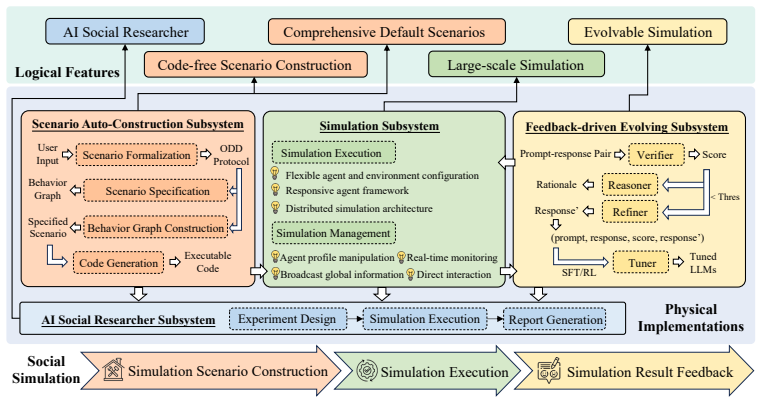
The load-bearing object is the behavior graph, a directed graph whose nodes are agent-type actions and whose edges are events that trigger the next action; a start node and an end node bookend the simulation. It carries the argument by giving the LLM a structured intermediate representation between the prose scenario and the executable code: the graph is structurally and semantically validated, then traversed in breadth-first order so that each action's handler code is generated with full knowledge of its incoming and outgoing events. Around this graph, the other mechanisms do supporting work: the ODD protocol standardizes the scenario description, the code-generation step assembles handlers from templates, and the VR²T loop scores prompt-response pairs, explains weak scores, repairs responses, and fine-tunes the backbone LLM. The distributed architecture that enables 100,000-agent runs is a master-worker system with an asynchronous event bus, topology-aware agent allocation, and cached peer-to-peer routing between workers.
What would settle it
Take one of the 50 default scenarios, silently change a single action's logic in the generated code so it violates an explicit precondition in the ODD protocol, and run the iterative validation; if the corruption is not detected, or if the corrected code no longer produces the ODD-described behavior, then the claim that validation guarantees faithful implementation is false.
Extended reading notes
Core claim
The central claim is that a single LLM-based platform can take a natural-language research prompt and turn it into an executable, large-scale social simulation with only human confirmation at editable checkpoints. The route from prompt to code passes through an intermediate representation: the ODD protocol formalizes the scenario, a behavior graph fixes agent actions and event flows, graph-guided code generation assembles executable handlers, and a final specification step supplies agent profiles and relationships. The paper further claims reliability is achieved through iterative validation of the graph and code, and through a Verifier-Reasoner-Refiner-Tuner loop that labels weak prompt-response pairs and fine-tunes the backbone LLM. On scalability, the paper claims a fully responsive, event-driven agent framework and a master-worker distributed architecture with topology-aware allocation and peer-to-peer event routing, demonstrated on roughly 100,000 agents. The same machinery is wrapped in an AI social researcher that designs experiments, runs the simulator, and produces and refines a LaTeX report, with the paper reporting an average scenario-design score of 4.13/5 and a report-quality score of 3.31/5.
Load-bearing premise
The load-bearing premise is that the LLM-based validation checks on the behavior graph and generated code are strong enough that a scenario which passes them really implements what the researcher described; the paper's own error analysis shows logical errors are the most common failure, so a silent logical mistake could break the code-free construction claim.
Editorial extensions
If this is right
- Users without programming skills can construct and refine a simulation scenario entirely through natural language, with generated code that is human-editable at the behavior-graph, code, and profile stages.
- A repository of 50 ready-to-run scenarios across economics, sociology, politics, psychology, organization, demographics, law, and communication gives researchers immediate access to simulations in their field.
- The VR²T loop turns accumulated human or system feedback into supervised fine-tuning or reinforcement learning data, so the simulator's backbone can improve over time on the scenarios its users actually run.
- The distributed, event-driven architecture makes population-scale experiments practical: approximately 100,000 agents completed a round in about 6,026 seconds with roughly 294,000 events processed per round.
- An AI social researcher can carry a topic from research-question generation through scenario construction, simulation, results analysis, and report drafting and revision, with the paper's evaluation showing strong feasibility of the designed scenarios and weaker insight and utility in the generated reports.
Reading between the lines
- Editorial inference: if the behavior graph is a faithful logical specification, it could be reused as a machine-readable record of what a scenario means, allowing independent teams to audit or replay a published simulation without re-running the LLM calls.
- Editorial inference: the reported error distribution, where logical errors dominate, suggests that a dedicated static-analysis or rule-based check on agent action logic could buy more reliability per effort than further prompt-level repair.
- Editorial inference: the 50 default scenarios could serve as a common testbed for comparing LLM social simulators, since each scenario pairs an ODD protocol, a behavior graph, executable code, and agent profiles.
- Editorial inference: because the AI researcher's lowest ratings are in insight and utility, a human in the loop is likely still needed for interpretation even when the pipeline itself runs autonomously.
Signed reviews
Editorial analysis
A structured set of objections, weighed in public.
Referee Report
Summary. The paper introduces YuLan-OneSim, an LLM-based social simulation platform with five stated advantages: code-free scenario construction via a four/five-step pipeline (ODD formalization, behavior graph construction, code generation, scenario specification), 50 default scenarios across eight domains, a feedback-driven Verifier-Reasoner-Refiner-Tuner (VR²T) evolving subsystem, a distributed architecture supporting up to 100,000 agents, and an AI social researcher that autonomously designs experiments and generates technical reports. The experimental section evaluates scenario-construction quality (behavior-graph/code ratings, generation time), simulation reliability (Axelrod cultural dissemination, Brazilian housing-price comparison), efficiency/scalability (100,000-agent runs on 8 A100 GPUs), and AI-researcher output quality. The authors report average behavior-graph and code ratings of 4.82/5 and 4.20/5, a throughput of about 49 events/second at 100,000 agents, and an AI-researcher scenario-design score of 4.13/5, and they release the project publicly.
Significance. If the headline claims were fully supported, YuLan-OneSim would be a substantial contribution to LLM-based social simulation: the system architecture is described in unusual detail, the default scenario repository is broad, the ablation in Table 6 does show that behavior-graph construction and the validation/refinement steps improve code quality, and the distributed-throughput numbers in Table 7 are a useful engineering data point. The paper also explicitly releases the codebase, which benefits reproducibility. However, the current evaluation does not establish several load-bearing claims: the headline VR²T evolving loop is never tested, the AI-researcher and code-quality assessments rely on the same LLM family that generated the outputs, the Axelrod reliability test is circular, and the real-world fit is assessed only visually. These gaps are localizable and, in principle, fixable within the manuscript's scope, so the appropriate disposition is major revision rather than rejection.
major comments (5)
- [4.4 and 4.1] The scenario-design scores in Table 8 and the report-quality scores in Table 9 are assigned by GPT-4o, the same model family used to generate the scenarios and reports, and Section 4.1 does not state who assigns the BG-Rating and C-Rating values. No human-rated validation set, inter-annotator agreement statistic, or independent judge is reported. An LLM assessing artifacts produced by the same LLM pipeline risks self-confirmation, so the averages (e.g., 4.13/5 for scenario design, 3.31/5 for reports, 4.20/5 for code) do not by themselves establish the claimed quality of either the auto-construction subsystem or the AI social researcher.
- [3.4] The Feedback-driven Evolving Subsystem (VR²T) is presented as a key advantage in the Introduction and described in detail in Section 3.4, but no experiment in Section 4 evaluates it. There is no subsection, table, or quantitative result testing whether the verifier-reasoner-refiner-tuner loop improves simulation quality, and the only evidence of feedback in the paper is the interface description in Appendix C.3. The claim that YuLan-OneSim is 'evolvable' is therefore unsupported by the experimental record.
- [4.2.1] The Axelrod cultural-dissemination test is circular as a reliability check. The scenario is built from the very theory it is used to verify: the ODD protocol and behavior graph encode Axelrod's model, including cultural features, local interaction rules, and the expected convergence/polarization outcome, and the simulation then reproduces that expected pattern. This confirms that the generated code can execute a re-implementation of a given specification, but it does not show that auto-constructed scenarios faithfully implement user intent or that the simulator is reliable for theories not already embedded in the scenario description. An independent theory or a scenario specified without transcribing the target theory would be a more meaningful test.
- [4.2.2] The Brazilian housing-price comparison in Figure 8 is purely qualitative: the text cites agreement in the lower price range and discrepancies in the mid-range, but reports no quantitative goodness-of-fit measure such as KL divergence, correlation, or chi-square statistic, no confidence intervals, and no sensitivity analysis. The simulation also runs for only 12 rounds. The claim that the simulator 'can approximate real-world economic distributions with reasonable accuracy' is not supported by any statistical test.
- [4.1, Figure 4] The error analysis in Figure 4 shows that logical errors—value-access errors, instruction-action mismatches, incorrect value assignments, and type-check oversights—are the dominant error class, yet the validation procedures in Sections 3.2.2 and 3.2.3 are themselves LLM-based structural and semantic checks. The paper does not provide evidence that the iterative repair loop eliminates these logical errors or that repaired behavior graphs and code preserve the semantics of the original scenario. Because code-free scenario construction is the paper's first headline contribution, this is a load-bearing gap; it could be closed by a human-annotated trace of a scenario subset, comparing the generated behavior graph and code against the reference ODD protocol.
minor comments (5)
- [Table 2, B.3.3] The scenario is listed as 'V oting' in Table 2 and Section B.3.3; this should be 'Voting'.
- [4.3] In the final paragraph of Section 4.3, 'the signal-node method' should be 'the single-node method'.
- [3.2] Section 3.2 states that the subsystem proposes a 'four-step framework' but then says 'In the following, we detail these five steps.' The count should be made consistent (the actual pipeline has five steps: formalization, behavior-graph construction, code generation, and specification are four, but the text treats them as five).
- [Table 5] The reported overall averages in Table 5 (G-Time 358.95, G-Tokens 18,080.7, Files 13.71, Lines 570.66) do not match the arithmetic means of the domain rows; for example, the mean of the eight G-Tokens entries is approximately 18,729.5, not 18,080.7. The averaging procedure should be stated and the values recomputed.
- [4.2.2] The text says the simulation is compared with 'the actual distribution of rental prices in Brazil from 2020 as reported in Furtado [2018]', but the cited reference is dated 2018; either the reference or the year should be corrected.
Circularity Check
The Axelrod 'theory verification' step instantiates the very mechanism it then claims to confirm, making that leg of the reliability evaluation circular; the remaining engineering claims are supported by independent timing, scale, and real-data comparisons.
-
self definitional
[Section 4.2.1, 'Social theory verification', Eqs. (1)-(2), Figures 5-6]
"In this experiment, we use Axelrod's cultural dissemination scenario as a case to study and evaluate our simulator Axelrod [1997]. Specifically, agents are arranged in an N ×N grid, with each agent possessing F cultural features... Agents interact with their adjacent neighbors, and the probability of interaction increases with cultural similarity. During these interactions, agents may adopt certain features from their neighbors, thereby modifying their own cultural profiles. This scenario is designed to explore how cultural traits diffuse and evolve within a population."
The scenario used to verify Axelrod's theory is built from that theory's own core mechanism: interaction probability increases with cultural similarity, and agents adopt features from neighbors. The paper then reports 'the coexistence of local convergence and global polarization—a key phenomenon predicted by Axelrod's theory' as evidence of simulator reliability. The predicted phenomenon is therefore encoded into the scenario's interaction rules before the simulation runs; observing it confirms that the generated code implements the stated rules, not that the simulator independently reproduces a theory it was not told about. This makes the theory-verification leg of RQ2 circular by construction, although the Brazilian price-data comparison in Sec. 4.2.2 remains an independent check.
full rationale
Most of YuLan-OneSim's central engineering claims are not circular. The code-free construction pipeline, 50-scenario repository, 100,000-agent execution at about 6,026 seconds per round, and the 75% speedup of the distributed architecture over single-node execution are supported by directly measured runtime, token, event-count, and scaling numbers that do not reduce to the paper's inputs. The Brazilian housing-price fitting is an external comparison against empirical data, and the paper openly reports discrepancies, so it is independent evidence. The AI-researcher and scenario-quality scores are weakened by the use of GPT-4o as both generator and grader, and the paper itself reports that logical errors dominate the generated code (Figure 4) while stating that further repair mechanisms are future work; however, the text does not exhibit a specific equation-level reduction that would make those evaluations circular under the strict standard. The one clear circular step is the Axelrod 'social theory verification': the scenario is constructed from Axelrod's own interaction rule, so the observed local convergence and global polarization re-express the input assumptions rather than independently validating the simulator. Because this circular step forms one of the two pillars of the reliability claim (RQ2), a partial-circularity score of 6 is warranted, while the independent real-data fit and objective scalability results prevent a higher score.
Assumptions & free parameters
assumptions (5)
- domain assumption LLM-generated agent responses approximate real human social behavior well enough for valid social simulation.
- domain assumption LLM-based quality ratings (GPT-4o) are valid measures of scenario and report quality.
- domain assumption Axelrod's cultural dissemination model is an appropriate benchmark, and reproducing it validates simulator reliability.
- domain assumption The empirical Brazilian rental price distribution from Furtado (2018) is a valid ground truth for a simplified three-market simulation.
- domain assumption The ODD protocol fully captures the information needed to generate correct executable simulation code.
Cite this review
Pith. "Pith review of YuLan-OneSim: Towards the Next Generation of Social Simulator with Large Language Models." pith.science (2026). https://pith.science/paper/KHEDRD2Q
@misc{pith2026250507581,
  author       = {Pith},
  title        = {Pith review of: YuLan-OneSim: Towards the Next Generation of Social Simulator with Large Language Models},
  year         = {2026},
  howpublished = {\url{https://pith.science/paper/KHEDRD2Q}},
  note         = {Machine review of arXiv:2505.07581}
}
read the original abstract
Leveraging large language model (LLM) based agents to simulate human social behaviors has recently gained significant attention. In this paper, we introduce a novel social simulator called YuLan-OneSim. Compared to previous works, YuLan-OneSim distinguishes itself in five key aspects: (1) Code-free scenario construction: Users can simply describe and refine their simulation scenarios through natural language interactions with our simulator. All simulation code is automatically generated, significantly reducing the need for programming expertise. (2) Comprehensive default scenarios: We implement 50 default simulation scenarios spanning 8 domains, including economics, sociology, politics, psychology, organization, demographics, law, and communication, broadening access for a diverse range of social researchers. (3) Evolvable simulation: Our simulator is capable of receiving external feedback and automatically fine-tuning the backbone LLMs, significantly enhancing the simulation quality. (4) Large-scale simulation: By developing a fully responsive agent framework and a distributed simulation architecture, our simulator can handle up to 100,000 agents, ensuring more stable and reliable simulation results. (5) AI social researcher: Leveraging the above features, we develop an AI social researcher. Users only need to propose a research topic, and the AI researcher will automatically analyze the input, construct simulation environments, summarize results, generate technical reports, review and refine the reports--completing the social science research loop. To demonstrate the advantages of YuLan-OneSim, we conduct experiments to evaluate the quality of the automatically generated scenarios, the reliability, efficiency, and scalability of the simulation process, as well as the performance of the AI social researcher.
Figures


Figures from the paper (71 more)


Forward citations
Cited by 1 Pith paper
-
Step-Level Preference Learning for Generative Agents in Social Simulations
Step-level human preference data collected via SimPref, then SFT+DPO, improves long-horizon social-simulation behavior of open-weight LLM agents on held-out events.
Reference graph
Works this paper leans on
-
[1]
Social simulation in the social sciences: A brief overview
Flaminio Squazzoni, Wander Jager, and Bruce Edmonds. Social simulation in the social sciences: A brief overview. Social Science Computer Review, 32 0 (3): 0 279--294, 2014
work page 2014
-
[2]
A survey of agent-based modeling practices (january 1998 to july 2008)
Brian Heath, Raymond Hill, and Frank Ciarallo. A survey of agent-based modeling practices (january 1998 to july 2008). Journal of Artificial Societies and Social Simulation, 12 0 (4): 0 9, 2009
work page 1998
-
[3]
Agent-based models in sociology
Federico Bianchi and Flaminio Squazzoni. Agent-based models in sociology. Wiley Interdisciplinary Reviews: Computational Statistics, 7 0 (4): 0 284--306, 2015
work page 2015
-
[4]
Large language models empowered agent-based modeling and simulation: A survey and perspectives
Chen Gao, Xiaochong Lan, Nian Li, Yuan Yuan, Jingtao Ding, Zhilun Zhou, Fengli Xu, and Yong Li. Large language models empowered agent-based modeling and simulation: A survey and perspectives. Humanities and Social Sciences Communications, 11 0 (1): 0 1--24, 2024 a
work page 2024
-
[5]
A survey of large language models
Wayne Xin Zhao, Kun Zhou, Junyi Li, Tianyi Tang, Xiaolei Wang, Yupeng Hou, Yingqian Min, Beichen Zhang, Junjie Zhang, Zican Dong, et al. A survey of large language models. arXiv preprint arXiv:2303.18223, 1 0 (2), 2023
arXiv 2023
-
[6]
Josh Achiam, Steven Adler, Sandhini Agarwal, Lama Ahmad, Ilge Akkaya, Florencia Leoni Aleman, Diogo Almeida, Janko Altenschmidt, Sam Altman, Shyamal Anadkat, et al. Gpt-4 technical report. arXiv preprint arXiv:2303.08774, 2023
arXiv 2023
-
[7]
Gensim: A general social simulation platform with large language model based agents
Jiakai Tang, Heyang Gao, Xuchen Pan, Lei Wang, Haoran Tan, Dawei Gao, Yushuo Chen, Xu Chen, Yankai Lin, Yaliang Li, et al. Gensim: A general social simulation platform with large language model based agents. arXiv preprint arXiv:2410.04360, 2024
-
[8]
Oasis: Open agents social interaction simulations on one million agents
Ziyi Yang, Zaibin Zhang, Zirui Zheng, Yuxian Jiang, Ziyue Gan, Zhiyu Wang, Zijian Ling, Jinsong Chen, Martz Ma, Bowen Dong, et al. Oasis: Open agents social interaction simulations on one million agents. arXiv preprint arXiv:2411.11581, 2024 a
arXiv 2024
Show all 38 references
-
[9]
Agentsociety: Large-scale simulation of llm-driven generative agents advances understanding of human behaviors and society
Jinghua Piao, Yuwei Yan, Jun Zhang, Nian Li, Junbo Yan, Xiaochong Lan, Zhihong Lu, Zhiheng Zheng, Jing Yi Wang, Di Zhou, et al. Agentsociety: Large-scale simulation of llm-driven generative agents advances understanding of human behaviors and society. arXiv preprint arXiv:2502...
2025 arXiv
-
[10]
Dynamic models of segregation
Thomas C Schelling. Dynamic models of segregation. Journal of mathematical sociology, 1 0 (2): 0 143--186, 1971
1971
-
[11]
The dissemination of culture: A model with local convergence and global polarization
Robert Axelrod. The dissemination of culture: A model with local convergence and global polarization. Journal of conflict resolution, 41 0 (2): 0 203--226, 1997
1997
-
[12]
An artificial stock market
Richard G Palmer, W Brian Arthur, John H Holland, and Blake LeBaron. An artificial stock market. Artificial Life and Robotics, 3: 0 27--31, 1999
1999
-
[13]
Recsim: A configurable simulation platform for recommender systems
Eugene Ie, Chih-wei Hsu, Martin Mladenov, Vihan Jain, Sanmit Narvekar, Jing Wang, Rui Wu, and Craig Boutilier. Recsim: A configurable simulation platform for recommender systems. arXiv preprint arXiv:1909.04847, 2019
1909 arXiv
-
[14]
Generative agents: Interactive simulacra of human behavior
Joon Sung Park, Joseph O'Brien, Carrie Jun Cai, Meredith Ringel Morris, Percy Liang, and Michael S Bernstein. Generative agents: Interactive simulacra of human behavior. In Proceedings of the 36th annual acm symposium on user interface software and technology, pages 1--22, 2023
2023
-
[15]
User behavior simulation with large language model-based agents
Lei Wang, Jingsen Zhang, Hao Yang, Zhi-Yuan Chen, Jiakai Tang, Zeyu Zhang, Xu Chen, Yankai Lin, Hao Sun, Ruihua Song, et al. User behavior simulation with large language model-based agents. ACM Transactions on Information Systems, 43 0 (2): 0 1--37, 2025
2025
-
[16]
S3: Social-network simulation system with large language model-empowered agents
Chen Gao, Xiaochong Lan, Zhihong Lu, Jinzhu Mao, Jinghua Piao, Huandong Wang, Depeng Jin, and Yong Li. S3: Social-network simulation system with large language model-empowered agents. arXiv preprint arXiv:2307.14984, 2023
2023 arXiv
-
[17]
Econagent: large language model-empowered agents for simulating macroeconomic activities
Nian Li, Chen Gao, Mingyu Li, Yong Li, and Qingmin Liao. Econagent: large language model-empowered agents for simulating macroeconomic activities. arXiv preprint arXiv:2310.10436, 2023
2023 arXiv
-
[18]
War and peace (waragent): Large language model-based multi-agent simulation of world wars
Wenyue Hua, Lizhou Fan, Lingyao Li, Kai Mei, Jianchao Ji, Yingqiang Ge, Libby Hemphill, and Yongfeng Zhang. War and peace (waragent): Large language model-based multi-agent simulation of world wars. arXiv preprint arXiv:2311.17227, 2023
2023 arXiv
-
[19]
Trendsim: Simulating trending topics in social media under poisoning attacks with llm-based multi-agent system
Zeyu Zhang, Jianxun Lian, Chen Ma, Yaning Qu, Ye Luo, Lei Wang, Rui Li, Xu Chen, Yankai Lin, Le Wu, et al. Trendsim: Simulating trending topics in social media under poisoning attacks with llm-based multi-agent system. arXiv preprint arXiv:2412.12196, 2024 a
2024 arXiv
-
[20]
Agent hospital: A simulacrum of hospital with evolvable medical agents
Junkai Li, Yunghwei Lai, Weitao Li, Jingyi Ren, Meng Zhang, Xinhui Kang, Siyu Wang, Peng Li, Ya-Qin Zhang, Weizhi Ma, et al. Agent hospital: A simulacrum of hospital with evolvable medical agents. arXiv preprint arXiv:2405.02957, 2024
2024 arXiv
-
[21]
Fincon: A synthesized llm multi-agent system with conceptual verbal reinforcement for enhanced financial decision making
Yangyang Yu, Zhiyuan Yao, Haohang Li, Zhiyang Deng, Yuechen Jiang, Yupeng Cao, Zhi Chen, Jordan Suchow, Zhenyu Cui, Rong Liu, et al. Fincon: A synthesized llm multi-agent system with conceptual verbal reinforcement for enhanced financial decision making. Advances in Neural Inf...
2024
-
[22]
On generative agents in recommendation
An Zhang, Yuxin Chen, Leheng Sheng, Xiang Wang, and Tat-Seng Chua. On generative agents in recommendation. In Proceedings of the 47th international ACM SIGIR conference on research and development in Information Retrieval, pages 1807--1817, 2024 b
2024
-
[23]
Urban generative intelligence (ugi): A foundational platform for agents in embodied city environment
Fengli Xu, Jun Zhang, Chen Gao, Jie Feng, and Yong Li. Urban generative intelligence (ugi): A foundational platform for agents in embodied city environment. arXiv preprint arXiv:2312.11813, 2023
2023 arXiv
-
[24]
Simulating opinion dynamics with networks of llm-based agents
Yun-Shiuan Chuang, Agam Goyal, Nikunj Harlalka, Siddharth Suresh, Robert Hawkins, Sijia Yang, Dhavan Shah, Junjie Hu, and Timothy T Rogers. Simulating opinion dynamics with networks of llm-based agents. arXiv preprint arXiv:2311.09618, 2023
2023 arXiv
-
[25]
Large language models show human-like content biases in transmission chain experiments
Alberto Acerbi and Joseph M Stubbersfield. Large language models show human-like content biases in transmission chain experiments. Proceedings of the National Academy of Sciences, 120 0 (44): 0 e2313790120, 2023
2023
-
[26]
Electionsim: Massive population election simulation powered by large language model driven agents
Xinnong Zhang, Jiayu Lin, Libo Sun, Weihong Qi, Yihang Yang, Yue Chen, Hanjia Lyu, Xinyi Mou, Siming Chen, Jiebo Luo, et al. Electionsim: Massive population election simulation powered by large language model driven agents. arXiv preprint arXiv:2410.20746, 2024 c
-
[27]
Agentscope: A flexible yet robust multi-agent platform
Dawei Gao, Zitao Li, Xuchen Pan, Weirui Kuang, Zhijian Ma, Bingchen Qian, Fei Wei, Wenhao Zhang, Yuexiang Xie, Daoyuan Chen, et al. Agentscope: A flexible yet robust multi-agent platform. arXiv preprint arXiv:2402.14034, 2024 b
2024 arXiv
-
[28]
Very large-scale multi-agent simulation in agentscope
Xuchen Pan, Dawei Gao, Yuexiang Xie, Yushuo Chen, Zhewei Wei, Yaliang Li, Bolin Ding, Ji-Rong Wen, and Jingren Zhou. Very large-scale multi-agent simulation in agentscope. arXiv preprint arXiv:2407.17789, 2024
2024 arXiv
-
[29]
Socioverse: A world model for social simulation powered by llm agents and a pool of 10 million real-world users
Xinnong Zhang, Jiayu Lin, Xinyi Mou, Shiyue Yang, Xiawei Liu, Libo Sun, Hanjia Lyu, Yihang Yang, Weihong Qi, Yue Chen, et al. Socioverse: A world model for social simulation powered by llm agents and a pool of 10 million real-world users. arXiv preprint arXiv:2504.10157, 2025
2025 arXiv
-
[30]
Sotopia: Interactive evaluation for social intelligence in language agents
Xuhui Zhou, Hao Zhu, Leena Mathur, Ruohong Zhang, Haofei Yu, Zhengyang Qi, Louis-Philippe Morency, Yonatan Bisk, Daniel Fried, Graham Neubig, et al. Sotopia: Interactive evaluation for social intelligence in language agents. arXiv preprint arXiv:2310.11667, 2023
-
[31]
Sotopia-s4: a user-friendly system for flexible, customizable, and large-scale social simulation
Xuhui Zhou, Zhe Su, Sophie Feng, Jiaxu Zhou, Jen-tse Huang, Hsien-Te Kao, Spencer Lynch, Svitlana Volkova, Tongshuang Sherry Wu, Anita Woolley, et al. Sotopia-s4: a user-friendly system for flexible, customizable, and large-scale social simulation. arXiv preprint arXiv:2504.16...
2025 arXiv
-
[32]
Medagents: Large language models as collaborators for zero-shot medical reasoning
Xiangru Tang, Anni Zou, Zhuosheng Zhang, Ziming Li, Yilun Zhao, Xingyao Zhang, Arman Cohan, and Mark Gerstein. Medagents: Large language models as collaborators for zero-shot medical reasoning. arXiv preprint arXiv:2311.10537, 2023
2023 arXiv
-
[33]
The odd protocol: a review and first update
Volker Grimm, Uta Berger, Donald L DeAngelis, J Gary Polhill, Jarl Giske, and Steven F Railsback. The odd protocol: a review and first update. Ecological modelling, 221 0 (23): 0 2760--2768, 2010
2010
-
[34]
Grpc: A communication cooperation mechanism in distributed systems
Xingwei Wang, Hong Zhao, and Jiakeng Zhu. Grpc: A communication cooperation mechanism in distributed systems. ACM SIGOPS Operating Systems Review, 27 0 (3): 0 75--86, 1993
1993
-
[35]
Policyspace: agent-based modeling
Bernardo Alves Furtado. Policyspace: agent-based modeling. 2018
2018
-
[36]
An Yang, Baosong Yang, Beichen Zhang, Binyuan Hui, Bo Zheng, Bowen Yu, Chengyuan Li, Dayiheng Liu, Fei Huang, Haoran Wei, et al. Qwen2. 5 technical report. arXiv preprint arXiv:2412.15115, 2024 b
2024 arXiv
-
[37]
Efficient memory management for large language model serving with pagedattention
Woosuk Kwon, Zhuohan Li, Siyuan Zhuang, Ying Sheng, Lianmin Zheng, Cody Hao Yu, Joseph Gonzalez, Hao Zhang, and Ion Stoica. Efficient memory management for large language model serving with pagedattention. In Proceedings of the 29th Symposium on Operating Systems Principles, p...
2023
-
[38]
Gpt-4o system card
Aaron Hurst, Adam Lerer, Adam P Goucher, Adam Perelman, Aditya Ramesh, Aidan Clark, AJ Ostrow, Akila Welihinda, Alan Hayes, Alec Radford, et al. Gpt-4o system card. arXiv preprint arXiv:2410.21276, 2024
2024 arXiv
Reviewed August 15, 2026 · model on record in the stance chip above.
Discussion (0). Continue with ORCID to comment.