Solving Nonlinear PDEs with Sparse Radial Basis Function Networks
Pith reviewed 2026-05-22 15:56 UTC · model grok-4.3
The pith
A representer theorem proves that sparse radial basis function optimization in reproducing kernel Banach spaces yields finite solutions for nonlinear PDEs.
A machine-rendered reading of the paper's core claim, the machinery that carries it, and where it could break.
Core claim
The central discovery is a representer theorem in the RKBS induced by one-hidden-layer neural networks of possibly infinite width: the sparse optimization problem admits a finite solution, and the associated error bounds supply a foundation for generalizing classical numerical analysis to this sparse RBF collocation setting for nonlinear PDEs.
What carries the argument
Reproducing kernel Banach spaces induced by one-hidden-layer neural networks of possibly infinite width, which serve as the function space in which the sparse RBF collocation problem is well-posed and the representer theorem holds.
If this is right
- The three-phase algorithm maintains computational efficiency through adaptive feature selection, second-order optimization, and pruning of inactive neurons.
- Numerical experiments show the method is effective and offers advantages over Gaussian process approaches in selected cases.
- Error bounds derived from the representer theorem provide a basis for generalizing classical numerical analysis techniques to the sparse RBF setting.
Where Pith is reading between the lines
- The same RKBS representer argument may extend to other kernel-based collocation schemes beyond radial basis functions.
- Automatic adaptation of network width during solution could reduce the need for manual tuning of basis functions in high-dimensional PDEs.
- The framework might transfer error-analysis tools from finite-width to infinite-width network models in related approximation problems.
Load-bearing premise
The reproducing kernel Banach space induced by one-hidden-layer neural networks of possibly infinite width supplies the correct setting in which the sparse RBF collocation problem is well-posed and admits a finite representer.
What would settle it
A concrete counter-example in which the sparse optimization problem formulated in this RKBS has no finite solution for a standard nonlinear PDE such as Burgers' equation, or in which the stated error bounds are violated by direct numerical computation, would falsify the claim.
Figures






read the original abstract
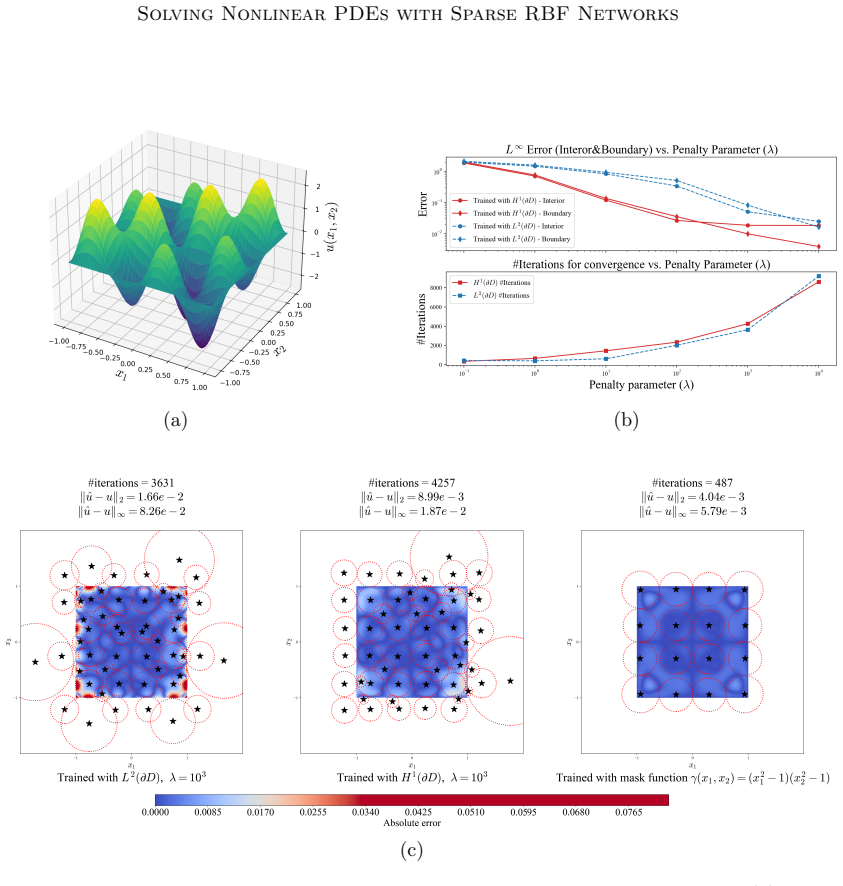
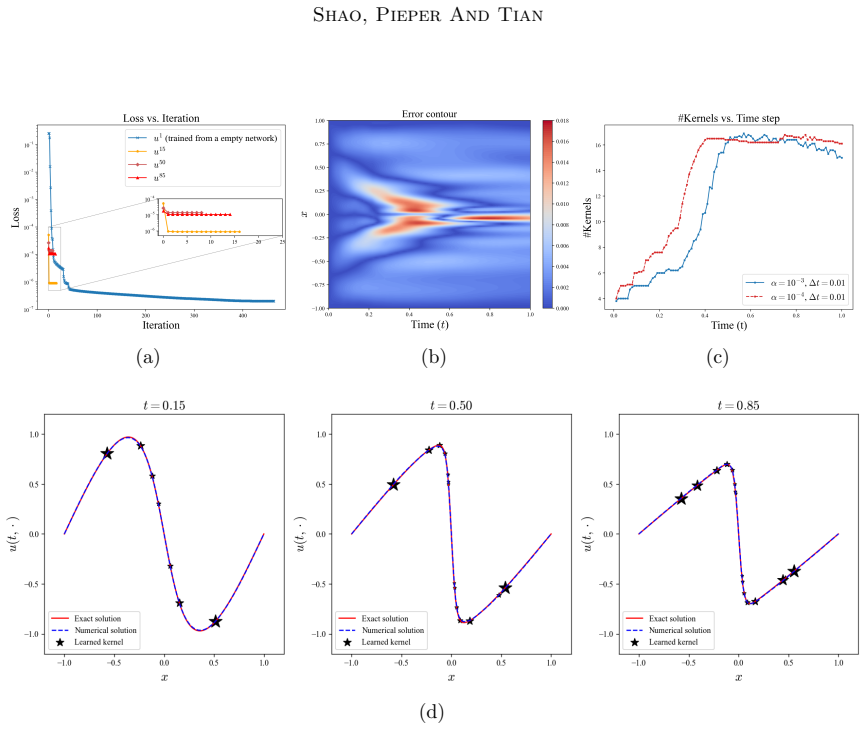
We propose a novel framework for solving nonlinear PDEs using sparse radial basis function (RBF) networks. Sparsity-promoting regularization is employed to prevent over-parameterization and reduce redundant features. This work is motivated by longstanding challenges in traditional RBF collocation methods, along with the limitations of physics-informed neural networks (PINNs) and Gaussian process (GP) approaches, aiming to blend their respective strengths in a unified framework. The theoretical foundation of our approach lies in the function space of Reproducing Kernel Banach Spaces (RKBS) induced by one-hidden-layer neural networks of possibly infinite width. We prove a representer theorem showing that the sparse optimization problem in the RKBS admits a finite solution and establishes error bounds that offer a foundation for generalizing classical numerical analysis. The algorithmic framework is based on a three-phase algorithm to maintain computational efficiency through adaptive feature selection, second-order optimization, and pruning of inactive neurons. Numerical experiments demonstrate the effectiveness of our method and highlight cases where it offers notable advantages over GP approaches. This work opens new directions for adaptive PDE solvers grounded in rigorous analysis with efficient, learning-inspired implementation.
Editorial analysis
A structured set of objections, weighed in public.
Referee Report
Summary. The manuscript proposes a framework for solving nonlinear PDEs via sparse radial basis function networks, set in Reproducing Kernel Banach Spaces induced by one-hidden-layer neural networks of possibly infinite width. It proves a representer theorem guaranteeing that the associated sparse optimization problem admits a finite solution, derives error bounds, and introduces a three-phase algorithm (adaptive feature selection, second-order optimization, pruning) whose effectiveness is illustrated on numerical examples that are claimed to outperform Gaussian-process baselines in selected cases.
Significance. If the representer theorem and error bounds are shown to hold for the nonlinear residual loss, the work would supply a rigorous, sparsity-promoting foundation that generalizes classical RBF collocation analysis while retaining computational advantages over dense PINN or GP formulations.
major comments (1)
- [§3] §3 (Representer Theorem and RKBS setting): The proof establishes finite support for the sparse optimization problem under the assumption that the loss depends on the function through a convex combination of point evaluations or satisfies a subdifferential condition. For the actual PDE objective, which includes the residual of a nonlinear differential operator evaluated at collocation points, no auxiliary argument is supplied showing that the nonlinearity preserves the required structure. Without this verification the finite-representer conclusion does not automatically transfer to the nonlinear PDE problem.
minor comments (2)
- [Algorithm section] The statement of the three-phase algorithm would benefit from an explicit description of the pruning threshold and the precise form of the second-order optimizer used in phase two.
- [Notation] Notation for the RKBS norm and the sparse regularizer should be unified between the theoretical statements and the algorithmic pseudocode.
Simulated Author's Rebuttal
We thank the referee for the thorough review and valuable feedback on our manuscript. We address the major comment below and outline the revisions we will make to strengthen the presentation.
read point-by-point responses
-
Referee: [§3] §3 (Representer Theorem and RKBS setting): The proof establishes finite support for the sparse optimization problem under the assumption that the loss depends on the function through a convex combination of point evaluations or satisfies a subdifferential condition. For the actual PDE objective, which includes the residual of a nonlinear differential operator evaluated at collocation points, no auxiliary argument is supplied showing that the nonlinearity preserves the required structure. Without this verification the finite-representer conclusion does not automatically transfer to the nonlinear PDE problem.
Authors: We agree that the representer theorem as stated in §3 relies on the loss satisfying either a convex-combination-of-point-evaluations structure or a subdifferential condition, and that the manuscript does not supply an explicit auxiliary argument confirming that the nonlinear residual loss (e.g., squared residual of a nonlinear differential operator at collocation points) inherits this structure. In the revised version we will add a short lemma (or remark) after the statement of the theorem that verifies the required condition for the specific loss used in the PDE examples. Under the standing assumption that the nonlinearity is locally Lipschitz, the residual evaluated at a finite set of collocation points remains a continuous function of finitely many pointwise values of the network and its derivatives; because the network itself is a finite linear combination of kernel sections, the composite loss still satisfies the subdifferential condition employed in the proof. We will also note the precise Lipschitz or smoothness hypotheses needed on the nonlinearity so that the finite-representer conclusion carries over directly to the nonlinear setting. revision: yes
Circularity Check
No significant circularity; theoretical claims are independent of numerical fits
full rationale
The paper's central derivation consists of a representer theorem and error bounds proved in the RKBS setting for the sparse optimization problem. No quoted step reduces the finite-support conclusion or the error estimates to a fitted parameter, a self-citation chain, or an ansatz smuggled from prior work by the same authors. The abstract and description present the RKBS representer result as a self-contained mathematical statement whose validity does not presuppose the target PDE residual or the numerical experiments. The three-phase algorithm and numerical tests are presented separately as implementation details, not as inputs that define the theorem. This satisfies the default expectation that a theoretical paper with an explicit proof is non-circular unless a specific equation or citation is shown to collapse the claim by construction.
Axiom & Free-Parameter Ledger
axioms (1)
- domain assumption The function space of Reproducing Kernel Banach Spaces induced by one-hidden-layer neural networks of possibly infinite width is the appropriate setting for the sparse RBF collocation problem.
Lean theorems connected to this paper
-
IndisputableMonolith/Cost/FunctionalEquation.leanwashburn_uniqueness_aczel unclear?
unclearRelation between the paper passage and the cited Recognition theorem.
We prove a representer theorem showing that the sparse optimization problem in the RKBS admits a finite solution
-
IndisputableMonolith/Foundation/ArithmeticFromLogic.leanLogicNat recovery unclear?
unclearRelation between the paper passage and the cited Recognition theorem.
the function space of Reproducing Kernel Banach Spaces induced by one-hidden-layer neural networks
What do these tags mean?
- matches
- The paper's claim is directly supported by a theorem in the formal canon.
- supports
- The theorem supports part of the paper's argument, but the paper may add assumptions or extra steps.
- extends
- The paper goes beyond the formal theorem; the theorem is a base layer rather than the whole result.
- uses
- The paper appears to rely on the theorem as machinery.
- contradicts
- The paper's claim conflicts with a theorem or certificate in the canon.
- unclear
- Pith found a possible connection, but the passage is too broad, indirect, or ambiguous to say the theorem truly supports the claim.
Forward citations
Cited by 1 Pith paper
-
An adaptive radial basis function approach for efficiently solving multidimensional spatiotemporal integrodifferential equations
An adaptive RBF approach is introduced that adjusts scales and centers to efficiently solve anisotropic spatiotemporal integrodifferential equations while remaining mesh-free.
Reference graph
Works this paper leans on
-
[1]
50 Solving Nonlinear PDEs with Sparse RBF Networks Francis Bach
doi: 10.1137/24M1658279. 50 Solving Nonlinear PDEs with Sparse RBF Networks Francis Bach. Breaking the curse of dimensionality with convex neural networks.J. Mach. Learn. Res., 18:53,
-
[2]
Jinshuai Bai, Gui-Rong Liu, Ashish Gupta, Laith Alzubaidi, Xi-Qiao Feng, and YuanTong Gu
URLhttps://doi.org/10.48550/arXiv.2302.03459. Jinshuai Bai, Gui-Rong Liu, Ashish Gupta, Laith Alzubaidi, Xi-Qiao Feng, and YuanTong Gu. Physics-informed radial basis network (PIRBN): A local approximating neural net- work for solving nonlinear partial differential equations.Computer Methods in Applied Mechanics and Engineering, 415:116290,
-
[3]
URLhttps://arxiv.org/ abs/2406.09217. Claire Boyer, Antonin Chambolle, Yohann De Castro, Vincent Duval, Fr´ ed´ eric De Gournay, and Pierre Weiss. On representer theorems and convex regularization.SIAM Journal on Optimization, 29(2):1260–1281,
-
[4]
Haim Brezis.Functional Analysis, Sobolev Spaces and Partial Differential Equations, vol- ume
doi: 10.1007/S10107-023-01975-Z. Haim Brezis.Functional Analysis, Sobolev Spaces and Partial Differential Equations, vol- ume
-
[5]
Yifan Chen, Bamdad Hosseini, Houman Owhadi, and Andrew M Stuart
Accessed: 2025-03-01. Yifan Chen, Bamdad Hosseini, Houman Owhadi, and Andrew M Stuart. Solving and learning nonlinear PDEs with Gaussian processes.Journal of Computational Physics, 447:110668,
work page 2025
-
[6]
Solving partial differential equations by collocation with radial basis functions
Gregory E Fasshauer. Solving partial differential equations by collocation with radial basis functions. InProceedings of Chamonix, volume 1997, pages 1–8. Citeseer,
work page 1997
-
[7]
Carsten Franke and Robert Schaback
doi: 10.1007/s10107-020-01530-0. Carsten Franke and Robert Schaback. Solving partial differential equations by collocation using radial basis functions.Applied Mathematics and Computation, 93(1):73–82,
-
[8]
Mirror descent on reproducing kernel banach spaces.arXiv preprint arXiv:2411.11242,
Akash Kumar, Mikhail Belkin, and Parthe Pandit. Mirror descent on reproducing kernel banach spaces.arXiv preprint arXiv:2411.11242,
-
[9]
A numerical approach to the testing of the fission hypothesis.Astronomical Journal, vol
Leon B Lucy. A numerical approach to the testing of the fission hypothesis.Astronomical Journal, vol. 82, Dec. 1977, p. 1013-1024., 82:1013–1024,
work page 1977
-
[10]
doi: https://doi.org/10. 1016/bs.hna.2024.05.007. URLhttps://www.sciencedirect.com/science/article/ pii/S1570865924000073. Yves Meyer.Wavelets and operators. Number
work page 2024
-
[11]
Konstantin Pieper, Zezhong Zhang, and Guannan Zhang
doi: 10.1051/cocv/ 2021042. Konstantin Pieper, Zezhong Zhang, and Guannan Zhang. Nonuniform random feature models using derivative information.arXiv preprint arXiv:2410.02132,
-
[12]
Saharon Rosset, Grzegorz Swirszcz, Nathan Srebro, and Ji Zhu.ℓ 1 regularization in infinite dimensional feature spaces. InLearning Theory: 20th Annual Conference on Learning Theory, COLT 2007, San Diego, CA, USA; June 13-15,
work page 2007
-
[13]
Zihan Shao, Konstantin Pieper, and Xiaochuan Tian. Sparse RBF networks for PDEs and nonlocal equations: function space theory, operator calculus, and training algorithms. arXiv preprint arXiv:2601.17562,
-
[14]
doi: https:// doi.org/10.1016/j.cma.2021.114333
ISSN 0045-7825. doi: https:// doi.org/10.1016/j.cma.2021.114333. URLhttps://www.sciencedirect.com/science/ article/pii/S0045782521006186. Michael E Taylor.Partial differential equations III, volume
-
[15]
ISBN 978-3-7643-7581-2. doi: 10.1007/3-7643-7582-5. Michael Ulbrich.Semismooth Newton Methods for Variational Inequalities and Constrained Optimization Problems in Function Spaces. MOS-SIAM Series on Optimization. SIAM,
-
[16]
Gerd Wachsmuth and Daniel Walter
ISBN 9781611970685. Gerd Wachsmuth and Daniel Walter. No-gap second-order conditions for minimization problems in spaces of measures.arXiv preprint arXiv:2403.12001,
-
[17]
Xianjin Yang and Houman Owhadi. A mini-batch method for solving nonlinear PDEs with Gaussian processes.arXiv preprint arXiv:2306.00307,
-
[18]
URLhttps://doi.org/10.1007/s10915-024-02463-y
doi: 10.1007/s10915-024-02463-y. URLhttps://doi.org/10.1007/s10915-024-02463-y. 57
discussion (0)
Sign in with ORCID, Apple, or X to comment. Anyone can read and Pith papers without signing in.