REVIEW 4 major objections 5 minor 2 cited by
A third star in the HAT-P-7 system, and a new dynamical pathway to misaligned hot Jupiters
T0 review · 4 major / 5 minor · reviewed 2026-08-15 · deepseek-v4-flash
Pith's one-line read HAT-P-7 hosts a third star, and a newly identified 'eccentricity cascade' can turn a cold Jupiter into the observed retrograde hot Jupiter.
desk verdict Credible detection of an inner M-dwarf companion in HAT-P-7 plus a genuinely new eccentricity-cascade route to hot Jupiters, though the dynamical demonstration rests on assumed initial conditions rather than a unique reconstruction. read the letter →
The pith
A machine-rendered reading of the paper's core claim, the machinery that carries it, and where it could break.
The reading
What carries the argument
The central object is the inner companion's orbit, and the load-bearing mechanism is the eccentricity cascade: the outer companion's von Zeipel-Lidov-Kozai (ZLK) cycles, the gravitational push-pull that can trade a body's inclination for eccentricity, periodically swing the inner companion's eccentricity to high values. The cascade works because the planet and inner companion are strongly coupled secularly: the ratio $\Omega_{12}/\omega_{p1} \sim 10^{-3}$ keeps the planet's orbital plane following the inner companion, so the outer companion cannot simply tilt the planet away, but when the inner companion's eccentricity peaks it comes close enough to the planet to deliver impulsive kicks to the planet's free eccentricity vector. Those kicks ratchet the planet's eccentricity upward until high-eccentricity tidal migration begins.
What would settle it
High-precision astrometry from Gaia or a successor mission would settle it: the paper predicts a host-star proper-motion change of roughly $0.13^{+0.10}_{-0.07}$ mas/yr between the beginning and end of the Gaia mission, tied to the claimed inner companion's orbit. If the measured astrometric acceleration is consistent with zero, or if a recovered astrometric orbit disagrees with the radial-velocity and transit-timing solution, the third-star interpretation and the cascade pathway built on it collapse.
Extended reading notes
Core claim
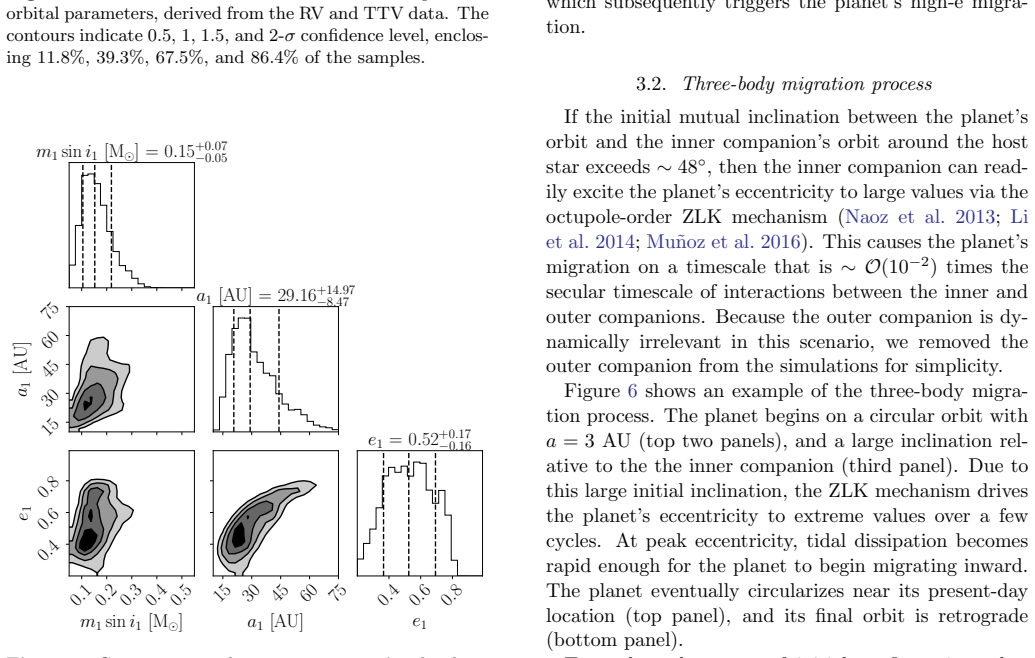
The paper's central discovery is a third stellar companion to HAT-P-7: an M dwarf with minimum mass $m_1\sin i_1 = 0.19^{+0.11}_{-0.06}\,M_\odot$, semi-major axis $a_1 = 32^{+16}_{-11}$ AU, and eccentricity $e_1 = 0.76^{+0.12}_{-0.26}$, obtained by jointly modeling the host's long-term radial-velocity trend and the gradual lengthening of the planet's transit interval. The accompanying dynamical claim is that this inner companion opens a new migration path: when the outer companion, at a projected separation of roughly a thousand AU, is sufficiently inclined, its von Zeipel-Lidov-Kozai cycles periodically excite the inner companion's eccentricity; at each high-eccentricity phase the inner companion makes weak close encounters with a cold Jupiter initially at about 3 AU, impulsively raising the planet's free eccentricity until tidal dissipation takes over and drags the planet inward into a retrograde, circularized hot Jupiter. N-body simulations demonstrate that this mechanism can produce retrograde hot Jupiters over a wide range of the outer companion's inclination, even when the planet and inner companion start nearly coplanar.
Load-bearing premise
The entire migration story assumes the planet started as a cold Jupiter on a circular orbit at about 3 AU; if it formed farther out or on a different orbit, the stability cuts applied to the inner companion's orbit would change and the eccentricity cascade might not produce HAT-P-7b.
Editorial extensions
If this is right
- HAT-P-7 becomes a hierarchical triple-star system, and at least some hot Jupiter hosts with seemingly useless distant companions actually have an intermediate star doing the dynamical work.
- High-eccentricity migration no longer needs the planet's initial orbit to be almost perpendicular to a stellar companion, because the eccentricity cascade can operate from a nearly coplanar starting configuration.
- The mechanism makes previously puzzling hot Jupiter systems, such as those with only very distant stellar companions, plausible products of ZLK-style migration and extends that logic to the HD 80606 and TIC 241249530 systems, where analogous inner companions are worth searching for.
- The predicted astrometric acceleration of the host star should be measurable in future Gaia data releases, giving an independent test of the inferred inner companion's orbit.
- The simulated retrograde hot Jupiters settle about 25% closer in than the observed HAT-P-7b, a gap the paper attributes to tidal radius inflation and chaotic tides, so a more complete tidal treatment is the natural next step for refining the prediction.
Reading between the lines
- Editorial inference: the cascade implies that surveys of hot Jupiter companions that only count stars close enough to act on the planet directly may systematically underestimate the rate of ZLK-style migration; a statistical test would compare the frequency of long-term radial-velocity trends among hot Jupiter hosts with wide stellar companions against matched stars without hot Jupiters.
- Editorial inference: because the cascade's efficiency depends on the cold Jupiter's starting radius, the mechanism carries a compositional fingerprint, so measuring HAT-P-7b's atmospheric C/O ratio could test whether it indeed formed near the ice line as assumed, a link the paper does not draw.
- Editorial inference: the same bridging logic should apply when the intermediate body is a brown dwarf instead of an M dwarf, and could extend to systems where the intermediate companion is currently below detection limits, broadening the hidden parameter space for hot Jupiter migration.
- Editorial inference: the K2-290 mechanism cited in the paper shows that a distant companion plus an intermediate body can transfer angular momentum inward even without close encounters, suggesting the eccentricity cascade may be one member of a family of coupled-timescale processes that channel wide-binary angular momentum into inner systems.
Signed reviews
Editorial analysis
A structured set of objections, weighed in public.
Referee Report
Summary. The paper reports a joint analysis of 15 years of Keck/HIRES radial velocities and Kepler/TESS transit-timing data for HAT-P-7, finding evidence for an inner stellar companion with m1 sin i1 = 0.19+0.11-0.06 Msun, a1 = 32+16-11 AU, and e1 = 0.76+0.12-0.26. It then uses N-body simulations to argue that this companion, together with the previously known outer M dwarf at ~1000 AU, can explain the retrograde hot Jupiter HAT-P-7b through high-eccentricity migration. Two pathways are investigated: direct octupole ZLK migration driven by the inner companion, and a novel four-body 'eccentricity cascade' in which the outer companion excites the inner companion's eccentricity and the inner companion then impulsively pumps the planet's eccentricity. The paper concludes that HAT-P-7b is one of the few hot Jupiters whose migration history can be simulated using only observed bodies, without finely tuned initial conditions.
Significance. The RV+TTV characterization of a ~0.2 Msun companion at a few tens of AU is a valuable observational result in itself, and the paper makes a concrete, falsifiable astrometric prediction for future Gaia data releases. The proposed eccentricity cascade is a genuinely new dynamical mechanism: a very distant stellar companion can act through an intermediate companion to excite a planet's eccentricity even when the planet and the intermediate companion are initially well aligned. If the mechanism survives robustness testing, it would broaden the class of stellar binaries that can produce misaligned hot Jupiters and would provide one of the few complete, observationally anchored migration histories. The dynamical claims, however, currently depend on several condition choices that are not yet shown to be representative of the measured parameter posteriors, as detailed in the major comments.
major comments (4)
- [Section 3.1, Eq. (4)] The Holman-Wiegert stability cut is load-bearing: it changes the adopted inner companion parameters from the RV+TTV best fit (e1 = 0.76, a1 = 32 AU) to the filtered fiducial values (e1 ~ 0.5, a1 ~ 28 AU, m1 sin i1 ~ 0.15 Msun), and all subsequent simulations use these filtered values. The cut is applied after assuming the planet formed on a circular orbit at 3 AU, and the paper itself notes that a larger formation radius would lower the allowed e1 and reduce the cascade efficiency. Since the central claim is that the migration history can be simulated from observed bodies, the assumed ap = 3 AU is an unobserved initial condition that drives the results. The paper should vary ap over plausible values (e.g., 3-8 AU, the disk-truncation radius) and resample from the full posterior rather than a single fiducial point to demonstrate that the mechanism's viability is not a selected configuration.
- [Appendix A and Section 3.1] The adopted inner companion mass m1 = 0.21 Msun is derived from an inclination distribution that assumes the inner companion must be misaligned with the proto-planet by more than ~48 degrees, i.e., the ZLK hypothesis. But the four-body eccentricity cascade scenario explicitly starts with ip1,0 = 10 degrees and does not require such a misalignment; for that scenario, the mass prior should not be conditioned on the ZLK requirement. This is a circular element for the four-body pathway, and it also propagates the present-day spin-orbit geometry onto the initial planet orbit. A cleaner approach would be to give separate mass estimates for the aligned and misaligned scenarios, or to marginalize over the inclination with a prior that does not presuppose the mechanism under investigation.
- [Section 3.3.1 and Table 2] The dynamical simulations are run for one hand-picked fiducial parameter set, even though the filtered posterior remains broad (e1 = 0.52+0.17-0.16, a1 = 29+15-8 AU, m1 sin i1 = 0.15+0.07-0.05), and the outer companion's e2 = 0.7 and a2 = 730 AU are assumed from an eccentricity distribution and an apocenter assumption rather than measured. The 1000 simulations in Figure 8 vary only the outer companion's initial mutual inclination. To support the claim that the eccentricity cascade is a robust pathway without fine tuning, the authors should sample the inner and outer companion parameters from their respective distributions and show the hot-Jupiter formation probability over that sampled ensemble.
- [Section 4.3 and Figure 8] The median final semimajor axis of retrograde hot Jupiters formed in the four-body simulations is 0.0266 AU, whereas the observed semimajor axis of HAT-P-7b is 0.0367 AU, an offset of about 25 percent. The paper attributes this to radius inflation and chaotic tides, but no simulation with an inflated radius or a stochastic tide model is presented; instead, the planet tidal quality factor is set to Qp = 10^4, which is already chosen to be low. As presented, the pathway systematically over-shrinks the orbit, and the match to HAT-P-7b's present-day semimajor axis is not demonstrated. A quantitative demonstration of the inflation/tide correction, or a parameter study in Qp, is needed before the paper can claim a complete migration history.
minor comments (5)
- [Section 2.3] The paper reports chi2 = 696 for 689 degrees of freedom but does not quantify the detection significance of the eccentric companion relative to a simpler constant-acceleration model; a delta-chi2 or model-comparison statement would strengthen the evidence claim.
- [Section 4.1] The sentence 'To our knowledge, the only confirmed hot Jupiter system with a stellar companion within 50 AU is WASP-11' is confusing in a paper that has just characterized an inner companion at 28-32 AU in HAT-P-7; please rephrase to refer to previously known systems.
- [Figure 16] The caption refers to an 'orange line' as the projected-separation constraint, but that line is not labeled in the figure; please add a label or describe it in the caption.
- [Equation (1)] The statement that a purely sinusoidal trend would have first and third coefficients of opposite signs is only true for a sinusoid of a particular phase; consider clarifying the intended comparison.
- [Figure 2 caption] The caption says the residuals are relative to a 'best-fitting constant-period model', but the parameters of that model are not specified; please state the fitted period and epoch or refer to the joint model.
Circularity Check
Companion detection is independent, but the companion mass input for the migration simulations is mildly conditioned on the very ZLK hypothesis being tested.
-
other
[Appendix A and Section 3.1 (inclination prior leading to m1 in Table 2)]
"the inner companion must be misaligned with the planet's orbit by more than ~48° for the octupole-order ZLK mechanism to be effective ... Based on these considerations, we adopt <sin i1> = 0.7 as a representative value. [Section 3.1:] Following a geometric argument outlined in Appendix A, we assumed sin i1 = 0.7, yielding m1 = 0.21 M_sun."
The simulation input m1 is not drawn from an isotropic inclination prior; it is inferred by conditioning on the requirement that the octupole ZLK mechanism be active (mutual inclination >48°). The simulations then use that same ZLK mechanism to explain the retrograde hot Jupiter, so the hypothesis partly sets the mass of the actor that is invoked to test the hypothesis. This is a mild self-referential conditioning rather than an independent measurement of m1. The authors state that 'small variations in m1 do not significantly affect our conclusions', which keeps the step from being the central load-bearing part of the paper.
full rationale
The observational detection of the inner companion in Section 2.3 is self-contained: the RV and TTV data are fit jointly, and the resulting posterior (m1 sin i1, a1, e1) is not fitted against the final retrograde state of HAT-P-7b. The dynamical simulations in Section 3 are scenario explorations with explicitly stated assumptions (planet formed on a circular orbit at 3 AU, outer-companion eccentricity 0.7, Qp = 10^4, etc.), and the paper openly reports that the simulated final semi-major axes are on average ~25% smaller than observed rather than tuning that quantity away. The 3 AU formation radius and the Holman-Wiegert stability filter alter the companion parameters used in the simulations, but this is model sensitivity and assumption-dependence, not circularity: the input posterior is not defined by the output hot-Jupiter outcome. The only quasi-circular element is the Appendix A inclination prior, which uses the ZLK activity threshold to set sin i1 = 0.7 and hence m1 = 0.21 M_sun for the simulations; this conditions the simulation input on the mechanism being tested. Because the authors explicitly state that small variations in m1 do not change the conclusions, this step is minor rather than load-bearing. No self-citation chain, imported uniqueness theorem, or ansatz-by-citation is used to force the central claim.
Assumptions & free parameters
free parameters (7)
- Qp (planet tidal quality factor) =
1e4
- Initial planet semi-major axis a_p,0 =
3 AU
- sin i1 for the inner companion =
0.7
- Outer companion eccentricity e2 and semi-major axis a2 =
e2 = 0.7, a2 = 730 AU
- Fiducial inner companion eccentricity e1 and semi-major axis a1 =
e1 = 0.5, a1 = 28 AU
- Outer companion mass m2 =
0.15 Msun
- Initial planet-inner companion mutual inclination ip1,0 =
10 deg
assumptions (5)
- domain assumption Holman-Wiegert stability criterion (Eq. 4) for a planet in a binary system
- standard math von Zeipel-Lidov-Kozai (ZLK) oscillations with octupole-order terms
- domain assumption Constant time-lag tidal dissipation model with specified quality factors
- domain assumption The host star's spin axis is nearly aligned with the line of sight, and the planet's orbit normal lies near the sky plane
- domain assumption Giant planet formation can occur in a disk truncated by a companion at ~30 AU
Cite this review
Pith. "Pith review of A third star in the HAT-P-7 system, and a new dynamical pathway to misaligned hot Jupiters." pith.science (2026). https://pith.science/paper/WDIVH45B
@misc{pith2026250507927,
  author       = {Pith},
  title        = {Pith review of: A third star in the HAT-P-7 system, and a new dynamical pathway to misaligned hot Jupiters},
  year         = {2026},
  howpublished = {\url{https://pith.science/paper/WDIVH45B}},
  note         = {Machine review of arXiv:2505.07927}
}
abstract
The retrograde orbit of the hot Jupiter HAT-P-7b is suggestive of high-eccentricity migration caused by dynamical interactions with a massive companion. However, the only other known body in the system is an M dwarf located $\sim$10$^3$~AU away, too distant to cause high-eccentricity migration without fine tuning. Here we present transit-timing and radial-velocity evidence for an additional stellar companion with semi-major axis $32^{+16}_{-11}$~AU, eccentricity $0.76^{+0.12}_{-0.26}$, and minimum mass $0.19^{+0.11}_{-0.06}$~$\rm M_\odot$. We investigate several dynamical routes by which this nearby companion star could have played a role in converting a cold Jupiter into the retrograde hot Jupiter that is observed today. Of particular interest is a novel "eccentricity cascade" mechanism involving both of the companion stars: the outer companion periodically excites the eccentricity of the inner companion through von Zeipel-Lidov-Kozai (ZLK) cycles, and this eccentricity excitation is slowly transferred to the cold Jupiter via successive close encounters, eventually triggering its high-eccentricity migration. The plausibility of this mechanism in explaining HAT-P-7b shows that stellar companions traditionally considered too distant to cause hot Jupiter formation might nevertheless be responsible, with the aid of closer-orbiting massive companions. With these developments, HAT-P-7b is one of the few hot Jupiters for which a complete high-eccentricity migration history can be simulated based only on observed bodies, rather than invoking bodies that are beneath detection limits or that are no longer in the system.
Figures


Figures from the paper (12 more)



Forward citations
Cited by 2 Pith papers
-
10,000 Resolved Triples from Gaia: Empirical Constraints on Triple Star Populations
A high-purity Gaia catalog of 9,767 resolved triples shows inner binary properties mirror isolated binaries, and the intrinsic triple fraction rises from 5% at 0.5 Msun to 35% at 2 Msun.
-
A Hot Jupiter with a Retrograde Orbit around a Sun-like Star and a Toy Model of Hot Jupiters in Wide Binary Star Systems
KELT-23A b orbits its cool, Sun-like host star on a retrograde or near-polar path, making it one of the few cool-star hot Jupiters with a highly misaligned orbit.
Reference graph
Works this paper leans on
-
[1]
Albrecht, S. H., Dawson, R. I., & Winn, J. N. 2022, Publications of the Astronomical Society of the Pacific, 134, 082001, doi: 10.1088/1538-3873/ac6c09
-
[2]
An, Q., Lu, T., Brandt, G. M., Brandt, T. D., & Li, G. 2024, The Astronomical Journal, 169, 22, doi: 10.3847/1538-3881/ad90b4
-
[3]
R., Collier Cameron, A., Delrez, L., et al
Anderson, D. R., Collier Cameron, A., Delrez, L., et al. 2017a, A&A, 604, A110, doi: 10.1051/0004-6361/201730439
-
[4]
Anderson, J. D., Esposito, P. B., Martin, W., Thornton, C. L., & Muhleman, D. O. 1975, ApJ, 200, 221, doi: 10.1086/153779
doi:10.1086/153779 1975
-
[5]
Anderson, K. R., Lai, D., & Storch, N. I. 2017b, MNRAS, 467, 3066, doi: 10.1093/mnras/stx293
-
[6]
Anderson, K. R., Storch, N. I., & Lai, D. 2016, Monthly Notices of the Royal Astronomical Society, 456, 3671, doi: 10.1093/mnras/stv2906
-
[7]
Antognini, J. M. O. 2015, Monthly Notices of the Royal Astronomical Society, 452, 3610, doi: 10.1093/mnras/stv1552
-
[8]
Artymowicz, P., & Lubow, S. H. 1994, ApJ, 421, 651, doi: 10.1086/173679
doi:10.1086/173679 1994
Show all 91 references
-
[9]
´A., Kov´ acs, G., Torres, G., et al
Bakos, G. ´A., Kov´ acs, G., Torres, G., et al. 2007, ApJ, 670, 826, doi: 10.1086/521866
2007 doi
-
[10]
´A., Torres, G., P´ al, A., et al
Bakos, G. ´A., Torres, G., P´ al, A., et al. 2010, ApJ, 710, 1724, doi: 10.1088/0004-637X/710/2/1724
2010 doi
-
[11]
H., & Laughlin, G
Batygin, K., Bodenheimer, P. H., & Laughlin, G. P. 2016, ApJ, 829, 114, doi: 10.3847/0004-637X/829/2/114 Beaug´ e, C., & Nesvorn´ y, D. 2012, ApJ, 751, 119, doi: 10.1088/0004-637X/751/2/119
2016 doi
-
[12]
2014, PASJ, 66, 94, doi: 10.1093/pasj/psu069
Benomar, O., Masuda, K., Shibahashi, H., & Suto, Y. 2014, PASJ, 66, 94, doi: 10.1093/pasj/psu069
2014 doi
-
[13]
2022, The Astrophysical Journal Letters, 925, L5, doi: 10.3847/2041-8213/ac49e9
Best, S., & Petrovich, C. 2022, The Astrophysical Journal Letters, 925, L5, doi: 10.3847/2041-8213/ac49e9
2022 doi
-
[14]
C., & White, R
Beyer, A. C., & White, R. J. 2024, The Kraft Break Sharply Divides Low Mass and Intermediate Mass Stars. https://arxiv.org/abs/2408.02638
2024 arXiv
-
[15]
Bodenheimer, P., Lin, D. N. C., & Mardling, R. A. 2001, ApJ, 548, 466, doi: 10.1086/318667
2001 doi
-
[16]
J., Koch, D., Basri, G., et al
Borucki, W. J., Koch, D., Basri, G., et al. 2010, Science, 327, 977, doi: 10.1126/science.1185402
2010 doi
-
[17]
2022, The Astronomical Journal, 163, 207, doi: 10.3847/1538-3881/ac517f —
Christian, S., Vanderburg, A., Becker, J., et al. 2022, The Astronomical Journal, 163, 207, doi: 10.3847/1538-3881/ac517f —. 2024, Wide Binary Orbits are Preferentially Aligned with the Orbits of Small Planets, but Probably Not Hot Jupiters. https://arxiv.org/abs/2405.10379
2022 arXiv
-
[18]
Dai, F., & Winn, J. N. 2017, AJ, 153, 205, doi: 10.3847/1538-3881/aa65d1
2017 doi
-
[19]
I., & Chiang, E
Dawson, R. I., & Chiang, E. 2014, Science, 346, 212, doi: 10.1126/science.1256943
2014 doi
-
[20]
I., & Johnson, J
Dawson, R. I., & Johnson, J. A. 2018, ARA&A, 56, 175, doi: 10.1146/annurev-astro-081817-051853 17 de Beurs, Z. L., de Wit, J., Venner, A., et al. 2023, The Astronomical Journal, 166, 136, doi: 10.3847/1538-3881/acedf1
2018 doi
-
[21]
X., Zhou, G., et al
Dong, J., Huang, C. X., Zhou, G., et al. 2021, The Astrophysical Journal Letters, 920, L16, doi: 10.3847/2041-8213/ac2600
2021 doi
-
[22]
J., Kraus, A
Dupuy, T. J., Kraus, A. L., Kratter, K. M., et al. 2022, Monthly Notices of the Royal Astronomical Society, 512, 648, doi: 10.1093/mnras/stac306
2022 doi
-
[23]
P., Kiseleva, L
Eggleton, P. P., Kiseleva, L. G., & Hut, P. 1998, ApJ, 499, 853, doi: 10.1086/305670
1998 doi
-
[24]
2007, The Astrophysical Journal, 669, 1298, doi: 10.1086/521702
Fabrycky, D., & Tremaine, S. 2007, The Astrophysical Journal, 669, 1298, doi: 10.1086/521702
2007 doi
-
[25]
W., Lang, D., & Goodman, J
Foreman-Mackey, D., Hogg, D. W., Lang, D., & Goodman, J. 2013, PASP, 125, 306, doi: 10.1086/670067 Gaia Collaboration, Vallenari, A., Brown, A. G. A., et al. 2023, A&A, 674, A1, doi: 10.1051/0004-6361/202243940
2013 doi
-
[26]
1966, Icarus, 5, 375, doi: https://doi.org/10.1016/0019-1035(66)90051-0
Goldreich, P., & Soter, S. 1966, Icarus, 5, 375, doi: https://doi.org/10.1016/0019-1035(66)90051-0
1966 doi
-
[27]
2011, The Astrophysical Journal, 732, 74, doi: 10.1088/0004-637x/732/2/74
Guillochon, J., Ramirez-Ruiz, E., & Lin, D. 2011, The Astrophysical Journal, 732, 74, doi: 10.1088/0004-637x/732/2/74
2011 doi
-
[28]
2024, in AAS/Division for Extreme Solar Systems Abstracts, Vol
Gupta, A., Millholland, S., Im, H., et al. 2024, in AAS/Division for Extreme Solar Systems Abstracts, Vol. 56, AAS/Division for Extreme Solar Systems Abstracts, 615.05
2024
-
[29]
S., Antonini, F., Lithwick, Y., Perets, H
Hamers, A. S., Antonini, F., Lithwick, Y., Perets, H. B., & Portegies Zwart, S. F. 2017, MNRAS, 464, 688, doi: 10.1093/mnras/stw2370 H´ ebrard, G., Bouchy, F., Pont, F., et al. 2008, A&A, 488, 763, doi: 10.1051/0004-6361:200810056 Høg, E., Fabricius, C., Makarov, V. V., et al....
2017 doi
-
[30]
2016, ApJS, 225, 9, doi: 10.3847/0067-0049/225/1/9
Holczer, T., Mazeh, T., Nachmani, G., et al. 2016, ApJS, 225, 9, doi: 10.3847/0067-0049/225/1/9
2016 doi
- [31]
-
[32]
Hwang, H.-C., Ting, Y.-S., & Zakamska, N. L. 2022, MNRAS, 512, 3383, doi: 10.1093/mnras/stac675
2022 doi
-
[33]
Ida, S., & Lin, D. N. C. 2004, ApJ, 616, 567, doi: 10.1086/424830
2004 doi
-
[34]
S., & Winn, J
Ivshina, E. S., & Winn, J. N. 2022, ApJS, 259, 62, doi: 10.3847/1538-4365/ac545b
2022 doi
-
[35]
2015, The Astrophysical Journal, 799, 147, doi: 10.1088/0004-637X/799/2/147
Jang-Condell, H. 2015, The Astrophysical Journal, 799, 147, doi: 10.1088/0004-637X/799/2/147
2015 doi
-
[36]
A., Fulton, B
Knutson, H. A., Fulton, B. J., Montet, B. T., et al. 2014, ApJ, 785, 126, doi: 10.1088/0004-637X/785/2/126
2014 doi
-
[37]
Dupuy, T. J. 2016, AJ, 152, 8, doi: 10.3847/0004-6256/152/1/8
2016 doi
-
[38]
2017, The Astronomical Journal, 153, 42, doi: 10.3847/1538-3881/153/1/42
Lai, D., & Pu, B. 2017, The Astronomical Journal, 153, 42, doi: 10.3847/1538-3881/153/1/42
2017 doi
- [39]
-
[40]
K., Knutson, H
Lewis, N. K., Knutson, H. A., Showman, A. P., et al. 2013, The Astrophysical Journal, 766, 95, doi: 10.1088/0004-637X/766/2/95
2013 doi
-
[41]
2014, ApJ, 791, 86, doi: 10.1088/0004-637X/791/2/86
Li, G., Naoz, S., Holman, M., & Loeb, A. 2014, ApJ, 791, 86, doi: 10.1088/0004-637X/791/2/86
2014 doi
-
[42]
J., & Lai, D
Liu, B., Mu˜ noz, D. J., & Lai, D. 2015, MNRAS, 447, 747, doi: 10.1093/mnras/stu2396
2015 doi
-
[43]
2025, The Astrophysical Journal, 979, 218, doi: 10.3847/1538-4357/ad9b79
Lu, T., An, Q., Li, G., et al. 2025, The Astrophysical Journal, 979, 218, doi: 10.3847/1538-4357/ad9b79
2025 doi
-
[44]
2023, ApJ, 948, 41, doi: 10.3847/1538-4357/acc06d
Lu, T., Rein, H., Tamayo, D., et al. 2023, ApJ, 948, 41, doi: 10.3847/1538-4357/acc06d
2023 doi
-
[45]
N., Lundkvist, M., Silva Aguirre, V., et al
Lund, M. N., Lundkvist, M., Silva Aguirre, V., et al. 2014, A&A, 570, A54, doi: 10.1051/0004-6361/201424326
2014 doi
-
[46]
2002, The Astrophysical Journal, 580, L171, doi: 10.1086/345520
Mandel, K., & Agol, E. 2002, The Astrophysical Journal, 580, L171, doi: 10.1086/345520
2002 doi
-
[47]
A., & Mandel, I
Mangipudi, A., Grishin, E., Trani, A. A., & Mandel, I. 2022, ApJ, 934, 44, doi: 10.3847/1538-4357/ac7958
2022 doi
-
[48]
2015, The Astrophysical Journal, 805, 28, doi: 10.1088/0004-637X/805/1/28
Masuda, K. 2015, The Astrophysical Journal, 805, 28, doi: 10.1088/0004-637X/805/1/28
2015 doi
-
[49]
2004, SoPh, 222, 191, doi: 10.1023/B:SOLA.0000043563.96766.21
Berthomieu, G. 2004, SoPh, 222, 191, doi: 10.1023/B:SOLA.0000043563.96766.21
2004
-
[50]
D., & Dermott, S
Murray, C. D., & Dermott, S. F. 2000, Secular Perturbations (Cambridge University Press), 274–320 Mu˜ noz, D. J., Lai, D., & Liu, B. 2016, Monthly Notices of the Royal Astronomical Society, 460, 1086, doi: 10.1093/mnras/stw983
2000 doi
-
[51]
W., Mayor, M., et al
Naef, D., Latham, D. W., Mayor, M., et al. 2001, A&A, 375, L27, doi: 10.1051/0004-6361:20010853
2001 doi
-
[52]
2008, ApJ, 678, 498, doi: 10.1086/529369
Nagasawa, M., Ida, S., & Bessho, T. 2008, ApJ, 678, 498, doi: 10.1086/529369
2008 doi
-
[53]
2011, Nature, 473, 187, doi: 10.1038/nature10076 —
Teyssandier, J. 2011, Nature, 473, 187, doi: 10.1038/nature10076 —. 2013, MNRAS, 431, 2155, doi: 10.1093/mnras/stt302
2011 doi
-
[54]
2009, PASJ, 61, L35, doi: 10.1093/pasj/61.5.L35
Narita, N., Sato, B., Hirano, T., & Tamura, M. 2009, PASJ, 61, L35, doi: 10.1093/pasj/61.5.L35
2009 doi
-
[55]
2010, PASJ, 62, 779, doi: 10.1093/pasj/62.3.779
Narita, N., Kudo, T., Bergfors, C., et al. 2010, PASJ, 62, 779, doi: 10.1093/pasj/62.3.779
2010 doi
-
[56]
H., Kuzuhara, M., et al
Narita, N., Takahashi, Y. H., Kuzuhara, M., et al. 2012, PASJ, 64, L7, doi: 10.1093/pasj/64.6.L7
2012 doi
-
[57]
A., Hinkley, S., et al
Ngo, H., Knutson, H. A., Hinkley, S., et al. 2015, The Astrophysical Journal, 800, 138, doi: 10.1088/0004-637X/800/2/138
2015 doi
-
[58]
A., Hinkley, S., et al
Ngo, H., Knutson, H. A., Hinkley, S., et al. 2016, ApJ, 827, 8, doi: 10.3847/0004-637X/827/1/8 18 P´ al, A., Bakos, G.´A., Torres, G., et al. 2008, ApJ, 680, 1450, doi: 10.1086/588010
2016 doi
-
[59]
J., & Mamajek, E
Pecaut, M. J., & Mamajek, E. E. 2013, ApJS, 208, 9, doi: 10.1088/0067-0049/208/1/9
2013 doi
-
[60]
2015, ApJ, 799, 27, doi: 10.1088/0004-637X/799/1/27
Petrovich, C. 2015, ApJ, 799, 27, doi: 10.1088/0004-637X/799/1/27
2015 doi
-
[61]
2016, The Astrophysical Journal, 829, 132, doi: 10.3847/0004-637X/829/2/132
Petrovich, C., & Tremaine, S. 2016, The Astrophysical Journal, 829, 132, doi: 10.3847/0004-637X/829/2/132
2016 doi
-
[62]
A., et al
Piaulet, C., Benneke, B., Rubenzahl, R. A., et al. 2021, AJ, 161, 70, doi: 10.3847/1538-3881/abcd3c
2021 doi
-
[63]
Rafikov, R. R. 2005, ApJL, 621, L69, doi: 10.1086/428899 —. 2006, ApJ, 648, 666, doi: 10.1086/505695
2005 doi
-
[64]
A., & Ford, E
Rasio, F. A., & Ford, E. B. 1996, Science, 274, 954, doi: 10.1126/science.274.5289.954
1996 doi
-
[65]
Rein, H., & Liu, S. F. 2012, A&A, 537, A128, doi: 10.1051/0004-6361/201118085
2012 doi
-
[66]
Rein, H., & Spiegel, D. S. 2015, MNRAS, 446, 1424, doi: 10.1093/mnras/stu2164
2015 doi
-
[67]
2022, The Astrophysical Journal Letters, 926, L17, doi: 10.3847/2041-8213/ac502d
Rice, M., Wang, S., & Laughlin, G. 2022, The Astrophysical Journal Letters, 926, L17, doi: 10.3847/2041-8213/ac502d
2022 doi
-
[68]
R., Winn, J
Ricker, G. R., Winn, J. N., Vanderspek, R., et al. 2015, Journal of Astronomical Telescopes, Instruments, and Systems, 1, 014003, doi: 10.1117/1.JATIS.1.1.014003
2015 doi
-
[69]
A., Dai, F., Howard, A
Rubenzahl, R. A., Dai, F., Howard, A. W., et al. 2021, AJ, 161, 119, doi: 10.3847/1538-3881/abd177
2021 doi
-
[70]
G., Collins, K
Stassun, K. G., Collins, K. A., & Gaudi, B. S. 2017, AJ, 153, 136, doi: 10.3847/1538-3881/aa5df3
2017 doi
-
[71]
G., Oelkers, R
Stassun, K. G., Oelkers, R. J., Paegert, M., et al. 2019, AJ, 158, 138, doi: 10.3847/1538-3881/ab3467
2019 doi
-
[72]
Tamayo, D., Rein, H., Shi, P., & Hernandez, D. M. 2020, MNRAS, 491, 2885, doi: 10.1093/mnras/stz2870
2020 doi
-
[73]
2019, MNRAS, 486, 2265, doi: 10.1093/mnras/stz1011
Teyssandier, J., Lai, D., & Vick, M. 2019, MNRAS, 486, 2265, doi: 10.1093/mnras/stz1011
2019 doi
-
[74]
P., Fortney, J
Thorngren, D. P., Fortney, J. J., Lopez, E. D., Berger, T. A., & Huber, D. 2021, The Astrophysical Journal Letters, 909, L16, doi: 10.3847/2041-8213/abe86d
2021 doi
-
[75]
Triaud, A. H. M. J., Collier Cameron, A., Queloz, D., et al. 2010, A&A, 524, A25, doi: 10.1051/0004-6361/201014525
2010 doi
-
[76]
Vick, M., Lai, D., & Anderson, K. R. 2019, Monthly Notices of the Royal Astronomical Society, 484, 5645, doi: 10.1093/mnras/stz354
2019 doi
-
[77]
2023, ApJL, 943, L13, doi: 10.3847/2041-8213/acaea6
Vick, M., Su, Y., & Lai, D. 2023, ApJL, 943, L13, doi: 10.3847/2041-8213/acaea6
2023 doi
-
[78]
S., Allen, S
Vogt, S. S., Allen, S. L., Bigelow, B. C., et al. 1994, in Society of Photo-Optical Instrumentation Engineers (SPIE) Conference Series, Vol. 2198, Instrumentation in Astronomy VIII, ed. D. L. Crawford & E. R. Craine, 362, doi: 10.1117/12.176725
1994 doi
-
[79]
A., Horch, E
Wang, J., Fischer, D. A., Horch, E. P., & Xie, J.-W. 2015, ApJ, 806, 248, doi: 10.1088/0004-637X/806/2/248
2015 doi
-
[80]
A., Xie, J.-W., & Ciardi, D
Wang, J., Fischer, D. A., Xie, J.-W., & Ciardi, D. R. 2014, ApJ, 791, 111, doi: 10.1088/0004-637X/791/2/111
2014 doi
-
[81]
A., Xie, J.-W., & Ciardi, D
Wang, J., Fischer, D. A., Xie, J.-W., & Ciardi, D. R. 2015, The Astrophysical Journal, 813, 130, doi: 10.1088/0004-637X/813/2/130
2015 doi
-
[82]
J., Beatty, T
Welbanks, L., Bell, T. J., Beatty, T. G., et al. 2024, Nature, 630, 836, doi: 10.1038/s41586-024-07514-w
2024 doi
-
[83]
N., Fabrycky, D., Albrecht, S., & Johnson, J
Winn, J. N., Fabrycky, D., Albrecht, S., & Johnson, J. A. 2010, The Astrophysical Journal Letters, 718, L145, doi: 10.1088/2041-8205/718/2/L145
2010 doi
-
[84]
N., Johnson, J
Winn, J. N., Johnson, J. A., Albrecht, S., et al. 2009, ApJL, 703, L99, doi: 10.1088/0004-637X/703/2/L99
2009 doi
-
[85]
A., Kataria, T., et al
Wong, I., Knutson, H. A., Kataria, T., et al. 2016, ApJ, 823, 122, doi: 10.3847/0004-637X/823/2/122
2016 doi
-
[86]
2018, AJ, 155, 118, doi: 10.3847/1538-3881/aaa970
Wu, Y. 2018, AJ, 155, 118, doi: 10.3847/1538-3881/aaa970
2018 doi
-
[87]
2011, ApJ, 735, 109, doi: 10.1088/0004-637X/735/2/109
Wu, Y., & Lithwick, Y. 2011, ApJ, 735, 109, doi: 10.1088/0004-637X/735/2/109
2011 doi
-
[88]
2003, The Astrophysical Journal, 589, 605, doi: 10.1086/374598
Wu, Y., & Murray, N. 2003, The Astrophysical Journal, 589, 605, doi: 10.1086/374598
2003 doi
-
[89]
W., & Ramsahai, J
Wu, Y., Murray, N. W., & Ramsahai, J. M. 2007, The Astrophysical Journal, 670, 820, doi: 10.1086/521996
2007 doi
-
[90]
2024, The Astrophysical Journal, 972, 159, doi: 10.3847/1538-4357/ad5ffb
Yu, H., & Dai, F. 2024, The Astrophysical Journal, 972, 159, doi: 10.3847/1538-4357/ad5ffb
2024 doi
-
[91]
2020, AJ, 159, 19, doi: 10.3847/1538-3881/ab55e9
Ziegler, C., Tokovinin, A., Brice˜ no, C., et al. 2020, AJ, 159, 19, doi: 10.3847/1538-3881/ab55e9
2020 doi
Reviewed August 15, 2026 · model on record in the stance chip above.
Discussion (0). Continue with ORCID to comment.