REVIEW 3 major objections 4 minor 1 cited by
10,000 Resolved Triples from Gaia: Empirical Constraints on Triple Star Populations
T0 review · 3 major / 4 minor · reviewed 2026-08-15 · deepseek-v4-flash
Pith's one-line read A Gaia catalog of ~10,000 resolved triple stars now maps how the triple fraction rises with primary mass, from about 5% near 0.5 solar masses to about 35% at 2 solar masses.
desk verdict Strong catalog paper; the completeness-corrected triple fractions need a sensitivity study before you quote the 5% to 35% numbers. read the letter →
The pith
A machine-rendered reading of the paper's core claim, the machinery that carries it, and where it could break.
The reading
What carries the argument
The machinery is the resolved-sample construction plus its completeness model. Triples are assembled by a graph search over Gaia pairs that share consistent parallax and proper motion, with a KDE-based chance-alignment statistic $R_{\rm triple}$ assigned to each system; then a synthetic triple population is generated from proposed intrinsic distributions, passed through Gaia's resolution and detection limits, and compared to the observed sample to select the underlying period, mass-ratio, and eccentricity laws and to correct observed fractions for incompleteness.
What would settle it
A volume-complete census of multiplicity within 100 pc that can detect tight inner binaries, for example through radial-velocity monitoring of every M and K dwarf, would settle the claim: if the intrinsic triple fraction as a function of primary mass does not rise from about 5% at $0.5\,M_\odot$ to about 35% at $2\,M_\odot$, the completeness correction is wrong.
Extended reading notes
Core claim
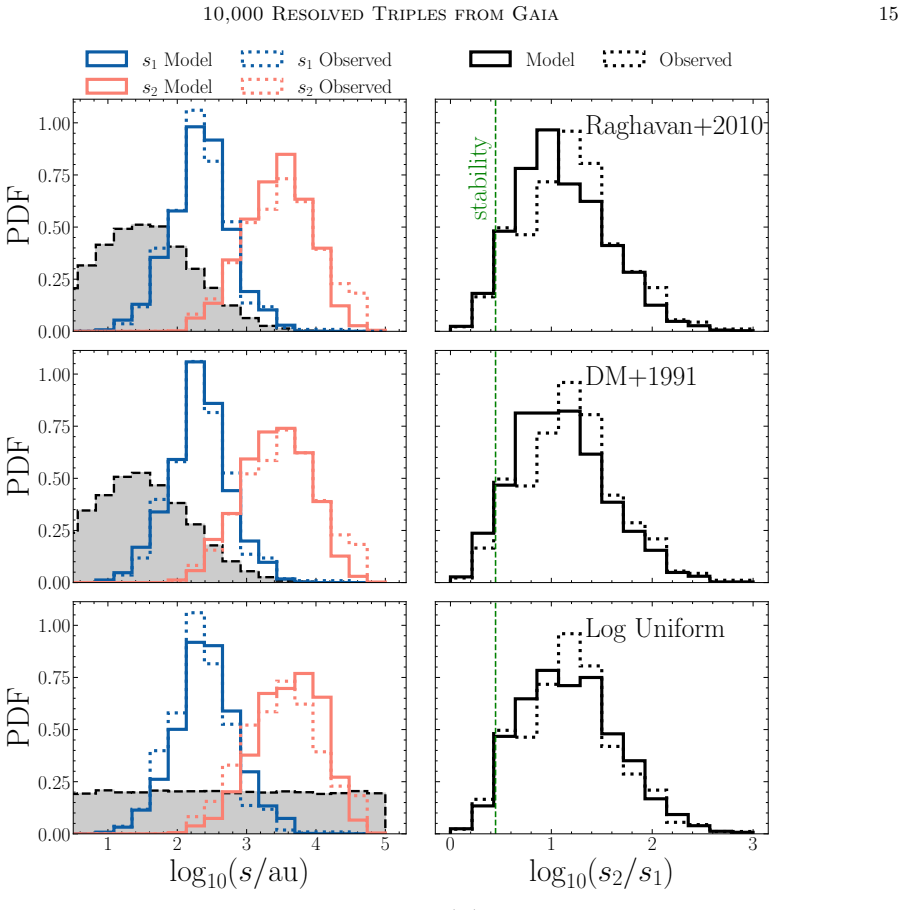
The paper claims that, after applying a stringent chance-alignment filter, Gaia data across a 500 pc volume yield 9,767 resolved hierarchical triples whose selection biases are understood well enough to infer intrinsic population statistics. Its central quantitative claims are: the intrinsic triple fraction rises monotonically with primary mass, from about 5% at $M_1 \lesssim 0.5\,M_\odot$ to about 35% at $2\,M_\odot$; inner binary orbital periods, eccentricities, and mass ratios match those of isolated binaries, including a twin excess at $q > 0.95$ out to separations of 1000+ au; tertiary mass ratios follow a power law $dN/dq \propto q^{-1.4}$; and outer orbits are consistent with a log-normal period distribution and thermal eccentricities, subject to dynamical stability. The paper also reports that mutual inclinations are isotropic for wide triples but show modest alignment for more compact systems, and that the observed fraction of triples that appear unstable in projection is reproduced by projection effects acting on an intrinsically stable hierarchical population.
Load-bearing premise
The completeness corrections used to back out intrinsic triple fractions assume that the intrinsic period and mass-ratio distributions inferred from the resolved sample are correct; if those distributions are wrong, the corrected triple fractions and outer-orbit demographics shift.
Editorial extensions
If this is right
- Triple inner binaries and isolated wide binaries likely share a common formation pathway, since both show the same twin excess and mass-ratio distributions at matched separations and distances.
- Population synthesis of stellar multiples can sample tertiaries from a log-normal period distribution and thermal eccentricities with dynamical-stability rejection, and reproduce observed resolved triples without invoking a separate triple-specific period law.
- Most triples that appear unstable in projection are actually hierarchical and stable; the simpler stability criterion $P_{\rm out}/P_{\rm in} > 5$ is inconsistent with the data.
- The triple fraction rises with primary mass, so multiplicity statistics of stellar populations must be treated as mass-dependent rather than as a single number.
- The public catalog, together with the sampling prescription, provides a testbed for models of triple dynamics and evolution, including exoplanet-hosting triples and white-dwarf triples.
Reading between the lines
- A consequence the paper leaves implicit: if triple inner binaries show the same wide-separation twin excess as isolated binaries, then the leading explanation of the binary twin excess—early close formation followed by dynamical widening by an interloper—must either operate before the tertiary is added or selectively preserve triples; otherwise the widening encounter would usually unbind the terti
- The finding that tertiaries follow a steeper mass-ratio distribution than isolated binaries suggests formation channels that favor low-mass companions, such as turbulent fragmentation or dynamical capture. A testable extension is to check whether the tertiary mass-ratio slope varies with galactic environment or stellar age.
- The catalog's cross-match with eclipsing-binary and non-single-star catalogs yields several hundred systems of multiplicity four and five. Comparing their frequency to random pairing in the field would test whether triples preferentially host close inner subsystems, a signature expected from Kozai-Lidov-driven orbital shrinking.
Signed reviews
Editorial analysis
A structured set of objections, weighed in public.
Referee Report
Summary. The paper constructs a catalog of 9,767 resolved triple star systems within 500 pc from Gaia DR3, using parallax, proper-motion, and chance-alignment cuts adapted from wide-binary catalogs, and it validates the R_triple statistic against shifted-catalog chance alignments. It characterizes the sample (separations, masses, CMD types, mutual-inclination proxy), compares inner binaries of triples to matched wide binaries (including a twin excess out to ~1000 au), and builds a generative model for triple masses, periods, and eccentricities. The model is then used to estimate catalog completeness and to derive a mass-dependent intrinsic triple fraction rising from ~5% at 0.5 Msun to ~35% at 2 Msun. A public catalog and sampling prescription are provided.
Significance. If the demographic claims hold, this is the largest homogeneous resolved-triple sample to date and a valuable community resource. The strengths are substantial: the chance-alignment statistic is validated against shifted catalogs, cluster contamination is explicitly addressed, the wide-binary control sample is matched in separation and distance, and the catalog and mock-population code are made public. The catalog-based results — separation distributions, twin excess, stellar-type diversity, and the existence of many new resolved triples — are robust and interesting. However, the absolute demographic conclusions, especially the mass-dependent triple fraction in Figure 10, rest on completeness corrections computed from a model calibrated on the same sample, and the mock selection does not fully reproduce the observed filtering. These issues are fixable with sensitivity tests and a more complete mock selection, but they currently limit the strength of the 'intrinsic triple fraction' claim.
major comments (3)
- [Section 4.6, Figure 10] The corrected triple fraction is not a direct observable: it is obtained by dividing the observed wide-triple fraction by a completeness fraction computed from the model of Section 4.4, and Section 4.5 states that this completeness is most sensitive to the adopted tertiary period distribution. That period distribution is adopted in Section 4.2 from field-binary log-normals after a qualitative comparison in Figure 7, i.e., it is calibrated on the same resolved sample that it is then used to correct. The reported 5%-to-35% mass trend should be accompanied by a sensitivity test in which completeness is recomputed for the log-uniform outer-period model and for log-normal models with shifted means or widths. If the corrected fractions change by more than the quoted Poisson errors, the central demographic claim needs to be softened accordingly.
- [Appendix C, Section 2, Eq. (3), Appendix F] The mock-observed sample used for completeness includes the resolvability/contrast curve and the G<20.5 cut, but it does not appear to apply the proper-motion consistency cut of Eq. (3) or the R_triple<0.1 chance-alignment cut, while the observed sample is filtered by both. The paper explicitly notes that the PM cut biases against compact inner binaries (Section 2), and Appendix F shows that the chance-alignment filter removes real wide systems at s > 30,000 au. Omitting these effects from the mock therefore likely overestimates the completeness fraction and biases the corrected triple fractions in Figure 10. The authors should either include these cuts in the mock or quantify their effect on the final completeness corrections.
- [Sections 4.1-4.3, 4.6] The intrinsic model used for completeness also adopts the qout power-law slope gamma = -1.4, thermal outer eccentricities, and the Moe & Di Stefano (2017) inner-binary distributions because those choices reproduce the observed resolved sample. This is not by itself an error, but it means Figures 6-8 and the resulting completeness corrections are consistency tests rather than independent constraints. An explicit out-of-sample validation — for example, fitting the model to the 500 pc sample and predicting the 100 pc sample, or comparing completeness predictions against an independently selected volume-limited sample — would substantially strengthen the demographic claims.
minor comments (4)
- [Section 3.2, Figure 4] The text states that the twin excess is present out to theta ~ 5 arcsec, while Figure 4 and its caption state theta ~ 4 arcsec; these should be harmonized.
- [Conclusions, item 5] The outer binary mass ratio is written as 'qin = M3/(M1+M2)'; this should be qout, since qin is defined elsewhere as M2/M1.
- [Appendix I] The sentence 'the cut on proper motion difference (Equation 2 and 2 removes...' should refer to Equations (2) and (3), and the sentence would be clearer if it explained how the proper-motion cut biases the NSS matches.
- [Section 2.1, Appendix A] The notation 'R chance align' is used inconsistently in the text ('R', 'Rtriple', and 'R chance align'); a single symbol for the triple-level statistic would improve readability.
Circularity Check
No significant circularity: the demographic constraints are empirical fits to the data, and the completeness correction is model-dependent but checked against independent surveys.
full rationale
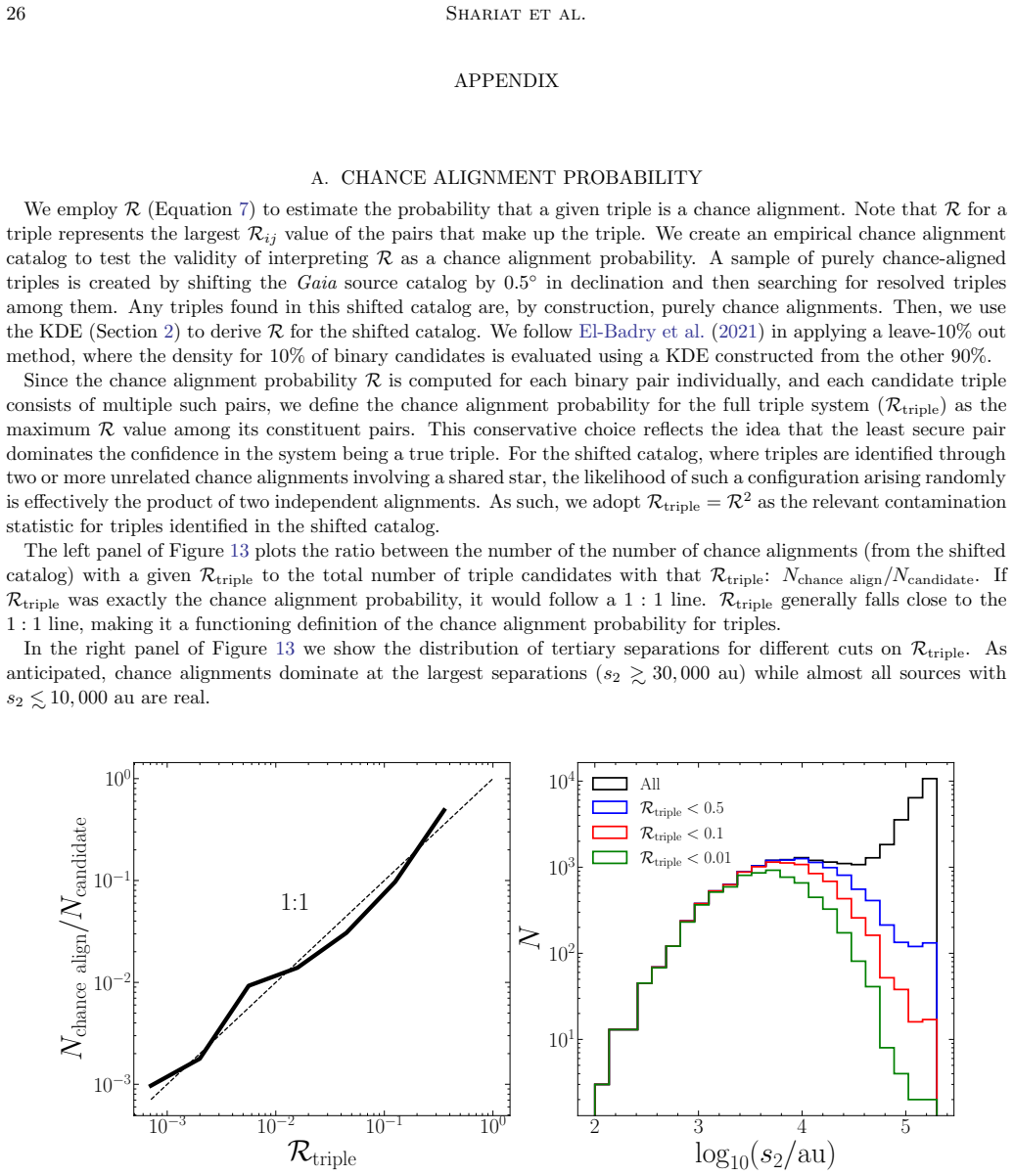
I find no circular step that reduces a claimed prediction or first-principles result to its own inputs by construction. The catalog is constructed directly from Gaia astrometry with a chance-alignment statistic (R) that the paper validates against shifted-catalog realizations (Appendix A), so the sample itself is not circularly defined. The qout slope of -1.4, the log-normal outer-period distribution, and the thermal outer eccentricities are presented as empirical parametrizations chosen to match the observed resolved sample, not as independent predictions; the paper explicitly frames its sampling prescription as observationally motivated and notes that the completeness estimate 'relies on assumptions about the intrinsic distribution of triple masses and orbital periods' (Section 4.5). The completeness correction in Sections 4.5-4.6 uses the adopted intrinsic model to convert observed resolved fractions into intrinsic triple fractions; this is model-dependent, but the outer-period parameters are taken from external binary surveys (Duquennoy & Mayor 1991; Raghavan et al. 2010; Winters et al. 2019) and the resulting triple fractions are compared with independent volume-limited measurements (Winters et al. 2019; Raghavan et al. 2010; Tokovinin 2014b; Moe & Kratter 2021), so the central claim retains independent content. The paper's own caveat that the completeness is sensitive to the assumed period distribution, and the skeptic's point that the mock omits some cuts (proper-motion consistency and Rtriple filtering), are correctness risks rather than circularity. The many citations of El-Badry et al. (2021) and El-Badry (2024) are methodological self-citations, but they are not load-bearing in the sense of importing an unverified uniqueness theorem or smuggling in the target result; the methods are externally validated and re-tested here. I therefore assign a low score of 2 for the minor model-dependence and self-citation presence, with no identified circular steps.
Assumptions & free parameters
free parameters (4)
- Outer mass-ratio power-law slope =
gamma = -1.4
- Outer eccentricity distribution =
thermal f(e)=2e
- M-dwarf period distribution parameters =
log10(a/au)=1.3, sigma=1.16
- Wide-binary separation power-law slope for truncation correction =
-1.6
assumptions (6)
- domain assumption Kroupa IMF describes the underlying stellar mass distribution
- ad hoc to paper Moe & Di Stefano (2017) joint binary distributions apply to triple inner binaries
- ad hoc to paper Tertiary orbital periods follow the binary log-normal period distribution
- domain assumption Mardling & Aarseth (2001) and hierarchy criterion epsilon<0.1 describe triple stability
- standard math Worley (1967) relation converts sign correlation to mean mutual inclination
- domain assumption Gaia resolvability curves from El-Badry (2024) describe detection probability
Cite this review
Pith. "Pith review of 10,000 Resolved Triples from Gaia: Empirical Constraints on Triple Star Populations." pith.science (2026). https://pith.science/paper/UPF3R33A
@misc{pith2026250616513,
  author       = {Pith},
  title        = {Pith review of: 10,000 Resolved Triples from Gaia: Empirical Constraints on Triple Star Populations},
  year         = {2026},
  howpublished = {\url{https://pith.science/paper/UPF3R33A}},
  note         = {Machine review of arXiv:2506.16513}
}
abstract
We present a catalog of $\sim 10,000$ resolved triple star systems within 500 pc of the Sun, constructed using Gaia data. The triples include main-sequence, red giant, and white dwarf components spanning separations of 10 to 50,000 au. A well-characterized selection function allows us to constrain intrinsic demographics of the triple star population. We find that (a) all systems are compatible with being hierarchical and dynamically stable; (b) mutual orbital inclinations are isotropic for wide triples but show modest alignment as the systems become more compact; (c) primary masses follow a Kroupa initial mass function weighted by the triple fraction; (d) inner binary orbital periods, eccentricities, and mass ratios mirror those of isolated binaries, including a pronounced twin excess (mass ratios greater than 0.95) out to separations of 1000+ au, suggesting a common formation pathway; (e) tertiary mass ratios follow a power-law distribution with slope $-1.4$; (f) tertiary orbits are consistent with a log-normal period distribution and thermal eccentricities, subject to dynamical stability. Informed by these observations, we develop a publicly available prescription for generating mock triple star populations. Finally, we estimate the catalog's completeness and infer the intrinsic triple fraction, which rises steadily with primary mass: from $5\%$ at $\lesssim 0.5\,{\rm M_\odot}$ to $35\%$ at $2\,{\rm M_\odot}$. The public catalog provides a robust testbed for models of triple star formation and evolution.
Figures


Figures from the paper (12 more)






Forward citations
Cited by 1 Pith paper
-
Unveiling the nature of G6096: a likely hierarchical triple system
G6096 is likely a hierarchical triple of main-sequence stars rather than a binary hosting a white dwarf or neutron star.
Reference graph
Works this paper leans on
-
[1]
Allen, P. R., Koerner, D. W., McElwain, M. W., Cruz, K. L., & Reid, I. N. 2007, AJ, 133, 971, doi: 10.1086/510346
doi:10.1086/510346 2007
-
[2]
J., Chanam´ e, J., & Ag¨ ueros, M
Andrews, J. J., Chanam´ e, J., & Ag¨ ueros, M. A. 2017, MNRAS, 472, 675, doi: 10.1093/mnras/stx2000 Anglada-Escud´ e, G., Amado, P. J., Barnes, J., et al. 2016, Nature, 536, 437, doi: 10.1038/nature19106
-
[3]
2006, A&A, 450, 1221, doi: 10.1051/0004-6361:20054040
Baraffe, I., Alibert, Y., Chabrier, G., & Benz, W. 2006, A&A, 450, 1221, doi: 10.1051/0004-6361:20054040
-
[4]
2024, A&A, 692, A247, doi: 10.1051/0004-6361/202452637
Bashi, D., & Tokovinin, A. 2024, A&A, 692, A247, doi: 10.1051/0004-6361/202452637
-
[5]
Bate, M. R. 2000, MNRAS, 314, 33, doi: 10.1046/j.1365-8711.2000.03333.x —. 2012, MNRAS, 419, 3115, doi: 10.1111/j.1365-2966.2011.19955.x
arXiv 2000
-
[6]
Bate, M. R., & Bonnell, I. A. 1997, MNRAS, 285, 33, doi: 10.1093/mnras/285.1.33
-
[7]
Bhaskar, H., Li, G., Hadden, S., Payne, M. J., & Holman, M. J. 2021, AJ, 161, 48, doi: 10.3847/1538-3881/abcbfc
-
[8]
2008, Galactic Dynamics: Second Edition
Binney, J., & Tremaine, S. 2008, Galactic Dynamics: Second Edition
2008
Show all 103 references
-
[9]
2016, MNRAS, 455, 4136, doi: 10.1093/mnras/stv2530
Borkovits, T., Hajdu, T., Sztakovics, J., et al. 2016, MNRAS, 455, 4136, doi: 10.1093/mnras/stv2530
2016 doi
-
[10]
2020, ApJ, 898, 71, doi: 10.3847/1538-4357/ab9d85
Breivik, K., Coughlin, S., Zevin, M., et al. 2020, ApJ, 898, 71, doi: 10.3847/1538-4357/ab9d85
2020 doi
-
[11]
2016, ApJ, 823, 102, doi: 10.3847/0004-637X/823/2/102
Choi, J., Dotter, A., Conroy, C., et al. 2016, ApJ, 823, 102, doi: 10.3847/0004-637X/823/2/102
2016 doi
-
[12]
C., & Whitworth, A
Clark, P. C., & Whitworth, A. P. 2021, MNRAS, 500, 1697, doi: 10.1093/mnras/staa3176
2021 doi
-
[13]
Correia, A. C. M., Bourrier, V., & Delisle, J. B. 2020, A&A, 635, A37, doi: 10.1051/0004-6361/201936967
2020 doi
-
[14]
Crossfield, I. J. M., Ciardi, D. R., Petigura, E. A., et al. 2016, ApJS, 226, 7, doi: 10.3847/0067-0049/226/1/7
2016 doi
-
[15]
E., Millard, M
Cuntz, M., Luke, G. E., Millard, M. J., Boyle, L., & Patel, S. D. 2022, ApJS, 263, 33, doi: 10.3847/1538-4365/ac9302
2022 doi
-
[16]
N., Albrecht, S., et al
Dai, F., Winn, J. N., Albrecht, S., et al. 2016, ApJ, 823, 115, doi: 10.3847/0004-637X/823/2/115 Duchˆ ene, G., & Kraus, A. 2013, ARA&A, 51, 269, doi: 10.1146/annurev-astro-081710-102602
2016 doi
-
[17]
1991, A&A, 248, 485
Duquennoy, A., & Mayor, M. 1991, A&A, 248, 485
1991
-
[18]
2024, NewAR, 98, 101694, doi: 10.1016/j.newar.2024.101694
El-Badry, K. 2024, NewAR, 98, 101694, doi: 10.1016/j.newar.2024.101694
2024
-
[19]
2018, Monthly Notices of the Royal Astronomical Society, 480, 4884, doi: 10.1093/mnras/sty2186
El-Badry, K., & Rix, H.-W. 2018, Monthly Notices of the Royal Astronomical Society, 480, 4884, doi: 10.1093/mnras/sty2186
2018 doi
-
[20]
2019, MNRAS, 482, L139, doi: 10.1093/mnrasl/sly206
El-Badry, K., & Rix, H.-W. 2019, MNRAS, 482, L139, doi: 10.1093/mnrasl/sly206
2019 doi
-
[21]
El-Badry, K., Rix, H.-W., & Heintz, T. M. 2021, MNRAS, 506, 2269, doi: 10.1093/mnras/stab323
2021 doi
-
[22]
2019, MNRAS, 489, 5822, doi: 10.1093/mnras/stz2480
El-Badry, K., Rix, H.-W., Tian, H., Duchˆ ene, G., & Moe, M. 2019, MNRAS, 489, 5822, doi: 10.1093/mnras/stz2480
2019 doi
-
[23]
2007, ApJ, 669, 1298, doi: 10.1086/521702
Fabrycky, D., & Tremaine, S. 2007, ApJ, 669, 1298, doi: 10.1086/521702
2007 doi
-
[24]
B., Hwang, H.-C., & Zakamska, N
Fezenko, G. B., Hwang, H.-C., & Zakamska, N. L. 2022, MNRAS, 511, 3881, doi: 10.1093/mnras/stac309
2022 doi
-
[25]
A., & Marcy, G
Fischer, D. A., & Marcy, G. W. 1992, ApJ, 396, 178, doi: 10.1086/171708 Gaia Collaboration, Prusti, T., de Bruijne, J. H. J., et al. 2016, A&A, 595, A1, doi: 10.1051/0004-6361/201629272 Gaia Collaboration, Smart, R. L., Sarro, L. M., et al. 2021a, A&A, 649, A6, doi: 10.1051/00...
1992 doi
-
[26]
2023, MNRAS, 518, 526, doi: 10.1093/mnras/stac3068 Gonz´ alez-Payo, J., Caballero, J
Gao, Y., Toonen, S., & Leigh, N. 2023, MNRAS, 518, 526, doi: 10.1093/mnras/stac3068 Gonz´ alez-Payo, J., Caballero, J. A., Gorgas, J., et al. 2024, A&A, 689, A302, doi: 10.1051/0004-6361/202450048
2023 doi
-
[27]
Grishin, E., & Perets, H. B. 2022, MNRAS, 512, 4993, doi: 10.1093/mnras/stac706 10,000 Resolved Triples from Gaia 33
2022 doi
-
[28]
B., Zenati, Y., & Michaely, E
Grishin, E., Perets, H. B., Zenati, Y., & Michaely, E. 2017, MNRAS, 466, 276, doi: 10.1093/mnras/stw3096
2017 doi
-
[29]
2016, AJ, 152, 132, doi: 10.3847/0004-6256/152/5/132
Grziwa, S., Gandolfi, D., Csizmadia, S., et al. 2016, AJ, 152, 132, doi: 10.3847/0004-6256/152/5/132
2016 doi
-
[30]
F., & Krumholz, M
Guszejnov, D., Hopkins, P. F., & Krumholz, M. R. 2017, MNRAS, 468, 4093, doi: 10.1093/mnras/stx725
2017 doi
-
[31]
S., Glanz, H., & Neunteufel, P
Hamers, A. S., Glanz, H., & Neunteufel, P. 2022, ApJS, 259, 25, doi: 10.3847/1538-4365/ac49e7
2022 doi
-
[32]
2022, ApJL, 929, L29, doi: 10.3847/2041-8213/ac6600
Hamilton, C. 2022, ApJL, 929, L29, doi: 10.3847/2041-8213/ac6600
2022 doi
-
[33]
D., & L´ epine, S
Hartman, Z. D., & L´ epine, S. 2020, ApJS, 247, 66, doi: 10.3847/1538-4365/ab79a6
2020 doi
-
[34]
M., Hermes, J
Heintz, T. M., Hermes, J. J., El-Badry, K., et al. 2022, ApJ, 934, 148, doi: 10.3847/1538-4357/ac78d9
2022 doi
-
[35]
M., Hermes, J
Heintz, T. M., Hermes, J. J., Tremblay, P. E., et al. 2024, arXiv e-prints, arXiv:2405.02423. https://arxiv.org/abs/2405.02423
2024 arXiv
-
[36]
2022a, ApJL, 933, L32, doi: 10.3847/2041-8213/ac7c70
Hwang, H.-C., El-Badry, K., Rix, H.-W., et al. 2022a, ApJL, 933, L32, doi: 10.3847/2041-8213/ac7c70
-
[37]
C., Zakamska, N
Hwang, H.-C., Ting, Y.-S., Schlaufman, K. C., Zakamska, N. L., & Wyse, R. F. G. 2021, MNRAS, 501, 4329, doi: 10.1093/mnras/staa3854
2021 doi
-
[38]
Hwang, H.-C., Ting, Y.-S., & Zakamska, N. L. 2022b, MNRAS, 512, 3383, doi: 10.1093/mnras/stac675
-
[39]
2010, MNRAS, 401, 977, doi: 10.1111/j.1365-2966.2009.15744.x
Jiang, Y.-F., & Tremaine, S. 2010, MNRAS, 401, 977, doi: 10.1111/j.1365-2966.2009.15744.x
2010
-
[40]
2017, A&A, 599, A14, doi: 10.1051/0004-6361/201629398
Joncour, I., Duchˆ ene, G., & Moraux, E. 2017, A&A, 599, A14, doi: 10.1051/0004-6361/201629398
2017 doi
-
[41]
A., & Raymond, S
Kaib, N. A., & Raymond, S. N. 2014, ApJ, 782, 60, doi: 10.1088/0004-637X/782/2/60
2014 doi
- [42]
-
[43]
Knigge, C., Toonen, S., & Boekholt, T. C. N. 2022, MNRAS, 514, 1895, doi: 10.1093/mnras/stac1336
2022 doi
-
[44]
2023, ApJS, 265, 4, doi: 10.3847/1538-4365/ac9da4
Kokori, A., Tsiaras, A., Edwards, B., et al. 2023, ApJS, 265, 4, doi: 10.3847/1538-4365/ac9da4
2023 doi
-
[45]
2019, AJ, 157, 196, doi: 10.3847/1538-3881/ab13b1
Kounkel, M., Covey, K., Moe, M., et al. 2019, AJ, 157, 196, doi: 10.3847/1538-3881/ab13b1
2019 doi
-
[46]
Kouwenhoven, M. B. N., Goodwin, S. P., Parker, R. J., et al. 2010, MNRAS, 404, 1835, doi: 10.1111/j.1365-2966.2010.16399.x
2010
- [47]
-
[48]
2016, ARA&A, 54, 271, doi: 10.1146/annurev-astro-081915-023307
Kratter, K., & Lodato, G. 2016, ARA&A, 54, 271, doi: 10.1146/annurev-astro-081915-023307
2016 doi
-
[49]
1995a, MNRAS, 277, 1491, doi: 10.1093/mnras/277.4.1491 —
Kroupa, P. 1995a, MNRAS, 277, 1491, doi: 10.1093/mnras/277.4.1491 —. 1995b, MNRAS, 277, 1507, doi: 10.1093/mnras/277.4.1507
- [50]
-
[51]
R., Zorotovic, M., et al
Lagos, F., Schreiber, M. R., Zorotovic, M., et al. 2021, MNRAS, 501, 676, doi: 10.1093/mnras/staa3703
2021 doi
-
[52]
G., & Mathieu, R
Laos, E., Stassun, K. G., & Mathieu, R. D. 2020, ApJ, 902, 107, doi: 10.3847/1538-4357/abb3fe
2020 doi
-
[53]
T., Offner, S
Lee, A. T., Offner, S. S. R., Kratter, K. M., Smullen, R. A., & Li, P. S. 2019, ApJ, 887, 232, doi: 10.3847/1538-4357/ab584b
2019 doi
-
[54]
M., Gosnell, N
Leiner, E. M., Gosnell, N. M., Geller, A. M., et al. 2025, ApJL, 979, L1, doi: 10.3847/2041-8213/ad9d0c
2025 doi
-
[55]
Lidov, M. L. 1962, Planet. Space Sci., 9, 719, doi: 10.1016/0032-0633(62)90129-0
1962 doi
- [56]
-
[57]
A., & Aarseth, S
Mardling, R. A., & Aarseth, S. J. 2001, MNRAS, 321, 398, doi: 10.1046/j.1365-8711.2001.03974.x
2001
-
[58]
2011, MNRAS, 417, 1702, doi: 10.1111/j.1365-2966.2011.19519.x
Marks, M., & Kroupa, P. 2011, MNRAS, 417, 1702, doi: 10.1111/j.1365-2966.2011.19519.x
2011
-
[59]
W., Vanderburg, A., Latham, D
Mayo, A. W., Vanderburg, A., Latham, D. W., et al. 2018, AJ, 155, 136, doi: 10.3847/1538-3881/aaadff
2018 doi
-
[60]
Michaely, E., & Perets, H. B. 2016, MNRAS, 458, 4188, doi: 10.1093/mnras/stw368
2016 doi
-
[61]
2017, ApJS, 230, 15, doi: 10.3847/1538-4365/aa6fb6
Moe, M., & Di Stefano, R. 2017, ApJS, 230, 15, doi: 10.3847/1538-4365/aa6fb6
2017 doi
-
[62]
Moe, M., & Kratter, K. M. 2021, MNRAS, 507, 3593, doi: 10.1093/mnras/stab2328
2021 doi
-
[63]
T., Morton, T
Montet, B. T., Morton, T. D., Foreman-Mackey, D., et al. 2015, ApJ, 809, 25, doi: 10.1088/0004-637X/809/1/25
2015 doi
-
[64]
2023, A&A, 674, A16, doi: 10.1051/0004-6361/202245330 Mu˜ noz, D
Mowlavi, N., Holl, B., Lecoeur-Ta¨ ıbi, I., et al. 2023, A&A, 674, A16, doi: 10.1051/0004-6361/202245330 Mu˜ noz, D. J., & Petrovich, C. 2020, ApJL, 904, L3, doi: 10.3847/2041-8213/abc564
2023 doi
-
[65]
2020, MNRAS, 498, 665, doi: 10.1093/mnras/staa2492
Mushkin, J., & Katz, B. 2020, MNRAS, 498, 665, doi: 10.1093/mnras/staa2492
2020 doi
-
[66]
2016, ARA&A, 54, 441, doi: 10.1146/annurev-astro-081915-023315
Naoz, S. 2016, ARA&A, 54, 441, doi: 10.1146/annurev-astro-081915-023315
2016 doi
-
[67]
Naoz, S., & Fabrycky, D. C. 2014, ApJ, 793, 137, doi: 10.1088/0004-637X/793/2/137
2014 doi
-
[68]
2013, MNRAS, 431, 2155, doi: 10.1093/mnras/stt302
Teyssandier, J. 2013, MNRAS, 431, 2155, doi: 10.1093/mnras/stt302
2013 doi
-
[69]
P., & Rasio, F
Naoz, S., Fragos, T., Geller, A., Stephan, A. P., & Rasio, F. A. 2016, ApJL, 822, L24, doi: 10.3847/2041-8205/822/2/L24
2016 doi
-
[70]
2022, ApJ, 931, 124, doi: 10.3847/1538-4357/ac6c84
Niu, Z., Yuan, H., Wang, Y., & Liu, J. 2022, ApJ, 931, 124, doi: 10.3847/1538-4357/ac6c84
2022 doi
-
[71]
2005, ApJ, 623, 922, doi: 10.1086/428601 34 Shariat et al
Ochi, Y., Sugimoto, K., & Hanawa, T. 2005, ApJ, 623, 922, doi: 10.1086/428601 34 Shariat et al. O’Connor, C. E., Liu, B., & Lai, D. 2021, MNRAS, 501, 507, doi: 10.1093/mnras/staa3723
2005 doi
-
[72]
Offner, S. S. R., Kratter, K. M., Matzner, C. D., Krumholz, M. R., & Klein, R. I. 2010, ApJ, 725, 1485, doi: 10.1088/0004-637X/725/2/1485
2010 doi
- [73]
-
[74]
J., & Mamajek, E
Pecaut, M. J., & Mamajek, E. E. 2013, ApJS, 208, 9, doi: 10.1088/0067-0049/208/1/9
2013 doi
- [75]
-
[76]
B., & Fabrycky, D
Perets, H. B., & Fabrycky, D. C. 2009, ApJ, 697, 1048, doi: 10.1088/0004-637X/697/2/1048
2009 doi
-
[77]
B., & Kratter, K
Perets, H. B., & Kratter, K. M. 2012, ApJ, 760, 99, doi: 10.1088/0004-637X/760/2/99 Perpiny` a-Vall` es, M., Rebassa-Mansergas, A., G¨ ansicke, B. T., et al. 2019, MNRAS, 483, 901, doi: 10.1093/mnras/sty3149
2012 doi
-
[78]
A., Sinukoff, E., Lopez, E
Petigura, E. A., Sinukoff, E., Lopez, E. D., et al. 2017, AJ, 153, 142, doi: 10.3847/1538-3881/aa5ea5
2017 doi
-
[79]
A., Henry, T
Raghavan, D., McAlister, H. A., Henry, T. J., et al. 2010, ApJS, 190, 1, doi: 10.1088/0067-0049/190/1/1
2010 doi
-
[80]
2012, Nature, 492, 221, doi: 10.1038/nature11662
Reipurth, B., & Mikkola, S. 2012, Nature, 492, 221, doi: 10.1038/nature11662
2012 doi
- [81]
-
[82]
2025b, ApJ, 983, 115, doi: 10.3847/1538-4357/adbf01 —
Shariat, C., Naoz, S., El-Badry, K., et al. 2025b, ApJ, 983, 115, doi: 10.3847/1538-4357/adbf01 —. 2025c, ApJ, 978, 47, doi: 10.3847/1538-4357/ad944a
-
[83]
Shariat, C., Naoz, S., Hansen, B. M. S., et al. 2023, ApJL, 955, L14, doi: 10.3847/2041-8213/acf76b
2023 doi
-
[84]
P., Naoz, S., & Gaudi, B
Stephan, A. P., Naoz, S., & Gaudi, B. S. 2021, ApJ, 922, 4, doi: 10.3847/1538-4357/ac22a9
2021 doi
-
[85]
F., & Tokovinin, A
Sterzik, M. F., & Tokovinin, A. A. 2002, A&A, 384, 1030, doi: 10.1051/0004-6361:20020105
2002 doi
-
[86]
2024, A&A, 689, A133, doi: 10.1051/0004-6361/202449649
Thomasson, B., Joncour, I., Moraux, E., et al. 2024, A&A, 689, A133, doi: 10.1051/0004-6361/202449649
2024 doi
-
[87]
2020, ApJS, 246, 4, doi: 10.3847/1538-4365/ab54c4
Tian, H.-J., El-Badry, K., Rix, H.-W., & Gould, A. 2020, ApJS, 246, 4, doi: 10.3847/1538-4365/ab54c4
2020 doi
-
[88]
J., Looney, L
Tobin, J. J., Looney, L. W., Li, Z.-Y., et al. 2016, ApJ, 818, 73, doi: 10.3847/0004-637X/818/1/73
2016 doi
-
[89]
2008, MNRAS, 389, 925, doi: 10.1111/j.1365-2966.2008.13613.x —
Tokovinin, A. 2008, MNRAS, 389, 925, doi: 10.1111/j.1365-2966.2008.13613.x —. 2014a, AJ, 147, 86, doi: 10.1088/0004-6256/147/4/86 —. 2014b, AJ, 147, 87, doi: 10.1088/0004-6256/147/4/87 —. 2020, MNRAS, 496, 987, doi: 10.1093/mnras/staa1639 —. 2021, Universe, 7, 352, doi: 10.339...
2008
-
[90]
2016, MNRAS, 456, 2070, doi: 10.1093/mnras/stv2825
Tokovinin, A., & Kiyaeva, O. 2016, MNRAS, 456, 2070, doi: 10.1093/mnras/stv2825
2016 doi
-
[91]
2006, A&A, 450, 681, doi: 10.1051/0004-6361:20054427
Tokovinin, A., Thomas, S., Sterzik, M., & Udry, S. 2006, A&A, 450, 681, doi: 10.1051/0004-6361:20054427
2006 doi
-
[92]
Tokovinin, A. A. 1997, Astronomy Letters, 23, 727 —. 2000, A&A, 360, 997
1997
-
[93]
Toonen, S., Boekholt, T. C. N., & Portegies Zwart, S. 2022, A&A, 661, A61, doi: 10.1051/0004-6361/202141991
2022 doi
-
[94]
B., & Hamers, A
Toonen, S., Perets, H. B., & Hamers, A. S. 2018, A&A, 610, A22, doi: 10.1051/0004-6361/201731874
2018 doi
-
[95]
2020, A&A, 640, A16, doi: 10.1051/0004-6361/201936835 Van Eylen, V., Nowak, G., Albrecht, S., et al
Bandopadhyay, D. 2020, A&A, 640, A16, doi: 10.1051/0004-6361/201936835 Van Eylen, V., Nowak, G., Albrecht, S., et al. 2016, ApJ, 820, 56, doi: 10.3847/0004-637X/820/1/56
2020 doi
-
[96]
A., Xu, S., et al
Vanderburg, A., Rappaport, S. A., Xu, S., et al. 2020, Nature, 585, 363, doi: 10.1038/s41586-020-2713-y von Zeipel, H. 1910, Astronomische Nachrichten, 183, 345, doi: 10.1002/asna.19091832202
2020 doi
-
[97]
C., Naoz, S., & Hansen, B
Weldon, G. C., Naoz, S., & Hansen, B. M. S. 2024, ApJ, 974, 302, doi: 10.3847/1538-4357/ad77a9
2024 doi
- [98]
-
[99]
G., Henry, T
Winters, J. G., Henry, T. J., Jao, W.-C., et al. 2019, AJ, 157, 216, doi: 10.3847/1538-3881/ab05dc
2019 doi
-
[100]
Worley, C. E. 1967, in On the Evolution of Double Stars, ed. J. Dommanget, Vol. 17, 221
1967
- [101]
-
[102]
D., & Clarke, C
Young, M. D., & Clarke, C. J. 2015, MNRAS, 452, 3085, doi: 10.1093/mnras/stv1512
2015 doi
- [103]
Reviewed August 15, 2026 · model on record in the stance chip above.
Discussion (0). Continue with ORCID to comment.