REVIEW 3 major objections 3 minor 57 references
The Adaptive Complexity of Finding a Stationary Point
T0 review · 3 major / 3 minor · reviewed 2026-08-15 · deepseek-v4-flash
Pith's one-line read Even large parallel query batches do not cut the worst-case sequential rounds needed to find a stationary point of a high-dimensional nonconvex function.
desk verdict Strong paper with a real gap: Theorem 4's stated dimension condition is missing a Δ² factor, so the theorem overclaims as printed, but the core construction is solid and the result looks salvageable. read the letter →
The pith
A machine-rendered reading of the paper's core claim, the machinery that carries it, and where it could break.
The reading
What carries the argument
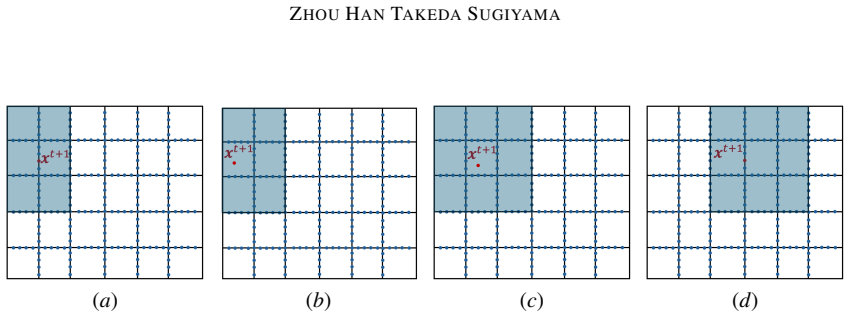
Two mechanisms carry the argument. In high dimension, the lower bound is driven by a family of hard functions $f_P(x) = g_P(\rho(x)) + \frac{1}{5}\|x\|^2$ parameterized by a uniformly random partition $P = (P_1,\dots,P_{r+2})$ of the $d$ coordinates into equal blocks; the block sums $X_i(x)$ feed a chaining sum of bump-function products $\Psi\Phi$ that is radially damped by $\rho$. The chain has two opposing properties: the gradient cannot drop below a fixed constant unless $|X_{r+1}-X_r| \ge 1$, yet the answer to any query depends only on the first $2\ell$ blocks unless some adjacent block sums exceed $1/2$ — and concentration of linear functions of conditioned Bernoulli variables keeps adjacent sums below $1/2$ with probability $1-d^{-\omega(1)}$, so each round of parallel queries reveals at most two blocks. In constant dimension, the algorithmic mechanism is the Gradient Flow Grid Trapping (GFGT) method: place $\ell_t$ equally spaced trap barriers in each coordinate, query a fine $\delta_t$-net on every barrier, move the iterate only to the lowest reachable queried point, and compress each side of the box by a factor of $3/\ell_t$ per round; unreachable boundaries guarantee the shrunken box still contains an $\varepsilon$-stationary point, so $k=\Theta(1)$ rounds suffice. The matching lower bound proceeds by a round-preserving reduction to finding the minimum of a random-staircase monotone path on a grid graph.
What would settle it
Run any candidate parallel algorithm on the paper's own hard family $f_P$ with $d/\log^2 d \ge c_2 (L_p/l_p)^{2/p}\varepsilon^{-(2+2p)/p}$: succeeding with probability at least $3/4$ in fewer than $c_0\Delta(L_p/l_p)^{1/p}\varepsilon^{-(1+p)/p}$ rounds would refute the high-dimensional lower bound. A cheaper partial check is whether a first-order oracle can be assembled from $\mathrm{poly}(d)$ zeroth-order queries in a single round; showing that any such simulation needs more than one round leaves the lower bound intact but undercuts the adaptive-optimality claim for the named methods.
Extended reading notes
Core claim
The central claim of the paper is an impossibility result for the high-dimensional regime $d = \widetilde\Omega(\varepsilon^{-(2+2p)/p})$: any randomized algorithm allowed $\mathrm{poly}(d)$ oracle queries per round still needs at least $c_0 \Delta (L_p/l_p)^{1/p} \varepsilon^{-(1+p)/p}$ rounds to output a point with expected gradient norm at most $\varepsilon$ for some function in $\mathcal{F}_p(L_p)$. Because this matches the known sequential one-query-per-round lower bound, the extra parallelism cannot help in the worst case, and the established methods — gradient descent for $p=1$, cubic-regularized Newton for $p=2$, and the adaptive regularization method AR$_p$ for general $p$ — are adaptively optimal. For the constant-dimensional setting $d=\Theta(1)$ on the cube $[0,1]^d$, the paper builds a deterministic algorithm that runs in $k=\Theta(1)$ rounds with $\varepsilon^{-(d-1)/2}(1+O(2^{-k}))$ queries per iteration, bridging the two previously known extremes, and proves that any randomized algorithm running in $k=\Theta(\log(1/\varepsilon))$ rounds needs at least $\widetilde\Omega(\varepsilon^{-(d-1)/2})$ queries per round, tight up to logarithmic factors and implying that the gradient-flow parallel trap is adaptively optimal.
Load-bearing premise
The transfer of the lower bound to gradient descent, cubic-regularized Newton, and AR$_p$ rests on the unproven premise, stated in the preliminaries, that a $p$-th order oracle can be simulated by $\mathrm{poly}(d)$ zeroth-order queries within the same round; if that simulation costs extra rounds, the adaptive-optimality conclusions for those methods do not follow, though the zeroth-order lower bound itself stands.
Editorial extensions
If this is right
- No amount of in-round parallelism improves worst-case round counts in high dimension: the $\Omega(\varepsilon^{-(p+1)/p})$ lower bound holds for algorithms making polynomially many queries per round, exactly as for one-query-per-round algorithms.
- Gradient descent ($p=1$), cubic-regularized Newton ($p=2$), and AR$_p$ (general $p$) are adaptively optimal, so their known iteration counts cannot be beaten by parallel methods on this function class.
- In constant dimension, an $\varepsilon$-stationary point can be found in $k=\Theta(1)$ rounds with $\varepsilon^{-(d-1)/2}(1+O(2^{-k}))$ queries per iteration, interpolating between grid search at $k=1$ and the flow-trapping rate as $k$ grows.
- Any $\Theta(\log(1/\varepsilon))$-round algorithm in constant dimension must issue at least $\widetilde\Omega(\varepsilon^{-(d-1)/2})$ queries per round, matching the gradient-flow parallel trap up to logarithmic factors and settling the open question about the low-depth region.
- In the zero-variance limit of stochastic non-convex optimization the construction combines with the stochastic lower bound $\Omega(\sigma^2\varepsilon^{-4})$ to give $\Omega(\varepsilon^{-2}+\sigma^2\varepsilon^{-4})$, matching the query complexity of SGD.
Reading between the lines
- Because the two regimes rest on different mechanisms — Boolean-slice concentration in high dimension, grid-graph staircase hardness in constant dimension — the intermediate dimension range the paper leaves open presumably contains the flip from 'parallelism useless' to 'parallelism helps'; testing whether the random-partition construction degrades gracefully as $d$ shrinks would locate that flip.
- The paper pins down the round-query tradeoff only at the extremes ($k=\Theta(1)$ and $k=\Theta(\log(1/\varepsilon))$); a testable extension is whether intermediate values of $k$ can attain the interpolating exponent $\frac{d-1}{2}(1+O(d^{-k}))$ that the lower bound predicts, which would fully settle the adaptivity hierarchy in fixed dimension.
- A practical reading the authors only gesture at: parallel hardware still pays off inside a round, since per-round query loads such as the $\delta_t$-nets of GFGT are exactly the parallelizable part — but the worst-case number of rounds is already achieved by sequential algorithms, so in high dimension more workers should not be expected to reduce iteration counts.
Signed reviews
Editorial analysis
A structured set of objections, weighed in public.
Referee Report
Summary. The paper studies the adaptive (round) complexity of finding an ε-stationary point of a smooth nonconvex function when each round can issue poly(d) parallel queries. In the high-dimensional regime d = Ω~(ε^{-(2+2p)/p}) the authors construct a family of hard functions based on random coordinate partitions and prove an Ω(Δ (L_p/ℓ_p)^{1/p} ε^{-(p+1)/p}) lower bound on the number of rounds for every randomized algorithm (Theorem 4). They conclude that parallelization yields no acceleration and that gradient descent, cubic regularization, and AR_p are adaptively optimal. In the constant-dimensional case they propose an algorithm called Gradient Flow Grid Trapping (GFGT) that finds an ε-stationary point in k = Θ(1) rounds with per-round query count approaching ε^{-(d-1)/2} as k grows (Theorem 10), and they prove a matching lower bound for algorithms running in O(log(1/ε)) rounds (Theorem 11), answering an open question from Bubeck and Mikulincer.
Significance. If the results are correct, this is a substantial contribution to the theory of parallel nonconvex optimization. It provides the first tight adaptive-complexity characterization for stationary-point finding in both high and constant dimension, and it introduces a random-partition chaining construction that genuinely improves on the projection-based arguments of Carmon et al. (2020) in the presence of many parallel queries. The constant-dimensional GFGT algorithm is a concrete algorithmic contribution with a detailed correctness proof, and the lower bound for logarithmic-round algorithms matches the known upper bound up to log factors. The paper would be considerably strengthened by fixing the Δ-dependence in Theorem 4 and supplying the missing zeroth-order simulation argument.
major comments (3)
- [Theorem 4 and Appendix B.4] The stated dimension condition in Theorem 4 is missing a Δ^2 factor. The proof sets r = floor(Δ / (1857 (L_p/l_p)^{1/p} ε^{-(1+p)/p})) and then requires 162·230^2 (r+1)^2 log^2 d ≤ d (Appendix B.4, proof of Theorem 4). Substituting r gives d/log^2 d ≥ C Δ^2 (L_p/l_p)^{2/p} ε^{-2(1+p)/p}, not the condition printed in the theorem. Consequently, for large Δ the claimed lower bound cannot be derived from the constructed family: the available chain length r/2 is bounded by roughly d^{1/2}/log d, while the theorem claims a lower bound proportional to Δ. The statement should either include the Δ^2 factor in the dimension condition, as the proof shows is necessary, or restrict Δ to an absolute constant, matching the abstract's regime.
- [Section 2, Oracle paragraph] The assertion that higher-order oracles can be constructed using poly(d) queries to the zeroth-order oracle is load-bearing and unproved. Theorem 4 is proved for zeroth-order queries only, but the conclusions about gradient descent, cubic-regularized Newton, and AR_p require that an algorithm with p-th-order oracle access can be simulated by zeroth-order queries within the same round. No finite-difference construction, accuracy analysis, or round-preservation argument is supplied. Without this, the lower bound applies only to zeroth-order algorithms, and the stated adaptive optimality of p-th-order methods is not established.
- [Appendix B.3, proof of Lemma 8] The concentration step invokes Theorem 12 with coefficients ρ_j(x), but Theorem 12 is stated for nonnegative coefficients α_i ≥ 0, whereas ρ_j(x) can be negative. The proof does not address this mismatch. The argument is likely repairable by splitting into positive and negative parts or by citing a signed-coefficient version, but as written the information-hiding step is not fully justified.
minor comments (3)
- [Theorem 10] The exponents in the two displayed query complexities are typeset without enough parentheses, making the claimed rates ambiguous; the cleaner expression in Appendix D.3, Lemma 31 should be used in the main text.
- [Lemma 8 and Lemma 9] Lemma 8 says 'up to addictive error' and should read 'additive error'; Lemma 9 says 'there exits a direction vector' and should read 'there exists'.
- [Section 1.2.1] The subsection heading 'Prior arguement fails under polynomial queries' contains a typo: 'arguement' should be 'argument'.
Circularity Check
No materially circular derivation: the lower bounds are adversarial constructions, and the self-citations are not load-bearing.
full rationale
Walking the derivation chain, the main high-dimensional lower bound (Theorem 4) is an adversarial construction rather than a fit: the hard function f_P is built from random partitions, the chain length r is chosen from Delta and the target epsilon only to set the scale of the instance, and Lemmas 8 and 9 establish that after fewer than r/2 rounds the output cannot satisfy the gradient condition. The proof does not use the claimed lower bound as an input; the constants (0.08, 1857, etc.) arise from explicit calculations. The random-partition idea is attributed to the authors' own earlier work (Zhou et al., 2024), but the paper re-proves the needed concentration via Theorem 12 (Polaczyk, 2023) and does not assume the conclusion of that prior work. The constant-dimensional lower bound is a round-preserving reduction to external local-search lower bounds (Vavasis, 1993; Branzei and Li, 2022), so it is independent. I therefore find no circular step. Two non-circular caveats are worth recording. First, Section 2 asserts without proof that higher-order oracles can be simulated by poly(d, 1/epsilon) zeroth-order queries in one round; this is the bridge from the zero-order lower bound to the claimed optimality of p-th order methods. That is an unsupported transfer or omitted proof, not circularity. Second, the proof of Theorem 4 sets r = floor(Delta / (1857 (L_p/l_p)^{1/p} epsilon^{-(1+p)/p})) and requires 162 * 230^2 (r+1)^2 log^2 d <= d, so the stated dimension condition d/log^2 d >= c2 (L_p/l_p)^{2/p} epsilon^{-(2+2p)/p} appears to omit a Delta^2 factor; this is an internal correctness or consistency issue, not circularity. The qualitative conclusion for bounded Delta is not affected by this observation.
Assumptions & free parameters
free parameters (3)
- R =
230*sqrt(r+1)
- part size d0 =
>= log^2 d
- alpha =
omega(1), e.g. log log d
assumptions (4)
- standard math Concentration for linear functions over a Boolean slice (Theorem 12, Polaczyk 2023)
- standard math Smooth lifting of monotone path functions to gradient-stationary functions (Vavasis 1993, Lemma 19)
- standard math Round-preserving reduction and local-search lower bound of Brânzei and Li (2022), Lemma 22
- domain assumption Zeroth-order oracle simulates p-th order oracles in one round (Section 2)
invented entities (2)
-
Random-partition chaining hard function f_P
-
Gradient Flow Grid Trapping (GFGT) Algorithm 1
Cite this review
Pith. "Pith review of The Adaptive Complexity of Finding a Stationary Point." pith.science (2026). https://pith.science/paper/NICHBE5T
@misc{pith2026250509045,
  author       = {Pith},
  title        = {Pith review of: The Adaptive Complexity of Finding a Stationary Point},
  year         = {2026},
  howpublished = {\url{https://pith.science/paper/NICHBE5T}},
  note         = {Machine review of arXiv:2505.09045}
}
abstract
In large-scale applications, such as machine learning, it is desirable to design non-convex optimization algorithms with a high degree of parallelization. In this work, we study the adaptive complexity of finding a stationary point, which is the minimal number of sequential rounds required to achieve stationarity given polynomially many queries executed in parallel at each round. For the high-dimensional case, i.e., $d = \widetilde{\Omega}(\varepsilon^{-(2 + 2p)/p})$, we show that for any (potentially randomized) algorithm, there exists a function with Lipschitz $p$-th order derivatives such that the algorithm requires at least $\varepsilon^{-(p+1)/p}$ iterations to find an $\varepsilon$-stationary point. Our lower bounds are tight and show that even with $\mathrm{poly}(d)$ queries per iteration, no algorithm has better convergence rate than those achievable with one-query-per-round algorithms. In other words, gradient descent, the cubic-regularized Newton's method, and the $p$-th order adaptive regularization method are adaptively optimal. Our proof relies upon novel analysis with the characterization of the output for the hardness potentials based on a chain-like structure with random partition. For the constant-dimensional case, i.e., $d = \Theta(1)$, we propose an algorithm that bridges grid search and gradient flow trapping, finding an approximate stationary point in constant iterations. Its asymptotic tightness is verified by a new lower bound on the required queries per iteration. We show there exists a smooth function such that any algorithm running with $\Theta(\log (1/\varepsilon))$ rounds requires at least $\widetilde{\Omega}((1/\varepsilon)^{(d-1)/2})$ queries per round. This lower bound is tight up to a logarithmic factor, and implies that the gradient flow trapping is adaptively optimal.
Figures

Reference graph
Works this paper leans on
-
[1]
Arpit Agarwal, Shivani Agarwal, Sepehr Assadi, and Sanjeev Khanna. Learning with limited rounds of adaptivity: Coin tossing, multi-armed bandits, and ranking from pairwise comparisons. In Conference on Learning Theory, pages 39--75. PMLR, 2017
work page 2017
-
[2]
A convergence theory for deep learning via over-parameterization
Zeyuan Allen-Zhu, Yuanzhi Li, and Zhao Song. A convergence theory for deep learning via over-parameterization. In International Conference on Machine Learning, pages 242--252. PMLR, 2019
work page 2019
-
[3]
Fast parallel sampling under isoperimetry
Nima Anari, Sinho Chewi, and Thuy-Duong Vuong. Fast parallel sampling under isoperimetry. In Proceedings of Thirty Seventh Conference on Learning Theory, volume 247 of Proceedings of Machine Learning Research, pages 161--185. PMLR, 30 Jun--03 Jul 2024
work page 2024
-
[4]
Lower bounds for non-convex stochastic optimization
Yossi Arjevani, Yair Carmon, John C Duchi, Dylan J Foster, Nathan Srebro, and Blake Woodworth. Lower bounds for non-convex stochastic optimization. Mathematical Programming, 199 0 (1): 0 165--214, 2023
2023
-
[5]
The adaptive complexity of maximizing a submodular function
Eric Balkanski and Yaron Singer. The adaptive complexity of maximizing a submodular function. In Proceedings of the 50th annual ACM SIGACT symposium on theory of computing, pages 1138--1151, 2018 a
work page 2018
-
[6]
Eric Balkanski and Yaron Singer. Parallelization does not accelerate convex optimization: Adaptivity lower bounds for non-smooth convex minimization. arXiv preprint arXiv:1808.03880, 2018 b
arXiv 2018
-
[7]
An elementary introduction to modern convex geometry
Keith Ball et al. An elementary introduction to modern convex geometry. Flavors of geometry, 31 0 (1-58): 0 26, 1997
work page 1997
-
[8]
Ernesto G Birgin, JL Gardenghi, Jos \'e Mario Mart \' nez, Sandra Augusta Santos, and Ph L Toint. Worst-case evaluation complexity for unconstrained nonlinear optimization using high-order regularized models. Mathematical Programming, 163: 0 359--368, 2017
work page 2017
Show all 57 references
-
[9]
Optimization methods for large-scale machine learning
L \'e on Bottou, Frank E Curtis, and Jorge Nocedal. Optimization methods for large-scale machine learning. SIAM review, 60 0 (2): 0 223--311, 2018
2018
-
[10]
The query complexity of local search and brouwer in rounds
Simina Br \^a nzei and Jiawei Li. The query complexity of local search and brouwer in rounds. In Conference on Learning Theory, pages 5128--5145. PMLR, 2022
2022
-
[11]
Parallel algorithms for select and partition with noisy comparisons
Mark Braverman, Jieming Mao, and S Matthew Weinberg. Parallel algorithms for select and partition with noisy comparisons. In Proceedings of the forty-eighth annual ACM symposium on Theory of Computing, pages 851--862, 2016
2016
-
[12]
How to trap a gradient flow
S \'e bastien Bubeck and Dan Mikulincer. How to trap a gradient flow. In Conference on Learning Theory, pages 940--960. PMLR, 2020
2020
-
[13]
Complexity of highly parallel non-smooth convex optimization
S \'e bastien Bubeck, Qijia Jiang, Yin-Tat Lee, Yuanzhi Li, and Aaron Sidford. Complexity of highly parallel non-smooth convex optimization. Advances in neural information processing systems, 32, 2019
2019
-
[14]
An adaptivity hierarchy theorem for property testing
Cl \'e ment L Canonne and Tom Gur. An adaptivity hierarchy theorem for property testing. computational complexity, 27: 0 671--716, 2018
2018
-
[15]
Lower bounds for finding stationary points i
Yair Carmon, John C Duchi, Oliver Hinder, and Aaron Sidford. Lower bounds for finding stationary points i. Mathematical Programming, 184 0 (1): 0 71--120, 2020
2020
-
[16]
Lower bounds for finding stationary points ii: first-order methods
Yair Carmon, John C Duchi, Oliver Hinder, and Aaron Sidford. Lower bounds for finding stationary points ii: first-order methods. Mathematical Programming, 185 0 (1): 0 315--355, 2021
2021
-
[17]
Resqueing parallel and private stochastic convex optimization
Yair Carmon, Arun Jambulapati, Yujia Jin, Yin Tat Lee, Daogao Liu, Aaron Sidford, and Kevin Tian. Resqueing parallel and private stochastic convex optimization. In 2023 IEEE 64th Annual Symposium on Foundations of Computer Science (FOCS), pages 2031--2058. IEEE, 2023
2023
-
[18]
Scalable subspace methods for derivative-free nonlinear least-squares optimization
Coralia Cartis and Lindon Roberts. Scalable subspace methods for derivative-free nonlinear least-squares optimization. Mathematical Programming, 199 0 (1): 0 461--524, 2023
2023
-
[19]
On the complexity of steepest descent, newton's and regularized newton's methods for nonconvex unconstrained optimization problems
Coralia Cartis, Nicholas IM Gould, and Ph L Toint. On the complexity of steepest descent, newton's and regularized newton's methods for nonconvex unconstrained optimization problems. Siam journal on optimization, 20 0 (6): 0 2833--2852, 2010
2010
-
[20]
Sharp worst-case evaluation complexity bounds for arbitrary-order nonconvex optimization with inexpensive constraints
Coralia Cartis, Nicholas IM Gould, and Philippe L Toint. Sharp worst-case evaluation complexity bounds for arbitrary-order nonconvex optimization with inexpensive constraints. SIAM Journal on Optimization, 30 0 (1): 0 513--541, 2020 a
2020
-
[21]
A concise second-order complexity analysis for unconstrained optimization using high-order regularized models
Coralia Cartis, Nick IM Gould, and Ph L Toint. A concise second-order complexity analysis for unconstrained optimization using high-order regularized models. Optimization Methods and Software, 35 0 (2): 0 243--256, 2020 b
2020
-
[22]
Improved lower bounds for submodular function minimization
Deeparnab Chakrabarty, Andrei Graur, Haotian Jiang, and Aaron Sidford. Improved lower bounds for submodular function minimization. In 2022 IEEE 63rd Annual Symposium on Foundations of Computer Science (FOCS), pages 245--254. IEEE, 2022
2022
-
[23]
Parallel submodular function minimization
Deeparnab Chakrabarty, Andrei Graur, Haotian Jiang, and Aaron Sidford. Parallel submodular function minimization. Advances in Neural Information Processing Systems, 36, 2024
2024
-
[24]
Settling the query complexity of non-adaptive junta testing
Xi Chen, Rocco A Servedio, Li-Yang Tan, Erik Waingarten, and Jinyu Xie. Settling the query complexity of non-adaptive junta testing. Journal of the ACM (JACM), 65 0 (6): 0 1--18, 2018
2018
-
[25]
The loss surfaces of multilayer networks
Anna Choromanska, Mikael Henaff, Michael Mathieu, G \'e rard Ben Arous, and Yann LeCun. The loss surfaces of multilayer networks. In Artificial Intelligence and Statistics, pages 192--204. PMLR, 2015
2015
-
[26]
Parallel merge sort
Richard Cole. Parallel merge sort. SIAM Journal on Computing, 17 0 (4): 0 770--785, 1988
1988
-
[27]
Large scale distributed deep networks
Jeffrey Dean, Greg Corrado, Rajat Monga, Kai Chen, Matthieu Devin, Mark Mao, Marc'aurelio Ranzato, Andrew Senior, Paul Tucker, Ke Yang, et al. Large scale distributed deep networks. Advances in Neural Information Processing Systems, 25, 2012
2012
-
[28]
Lower bounds for parallel and randomized convex optimization
Jelena Diakonikolas and Crist \'o bal Guzm \'a n. Lower bounds for parallel and randomized convex optimization. In Conference on Learning Theory, pages 1132--1157. PMLR, 2019
2019
-
[29]
Spider: Near-optimal non-convex optimization via stochastic path-integrated differential estimator
Cong Fang, Chris Junchi Li, Zhouchen Lin, and Tong Zhang. Spider: Near-optimal non-convex optimization via stochastic path-integrated differential estimator. Advances in Neural Information Processing Systems, 31, 2018
2018
-
[30]
Escaping from saddle points—online stochastic gradient for tensor decomposition
Rong Ge, Furong Huang, Chi Jin, and Yang Yuan. Escaping from saddle points—online stochastic gradient for tensor decomposition. In Conference on learning theory, pages 797--842. PMLR, 2015
2015
-
[31]
Matrix completion has no spurious local minimum
Rong Ge, Jason D Lee, and Tengyu Ma. Matrix completion has no spurious local minimum. Advances in neural information processing systems, 29, 2016
2016
-
[32]
The computational complexity of finding stationary points in non-convex optimization
Alexandros Hollender and Emmanouil Zampetakis. The computational complexity of finding stationary points in non-convex optimization. In The Thirty Sixth Annual Conference on Learning Theory, pages 5571--5572. PMLR, 2023
2023
-
[33]
Non-convex optimization for machine learning
Prateek Jain, Purushottam Kar, et al. Non-convex optimization for machine learning. Foundations and Trends in Machine Learning , 10 0 (3-4): 0 142--363, 2017
2017
-
[34]
How to escape saddle points efficiently
Chi Jin, Rong Ge, Praneeth Netrapalli, Sham M Kakade, and Michael I Jordan. How to escape saddle points efficiently. In International Conference on Machine Learning, pages 1724--1732. PMLR, 2017
2017
-
[35]
Deep learning without poor local minima
Kenji Kawaguchi. Deep learning without poor local minima. Advances in Neural Information Processing Systems, 29, 2016
2016
-
[36]
Adam: A method for stochastic optimization
Diederik P Kingma. Adam: A method for stochastic optimization. arXiv preprint arXiv:1412.6980, 2014
2014 arXiv
-
[37]
On the complexity of first-order methods in stochastic bilevel optimization
Jeongyeol Kwon, Dohyun Kwon, and Hanbaek Lyu. On the complexity of first-order methods in stochastic bilevel optimization. arXiv preprint arXiv:2402.07101, 2024
2024 arXiv
-
[38]
A polynomial lower bound on adaptive complexity of submodular maximization
Wenzheng Li, Paul Liu, and Jan Vondr \'a k. A polynomial lower bound on adaptive complexity of submodular maximization. In Proceedings of the 52nd Annual ACM SIGACT Symposium on Theory of Computing, pages 140--152, 2020
2020
-
[39]
Implicit regularization in nonconvex statistical estimation: Gradient descent converges linearly for phase retrieval and matrix completion
Cong Ma, Kaizheng Wang, Yuejie Chi, and Yuxin Chen. Implicit regularization in nonconvex statistical estimation: Gradient descent converges linearly for phase retrieval and matrix completion. In International Conference on Machine Learning, pages 3345--3354. PMLR, 2018
2018
-
[40]
Some np-complete problems in quadratic and nonlinear programming
Katta G Murty and Santosh N Kabadi. Some np-complete problems in quadratic and nonlinear programming. Technical report, 1985
1985
-
[41]
Problem complexity and method efficiency in optimization
Arkadij Semenovi c Nemirovskij and David Borisovich Yudin. Problem complexity and method efficiency in optimization. 1983
1983
-
[42]
How to make the gradients small
Yurii Nesterov. How to make the gradients small. Optima. Mathematical Optimization Society Newsletter, 0 (88): 0 10--11, 2012
2012
-
[43]
Introductory lectures on convex optimization: A basic course, volume 87
Yurii Nesterov. Introductory lectures on convex optimization: A basic course, volume 87. Springer Science & Business Media, 2013
2013
-
[44]
Cubic regularization of newton method and its global performance
Yurii Nesterov and Boris T Polyak. Cubic regularization of newton method and its global performance. Mathematical programming, 108 0 (1): 0 177--205, 2006
2006
-
[45]
Concentration of Measure and Functional Inequalities
Bart omiej Polaczyk. Concentration of Measure and Functional Inequalities. PhD thesis, University of Warsaw, 2023
2023
-
[46]
Hogwild!: A lock-free approach to parallelizing stochastic gradient descent
Benjamin Recht, Christopher Re, Stephen Wright, and Feng Niu. Hogwild!: A lock-free approach to parallelizing stochastic gradient descent. Advances in Neural Information Processing Systems, 24, 2011
2011
-
[47]
A geometric analysis of phase retrieval
Ju Sun, Qing Qu, and John Wright. A geometric analysis of phase retrieval. Foundations of Computational Mathematics, 18: 0 1131--1198, 2018
2018
-
[48]
Parallelism in comparison problems
Leslie G Valiant. Parallelism in comparison problems. SIAM Journal on Computing, 4 0 (3): 0 348--355, 1975
1975
-
[49]
Black-box complexity of local minimization
Stephen A Vavasis. Black-box complexity of local minimization. SIAM Journal on Optimization, 3 0 (1): 0 60--80, 1993
1993
-
[50]
Lower bound for randomized first order convex optimization
Blake Woodworth and Nathan Srebro. Lower bound for randomized first order convex optimization. arXiv preprint arXiv:1709.03594, 2017
2017 arXiv
-
[51]
Large batch training of convolutional networks
Yang You, Igor Gitman, and Boris Ginsburg. Large batch training of convolutional networks. arXiv preprint arXiv:1708.03888, 2017
2017 arXiv
-
[52]
Large batch optimization for deep learning: Training BERT in 76 minutes
Yang You, Jing Li, Sashank Reddi, Jonathan Hseu, Sanjiv Kumar, Srinadh Bhojanapalli, Xiaodan Song, James Demmel, Kurt Keutzer, and Cho-Jui Hsieh. Large batch optimization for deep learning: Training BERT in 76 minutes. In International Conference on Learning Representations, 2...
2020
-
[53]
On the lower bound of minimizing polyak- ojasiewicz functions
Pengyun Yue, Cong Fang, and Zhouchen Lin. On the lower bound of minimizing polyak- ojasiewicz functions. In The Thirty Sixth Annual Conference on Learning Theory, pages 2948--2968. PMLR, 2023
2023
-
[54]
Adaptive methods for nonconvex optimization
Manzil Zaheer, Sashank Reddi, Devendra Sachan, Satyen Kale, and Sanjiv Kumar. Adaptive methods for nonconvex optimization. Advances in Neural Information Processing systems, 31, 2018
2018
-
[55]
On lower iteration complexity bounds for the convex concave saddle point problems
Junyu Zhang, Mingyi Hong, and Shuzhong Zhang. On lower iteration complexity bounds for the convex concave saddle point problems. Mathematical Programming, 194 0 (1): 0 901--935, 2022
2022
-
[56]
Parallel simulation for sampling under isoperimetry and score-based diffusion models
Huanjian Zhou and Masashi Sugiyama. Parallel simulation for sampling under isoperimetry and score-based diffusion models. arXiv preprint arXiv:2412.07435, 2024
2024
-
[57]
Adaptive complexity of log-concave sampling
Huanjian Zhou, Baoxiang Wang, and Masashi Sugiyama. Adaptive complexity of log-concave sampling. arXiv preprint arXiv:2408.13045, 2024
2024 arXiv
Reviewed August 15, 2026 · model on record in the stance chip above.
Discussion (0). Continue with ORCID to comment.