InvDesFlow-AL: active learning-based workflow for inverse design of functional materials
Pith reviewed 2026-05-22 15:52 UTC · model grok-4.3
The pith
InvDesFlow-AL uses active learning to cut crystal structure prediction error by a third and finds a 140 K ambient-pressure superconductor.
A machine-rendered reading of the paper's core claim, the machinery that carries it, and where it could break.
Core claim
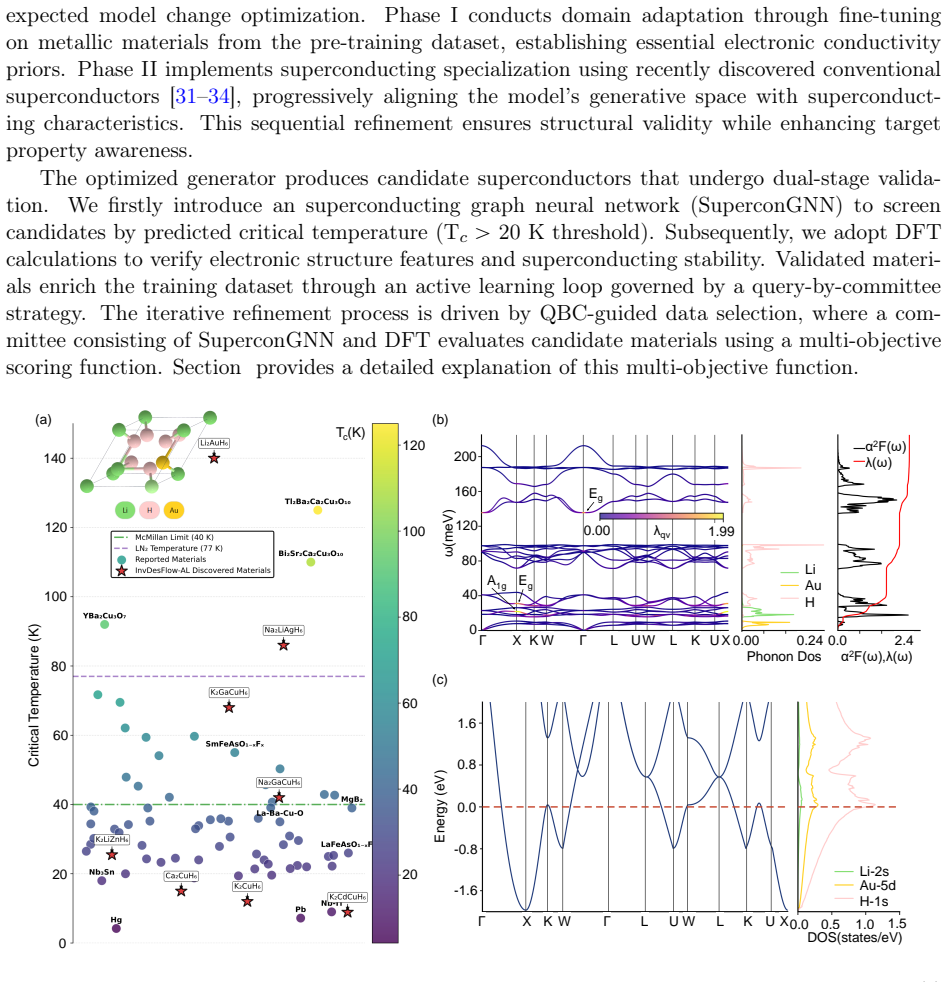
InvDesFlow-AL is an active-learning-driven generative framework that iteratively optimizes crystal generation toward desired performance metrics. On crystal structure prediction the model reaches an RMSE of 0.0423 Å, representing a 32.96 percent improvement over existing generative models. The framework systematically yields materials with lower formation energies and lower Ehull values while broadening chemical-space coverage. When applied to the search for BCS superconductors at ambient pressure, it identifies Li₂AuH₆ as a conventional superconductor with a transition temperature of 140 K.
What carries the argument
InvDesFlow-AL, the active-learning loop that feeds model-generated candidates back into an iterative refinement process to steer diffusion-based generation toward lower-energy or higher-performance structures.
If this is right
- The workflow can systematically generate materials whose formation energies decrease across successive active-learning iterations.
- Exploration reaches a wider range of chemical compositions while maintaining focus on low-Ehull candidates.
- The same active-learning strategy applies to the targeted search for conventional superconductors under ambient conditions.
- Validated low-formation-energy outputs demonstrate the framework's utility for inverse design of functional materials.
Where Pith is reading between the lines
- The iterative loop could be extended to additional target properties such as band gaps or catalytic activity without changing the core machinery.
- Coupling the generative loop with high-throughput experimental synthesis would test whether the predicted structures can be realized in the laboratory.
- The approach may reduce wasted computation by discarding low-quality candidates earlier in the generation cycle.
Load-bearing premise
The structures produced by successive active-learning rounds are genuinely new and stable, and their formation energies plus superconducting properties are verified by independent calculations rather than being artifacts of the generative model itself.
What would settle it
Independent first-principles calculations that either confirm or refute a superconducting transition temperature near 140 K for the proposed Li₂AuH₆ structure at zero external pressure.
Figures






read the original abstract
Developing inverse design methods for functional materials with specific properties is critical to advancing fields like renewable energy, catalysis, energy storage, and carbon capture. Generative models based on diffusion principles can directly produce new materials that meet performance constraints, thereby significantly accelerating the material design process. However, existing methods for generating and predicting crystal structures often remain limited by low success rates. In this work, we propose a novel inverse material design generative framework called InvDesFlow-AL, which is based on active learning strategies. This framework can iteratively optimize the material generation process to gradually guide it towards desired performance characteristics. In terms of crystal structure prediction, the InvDesFlow-AL model achieves an RMSE of 0.0423 {\AA}, representing an 32.96% improvement in performance compared to exsisting generative models. Additionally, InvDesFlow-AL has been successfully validated in the design of low-formation-energy and low-Ehull materials. It can systematically generate materials with progressively lower formation energies while continuously expanding the exploration across diverse chemical spaces. These results fully demonstrate the effectiveness of the proposed active learning-driven generative model in accelerating material discovery and inverse design. To further prove the effectiveness of this method, we took the search for BCS superconductors under ambient pressure as an example explored by InvDesFlow-AL. As a result, we successfully identified Li\(_2\)AuH\(_6\) as a conventional BCS superconductor with an ultra-high transition temperature of 140 K. This discovery provides strong empirical support for the application of inverse design in materials science.
Editorial analysis
A structured set of objections, weighed in public.
Referee Report
Summary. The paper introduces InvDesFlow-AL, an active-learning-augmented diffusion-based generative framework for inverse design of crystal structures and functional materials. It reports an RMSE of 0.0423 Å for crystal structure prediction (32.96% improvement over existing generative models), successful generation of progressively lower-formation-energy and low-Ehull materials across chemical spaces, and the discovery of Li₂AuH₆ as a conventional BCS superconductor with a transition temperature of 140 K at ambient pressure.
Significance. If the performance metrics and the superconductor identification are supported by independent first-principles validation, the work could offer a useful demonstration of active learning for guiding generative models toward targeted material properties. The approach of iteratively refining generation toward low-energy and functional criteria addresses a recognized challenge in materials inverse design, though its incremental advance over prior diffusion and active-learning methods in the field remains to be quantified with fuller benchmarks.
major comments (3)
- [Superconductor results section] Superconductor results section: The claim that Li₂AuH₆ is a BCS superconductor with Tc = 140 K under ambient pressure must be accompanied by explicit documentation of the independent post-generation calculations (DFT formation energies, DFPT phonon spectra for dynamical stability, and Eliashberg or McMillan equations for Tc). If these properties are evaluated only via the generative model, surrogate, or training-distribution reuse, the result is at risk of circularity and cannot substantiate an independent discovery.
- [Crystal structure prediction results] Crystal structure prediction results: The reported RMSE of 0.0423 Å and 32.96% improvement are presented without naming the baseline generative models, the exact test dataset or split, validation protocol, or statistical error bars. These omissions prevent assessment of whether the improvement is load-bearing for the central performance claim.
- [Active-learning workflow description] Active-learning workflow description: The manuscript must clarify how the active-learning loop selects candidates, what surrogate is used for property feedback, and evidence that newly generated structures lie outside the original training distribution and receive separate first-principles evaluation rather than post-hoc selection of already-favored low-energy candidates.
minor comments (2)
- [Abstract] Abstract contains the typo 'exsisting' (should be 'existing').
- [Figures and methods] Ensure all figures include error bars where quantitative comparisons are shown and that method sections provide sufficient detail for reproducibility of the active-learning iterations.
Simulated Author's Rebuttal
We thank the referee for the constructive and detailed comments, which have helped us improve the clarity and rigor of the manuscript. We address each major comment point by point below and have revised the manuscript accordingly to provide the requested documentation and clarifications.
read point-by-point responses
-
Referee: [Superconductor results section] Superconductor results section: The claim that Li₂AuH₆ is a BCS superconductor with Tc = 140 K under ambient pressure must be accompanied by explicit documentation of the independent post-generation calculations (DFT formation energies, DFPT phonon spectra for dynamical stability, and Eliashberg or McMillan equations for Tc). If these properties are evaluated only via the generative model, surrogate, or training-distribution reuse, the result is at risk of circularity and cannot substantiate an independent discovery.
Authors: We thank the referee for emphasizing the need to demonstrate independence from the generative process. The Li₂AuH₆ candidate was first produced by InvDesFlow-AL and then subjected to fully independent post-generation first-principles calculations: DFT relaxation and formation-energy evaluation with VASP (PBE functional, 520 eV cutoff), DFPT phonon calculations confirming dynamical stability (no imaginary modes), and solution of the Eliashberg equations within the McMillan framework to obtain Tc = 140 K. These steps used standard external codes and were not derived from the diffusion model, surrogate, or training-set reuse. In the revised manuscript we have expanded the superconductor section with a dedicated paragraph describing the computational parameters, convergence criteria, and key results (including phonon dispersion plots and the Eliashberg spectral function), with additional numerical data placed in the Supplementary Information. revision: yes
-
Referee: [Crystal structure prediction results] Crystal structure prediction results: The reported RMSE of 0.0423 Å and 32.96% improvement are presented without naming the baseline generative models, the exact test dataset or split, validation protocol, or statistical error bars. These omissions prevent assessment of whether the improvement is load-bearing for the central performance claim.
Authors: We agree that these methodological details are necessary for proper evaluation. The revised manuscript now explicitly names the baseline models (CDVAE and DiffCSP), specifies the test set as a random 10 % hold-out from the MP-20 subset of the Materials Project (with an 80/10/10 train/validation/test split), describes the validation protocol as five-fold cross-validation, and reports statistical error bars obtained from five independent training runs (RMSE = 0.0423 ± 0.0018 Å). A new comparison table has been added to the results section to document the 32.96 % improvement relative to the strongest baseline. revision: yes
-
Referee: [Active-learning workflow description] Active-learning workflow description: The manuscript must clarify how the active-learning loop selects candidates, what surrogate is used for property feedback, and evidence that newly generated structures lie outside the original training distribution and receive separate first-principles evaluation rather than post-hoc selection of already-favored low-energy candidates.
Authors: We have substantially expanded the Methods section to describe the active-learning workflow in detail. Candidate selection is performed via uncertainty sampling (highest predictive variance) from a graph-neural-network surrogate trained on formation energies. We now provide explicit evidence that newly generated structures lie outside the original training distribution, including a t-SNE embedding of compositional and structural descriptors and a quantitative diversity metric showing separation from the training set. All structures advanced to the final reported results were re-evaluated with independent DFT calculations for formation energy and Ehull; the surrogate was used only for selection, not for the final property values. A flowchart and pseudocode of the iterative loop have been added for clarity. revision: yes
Circularity Check
No circularity: claims rest on external validation steps outside the generative loop
full rationale
The provided abstract and context describe a generative diffusion model augmented by active learning that produces candidate structures, followed by separate reporting of formation energies, Ehull, and superconducting Tc values. No equations, sections, or self-citations are shown that define the target property in terms of the model's own output or that rename a fitted surrogate as an independent prediction. The 140 K claim is presented as a downstream result of the workflow rather than a quantity computed inside the generative or active-learning loop itself. Without any quoted reduction of the form 'property P equals model output M by construction,' the derivation chain remains non-circular and self-contained against external first-principles benchmarks.
Axiom & Free-Parameter Ledger
Lean theorems connected to this paper
-
IndisputableMonolith/Cost/FunctionalEquation.leanwashburn_uniqueness_aczel unclear?
unclearRelation between the paper passage and the cited Recognition theorem.
InvDesFlow-AL is a active learning-based diffusion model... multi-objective scoring function... SuperconGNN... DFT calculations to verify... Eliashberg spectral function α²F(ω) and ... λ = 2.84
-
IndisputableMonolith/Foundation/RealityFromDistinction.leanreality_from_one_distinction unclear?
unclearRelation between the paper passage and the cited Recognition theorem.
RMSE of 0.0423 Å... 1,598,551 materials with Ehull < 50 meV... Li₂AuH₆ ... 140 K
What do these tags mean?
- matches
- The paper's claim is directly supported by a theorem in the formal canon.
- supports
- The theorem supports part of the paper's argument, but the paper may add assumptions or extra steps.
- extends
- The paper goes beyond the formal theorem; the theorem is a base layer rather than the whole result.
- uses
- The paper appears to rely on the theorem as machinery.
- contradicts
- The paper's claim conflicts with a theorem or certificate in the canon.
- unclear
- Pith found a possible connection, but the passage is too broad, indirect, or ambiguous to say the theorem truly supports the claim.
Forward citations
Cited by 1 Pith paper
-
HTSC-2025: A Benchmark Dataset of Ambient-Pressure High-Temperature Superconductors for AI-Driven Critical Temperature Prediction
HTSC-2025 is a publicly released benchmark dataset aggregating theoretically predicted ambient-pressure high-Tc superconductors from recent BCS-based studies for training and comparing AI models that predict critical ...
Reference graph
Works this paper leans on
-
[1]
Schoenholz, Muratahan Aykol, Gowoon Cheon, and Ekin Dogus Cubuk
Amil Merchant, Simon Batzner, Samuel S. Schoenholz, Muratahan Aykol, Gowoon Cheon, and Ekin Dogus Cubuk. Scaling deep learning for materials discovery.Nature, 624(7990):80–85, 2023
work page 2023
-
[2]
A generative model for inorganic materials design.Nature, 2025
Claudio Zeni, Robert Pinsler, Daniel Zügner, Andrew Fowler, Matthew Horton, Xiang Fu, Zilong Wang, Aliaksandra Shysheya, Jonathan Crabbé, Shoko Ueda, Roberto Sordillo, Lixin Sun, Jake Smith, Bichlien Nguyen, Hannes Schulz, Sarah Lewis, Chin-Wei Huang, Ziheng Lu, Yichi Zhou, Han Yang, Hongxia Hao, Jielan Li, Chunlei Yang, Wenjie Li, Ryota Tomioka, and Tian...
work page 2025
-
[3]
Aqueous-based recycling of perovskite photovoltaics.Nature, 2025
Xun Xiao, Niansheng Xu, Xueyu Tian, Tiankai Zhang, Bingzheng Wang, Xiaoming Wang, Yeming Xian, Chunyuan Lu, Xiangyu Ou, Yanfa Yan, Licheng Sun, Fengqi You, and Feng Gao. Aqueous-based recycling of perovskite photovoltaics.Nature, 2025
work page 2025
-
[4]
Signatures of superconductivity near 80 k in a nickelate under high pressure
Hualei Sun, Mengwu Huo, Xunwu Hu, Jingyuan Li, Zengjia Liu, Yifeng Han, Lingyun Tang, Zhongquan Mao, Pengtao Yang, Bosen Wang, Jinguang Cheng, Dao-Xin Yao, Guang-Ming Zhang, and Meng Wang. Signatures of superconductivity near 80 k in a nickelate under high pressure. Nature, 621(7979):493–498, 2023
work page 2023
-
[5]
Ambient-pressure superconduc- tivity onset above 40 k in (la,pr)3ni2o7 films.Nature, 2025
Guangdi Zhou, Wei Lv, Heng Wang, Zihao Nie, Yaqi Chen, Yueying Li, Haoliang Huang, Weiqiang Chen, Yujie Sun, Qi-Kun Xue, and Zhuoyu Chen. Ambient-pressure superconduc- tivity onset above 40 k in (la,pr)3ni2o7 films.Nature, 2025
work page 2025
-
[6]
Shielding pt/γ mo2n by inert nano- overlays enables stable h2 production.Nature, 2025
Zirui Gao, Aowen Li, Xingwu Liu, Mi Peng, Shixiang Yu, Maolin Wang, Yuzhen Ge, Chengyu Li, Tie Wang, Zhaohua Wang, Wu Zhou, and Ding Ma. Shielding pt/γ mo2n by inert nano- overlays enables stable h2 production.Nature, 2025
work page 2025
-
[7]
Two-dimensional czochralski growth of single-crystal mos2
He Jiang, Xiankun Zhang, Kuanglei Chen, Xiaoyu He, Yihe Liu, Huihui Yu, Li Gao, Mengyu Hong, Yunan Wang, Zheng Zhang, and Yue Zhang. Two-dimensional czochralski growth of single-crystal mos2. Nature Materials, 24(2):188–196, 2025
work page 2025
-
[8]
Implantable batteries for bioelectronics.Accounts of Materials Research, 1:1–6, 2025
Yiding Jiao, Er He, Tingting Ye, Yuanzhen Wang, Haotian Yin, and Ye Zhang. Implantable batteries for bioelectronics.Accounts of Materials Research, 1:1–6, 2025
work page 2025
-
[9]
Kamal Choudhary and Kevin Garrity. Designing high-tc superconductors with bcs-inspired screening, density functional theory, and deep-learning.NPJ Comput. Mater., 8(1):244, 2022
work page 2022
-
[10]
OpenAI, Josh Achiam, and Steven Adler. Gpt-4 technical report, 2024. 18
work page 2024
-
[11]
Luis M. Antunes, Keith T. Butler, and Ricardo Grau-Crespo. Crystal structure generation with autoregressive large language modeling.Nature Communications, 15(1):10570, 2024
work page 2024
-
[12]
Ai-driven inverse design of materials: Past, present and future.Chinese Physics Letters, 2025
Xiao-Qi Han, Xin-De Wang, Meng-Yuan Xu, Zhen Feng, Bo-Wen Yao, Peng-Jie Guo, Ze-Feng Gao, and Zhong-Yi Lu. Ai-driven inverse design of materials: Past, present and future.Chinese Physics Letters, 2025
work page 2025
-
[13]
A survey of geometric graph neural networks: Data structures, models and applications, 2024
Jiaqi Han, Jiacheng Cen, Liming Wu, Zongzhao Li, Xiangzhe Kong, Rui Jiao, Ziyang Yu, Tingyang Xu, Fandi Wu, Zihe Wang, Hongteng Xu, Zhewei Wei, Yang Liu, Yu Rong, and Wenbing Huang. A survey of geometric graph neural networks: Data structures, models and applications, 2024
work page 2024
-
[14]
Denoising diffusion probabilistic models, 2020
Jonathan Ho, Ajay Jain, and Pieter Abbeel. Denoising diffusion probabilistic models, 2020
work page 2020
-
[15]
Kingma, Abhishek Kumar, Stefano Ermon, and Ben Poole
Yang Song, Jascha Sohl-Dickstein, Diederik P. Kingma, Abhishek Kumar, Stefano Ermon, and Ben Poole. Score-based generative modeling through stochastic differential equations.ICLR, 2021
work page 2021
-
[16]
Crystal structure prediction by joint equivariant diffusion on lattices and fractional coordinates
Rui Jiao, Wenbing Huang, Peijia Lin, Jiaqi Han, Pin Chen, Yutong Lu, and Yang Liu. Crystal structure prediction by joint equivariant diffusion on lattices and fractional coordinates. In Workshop on ”Machine Learning for Materials” ICLR 2023, 2023
work page 2023
-
[17]
Cai-YuanYe, Hong-MingWeng, andQuan-ShengWu. Con-cdvae: Amethodfortheconditional generation of crystal structures.Computational Materials Today, 1:100003, May 2024
work page 2024
-
[18]
Invdesflow: An ai search engine to explore possible high-temperature superconductors, 2024
Xiao-Qi Han, Zhenfeng Ouyang, Peng-Jie Guo, Hao Sun, Ze-Feng Gao, and Zhong-Yi Lu. Invdesflow: An ai search engine to explore possible high-temperature superconductors, 2024
work page 2024
-
[19]
Dilanga Siriwardane, Zhenyao Wu, Nihang Fu, Mohammed Al- Fahdi, Ming Hu, and Jianjun Hu
Yong Zhao, Edirisuriya M. Dilanga Siriwardane, Zhenyao Wu, Nihang Fu, Mohammed Al- Fahdi, Ming Hu, and Jianjun Hu. Physics guided deep learning for generative design of crystal materials with symmetry constraints.npj Computational Materials, 9(1):38, 2023
work page 2023
-
[20]
Crystal diffusion variational autoencoder for periodic material generation
Tian Xie, Xiang Fu, Octavian-Eugen Ganea, Regina Barzilay, and Tommi S Jaakkola. Crystal diffusion variational autoencoder for periodic material generation. InInternational Conference on Learning Representations, 2021
work page 2021
-
[21]
Hu, Yelong Shen, Phillip Wallis, Zeyuan Allen-Zhu, Yuanzhi Li, Shean Wang, Lu Wang, and Weizhu Chen
Edward J. Hu, Yelong Shen, Phillip Wallis, Zeyuan Allen-Zhu, Yuanzhi Li, Shean Wang, Lu Wang, and Weizhu Chen. Lora: Low-rank adaptation of large language models, 2021
work page 2021
-
[22]
Parameter-efficient transfer learning for nlp, 2019
Neil Houlsby, Andrei Giurgiu, Stanislaw Jastrzebski, Bruna Morrone, Quentin de Laroussilhe, Andrea Gesmundo, Mona Attariyan, and Sylvain Gelly. Parameter-efficient transfer learning for nlp, 2019
work page 2019
-
[23]
Learning multiple visual domains with residual adapters, 2017
Sylvestre-Alvise Rebuffi, Hakan Bilen, and Andrea Vedaldi. Learning multiple visual domains with residual adapters, 2017
work page 2017
-
[24]
Anubhav Jain, Joseph Montoya, Shyam Dwaraknath, Nils E. R. Zimmermann, John Dagdelen, Matthew Horton, Patrick Huck, Donny Winston, Shreyas Cholia, Shyue Ping Ong, and Kristin Persson. The materials project: Accelerating materials design through theory-driven data and tools. In Handbook of Materials Modeling: Methods: Theory and Modeling, pages 1751–1784. ...
work page 2020
-
[25]
Dpa-2: a large atomic model as a multi-task learner
Duo Zhang, Xinzijian Liu, Xiangyu Zhang, et al. Dpa-2: a large atomic model as a multi-task learner. npj Computational Materials, 10(1):293, 2024
work page 2024
-
[26]
Xiao-Qi Han, Zhenfeng Ouyang, Peng-Jie Guo, Hao Sun, Ze-Feng Gao, and Zhong-Yi Lu. Invdesflow: Anai-drivenmaterialsinversedesignworkflowtoexplorepossiblehigh-temperature superconductors. Chin. Phys. Lett., 42(4):047301, 2025
work page 2025
-
[27]
A. P. Drozdov, M. I. Eremets, I. A. Troyan, V. Ksenofontov, and S. I. Shylin. Conven- tional superconductivity at 203 kelvin at high pressures in the sulfur hydride system.Nature, 525(7567):73–76, 2015
work page 2015
-
[28]
A. P. Drozdov, P. P. Kong, V. S. Minkov, S. P. Besedin, M. A. Kuzovnikov, S. Mozaffari, L. Balicas, F. F. Balakirev, D. E. Graf, V. B. Prakapenka, E. Greenberg, D. A. Knyazev, M. Tkacz, and M. I. Eremets. Superconductivity at 250 k in lanthanum hydride under high pressures. Nature, 569(7757):528–531, 2019
work page 2019
-
[29]
Maddury Somayazulu, Muhtar Ahart, Ajay K. Mishra, Zachary M. Geballe, Maria Baldini, Yue Meng, Viktor V. Struzhkin, and Russell J. Hemley. Evidence for superconductivity above 260 k in lanthanum superhydride at megabar pressures.Phys. Rev. Lett., 122:027001, Jan 2019
work page 2019
-
[30]
Hemley, Changfeng Chen, and Yanming Ma
Xin Zhong, Ying Sun, Toshiaki Iitaka, Meiling Xu, Hanyu Liu, Russell J. Hemley, Changfeng Chen, and Yanming Ma. Prediction of above-room-temperature superconductivity in lanthanide/actinide extreme superhydrides. Journal of the American Chemical Society , 144(29):13394–13400, 07 2022
work page 2022
-
[31]
Antonio Sanna, Tiago F. T. Cerqueira, Yue-Wen Fang, Ion Errea, Alfred Ludwig, and Miguel A. L. Marques. Prediction of ambient pressure conventional superconductivity above 80 k in hydride compounds. npj Computational Materials, 10(1):44, 02 2024
work page 2024
-
[34]
Feng Zheng, Zhen Zhang, Zepeng Wu, Shunqing Wu, Qiubao Lin, Renhai Wang, Yimei Fang, Cai-Zhuang Wang, Vladimir Antropov, Yang Sun, and Kai-Ming Ho. Prediction of ambient pressure superconductivity in cubic ternary hydrides with mh6 octahedra.Materials Today Physics, 42:101374, 2024
work page 2024
-
[35]
Zhenfeng Ouyang, Bo-Wen Yao, Xiao-Qi Han, Peng-Jie Guo, Ze-Feng Gao, and Zhong-Yi Lu. High-temperature superconductivity in li2auh6 mediated by strong electron-phonon coupling under ambient pressure.Phys. Rev. B, 111:L140501, Apr 2025
work page 2025
-
[36]
Equivariant diffusion for crystal structure prediction
Peijia Lin, Pin Chen, Rui Jiao, Qing Mo, Cen Jianhuan, Wenbing Huang, Yang Liu, Dan Huang, and Yutong Lu. Equivariant diffusion for crystal structure prediction. In Ruslan Salakhutdinov, Zico Kolter, Katherine Heller, Adrian Weller, Nuria Oliver, Jonathan Scarlett, and Felix Berkenkamp, editors,Proceedings of the 41st International Conference on Machine L...
work page 2024
-
[37]
Inverse design of 3d molecular structures with conditional generative neural networks
Niklas WA Gebauer, Michael Gastegger, Stefaan SP Hessmann, Klaus-Robert Müller, and Kristof T Schütt. Inverse design of 3d molecular structures with conditional generative neural networks. Nature communications, 13(1):1–11, 2022
work page 2022
-
[38]
Wyatt, Srinivasa Kartik Nemani, Gregory E
Brian C. Wyatt, Srinivasa Kartik Nemani, Gregory E. Hilmas, Elizabeth J. Opila, and Babak Anasori. Ultra-high temperature ceramics for extreme environments.Nature Reviews Materials, 9(11):773–789, 2024
work page 2024
-
[39]
Tantalum diboride obtained by reactive sintering–properties and wear resis- tance
Lucyna Jaworska. Tantalum diboride obtained by reactive sintering–properties and wear resis- tance. DEStech Transactions on Environment, Energy and Earth Science, 2016
work page 2016
-
[40]
Xiaohong Zhang, Gregory Hilmas, and William Fahrenholtz. Synthesis, densification, and mechanical properties of tab2.Materials Letters - MATER LETT, 62:4251–4253, 10 2008
work page 2008
-
[41]
Yutai Katoh, Gokul Vasudevamurthy, Takashi Nozawa, and Lance L. Snead. Properties of zirconium carbide for nuclear fuel applications.Journal of Nuclear Materials, 441(1-3):718– 742, October 2013
work page 2013
-
[42]
New design for highly durable infrared-reflective coatings
Chaoquan Hu, Jian Liu, Jianbo Wang, Zhiqing Gu, Chao Li, Qian Li, Yuankai Li, Sam Zhang, Chaobin Bi, Xiaofeng Fan, and Weitao Zheng. New design for highly durable infrared-reflective coatings. Light: Science & Applications, 7(4):17175, April 2018
work page 2018
-
[43]
Jonathan Schmidt, Tiago F.T. Cerqueira, Aldo H. Romero, Antoine Loew, Fabian Jäger, Hai- Chen Wang, Silvana Botti, and Miguel A.L. Marques. Improving machine-learning models in materials science through large datasets.Materials Today Physics, 48:101560, 2024
work page 2024
-
[44]
E(n) equivariant graph neural networks, 2022
Victor Garcia Satorras, Emiel Hoogeboom, and Max Welling. E(n) equivariant graph neural networks, 2022
work page 2022
-
[45]
Josh Abramson, Jonas Adler, Jack Dunger, and Richard Evans. Accurate structure prediction of biomolecular interactions with alphafold 3.Nature, 630(8016):493–500, 2024
work page 2024
-
[46]
Deep-learning electronic-structure calculation of magnetic superstructures
He Li, Zechen Tang, Xiaoxun Gong, Nianlong Zou, Wenhui Duan, and Yong Xu. Deep-learning electronic-structure calculation of magnetic superstructures. Nature Computational Science, 3(4):321–327, 2023
work page 2023
-
[47]
Kun Gao, Tiago F. T. Cerqueira, Antonio Sanna, Yue-Wen Fang, Ðorđe Dangić, Ion Errea, Hai-Chen Wang, Silvana Botti, and Miguel A. L. Marques. The maximumtc of conventional superconductors at ambient pressure, 2025
work page 2025
-
[48]
Application-oriented design of machine learning paradigms for battery science
Ying Wang. Application-oriented design of machine learning paradigms for battery science. npj Computational Materials, 11(1):89, 2025
work page 2025
-
[49]
Linming Zhou, Archie Mingze Yao, Yongjun Wu, Ziyi Hu, Yuhui Huang, and Zijian Hong. Machine learning assisted prediction of cathode materials for zn-ion batteries.Advanced Theory and Simulations, 4(9):2100196, 2021
work page 2021
-
[50]
Panpan Zhou, Qianwen Zhou, Xuezhang Xiao, Xiulin Fan, Yongjin Zou, Lixian Sun, Jinghua Jiang, Dan Song, and Lixin Chen. Machine learning in solid-state hydrogen storage materials: Challenges and perspectives.Advanced Materials, 37(6):2413430, 2025. 21
work page 2025
-
[51]
Xiaoyue Zhang, Shunlong Ju, Chaoqun Li, Jiazheng Hao, Yahui Sun, Xuechun Hu, Wei Chen, Jie Chen, Lunhua He, Guanglin Xia, Fang Fang, Dalin Sun, and Xuebin Yu. Atomic recon- struction for realizing stable solar-driven reversible hydrogen storage of magnesium hydride. Nature Communications, 15(1):2815, 2024
work page 2024
-
[52]
Yufei Hao, Shixin Zhang, Bin Fang, Fuchun Sun, Huaping Liu, and Haiyuan Li. A review of smart materials for the boost of soft actuators, soft sensors, and robotics applications.Chinese Journal of Mechanical Engineering, 35(1):37, 2022
work page 2022
-
[53]
Diffdock: Diffusion steps, twists, and turns for molecular docking, 2023
Gabriele Corso, Hannes Stärk, Bowen Jing, Regina Barzilay, and Tommi Jaakkola. Diffdock: Diffusion steps, twists, and turns for molecular docking, 2023
work page 2023
-
[54]
Nathaniel Thomas, Tess Smidt, Steven Kearnes, Lusann Yang, Li Li, Kai Kohlhoff, and Patrick Riley. Tensor field networks: Rotation- and translation-equivariant neural networks for 3d point clouds, 2018
work page 2018
-
[55]
e3nn: Euclidean neural networks, 2022
Mario Geiger and Tess Smidt. e3nn: Euclidean neural networks, 2022
work page 2022
-
[56]
Torsional diffusion for molecular conformer generation, 2023
Bowen Jing, Gabriele Corso, Jeffrey Chang, Regina Barzilay, and Tommi Jaakkola. Torsional diffusion for molecular conformer generation, 2023
work page 2023
-
[57]
Kamal Choudhary and Kevin Garrity. Designing high-tc superconductors with bcs-inspired screening, density functional theory, and deep-learning.npj Computational Materials, 8(1):244, 2022
work page 2022
-
[58]
Tiago F. T. Cerqueira, Yue-Wen Fang, Ion Errea, Antonio Sanna, and Miguel A. L. Mar- ques. Searching materials space for hydride superconductors at ambient pressure.Advanced Functional Materials, 34(40):2404043, 2024
work page 2024
-
[59]
Conway, Christoph Heil, Timothy A
Kapildeb Dolui, Lewis J. Conway, Christoph Heil, Timothy A. Strobel, Rohit P. Prasankumar, and Chris J. Pickard. Feasible route to high-temperature ambient-pressure hydride supercon- ductivity. Phys. Rev. Lett., 132:166001, Apr 2024
work page 2024
-
[60]
Antonio Sanna, Tiago F. T. Cerqueira, Yue-Wen Fang, Ion Errea, Alfred Ludwig, and Miguel A. L. Marques. Prediction of ambient pressure conventional superconductivity above 80 k in hydride compounds. npj Computational Materials, 10(1):44, 2024
work page 2024
-
[61]
Deepseek-r1: Incentivizing reasoning capability in llms via reinforcement learning, 2025
DeepSeek-AI, Daya Guo, and Dejian Yang. Deepseek-r1: Incentivizing reasoning capability in llms via reinforcement learning, 2025
work page 2025
-
[62]
Long Ouyang, Jeff Wu, Xu Jiang, Diogo Almeida, Carroll L. Wainwright, Pamela Mishkin, Chong Zhang, Sandhini Agarwal, Katarina Slama, Alex Ray, John Schulman, Jacob Hilton, Fraser Kelton, Luke Miller, Maddie Simens, Amanda Askell, Peter Welinder, Paul Christiano, Jan Leike, and Ryan Lowe. Training language models to follow instructions with human feedback, 2022
work page 2022
-
[63]
Proximal policy optimization algorithms, 2017
John Schulman, Filip Wolski, Prafulla Dhariwal, Alec Radford, and Oleg Klimov. Proximal policy optimization algorithms, 2017
work page 2017
-
[64]
Rafael Rafailov, Archit Sharma, Eric Mitchell, Stefano Ermon, Christopher D. Manning, and Chelsea Finn. Direct preference optimization: Your language model is secretly a reward model, 2024. 22
work page 2024
-
[65]
QUANTUMESPRESSO:amodularandopen-sourcesoft- ware project for quantum simulations of materials.J
Paolo Giannozzi, Stefano Baroni, Nicola Bonini, Matteo Calandra, Roberto Car, Carlo Cavaz- zoni, Davide Ceresoli, Guido L Chiarotti, Matteo Cococcioni, Ismaila Dabo, Andrea Dal Corso, Stefano de Gironcoli, Stefano Fabris, Guido Fratesi, Ralph Gebauer, Uwe Gerstmann, Christos Gougoussis, Anton Kokalj, Michele Lazzeri, Layla Martin-Samos, Nicola Marzari, Fr...
work page 2009
-
[66]
Perdew, Kieron Burke, and Matthias Ernzerhof
John P. Perdew, Kieron Burke, and Matthias Ernzerhof. Generalized Gradient Approximation Made Simple. Phys. Rev. Lett., 77:3865–3868, Oct 1996
work page 1996
-
[67]
D. R. Hamann. Optimized norm-conserving Vanderbilt pseudopotentials. Phys. Rev. B, 88:085117, Aug 2013
work page 2013
-
[68]
M. Methfessel and A. T. Paxton. High-precision sampling for Brillouin-zone integration in metals. Phys. Rev. B, 40:3616–3621, Aug 1989
work page 1989
-
[69]
Phonons and relatedcrystalpropertiesfromdensity-functionalperturbationtheory
Stefano Baroni, Stefano de Gironcoli, Andrea Dal Corso, and Paolo Giannozzi. Phonons and relatedcrystalpropertiesfromdensity-functionalperturbationtheory. Rev. Mod. Phys., 73:515– 562, Jul 2001
work page 2001
-
[70]
S. Poncé, E.R. Margine, C. Verdi, and F. Giustino. EPW: Electron–phonon coupling, transport and superconducting properties using maximally localized Wannier functions. Comp. Phy. Commun., 209:116–133, 2016
work page 2016
-
[71]
Wannier90 as a community code: new features and applications.J
GiovanniPizzi, ValerioVitale, RyotaroArita, StefanBlügel, FrankFreimuth, GuillaumeGéran- ton, Marco Gibertini, Dominik Gresch, Charles Johnson, Takashi Koretsune, Julen Ibañez- Azpiroz, Hyungjun Lee, Jae-Mo Lihm, Daniel Marchand, Antimo Marrazzo, Yuriy Mokrousov, Jamal I Mustafa, Yoshiro Nohara, Yusuke Nomura, Lorenzo Paulatto, Samuel Poncé, Thomas Ponwei...
work page 2020
discussion (0)
Sign in with ORCID, Apple, or X to comment. Anyone can read and Pith papers without signing in.