REVIEW 4 major objections 5 minor 50 references
Few-Shot Anomaly-Driven Generation for Anomaly Classification and Segmentation
T0 review · 4 major / 5 minor · reviewed 2026-08-15 · deepseek-v4-flash
Pith's one-line read AnoGen learns a 768-parameter anomaly embedding from three real defects; generated images lift DRAEM segmentation AU-PR from 67.4 to 73.2.
desk verdict Read this for the evaluation protocol, not for the diffusion novelty: the pipeline is clean, but the headline AU-PR gains rest on a support-set selection that likely leaks MVTec test data into training. read the letter →
The pith
A machine-rendered reading of the paper's core claim, the machinery that carries it, and where it could break.
The reading
What carries the argument
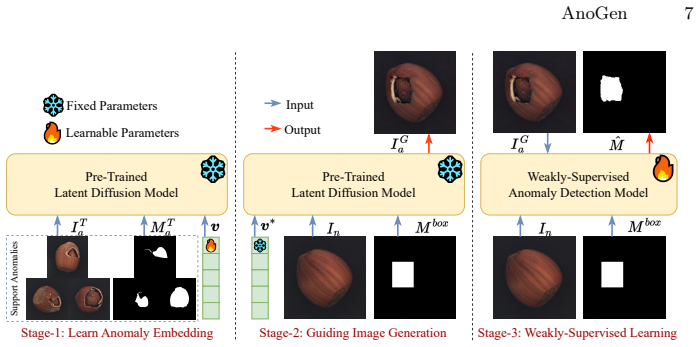
The load-bearing object is a 768-dimensional embedding $v$, initialized from the CLIP text embedding of the word 'defect' and optimized with a mask-weighted latent-diffusion noise-prediction loss. It carries the anomaly concept into the frozen network via cross-attention, and the bounding-box inpainting (Eq. 7) gives spatial control and a free weak label. The weak-supervision loss (Eq. 9) with confidence filter $\delta$ prevents normal pixels inside the box from being trained as anomalies. The pre-trained latent diffusion model itself is a denoising network whose weights are never updated, so the only learnable parameters in the generation stage are those of the embedding.
What would settle it
Re-run the Table 1 experiment with support anomalies drawn only from a held-out partition of MVTec test anomalies, so that the evaluated images cannot appear in the embedding-learning set, and check whether DRAEM's pixel AU-PR still rises from 67.4 to 73.2; if the gain shrinks toward noise, the effect depends on test leakage.
Extended reading notes
Core claim
On MVTec, the paper shows that the anomaly distribution of a defect type can be compressed into a single embedding $v$ by optimizing the latent diffusion noise-prediction loss over a few real anomaly images $I_a^T$ and their segmentation masks $M_a^T$: $v^* = \arg\min_v \mathbb{E}[\|(\epsilon - \epsilon_\theta(\mathcal{E}(I_a^T),t,v)) \odot M_a^T\|^2]$. The learned $v$ is then injected through cross-attention into a frozen pre-trained latent diffusion model; inpainting with Eq. (7) places the anomaly inside an arbitrary bounding box on a normal image. For the downstream model, the box is treated as a weak label, and the weakly-supervised loss $L'_{\rm seg} = M_{\rm box} \odot (1-\delta) \odot L_{\rm seg} + (1-M_{\rm box}) \odot L_{\rm seg}$ zeros out high-confidence normal predictions (predicted normal probability $\hat p \ge \tau=0.9$) inside the box. The paper's central discovery is that this combination—generated anomalies plus box supervision—simultaneously improves DRAEM's and DeSTSeg's image-level AU-ROC/AU-PR and pixel-level AU-ROC/AU-PR, with the largest absolute gain in pixel-level AU-PR: 67.4 to 73.2 for DRAEM and 76.6 to 78.1 for DeSTSeg.
Load-bearing premise
The central assumption is that the few support anomalies used to learn the embedding are not themselves evaluation images: MVTec's anomalous images live only in its test split, and the paper never states a rule for holding those images out, so the reported AU-PR gains could be inflated if test defects leak into the generation stage.
Editorial extensions
If this is right
- Generated anomalies improve both classification and segmentation of DRAEM and DeSTSeg on MVTec, with segmentation benefiting more (5.8pp vs 1.5pp pixel AU-PR).
- Using generated anomalies together with DRAEM's original DTD-based synthetic anomalies gives the best result (73.2 pixel AU-PR), rather than replacing the old synthetic data.
- Three support anomalies are nearly as good as five; one support image degrades diversity and downstream performance.
- Mask-guided embedding learning is necessary; without the mask the embedding captures the whole object and fails to generate the defect.
- The confidence threshold $\tau$ matters; $\tau=0.9$ balances ignoring normal pixels and learning anomalous pixels inside the box.
Reading between the lines
- Because the embedding is only 768 parameters and the diffusion backbone is frozen, the per-defect-type cost is small; one could generate counterfactual placements of the same defect on different normal objects to probe detector robustness without collecting new data.
- The weak-supervision loss (Eq. 9) is not specific to DRAEM or DeSTSeg; any pixel-level detector trained on box-annotated pseudo-anomalies could adopt the confident-normal filtering trick, so the recipe may generalize beyond the two architectures tested.
- The authors' stated limitation—bounding boxes rather than pixel masks—suggests a next step: use the generated images to bootstrap a refinement network that predicts dense masks from the box, removing the extra hyperparameter $\tau$.
Signed reviews
Editorial analysis
A structured set of objections, weighed in public.
Referee Report
Summary. The paper proposes AnoGen, a three-stage few-shot anomaly generation framework. In Stage 1, an embedding vector is learned by minimizing a masked diffusion loss (Eq. 6) on a few real anomaly images with their segmentation masks. In Stage 2, this embedding conditions a pre-trained latent diffusion model to inpaint anomalies into normal images at user-specified bounding-box locations. In Stage 3, the generated images and their bounding boxes are used to train DRAEM and DeSTSeg with a weakly supervised loss (Eq. 9) that suppresses loss for high-confidence normal pixels inside the box. Experiments on MVTec report consistent improvements for both models on image-level and pixel-level metrics, with the headline result being a 5.8 percentage-point improvement in pixel AU-PR for DRAEM (67.4 to 73.2) and 1.5 points for DeSTSeg (76.6 to 78.1). Ablations study support-set choice, number of support anomalies, mask-guided loss, confidence threshold tau, mixing with synthetic anomalies, and number of generated images N.
Significance. If the empirical claims hold, the paper would make a useful contribution: it demonstrates that a tiny learnable embedding (768 parameters) can inject a few-shot anomaly concept into a diffusion model and that the resulting generated anomalies can improve discriminative anomaly segmentation models. The method is simple, parameter-efficient, and the authors release code and generated data, which are concrete assets for reproducibility. The mask-guided embedding loss and the bounding-box weak-supervision loss are reasonable design choices that could be reused by other works. However, the significance is currently conditional on resolving the data-protocol question described in the major comments: because MVTec contains anomalous images only in its test split, the support set used for embedding learning may overlap with the evaluation set, which would make the reported gains partly an artifact of test-distribution leakage rather than genuine few-shot generation. The paper does not provide error bars, multiple-seed results, or a sensitivity analysis over support draws, so the robustness of the headline numbers is not established.
major comments (4)
- [5.1, Eq. (5)-(6), Table 1] The paper does not state how the three support anomalies selected in Section 5.1 relate to the MVTec test set used in Table 1. MVTec contains anomalous images only in its test split, so sampling '3 anomalous images from the real anomalies' draws directly from the evaluation distribution unless those images are explicitly held out. Because the embedding is optimized on these support anomalies (Eq. 5-6) and then used to generate training images, the evaluation on the same test set can reward memorization of test-set appearance. This is load-bearing for the central claim that generated anomalies improve DRAEM and DeSTSeg. Please specify the exact hold-out rule (e.g., per defect type, the support images are excluded from evaluation, or the generated set is ensured not to include test images) and, ideally, re-run the main comparison under a protocol where the support set is chosen before seeing any test images.
- [Abstract, Introduction, Table 1] The reported numbers are internally inconsistent. The abstract says DRAEM and DeSTSeg achieved a 5.8% and 1.5% improvement in AU-PR, which matches Table 1 (67.4 to 73.2 and 76.6 to 78.1, respectively). However, the introduction states that DRAEM improves 'from 67.4% to 76.6%' and DeSTSeg 'from 73.2% to 78.1%', which swaps the baseline values of the two methods. This discrepancy must be corrected, as it currently undermines trust in the reported results.
- [Table 2a, Section 5.1] Table 2a shows that different support sets change pixel AU-PR by 1.8 points (73.2 vs. 71.4), which is larger than the reported DeSTSeg improvement of 1.5 points. No variance over support draws is reported, and the main experiment uses a single randomly drawn support set. Please report mean and standard deviation over multiple support-set draws, and state how many draws were used for the main numbers in Table 1.
- [Table 3, Section 6.2] The confidence threshold tau is selected on the test set: Table 3 reports results for tau = 1.0, 0.95, 0.90, 0.80 and the best value (0.90, with 73.2 AU-PR) is used for the main comparison. Since tau is a hyperparameter of the proposed weak-supervision loss, tuning it on the evaluation set can inflate the reported improvement. Please either fix tau without looking at test performance or perform selection on a validation split and report the resulting test numbers.
minor comments (5)
- [Abstract and full text] There are multiple typos and inconsistent name spellings: 'DseTSeg', 'DesTSeg', and 'DeSTSeg' are all used; 'addnosing' should be 'adding noise' in Section 3. These should be unified and corrected.
- [Table 2b] The entry '70.5.' for the 1-shot pixel AU-PR contains a stray period; this is presumably '70.5' and should be cleaned.
- [Figure 5] The x-axis of Figure 5 is labeled 'N' but the caption does not clarify whether N is the number of generated images per object per anomaly type or another quantity. Please make the axis label and caption explicit.
- [Section 4.2, Eq. (7)] The inpainting update in Eq. (7) is described as replacing the area outside the box with a noisy version of the input, but the formula conditions on a bounding-box mask Mbox that is not explicitly defined as binary. Please define the mask convention (0/1 for inside/outside the box) so that the equation is unambiguous.
- [References] Reference [42] is cited for the pre-trained LDM but points to a CVPR 2018 paper on conditional GANs ('High-resolution image synthesis and semantic manipulation with conditional GANs'). This appears to be the wrong reference; please cite the actual latent diffusion model paper.
Circularity Check
Table 1 AU-PR gains are partly circular: support anomalies are sampled from MVTec's real anomalies (test split) without a stated hold-out, and the embedding fit to them (Eq. 5-6) is then evaluated on the same split.
-
fitted input called prediction
[Section 5.1 (Implementation Details), Eq. (5)-(6), Table 1]
"In the stage of learning v, we randomly select 3 anomalous images from the real anomalies to be the support anomalies."
The embedding v is optimized by Eq. (5) on the support anomalies I_T^a and by Eq. (6) on their masks. The paper states only that the support anomalies are 'real anomalies' from MVTec; MVTec AD provides anomalous images exclusively in the test split. Thus the fitted embedding encodes appearance from the evaluation set. Stage 2 then generates training anomalies using v*, and Table 1 evaluates DRAEM/DeSTSeg on the same MVTec test split. The reported pixel AU-PR gains (67.4 to 73.2, 76.6 to 78.1) therefore partly measure the model's retention of test-set information injected through Eq. 5-6 rather than independent few-shot generalization. No hold-out rule for the support anomalies is given.
full rationale
The paper's central empirical claim is that generated anomalies improve DRAEM and DeSTSeg on MVTec. The generation mechanism (Eq. 5-6) learns an embedding from three 'real anomalies' per type, and the evaluation (Table 1) is on MVTec. Since MVTec's anomalous images are only in the test split, the support anomalies are drawn from the evaluation distribution unless an unstated hold-out was applied; the paper never states one. This makes the headline AU-PR improvements partly circular: the model is fit to test-set appearance and then measured on that same set, with no variance over support draws reported. The weakly-supervised loss (Eq. 9) and the diffusion generation mechanism are otherwise not circular, and self-citations are not load-bearing. If the released code shows the support anomalies were held out from evaluation, or were drawn from an external anomaly source, the score would be substantially lower.
Assumptions & free parameters
free parameters (6)
- anomaly embedding v =
768-dim vector, optimized on support anomalies
- support set size k =
3
- confidence threshold tau =
0.9
- number of generated images per object per anomaly type N =
4
- bounding box size constraints =
per-object hyperparameters, e.g., hazelnut-hole [0.1, 0.5]
- mix probability of original synthetic vs. generated anomalies =
0.5
assumptions (5)
- domain assumption The pre-trained latent diffusion model can represent an industrial anomaly concept through a single 768-dimensional embedding while all parameters are frozen.
- domain assumption The few support anomalies are representative of the anomaly distribution seen at test time.
- domain assumption A bounding box generated with GrabCut and per-object size ranges is a usable weak label for anomaly segmentation.
- standard math The diffusion noise-prediction objective (Eq. 2) transfers to representing anomaly statistics when optimized only through the embedding.
- domain assumption CLIP text embedding of 'defect' is a reasonable initialization for anomaly embeddings.
Cite this review
Pith. "Pith review of Few-Shot Anomaly-Driven Generation for Anomaly Classification and Segmentation." pith.science (2026). https://pith.science/paper/PCY2NESD
@misc{pith2026250509263,
  author       = {Pith},
  title        = {Pith review of: Few-Shot Anomaly-Driven Generation for Anomaly Classification and Segmentation},
  year         = {2026},
  howpublished = {\url{https://pith.science/paper/PCY2NESD}},
  note         = {Machine review of arXiv:2505.09263}
}
read the original abstract
Anomaly detection is a practical and challenging task due to the scarcity of anomaly samples in industrial inspection. Some existing anomaly detection methods address this issue by synthesizing anomalies with noise or external data. However, there is always a large semantic gap between synthetic and real-world anomalies, resulting in weak performance in anomaly detection. To solve the problem, we propose a few-shot Anomaly-driven Generation (AnoGen) method, which guides the diffusion model to generate realistic and diverse anomalies with only a few real anomalies, thereby benefiting training anomaly detection models. Specifically, our work is divided into three stages. In the first stage, we learn the anomaly distribution based on a few given real anomalies and inject the learned knowledge into an embedding. In the second stage, we use the embedding and given bounding boxes to guide the diffusion model to generate realistic and diverse anomalies on specific objects (or textures). In the final stage, we propose a weakly-supervised anomaly detection method to train a more powerful model with generated anomalies. Our method builds upon DRAEM and DesTSeg as the foundation model and conducts experiments on the commonly used industrial anomaly detection dataset, MVTec. The experiments demonstrate that our generated anomalies effectively improve the model performance of both anomaly classification and segmentation tasks simultaneously, \eg, DRAEM and DseTSeg achieved a 5.8\% and 1.5\% improvement in AU-PR metric on segmentation task, respectively. The code and generated anomalous data are available at https://github.com/gaobb/AnoGen.
Figures


Figures from the paper (2 more)


Reference graph
Works this paper leans on
-
[42]
Wang, T.C., Liu, M.Y., Zhu, J.Y., Tao, A., Kautz, J., Catanzaro, B.: High- resolution image synthesis and semantic manipulation with conditional gans. In: CVPR (2018) AnoGen 17
work page 2018
-
[1]
Ahuja, N.A., Ndiour, I., Kalyanpur, T., Tickoo, O.: Probabilistic modeling of deep features for out-of-distribution and adversarial detection. In: NeurIPSW (2019)
work page 2019
-
[2]
Akrout, M., Gyepesi, B., Holló, P., Poór, A., Kincső, B., Solis, S., Cirone, K., Kawahara, J., Slade, D., Abid, L., et al.: Diffusion-based data augmentation for skin disease classification: Impact across original medical datasets to fully synthetic images. In: MICCAI (2023)
work page 2023
-
[3]
Avrahami, O., Fried, O., Lischinski, D.: Blended latent diffusion. In: CVPR (2022)
work page 2022
-
[4]
Azizi, S., Kornblith, S., Saharia, C., Norouzi, M., Fleet, D.J.: Synthetic data from diffusion models improves imagenet classification. In: TMLR (2023)
work page 2023
-
[5]
Balaji, Y., Nah, S., Huang, X., Vahdat, A., Song, J., Kreis, K., Aittala, M., Aila, T., Laine, S., Catanzaro, B., et al.: ediff-i: Text-to-image diffusion models with an ensemble of expert denoisers. arXiv:2211.01324 (2022)
arXiv 2022
-
[6]
In: CVPR (2019)
Bergmann, P., Fauser, M., Sattlegger, D., Steger, C.: MVTec AD: A comprehensive real-world dataset for unsupervised anomaly detection. In: CVPR (2019)
2019
-
[7]
Chai, S., Zhuang, L., Yan, F.: Layoutdm: Transformer-based diffusion model for layout generation. In: CVPR (2023)
work page 2023
Show all 50 references
-
[8]
ICCV (2021)
Choi, J., Kim, S., Jeong, Y., Gwon, Y., Yoon, S.: Ilvr: Conditioning method for denoising diffusion probabilistic models. ICCV (2021)
2021
-
[9]
In: CVPR (2014)
Cimpoi, M., Maji, S., Kokkinos, I., Mohamed, S., Vedaldi, A.: Describing textures in the wild. In: CVPR (2014)
2014
-
[10]
In: ICML (2006)
Davis, J., Goadrich, M.: The relationship between precision-recall and roc curves. In: ICML (2006)
2006
-
[11]
In: ICPR (2021)
Defard, T., Setkov, A., Loesch, A., Audigier, R.: Padim: a patch distribution mod- eling framework for anomaly detection and localization. In: ICPR (2021)
2021
-
[12]
In: CVPR (2022)
Deng, H., Li, X.: Anomaly detection via reverse distillation from one-class embed- ding. In: CVPR (2022)
2022
-
[13]
In: NeurIPS (2021)
Dhariwal, P., Nichol, A.: Diffusion models beat gans on image synthesis. In: NeurIPS (2021)
2021
-
[14]
In: AAAI (2023)
Duan, Y., Hong, Y., Niu, L., Zhang, L.: Few-shot defect image generation via defect-aware feature manipulation. In: AAAI (2023)
2023
-
[15]
In: ICLR (2023)
Gal, R., Alaluf, Y., Atzmon, Y., Patashnik, O., Bermano, A.H., Chechik, G., Cohen-Or, D.: An image is worth one word: Personalizing text-to-image gener- ation using textual inversion. In: ICLR (2023)
2023
-
[16]
In: NeurIPS (2020)
Ho, J., Jain, A., Abbeel, P.: Denoising diffusion probabilistic models. In: NeurIPS (2020)
2020
-
[17]
In: AAAI (2024)
Hu, T., Zhang, J., Yi, R., Du, Y., Chen, X., Liu, L., Wang, Y., Wang, C.: Anoma- lydiffusion: Few-shot anomaly image generation with diffusion model. In: AAAI (2024)
2024
-
[18]
In: CVPR (2023)
Kawar, B., Zada, S., Lang, O., Tov, O., Chang, H., Dekel, T., Mosseri, I., Irani, M.: Imagic: Text-based real image editing with diffusion models. In: CVPR (2023)
2023
-
[19]
IEEE Access10 (2022)
Lee, S., Lee, S., Song, B.C.: Cfa: Coupled-hypersphere-based feature adaptation for target-oriented anomaly localization. IEEE Access10 (2022)
2022
-
[20]
In: CVPR (2021)
Li, C.L., Sohn, K., Yoon, J., Pfister, T.: Cutpaste: Self-supervised learning for anomaly detection and localization. In: CVPR (2021)
2021
-
[21]
In: CVPR (2023)
Li,Y., Liu, H.,Wu,Q., Mu, F., Yang, J.,Gao, J.,Li,C., Lee, Y.J.:Gligen: Open-set grounded text-to-image generation. In: CVPR (2023)
2023
-
[22]
In: ICCV (2017) 16 G
Lin, T.Y., Goyal, P., Girshick, R., He, K., Dollár, P.: Focal loss for dense object detection. In: ICCV (2017) 16 G. Gui and B.-B. Gao et al
2017
-
[23]
In: WACV (2023)
Liu, X., Park, D.H., Azadi, S., Zhang, G., Chopikyan, A., Hu, Y., Shi, H., Rohrbach, A., Darrell, T.: More control for free! image synthesis with semantic diffusion guidance. In: WACV (2023)
2023
-
[24]
In: CVPR (2023)
Liu, Z., Zhou, Y., Xu, Y., Wang, Z.: Simplenet: A simple network for image anomaly detection and localization. In: CVPR (2023)
2023
-
[25]
In: CVPR (2022)
Lugmayr, A., Danelljan, M., Romero, A., Yu, F., Timofte, R., Van Gool, L.: Re- paint: Inpainting using denoising diffusion probabilistic models. In: CVPR (2022)
2022
-
[26]
In: ECCV (2021)
Meng, C., He, Y., Song, Y., Song, J., Wu, J., Zhu, J.Y., Ermon, S.: Sdedit: Guided image synthesis and editing with stochastic differential equations. In: ECCV (2021)
2021
-
[27]
In: ICLR (2022)
Mou, S., Gu, X., Cao, M., Bai, H., Huang, P., Shan, J., Shi, J.: Rgi: robust gan- inversion for mask-free image inpainting and unsupervised pixel-wise anomaly de- tection. In: ICLR (2022)
2022
-
[28]
In: ICML (2021)
Nichol, A., Dhariwal, P., Ramesh, A., Shyam, P., Mishkin, P., McGrew, B., Sutskever, I., Chen, M.: Glide: Towards photorealistic image generation and editing with text-guided diffusion models. In: ICML (2021)
2021
-
[29]
IEEE access7 (2019)
Pan, Z., Yu, W., Yi, X., Khan, A., Yuan, F., Zheng, Y.: Recent progress on gener- ative adversarial networks (gans): A survey. IEEE access7 (2019)
2019
-
[30]
In: ICML (2021)
Radford, A., Kim, J.W., Hallacy, C., Ramesh, A., Goh, G., Agarwal, S., Sastry, G., Askell, A., Mishkin, P., Clark, J., et al.: Learning transferable visual models from natural language supervision. In: ICML (2021)
2021
-
[31]
In: CVPR (2021)
Reiss, T., Cohen, N., Bergman, L., Hoshen, Y.: Panda: Adapting pretrained fea- tures for anomaly detection and segmentation. In: CVPR (2021)
2021
-
[32]
In: CVPR (2022)
Ristea, N.C., Madan, N., Ionescu, R.T., Nasrollahi, K., Khan, F.S., Moes- lund, T.B., Shah, M.: Self-supervised predictive convolutional attentive block for anomaly detection. In: CVPR (2022)
2022
-
[33]
In: CVPR (2022)
Roth, K., Pemula, L., Zepeda, J., Schölkopf, B., Brox, T., Gehler, P.: Towards total recall in industrial anomaly detection. In: CVPR (2022)
2022
-
[34]
TOG23(3) (2004)
Rother, C., Kolmogorov, V., Blake, A.: “GrabCut” interactive foreground extrac- tion using iterated graph cuts. TOG23(3) (2004)
2004
-
[35]
In: WACV (2022)
Rudolph, M., Wehrbein, T., Rosenhahn, B., Wandt, B.: Fully convolutional cross- scale-flows for image-based defect detection. In: WACV (2022)
2022
-
[36]
In: CVPR (2023)
Ruiz, N., Li, Y., Jampani, V., Pritch, Y., Rubinstein, M., Aberman, K.: Dream- booth: Fine tuning text-to-image diffusion models for subject-driven generation. In: CVPR (2023)
2023
-
[37]
In: NeurIPS (2022)
Saharia, C., Chan, W., Saxena, S., Li, L., Whang, J., Denton, E.L., Ghasemipour, K., Gontijo Lopes, R., Karagol Ayan, B., Salimans, T., et al.: Photorealistic text- to-image diffusion models with deep language understanding. In: NeurIPS (2022)
2022
-
[38]
In: IPMI (2017)
Schlegl, T., Seeböck, P., Waldstein, S.M., Schmidt-Erfurth, U., Langs, G.: Unsu- pervised anomaly detection with generative adversarial networks to guide marker discovery. In: IPMI (2017)
2017
-
[39]
In: CVPR (2024)
Shi, J., Xiong, W., Lin, Z., Jung, H.J.: Instantbooth: Personalized text-to-image generation without test-time finetuning. In: CVPR (2024)
2024
-
[40]
In: CVPRW (2022)
Singh, V., Jandial, S., Chopra, A., Ramesh, S., Krishnamurthy, B., Balasubrama- nian, V.N.: On conditioning the input noise for controlled image generation with diffusion models. In: CVPRW (2022)
2022
-
[41]
arXiv preprint arXiv:2302.07944 (2023)
Trabucco, B., Doherty, K., Gurinas, M., Salakhutdinov, R.: Effective data augmen- tation with diffusion models. arXiv preprint arXiv:2302.07944 (2023)
2023 arXiv
-
[43]
ACM Computing Surveys53(3) (2020)
Wang, Y., Yao, Q., Kwok, J.T., Ni, L.M.: Generalizing from a few examples: A survey on few-shot learning. ACM Computing Surveys53(3) (2020)
2020
-
[44]
TIP13(4) (2004)
Wang, Z., Bovik, A.C., Sheikh, H.R., Simoncelli, E.P.: Image quality assessment: from error visibility to structural similarity. TIP13(4) (2004)
2004
-
[45]
ACM Computing Surveys56(4) (2023)
Yang,L.,Zhang,Z.,Song,Y.,Hong,S.,Xu,R.,Zhao,Y.,Zhang,W.,Cui,B.,Yang, M.H.: Diffusion models: A comprehensive survey of methods and applications. ACM Computing Surveys56(4) (2023)
2023
-
[46]
In: NeurIPS (2022)
You, Z., Cui, L., Shen, Y., Yang, K., Lu, X., Zheng, Y., Le, X.: A unified model for multi-class anomaly detection. In: NeurIPS (2022)
2022
-
[47]
In: ICCV (2021)
Zavrtanik, V., Kristan, M., Skočaj, D.: Draem-a discriminatively trained recon- struction embedding for surface anomaly detection. In: ICCV (2021)
2021
-
[48]
Pattern Recognition112, 107706 (2021)
Zavrtanik, V., Kristan, M., Skočaj, D.: Reconstruction by inpainting for visual anomaly detection. Pattern Recognition112, 107706 (2021)
2021
-
[49]
In: CVPR (2023)
Zhang, X., Li, S., Li, X., Huang, P., Shan, J., Chen, T.: Destseg: Segmentation guided denoising student-teacher for anomaly detection. In: CVPR (2023)
2023
-
[50]
National Science Review 5(1) (2018)
Zhou, Z.H.: A brief introduction to weakly supervised learning. National Science Review 5(1) (2018)
2018
Reviewed August 15, 2026 · model on record in the stance chip above.
Discussion (0). Continue with ORCID to comment.