RAG-Enabled Intent Reasoning for Application-Network Interaction
Pith reviewed 2026-05-22 15:30 UTC · model grok-4.3
The pith
A context-aware AI framework uses RAG and machine reasoning to translate application intents into structured network commands without custom ontologies.
A machine-rendered reading of the paper's core claim, the machinery that carries it, and where it could break.
Core claim
The central claim is that a unified context-aware framework integrating machine reasoning, retrieval augmented generation, and generative AI can interpret intents expressed in generalized or domain-specific ways from different applications and produce structured network intents, with experimental results showing better performance than pure large language model or vanilla-RAG approaches.
What carries the argument
The intent-RAG framework, which retrieves relevant context and applies machine reasoning steps to generate accurate translations of application intents into network commands.
If this is right
- Networks can accept human-tailored intent expressions from applications without requiring users to learn technical device language.
- Network operation automation scales across multiple application domains without manual ontology development.
- Intent translation becomes more reliable by combining retrieval with reasoning to reduce common LLM errors.
- Generalized intent handling supports both broad and specialized application needs in the same system.
Where Pith is reading between the lines
- The method could simplify integration of new applications into existing network management systems.
- It suggests a path toward more adaptive intent handling in evolving network environments such as those with dynamic resource needs.
- Further validation might involve measuring performance when multiple applications interact simultaneously.
Load-bearing premise
That one unified AI system using retrieval, reasoning, and generation can correctly handle intents from arbitrary applications without needing separate semantic languages for each domain.
What would settle it
A test case where the framework generates incorrect or incomplete network intents for an application using terminology outside the retrieved context data.
Figures


read the original abstract
Intent-based network (IBN) is a promising solution to automate network operation and management. IBN aims to offer human-tailored network interaction, allowing the network to communicate in a way that aligns with the network users' language, rather than requiring the network users to understand the technical language of the network/devices. Nowadays, different applications interact with the network, each with its own specialized needs and domain language. Creating semantic languages (i.e., ontology-based languages) and associating them with each application to facilitate intent translation lacks technical expertise and is neither practical nor scalable. To tackle the aforementioned problem, we propose a context-aware AI framework that utilizes machine reasoning (MR), retrieval augmented generation (RAG), and generative AI technologies to interpret intents from different applications and generate structured network intents. The proposed framework allows for generalized/domain-specific intent expression and overcomes the drawbacks of large language models (LLMs) and vanilla-RAG framework. The experimental results show that our proposed intent-RAG framework outperforms the LLM and vanilla-RAG framework in intent translation.
Editorial analysis
A structured set of objections, weighed in public.
Referee Report
Summary. The manuscript proposes a context-aware AI framework called intent-RAG that integrates machine reasoning (MR), retrieval-augmented generation (RAG), and generative AI to translate intents expressed in application-specific languages into structured network intents for intent-based networking (IBN). It claims this single framework supports both generalized and domain-specific expressions, overcomes limitations of LLMs and vanilla RAG, and does not require creating per-application ontologies, with experimental results purportedly showing outperformance in intent translation accuracy.
Significance. If the claims are substantiated with rigorous cross-domain evaluation, the approach could meaningfully advance scalable IBN by reducing reliance on hand-crafted ontologies for diverse applications. The combination of MR with RAG for dynamic semantic injection is a relevant direction for network automation research.
major comments (2)
- [§5] §5 (Experimental Evaluation): No cross-domain test cases are described where intents originate from applications whose specialized vocabulary and constraints are absent from the RAG corpus; all reported comparisons appear to use domains already represented in retrieval, which fails to test the central generality claim that the framework handles arbitrary applications without per-domain ontologies.
- [§4.1] §4.1 (Framework Description): The interaction between the machine reasoning module and RAG retrieval is specified only at a high level with no concrete rules, inference procedure, or pseudocode; without this, it is impossible to verify how the system injects correct domain semantics on the fly or avoids reducing to the LLM baseline whose drawbacks it claims to fix.
minor comments (2)
- [Abstract] Abstract: The statement that 'experimental results show outperformance' should include at least one quantitative metric (e.g., accuracy delta) and a brief note on the number of domains tested to allow readers to gauge the strength of the claim.
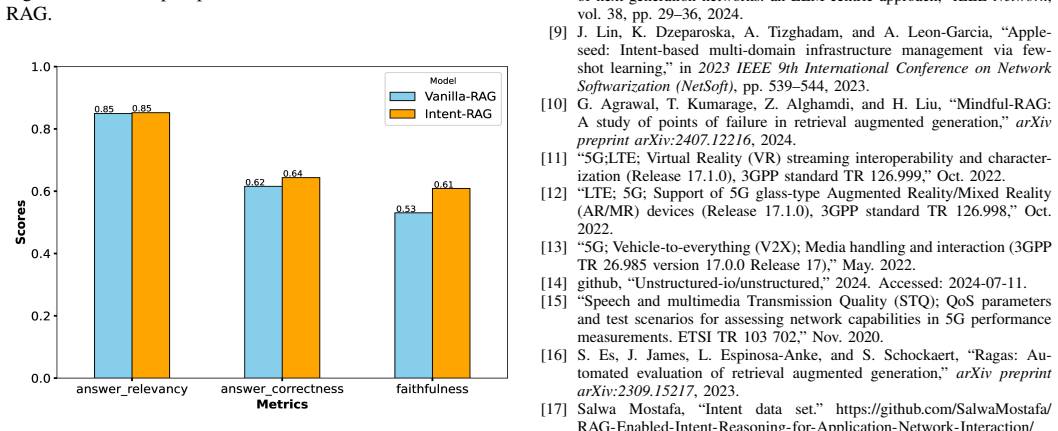
- [Figure 3] Figure 3: Axis labels and legend entries for the baseline comparisons (LLM, vanilla-RAG, intent-RAG) are too small and lack units, reducing readability of the intent translation performance plots.
Simulated Author's Rebuttal
We thank the referee for the constructive feedback on our manuscript. We address each major comment below and indicate planned revisions to improve clarity and rigor.
read point-by-point responses
-
Referee: [§5] §5 (Experimental Evaluation): No cross-domain test cases are described where intents originate from applications whose specialized vocabulary and constraints are absent from the RAG corpus; all reported comparisons appear to use domains already represented in retrieval, which fails to test the central generality claim that the framework handles arbitrary applications without per-domain ontologies.
Authors: We agree that testing with applications whose specialized vocabulary is absent from the RAG corpus is essential to substantiate the generality claim. The current evaluation uses a corpus spanning multiple domains to illustrate support for generalized and domain-specific expressions, but we acknowledge this does not fully isolate the zero-shot case. In the revised manuscript we will add explicit cross-domain experiments with held-out applications to directly address this point. revision: yes
-
Referee: [§4.1] §4.1 (Framework Description): The interaction between the machine reasoning module and RAG retrieval is specified only at a high level with no concrete rules, inference procedure, or pseudocode; without this, it is impossible to verify how the system injects correct domain semantics on the fly or avoids reducing to the LLM baseline whose drawbacks it claims to fix.
Authors: The description in §4.1 outlines the high-level integration of machine reasoning with RAG for dynamic semantic injection. To improve verifiability and reproducibility, we will expand this section with a more precise account of the interaction rules, the inference steps, and pseudocode for the core procedure in the revised version. revision: yes
Circularity Check
No circularity detected in derivation or claims
full rationale
The paper proposes a context-aware framework combining machine reasoning, RAG, and generative AI for intent translation across applications. Its central claims rest on experimental comparisons showing outperformance versus LLM and vanilla-RAG baselines, with no equations, mathematical derivations, fitted parameters renamed as predictions, or self-referential definitions. No load-bearing steps reduce by construction to inputs; the work is self-contained as an empirical system proposal without invoking uniqueness theorems or ansatzes from prior self-citations.
Axiom & Free-Parameter Ledger
axioms (1)
- domain assumption A context-aware AI framework can interpret intents from different applications without creating semantic languages for each one
Lean theorems connected to this paper
-
IndisputableMonolith/Cost/FunctionalEquation.leanwashburn_uniqueness_aczel unclear?
unclearRelation between the paper passage and the cited Recognition theorem.
The proposed framework allows for generalized/domain-specific intent expression and overcomes the drawbacks of large language models (LLMs) and vanilla-RAG framework.
-
IndisputableMonolith/Foundation/RealityFromDistinction.leanreality_from_one_distinction unclear?
unclearRelation between the paper passage and the cited Recognition theorem.
We propose a context-aware AI framework that utilizes machine reasoning (MR), retrieval augmented generation (RAG), and generative AI technologies
What do these tags mean?
- matches
- The paper's claim is directly supported by a theorem in the formal canon.
- supports
- The theorem supports part of the paper's argument, but the paper may add assumptions or extra steps.
- extends
- The paper goes beyond the formal theorem; the theorem is a base layer rather than the whole result.
- uses
- The paper appears to rely on the theorem as machinery.
- contradicts
- The paper's claim conflicts with a theorem or certificate in the canon.
- unclear
- Pith found a possible connection, but the passage is too broad, indirect, or ambiguous to say the theorem truly supports the claim.
Reference graph
Works this paper leans on
-
[1]
A survey on intent-based networking,
A. Leivadeas and M. Falkner, “A survey on intent-based networking,” IEEE Communications Surveys & Tutorials, vol. 25, no. 1, pp. 625–655, 2022
work page 2022
-
[2]
Y . Hui, Z. Kaixuan, Y . Qiuyan, Z. Xudong, Z. Jie, and L. Young, “In- tent defined optical network with artificial intelligence-based automated operation and maintenance,”Science China, vol. 63, no. 06, pp. 55–66, 2020
work page 2020
-
[3]
Refining network intents for self-driving networks,
A. S. Jacobs, R. J. Pfitscher, R. A. Ferreira, and L. Z. Granville, “Refining network intents for self-driving networks,” inProceedings of the Afternoon Workshop on Self-Driving Networks, pp. 15–21, 2018
work page 2018
-
[4]
Intent-based networking for connectivity and cloud services,
M. Toy, “Intent-based networking for connectivity and cloud services,” Adv. Netw., vol. 9, no. 1, pp. 19–22, 2021
work page 2021
-
[5]
Hey network, can you understand me?,
A. Alsudais and E. Keller, “Hey network, can you understand me?,” in2017 IEEE Conference on Computer Communications Workshops, pp. 193–198, 2017
work page 2017
-
[6]
An intent-based networks framework based on large language models,
A. Fuad, A. H. Ahmed, M. A. Riegler, and T. ˇCiˇci´c, “An intent-based networks framework based on large language models,” in2024 IEEE 10th International Conference on Network Softwarization (NetSoft), pp. 7–12, 2024
work page 2024
-
[7]
LLM- based policy generation for intent-based management of applications,
K. Dzeparoska, J. Lin, A. Tizghadam, and A. Leon-Garcia, “LLM- based policy generation for intent-based management of applications,” in 2023 19th International Conference on Network and Service Management (CNSM), pp. 1–7, 2023
work page 2023
-
[8]
Intent-based management of next-generation networks: an LLM-centric approach,
A. Mekrache, A. Ksentini, and C. Verikoukis, “Intent-based management of next-generation networks: an LLM-centric approach,”IEEE Network, vol. 38, pp. 29–36, 2024
work page 2024
-
[9]
Apple- seed: Intent-based multi-domain infrastructure management via few- shot learning,
J. Lin, K. Dzeparoska, A. Tizghadam, and A. Leon-Garcia, “Apple- seed: Intent-based multi-domain infrastructure management via few- shot learning,” in2023 IEEE 9th International Conference on Network Softwarization (NetSoft), pp. 539–544, 2023
work page 2023
-
[10]
Mindful-RAG: A study of points of failure in retrieval augmented generation,
G. Agrawal, T. Kumarage, Z. Alghamdi, and H. Liu, “Mindful-RAG: A study of points of failure in retrieval augmented generation,”arXiv preprint arXiv:2407.12216, 2024
-
[11]
“5G;LTE; Virtual Reality (VR) streaming interoperability and character- ization (Release 17.1.0), 3GPP standard TR 126.999,” Oct. 2022
work page 2022
-
[12]
“LTE; 5G; Support of 5G glass-type Augmented Reality/Mixed Reality (AR/MR) devices (Release 17.1.0), 3GPP standard TR 126.998,” Oct. 2022
work page 2022
-
[13]
“5G; Vehicle-to-everything (V2X); Media handling and interaction (3GPP TR 26.985 version 17.0.0 Release 17),” May. 2022
work page 2022
-
[14]
github, “Unstructured-io/unstructured,” 2024. Accessed: 2024-07-11
work page 2024
-
[15]
“Speech and multimedia Transmission Quality (STQ); QoS parameters and test scenarios for assessing network capabilities in 5G performance measurements. ETSI TR 103 702,” Nov. 2020
work page 2020
-
[16]
Ragas: Automated Evaluation of Retrieval Augmented Generation
S. Es, J. James, L. Espinosa-Anke, and S. Schockaert, “Ragas: Au- tomated evaluation of retrieval augmented generation,”arXiv preprint arXiv:2309.15217, 2023
work page internal anchor Pith review Pith/arXiv arXiv 2023
-
[17]
Salwa Mostafa, “Intent data set.” https://github.com/SalwaMostafa/ RAG-Enabled-Intent-Reasoning-for-Application-Network-Interaction/ blob/main/dataset, 2026. Accessed: Jan 2026
work page 2026
discussion (0)
Sign in with ORCID, Apple, or X to comment. Anyone can read and Pith papers without signing in.