REVIEW 5 major objections 4 minor 103 references
SELECT: A Submodular Approach for Active LiDAR Semantic Segmentation
T0 review · 5 major / 4 minor · reviewed 2026-08-15 · deepseek-v4-flash
Pith's one-line read Submodular three-stage selection lifts LiDAR mIoU by up to 8 points
desk verdict A pragmatic three-stage heuristic for active LiDAR segmentation with real-looking gains, but the submodular framing is overstated and the class-balancing stage leans on the very predictions it is meant to fix. read the letter →
The pith
A machine-rendered reading of the paper's core claim, the machinery that carries it, and where it could break.
The reading
What carries the argument
The central object is the three-stage voxel-centric selection pipeline. Stage 1 uses a variance-based submodular score on averaged point features with a concave gain function, maximizing a submodular objective via greedy selection to avoid pairwise distance computations. Stage 2 computes voxel-level uncertainty by averaging Monte Carlo dropout logits and taking the majority predicted class per voxel. Stage 3 estimates the class distribution of already-selected voxels and each candidate voxel, applies softmax normalization, and greedily selects voxels that maximize the entropy of the resulting class distribution. The diminishing-returns property of submodular functions is what lets the framework encourage diversity and balance while remaining scalable.
What would settle it
Run SELECT on SemanticPOSS with Stage 3's class proportions computed from ground-truth labels instead of model predictions; if the mIoU gain over the predicted-label version is small, the balancing stage is robust, while a large gap would show the stage is driven by the very misclassifications it is meant to fix.
Extended reading notes
Core claim
The central claim is that a voxel-centric, unified submodular framework can jointly optimize informativeness, uncertainty, and class balance in active LiDAR semantic segmentation. SELECT works in three coordinated stages: it uses a variance-based submodular function to select a representative set of voxels without pairwise comparisons, aggregates Monte Carlo dropout logits to identify voxels where the model is uncertain, and then applies an entropy-based submodular maximization step to choose voxels that push the labeled point distribution toward class balance. The paper demonstrates this on three outdoor benchmarks with two backbones, and reports that the full three-stage pipeline outperforms all prior active learning baselines, with particularly strong per-class gains on rare classes such as pedestrians, riders, and cones.
Load-bearing premise
Stage 3 assumes the segmentation model's predicted labels are accurate enough to estimate the class distribution of both already-selected and candidate voxels, even for the rare classes the active learning loop exists to improve.
Editorial extensions
If this is right
- Annotation budgets can be spent at voxel granularity, reducing human labeling effort while preserving a point-level budget control mechanism.
- Rare classes such as pedestrian, rider, and cone receive enough selected points to reach nonzero mIoU where many baselines score near zero.
- The feature-based submodular selection scales linearly with candidate voxels, avoiding clustering methods that require pairwise distance matrices.
- Consistent gains across SemanticPOSS, SemanticKITTI, and nuScenes with two backbones suggest the pipeline transfers across sensor configurations and class taxonomies.
Reading between the lines
- Because Stage 3 uses the model's predicted labels to estimate class proportions, a calibration failure on rare classes would bias the balancing step; a testable extension is to weight pseudo-labels by confidence or to compare with oracle class counts.
- The paper uses voxel size 0.25 for selection and 0.05 for training, so the sensitivity of the full pipeline to selection-voxel granularity is a natural next experiment that could trade rare-class recall against computational cost.
- The observation that SELECT selects about 9% multi-class voxels versus 5% for the prior baseline suggests that boundary and rare-class voxels are only a small fraction of the pool, implying a possible ceiling on gains achievable from uncertainty alone.
- A direct test of the framework's generality would be to apply the same three stages to indoor LiDAR or dense point cloud segmentation, where voxel label homogeneity is weaker.
Signed reviews
Editorial analysis
A structured set of objections, weighed in public.
Referee Report
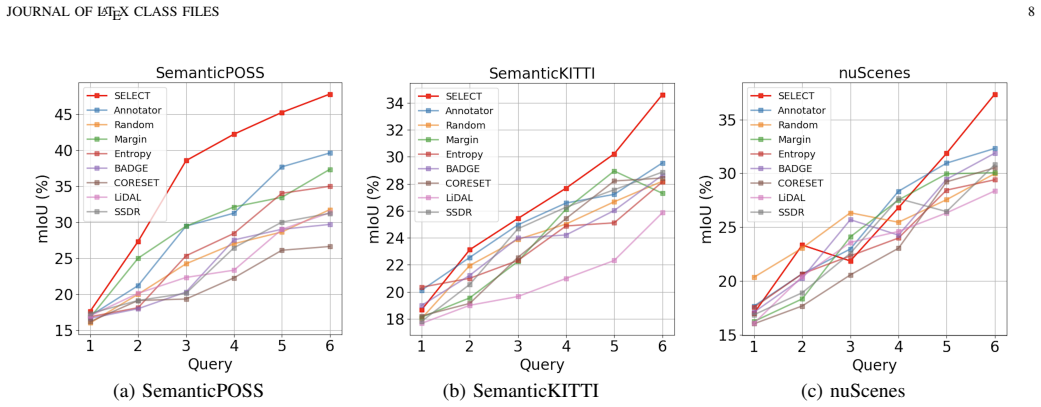
Summary. The manuscript proposes SELECT, a three-stage active learning pipeline for LiDAR semantic segmentation. Stage 1 ('Voxel-Level Submodular Subset Selection') scores voxels by the variance of their averaged feature vectors and claims to select a diverse representative subset. Stage 2 ('Voxel-Level Model Uncertainty Estimation') ranks the surviving voxels using MC-dropout logits. Stage 3 ('Submodular Maximization for Point-Level Class Balancing') selects a final voxel per point cloud using an entropy criterion over predicted class proportions. The authors report consistent mIoU gains over a wide set of baselines on SemanticPOSS, SemanticKITTI, and nuScenes, with headline improvements of +8.17, +5.06, and +5.05 mIoU over Annotator, respectively, under a 6000-point budget. The central claim is that SELECT constitutes a unified submodular framework that is simultaneously scalable, uncertainty-aware, and class-balanced.
Significance. If the empirical results hold, the practical significance is real: reducing annotation cost in outdoor LiDAR semantic segmentation is an important problem, and the paper compares against many recent AL baselines on three standard benchmarks. The per-class tables and the stage ablations are useful evidence that rare-class performance can be improved by selection strategies. However, the significance is currently undercut by three issues: the 'submodular' Stage 1 objective is additive and reduces to variance ranking; Stage 3 with Lambda3=1 is a single entropy evaluation rather than a submodular maximization; and the class-balance stage depends on predicted labels in exactly the regime where the paper itself shows rare-class predictions are zero. The absence of error bars and code further weakens the support for the headline numerical claims. The manuscript would be a valuable practical contribution after these claims are corrected and the corresponding experiments are added, but in its present form the technical contribution is overstated.
major comments (5)
- [IV-A, Eqs. (3)-(5)] Stage 1 is not a submodular subset selection in any meaningful sense. The objective in Eq. (5) is f(S) = sum over V_j in S of g(sigma(f_{V_j})), so the marginal gain of adding a voxel is g(sigma(f_{V_j})), independent of the current set S; the function is additive, not merely submodular. Under the cardinality constraint the maximizer is simply the Lambda1 voxels with the largest sigma values, and no diversity, redundancy reduction, or pairwise interaction is enforced. Moreover, Eq. (4) computes the variance across the D components of the averaged voxel feature, not the spread of point-level features inside the voxel, so the text's claim that the score 'captures dissimilarity between point-level features' is not supported. The authors should either introduce an interaction term that actually encourages diversity or reframe Stage 1 as top-k variance selection and remove the submodularity claim from the paper's central contribution.
- [IV-C, Eqs. (8)-(10), V-A] With the experimental setting Lambda3=1, Stage 3 chooses a single voxel per point cloud per active-learning round. The greedy 'submodular maximization' is therefore a single evaluation of H(V_j) for each candidate, not an iterative optimization of a submodular function. The claimed contribution of submodular class balancing is not exercised by the reported protocol. If the authors wish to claim submodular maximization, they should either select multiple voxels per round at Stage 3 or explicitly clarify that submodularity is only a motivation for a one-step entropy heuristic.
- [IV-C, Eq. (8)] Stage 3 uses the model's predicted labels N_c^{V_j} to estimate the class composition of each candidate voxel. When the segmentation model is miscalibrated and assigns zero probability mass to a rare class, a voxel that actually contains that class contributes zero count to N_c^{V_j}, so the entropy objective cannot prefer it. This is not hypothetical: the paper's own ablation in Table III shows that Stages 1+2 alone produce 0 mIoU on the garbage-can and cone/stone classes on SemanticPOSS, and the full pipeline attributes +4.49 mIoU over Stages 1+2 to Stage 3. The manuscript provides no calibration analysis, no sensitivity test for the predicted-label dependency, and no error bars. The authors should add such an analysis or use a label-free uncertainty-aware class-balance criterion.
- [V-A] The annotation budget is specified as 6000 points, but the protocol states that every method selects Nq=1 voxel per point cloud per round. If all training scans are used, the number of selected voxels would be many thousands, and even a handful of voxels per scan would already exceed 6000 points; if only a subset of scans is used, the selection of that subset is not described. This makes the budget comparison and the reported point-level cost difficult to reproduce. Please specify the number of point clouds used per round, how the 6000-point budget is shared across point clouds, and how voxel point counts are counted.
- [V-B, Tables I-II] All reported mIoU values appear to be from a single run; no standard deviations, seeds, or code are provided. Given that the headline improvements are 5-8 mIoU points and several baselines differ by only 1-2 points, the claim of consistent superiority is not statistically supported. Please provide multiple seeds with error bars for at least the main tables and make code and configuration public.
minor comments (4)
- [Abstract] The abstract contains a typo: 'understating' should be 'understanding', and the comma in 'costly and, requires' should be removed.
- [III] The notation P_i = {V_j = {...}_{k=1}^{N_j}}_{j=1}^{N_i} in Section III is malformed and should be rewritten for clarity.
- [Tables I-II] Table II column headers contain OCR artifacts such as 'Ba.ier', 'Fraff.', and 'Sqn', and several class names are inconsistently capitalized; please proofread the tables.
- [IV-A, Eq. (4)] The text should state explicitly that the variance in Eq. (4) is over feature dimensions of the mean voxel feature, not over the point features within the voxel, to avoid the misleading wording in the surrounding paragraph.
Circularity Check
No significant circularity: the mIoU claims are measured against external benchmarks, and the self-referential selection signals are active-learning heuristics rather than predictions fitted to the evaluation quantity.
full rationale
SELECT's central claim is an empirical comparison: under a 6000-point labeling budget, the three-stage selector achieves higher mIoU than prior active-learning methods on SemanticPOSS, SemanticKITTI, and nuScenes. These numbers come from held-out ground-truth evaluation, not from a parameter fitted to those datasets and then renamed as a prediction. No equation in the paper defines the reported mIoU in terms of the selection scores, so no 'prediction' reduces by construction to an input. The self-referential elements are real but not circular: Stage 2 uses the model's own MC-dropout predictions to estimate uncertainty, and Stage 3 (Eqs. 8-10) uses predicted class counts to estimate candidate-voxel class proportions. This is the standard active-learning loop, and the evaluation is still against ground-truth labels. The paper's own ablation (Table III) exposes the consequence of this dependency, showing that Stages 1+2 alone give 0 mIoU on garbage-can and cone/stone on SemanticPOSS; that is a robustness limitation about a heuristic, not a logical reduction of the central claim to its inputs. Stage 1's objective (Eq. 5) is additive over per-voxel variance scores, so with increasing g the selection is effectively a top-Λ1 variance ranking; the 'submodular diversity' wording is stronger than what the equation guarantees, but this overclaim concerns the method's framing, not circularity of the experimental result. Self-citations [74] and [100] appear only in related-work lists, and no load-bearing argument cites the authors' prior work. Therefore, the correct finding is no significant circularity; the empirical claims stand or fall on the reported experiments, not on a self-citation chain or on equations that are equivalent to their own inputs.
Assumptions & free parameters
free parameters (6)
- Voxel size lambda for selection =
0.25
- Voxel size lambda for training =
0.05
- Lambda1 (voxels kept after Stage 1) =
200
- Lambda2 (voxels kept after Stage 2) =
5
- Lambda3 (voxels finally selected) =
1
- MC-dropout forward passes T
assumptions (5)
- standard math The additive objective F(S)=sum over selected voxels of g(sigma(f_Vj)) is submodular, so greedy maximization yields a diverse, representative subset.
- domain assumption Points within the same voxel typically share the same semantic label in outdoor LiDAR scans.
- domain assumption A low average logit of the majority class within a voxel indicates low model confidence and high informativeness.
- domain assumption The current model's predicted labels can be used to estimate class distribution for balancing the annotated set.
- standard math Maximizing the entropy of class proportions improves rare-class performance.
Cite this review
Pith. "Pith review of SELECT: A Submodular Approach for Active LiDAR Semantic Segmentation." pith.science (2026). https://pith.science/paper/NBJCS537
@misc{pith2026250511516,
  author       = {Pith},
  title        = {Pith review of: SELECT: A Submodular Approach for Active LiDAR Semantic Segmentation},
  year         = {2026},
  howpublished = {\url{https://pith.science/paper/NBJCS537}},
  note         = {Machine review of arXiv:2505.11516}
}
read the original abstract
LiDAR-based semantic segmentation plays a vital role in autonomous driving by enabling detailed understanding of 3D environments. However, annotating LiDAR point clouds is extremely costly and requires assigning semantic labels to millions of points with complex geometric structures. Active Learning (AL) has emerged as a promising approach to reduce labeling costs by querying only the most informative samples. Yet, existing AL methods face critical challenges when applied to large-scale 3D data: outdoor scenes contain an overwhelming number of points and suffer from severe class imbalance, where rare classes have far fewer points than dominant classes. To address these issues, we propose SELECT, a voxel-centric submodular approach tailored for active LiDAR semantic segmentation. Our method targets both scalability problems and class imbalance through three coordinated stages. First, we perform Voxel-Level Submodular Subset Selection, which efficiently identifies representative voxels without pairwise comparisons, ensuring scalability. Second, we estimate Voxel-Level Model Uncertainty using Monte Carlo dropout, aggregating point-wise uncertainties to identify informative voxels. Finally, we introduce Submodular Maximization for Point-Level Class Balancing, which selects a subset of points that enhances label diversity, explicitly mitigating class imbalance. Experiments on SemanticPOSS, SemanticKITTI, and nuScenes benchmarks demonstrate that SELECT achieves superior performance compared to prior active learning approaches for 3D semantic segmentation.
Figures


Figures from the paper (3 more)


Reference graph
Works this paper leans on
-
[1]
nuScenes: A multimodal dataset for autonomous driving,
H. Caesar, V . Bankiti, A. H. Lang, S. V ora, V . E. Liong, Q. Xu, A. Kr- ishnan, Y . Pan, G. Baldan, and O. Beijbom, “nuScenes: A multimodal dataset for autonomous driving,” in Proc. IEEE/CVF Conf. Comput. Vis. Pattern Recognit. (CVPR), Seattle, W A, USA, 2020, pp. 11621–11631
2020
-
[2]
Two faces of active learning,
S. Dasgupta, “Two faces of active learning,” Theor . Comput. Sci., vol. 412, no. 19, pp. 1767–1781, 2011
2011
-
[3]
One thing one click: A self-training approach for weakly supervised 3D semantic segmentation,
Z. Liu, X. Qi, and C.-W. Fu, “One thing one click: A self-training approach for weakly supervised 3D semantic segmentation,” in Proc. IEEE/CVF Conf. Comput. Vis. Pattern Recognit. (CVPR), Nashville, TN, USA, 2021, pp. 1726–1736
2021
-
[4]
SemanticKITTI: A dataset for semantic scene understanding of LiDAR sequences,
J. Behley, M. Garbade, A. Milioto, J. Quenzel, S. Behnke, C. Stachniss, and J. Gall, “SemanticKITTI: A dataset for semantic scene understanding of LiDAR sequences,” in Proc. IEEE/CVF Int. Conf. Comput. Vis. (ICCV), Seoul, South Korea, 2019
2019
-
[5]
KPConv: Flexible and deformable convolution for point clouds,
H. Thomas, C. R. Qi, J.-E. Deschaud, B. Marcotegui, F. Goulette, and L. J. Guibas, “KPConv: Flexible and deformable convolution for point clouds,” in Proc. IEEE/CVF Int. Conf. Comput. Vis. (ICCV), Seoul, South Korea, 2019, pp. 6411–6420
2019
-
[6]
Unsupervised multi-task feature learning on point clouds,
K. Hassani and M. Haley, “Unsupervised multi-task feature learning on point clouds,” in Proc. IEEE/CVF Int. Conf. Comput. Vis. (ICCV), Seoul, South Korea, 2019, pp. 8160–8171
2019
-
[7]
Self-supervised learning of local features in 3D point clouds,
A. Thabet, H. Alwassel, and B. Ghanem, “Self-supervised learning of local features in 3D point clouds,” in Proc. IEEE/CVF Conf. Comput. Vis. Pattern Recognit. Workshops (CVPRW), Seattle, W A, USA, 2020, pp. 938–939
2020
-
[8]
Unsupervised point cloud representation learning by clustering and neural rendering,
G. Mei, C. Saltori, E. Ricci, N. Sebe, Q. Wu, J. Zhang, and F. Poiesi, “Unsupervised point cloud representation learning by clustering and neural rendering,” Int. J. Comput. Vis. , vol. 132, no. 8, pp. 3251–3269, 2024
2024
Show all 103 references
-
[9]
Image2point: 3D point-cloud understanding with pretrained 2D convnets,
C. Xu, S. Yang, B. Zhai, B. Wu, X. Yue, W. Zhan, et al., “Image2point: 3D point-cloud understanding with pretrained 2D convnets,” arXiv preprint arXiv:2101.02691, 2021
2021 arXiv
-
[10]
Fusion-then- distillation: Toward cross-modal positive distillation for domain adaptive 3D semantic segmentation,
Y . Wu, M. Xing, Y . Zhang, Y . Xie, K. Peng, and Y . Qu, “Fusion-then- distillation: Toward cross-modal positive distillation for domain adaptive 3D semantic segmentation,” IEEE Trans. Circuits Syst. Video Technol. , 2025
2025
-
[11]
3D unsupervised learning by distilling 2D open-vocabulary segmentation models for autonomous driving,
B. Sun, Y . Liu, X. Wang, B. Tian, L. Chen, and F.-Y . Wang, “3D unsupervised learning by distilling 2D open-vocabulary segmentation models for autonomous driving,” arXiv preprint arXiv:2405.15286 , 2024
2024 arXiv
-
[12]
4D spatio-temporal ConvNets: Minkowski convolutional neural networks,
C. B. Choy, J. Gwak, and S. Savarese, “4D spatio-temporal ConvNets: Minkowski convolutional neural networks,” in Proc. IEEE Conf. Comput. Vis. Pattern Recognit. (CVPR), Long Beach, CA, USA, 2019, pp. 3075– 3084
2019
-
[13]
Multi-class active learning for image classification,
A. J. Joshi, F. Porikli, and N. Papanikolopoulos, “Multi-class active learning for image classification,” in Proc. IEEE Conf. Comput. Vis. Pattern Recognit. (CVPR), Miami, FL, USA, 2009, pp. 2372–2379
2009
-
[14]
Searching efficient 3D architectures with sparse point-voxel convolution,
H. Tang, Z. Liu, S. Zhao, Y . Lin, J. Lin, H. Wang, and S. Han, “Searching efficient 3D architectures with sparse point-voxel convolution,” in Proc. Eur. Conf. Comput. Vis. (ECCV), Glasgow, U.K., 2020, pp. 685–702
2020
-
[15]
A dataset for semantic scene understanding of LiDAR sequences,
J. Behley, M. Garbade, A. Milioto, J. Quenzel, S. Behnke, C. Stachniss, and J. Gall, “A dataset for semantic scene understanding of LiDAR sequences,” in Proc. IEEE/CVF Int. Conf. Comput. Vis. (ICCV), Seoul, South Korea, 2019, pp. 9297–9307
2019
-
[16]
Gaussian Mixture Models,
D. A. Reynolds, “Gaussian Mixture Models,” in *Encyclopedia of Biometrics*, S. Z. Li and A. Jain, Eds. Boston, MA, USA: Springer, 2009, pp. 659–663
2009
-
[17]
Least squares quantization in PCM,
S. P. Lloyd, “Least squares quantization in PCM,” *IEEE Trans. Inf. Theory*, vol. 28, no. 2, pp. 129–137, Mar. 1982
1982
-
[18]
k-means++: The advantages of careful seeding,
D. Arthur and S. Vassilvitskii, “k-means++: The advantages of careful seeding,” in *Proc. 18th Annu. ACM-SIAM Symp. Discrete Algorithms (SODA)*, New Orleans, LA, USA, Jan. 2007, pp. 1027–1035
2007
-
[19]
Class- imbalanced semi-supervised learning for large-scale point cloud semantic segmentation via decoupling optimization,
M. Li, S. Lin, Z. Wang, Y . Shen, B. Zhang, and L. Ma, “Class- imbalanced semi-supervised learning for large-scale point cloud semantic segmentation via decoupling optimization,” Pattern Recognit., vol. 156, 2024, Art. no. 110701
2024
-
[20]
SemanticPOSS: A point cloud dataset with large quantity of dynamic instances,
Y . Pan, B. Gao, J. Mei, S. Geng, C. Li, and H. Zhao, “SemanticPOSS: A point cloud dataset with large quantity of dynamic instances,” 2020. [Online]. Available: https://arxiv.org/abs/2002.09147
2020 arXiv
-
[21]
Deep learning-based LiDAR point cloud semantic segmentation for robotics: A survey,
W. Zhang, H. Wang, X. Li, and C. Xu, “Deep learning-based LiDAR point cloud semantic segmentation for robotics: A survey,” IEEE Trans. Robot., vol. 39, no. 2, pp. 150–170, 2023
2023
-
[22]
LiDAR-based urban scene understanding for smart city applications: A review,
J. Yan, Z. Chen, and B. Liu, “LiDAR-based urban scene understanding for smart city applications: A review,” IEEE Internet Things J. , vol. 9, no. 18, pp. 17088–17104, 2022
2022
-
[23]
PointNet++: Deep hierarchical feature learning on point sets in a metric space,
C. R. Qi, L. Yi, H. Su, and L. J. Guibas, “PointNet++: Deep hierarchical feature learning on point sets in a metric space,” in Proc. Adv. Neural Inf. Process. Syst. (NeurIPS), Long Beach, CA, USA, 2017, pp. 5099–5108
2017
-
[24]
Spatio-temporal self- supervised representation learning for 3D point clouds,
S. Huang, Y . Xie, S.-C. Zhu, and Y . Zhu, “Spatio-temporal self- supervised representation learning for 3D point clouds,” in Proc. IEEE/CVF Int. Conf. Comput. Vis. (ICCV), Montreal, QC, Canada, 2021, pp. 6535–6545
2021
-
[25]
Batch mode active learning and its application to medical image classification,
S. C. H. Hoi, R. Jin, J. Zhu, and M. R. Lyu, “Batch mode active learning and its application to medical image classification,” in Proc. 23rd Int. Conf. Mach. Learn. (ICML), Pittsburgh, PA, USA, 2006, pp. 417–424
2006
-
[26]
Active learning using pre-clustering,
H. T. Nguyen and A. Smeulders, “Active learning using pre-clustering,” in Proc. 21st Int. Conf. Mach. Learn. (ICML), Banff, AB, Canada, 2004, p. 79
2004
-
[27]
Active learning with clustering,
Z. Bod ´o, Z. Minier, and L. Csat ´o, “Active learning with clustering,” in Proc. Active Learn. Exp. Design Workshop, Int. Conf. Artif. Intell. Statist. (AISTATS), Ft. Lauderdale, FL, USA, 2011, pp. 127–139
2011
-
[28]
Subspace prototype guidance for mitigating class imbalance in point cloud semantic segmentation,
J. Han, K. Liu, W. Li, and G. Chen, “Subspace prototype guidance for mitigating class imbalance in point cloud semantic segmentation,” in Proc. Eur. Conf. Comput. Vis. (ECCV), Milan, Italy, 2024, pp. 255–272
2024
-
[29]
BoxSup: Exploiting bounding boxes to supervise convolutional networks for semantic segmentation,
J. Dai, K. He, and J. Sun, “BoxSup: Exploiting bounding boxes to supervise convolutional networks for semantic segmentation,” in Proc. IEEE Int. Conf. Comput. Vis. (ICCV), Santiago, Chile, 2015, pp. 1635– 1643
2015
-
[30]
Discriminative active learning,
D. Gissin and S. Shalev-Shwartz, “Discriminative active learning,” arXiv preprint arXiv:1907.06347, 2019
1907 arXiv
-
[31]
Active learning literature survey,
B. Settles, “Active learning literature survey,” Univ. Wisconsin–Madison, Dept. Comput. Sci., Madison, WI, USA, Tech. Rep. 1648, 2009
2009
-
[32]
Cylindrical and asymmetrical 3D convolution networks for LiDAR segmentation,
X. Zhu, H. Zhou, T. Wang, F. Hong, Y . Ma, W. Li, H. Li, and D. Lin, “Cylindrical and asymmetrical 3D convolution networks for LiDAR segmentation,” in Proc. IEEE/CVF Conf. Comput. Vis. Pattern Recognit. (CVPR), Nashville, TN, USA, 2021, pp. 9939–9948
2021
-
[33]
A survey of deep active learning,
P. Ren, Y . Xiao, X. Chang, P.-Y . Huang, Z. Li, B. B. Gupta, X. Chen, and X. Wang, “A survey of deep active learning,” ACM Comput. Surv. , vol. 54, no. 9, pp. 1–40, 2021
2021
-
[34]
3D spatial recognition without spatially labeled 3D,
Z. Ren, I. Misra, A. G. Schwing, and R. Girdhar, “3D spatial recognition without spatially labeled 3D,” in Proc. IEEE/CVF Conf. Comput. Vis. Pattern Recognit. (CVPR), Nashville, TN, USA, 2021, pp. 13204–13213
2021
-
[35]
A sequential algorithm for training text classifiers: Corrigendum and additional data,
D. D. Lewis, “A sequential algorithm for training text classifiers: Corrigendum and additional data,” ACM SIGIR F orum , vol. 29, no. 2, pp. 13–19, 1995. JOURNAL OF LATEX CLASS FILES 11
1995
-
[36]
A new active labeling method for deep learning,
D. Wang and Y . Shang, “A new active labeling method for deep learning,” in Proc. Int. Joint Conf. Neural Netw. (IJCNN), Beijing, China, 2014, pp. 112–119
2014
-
[37]
Margin-based active learning for structured output spaces,
D. Roth and K. Small, “Margin-based active learning for structured output spaces,” in Proc. Eur. Conf. Mach. Learn. (ECML), Berlin, Germany, 2006, pp. 413–424
2006
-
[38]
LADA: Look-ahead data acquisition via augmentation for deep active learning,
Y .-Y . Kim, K. Song, J. Jang, and I.-C. Moon, “LADA: Look-ahead data acquisition via augmentation for deep active learning,” Adv. Neural Inf. Process. Syst., vol. 34, pp. 22919–22930, 2021
2021
-
[39]
Active learning by feature mixing,
A. Parvaneh, E. Abbasnejad, D. Teney, G. R. Haffari, A. Van Den Hen- gel, and J. Q. Shi, “Active learning by feature mixing,” in Proc. IEEE/CVF Conf. Comput. Vis. Pattern Recognit. (CVPR), New Orleans, LA, USA, 2022, pp. 12237–12246
2022
-
[40]
Heterogeneous uncertainty sampling for supervised learning,
D. D. Lewis and J. Catlett, “Heterogeneous uncertainty sampling for supervised learning,” in Proc. 11th Int. Conf. Mach. Learn. (ICML), New Brunswick, NJ, USA, 1994, pp. 148–156
1994
-
[41]
SQN: Weakly- supervised semantic segmentation of large-scale 3D point clouds,
Z. Hu, J. Shang, X. Bai, C.-L. Tai, and H. Fu, “SQN: Weakly- supervised semantic segmentation of large-scale 3D point clouds,” in Proc. IEEE/CVF Conf. Comput. Vis. Pattern Recognit. (CVPR), 2023, pp. 14699–14708
2023
-
[42]
Bayesian generative active deep learning,
T. Tran, T.-T. Do, I. Reid, and G. Carneiro, “Bayesian generative active deep learning,” in Proc. Int. Conf. Mach. Learn. (ICML), 2019, pp. 6295– 6304
2019
-
[45]
BaSAL: Size-balanced active learning for LiDAR semantic segmentation,
B. Wei, B. Gao, C. Li, and H. Zhao, “BaSAL: Size-balanced active learning for LiDAR semantic segmentation,” in Proc. IEEE/CVF Conf. Comput. Vis. Pattern Recognit. (CVPR), 2023, pp. 4812–4821
2023
-
[46]
MiLAN: Minimal annotation for LiDAR semantic segmentation via self-supervised learn- ing,
B. Samet, P. Dvornik, E. Belilovsky, and I. Laptev, “MiLAN: Minimal annotation for LiDAR semantic segmentation via self-supervised learn- ing,” arXiv preprint arXiv:2404.10986, 2024
2024 arXiv
-
[47]
Active learning for point cloud semantic segmentation via spatial-structural diversity reasoning,
F. Shao, Y . Luo, P. Liu, J. Chen, Y . Yang, Y . Lu, and J. Xiao, “Active learning for point cloud semantic segmentation via spatial-structural diversity reasoning,” in Proc. 30th ACM Int. Conf. Multimedia, 2022, pp. 2575–2585
2022
-
[48]
Box2Mask: Weakly supervised 3D semantic instance segmentation using bounding boxes,
J. Chibane, F. Engelmann, T. A. Tran, and G. Pons-Moll, “Box2Mask: Weakly supervised 3D semantic instance segmentation using bounding boxes,” in Proc. Eur. Conf. Comput. Vis. (ECCV), Tel Aviv, Israel, 2022, pp. 681–699
2022
-
[49]
REDAL: Region-based and diversity-aware active learning for point cloud semantic segmentation,
T.-H. Wu, Y .-C. Liu, Y .-K. Huang, H.-Y . Lee, H.-T. Su, P.-C. Huang, and W. H. Hsu, “REDAL: Region-based and diversity-aware active learning for point cloud semantic segmentation,” in Proc. IEEE/CVF Int. Conf. Comput. Vis. (ICCV), Montreal, QC, Canada, 2021, pp. 15510–15519
2021
-
[50]
Exploring active 3D object detection from a generalization perspective,
Y . Luo, Z. Chen, Z. Wang, X. Yu, Z. Huang, and M. Baktashmotlagh, “Exploring active 3D object detection from a generalization perspective,” in Proc. Int. Conf. Learn. Represent. (ICLR), Kigali, Rwanda, 2023
2023
-
[51]
VMNet: V oxel-mesh network for geodesic-aware 3D semantic segmentation,
Z. Hu, X. Bai, J. Shang, R. Zhang, J. Dong, X. Wang, G. Sun, H. Fu, and C.-L. Tai, “VMNet: V oxel-mesh network for geodesic-aware 3D semantic segmentation,” in Proc. IEEE/CVF Int. Conf. Comput. Vis. (ICCV), Montreal, QC, Canada, 2021, pp. 15488–15498
2021
-
[52]
JSENet: Joint semantic segmentation and edge detection network for 3D point clouds,
Z. Hu, M. Zhen, X. Bai, H. Fu, and C.-L. Tai, “JSENet: Joint semantic segmentation and edge detection network for 3D point clouds,” in Proc. Eur. Conf. Comput. Vis. (ECCV), Glasgow, U.K., 2020, pp. 222–239
2020
-
[53]
Semantic3D.net: A new large-scale point cloud classifica- tion benchmark,
T. Hackel, N. Savinov, ˇL. Ladick ´y, J. D. Wegner, K. Schindler, and M. Pollefeys, “Semantic3D.net: A new large-scale point cloud classifica- tion benchmark,” arXiv preprint arXiv:1704.03847 , 2017
2017 arXiv
-
[54]
Multiple-instance active learning,
B. Settles, M. Craven, and S. Ray, “Multiple-instance active learning,” Adv. Neural Inf. Process. Syst. , vol. 20, 2007
2007
-
[55]
Active learning with statistical models,
D. A. Cohn, Z. Ghahramani, and M. I. Jordan, “Active learning with statistical models,” J. Artif. Intell. Res. , vol. 4, pp. 129–145, 1996
1996
-
[56]
Efficient learning on point clouds with basis point sets,
S. Prokudin, C. Lassner, and J. Romero, “Efficient learning on point clouds with basis point sets,” in Proc. IEEE/CVF Int. Conf. Comput. Vis. (ICCV), Seoul, South Korea, 2019, pp. 4332–4341
2019
-
[57]
Multi-path region mining for weakly supervised 3D semantic segmentation on point clouds,
J. Wei, G. Lin, K.-H. Yap, T.-Y . Hung, and L. Xie, “Multi-path region mining for weakly supervised 3D semantic segmentation on point clouds,” in Proc. IEEE/CVF Conf. Comput. Vis. Pattern Recognit. (CVPR), Seattle, W A, USA, 2020, pp. 4384–4393
2020
-
[58]
Divergence measures based on the Shannon entropy,
J. Lin, “Divergence measures based on the Shannon entropy,” IEEE Trans. Inf. Theory , vol. 37, no. 1, pp. 145–151, 1991
1991
-
[59]
GroupContrast: Semantic-aware self-supervised representation learning for 3D understanding,
C. Wang, L. Jiang, X. Wu, Z. Tian, B. Peng, H. Zhao, and J. Jia, “GroupContrast: Semantic-aware self-supervised representation learning for 3D understanding,” in Proc. IEEE/CVF Conf. Comput. Vis. Pattern Recognit. (CVPR), Seattle, W A, USA, 2024, pp. 4917–4928
2024
-
[60]
Active learning for convolutional neural networks: A core-set approach,
O. Sener and S. Savarese, “Active learning for convolutional neural networks: A core-set approach,” arXiv preprint arXiv:1708.00489 , 2017
2017 arXiv
-
[61]
DeepCore: A comprehensive library for coreset selection in deep learning,
C. Guo, B. Zhao, and Y . Bai, “DeepCore: A comprehensive library for coreset selection in deep learning,” in Proc. Int. Conf. Database Expert Syst. Appl. (DEXA), Vienna, Austria, 2022, pp. 181–195
2022
-
[62]
Active learning through density clustering,
M. Wang, F. Min, Z.-H. Zhang, and Y .-X. Wu, “Active learning through density clustering,” Expert Syst. Appl. , vol. 85, pp. 305–317, 2017
2017
-
[63]
Deep batch active learning by diverse, uncertain gradient lower bounds,
J. T. Ash, C. Zhang, A. Krishnamurthy, J. Langford, and A. Agarwal, “Deep batch active learning by diverse, uncertain gradient lower bounds,” arXiv preprint arXiv:1906.03671 , 2019
1906 arXiv
-
[64]
Localization-aware active learning for object detection,
C.-C. Kao, T.-Y . Lee, P. Sen, and M.-Y . Liu, “Localization-aware active learning for object detection,” in Proc. Asian Conf. Comput. Vis. (ACCV), Perth, W A, Australia, 2019, pp. 506–522
2019
-
[65]
Annotating object instances with a Polygon-RNN,
L. Castrej ´on, K. Kundu, R. Urtasun, and S. Fidler, “Annotating object instances with a Polygon-RNN,” in Proc. IEEE Conf. Comput. Vis. Pattern Recognit. (CVPR), Honolulu, HI, USA, 2017, pp. 5230–5238
2017
-
[66]
Uncertainty in deep learning,
Y . Gal, “Uncertainty in deep learning,” Ph.D. dissertation, Univ. Cam- bridge, Cambridge, U.K., 2016
2016
-
[67]
Demystifying multi- faceted video summarization: Tradeoff between diversity, representation, coverage and importance,
V . Kaushal, R. Iyer, K. Doctor, A. Sahoo, P. Dubal, S. Kothawade, R. Mahadev, K. Dargan, and G. Ramakrishnan, “Demystifying multi- faceted video summarization: Tradeoff between diversity, representation, coverage and importance,” in Proc. IEEE Winter Conf. Appl. Comput. Vis. ...
2019
-
[68]
An analysis of approximations for maximizing submodular set functions—I,
G. L. Nemhauser, L. A. Wolsey, and M. L. Fisher, “An analysis of approximations for maximizing submodular set functions—I,” Math. Program., vol. 14, no. 1, pp. 265–294, 1978
1978
-
[69]
Bayesian active learning for classification and preference learning,
N. Houlsby, F. Husz ´ar, Z. Ghahramani, and M. Lengyel, “Bayesian active learning for classification and preference learning,” arXiv preprint arXiv:1112.5745, 2011
2011 arXiv
-
[70]
Scalable active learning for object detection,
E. Haussmann, M. Fenzi, K. Chitta, J. Ivanecky, H. Xu, D. Roy, A. Mittel, N. Koumchatzky, C. Farabet, and J. M. Alvarez, “Scalable active learning for object detection,” in Proc. IEEE Intell. V eh. Symp. (IV), Las Vegas, NV , USA, 2020, pp. 1430–1435
2020
-
[71]
Submodularity in machine learning and artificial intelli- gence,
J. Bilmes, “Submodularity in machine learning and artificial intelli- gence,” arXiv preprint arXiv:2202.00132 , 2022
2022 arXiv
-
[72]
Kecor: Kernel coding rate maximization for active 3D object detection,
Y . Luo, Z. Chen, Z. Fang, Z. Zhang, M. Baktashmotlagh, and Z. Huang, “Kecor: Kernel coding rate maximization for active 3D object detection,” in Proc. IEEE/CVF Int. Conf. Comput. Vis. (ICCV) , Paris, France, 2023, pp. 18279–18290
2023
-
[73]
Prism: A rich class of parameterized submodular information measures for guided data subset selection,
S. Kothawade, V . Kaushal, G. Ramakrishnan, J. Bilmes, and R. Iyer, “Prism: A rich class of parameterized submodular information measures for guided data subset selection,” inProc. AAAI Conf. Artif. Intell., vol. 36, no. 9, 2022, pp. 10238–10246
2022
-
[74]
Inconsistency-based data-centric active open-set annotation,
R. Mao, X. Ouyang, and Y . Guo, “Inconsistency-based data-centric active open-set annotation,” in Proc. AAAI Conf. Artif. Intell. , vol. 38, no. 5, 2024, pp. 4180–4188
2024
-
[75]
Similar: Submod- ular information measures based active learning in realistic scenarios,
S. Kothawade, N. Beck, K. Killamsetty, and R. Iyer, “Similar: Submod- ular information measures based active learning in realistic scenarios,” Adv. Neural Inf. Process. Syst. , vol. 34, 2021, pp. 18685–18697
2021
-
[76]
Talisman: Targeted active learning for object detection with rare classes and slices using submodular mutual information,
S. Kothawade, S. Ghosh, S. Shekhar, Y . Xiang, and R. Iyer, “Talisman: Targeted active learning for object detection with rare classes and slices using submodular mutual information,” in Proc. Eur . Conf. Comput. Vis. (ECCV), Tel Aviv, Israel, 2022, pp. 1–16
2022
-
[77]
Submodular subset selection for large-scale speech training data,
K. Wei, Y . Liu, K. Kirchhoff, C. Bartels, and J. Bilmes, “Submodular subset selection for large-scale speech training data,” in Proc. IEEE Int. Conf. Acoust., Speech, Signal Process. (ICASSP) , Florence, Italy, 2014, pp. 3311–3315
2014
-
[78]
Automata: Gradient based data subset selection for compute-efficient hyper-parameter tuning,
K. Killamsetty, G. S. Abhishek, A. Lnu, G. Ramakrishnan, A. Ev- fimievski, L. Popa, and R. Iyer, “Automata: Gradient based data subset selection for compute-efficient hyper-parameter tuning,” Adv. Neural Inf. Process. Syst., vol. 35, 2022, pp. 28721–28733
2022
-
[79]
GCR: Gradient coreset based replay buffer selection for continual learning,
R. Tiwari, K. Killamsetty, R. Iyer, and P. Shenoy, “GCR: Gradient coreset based replay buffer selection for continual learning,” in Proc. IEEE/CVF Conf. Comput. Vis. Pattern Recognit. (CVPR) , New Orleans, LA, USA, 2022, pp. 99–108
2022
-
[80]
Deep similarity-based batch mode active learning with exploration- exploitation,
C. Yin, B. Qian, S. Cao, X. Li, J. Wei, Q. Zheng, and I. Davidson, “Deep similarity-based batch mode active learning with exploration- exploitation,” in Proc. IEEE Int. Conf. Data Min. (ICDM) , New Orleans, LA, USA, 2017, pp. 575–584
2017
-
[81]
Batch active learning using determinantal point processes,
E. Bıyık, K. Wang, N. Anari, and D. Sadigh, “Batch active learning using determinantal point processes,” arXiv preprint arXiv:1906.07975 , 2019
1906 arXiv
-
[82]
A mathematical theory of communication,
C. E. Shannon, “A mathematical theory of communication,” ACM SIGMOBILE Mobile Comput. Commun. Rev. , vol. 5, no. 1, pp. 3–55, 2001. JOURNAL OF LATEX CLASS FILES 12
2001
-
[83]
SUN RGB-D: A RGB-D scene understanding benchmark suite,
S. Song, S. P. Lichtenberg, and J. Xiao, “SUN RGB-D: A RGB-D scene understanding benchmark suite,” in Proc. IEEE Conf. Comput. Vis. Pattern Recognit. (CVPR) , Boston, MA, USA, 2015, pp. 567–576
2015
-
[84]
Annotator: A generic active learning baseline for LiDAR semantic segmentation,
B. Xie, S. Li, Q. Guo, C. Liu, and X. Cheng, “Annotator: A generic active learning baseline for LiDAR semantic segmentation,” Adv. Neural Inf. Process. Syst. , vol. 36, 2023
2023
-
[85]
Are we hungry for 3D LiDAR data for semantic segmentation? A survey of datasets and methods,
B. Gao, Y . Pan, C. Li, S. Geng, and H. Zhao, “Are we hungry for 3D LiDAR data for semantic segmentation? A survey of datasets and methods,” IEEE Trans. Intell. Transp. Syst. , vol. 23, no. 7, pp. 6063– 6081, 2021
2021
-
[86]
Towards 3D LiDAR-based semantic scene understanding of 3D point cloud sequences: The SemanticKITTI Dataset,
J. Behley, M. Garbade, A. Milioto, J. Quenzel, S. Behnke, J. Gall, and C. Stachniss, “Towards 3D LiDAR-based semantic scene understanding of 3D point cloud sequences: The SemanticKITTI Dataset,” Int. J. Robot. Res., vol. 40, no. 8–9, pp. 959–967, 2021
2021
-
[87]
SECOND: Sparsely embedded convolutional detection,
Y . Yan, Y . Mao, and B. Li, “SECOND: Sparsely embedded convolutional detection,” Sensors, vol. 18, no. 10, p. 3337, 2018
2018
-
[88]
LESS: Label-efficient semantic segmentation for LiDAR point clouds,
M. Liu, Y . Zhou, C. R. Qi, B. Gong, H. Su, and D. Anguelov, “LESS: Label-efficient semantic segmentation for LiDAR point clouds,” in Proc. Eur . Conf. Comput. Vis. (ECCV) , Tel Aviv, Israel, 2022, pp. 70–89
2022
-
[89]
Multi-class active learning for image classification,
A. J. Joshi, F. Porikli, and N. Papanikolopoulos, “Multi-class active learning for image classification,” in Proc. IEEE Conf. Comput. Vis. Pattern Recognit. (CVPR) , Miami, FL, USA, 2009, pp. 2372–2379
2009
-
[90]
Cost-effective active learning for deep image classification,
K. Wang, D. Zhang, Y . Li, R. Zhang, and L. Lin, “Cost-effective active learning for deep image classification,” IEEE Trans. Circuits Syst. Video Technol., vol. 27, no. 12, pp. 2591–2600, 2016
2016
-
[91]
The power of ensembles for active learning in image classification,
W. H. Beluch, T. Genewein, A. N ¨urnberger, and J. M. K ¨ohler, “The power of ensembles for active learning in image classification,” in Proc. IEEE Conf. Comput. Vis. Pattern Recognit. (CVPR) , Salt Lake City, UT, USA, 2018, pp. 9368–9377
2018
-
[92]
A multi-granularity semi- supervised active learning for point cloud semantic segmentation,
S. Ye, Z. Yin, Y . Fu, H. Lin, and Z. Pan, “A multi-granularity semi- supervised active learning for point cloud semantic segmentation,” Neural Comput. Appl. , vol. 35, no. 21, pp. 15629–15645, 2023
2023
-
[93]
Making your first choice: To address cold start problem in vision active learning,
L. Chen, Y . Bai, S. Huang, Y . Lu, B. Wen, A. L. Yuille, and Z. Zhou, “Making your first choice: To address cold start problem in vision active learning,” arXiv preprint arXiv:2210.02442 , 2022
2022 arXiv
-
[94]
Addressing the item cold-start problem by attribute-driven active learning,
Y . Zhu, J. Lin, S. He, B. Wang, Z. Guan, H. Liu, and D. Cai, “Addressing the item cold-start problem by attribute-driven active learning,” IEEE Trans. Knowl. Data Eng. , vol. 32, no. 4, pp. 631–644, 2019
2019
-
[95]
Cold-start active learning with robust ordinal matrix factorization,
N. Houlsby, J. M. Hern ´andez-Lobato, and Z. Ghahramani, “Cold-start active learning with robust ordinal matrix factorization,” in Proc. Int. Conf. Mach. Learn. (ICML) , Beijing, China, 2014, pp. 766–774
2014
-
[96]
Gaussian mixture models,
D. A. Reynolds, “Gaussian mixture models,” in Encyclopedia of Biomet- rics, vol. 741, A. Jain and P. Flynn, Eds., Springer, 2009, pp. 659–663
2009
-
[97]
Active learning for point cloud semantic segmentation via spatial-structural diversity reasoning,
F. Shao, Y . Luo, P. Liu, J. Chen, Y . Yang, Y . Lu, and J. Xiao, “Active learning for point cloud semantic segmentation via spatial-structural diversity reasoning,” in Proc. 30th ACM Int. Conf. Multimedia (ACM MM), Lisbon, Portugal, 2022, pp. 2575–2585
2022
-
[98]
LIDAL: Inter-frame uncertainty based active learning for 3D LiDAR semantic segmentation,
Z. Hu, X. Bai, R. Zhang, X. Wang, G. Sun, H. Fu, and C.-L. Tai, “LIDAL: Inter-frame uncertainty based active learning for 3D LiDAR semantic segmentation,” in Proc. Eur . Conf. Comput. Vis. (ECCV) , Tel Aviv, Israel, 2022, pp. 248–265
2022
-
[99]
Active learning for deep detection neural networks,
H. H. Aghdam, A. Gonzalez-Garcia, J. van de Weijer, and A. M. L ´opez, “Active learning for deep detection neural networks,” in Proc. IEEE/CVF Int. Conf. Comput. Vis. (ICCV) , Seoul, South Korea, 2019, pp. 3672– 3680
2019
-
[100]
STONE: A submodular optimization framework for active 3D object detection,
R. Mao, S. K. Maharana, R. K. Iyer, and Y . Guo, “STONE: A submodular optimization framework for active 3D object detection,”arXiv preprint arXiv:2410.03918, 2024
2024 arXiv
-
[101]
ViewAL: Active learning with viewpoint entropy for semantic segmentation,
Y . Siddiqui, J. Valentin, and M. Nießner, “ViewAL: Active learning with viewpoint entropy for semantic segmentation,” in Proc. IEEE/CVF Conf. Comput. Vis. Pattern Recognit. (CVPR) , Seattle, W A, USA, 2020, pp. 9433–9443
2020
-
[102]
Suggestive annotation: A deep active learning framework for biomedical image segmentation,
L. Yang, Y . Zhang, J. Chen, S. Zhang, and D. Z. Chen, “Suggestive annotation: A deep active learning framework for biomedical image segmentation,” in Proc. Med. Image Comput. Comput.-Assist. Interv. (MICCAI), Quebec City, QC, Canada, 2017, pp. 399–407
2017
-
[103]
Efficient data subset selection to generalize training across models: Transductive and inductive networks,
E. Jain, T. Nandy, G. Aggarwal, A. Tendulkar, R. Iyer, and A. De, “Efficient data subset selection to generalize training across models: Transductive and inductive networks,” Adv. Neural Inf. Process. Syst. (NeurIPS), vol. 36, 2024
2024
-
[104]
How good is a video summary? A new benchmarking dataset and eval- uation framework towards realistic video summarization,
V . Kaushal, S. Kothawade, A. Tomar, R. Iyer, and G. Ramakrishnan, “How good is a video summary? A new benchmarking dataset and eval- uation framework towards realistic video summarization,” arXiv preprint arXiv:2101.10514, 2021
2021 arXiv
-
[105]
Effective evaluation of deep active learning on image classification tasks,
N. Beck, D. Sivasubramanian, A. Dani, G. Ramakrishnan, and R. Iyer, “Effective evaluation of deep active learning on image classification tasks,” arXiv preprint arXiv:2106.15324 , 2021. Ruiyu Mao is a Ph.D. candidate in Computer Sci- ence at the University of Texas at Dallas, ...
2021 arXiv
Reviewed August 15, 2026 · model on record in the stance chip above.
Discussion (0). Continue with ORCID to comment.