REVIEW 3 major objections 6 minor 1 cited by
VTBench: Evaluating Visual Tokenizers for Autoregressive Image Generation
T0 review · 3 major / 6 minor · reviewed 2026-08-15 · deepseek-v4-flash
Pith's one-line read VTBench shows that discrete visual tokenizers used in autoregressive image generation reconstruct images, fine detail, and text substantially worse than continuous VAEs.
desk verdict A useful new benchmark for isolating visual tokenizer quality, but the headline discrete-vs-continuous gap is partly a resolution mismatch and should be reframed. read the letter →
The pith
A machine-rendered reading of the paper's core claim, the machinery that carries it, and where it could break.
The reading
What carries the argument
The central object is the visual tokenizer treated as a standalone encoder-quantizer-decoder module, probed by reconstruction rather than by end-to-end generation. VTBench's load-bearing machinery is the task decomposition, covering ImageNet reconstruction, high-resolution and varying-resolution inputs, texture-rich detail images, and easy, hard, and multilingual text images, together with the metric set PSNR, SSIM, LPIPS, FID, CER, and WER, which makes quantization loss visible separately from the generative model.
What would settle it
Run each discrete tokenizer at 1024x1024 with the input downscaled to the tokenizer's native resolution and the reconstruction upscaled back, and also with matched token counts per image; if discrete tokenizers then close the PSNR and SSIM gap to continuous VAEs, the claim that discrete quantization itself is the bottleneck would be undercut. A second check: if a discrete tokenizer trained with OCR-aware losses reaches near-zero CER and WER on the VTBench text set, the text-preservation gap is not intrinsic to discretization.
Extended reading notes
Core claim
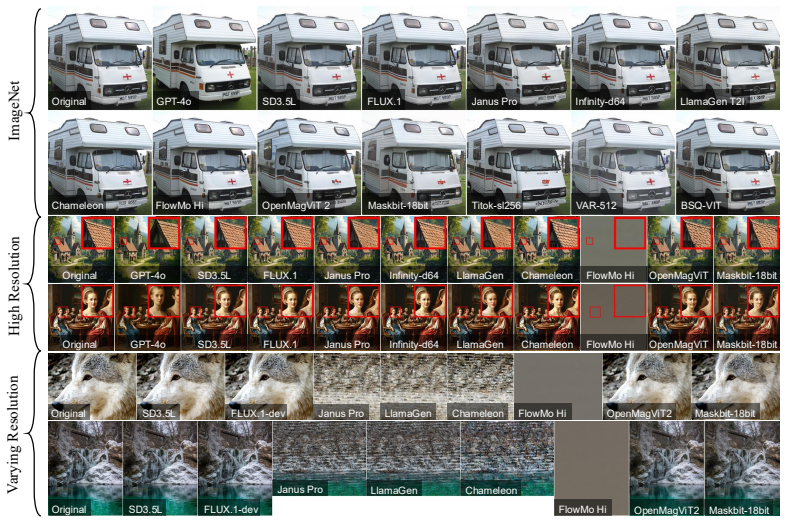
On the paper's own terms, the discovery is that the bottleneck in current autoregressive image generation sits in the discrete visual tokenizer, not the downstream model. Across VQ, LFQ, BSQ, RVQ, and RBSQ tokenizers taken from Chameleon, LlamaGen, MaskBiT, TiTok, VAR, OpenMagViT2, Janus Pro, FlowMo, and Infinity, VTBench's reconstruction numbers show lower PSNR and SSIM, higher LPIPS and FID, and far worse OCR-based character and word error rates than continuous VAEs such as SD3.5L and FLUX.1. The best discrete tokenizer, Infinity-d64, narrows the image-quality gap but still loses on text and resolution flexibility. The paper also reports that GPT-4o, when asked to copy an image with unreadable blurred text, outputs clean readable text, which it interprets as evidence that GPT-4o's tokenizer or backbone operates on semantic content and language priors rather than raw pixels.
Load-bearing premise
The headline comparison assumes that running each tokenizer at its native resolution is a fair test, so the large gaps at high and varying resolutions may reflect resolution handling rather than the quantization scheme alone.
Editorial extensions
If this is right
- Every autoregressive generator built on a current discrete visual tokenizer inherits a reconstruction ceiling below diffusion models, so tokenizer research should move from end-to-end FID comparisons to VTBench-style isolated evaluation.
- Resolution flexibility is a required property: because most discrete tokenizers fail on 1024x1024 or mixed-resolution inputs, autoregressive image generation cannot handle real-world images without resizing or cropping preprocessing.
- Text rendering in autoregressive models will stay unreliable for documents, signage, and interfaces until tokenizers preserve symbolic detail, which blocks OCR and document-generation use cases.
- The GPT-4o experiments suggest that a competitive autoregressive pipeline may need a tokenizer that encodes semantics and supports language-conditioned editing, not just pixel-level fidelity.
Reading between the lines
- The paper leaves implicit that its native-resolution protocol conflates two effects: the discrete tokenizer's quantization error and its inability to process off-spec resolutions; a token-count-matched comparison at the same resolution would isolate the quantization scheme.
- Reconstruction-only scoring may underrate tokenizers designed to feed a language model: a tokenizer that discards low-level noise while the language model fills in plausible content could score poorly on PSNR yet generate more useful images, as the GPT-4o restoration behavior suggests.
- A direct testable extension is to train a discrete tokenizer with OCR-aware and high-frequency objectives on VTBench-like data and measure whether end-to-end autoregressive generation closes the gap to diffusion models.
Signed reviews
Editorial analysis
A structured set of objections, weighed in public.
Referee Report
Summary. The paper introduces VTBench, a benchmark for evaluating visual tokenizers (VTs) in autoregressive image generation. It proposes three tasks—image reconstruction (ImageNet, high-resolution, varying-resolution), detail preservation, and text preservation (including multilingual Chinese, Hindi, Japanese, Korean)—with metrics PSNR, SSIM, LPIPS, FID, CER, and WER. The authors evaluate a broad selection of open-source discrete VTs (VQ, LFQ, BSQ, RVQ, RBSQ) plus continuous VAEs from SD3.5L and FLUX.1, and provide GPT-4o as an undisclosed reference. The central claim is that current discrete VTs fall significantly behind continuous VAEs in reconstruction quality, detail preservation, and text fidelity, and that this gap is a key bottleneck for AR image generation. The paper also includes speculative architectural analysis of GPT-4o and releases code and data.
Significance. The paper addresses an important and under-served evaluation gap: visual tokenizers are typically assessed only indirectly through end-to-end generation quality. VTBench is a focused, inference-only benchmark with no fitted parameters, and the public release of code and data is a concrete asset for the community. The qualitative demonstrations (e.g., Figure 5) are visually striking and support the intuition that discrete tokenizers lose fine-grained detail and text legibility. If the quantitative conclusions were fully controlled, the benchmark would provide a useful diagnostic tool for improving AR image generation pipelines. However, as detailed in the major comments, the headline comparison conflates quantization scheme with input resolution and representational budget, and the 100-image settings lack statistical rigor. The existence of Infinity-d64, a discrete tokenizer that at 1024x1024 nearly matches SD3.5L on PSNR/SSIM, shows that the claimed gap is not intrinsic to discrete versus continuous quantization and that the conclusion needs refinement.
major comments (3)
- [Section 3.1, Table 1] The headline comparison between discrete VTs and continuous VAEs is not resolution-matched. In the ImageNet subtask, SD3.5L and FLUX.1 are evaluated at 1024x1024, whereas most discrete VTs are evaluated at 256x256 or 512x512; in the High Resolution subtask, discrete VTs are forced to process 1024x1024 inputs for which they were not trained. This confounds quantization scheme with input resolution and representational budget, since a 1024x1024 input yields a much larger latent/token grid than a 256x256 input even at the same downsampling factor. The confound is visible in Table 1: Infinity-d64, a discrete RBSQ tokenizer evaluated at 1024x1024, achieves PSNR 36.0 on ImageNet and 37.6 on High Resolution, close to SD3.5L (38.8 and 38.5) and much closer to FLUX.1 than the 256x256 discrete models are. The paper should either add matched-resolution and matched-budget experiments across all tokenizers (e.g., at 256, 512, and 1024 with comparable latent dimensions) or explicitly reframe the conclusion as a resolution-flexibility limitation rather than a fundamental discrete-vs-continuous quality gap.
- [Section 3.4, Appendix C] Text-preservation metrics are computed by comparing OCR outputs of the original and reconstructed images using Gemma 3, rather than comparing reconstructed-image OCR to the known ground-truth strings that were used to synthesize the images. This makes the reference itself subject to OCR errors, which can be considerable for stylized poster text and small abstract fonts, and it conflates tokenizer ability with OCR quality. Since the ground-truth text is available by construction (Section 3.3, Appendix B), the evaluation should compare reconstructed images' OCR directly to those ground-truth strings, or at minimum report OCR accuracy on the original images as a sanity check.
- [Sections 3.1-3.3, Tables 2-3] All non-ImageNet evaluation settings use only 100 images per condition, and no variance estimates, confidence intervals, or significance tests are reported. Given the large image-to-image variability in reconstruction metrics, close rankings (e.g., OpenMagViT2 versus LlamaGen ds8 in Table 1) may not be stable, and the word 'significantly' in the abstract and Section 4.3 is not statistically supported. I recommend reporting bootstrapped confidence intervals or per-image standard errors for every 100-image subtask, and an analysis of ranking stability as a function of sample size.
minor comments (6)
- [Introduction] A typo: 'across a wide range of task' should be 'across a wide range of tasks'.
- [Section 3.4] A typo: 'caluation' should be 'calculation'; also 'detialed' in Section 4 should be 'detailed'.
- [Throughout] Model naming is inconsistent: 'Titok' vs 'TiTok', 'V AR' vs 'VAR', and 'BSQ-VIT' vs 'BSQ-ViT'. Please standardize.
- [Section 3.1] For the Varying Resolution subtask, the paper does not specify how output images are handled when a discrete VT cannot produce the requested resolution (e.g., if the model outputs a fixed size or a different aspect ratio). Please state the preprocessing and any resizing performed before computing PSNR/SSIM/LPIPS/FID.
- [Section 5, Appendix E] The analysis of GPT-4o's internal architecture is based on qualitative, anecdotal examples and is phrased as speculation (e.g., 'we hypothesize'), but later conclusions in Section 5 read as established findings ('GPT-4o may employ an autoregressive generation mechanism'). Please clearly mark this section as untested speculation and soften the language so it does not appear to be an empirical result of the benchmark.
- [References] There are duplicate references (Janus-Pro appears as both [4] and [5]) and inconsistent formatting between 'arXiv preprint' and 'CoRR' entries; please unify.
Circularity Check
No significant circularity: VTBench is an empirical benchmark whose conclusions rest on external pretrained models and measured reconstruction metrics, not on any derivation from its own outputs.
full rationale
The paper is a measurement study, not a derivation. Its central claim that discrete visual tokenizers fall behind continuous VAEs is supported by reconstruction experiments on external, publicly available pretrained tokenizers (Section 4, Tables 1-3). There is no fitted parameter that is later renamed as a prediction, no equation whose output is identical to its input by construction, and no load-bearing self-citation chain. The authors' own prior works appear only as ordinary references for LLM reasoning and related methodology, and they are not used to justify the benchmark's conclusions. The GPT-4o architecture discussion is explicitly framed as an interpretation of observed behavior, not as a result derived from an assumption. The main caveat, that the comparison is not resolution-matched across tokenizer classes, is a threat to experimental fairness rather than a circularity: it does not make the headline result true by definition, because the gap is an empirical measurement. Under the stated rules, a benchmark with no fitted parameters and no internal derivation chain should receive a low circularity score; the absence of a mathematical derivation is expected for this paper type and is not itself circularity.
Assumptions & free parameters
assumptions (4)
- domain assumption A tokenizer's standalone reconstruction quality with its own decoder bounds downstream autoregressive generation quality.
- domain assumption GPT-4o-synthesized images are valid ground truth for evaluating tokenizers.
- domain assumption Gemma 3 OCR provides sufficiently accurate transcription for CER/WER comparison.
- ad hoc to paper Metrics computed on 100 images yield stable rankings.
Cite this review
Pith. "Pith review of VTBench: Evaluating Visual Tokenizers for Autoregressive Image Generation." pith.science (2026). https://pith.science/paper/TYGM2W6N
@misc{pith2026250513439,
  author       = {Pith},
  title        = {Pith review of: VTBench: Evaluating Visual Tokenizers for Autoregressive Image Generation},
  year         = {2026},
  howpublished = {\url{https://pith.science/paper/TYGM2W6N}},
  note         = {Machine review of arXiv:2505.13439}
}
read the original abstract
Autoregressive (AR) models have recently shown strong performance in image generation, where a critical component is the visual tokenizer (VT) that maps continuous pixel inputs to discrete token sequences. The quality of the VT largely defines the upper bound of AR model performance. However, current discrete VTs fall significantly behind continuous variational autoencoders (VAEs), leading to degraded image reconstructions and poor preservation of details and text. Existing benchmarks focus on end-to-end generation quality, without isolating VT performance. To address this gap, we introduce VTBench, a comprehensive benchmark that systematically evaluates VTs across three core tasks: Image Reconstruction, Detail Preservation, and Text Preservation, and covers a diverse range of evaluation scenarios. We systematically assess state-of-the-art VTs using a set of metrics to evaluate the quality of reconstructed images. Our findings reveal that continuous VAEs produce superior visual representations compared to discrete VTs, particularly in retaining spatial structure and semantic detail. In contrast, the degraded representations produced by discrete VTs often lead to distorted reconstructions, loss of fine-grained textures, and failures in preserving text and object integrity. Furthermore, we conduct experiments on GPT-4o image generation and discuss its potential AR nature, offering new insights into the role of visual tokenization. We release our benchmark and codebase publicly to support further research and call on the community to develop strong, general-purpose open-source VTs.
Figures


Figures from the paper (10 more)


Forward citations
Cited by 1 Pith paper
-
Tokenizer Generator Coupling in Medical Image Generation
On 64x64 ChestMNIST, tokenizer quality for generation is not separable from the generator and sampler, and a new token-predictability statistic predicts which tokenizers will generate well.
Reference graph
Works this paper leans on
-
[1]
Ntire 2017 challenge on single image super-resolution: Dataset and study
Eirikur Agustsson and Radu Timofte. Ntire 2017 challenge on single image super-resolution: Dataset and study. In The IEEE Conference on Computer Vision and Pattern Recognition (CVPR) Workshops, July 2017
work page 2017
-
[2]
Clifton, Yuxiong He, Dacheng Tao, and Shuaiwen Leon Song
Fengxiang Bie, Yibo Yang, Zhongzhu Zhou, Adam Ghanem, Minjia Zhang, Zhewei Yao, Xiaoxia Wu, Connor Holmes, Pareesa Ameneh Golnari, David A. Clifton, Yuxiong He, Dacheng Tao, and Shuaiwen Leon Song. Renaissance: A survey into AI text-to-image generation in the era of large model. IEEE Trans. Pattern Anal. Mach. Intell., 47(3):2212–2231, 2025
work page 2025
-
[3]
Huiwen Chang, Han Zhang, Lu Jiang, Ce Liu, and William T. Freeman. Maskgit: Masked generative image transformer. In IEEE/CVF Conference on Computer Vision and Pattern Recognition, CVPR, pages 11305–11315, New Orleans, LA, 2022
work page 2022
-
[5]
Janus-pro: Unified multimodal understanding and generation with data and model scaling
Xiaokang Chen, Zhiyu Wu, Xingchao Liu, Zizheng Pan, Wen Liu, Zhenda Xie, Xingkai Yu, and Chong Ruan. Janus-pro: Unified multimodal understanding and generation with data and model scaling. arXiv preprint arXiv:2501.17811, 2025
arXiv 2025
-
[6]
ANOLE: an open, autoregressive, native large multimodal models for interleaved image-text generation
Ethan Chern, Jiadi Su, Yan Ma, and Pengfei Liu. ANOLE: an open, autoregressive, native large multimodal models for interleaved image-text generation. CoRR, abs/2407.06135, 2024
arXiv 2024
-
[7]
Diffusion models in vision: A survey
Florinel-Alin Croitoru, Vlad Hondru, Radu Tudor Ionescu, and Mubarak Shah. Diffusion models in vision: A survey. IEEE Trans. Pattern Anal. Mach. Intell., 45(9):10850–10869, 2023
work page 2023
-
[8]
DeepSeek-AI, Aixin Liu, Bei Feng, Bing Xue, Bingxuan Wang, Bochao Wu, Chengda Lu, Chenggang Zhao, Chengqi Deng, Chenyu Zhang, Chong Ruan, Damai Dai, Daya Guo, Dejian Yang, Deli Chen, Dongjie Ji, Erhang Li, Fangyun Lin, Fucong Dai, Fuli Luo, Guangbo Hao, Guanting Chen, Guowei Li, H. Zhang, Han Bao, Hanwei Xu, Haocheng Wang, Haowei Zhang, Honghui Ding, Huaj...
arXiv 2024
-
[9]
Taming transformers for high-resolution image synthesis
Patrick Esser, Robin Rombach, and Björn Ommer. Taming transformers for high-resolution image synthesis. In IEEE Conference on Computer Vision and Pattern Recognition, CVPR, pages 12873–12883, virtual, 2021. Computer Vision Foundation / IEEE
work page 2021
Show all 55 references
-
[10]
Fluid: Scaling autoregressive text-to-image generative models with continuous tokens
Lijie Fan, Tianhong Li, Siyang Qin, Yuanzhen Li, Chen Sun, Michael Rubinstein, Deqing Sun, Kaiming He, and Yonglong Tian. Fluid: Scaling autoregressive text-to-image generative models with continuous tokens. CoRR, abs/2410.13863, 2024
-
[11]
Unified autoregressive visual generation and understanding with continuous tokens
Lijie Fan, Luming Tang, Siyang Qin, Tianhong Li, Xuan Yang, Siyuan Qiao, Andreas Steiner, Chen Sun, Yuanzhen Li, Tao Zhu, Michael Rubinstein, Michalis Raptis, Deqing Sun, and Radu Soricut. Unified autoregressive visual generation and understanding with continuous tokens. CoRR,...
2025 arXiv
-
[12]
SEED-X: multimodal models with unified multi-granularity comprehension and generation
Yuying Ge, Sijie Zhao, Jinguo Zhu, Yixiao Ge, Kun Yi, Lin Song, Chen Li, Xiaohan Ding, and Ying Shan. SEED-X: multimodal models with unified multi-granularity comprehension and generation. CoRR, abs/2404.14396, 2024
2024 arXiv
-
[13]
Geneval: An object-focused frame- work for evaluating text-to-image alignment
Dhruba Ghosh, Hannaneh Hajishirzi, and Ludwig Schmidt. Geneval: An object-focused frame- work for evaluating text-to-image alignment. In Advances in Neural Information Processing Systems NeurIPS, New Orleans, LA, 2023
2023
-
[14]
Infinity: Scaling bitwise autoregressive modeling for high-resolution image synthesis
Jian Han, Jinlai Liu, Yi Jiang, Bin Yan, Yuqi Zhang, Zehuan Yuan, Bingyue Peng, and Xiaobing Liu. Infinity: Scaling bitwise autoregressive modeling for high-resolution image synthesis. CoRR, abs/2412.04431, 2024
2024 arXiv
-
[15]
Denoising diffusion probabilistic models
Jonathan Ho, Ajay Jain, and Pieter Abbeel. Denoising diffusion probabilistic models. In Advances in Neural Information Processing Systems NeurIPS, virtual, 2020
2020
-
[16]
T2i-compbench: A compre- hensive benchmark for open-world compositional text-to-image generation
Kaiyi Huang, Kaiyue Sun, Enze Xie, Zhenguo Li, and Xihui Liu. T2i-compbench: A compre- hensive benchmark for open-world compositional text-to-image generation. In Advances in Neural Information Processing Systems NeurIPS, New Orleans, LA, 2023
2023
-
[17]
T2i- compbench++: An enhanced and comprehensive benchmark for compositional text-to-image generation
Kaiyi Huang, Chengqi Duan, Kaiyue Sun, Enze Xie, Zhenguo Li, and Xihui Liu. T2i- compbench++: An enhanced and comprehensive benchmark for compositional text-to-image generation. IEEE Trans. Pattern Anal. Mach. Intell., 47(5):3563–3579, 2025
2025
-
[18]
Albert Q. Jiang, Alexandre Sablayrolles, Antoine Roux, Arthur Mensch, Blanche Savary, Chris Bamford, Devendra Singh Chaplot, Diego de Las Casas, Emma Bou Hanna, Florian Bressand, Gianna Lengyel, Guillaume Bour, Guillaume Lample, Lélio Renard Lavaud, Lucile Saulnier, Marie-Anne...
2024 arXiv
-
[19]
Aishwarya Kamath, Johan Ferret, Shreya Pathak, Nino Vieillard, Ramona Merhej, Sarah Perrin, Tatiana Matejovicova, Alexandre Ramé, Morgane Rivière, Louis Rouillard, Thomas Mesnard, Geoffrey Cideron, Jean-Bastien Grill, Sabela Ramos, Edouard Yvinec, Michelle Casbon, Eti- enne Po...
2025 arXiv
-
[20]
Black Forest Labs. Flux. https://github.com/black-forest-labs/flux , 2024
2024
-
[21]
Have we unified image generation and understanding yet? an empirical study of gpt-4o’s image generation ability
Ning Li, Jingran Zhang, and Justin Cui. Have we unified image generation and understanding yet? an empirical study of gpt-4o’s image generation ability. arXiv preprint arXiv:2504.08003, 2025
2025 arXiv
-
[22]
Autoregressive image generation without vector quantization
Tianhong Li, Yonglong Tian, He Li, Mingyang Deng, and Kaiming He. Autoregressive image generation without vector quantization. In Advances in Neural Information Processing Systems NeurIPS, Vancouver, BC, Canada, 2024
2024
-
[23]
Dmin: Scalable training data influence estimation for diffusion models
Huawei Lin, Yingjie Lao, and Weijie Zhao. Dmin: Scalable training data influence estimation for diffusion models. CoRR, abs/2412.08637, 2024
2024 arXiv
-
[24]
Token-wise influential training data retrieval for large language models
Huawei Lin, Jikai Long, Zhaozhuo Xu, and Weijie Zhao. Token-wise influential training data retrieval for large language models. In Proceedings of the 62nd Annual Meeting of the Association for Computational Linguistics (Volume 1: Long Papers), ACL , pages 841–860, Bangkok, Tha...
2024
-
[25]
Uniguardian: A unified defense for detecting prompt injection, backdoor attacks and adversarial attacks in large language models
Huawei Lin, Yingjie Lao, Tong Geng, Tan Yu, and Weijie Zhao. Uniguardian: A unified defense for detecting prompt injection, backdoor attacks and adversarial attacks in large language models. CoRR, abs/2502.13141, 2025
2025 arXiv
-
[26]
Unified-io 2: Scaling autoregressive multimodal models with vision, language, audio, and action
Jiasen Lu, Christopher Clark, Sangho Lee, Zichen Zhang, Savya Khosla, Ryan Marten, Derek Hoiem, and Aniruddha Kembhavi. Unified-io 2: Scaling autoregressive multimodal models with vision, language, audio, and action. In IEEE/CVF Conference on Computer Vision and Pattern Recogn...
2024
-
[27]
Open- magvit2: An open-source project toward democratizing auto-regressive visual generation.CoRR, abs/2409.04410, 2024
Zhuoyan Luo, Fengyuan Shi, Yixiao Ge, Yujiu Yang, Limin Wang, and Ying Shan. Open- magvit2: An open-source project toward democratizing auto-regressive visual generation.CoRR, abs/2409.04410, 2024
2024 arXiv
-
[28]
Token-shuffle: Towards high-resolution image generation with autoregressive models
Xu Ma, Peize Sun, Haoyu Ma, Hao Tang, Chih-Yao Ma, Jialiang Wang, Kunpeng Li, Xiaoliang Dai, Yujun Shi, Xuan Ju, et al. Token-shuffle: Towards high-resolution image generation with autoregressive models. arXiv preprint arXiv:2504.17789, 2025
2025 arXiv
-
[29]
Blaschko, Guohao Dai, Huazhong Yang, and Yu Wang
Xuefei Ning, Zifu Wang, Shiyao Li, Zinan Lin, Peiran Yao, Tianyu Fu, Matthew B. Blaschko, Guohao Dai, Huazhong Yang, and Yu Wang. Can llms learn by teaching for better reasoning? A preliminary study. In Advances in Neural Information Processing Systems, NeurIPS, Vancouver, BC,...
2024
-
[30]
Introducing 4o image generation, 2025
OpenAI. Introducing 4o image generation, 2025. URL https://openai.com/index/ introducing-4o-image-generation/
2025
-
[31]
Alinfik: Learning to approximate linearized future influence kernel for scalable third-parity LLM data valuation
Yanzhou Pan, Huawei Lin, Yide Ran, Jiamin Chen, Xiaodong Yu, Weijie Zhao, Denghui Zhang, and Zhaozhuo Xu. Alinfik: Learning to approximate linearized future influence kernel for scalable third-parity LLM data valuation. CoRR, abs/2503.01052, 2025
2025 arXiv
-
[32]
Scalable diffusion models with transformers
William Peebles and Saining Xie. Scalable diffusion models with transformers. In IEEE/CVF International Conference on Computer Vision, ICCV, pages 4172–4182, Paris, France, 2023
2023
-
[33]
Reasoning with large language models, a survey
Aske Plaat, Annie Wong, Suzan Verberne, Joost Broekens, Niki van Stein, and Thomas Bäck. Reasoning with large language models, a survey. CoRR, abs/2407.11511, 2024. 12
2024
-
[34]
High-resolution image synthesis with latent diffusion models
Robin Rombach, Andreas Blattmann, Dominik Lorenz, Patrick Esser, and Björn Ommer. High-resolution image synthesis with latent diffusion models. CoRR, abs/2112.10752, 2021
2021 arXiv
-
[35]
High- resolution image synthesis with latent diffusion models
Robin Rombach, Andreas Blattmann, Dominik Lorenz, Patrick Esser, and Björn Ommer. High- resolution image synthesis with latent diffusion models. In IEEE/CVF Conference on Computer Vision and Pattern Recognition, CVPR, pages 10674–10685, New Orleans, LA, 2022
2022
-
[36]
Bernstein, Alexander C
Olga Russakovsky, Jia Deng, Hao Su, Jonathan Krause, Sanjeev Satheesh, Sean Ma, Zhiheng Huang, Andrej Karpathy, Aditya Khosla, Michael S. Bernstein, Alexander C. Berg, and Li Fei- Fei. Imagenet large scale visual recognition challenge. Int. J. Comput. Vis., 115(3):211–252, 2015
2015
-
[37]
Flow to the mode: Mode- seeking diffusion autoencoders for state-of-the-art image tokenization
Kyle Sargent, Kyle Hsu, Justin Johnson, Li Fei-Fei, and Jiajun Wu. Flow to the mode: Mode- seeking diffusion autoencoders for state-of-the-art image tokenization. CoRR, abs/2503.11056, 2025
2025
-
[38]
Drivelm: Driving with graph visual question answering
Chonghao Sima, Katrin Renz, Kashyap Chitta, Li Chen, Hanxue Zhang, Chengen Xie, Jens Beißwenger, Ping Luo, Andreas Geiger, and Hongyang Li. Drivelm: Driving with graph visual question answering. In Computer Vision - ECCV 2024 - 18th European Conference, Milan, Italy, September...
2024
-
[39]
Autoregressive model beats diffusion: Llama for scalable image generation
Peize Sun, Yi Jiang, Shoufa Chen, Shilong Zhang, Bingyue Peng, Ping Luo, and Zehuan Yuan. Autoregressive model beats diffusion: Llama for scalable image generation. CoRR, abs/2406.06525, 2024
2024 arXiv
-
[40]
Chameleon: Mixed-modal early-fusion foundation models
Chameleon Team. Chameleon: Mixed-modal early-fusion foundation models. CoRR, abs/2405.09818, 2024
2024 arXiv
-
[41]
Visual autoregressive modeling: Scalable image generation via next-scale prediction
Keyu Tian, Yi Jiang, Zehuan Yuan, Bingyue Peng, and Liwei Wang. Visual autoregressive modeling: Scalable image generation via next-scale prediction. In Advances in Neural Informa- tion Processing Systems 38: Annual Conference on Neural Information Processing Systems, NeurIPS, ...
2024
-
[42]
Llama: Open and efficient foundation language models
Hugo Touvron, Thibaut Lavril, Gautier Izacard, Xavier Martinet, Marie-Anne Lachaux, Timo- thée Lacroix, Baptiste Rozière, Naman Goyal, Eric Hambro, Faisal Azhar, Aurélien Rodriguez, Armand Joulin, Edouard Grave, and Guillaume Lample. Llama: Open and efficient foundation langua...
2023 arXiv
-
[43]
Neural discrete representation learning
Aäron van den Oord, Oriol Vinyals, and Koray Kavukcuoglu. Neural discrete representation learning. In Advances in Neural Information Processing Systems 30: Annual Conference on Neural Information Processing Systems 2017, December 4-9, 2017, Long Beach, CA, USA , pages 6306–631...
2017
-
[44]
Kankanhalli, and Ying Shan
Guangzhi Wang, Yixiao Ge, Xiaohan Ding, Mohan S. Kankanhalli, and Ying Shan. What makes for good visual tokenizers for large language models? CoRR, abs/2305.12223, 2023
2023 arXiv
-
[45]
Maskbit: Embedding-free image generation via bit tokens
Mark Weber, Lijun Yu, Qihang Yu, Xueqing Deng, Xiaohui Shen, Daniel Cremers, and Liang- Chieh Chen. Maskbit: Embedding-free image generation via bit tokens. CoRR, abs/2409.16211, 2024
2024 arXiv
-
[46]
Liquid: Language models are scalable multi-modal generators
Junfeng Wu, Yi Jiang, Chuofan Ma, Yuliang Liu, Hengshuang Zhao, Zehuan Yuan, Song Bai, and Xiang Bai. Liquid: Language models are scalable multi-modal generators. arXiv preprint arXiv:2412.04332, 2024
2024 arXiv
-
[47]
VILA-U: a unified foundation model integrating visual understanding and generation
Yecheng Wu, Zhuoyang Zhang, Junyu Chen, Haotian Tang, Dacheng Li, Yunhao Fang, Ligeng Zhu, Enze Xie, Hongxu Yin, Li Yi, Song Han, and Yao Lu. VILA-U: a unified foundation model integrating visual understanding and generation. CoRR, abs/2409.04429, 2024
2024 arXiv
-
[48]
Show-o: One single transformer to unify multimodal understanding and generation
Jinheng Xie, Weijia Mao, Zechen Bai, David Junhao Zhang, Weihao Wang, Kevin Qinghong Lin, Yuchao Gu, Zhijie Chen, Zhenheng Yang, and Mike Zheng Shou. Show-o: One single transformer to unify multimodal understanding and generation. CoRR, abs/2408.12528, 2024. 13
2024 arXiv
-
[49]
Gpt-imgeval: A comprehensive benchmark for diagnosing gpt4o in image generation
Zhiyuan Yan, Junyan Ye, Weijia Li, Zilong Huang, Shenghai Yuan, Xiangyang He, Kaiqing Lin, Jun He, Conghui He, and Li Yuan. Gpt-imgeval: A comprehensive benchmark for diagnosing gpt4o in image generation. arXiv preprint arXiv:2504.02782, 2025
2025 arXiv
-
[50]
Diffusion models: A comprehensive survey of methods and applications
Ling Yang, Zhilong Zhang, Yang Song, Shenda Hong, Runsheng Xu, Yue Zhao, Wentao Zhang, Bin Cui, and Ming-Hsuan Yang. Diffusion models: A comprehensive survey of methods and applications. ACM Comput. Surv., 56(4):105:1–105:39, 2024
2024
-
[51]
Hauptmann, Ming-Hsuan Yang, Yuan Hao, Irfan Essa, and Lu Jiang
Lijun Yu, Yong Cheng, Kihyuk Sohn, José Lezama, Han Zhang, Huiwen Chang, Alexander G. Hauptmann, Ming-Hsuan Yang, Yuan Hao, Irfan Essa, and Lu Jiang. MAGVIT: masked generative video transformer. In IEEE/CVF Conference on Computer Vision and Pattern Recognition, CVPR, pages 104...
2023
-
[52]
Hauptmann, Boqing Gong, Ming-Hsuan Yang, Irfan Essa, David A
Lijun Yu, José Lezama, Nitesh Bharadwaj Gundavarapu, Luca Versari, Kihyuk Sohn, David Minnen, Yong Cheng, Agrim Gupta, Xiuye Gu, Alexander G. Hauptmann, Boqing Gong, Ming-Hsuan Yang, Irfan Essa, David A. Ross, and Lu Jiang. Language model beats diffusion - tokenizer is key to ...
2024
-
[53]
An image is worth 32 tokens for reconstruction and generation
Qihang Yu, Mark Weber, Xueqing Deng, Xiaohui Shen, Daniel Cremers, and Liang-Chieh Chen. An image is worth 32 tokens for reconstruction and generation. In Advances in Neural Information Processing Systems, NeurIPS, Vancouver, BC, Canada, 2024
2024
-
[54]
A simple LLM framework for long-range video question-answering
Ce Zhang, Taixi Lu, Md Mohaiminul Islam, Ziyang Wang, Shoubin Yu, Mohit Bansal, and Gedas Bertasius. A simple LLM framework for long-range video question-answering. In Proceedings of the 2024 Conference on Empirical Methods in Natural Language Processing, EMNLP, pages 21715–21...
2024
-
[55]
Efros, Eli Shechtman, and Oliver Wang
Richard Zhang, Phillip Isola, Alexei A. Efros, Eli Shechtman, and Oliver Wang. The unrea- sonable effectiveness of deep features as a perceptual metric. In 2018 IEEE Conference on Computer Vision and Pattern Recognition, CVPR, pages 586–595, Salt Lake City, UT, 2018
2018
-
[56]
I want to generate high-resolution images with a size of 1024× 1024. Please directly create 10 different fictional scenes for me and output them in JSONL format
Yue Zhao, Yuanjun Xiong, and Philipp Krähenbühl. Image and video tokenization with binary spherical quantization. CoRR, abs/2406.07548, 2024. A Extended Background on Visual Tokenizers While the main text provides a brief overview of VTs, this section offers a more detailed ex...
2024 arXiv
Reviewed August 15, 2026 · model on record in the stance chip above.
Discussion (0). Continue with ORCID to comment.