REVIEW 4 major objections 4 minor 1 cited by
Accuracy and Fairness of Facial Recognition Technology in Low-Quality Police Images: An Experiment With Synthetic Faces
T0 review · 4 major / 4 minor · reviewed 2026-08-07 · deepseek-v4-flash
Pith's one-line read Under controlled synthetic degradations, facial recognition false negatives rise steeply with blur and low resolution, and error rates are highest for Black women, while false positives peak at near-baseline image quality.
desk verdict A useful synthetic experiment mapping how five degradations shift FPR/FNR by demographic group, but the Discussion misstates the paper's own FPR result and the forensic comparison is not supported by the experiment. read the letter →
The pith
A machine-rendered reading of the paper's core claim, the machinery that carries it, and where it could break.
The reading
The main findings are that false positives, claiming a wrong match, are most common when the image is close to clean, while false negatives, failing to recognize a person who is in the database, climb steadily as blur and resolution get worse. Across nearly all conditions, women and Black faces, especially Black women, have higher error rates than White men. The authors also argue that even the worst error rates they measure stay below error rates reported for fingerprint and firearm comparison in other studies.
The results come with a major caveat. All faces are synthetic, labels come from an automated classifier, and the experiment uses one recognition model with a fixed threshold. Whether the same patterns hold for real police photos of actual people is not tested here.
Extended reading notes
Core claim
Section 5 states: 'Our experiment finds that facial recognition technology (FRT) performance degrades under poor image conditions, particularly with blur, pose variation, and reduced resolution, and that this degradation is not evenly distributed across demographic groups. False positive and false negative rates increase with image degradation, disproportionately affecting individuals from marginalized race and gender groups.' If correct, this means FRT error rates are quality-dependent and demographic-disparate in the measured synthetic 1:n task.
Load-bearing premise
The transfer from this experiment to real policing depends on StyleGAN3 synthetic faces and FairFace labels being adequate proxies for real photos of actual suspects, including the same demographic error structure. The Discussion states 'we assume the data generation and labeling algorithms have no errors' and concedes the generated data may reflect a narrow type of face. If the synthetic distribution, or FairFace's label errors, differs from real police images, the headline error-rate curves and race/gender disparities could change.
Editorial analysis
A structured set of objections, weighed in public.
Referee Report
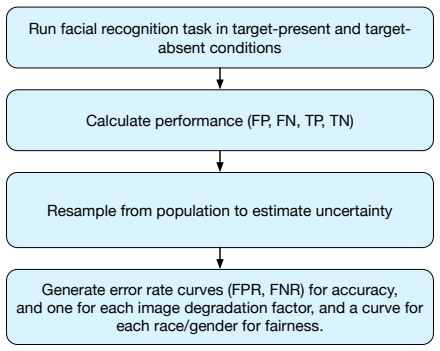
Summary. The paper reports a controlled experiment on how five image degradations (contrast, brightness, motion blur, pose, resolution) affect the accuracy and fairness of a DeepFace/ArcFace 1:n identification system, using 50,000 StyleGAN3 synthetic faces labeled by FairFace. The authors construct a 167-face control database representative of the US census, generate treated images, and compute false positive and false negative rates overall and by race/gender. The central empirical finding, as stated in the Abstract and Section 4, is that false positives peak near baseline quality and decline with degradation, while false negatives increase with degradation, especially for blur and reduced resolution; error rates are generally higher for women and Black individuals. The Discussion, however, contains a sentence claiming both FPR and FNR increase with degradation, which directly contradicts the paper's own figures and text. The paper also includes a comparison of FRT error rates to traditional forensic disciplines and argues that FRT, if properly validated and regulated, remains a valuable investigative tool.
Significance. If the empirical curves are correct, the paper provides a useful experimental template for isolating the effects of specific image-quality factors on FRT accuracy and fairness, and it highlights a counterintuitive pattern (FPR highest at high quality) that is relevant for police practice. The use of synthetic faces allows controlled, gradual degradation at scale, and the resampling-based confidence intervals are a methodological strength. However, the paper's significance is bounded by two threats: the synthetic data and FairFace labels are treated as ground truth, and the Discussion's summary sentence misstates the reported FPR trend. Neither threat invalidates the experimental design, but the first limits external validity and the second must be corrected before the paper can be accepted.
major comments (4)
- [Section 5, first paragraph] The sentence "False positive and false negative rates increase with image degradation" is directly contradicted by the paper's own results in Section 4.1 and Figure 6, which show FPR peaking near baseline and declining as degradation intensifies (the "inverted U-shaped pattern"), and by Section 4.2, which states that FPR disparities "grow less pronounced as degradation intensifies." The Abstract and Section 4.1 correctly describe the FPR trend. Because this Discussion sentence is part of the paper's headline summary and appears verbatim in the reader-facing description, it is a load-bearing internal inconsistency that must be corrected to match the empirical curves.
- [Section A.3 (Pose)] The description of the pose baseline correction is incomplete: the sentence "This shift w" ends mid-word. The reader cannot determine how the pose curve was shifted relative to the other degradation factors, which is necessary to interpret Figure 6 and Figure 7 and to reproduce the analysis. Please provide the full correction formula and the numerical value of the shift.
- [Section 3.2 (Replications)] The paper states "We perform a total of 2^8 = 256 replications" but does not explain how the sample of 167 control and 167 treated faces is redrawn in each replication, nor how the empirical confidence intervals are constructed from these replications. This is central to the uncertainty estimates in Figures 6 and 7. Please clarify the resampling protocol (e.g., independent draws from the 50,000-face population for each replication, or bootstrap over a fixed sample) and report the exact procedure used to obtain the 95% intervals.
- [Sections 2.3 and 5 (External validity)] The paper relies on FairFace labels as ground truth for race/gender and, as stated in the Discussion, "assume[s] the data generation and labeling algorithms have no errors" while also acknowledging that the generated data "could lead to having the data show a narrow type of face." These are not merely minor caveats: the headline claims about "individuals from marginalized race and gender groups" and the comparison to real police images depend on the synthetic faces and labels being adequate proxies for real-world low-quality images. The paper should either explicitly restrict the conclusions to the synthetic distribution or provide additional evidence (e.g., a comparison with a real low-quality face dataset) that the demographic error structure transfers.
minor comments (4)
- [Figure captions and Section 5] The word "Degredation" in the captions of Figures 6 and 7 should be "Degradation," and "eggregious" in Section 5 should be "egregious."
- [Section 3.2] The expression "2 8" should be typeset as "2^8" to avoid ambiguity.
- [References] Reference [56] duplicates Reference [11] (both are FRVT Part 3 demographic effects); please merge or differentiate them.
- [Section 5] The sentence "While this decision provides a conservative estimate of system performance under real-world conditions" references which decision (likely the enforce_detection=False setting) but the antecedent is unclear; please name the setting explicitly.
Circularity Check
No derivation-level circularity: error-rate curves are measured outputs, not fitted inputs; the two self-citations are framing-only and non-load-bearing.
full rationale
The paper's central quantities, FPR and FNR, are defined by the standard formulas in Eqs. (1)-(2) and computed from observed match outcomes of Deepface/ArcFace in a fixed 1:167 identification task; the degradation treatments (contrast, brightness, motion blur, pose, resolution) are exogenous image edits, and the demographic groupings come from FairFace labels. No parameter in this pipeline is fitted to the reported curves and then renamed as a prediction, and no theoretical uniqueness claim is imported to force a choice. The only self-citations ([26], [30]) appear in framing passages about forensic-reform lessons and about methodological criticism of prior firearm-comparison studies; they do not carry any of the experimental results, so they are not load-bearing. The Discussion does contain an internal-consistency problem that is not circularity: Section 5 says 'False positive and false negative rates increase with image degradation,' whereas Section 4.1 reports an 'inverted U-shaped pattern' with degradation acting 'as a kind of natural filter' and Section 4.2 reports FPR disparities 'grow less pronounced as degradation intensifies'; this overstatement is a correctness issue in the summary, not a reduction of output to input. The authors' own limitations (assumption that generation and labeling have no errors; possibility of a 'narrow type of face') are external-validity and measurement-error caveats, not circularity.
Assumptions & free parameters
free parameters (4)
- ArcFace cosine distance threshold T =
Not reported in the paper; DeepFace developer-recommended default was used.
- StyleGAN3 truncation parameter psi =
0.7 (fixed in Section 2.1).
- Pose baseline correction offset =
Difference between pose psi = 0 error rates and the common baseline error rate, computed from the experiment's own data.
- Degradation parameter grids =
Contrast alpha from 0.25 to 4; brightness beta from 0 to 100; blur strength s from 0 to 100; pose psi from -5 to 5…
assumptions (5)
- domain assumption StyleGAN3 faces trained on FFHQ are an adequate proxy for real human faces encountered in police images.
- domain assumption FairFace predictions are correct ground-truth labels for race and gender.
- domain assumption DeepFace with ArcFace at a fixed developer-recommended threshold represents law enforcement FRT use.
- domain assumption Latent-space pose editing with restyle e4e produces pose variation comparable to real-world non-frontal photos.
- standard math Empirical resampling from the synthetic population approximates the sampling distribution of error rates.
Cite this review
Pith. "Pith review of Accuracy and Fairness of Facial Recognition Technology in Low-Quality Police Images: An Experiment With Synthetic Faces." pith.science (2026). https://pith.science/paper/UNWAQGSG
@misc{pith2026250514320,
  author       = {Pith},
  title        = {Pith review of: Accuracy and Fairness of Facial Recognition Technology in Low-Quality Police Images: An Experiment With Synthetic Faces},
  year         = {2026},
  howpublished = {\url{https://pith.science/paper/UNWAQGSG}},
  note         = {Machine review of arXiv:2505.14320}
}
read the original abstract
Facial recognition technology (FRT) is increasingly used in criminal investigations, yet most evaluations of its accuracy rely on high-quality images, unlike those often encountered by law enforcement. This study examines how five common forms of image degradation--contrast, brightness, motion blur, pose shift, and resolution--affect FRT accuracy and fairness across demographic groups. Using synthetic faces generated by StyleGAN3 and labeled with FairFace, we simulate degraded images and evaluate performance using Deepface with ArcFace loss in 1:n identification tasks. We perform an experiment and find that false positive rates peak near baseline image quality, while false negatives increase as degradation intensifies--especially with blur and low resolution. Error rates are consistently higher for women and Black individuals, with Black females most affected. These disparities raise concerns about fairness and reliability when FRT is used in real-world investigative contexts. Nevertheless, even under the most challenging conditions and for the most affected subgroups, FRT accuracy remains substantially higher than that of many traditional forensic methods. This suggests that, if appropriately validated and regulated, FRT should be considered a valuable investigative tool. However, algorithmic accuracy alone is not sufficient: we must also evaluate how FRT is used in practice, including user-driven data manipulation. Such cases underscore the need for transparency and oversight in FRT deployment to ensure both fairness and forensic validity.
Figures


Figures from the paper (4 more)



Forward citations
Cited by 1 Pith paper
-
A Lightweight Ensemble-Based Face Image Quality Assessment Method with Correlation-Aware Loss
An ensemble of MobileNetV3-Small and ShuffleNetV2 with a correlation-aware loss and test-time augmentation reaches SRCC 0.9829 and PLCC 0.9894 on the VQualA FIQA validation set.
Reference graph
Works this paper leans on
-
[1]
A forensic without the science: face recognition in US criminal inves- tigations
Garvie C. A forensic without the science: face recognition in US criminal inves- tigations. Center on Privacy & Technology at Georgetown Law. 2022;6
work page 2022
-
[2]
Clearview AI. Linden L, editor. Consecutive NIST Tests Confirm Su- periority of Clearview AI’s Facial Recognition Platform. Online; 2021. https://www.clearview.ai/press-room/consecutive-nist-tests- confirm-superiority-of-clearview-ais-facial-recognition-platform
work page 2021
-
[3]
Grother P. Face Recognition Vendor Test (FR VT); 2019.https:// www.nist.gov/programs-projects/face-recognition-vendor-test-frvt
work page 2019
-
[4]
MacMillan D, Ovalle D, Schaffer A. Arrested by AI: Police ig- nore standards after facial recognition matches; 2025.https: //www.washingtonpost.com/business/interactive/2025/police- artificial-intelligence-facial-recognition/?itid=sr 0 8204cd4d- 7801-4d64-986f-b99edd2636a1 03abe5cd-4d5a-4f6b-91bf-6a1a2a070092
work page 2025
-
[5]
Sanford A. Artificial Intelligence Is Putting Innocent People at Risk of Being Incarcerated; 2024.https://innocenceproject.org/news/ artificial-intelligence-is-putting-innocent-people-at-risk-of- being-incarcerated/
work page 2024
-
[6]
Learning to under- stand image blur
Zhang S, Shen X, Lin Z, Mˇ ech R, Costeira JP, Moura JM. Learning to under- stand image blur. In: Proceedings of the IEEE conference on computer vision and pattern recognition; 2018. p. 6586-95
work page 2018
-
[7]
Image partial blur detection and classification
Liu R, Li Z, Jia J. Image partial blur detection and classification. In: 2008 IEEE conference on computer vision and pattern recognition. IEEE; 2008. p. 1-8
work page 2008
-
[8]
Face recognition across non-uniform motion blur, illumination, and pose
Punnappurath A, Rajagopalan AN, Taheri S, Chellappa R, Seetharaman G. Face recognition across non-uniform motion blur, illumination, and pose. IEEE Transactions on image processing. 2015;24(7):2067-82. 21
work page 2015
Show all 58 references
-
[9]
Prioritising quality: investigating the influence of image quality on forensic facial comparison
Bacci N, Briers N, Steyn M. Prioritising quality: investigating the influence of image quality on forensic facial comparison. International Journal of Legal Medicine. 2024:1-14
2024
-
[10]
Pixel-Level Face Image Quality Assessment for Explainable Face Recognition
Terh¨ orst P, et al. Pixel-Level Face Image Quality Assessment for Explainable Face Recognition. ResearchGate. 2023. Available from:https://www.researchgate.net/publication/369678929 Pixel- Level Face Image Quality Assessment for Explainable Face Recognition
2023
-
[11]
Face recognition vendor test (fvrt): Part 3, demographic effects
Grother P, Ngan M, Hanaoka K. Face recognition vendor test (fvrt): Part 3, demographic effects. National Institute of Standards and Technology Gaithers- burg, MD; 2019
2019
-
[12]
Accuracy comparison across face recognition algorithms: Where are we on measuring race bias? IEEE transactions on biometrics, behavior, and identity science
Cavazos JG, Phillips PJ, Castillo CD, O’Toole AJ. Accuracy comparison across face recognition algorithms: Where are we on measuring race bias? IEEE transactions on biometrics, behavior, and identity science. 2020;3(1):101-11
2020
-
[13]
Benchmarking Algorithmic Bias in Face Recognition: An Experimental Approach Using Synthetic Faces and Human Evaluation
Liang H, Perona P, Balakrishnan G. Benchmarking Algorithmic Bias in Face Recognition: An Experimental Approach Using Synthetic Faces and Human Evaluation. In: Proceedings of the IEEE/CVF International Conference on Computer Vision; 2023. p. 4977-87
2023
-
[14]
Learning Face Image Qual- ity from Human Assessments
Best-Rowden L, Jain AK. Learning Face Image Qual- ity from Human Assessments. IEEE Transactions on Infor- mation Forensics and Security. 2018;13(12):3064-77. Avail- able from:https://biometrics.cse.msu.edu/Publications/Face/ BestRowdenJain FaceQualityHumanAssessments TIFS2018.pdf
2018
-
[15]
The effect of broad and specific demo- graphic homogeneity on the imposter distributions and false match rates in face recognition algorithm performance
Howard JJ, Sirotin YB, Vemury AR. The effect of broad and specific demo- graphic homogeneity on the imposter distributions and false match rates in face recognition algorithm performance. In: 2019 ieee 10th international conference on biometrics theory, applications and system...
2019
-
[16]
Quantifying the extent to which race and gender features determine identity in commercial face recognition algorithms
Howard JJ, Sirotin YB, Tipton JL, Vemury AR. Quantifying the extent to which race and gender features determine identity in commercial face recognition algorithms. arXiv preprint arXiv:201007979. 2020
2020
-
[17]
Disparate impact in facial recognition stems from the broad homogeneity effect: A case study and method to resolve
Howard JJ, Laird EJ, Sirotin YB. Disparate impact in facial recognition stems from the broad homogeneity effect: A case study and method to resolve. In: International Conference on Pattern Recognition. Springer; 2022. p. 448-64. 22
2022
-
[18]
Evaluat- ing proposed fairness models for face recognition algorithms
Howard JJ, Laird EJ, Rubin RE, Sirotin YB, Tipton JL, Vemury AR. Evaluat- ing proposed fairness models for face recognition algorithms. In: International Conference on Pattern Recognition. Springer; 2022. p. 431-47
2022
-
[19]
Reformer TM, editor; 2025.https://minnesotareformer.com/2025/ 02/04/facial-recognition-in-policing-is-getting-state-by-state- guardrails/
Gross P. Reformer TM, editor; 2025.https://minnesotareformer.com/2025/ 02/04/facial-recognition-in-policing-is-getting-state-by-state- guardrails/
2025
-
[20]
Challenging facial recognition software in criminal court
Jackson K. Challenging facial recognition software in criminal court. The Cham- pion. 2019:14-26
2019
-
[21]
State of New Jersey vs
Superior Court of New Jersey Appellate Division. State of New Jersey vs. Francisco Arteaga. Docket No. A-3078-21; 2023
2023
-
[22]
NA, editor
ACLU. NA, editor. New Jersey Appellate Division One of First Courts in Country to Rule on Constitutional Rights Related to Facial Recognition Technologies. NA; 2023. https://www.aclu-nj.org/en/press-releases/new-jersey- appellate-division-one-first-courts-country-rule-constitu...
2023
-
[23]
Confronting the biased algorithm: the danger of admitting fa- cial recognition technology results in the courtroom
Haddad GM. Confronting the biased algorithm: the danger of admitting fa- cial recognition technology results in the courtroom. Vand J Ent & Tech L. 2020;23:891
2020
-
[24]
Face-to-face with facial recognition evidence: Admissibility under the post-crawford confrontation clause
Celentino JC. Face-to-face with facial recognition evidence: Admissibility under the post-crawford confrontation clause. Mich L Rev. 2015;114:1317
2015
-
[25]
NA, editor
PCAST Working Group. NA, editor. Forensic science in criminal courts: En- suring scientific validity of feature-comparison methods. Washington, DC, USA: President’s Council of Advisors on Science and Technology (US); 2016
2016
-
[26]
Reliability and Validity of Forensic Science Evidence
Stern HS, Cuellar M, Kaye DH. Reliability and Validity of Forensic Science Evidence. Significance. 2019;16(2):21-4
2019
-
[27]
Ongoing face recognition vendor test (FR VT) part 1: Verification
Grother P, Ngan M, Hanaoka K. Ongoing face recognition vendor test (FR VT) part 1: Verification. National Institute of Standards and Technology. 2019
2019
-
[28]
Accuracy and reliability of forensic latent fingerprint decisions
Ulery BT, Hicklin RA, Buscaglia J, Roberts MA. Accuracy and reliability of forensic latent fingerprint decisions. Proceedings of the National Academy of Sciences. 2011;108(19):7733-8. Available from:https://www.pnas.org/doi/ abs/10.1073/pnas.1018707108. 23
2011 doi
-
[29]
A study of false-positive and false-negative error rates in cartridge case comparisons
Baldwin DP, Bajic SJ, Morris M, Zamzow D. A study of false-positive and false-negative error rates in cartridge case comparisons. Technical report; 2014
2014
-
[30]
Methodological problems in every black-box study of forensic firearm comparisons
Cuellar M, Vanderplas S, Luby A, Rosenblum M. Methodological problems in every black-box study of forensic firearm comparisons. Law, Probability and Risk. 2024 12;23(1):mgae015. Available from:https://doi.org/10.1093/lpr/ mgae015
2024 doi
-
[31]
FRCSyn Challenge at W ACV 2024: Face Recognition Challenge in the Era of Synthetic Data
Melzi P, Tolosana R, Vera-Rodriguez R, Kim M, Rathgeb C, Liu X, et al. FRCSyn Challenge at W ACV 2024: Face Recognition Challenge in the Era of Synthetic Data. In: Proceedings of the IEEE/CVF Winter Conference on Applications of Computer Vision Workshops; 2024. Available from:...
2024 arXiv
-
[32]
The Impact of Balancing Real and Synthetic Data on Accuracy and Fairness in Face Recognition
Atzori A, Cosseddu P, Fenu G, Marras M. The Impact of Balancing Real and Synthetic Data on Accuracy and Fairness in Face Recognition. arXiv preprint arXiv:240902867. 2024. Available from:https://arxiv.org/abs/2409.02867
2024 arXiv
-
[33]
Synthetic to Authentic: Transferring Realism to 3D Face Renderings for Face Recognition
Rahimi P, et al. Synthetic to Authentic: Transferring Realism to 3D Face Renderings for Face Recognition. In: Proceedings of the European Conference on Computer Vision (ECCV); 2024. Available from:https://arxiv.org/html/ 2407.07627v2
2024 arXiv
-
[34]
Alias- free generative adversarial networks
Karras T, Aittala M, Laine S, H¨ ark¨ onen E, Hellsten J, Lehtinen J, et al. Alias- free generative adversarial networks. Advances in neural information processing systems. 2021;34:852-63
2021
-
[35]
Third time’s the charm? image and video editing with stylegan3
Alaluf Y, Patashnik O, Wu Z, Zamir A, Shechtman E, Lischinski D, et al. Third time’s the charm? image and video editing with stylegan3. In: European Conference on Computer Vision. Springer; 2022. p. 204-20
2022
-
[36]
Examining Pathological Bias in a Generative Adversarial Network Discriminator: A Case Study on a StyleGAN3 Model
Grissom II A, Lei RF, Neto JFSR, Lin B, Trotter R. Examining Pathological Bias in a Generative Adversarial Network Discriminator: A Case Study on a StyleGAN3 Model. arXiv preprint arXiv:240209786. 2024
2024
-
[37]
A style-based generator architecture for generative adversarial networks
Karras T, Laine S, Aila T. A style-based generator architecture for generative adversarial networks. In: Proceedings of the IEEE/CVF conference on computer vision and pattern recognition; 2019. p. 4401-10
2019
-
[38]
Exposing GAN- generated profile photos from compact embeddings
Mundra S, Porcile GJA, Marvaniya S, Verbus JR, Farid H. Exposing GAN- generated profile photos from compact embeddings. In: Proceedings of the 24 IEEE/CVF Conference on Computer Vision and Pattern Recognition; 2023. p. 884-92
2023
-
[39]
Studying bias in gans through the lens of race
Maluleke VH, Thakkar N, Brooks T, Weber E, Darrell T, Efros AA, et al. Studying bias in gans through the lens of race. In: European Conference on Computer Vision. Springer; 2022. p. 344-60
2022
-
[40]
MRMCsamplesize: An R Package for Esti- mating Sample Sizes for Multi-Reader Multi-Case Studies
Robert D, Sathyamurthy S, Putha P. MRMCsamplesize: An R Package for Esti- mating Sample Sizes for Multi-Reader Multi-Case Studies. medRxiv. 2023:2023- 09
2023
-
[41]
Fairface: Face attribute dataset for balanced race, gender, and age for bias measurement and mitigation
Karkkainen K, Joo J. Fairface: Face attribute dataset for balanced race, gender, and age for bias measurement and mitigation. In: Proceedings of the IEEE/CVF winter conference on applications of computer vision; 2021. p. 1548-58
2021
-
[42]
Gandiffface: Controllable generation of synthetic datasets for face recog- nition with realistic variations
Melzi P, Rathgeb C, Tolosana R, Vera-Rodriguez R, Lawatsch D, Domin F, et al. Gandiffface: Controllable generation of synthetic datasets for face recog- nition with realistic variations. In: Proceedings of the IEEE/CVF International Conference on Computer Vision; 2023. p. 3086-95
2023
-
[43]
Age boundaries in juvenile justice systems
Association NG, et al. Age boundaries in juvenile justice systems. Washington, DC: National Governors Association. 2021
2021
-
[44]
Juvenile Offenders Ordinance, Cap
Hong Kong SAR Government. Juvenile Offenders Ordinance, Cap. 226
-
[45]
Age of criminal responsibility; 2025
UK Government. Age of criminal responsibility; 2025. Accessed: 2025-05-16. Available from:https://www.gov.uk/age-of-criminal-responsibility
2025
-
[46]
Minimum age of criminal responsibility; 2025
Attorney-General’s Department, Government of South Australia. Minimum age of criminal responsibility; 2025. Accessed: 2025-05-16. Avail- able from:https://www.agd.sa.gov.au/law-and-justice/consultation/ minimum-age-of-criminal-responsibility
2025
-
[47]
2020 Census Redistricting Data (Public Law 94-171) Summary File; 2021
U S Census Bureau. 2020 Census Redistricting Data (Public Law 94-171) Summary File; 2021. Accessed: 2025-05-07. Available from:https:// www.census.gov/data/datasets/2020/dec/2020-redistricting-data.html
2020
-
[48]
The OpenCV Library
Bradski G. The OpenCV Library. Dr Dobb’s Journal of Software Tools. 2000. 25
2000
-
[49]
Blur-Generator: Simulates realistic blur on images using Python; 2023
Lee N. Blur-Generator: Simulates realistic blur on images using Python; 2023. Accessed: 2025-05-07. Available from:https://github.com/NatLee/Blur- Generator
2023
-
[50]
Interpreting the latent space of gans for semantic face editing
Shen Y, Gu J, Tang X, Zhou B. Interpreting the latent space of gans for semantic face editing. In: Proceedings of the IEEE/CVF conference on computer vision and pattern recognition; 2020. p. 9243-52
2020
-
[51]
LightFace: A Hybrid Deep Face Recognition Frame- work
Serengil SI, Ozpinar A. LightFace: A Hybrid Deep Face Recognition Frame- work. In: 2020 Innovations in Intelligent Systems and Applications Confer- ence (ASYU). IEEE; 2020. p. 23-7. Available from:https://doi.org/10.1109/ ASYU50717.2020.9259802
2020
-
[52]
Retinaface: Single-shot multi- level face localisation in the wild
Deng J, Guo J, Ververas E, Kotsia I, Zafeiriou S. Retinaface: Single-shot multi- level face localisation in the wild. In: Proceedings of the IEEE/CVF conference on computer vision and pattern recognition; 2020. p. 5203-12
2020
-
[53]
Arcface: Additive angular margin loss for deep face recognition
Deng J, Guo J, Xue N, Zafeiriou S. Arcface: Additive angular margin loss for deep face recognition. In: Proceedings of the IEEE/CVF conference on computer vision and pattern recognition; 2019. p. 4690-9
2019
-
[54]
Face recognition oak ridge (faro): A framework for distributed and scalable biometrics applications
Bolme DS, Srinivas N, Brogan J, Cornett D. Face recognition oak ridge (faro): A framework for distributed and scalable biometrics applications. In: 2020 IEEE International Joint Conference on Biometrics (IJCB). IEEE; 2020. p. 1-8
2020
-
[55]
FR VT 1:1 Verification Visa Results; n.d
of Standards NI, Technology. FR VT 1:1 Verification Visa Results; n.d. Accessed: 2025-05-16.https://pages.nist.gov/frvt/plots/11/visa.html
2025
-
[56]
NA, editor
Grother P, Ngan M, Hanaoka K. NA, editor. Face Recognition Vendor Test (FR VT), Part 3: Demographic Effects. NA; 2019
2019
-
[57]
Replicating Gimp’s brightness/contrast adjustment in python
Greenawalt J. Replicating Gimp’s brightness/contrast adjustment in python. Medium. 2023 21 December. Available from:https: //medium.com/@jsgreenawalt/replicating-gimps-brightness-contrast- adjustment-in-python-e9c962391162. 26
2023
-
[2022]
Point in time: 01/07/2022.https://www.elegislation.gov.hk/hk/ cap226?xpid=ID 1438402856544 001
2022
Reviewed August 7, 2026 · model on record in the stance chip above.
Discussion (0). Continue with ORCID to comment.