REVIEW 3 major objections 5 minor 103 references
Kaleidoscope Gallery: Exploring Ethics and Generative AI Through Art
T0 review · 3 major / 5 minor · reviewed 2026-08-07 · deepseek-v4-flash
Pith's one-line read This paper claims that DALL-E 3, asked to picture five ethical theories, produces a visual grammar of morality that experts read as Western, hierarchical, and biased by gender and geography.
desk verdict A genuinely useful art-based method for probing how T2I models visualize ethics, undercut by a headline generalization the closed evaluation loop cannot support. read the letter →
The pith
A machine-rendered reading of the paper's core claim, the machinery that carries it, and where it could break.
The reading
What carries the argument
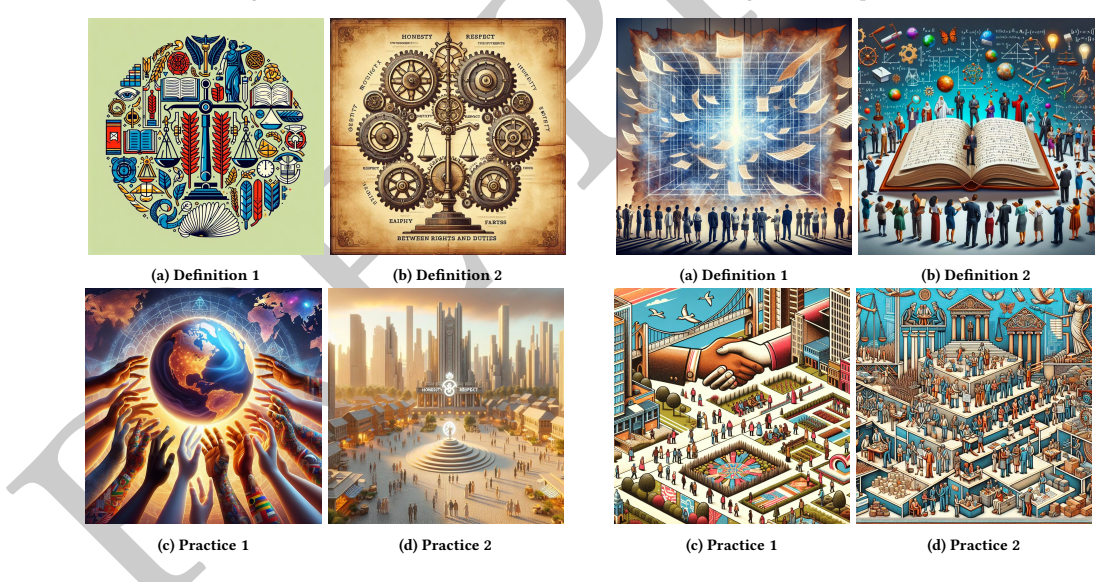
The mechanism that carries the argument is a closed human-in-the-loop pipeline. Ten ethics experts first supply definitions and practices of ethical theories; inductive coding reduces those accounts to five families (Virtue, Duty-based, Consequentialism, Contractualism, Pluralism) and to paired 'definition' and 'practice' prompts; DALL-E 3 renders each prompt twice, producing the twenty-image Kaleidoscope Gallery; the same experts then interpret the images grouped by family; and iterative thematic analysis turns their commentary into the eight-theme codebook. The physical kaleidoscope shown to participants at the start of the formative interviews is the design probe that primes the 'ever-changing' framing linking ethics and generative models. The eight-theme codebook is the key diagnostic object: it converts subjective expert commentary into a reusable vocabulary for detecting the model's biases.
What would settle it
Have a fresh panel of evaluators, blind to the prompts and to the family grouping, tag the same twenty Kaleidoscope Gallery images for the eight themes; the claim predicts the Western, hierarchical, and gender-and-geography pattern will reproduce, while the closed-loop alternative predicts it will weaken or shift.
Extended reading notes
Core claim
In the paper's telling, the discovery is that DALL-E 3 can translate abstract ethical theories into images that expert viewers recognize as coherent visualizations of those theories, but the visual language of those images is systematically lopsided. The ten expert participants described images in terms of an internal moral compass, cosmic and religious imagery, scales and legal symbols, structured and hierarchical governance, and learned symbolic associations; they also flagged male-coded moral exemplars in virtue ethics, the Americas foregrounded in duty-based images, sexualized depictions of women in contractualism, and US-centered or stereotyped portrayals of global cultures. From these readings the paper builds three categories (morality, society, learned associations), eight themes, and seventeen sub-themes, and it concludes that the model is hierarchical in social construct, western in worldview, and biased in gender and geography—even while succeeding at conceptualizing complex ethical concepts.
Load-bearing premise
The claim assumes that the ten experts' evaluations measure DALL-E 3's own representations rather than re-reading the definitions those same experts supplied for the prompts—a concern the paper itself acknowledges through its Western institutional framing, family-grouped presentation, and small twenty-image sample.
Editorial extensions
If this is right
- AI-generated illustrations of abstract ideas should be treated as culturally positioned artifacts, not neutral diagrams, especially when used in classrooms, newsrooms, or public policy materials.
- The eight-theme codebook gives researchers a transferable vocabulary for auditing text-to-image models, so bias checks need not start from scratch with every new model.
- Separating 'definition' from 'practice' prompts proved generative; applying the same two-track prompting to other abstract concepts such as fairness, privacy, or justice could expose where a model's conceptual grammar shifts between theory and application.
- Because the paper deliberately chose DALL-E 3 for its prompt-following ability, a direct corollary is that other text-to-image models should be expected to produce different and possibly less biased visual grammars, and the paper explicitly calls for such comparisons.
- The findings strengthen the case for participatory and community-centered design of generative systems, since the bias pattern is visible to domain experts but not to a purely technical evaluation.
Reading between the lines
- A testable extension: turn the eight-theme codebook into a quantitative probe—generate a fixed prompt set, count occurrences of male-coded exemplars, Western geography, scales, and blue-orange palettes, and compare across models or prompt variants.
- An implication the paper leaves implicit: running the same pipeline with non-Western ethical traditions (the paper notes its own Western skew) would likely require new themes, not a simple reversal of the existing ones.
- A caution supported by the paper's own limitations: because experts saw images grouped by family and knew the study's purpose, a blind replication would separate model-level bias from expectation-driven reading.
- If the hierarchy and geography findings generalize, they may point to a broader compositional bias in text-to-image models—social pyramids and US-centered maps could appear just as readily for abstract concepts such as order, progress, or community.
Editorial analysis
A structured set of objections, weighed in public.
Referee Report
Summary. The paper presents a qualitative, art-based study ('Kaleidoscope Gallery') in which ten ethics experts were first interviewed about ethical theories, their responses were distilled into five ethical families (Virtue, Duty-based, Consequentialism, Contractualism, Pluralism) and two prompts per family (definition and practice), and DALL-E 3 was used to generate twenty images. The same ten experts then evaluated the images, which were grouped by ethical family, during follow-up interviews. Thematic analysis of those evaluations yielded three categories, eight themes, and seventeen sub-themes, and the paper argues that the images reveal how T2I models visually and conceptually represent ethical theories, while also exhibiting western, hierarchical, gendered, and geographic biases. The paper positions the work within Visual Ethics, critical AI art, and research-through-design, and it closes with cautions, limitations, and future work.
Significance. If the central claims are accepted, the paper offers a novel methodological contribution: using generative imagery and expert interpretation as a critical lens on T2I models' representation of complex philosophical concepts. The study is transparent about its qualitative coding process (consensus then split coding, three-step iterative analysis), provides participant quotes and image references for each theme, and acknowledges several limitations in §5.4. The eight themes in Table 2 could serve as a useful vocabulary for discussing how AI-generated imagery encodes moral, social, and symbolic content. However, the significance is currently constrained by the study's closed evaluation loop and by the gap between the evidence gathered (ten experts, twenty images, one model) and the generalizing language used in the abstract and §5.3. The work's value as a design exploration and critical provocation is clear; its value as an empirical measurement of T2I model properties is not yet established.
major comments (3)
- [§3.2, §3.3, §3.5, §5.3] The load-bearing claim in §5.3 that T2I models are 'hierarchical in social construct, western in worldview, and biased in gender and geography' is not supported by the study design, because the evaluation loop is closed: the same ten experts supplied the ethical-theory definitions from which the prompts were built (§3.2, §3.3), and the same experts then judged images they knew were grouped by ethical family (§3.5). The evaluation therefore functions partly as a member-check of the prompt source rather than an independent measurement of model properties. To support the bias attribution, the paper should either reframe the claim as describing the human-AI-human loop (experts, prompts, images, experts) or add an independent validation step, such as blind presentation of unlabelled images, a fresh evaluator panel, or baseline prompts unrelated to the expert interviews.
- [§3.4, §5.3, §5.4] The plural 'T2I models' in §5.3 and in the abstract overgeneralizes from a single model and a small sample. Images were generated only with DALL-E 3 (§3.4), with two prompts per family and two images per prompt, yielding twenty images total. Section 5.4 acknowledges that this 'small sample might limit potential arguments about inherent bias within the models,' but the wording of the central finding in §5.3 does not carry that caveat. The authors should either restrict the claim to DALL-E 3 or present comparative evidence from additional T2I models, as planned in §5.4.
- [§1, §3.5, §5.3] The distinction between RQ1 (visual representation) and RQ2 (conceptual representation) is not operationalized. Both research questions are answered with the same evidence: expert interpretations of images that were grouped by family and prompted by expert-derived definitions. The abstract and §5.3 use 'conceptualize complex concepts,' but the paper does not define what would count as conceptual representation as opposed to visual representation, especially given the paper's own citation of West et al. (§2.1.2) noting that generative capability may not entail understanding. The claim that T2I models 'conceptualize' ethical theories therefore needs either a stated operational definition or a more cautious phrasing, such as 'prompt-conditioned visual synthesis that experts read as conceptually meaningful.'
minor comments (5)
- [Figure 2] The summary of study procedure in Figure 2 labels the final analysis step 'Section 1,' but the methodology and analysis are described in Section 3; the label appears to be a leftover placeholder and should be corrected.
- [§4.6.2] The text reads 'a classic symbol respresenting justice'; 'respresenting' is a typo for 'representing.'
- [§5.1] The phrase 'GenAI models and ethical theories' are seemingly static yet dynamic' mixes singular and plural agreement and reads awkwardly; it should be rephrased.
- [§4.3.1] The abbreviation 'NSFW' is introduced without expansion; please define it at first use (e.g., 'not safe for work (NSFW)').
- [References] Reference [19] cites a Wikipedia page version for Fricker's concept of epistemic injustice; the authors should cite the primary source (M. Fricker, 'Epistemic Injustice: Power and the Ethics of Knowing,' Oxford University Press, 2007) instead of or in addition to the encyclopedia entry.
Circularity Check
Central bias claim rests on a closed expert-prompt-expert loop: same experts supplied definitions used to build prompts and then judged family-labeled images, making the 'T2I model bias' attribution partly a member-check of the prompt source.
-
fitted input called prediction
[§3.2–§3.5 with claim in §5.3]
"First, we found that T2I models were able to conceptualize complex concepts, as highlighted in our themes, however, as determined by our experts, showed to be hierarchical in social construct, western in worldview, and biased in gender and geography (RQ1). ... The generated images were grouped according to their corresponding ethical family and presented to the experts in a 30-minute follow-up interview ... we identified the five families of ethical theories spun from both selected and participant-introduced ethical theories."
The prompt content is fitted to the ten experts' own definitions (§3.2: 'participants were asked to detail their understanding of seven prominent ethical theories'; §3.3: five families 'spun from both selected and participant-introduced ethical theories'), and the same experts then evaluate the family-labeled images (§3.5). The §5.3 inference about 'T2I models' therefore measures whether experts recognize their own prior definitions in the model's rendering of prompts built from those definitions, not model behavior independently. Gender, geographic, and hierarchical attributions are read onto images whose provenance and grouping the evaluators knew, so those attributions are partly constructed by the study loop.
full rationale
The paper is not circular via self-citation: background citations are external, the kaleidoscope metaphor is borrowed, and no uniqueness theorem is invoked. The circularity is the empirical loop. In §3.2 the same ten experts supplied the theory definitions; §3.3 coded those into the five prompt families; §3.4 DALL-E 3 generated images; §3.5 the same experts, seeing family-labeled exhibits, evaluated them. The §5.3 conclusion about model-level bias is therefore partly a re-description of the evaluators' own inputs: the prompts are a re-encoding of expert concepts, so the evaluation functions as a member-check of the prompt source. Some independent content remains (composition, color, symbolism, and the model's actual renderings), so the paper is not entirely reducible to its inputs; the score is 6 rather than 8-10. The paper's explicit limitations in §5.4 partially mitigate the over-generalization but do not remove the circularity from the §5.3 wording.
Assumptions & free parameters
free parameters (5)
- Five-family taxonomy =
Virtue, Duty-based, Consequentialism, Contractualism, Pluralism
- Definition/practice prompt split =
2 prompts per family
- Images per family =
4 (2 per prompt)
- Model choice =
DALL-E 3
- Expert panel =
n=10, snowball-sampled, Western institution
assumptions (4)
- domain assumption Ten expert interviews provide a valid foundation for the space of ethical theories
- domain assumption DALL-E 3 outputs can be read as 'the model's representation' of the prompt
- domain assumption Expert evaluation is not unduly influenced by known family labels
- domain assumption Two-researcher coding without an inter-rater reliability statistic is reliable
invented entities (2)
-
Kaleidoscope Gallery
-
Five ethical families taxonomy
Cite this review
Pith. "Pith review of Kaleidoscope Gallery: Exploring Ethics and Generative AI Through Art." pith.science (2026). https://pith.science/paper/QUZTSUOA
@misc{pith2026250514758,
  author       = {Pith},
  title        = {Pith review of: Kaleidoscope Gallery: Exploring Ethics and Generative AI Through Art},
  year         = {2026},
  howpublished = {\url{https://pith.science/paper/QUZTSUOA}},
  note         = {Machine review of arXiv:2505.14758}
}
read the original abstract
Ethical theories and Generative AI (GenAI) models are dynamic concepts subject to continuous evolution. This paper investigates the visualization of ethics through a subset of GenAI models. We expand on the emerging field of Visual Ethics, using art as a form of critical inquiry and the metaphor of a kaleidoscope to invoke moral imagination. Through formative interviews with 10 ethics experts, we first establish a foundation of ethical theories. Our analysis reveals five families of ethical theories, which we then transform into images using the text-to-image (T2I) GenAI model. The resulting imagery, curated as Kaleidoscope Gallery and evaluated by the same experts, revealed eight themes that highlight how morality, society, and learned associations are central to ethical theories. We discuss implications for critically examining T2I models and present cautions and considerations. This work contributes to examining ethical theories as foundational knowledge that interrogates GenAI models as socio-technical systems.
Figures


Figures from the paper (2 more)

Reference graph
Works this paper leans on
-
[1]
Evgeni Aizenberg and Jeroen van den Hoven. 2020. Designing for human rights in AI. https://doi.org/10.1177/2053951720949566
-
[2]
Baraniuk
Sina Alemohammad, Josue Casco-Rodriguez, Lorenzo Luzi, Ahmed Imtiaz Hu- mayun, Hossein Babaei, Daniel LeJeune, Ali Siahkoohi, and Richard G. Baraniuk
-
[3]
Larry Alexander and Michael Moore. 2024. Deontological Ethics. In The Stanford Encyclopedia of Philosophy (winter 2024 ed.), Edward N. Zalta and Uri Nodelman (Eds.). Metaphysics Research Lab, Stanford University. https://plato.stanford. edu/archives/win2024/entries/ethics-deontological/
2024
-
[4]
Prithviraj Ammanabrolu, Liwei Jiang, Maarten Sap, Hannaneh Hajishirzi, and Yejin Choi. 2022. Aligning to Social Norms and Values in Interactive Narratives. https://doi.org/10.48550/arXiv.2205.01975 arXiv:2205.01975
-
[5]
Elizabeth Ashford and Tim Mulgan. 2018. Contractualism. In The Stanford Encyclopedia of Philosophy (summer 2018 ed.), Edward N. Zalta (Ed.). Metaphysics Research Lab, Stanford University. https://plato.stanford.edu/archives/sum2018/ entries/contractualism/
2018
-
[6]
Bennett, Cecilia Chi-Ham, Geoffrey Barrows, Steven Sexton, and David Zilberman
Alan B. Bennett, Cecilia Chi-Ham, Geoffrey Barrows, Steven Sexton, and David Zilberman. 2013. Agricultural Biotechnology: Economics, Environment, Ethics, and the Future. Annual Review of Environment and Resources 38, 1 (2013), 249–279. https://doi.org/10.1146/annurev-environ-050912-124612 _eprint: https://doi.org/10.1146/annurev-environ-050912-124612
-
[7]
James Betker, Gabriel Goh, Li Jing, Tim Brooks, Jianfeng Wang, Linjie Li, Long Ouyang, Juntang Zhuang, Joyce Lee, Yufei Guo, Wesam Manassra, Prafulla Dhari- wal, Casey Chu, Yunxin Jiao, and Aditya Ramesh. 2023. Improving Image Gener- ation with Better Captions. (2023)
2023
-
[8]
Camilla Bignotti and Carolina Camassa. 2024. Legal Minds, Algorithmic De- cisions: How LLMs Apply Constitutional Principles in Complex Scenarios. https://doi.org/10.48550/arXiv.2407.19760 arXiv:2407.19760
work page Pith review arXiv doi:10.48550/arxiv.2407.19760 2024
Show all 103 references
-
[9]
Charlotte Bird, Eddie Ungless, and Atoosa Kasirzadeh. 2023. Typology of Risks of Generative Text-to-Image Models. In Proceedings of the 2023 AAAI/ACM Conference on AI, Ethics, and Society . ACM, Montr\’{e}al QC Canada, 396–410. https://doi.org/10.1145/3600211.3604722
2023
-
[10]
Maarten Buyl, Alexander Rogiers, Sander Noels, Iris Dominguez-Catena, Edith Heiter, Raphael Romero, Iman Johary, Alexandru-Cristian Mara, Jefrey Lijffijt, and Tijl De Bie. 2024. Large Language Models Reflect the Ideology of their Creators. http://arxiv.org/abs/2410.18417 arXiv...
2024 arXiv
-
[11]
Michaud, Jacob Pfau, Dmitrii Krasheninnikov, Xin Chen, Lauro Langosco, Peter Hase, Erdem Bıyık, Anca Dragan, David Krueger, Dorsa Sadigh, and Dylan Hadfield-Menell
Stephen Casper, Xander Davies, Claudia Shi, Thomas Krendl Gilbert, Jérémy Scheurer, Javier Rando, Rachel Freedman, Tomasz Korbak, David Lindner, Pe- dro Freire, Tony Wang, Samuel Marks, Charbel-Raphaël Segerie, Micah Carroll, Andi Peng, Phillip Christoffersen, Mehul Damani, St...
2023 arXiv
- [12]
-
[13]
Kientz, Jason Yip, and Caroline Pitt
Aayushi Dangol, Michele Newman, Robert Wolfe, Jin Ha Lee, Julie A. Kientz, Jason Yip, and Caroline Pitt. 2024. Mediating Culture: Cultivating Socio-cultural Understanding of AI in Children through Participatory Design. In Designing Interactive Systems Conference . ACM, IT Univ...
2024
-
[14]
Antonio Daniele and Yi-Zhe Song. 2019. AI + Art = Human. In Proceedings of the 2019 AAAI/ACM Conference on AI, Ethics, and Society . ACM, Honolulu HI USA, 155–161. https://doi.org/10.1145/3306618.3314233
2019
-
[15]
Ernest. 2018. Pictograms and Ideograms - Origin and History. https://citrinitas. com/a-history-of-visual-communication-pictograms-and-ideograms/
2018
-
[16]
Hugging Face. 2024. What is Text-to-Image? https://huggingface.co/tasks/text- to-image
2024
-
[17]
Maria Flis and Karol Piotrowski. 2024. The Conceptual Metaphor as an Ethical Kaleidoscope in Field Research. Qualitative Sociology Review 20, 1 (Jan. 2024), 30–41. https://doi.org/10.18778/1733-8077.20.1.03
2024 doi
-
[18]
Interaction Design Foundation. 2016. What is Color Theory? https://www. interaction-design.org/literature/topics/color-theory
2016
-
[19]
Miranda Fricker. 2024. Epistemic injustice. https://en.wikipedia.org/w/index. php?title=Epistemic_injustice&oldid=1251981459 Page Version ID: 1251981459
2024
-
[20]
Batya Friedman and David G. Hendry. 2019. Value Sensitive Design: Shaping Technology with Moral Imagination. The MIT Press. https://mitpress.mit.edu/ 9780262039536/value-sensitive-design/
2019
-
[21]
Iason Gabriel. 2020. Artificial Intelligence, Values and Alignment. Minds and Machines 30, 3 (Sept. 2020), 411–437. https://doi.org/10.1007/s11023-020-09539-2 arXiv:2001.09768 [cs]
2020 arXiv
-
[22]
Ainur Gainetdinov. 2023. Diffusion Models vs GANs vs VAEs: Comparison of Deep Generative Models. https://pub.towardsai.net/diffusion-models-vs-gans- vs-vaes-comparison-of-deep-generative-models-67ab93e0d9ae
2023
-
[23]
Alexandre Gefen, Léa Saint-Raymond, and Tommaso Venturini. 2021. AI for Digital Humanities and Computational Social Sciences.Lecture Notes in Computer Science (2021). https://doi.org/10.1007/978-3-030-69128-8_12
2021 doi
-
[24]
Sourojit Ghosh. 2024. Interpretations, Representations, and Stereotypes of Caste within Text-to-Image Generators. https://arxiv.org/html/2408.01590v1
2024 arXiv
-
[25]
Trystan S. Goetze. 2024. Ai Art is Theft: Labour, Extraction, and Exploitation, or, on the Dangers of Stochastic Pollocks. Proceedings of the 2024 Acm Conference on Fairness, Accountability, and Transparency (2024), 186–196
2024
-
[26]
Wilson Wen Bin Goh and Chun Chau Sze. 2019. AI Paradigms for Teach- ing Biotechnology. Trends in Biotechnology (2019). https://doi.org/10.1016/ J.TIBTECH.2018.09.009
2019
-
[27]
Leo A. Goodman. 1961. Snowball Sampling. The Annals of Mathematical Statistics 32, 1 (1961), 148 – 170. https://doi.org/10.1214/aoms/1177705148
1961
-
[28]
Jan-Christoph Heilinger. 2022. The Ethics of AI Ethics. A Constructive Critique. Philosophy & Technology 35, 3 (July 2022), 61. https://doi.org/10.1007/s13347- 022-00557-9
2022 doi
-
[30]
Dan Hendrycks, Collin Burns, Steven Basart, Andrew Critch, Jerry Li, Dawn Song, and Jacob Steinhardt. 2023. Aligning AI With Shared Human Values. http://arxiv.org/abs/2008.02275 arXiv:2008.02275 [cs]
2023 arXiv
-
[31]
John Hospers. 1954. The Concept of Artistic Expression. Proceedings of the Aristotelian Society 55 (1954), 313–344. https://www.jstor.org/stable/4544551 Publisher: [Aristotelian Society, Wiley]
1954
-
[32]
Rosalind Hursthouse and Glen Pettigrove. 2023. Virtue Ethics. In The Stanford Encyclopedia of Philosophy (fall 2023 ed.), Edward N. Zalta and Uri Nodelman (Eds.). Metaphysics Research Lab, Stanford University. https://plato.stanford. edu/archives/fall2023/entries/ethics-virtue/
2023
-
[33]
Shir Iluz, Yael Vinker, Amir Hertz, Daniel Berio, Daniel Cohen-Or, and Ariel Shamir. 2023. Word-As-Image for Semantic Typography. http://arxiv.org/abs/ 2303.01818 arXiv:2303.01818 [cs]
2023 arXiv
-
[34]
Lam, Minh Chau Mai, Jeff Hancock, and Michael S
Chenyan Jia, Michelle S. Lam, Minh Chau Mai, Jeff Hancock, and Michael S. Bernstein. 2023. Embedding Democratic Values into Social Media AIs via Societal Objective Functions. arXiv:2307.13912 [cs.HC]
2023 arXiv
- [35]
-
[36]
Mark Johnson. 1994. Moral Imagination: Implications of Cognitive Science for Ethics. University of Chicago Press, Chicago, IL. https://press.uchicago.edu/ucp/ books/book/chicago/M/bo3684141.html
1994
- [37]
-
[38]
Zachary Kenton, Tom Everitt, Laura Weidinger, Iason Gabriel, Vladimir Mikulik, and Geoffrey Irving. 2021. Alignment of Language Agents. http://arxiv.org/abs/ 2103.14659 arXiv:2103.14659 [cs]
2021 arXiv
-
[39]
Kurt Koffka. 2014. Perception: An Introduction To The Gestalt Theory: A Classic Article in the History of Psychology . www.all-about-psychology.com
2014
-
[40]
Olya Kudina and Ibo van de Poel. 2024. A sociotechnical system perspective on AI. Minds and Machines 34, 3 (June 2024), 21. https://doi.org/10.1007/s11023- 024-09680-2
2024 doi
-
[41]
George Lakoff and Mark Johnson. 2003. Metaphors We Live By . University of Chicago Press, Chicago, IL. https://press.uchicago.edu/ucp/books/book/chicago/ M/bo3637992.html
2003
-
[42]
Hannah Landecker. 1999. Between Beneficence and Chattel: The Human Bi- ological in Law and Science. Science in Context 12, 1 (April 1999), 203–225. https://doi.org/10.1017/S0269889700003367 Publisher: Cambridge University Press
1999 doi
-
[43]
Dabae Lee, Sheunghyun Yeo, Dabae Lee, and Sheunghyun Yeo. 2022. Developing an AI-based chatbot for practicing responsive teaching in mathematics. (2022). https://doi.org/10.1016/J.COMPEDU.2022.104646
2022
-
[44]
Harrison Lee, Samrat Phatale, Hassan Mansoor, Kellie Lu, Thomas Mesnard, Colton Bishop, Victor Carbune, and Abhinav Rastogi. 2023. RLAIF: Scaling Reinforcement Learning from Human Feedback with AI Feedback. http://arxiv. org/abs/2309.00267 arXiv:2309.00267 [cs]
2023 arXiv
-
[45]
Long Lian, Boyi Li, Adam Yala, and Trevor Darrell. 2023. LLM-grounded Diffusion: Enhancing Prompt Understanding of Text-to-Image Diffusion Models with Large Language Models. http://arxiv.org/abs/2305.13655 arXiv:2305.13655 [cs]
2023 arXiv
- [46]
-
[47]
Elinor Mason. 2023. Value Pluralism. In The Stanford Encyclopedia of Philosophy (summer 2023 ed.), Edward N. Zalta and Uri Nodelman (Eds.). Metaphysics Research Lab, Stanford University. https://plato.stanford.edu/archives/sum2023/ entries/value-pluralism/
2023
-
[48]
Marian Mazzone and Ahmed Elgammal. 2019. Art, Creativity, and the Potential of Artificial Intelligence. Arts 8 (Feb. 2019). https://doi.org/10.3390/arts8010026
2019 doi
-
[49]
Nan Leslie McDonald and Douglas Fisher. 2006. Teaching Literacy Through the Arts. Guilford Press. Google-Books-ID: lrQukcPC_zYC
2006
-
[50]
Meta. 2024. Movie Gen: A Cast of Media Foundation Models. AI at Meta. https://ai.meta.com/static-resource/movie-gen-research-paper
2024
-
[51]
W. J. T. Mitchell. 1995. Picture Theory: Essays on Verbal and Visual Representation . University of Chicago Press, Chicago, IL. https://press.uchicago.edu/ucp/books/ book/chicago/P/bo3683962.html
1995
-
[52]
Luis Morales-Navarro, Yasmin B Kafai, Francisco Castro, William Payne, Kayla DesPortes, Daniella DiPaola, Randi Williams, Safinah Ali, Cynthia Breazeal, Clifford Lee, Elisabeth Soep, YR Media, Duri Long, Brian Magerko, Jaemarie Solyst, Amy Ogan, Cansu Tatar, Shiyan Jiang, Jie ...
2023 arXiv
-
[53]
Seana Moran. 2014. Introduction: The Crossroads of Creativity and Ethics. InThe Ethics of Creativity, Seana Moran, David Cropley, and James C. Kaufman (Eds.). Palgrave Macmillan UK, London, 1–22. https://doi.org/10.1057/9781137333544_1
2014 doi
-
[54]
Albert Musschenga. 2005. Empirical Ethics, Context-Sensitivity, and Contex- tualism. The Journal of Medicine and Philosophy 30, 5 (Oct. 2005), 467–490. https://doi.org/10.1080/03605310500253030
2005 doi
-
[55]
Davy Tsz Kit Ng, Jac Ka Lok Leung, Samuel Kai Wah Chu, and Maggie Shen Qiao. 2021. Conceptualizing AI literacy: An exploratory review. Computers and Education: Artificial Intelligence 2 (2021), 100041. https://doi.org/10.1016/j.caeai. 2021.100041
2021
-
[56]
Dietmar Offenhuber. 2023. Autographic Design: The Matter of Data in a Self- Inscribing World. MIT Press. Google-Books-ID: bpO0EAAAQBAJ
2023
-
[57]
OpenAI. 2024. How your data is used to improve model perfor- mance. https://help.openai.com/en/articles/5722486-how-your-data-is-used-to- improve-model-performance
2024
-
[58]
Long Ouyang, Jeff Wu, Xu Jiang, Diogo Almeida, Carroll L. Wainwright, Pamela Mishkin, Chong Zhang, Sandhini Agarwal, Katarina Slama, Alex Ray, John Schulman, Jacob Hilton, Fraser Kelton, Luke Miller, Maddie Simens, Amanda Askell, Peter Welinder, Paul Christiano, Jan Leike, and...
2022 arXiv
-
[59]
Dino Pedreschi, Luca Pappalardo, Emanuele Ferragina, Ricardo Baeza-Yates, Albert-László Barabási, Frank Dignum, Virginia Dignum, Tina Eliassi-Rad, Fosca Giannotti, János Kertész, Alistair Knott, Yannis Ioannidis, Paul Lukowicz, Andrea Passarella, Alex Sandy Pentland, John Shaw...
-
[60]
William Peebles and Saining Xie. 2023. Scalable Diffusion Models with Trans- formers. arXiv:2212.09748 [cs.CV] https://arxiv.org/abs/2212.09748
2023 arXiv
-
[61]
Bennett, and Emily Denton
Rida Qadri, Renee Shelby, Cynthia L. Bennett, and Emily Denton. 2023. AI’s Regimes of Representation: A Community-centered Study of Text-to-Image Models in South Asia. In 2023 ACM Conference on Fairness, Accountability, and Transparency. ACM, Chicago IL USA, 506–517. https://d...
2023 doi
-
[62]
Prabhakar Raghavan. 2024. Gemini image generation got it wrong. We’ll do better. https://blog.google/products/gemini/gemini-image-generation-issue/
2024
-
[64]
Andrew R
K. Andrew R. Richards and Michael A. Hemphill. [n. d.]. A Practical Guide to Collaborative Qualitative Data Analysis. 37, 2 ([n. d.]), 225–231. https://doi.org/ 10.1123/jtpe.2017-0084 Publisher: Human Kinetics Section: Journal of Teaching in Physical Education
2017 doi
-
[65]
William A Gaviria Rojas, Sudnya Diamos, Keertan Ranjan Kini, David Kanter, Vijay Janapa Reddi, and Cody Coleman. 2022. The Dollar Street Dataset: Im- ages Representing the Geographic and Socioeconomic Diversity of the World. Thirty-sixth Conference on Neural Information Proces...
2022
-
[66]
Marinela Rusu. 2017. 2. Empathy and Communication through Art. Review of Artistic Education 14 (March 2017). https://doi.org/10.1515/rae-2017-0018
2017 doi
-
[67]
Johnny Saldana. 2021. The Coding Manual for Qualitative Researchers. (2021), 1–440. https://www.torrossa.com/en/resources/an/5018667 Publisher: SAGE Publications Ltd
2021
-
[68]
Elizabeth S Scott. 2009. Surrogacy and the Politics of Commodification. LA W AND CONTEMPORARY PROBLEMS 72 (2009)
2009
-
[69]
Selbst, Danah Boyd, Sorelle A
Andrew D. Selbst, Danah Boyd, Sorelle A. Friedler, Suresh Venkatasubramanian, and Janet Vertesi. 2019. Fairness and Abstraction in Sociotechnical Systems. In Proceedings of the Conference on Fairness, Accountability, and Transparency . ACM, Atlanta GA USA, 59–68. https://doi.o...
2019
-
[70]
William Seymour, Max Van Kleek, Reuben Binns, and Dave Murray-Rust. 2022. Re- spect as a Lens for the Design of AI Systems. InProceedings of the 2022 AAAI/ACM Conference on AI, Ethics, and Society . ACM, Oxford United Kingdom, 641–652. https://doi.org/10.1145/3514094.3534186
2022
-
[71]
Andrew K. Shenton. [n. d.]. Strategies for ensuring trustworthiness in qualitative research projects. 22, 2 ([n. d.]), 63–75. https://doi.org/10.3233/EFI-2004-22201 Publisher: IOS Press
2004 doi
-
[72]
Ilia Shumailov, Zakhar Shumaylov, Yiren Zhao, Nicolas Papernot, Ross Anderson, and Yarin Gal. 2024. AI models collapse when trained on recursively generated data. Nature 631, 8022 (July 2024), 755–759. https://doi.org/10.1038/s41586-024- 07566-y
2024 doi
-
[73]
Walter Sinnott-Armstrong. 2023. Consequentialism. In The Stanford Encyclopedia of Philosophy (winter 2023 ed.), Edward N. Zalta and Uri Nodelman (Eds.). Meta- physics Research Lab, Stanford University. https://plato.stanford.edu/archives/ win2023/entries/consequentialism/
2023
-
[74]
Katrina Sluis and Erica Molesworth. 2023. Critical AI in the Art Museum. https: //criticalai.art/
2023
-
[75]
Taylor Sorensen, Liwei Jiang, Jena Hwang, Sydney Levine, Valentina Pyatkin, Peter West, Nouha Dziri, Ximing Lu, Kavel Rao, Chandra Bhagavatula, Maarten Sap, John Tasioulas, and Yejin Choi. 2023. Value Kaleidoscope: Engaging AI with Pluralistic Human Values, Rights, and Duties....
2023 arXiv
-
[76]
Ramya Srinivasan. 2024. To See or Not to See: Understanding the Tensions of Algorithmic Curation for Visual Arts. In The 2024 ACM Conference on Fairness, Accountability, and Transparency. ACM, Rio de Janeiro Brazil, 444–455. https: //doi.org/10.1145/3630106.3658917
2024
-
[77]
Ramya Srinivasan and Devi Parikh. 2022. Building Bridges: Generative Artworks to Explore AI Ethics. http://arxiv.org/abs/2106.13901 2022 CVPR Workshop on Ethical Considerations in Creative Applications of Computer Vision
2022 arXiv
-
[78]
Ramya Srinivasan and Kanji Uchino. 2021. The Role of Arts in Shaping AI Ethics. 2021 AAAI Workshop on Reframing Diversity in AI: Representation, Power, and Inclusion
2021
-
[79]
Ramya Srinivasan and Kanji Uchino. U.S. Patent 20230186535A1, Jun. 2023. Image Generation based on Ethical Viewpoints
2023
-
[80]
Sarah Sterman, Molly Jane Nicholas, Janaki Vivrekar, Jessica R Mindel, and Eric Paulos. 2023. Kaleidoscope: A Reflective Documentation Tool for a User Interface Design Course. In Proceedings of the 2023 CHI Conference on Human Factors in Computing Systems. ACM, Hamburg Germany...
2023
-
[81]
Selvaraju, and Devi Parikh
Purva Tendulkar, Kalpesh Krishna, Ramprasaath R. Selvaraju, and Devi Parikh
-
[82]
Thiroux and Keith W
Jacques P. Thiroux and Keith W. Krasemann. 2014. Ethics: Theory and Practice (11th edition ed.). Pearson, Boston
2014
-
[83]
Mark Timmons. 2012. Moral Theory: An Introduction . Rowman & Littlefield Publishers. Google-Books-ID: qWGp1iK9IlAC
2012
-
[84]
Edidiong Enyeneokpon Ukoh, Jude Nicholas, Edidiong Enyeneokpon Ukoh, and Jude Nicholas. 2022. AI Adoption for Teaching and Learning of Physics. (2022). https://doi.org/10.20533/IJI.1742.4712.2022.0222
2022
-
[85]
Varshney
Kush R. Varshney. 2024. Decolonial AI Alignment: Openness, Viśe\d{s}a- Dharma, and Including Excluded Knowledges. http://arxiv.org/abs/2309.05030 arXiv:2309.05030
2024 arXiv
-
[86]
Gergana Vladova, Jennifer Haase, and Sascha Friesike. 2024. Why, with whom, and how to conduct interdisciplinary research? A review from a researcher’s perspective. Science and Public Policy 52, 2 (Nov. 2024), 165–180. https: //doi.org/10.1093/scipol/scae070 _eprint: https://a...
2024 doi
-
[87]
Johanna Walker, Gefion Thuermer, Julian Vicens, and Elena Simperl. 2023. AI Art and Misinformation: Approaches and Strategies for Media Literacy and Fact Checking. In Proceedings of the 2023 AAAI/ACM Conference on AI, Ethics, and Society. ACM, Montr\’{e}al QC Canada, 26–37. ht...
2023 doi
-
[88]
Wendell Wallach and Shannon Vallor. 2020. Moral Machines: From Value Align- ment to Embodied Virtue. In Ethics of Artificial Intelligence, S. Matthew Liao (Ed.). Oxford University Press, 0. https://doi.org/10.1093/oso/9780190905033.003.0014
2020
-
[89]
Jiajun Wang, Morteza Ghahremani, Yitong Li, Björn Ommer, and Christian Wachinger. 2024. Stable-Pose: Leveraging Transformers for Pose-Guided Text-to- Image Generation. arXiv:2406.02485 [cs.CV] https://arxiv.org/abs/2406.02485
2024 arXiv
-
[90]
Xinru Wang and Ming Yin. 2023. Watch Out for Updates: Understanding the Effects of Model Explanation Updates in AI-Assisted Decision Making. In Pro- ceedings of the 2023 CHI Conference on Human Factors in Computing Systems (CHI ’23) . Association for Computing Machinery, New Y...
2023
-
[91]
What It Can Create, It May Not Understand
Peter West, Ximing Lu, Nouha Dziri, Faeze Brahman, Linjie Li, Jena D. Hwang, Li- wei Jiang, Jillian Fisher, Abhilasha Ravichander, Khyathi Chandu, Benjamin New- man, Pang Wei Koh, Allyson Ettinger, and Yejin Choi. 2023. The Generative AI Paradox: "What It Can Create, It May No...
2023 arXiv
-
[92]
Robert Wolfe and Tanushree Mitra. 2024. The Implications of Open Generative Models in Human-Centered Data Science Work: A Case Study with Fact-Checking Organizations. In Proceedings of the AAAI/ACM Conference on AI, Ethics, and Society, Vol. 7. 1595–1607. https://ojs.aaai.org/...
2024
-
[93]
Carissa Wong. 2024. AI-generated images and video are here: how could they shape research? Nature (March 2024). https://doi.org/10.1038/d41586-024-00659- 8 Bandiera_abtest: a Cg_type: News Explainer Publisher: Nature Publishing Group Subject_term: Scientific community, Softwar...
2024 doi
-
[94]
Stephen Tze-Inn Wu, Daniel Demetriou, and Rudwan Ali Husain. 2023. Honor Ethics: The Challenge of Globalizing Value Alignment in AI. In 2023 ACM Con- ference on Fairness, Accountability, and Transparency . ACM, Chicago IL USA, 593–602. https://doi.org/10.1145/3593013.3594026
2023
- [95]
-
[96]
Chenshuang Zhang, Chaoning Zhang, Mengchun Zhang, and In So Kweon
-
[97]
Junsong Zhang, Yu Wang, Weiyi Xiao, and Zhenshan Luo. 2017. Synthesizing Ornamental Typefaces. Computer Graphics Forum 36, 1 (2017), 64–75. https://doi.org/10.1111/cgf.12785 _eprint: https://onlinelibrary.wiley.com/doi/pdf/10.1111/cgf.12785. A FORMATIVE STUDY INTERVIEW SCRIPT
2017 doi
-
[100]
http: //arxiv.org/abs/2303.07909 arXiv:2303.07909 [cs]
Text-to-image Diffusion Models in Generative AI: A Survey. http: //arxiv.org/abs/2303.07909 arXiv:2303.07909 [cs]
-
[102]
Thank you for joining me in conversation today! My name is [name], and I am [occupation] in [Institution]
Introduction Hello [Insert name]! Pleasure to meet you. Thank you for joining me in conversation today! My name is [name], and I am [occupation] in [Institution]. I look forward to our conversation today! Before we begin, I will detail the study we’re to embark on. This resear...
-
[103]
[Detail answer] Awesome! Thank you for that
Interviewee I’d like to begin by allowing you to introduce yourself and the academic discipline you come from. [Detail answer] Awesome! Thank you for that. It’s a pleasure to get to know you!
-
[104]
Ethical Theories Let’s begin with Ethical Theories. • To your understanding, what are ethical theories as a syn- thesis, and you can dive back into what ethics are in the first place? This is what you conceptualize as theories prior to categories of what may lie underneath. • ...
2025
-
[105]
There are very im- portant cases in which what we identify as ethics may have, or not have been divided as such
Examples of Ethical Theories Thank you so much for sharing your insight. There are very im- portant cases in which what we identify as ethics may have, or not have been divided as such. The distinctions make us aware. Now, to may proceed. We’re looking to define these definiti...
-
[2019]
In Proceedings of the 2019 International Conference on Computational Creativity
Trick or TReAT: Thematic Reinforcement for Artistic Typography. In Proceedings of the 2019 International Conference on Computational Creativity . PRE-PRINT C&C ’25, June 23–25, 2025, Virtual, United Kingdom Issak et al. ICCC
2019
- [2023]
-
[2025]
Artificial Intelligence 339 (2025), 104244
Human-AI coevolution. Artificial Intelligence 339 (2025), 104244. https: //doi.org/10.1016/j.artint.2024.104244
2025
Reviewed August 7, 2026 · model on record in the stance chip above.
Discussion (0). Sign in to comment.